Connect with us
DAPA Banner

NewsBeat

ITV viewers brand Celebrity Sabotage ‘utter rubbish’ after being left unimpressed by first episode

Published

on

Manchester Evening News

The ITV series brings together a host of popular famous faces as they try to prank members of the public

ITV viewers have branded Celebrity Sabotage ‘utter rubbish’ after being left unimpressed by its first episode of the new prank series.

Advertisement

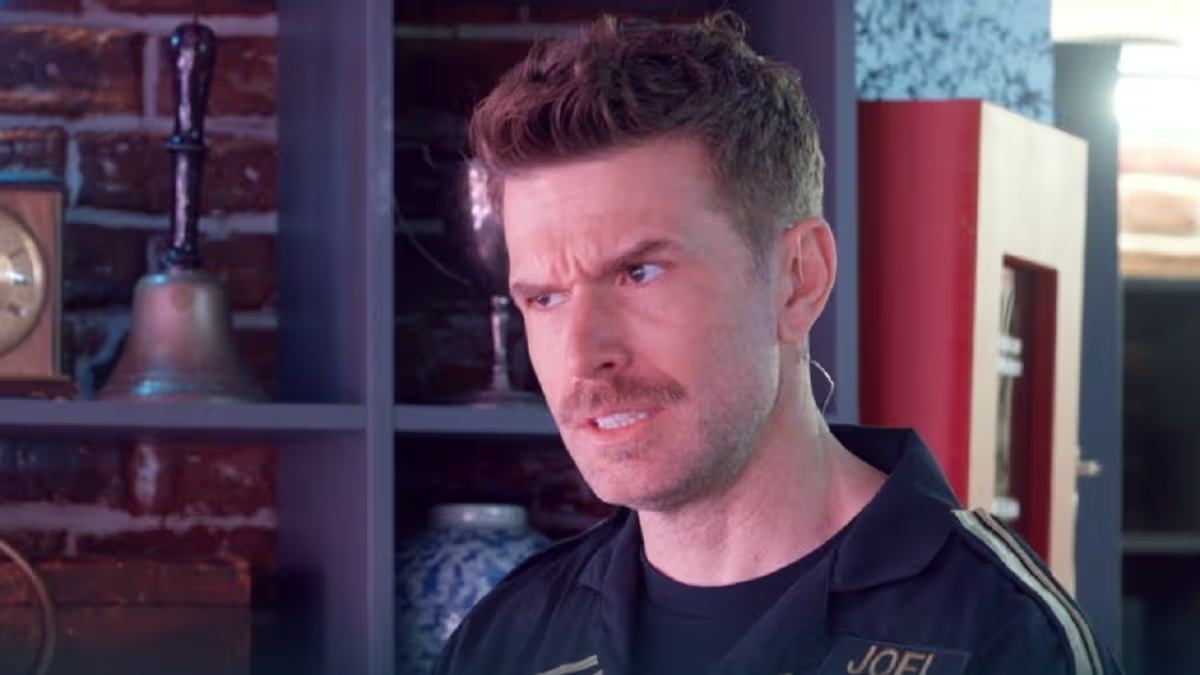
Premiering on Saturday night (March 21) after Britain’s Got Talent, ITV are hoping the the new series brings in younger viewers. It features I’m A Celebrity 2023 winner Sam Thompson, The Masked Singer host Joel Dommett, and Loose Women duo Judi Love and YouTuber GK Barry as part of a team.

Get MEN Premium now for just £1 HERE – or get involved in our WhatsApp group by clicking HERE. And don’t miss out on our brilliant selection of newsletters HERE.

Each episode sees members of the public unwittingly take part in a fake ITV show. Complete with a famous host, the team of celebrity saboteurs watch from nearby and attempt to cause chaos at every turn, without getting caught.

The fake shows include Couple Goals, hosted by husband and wife Matt and Emma Willis, The Applicant, hosted by former Dragons’ Den star Sara Davies and The Backstabber, hosted by Rylan Clark, who rose to fame on The X Factor.

Advertisement

For each successfully executed sabotage mission, money will be added to a secret cash prize pot. With up to £30,000 up for grabs, which isn’t revealed until the end of each episode when it is distributed equally among all the contestants.

Teasing what to expect from the series, Joel told PA this week: “We had so much fun making it, and all I can hope is that the fun comes across on screen. We worked really hard to make it as fun as possible and to give some money to some really deserving people.

“Genuinely, this show has been one of the highlights of my career! You never really know what a new show will be like. I really hope people watching it enjoy it as much as we enjoyed making it.”

Advertisement

Episode one saw the stars entering their secret HQ, which was located behind in a bookcase in a lavish country home. Joining them as a guest saboteur this week was UK comedy legend Jo Brand.

The first fake show to be put under the spotlight was The Applicant, with Sara Davies showing off some of her business skills. Viewers saw a host of contestants explaining why their business skills would make them a worthy victor.

Highlights from the episode included when Judi knocked off a tower of glasses and blamed it on a contestant and Sam switching a USB full of business images for an empty one. The latter did this without getting caught by hiding in a knight’s armour.

Those who tuned in to Celebrity Sabotage’s first episode were left divided as they took to X, previously known as Twitter, to share their frustrations with its series premiere.

Advertisement

@Kazzie_P_60 said: “How do programmes like these ever get commissioned? Utter rubbish #celebritysabotage.” @Pickitflickit added: “There’s a great idea in there but it is a right old mess #Celebritysabotage.”

@philm2244 wrote: “How has Saturday night entertainment come to this? #celebritysabotage.” @Terrismith32115 stated: “Who is the target audience for this my 8yo hasnt so much as smirked and im just about ready to turn it off #celebritysabotage

@AlexPaterson0 argued: “Just what we need on a Saturday night, just a good light hearted show #CelebritySabotage.” @TGherewego: “#CelebritySabotage I’m going to assume all the fake shows are rip offs of other shows, and that’s kinda love that.”


Source link

Advertisement
Continue Reading
Click to comment

You must be logged in to post a comment Login

Leave a Reply

NewsBeat

Trump gives Iran 48-hour ultimatum to reopen Strait of Hormuz or face ‘obliteration’ of power infrastructure

Published

on

Trump gives Iran 48-hour ultimatum to reopen Strait of Hormuz or face ‘obliteration’ of power infrastructure

President Donald Trump issued a high-stakes, two-day ultimatum to Iran: enable vessel traffic through the Strait of Hormuz or endure punishing strikes on its power grid.

Unless Tehran “fully” opens the strait within 48 hours, the U.S. military will “obliterate” Iran’s power plants, starting with their largest, the president wrote on Truth Social on Saturday evening from Mar-a-Lago.

In response, Iranian officials quickly telegraphed their willingness to go tit-for-tat. According to state media, Iran’s military vowed to target U.S. energy and desalination infrastructure in the region if Trump follows through on his threat.

Traffic through the Strait of Hormuz — a vital trade chokepoint through which 20 percent of the world’s oil flows — has all but ground to a halt due to Iran’s de facto blockade, put in place after the war broke out last month.

Advertisement

As a result, oil prices have surged past $100-a-barrel multiple times in recent weeks, with diesel prices surpassing $5 a gallon on Tuesday. Experts have warned that skyrocketing fuel costs could soon ripple through the economy, driving up prices for groceries, shipping and construction.

On Saturday, President Donald Trump issued a 48-hour ultimatum to Iran, demanding it reopen the Strait of Hormuz or risk the 'obliteration' of its power infrastructure
On Saturday, President Donald Trump issued a 48-hour ultimatum to Iran, demanding it reopen the Strait of Hormuz or risk the ‘obliteration’ of its power infrastructure (Getty Images)

While speaking to reporters on Friday, the 79-year-old president fumed that NATO allies have so far declined to assist in securing the waterway, branding them cowardly. He also declined to comment on reports that he is considering deploying troops to help dismantle the blockade.

At the same time, Trump insisted that the strait is of little strategic importance to the U.S. and claimed that it would eventually “open itself.”

He’s also dismissed concerns about rising fuel costs, writing on Truth Social earlier this month that “short term oil prices” are “a very small price to pay” for global security.

The war — launched jointly by the U.S. and Israel on February 28 — has now stretched on for three full weeks, engulfing the broader Middle East region in violence.

Advertisement

Defense Secretary Pete Hegseth said during a briefing on Thursday that the U.S. had struck more than 7,000 targets inside Iran. “We’re winning, decisively and on our terms,” he said.

Iran has retaliated with missile and drone strikes on nearby nations, including Israel, Qatar, Kuwait, the United Arab Emirates and Saudi Arabia — a response that Trump said surprised him.

To date, more than 1,500 Iranians have died, according to state media, and 13 U.S. service members have been killed, the Pentagon has said.

Traffic through the Strait of Hormuz, a vital artery of global trade, has all but ground to a halt, leading fuel costs to skyrocket
Traffic through the Strait of Hormuz, a vital artery of global trade, has all but ground to a halt, leading fuel costs to skyrocket (AFP/Getty)

Trump has not provided a definitive timeline for when the war will end — and his recent statements have done little to clear the air.

Last week, he told Fox News that deadly conflict will wrap up when “I feel it in my bones.” On Friday, he said he’s considering “winding down” the conflict, while on Saturday, he stated: “We are weeks ahead of schedule.”

Advertisement

Meanwhile, the Pentagon is seeking $200 billion in additional funds for the overseas offensive, a senior administration official told The Associated Press this week. And The Wall Street Journal reported on Friday that upwards of 2,200 Marines are already en route to the region.

Multiple recent polls have found that a majority of Americans are opposed to the war.

Fifty-three percent of respondents in a March 9 Quinnipiac survey said they are against U.S. military action in Iran, while 40 percent are in favor. And a Reuters poll released on March 2 found that just one in four respondents supports Trump’s strikes on the Middle East nation.

Source link

Advertisement
Continue Reading

NewsBeat

Israel says Iran has ‘4,000km missiles that can hit London and Paris’ after attack on UK base

Published

on

Manchester Evening News

Iran launched an attack on the UK military base of Diego Garcia

Israel has claimed that Iran has ‘missiles that can reach London’ after an attack was carried out on a UK-US base.

Iran targeted Diego Garcia in the Chagos Islands, the military base run by British and American troops. The attack was carried out before the Government gave the US permission to strike missile sites targeting the Strait of Hormuz on Friday, but it is not clear exactly when the two intermediate-range ballistic missiles were fired.

One of the missiles was shot down by a US warship while the other failed in flight, the Wall Street Journal reported. The Ministry of Defence (MoD) declined to comment on when the attack was launched.

Advertisement

The Ministry of Defence strongly condemned the reckless attacks, though. The base, which is around 3,800km from Iran, serves as a vital launchpad for long-range bombers and is home to roughly 2,500 personnel.

Get MEN Premium now for just £1 HERE – or get involved in our WhatsApp group by clicking HERE. And don’t miss out on our brilliant selection of newsletters HERE.

However, following the attack and the UK granting US permission, an Iranian minister warned British lives are now ‘in danger’. Iranian Foreign Minister Abbas Araghchi reacted angrily on social media, claiming that the Prime Minister is putting British lives at risk by allowing UK territory to be used for “aggression.”

He insisted that Iran would exercise its right to self-defence, a sentiment that follows a previous Iranian drone strike on RAF Akrotiri in Cyprus earlier this month.

And on X on Saturday evening, the Israel Defence Forces (IDF), who are leading Israel’s attacks on Iran, claimed the state had missiles ‘that threatened Europe’. The BBC reports defence experts say there is still not proof Iran has missiles capable of reaching 4,000km, however.

In a post on X, the IDF said: “The Iranian terrorist regime launched a long-range missile for the first time since the start of Operation Roaring Lion that could reach a distance of ~4,000 km.

“During Operation Rising Lion in June 2025, the IDF revealed that the Iranian regime has intentions to develop missiles with a range of 4,000 km, which pose a danger to dozens of countries in Europe, Asia and Africa. The Iranian regime denied this. We have been saying it: The Iranian terrorist regime poses a global threat.

Advertisement

“Now, with missiles that can reach London, Paris or Berlin. The Iranian terror regime has carried out attacks against 12 countries in the region and is developing a capability that poses a much broader threat.”

Content cannot be displayed without consent

The posts came as Tehran came under further attacks by the US and Israel, and Iran launched a massive missile strike on Arad and Dimona in southern Israel. The BBC reports that over 80 people have been injured in both strikes.

Following the Iranian minister’s comments, Foreign Secretary Yvette Cooper condemned the missile strike on Diego Garcia while stressing that the UK has “taken a different position from the US and Israel” on the conflict.

Ms Cooper told broadcasters the Government is supporting defensive action against the “reckless Iranian threats”. She said: “We have continued to support defensive action to support UK interests, including defensive action against ballistic missile threats.

Advertisement

“But we want to see as swift as possible a resolution to this conflict. Our approach to this conflict has been the same throughout. We were not and continue not to be involved in offensive action, and we’ve taken a different view from the US and Israel on this.

“But we are supporting defensive action to support our interests. That includes recognising Iran’s escalating threats to international shipping, as well as their threats to our Gulf partners.”

On Saturday, Sir Keir also spoke to Cypriot president Nikos Christodoulides on Saturday morning, reiterating that RAF Akrotiri will not be used by the US to target Iranian missile sites.

Advertisement

Source link

Continue Reading

NewsBeat

Why visitors say Middleham is like ‘stepping back in time’

Published

on

Why visitors say Middleham is like 'stepping back in time'

Despite its modest size, the town is steeped in history, thanks to the imposing Middleham Castle that still dominates its skyline.

Middleham’s roots stretch back to at least the Domesday Book of 1086, and possibly earlier, with evidence of Roman activity found nearby.

Middleham (Image: TRIPADVISOR)

Its name, meaning “middle village”, reflects its position within the Dales landscape.

The town rose to prominence in the medieval period, particularly under Richard III, who used Middleham Castle as his northern base.

Advertisement

His son, Edward of Middleham, was born there, cementing the town’s place in royal history.

Today, the castle remains one of the area’s most significant attractions.

Although partly in ruins, its keep and surrounding structures still draw visitors keen to explore its past.

Advertisement

Middleham has retained much of its historic layout, with two market squares and buildings in the older parts of town dating back to before 1600.

One visitor wrote in an online review: “A fascinating little town full of history, the castle alone is worth the visit, but the whole place feels like stepping back in time.”

Another described it as “quiet, beautiful and packed with character”, adding that it was “less crowded than some of the better-known Dales spots”.

Middleham is known for horse racing (Image: SARAH CALDECOTT)

Beyond its history, Middleham has a distinctive modern identity as a centre for horse racing.

Advertisement

The town is home to the Middleham Trainers’ Association and several racing stables, with horses regularly seen being exercised on the surrounding gallops.

This connection to racing remains a key part of the local economy, alongside tourism.

Visitors often remark on this unique feature.

One person said: “Seeing racehorses walking through the streets was something you don’t get anywhere else; it makes Middleham feel really special.”

Advertisement

Another added: “If you love racing, this is the place to be.”

Despite its rural setting, the town offers a selection of pubs, cafés and small businesses, alongside accommodation options that make it a popular stop for walkers and cyclists exploring Wensleydale.

The Church of St Mary and St Alkelda, dating largely from the 14th and 15th centuries, is another focal point, while nearby walking routes offer views across the Dales’ rolling hills and limestone landscape.

Online, Middleham is frequently praised for its peaceful setting and authenticity.

One visitor described it as “a proper Yorkshire town, unspoilt, friendly and full of history”.

Advertisement

Another wrote: “Perfect if you want to escape the crowds and experience the Dales at a slower pace.”

With its blend of royal history, racing heritage and scenic surroundings, Middleham continues to attract those looking for a different kind of Yorkshire Dales experience.

Source link

Advertisement
Continue Reading

NewsBeat

Cuba’s power grid collapses leaving it without electricity for the 3rd time this month

Published

on

Cuba’s power grid collapses leaving it without electricity for the 3rd time this month

Cuba’s power grid collapsed Saturday leaving the country without electricity for a third time in March as the communist government battles with a decaying infrastructure and a U.S.-imposed oil blockade.

The Cuban Electric Union, which reports to the Ministry of Energy and Mines, announced a total blackout across the island without initially giving a cause for the outage.

The union later said the blackout was caused by an unexpected failure of a generating unit at the Nuevitas thermoelectric plant in Camagüey province.

“From that moment, a cascading effect occurred in the machines that were online,” said a report from the Ministry of Energy and Mines, which activated “micro-islands” of generating units to provide power to vital centers, hospitals and water systems.

Advertisement

Authorities said they were working to restore power.

Power outages, whether nationwide or regional, have become relatively common in the last two years due to breakdowns in the aging infrastructure. The breakdowns are compounded by daily blackouts of up to 12 hours caused by fuel shortages, which also destabilize the system.

The last nationwide blackout occurred on Monday. Saturday’s outage was the second in the past week and the third in March.

The blackouts have a significant impact on the population, whose lives are disrupted by reduced work hours, lack of electricity for cooking, and food spoilage when refrigerators stop working, among many other consequences.

Advertisement

President Miguel Díaz-Canel has said the island has not received oil from foreign suppliers for three months. Cuba produces barely 40% of the fuel it needs to power its economy.

Cuba’s aging grid has drastically eroded in recent years. But the government has also blamed the outages on a U.S. energy blockade after U.S. President Donald Trump in January warned of tariffs on any country that sells or provides oil to Cuba. The Trump administration is demanding that Cuba release political prisoners and move toward political and economic liberalization in return for a lifting of sanctions. Trump also has raised the possibility of a “friendly takeover of Cuba.”

Source link

Advertisement
Continue Reading

NewsBeat

AI videos of sexualised black women removed from TikTok after BBC investigation

Published

on

AI videos of sexualised black women removed from TikTok after BBC investigation

The BBC, working in collaboration with analysts Jeremy Carrasco and Angel Nulani from Riddance, has identified 60 such accounts, mainly on Instagram, that have carried links, or chains of links, to paid-for sexually explicit content on third-party sites. The sites labelled the imagery as AI-generated, but the Instagram accounts did not.

Source link

Continue Reading

NewsBeat

Bags of suspected cannabis dumped in Bolton and Bury canal

Published

on

Bags of suspected cannabis dumped in Bolton and Bury canal

The material was believed to have been dumped overnight into the Manchester, Bolton and Bury canal near close to the Bolton border with Radcliffe.

Several black bags were dumped into the water, and a wire fence was damaged which is thought to have been the access point.

damage was made to a wire fence, which is believed to have been the used access point (Image: Tracey Owen)

by those responsible.

Eric Owen, of Little Britain Anglers found the bags on March 17 and said the waste posed a risk to the canal environment.

Advertisement

He said: “The chemicals used to grow the cannabis wouldn’t be good for wildlife and invertebrates.

“It’s extremely difficult to remove once it’s in the water because it becomes very heavy when soaked.”

The dumped cannabis has since been taken out of the canal by anglers Tracey and Eric Owen and placed on the side of the banking, where it can decompose naturally.

According to Eric, this is not the first time they have dealt with cannabis in the canal (Image: Tracey Owen)

Tracey said: “There are still a few leaves and bits which should rot down.

Advertisement

“We’re going back to rake the soil in a couple of days.

“I presume someone had to get rid of it, but why the canal, who knows?”

The pair who regularly clean up alongside and in the waterways said they are frustrated as it is an ‘ongoing’ issue in waterways across the area.

Similar incidents have been reported in the past, including the discovery of cannabis irrigation equipment in the canal.

Advertisement

In 2021 bags, which were left strewn across the weir, close to Rock Hall, in Moses Gate Country Park, full on cannabis by-products.far

Source link

Advertisement
Continue Reading

NewsBeat

Westhoughton residents concerned over lack of amenities

Published

on

Westhoughton residents concerned over lack of amenities

There are more than 1,450 new homes planned as part of Peel Land and Property’s Lee Hall development, but residents and local councillors feel the town is not set up to handle this many new people.

Councillors and residents report issues in three key areas – traffic, which is already said to be bad, school places, and doctor’s surgeries.

Cllr Arthur Price said there are not enough doctors’ surgeries in Bolton to cope with increasing developments.

He added: “If you move here now, where are your kids going to go to school?

Advertisement

“I’ve lived here for 40 years, but it is not the place I moved into.

“Westhoughton is a thriving town – just look at the nightlife.

Westhoughton Councillor David Wilkinson (Image: Bolton Council)

“People deserve better then what they get here – sometimes it feels like I’m banging my head against a brick wall.

“We’re a cash cow – we can’t get upgrades to the roads or services, but they’ll put new houses here.”

Advertisement

And the developments do not stop at Lee Hall.

According to fellow Westhoughton Councillor David Wilkinson, Bolton’s Local Plan for the next few years could see Westhoughton ‘nearly double’ in size.

“If you look at the plans, everywhere else has hardly any developments – it’s mainly Westhoughton.”

A consultation on Bolton’s local plan, which aims to shape developments around the borough for the next 15 years, closed on January 22 this year.

Advertisement

“People say to me all the time ‘there’s never money to fix roads or amenities’, but then they find £70m for a golf course.

Westhoughton’s Manchester Road is very busy at peak times (Image: Dan Dougherty)

“And this link road – people who’ve looked at it have told me it won’t be enough for the amount of people they’re expecting.”

“We’ve not had a new school built in Westhoughton for over 40 years,” said Cllr Wilkinson, “and that was Eatock Primary.”

He added: “And as far as the high school, kids there are already being shipped out to other schools because there isn’t enough room,” said Cllr Wilkinson, “It isn’t big enough now! And pupils from Lee Hall alone will make it far far worse.”

Advertisement

Source link

Continue Reading

NewsBeat

Richmond firefighters free person from their own bedroom

Published

on

Richmond firefighters free person from their own bedroom

The bedroom door had malfunctioned so when it was closed with the person inside, it couldn’t reopen.

Richmond Fire Station despatched a crew to rescue the trapped person at 9.48 yesterday evening.

The firefighters used their specialist tools to get the door open and free the person inside, who suffered no injuries during the incident, which happened at an address in Richmond.

Advertisement

Source link

Continue Reading

NewsBeat

What would a social media ban mean for Ireland’s status as Europe’s tech hub?

Published

on

What would a social media ban mean for Ireland’s status as Europe’s tech hub?

The Irish government has signalled that it is exploring options to introduce age restrictions on social media use for under-16s. The proposal sits within the government’s new National Digital and AI Strategy 2030, which frames online safety and age verification as part of Ireland’s broader ambition to act as a European digital regulatory hub.

The proposals include a “digital wallet” age-verification system. Detailed technical specifications have not yet been published. However, digital identity wallet models typically work by allowing a user to verify their age once through a trusted authority. After that, they can share only a simple confirmation – such as whether they are over 16 – rather than handing over full identity documents. The government has not set out the final architecture, but the stated aim is to reduce repeated data sharing with individual platforms.

Ireland is not alone in looking at age restrictions. Australia introduced a statutory ban, and other European countries are considering stricter access rules. But Ireland’s position is distinctive. It hosts the European headquarters of many major technology companies. It also plays a central role in EU enforcement of the Digital Services Act, which requires very large platforms to assess and mitigate systemic risks to minors.

The debate is not simply whether social media is good or bad for children. Blanket restrictions for under-16s raise an important question: are bans the most effective way to reduce harm? Or do they offer reassurance while leaving deeper problems – such as platform design – unchanged?

Advertisement

The Irish context

Ireland’s situation is significant because structural regulatory tools already exist at European level. Under the EU Digital Services Act, very large platforms must conduct systemic risk assessments, including risks to minors, and implement mitigation measures. Ireland plays a key role in this through Coimisiún na Meán, the country’s statutory media and online safety regulator.

Established under the Online Safety and Media Regulation Act 2022, the regulator has powers to oversee video-sharing platforms, develop binding online safety codes and investigative non-compliance by the technology companies based in Ireland. This includes in relation to the EU Digital Services Act in Ireland. This raises the question of whether new access restrictions are set to be introduced before these structural obligations are fully deployed.

Ireland’s proposed digital wallet pilot also intersects with EU plans for a European Digital Identity framework. The EU’s forthcoming European Digital Identity Wallet is intended to support digital proof of certain facts about a person, such as their age. No specific design for any Irish pilot has been produced. However, alignment with EU interoperability standards would be required if it is to integrate into the wider European system.

Evidence driving the debate

Ireland’s proposed ban is framed primarily in child-protection terms. These include concerns about youth mental health pressures, exposure to harmful or age-inappropriate material, and risks such as online grooming and exploitation. These concerns are not unfounded.

Advertisement

A 2020 review of research studies found associations between heavy social media use and anxiety or depressive symptoms. However, large-scale analyses suggest that average effects on wellbeing are small and highly variable. They can differ significantly depending on context and individual vulnerability. Risks exist, but they are not uniform.

Exposure to harmful content, including self-harm material, misogynistic narratives, or extremist content, is often shaped by how platforms recommend and amplify posts. Research from my colleagues in the DCU Anti-Bullying Centre shows how recommender systems can contribute to the circulation of toxic content.

Social media platforms aren’t neutral spaces.
Media_Photos/Shutterstock

Social media platforms are not neutral spaces. Their business models rely on maximising engagement and attention. Recommender systems prioritise emotionally charged material, and feedback mechanisms reward visibility and interaction.

These systems operate regardless of age. If a 17-year-old and a 15-year-old encounter harmful amplified content, the risk doesn’t go away for one user just because they’re over 16.

Advertisement

Age restrictions may form part of a broader safeguarding approach. However, on their own, they do not address recommender systems, addictive design features or the amplification of harmful material.

Risk and opportunity

At the same time, research consistently shows that risk and opportunity are intertwined. Children who are more active online may encounter greater exposure to harm. On the other hand, they may also gain more social connection and access to information. That complexity matters when designing policies intended to reduce harm without undermining participation.

Research on children’s own experiences suggests that many see social media as a normal part of their lives and use in-app safety tools to manage risks. Many also say they prefer safer platform design and clearer accountability rather than outright bans.

Children’s rights bodies in Ireland have similarly emphasised the need to balance protection with participation. They also point out that children’s views should be considered in the development of any pilot measures.

Advertisement

Ireland’s proposal reflects a broader shift away from relying solely on platform self-regulation. However, the key question is whether systems that amplify harmful content and reward attention can be effectively governed.

Ireland’s Digital and AI Strategy 2030 positions the country as both a host to global platforms and a digital regulatory leader. That dual role gives particular weight to how these measures are designed and enforced. Ultimately, the effectiveness of Ireland’s approach will depend not only on age thresholds, but on how robustly structural risk obligations are implemented.

Source link

Advertisement
Continue Reading

NewsBeat

Coronation Street star Farrel Hegarty leaves ITV soap again

Published

on

Coronation Street star Farrel Hegarty leaves ITV soap again

Farrel Hegarty, who plays Lou Michaelis in the ITV soap, has said that she is now “out of the show” once again.

The soap star made a shock exit just months after being introduced last year, before returning last month.

Coronation Street star Farrel Hegarty leaves ITV soap again

Hegarty joined the cast of Coronation Street towards the beginning of 2025, debuting alongside on-screen husband Mick Michaelis, played by Joe Layton.

She was subsequently revealed as the mother of Brody Michaelis (Ryan Mulvey), who is in a young offender’s institution.

Brody’s father is later revealed not to be Mick, but Kit Green (Jacob Roberts).

Advertisement

Her character was sent to prison in July 2025, with Hegarty departing the show before returning in February 2026.

Now, Farrel is set to leave the show once again after her brief return, and she spoke about her latest departure on the Girlfriend Material podcast.

She said: “I’m out of the show now.

“I’ve stopped filming.

Advertisement

“I came back in Corrie for, like, a short stint.

“I was in it for six months and I came back because I’m [her character is] in prison.

“She’s in prison, she’s not a good girl.”

Farrel had previously said how she would get emotional filming her last scenes, having planned to move abroad before landing her role in Corrie.

She told The Mirror : “Watching the other actors is like a masterclass in acting.

Advertisement

“When I do film my final scenes, I’ll probably cry.”

Who has been on Coronation Street the longest?

While Farrel’s time on Coronation Street has not been the longest stint, there are several actors who have been on the Cobbles for years.

William Roache holds the Guinness World Record for the longest-serving actor in a television soap opera, having played Ken Barlow on Coronation Street since 1960.

Barbara Knox, who plays Rita Tanner, has been on the show since 1964.

Advertisement

She first appeared as Rita for one episode before returning to the show as a full-time cast member in 1972.

Sue Nicholls (Audrey Roberts) has been on Corrie since the 1980s, with Michael Le Vell (Kevin Webster), having been on the show since 1983, notably returning in 2014.

Other long-standing actors include Sally Dynevor (Sally Metcalfe) and Simon Gregson (Steve McDonald), who have also been on the show for a few decades.

Who is your favourite character on Coronation Street? Let us know in the comments.

Advertisement

Source link

Continue Reading

Trending

Copyright © 2025