






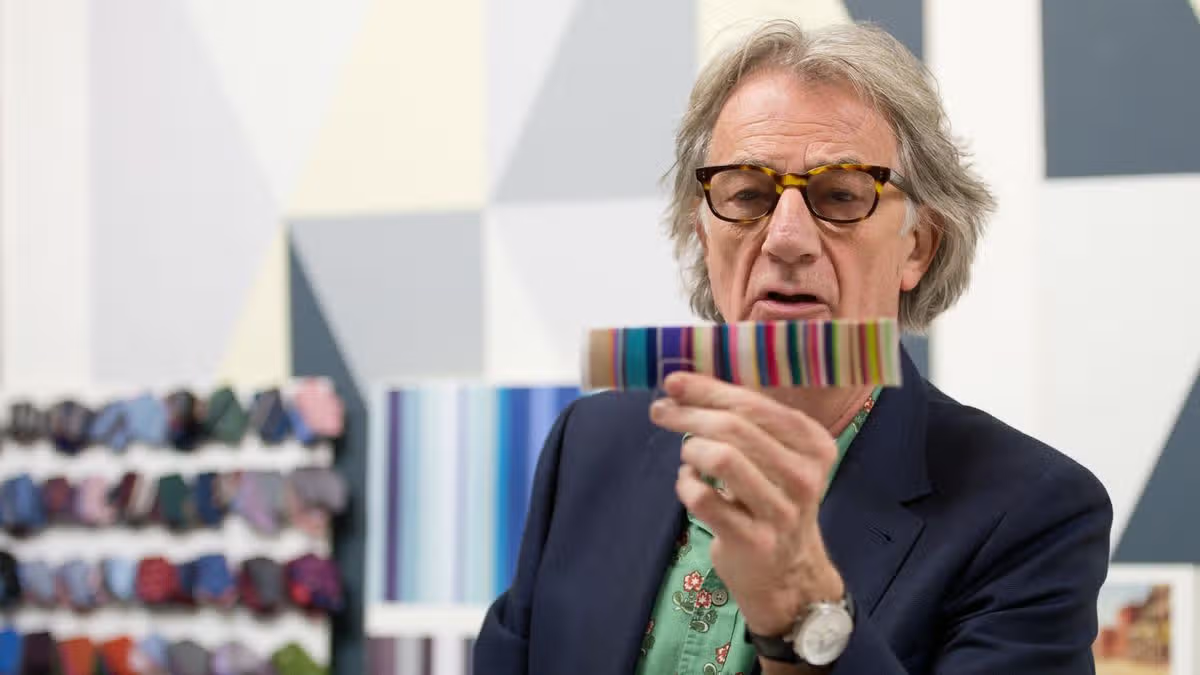
Exclusive – Paul Smith’s new memoir contains business advice and some incredible adventures he has had on his way to becoming Britain’s top menswear designer
He is a man who has earned his stripes in fashion, and then used them to his advantage. But British designer Sir Paul Smith can still be found on the shop floor most Saturdays in London, as he remains someone who loves chatting with his customers. And in his new memoir, the 80-year-old talks readers through some of the more famous people to wear his clothes.
But his first A-list friend was someone he didn’t dress, as he ended up befriending George Best in the early Seventies, whilst working for the company Lindcroft that was involved with a clothing range the footballer put his name to. Paul also helped to sort out stock in some shops Best owned which were piled high with clothes.
“I got to know George and sometimes he would stay with me,” he writes, explaining that the two-bedroom flat the company rented for him became a hiding place for Best away from the media.
On at least one occasion when Best was supposed to be playing for Manchester United, he was in Paul’s spare bedroom.
“I knew nothing about football. I talked to him about things nobody else talked to him about. They were mostly simple subjects, although I do remember having a conversation with him about astrology. I got on so well with him because there were no strings attached.”
Paul added to the BBC this week: “He famously used to get quite stressed out because he was the first superstar footballer and there was a lot of so-called friends that weren’t really friends. He said to me, ‘Nobody’s ever talked to me like this’. We used to have fish and chips.”
In his book Paul goes on to say he feels George was “exploited” by others “in the end it became a cautionary tale.”
Many years later he worked with another Manchester United legend in Sir Alex Ferguson, dressing his United squad and even wiping tomato soup of Fergie’s nose when they bonded over lunch.
But he got on less well with Glenn Hoddle when he was England manager. After kitting England out for the European Championships in 1996 in suits and describing Paul Gascoigne as “hilarious” and “really very funny” messing about in a photoshoot with a daffodil down his sock, Paul was asked back to design the suit for the 1998 World Cup.
Describing Hoddle and his background as a player, singer, then manager and born-again christian who believes in reincarnation, Paul writes: “So he was a man of many parts. What I hadn’t expected was that he also saw himself as a fashion designer.
“I wanted to put the players in navy blue suits and white shirts, something very smart and not flashy. But Glenn had a very clear view what he wanted, involving pale creamy beige, a cashmere blazer and shoes I didn’t particularly care for. He was asking for us to dress the team, but really he wanted to design the look himself.
“He was a nice enough man, and I was proud to have been given the job again, so we did what he wanted. Personally I thought the clothes didn’t look good at all.”
Aside from when dressing England’s footballers, Paul is someone who has always prides himself on all his outfits and products looking great. He turned to fashion after becoming interested in it alongside music and art after a bicycle crash aged 17 ruled out his dreams of becoming a professional cyclist.
After sourcing clothes and helping design a boutique called The Birdcage for friend Janet Campbell in the Sixties, he then launched his own tiny shop tucked behind a dark, damp corridor in his home town of Nottingham, opening just two days a week in 1970. In the beginning at the Birdcage, he would silkscreen his own T-shirts, make ties with offcuts of material on his mum’s sewing machine and handmade cufflinks.
But he turned 21 and met Pauline Denyer and his life changed forever. His life partner, she was teaching at Nottingham Art College and had previously worked as a pattern-room assistant so could help make clothes for him and also offer endless inspiration and encouragement. Whilst working to help finance his part time shop, Paul also took classes in tailoring and worked as a buyer for other stores, which helped build his contacts.
Soon the shop needed to be open for more hours and expanded. As the business grew he even threw small Menswear shows in Paris from 1976 in a friend’s apartment to help expand his name. And by 1979 he opened his first London store in Covent Garden. It was still seen as a dodgy area, and it was sadly broken into on the first night. But the one thing they couldn’t take away from him was the incredible raw concrete look of the shop, which was a one-off in Britain at the time.
And better luck was to come when architects like Norman Foster and Richard who loved its minimalist design helped spread the word about the shop. After Ringo Starr and George Harrison came to buy things, Paul McCartney was soon on the phone wanting to see some of the clothes too.
Too busy in a soundcheck to come to shop, Paul raced down to Hammersmith Odeon with 10 outfits he thought might work. He said ‘they’re great. Do you want a cheese sandwich?’. It was like £5000-worth which to me the was an absolutely amazing order. He didn’t try anything on. He just bought the lot.”
David Bowie began by buying suits and then when he moved to New York would be known to go into the store there and buy every shirt in his size. Paul designed a T-shirt for his final album and describes him as “a curious man” who was always very inquisitive.
One of Paul’s biggest successes was the ‘multistripe’ he first designed in 1992 for a shirt fabric. Meant as a one-off, Harrods called up and wanted it again as it sold so well and it then spiralled into a hugely popular design on many other items. Paul says it became a “bit of a burden” to him at one stage and so he stopped using it but it “cost me £5 million in lost revenue” so he reinvented it by changing the colours and scale of the stripes so it feels like it is not always the same.
Thanks to things like those stripes and his suits, Paul could have sold the business for many millions and it would have expanded into a global empire, but his name would still be on the door and the products which is one of the things which puts him off and why he continues to own the majority of the firm.
“Greed seems to be the point of the whole world at the moment,” he says. “Without me controlling Paul Smith in terms of aesthetic and size, it could be a billion dollar company.
“But Pauline and I would probably have split up and I’d be a bit of a prat and have a fat belly. Luckily because of a sense of discipline and standards she created, it is what it is. Greed had nothing to do with it.”
The company hit tough times in the covid lockdown which coincided with their fiftieth anniversary. It meant they made a loss in their anniversary year, and they had to make staff redundant and change the business style, but things have improved thanks to increased online sales and a divergence in the clothes collections as in lockdown and afterwards people wore less suits.
He was made a ‘Sir’ at a ceremony in November 2000 and married Pauline on the same day, having lived together since 1967.
Going back to his beloved cycling for a final business analogy, Paul concludes: “Running a company like mine is a bit like riding the Tour De France. You’ve got bits where you’re freewheeling quite happily, you’ve got rest days, the uneventful flat stages and the sudden sprints, and then you’ve got an enormous quantity of mountain stages. You’ve got exhilaration and pain.
“And through cycling, I learnt lessons about two things I can use in my business: teamwork and pacing.”
He says his wife – perhaps only half jokingly – tells him words to the effect of not to retire anytime soon as “I know you’ll end up dying on me”.
And it is this passion and drive that she sees in him, which explains why if you go into the flagship Paul Smith store in London, you may still buy your clothes from the man himself.
* Threads: My Life In Style by Paul Smith is out on September 10 published by Macmillan.
Like this story? For more of the latest showbiz news and gossip, follow Mirror Celebs on TikTok, Snapchat, Instagram, Twitter, Facebook, YouTube and Threads.




































You must be logged in to post a comment Login