

Since stepping back from life as a working royal more than six years ago, Prince Harry has often spoken publicly about the ‘generational trauma’ he believes he suffered as a young ‘spare’.
He wrote in his 2023 memoir: ‘I was the shadow, the support, the Plan B. I was brought into the world in case something happened to Willy.
‘I was summoned to provide back-up, distraction, diversion and, if necessary, a spare part. Kidney, perhaps. Blood transfusion. Speck of bone marrow.’
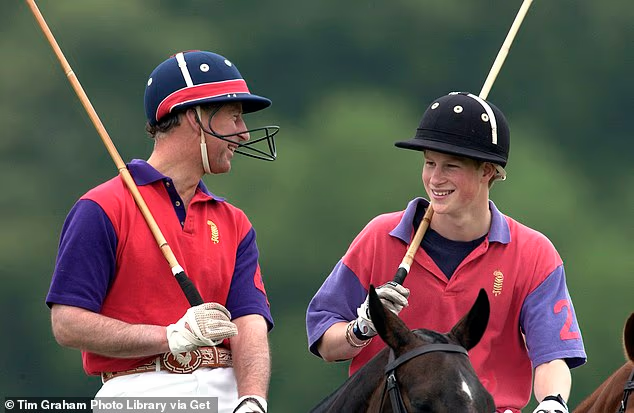
Yet archive footage of 18-year-old Harry discussing his sporting victories with his father, now King Charles, and Prince William, then 20, appears to paint a rather different picture.
According to body language expert Judi James, the ‘strained and complex’ father-son relationship that Harry, 41, often cites ‘doesn’t appear to be visually endorsed by footage of the pair at the time’.
She told the Daily Mail: ‘Charles’s physical awkwardness might be legendary but in clips like this one he appears to be giving Harry a unique form of watchful attention that is littered with subtle but powerful displays of fondness.’
The lighthearted conversation – which was filmed in Anglesey, north Wales, in June 2003 – shows Charles, William and Harry reflecting after a polo match. Charles praises his youngest son for his ‘brilliant’ performance.
‘You scored two goals didn’t you?’ Charles asked Harry, before the prince replied: ‘Three.’ His father then said: ‘Well done, brilliant.’
Prince Harry, then 17, laughs with his father after they won a polo match at Cirencester Park Polo Club in Gloucestershire

Archive footage has shown an 18-year-old Harry discussing his sporting victories with the now King Charles and brother Prince William, then 20

According to body language Judi James, the ‘strained and complex’ father-son relationship Harry often cites ‘doesn’t appear to be visually endorsed by footage of the pair at the time’
After that, William interjected: ‘I did all the hard work in the middle pitch obviously. Didn’t score any goals myself.’
At a later stage in the conversation, Harry jokingly calls his brother a ‘spoon’, adding: ‘I almost fell off my horse trying to get you the ball and you missed it!’
‘Spoon did you say?’ Charles queried, with Harry going on to explain: ‘It isn’t a swear word’.
Ms James notes that the lighthearted interaction between Charles and Harry highlights the ’empathy’ shared between the pair.
‘We have Charles creating a preferential form of proximity with his youngest son, both when he sits with one boy on either side and then very emphatically when another player joins them and Charles sits next to Harry, mirroring him and chatting quietly while William is now one seat away,’ she said.
‘It is clearly Harry who gets Charles’s prime and then exclusive attention in this video while William appears to have to work to dominate the spotlight or break into and take over the conversation.
‘Charles gives two different types of attention to his sons here: with Harry he appears gentle, caring and watchful but William is treated more like a fellow adult and equal.’
Ms James added while William appears both ‘confident and socially at ease’, Harry’s body language suggests he ‘might actually resonate more strongly with his father’.
She added: ‘Red-cheeked and bashful-looking, he sits hunched and glowering slightly, hiding his face behind his hand and a glass in a gesture of shyness that would probably promote feelings of empathy in his father, who often looked like the shy, awkward, isolated and less confident member of his family group when he was younger.’

Ms James said while William appears ‘socially at ease’, Harry’s body language suggests he ‘might actually resonate more strongly with his father’

Ms James notes that ultimately William ‘appears to have inherited Diana’s ease in public and in front of a camera’, while ‘Harry and Charles seem twinned in their inner awkwardness’

While Charles is often depicted as a father who maintained a ‘stiff upper lip’ at all occasions, he always spoke fondly of his affection for his youngest son
And it appears that Charles, while not naturally a tactile father, appears to acknowledge his son’s cues ‘subtly’ here.
‘He pays his son individual and full eye-attention and his vocal tone softens and drops to signal affection as he tries to draw him into the conversation.
‘He points at Harry’s banana to ask if it’s his “method of recovery” with an amused but nurturing approach and his features soften in a look of indulgence, along with his tone.’
The expert added that even when William is discussing his involvement in the sporting game and the challenges he faced trying to score, Charles’s ‘body position shows his closeness to Harry’.
‘He turns his head to listen as William talks, but his right hand remains close to his younger son and his right leg is splayed out next to and close to Harry,’ she explained.
Indeed, while Charles is often depicted as a father who was a ‘product of protocol and boarding schools’ and maintained a ‘stiff upper lip’ at all occasions, the King has always spoken fondly of his affection for his youngest son.
He referred to Harry as his ‘darling boy’ and in a 2017 interview for the Today programme on BBC Radio 4. Harry shared how he and his father, whom he affectionately referred to as ‘Pa’, would ‘talk for hours and hours’ about Charles’s passion for the environment.
He also revealed how he valued his father’s opinion saying: ‘I do end up picking your brains more now than I ever have done.’
That same year, William and Harry paid tribute to their father for being ‘there for us’ following the death of Princess Diana, during a BBC documentary to mark the 12th anniversary of her death.
Both princes were staying at Balmoral with their father in 1997 when Princess Diana was killed in a car crash in Paris – and it was up to Charles to break the news to them.
Harry said of his father: ‘One of the hardest things for a parent to have to do is to tell your children that your other parent has died.
‘How you deal with that, I don’t know. But, you know, he was there for us. He was the one of the two left.’
Writing in Spare, Harry recalled that Charles sat him down on the bed to break the news of the car accident, calling him ‘my dear son’ as he told him how Diana had sustained head injuries that didn’t look likely to improve.
He writes: ‘What I do remember with stunning clarity is that I did not cry. Not a tear. My father did not hug me.’
While he claims Charles did not cry while breaking the news, he said his father put his hand on Harry’s knee and claimed everything would be OK.

Charles referred to Harry as his ‘darling boy’ and in a 2017 interview for the Today programme on BBC Radio 4, while Harry affectionately referred to him as ‘Pa’

Harry and Charles share a moment of affection at the Queen Elizabeth Olympic Park in east London back in September 2014
In 2021, during an interview on the Armchair Expert podcast with host Dax Shepard, Harry said his father had treated him ‘the way he was treated’, with Harry asking himself ‘so how can I change that for my own kids?’
The Duke then went on to add that he and Meghan had made the move to the US to ‘break the cycle’ of ‘genetic pain’ he had experienced growing up.
Harry suggested that Charles had ‘suffered’ because of his upbringing by the Queen and Prince Philip, and the Prince of Wales had ‘treated me the way he was treated’, calling it ‘genetic pain’.
Ms James added: ‘Tactile behaviours have never appeared to be Charles’s love language.
‘It was Diana who put hugs on the royal PDA menu, while her husband could barely place his hand on her shoulder for their engagement photos without looking ill at ease.’
She notes that ultimately William ‘appears to have inherited Diana’s ease in public and in front of a camera’, while ‘Harry and Charles seem twinned in their inner awkwardness and signals of diffidence’.
‘They fall into a much more intimate and personal form of verbal dialogue that both seem happier and more comfortable with than with William’s alpha banter mode,’ she explained.
‘Their voices become private and softer and their speed of speech increases until they appear to be mumbling together in what almost sounds like their own form of dialogue.’
The heartwarming footage of the father-son pair comes as Harry is soon set to celebrate his 42nd birthday on September 15 – just weeks after he and Meghan Markle relocated back to the UK with their two children.
Harry and Meghan, 45, will live in a non-royal residence outside of London. Their children Archie, seven, and Lilibet, five, have both been enrolled in UK schools, ready to start next week.
But despite their close bond, Charles was said to have only been informed just days before the news dropped about the Sussexes’ return to Britain.
Harry and Meghan will remain private individuals and non-working members of the Royal Family, in keeping with their ‘clearly expressed wishes and the agreement reached in recent years’.
He is understood to have visited his father at Highgrove House in Gloucestershire following an Invictus Games one-year-to-go event in Birmingham.
Harry was joined by his wife and two children in what is believed to have been the first time Archie and Lilibet had seen the monarch since Queen Elizabeth II’s Platinum Jubilee celebrations in June 2022.
Just weeks ago, sources close to Harry said he wanted to visit Britain ‘every few months’ over the next year after his reunion with King Charles last month.
Before deciding on a longer-term return, the Duke of Sussex said his most recent visit to the UK and time with his father left him feeling ‘buoyed’, ‘very happy’ and ‘really energised’.
Harry was already due to return to Britain in September for a week of engagements.
A source previously told The Sunday Times: ‘He wants more of a foothold here, more trips back, less courtroom drama. And he always loves seeing his family.’
Sign up to our Palace Confidential newsletter for FREE and we’ll send you an exclusive article on the moment the Royal Family started to question Meghan’s motivations. Get it HERE







































You must be logged in to post a comment Login