
Connect with us
DAPA Banner
DAPA Coin
DAPA
COIN PAYMENT ASSET
PRIVACY · BLOCKDAG · HOMOMORPHIC ENCRYPTION · RUST
ElGamal Encrypted MINE DAPA
🚫 GENESIS SOLD OUT
DAPAPAY COMING

NewsBeat

Kirkleatham Hall School recognised for inclusive sport

Published

on

Kirkleatham Hall School recognised for inclusive sport

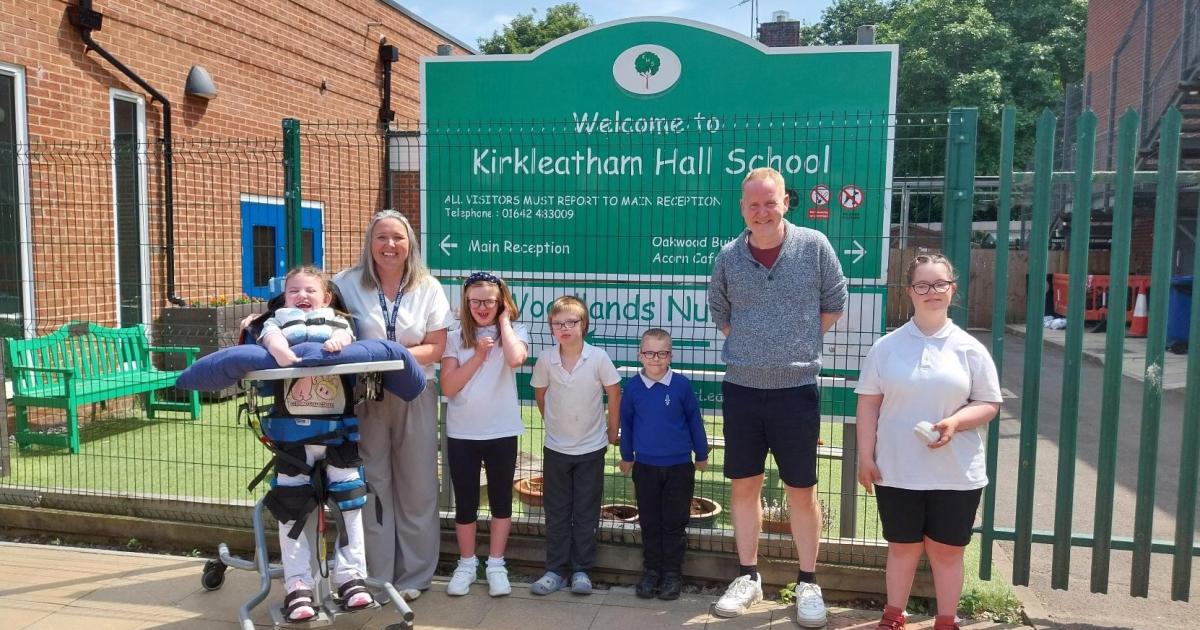
Kirkleatham Hall School has been awarded the Platinum School Games Mark for its outstanding commitment to PE, sport and inclusion.

Funded by Sport England and delivered by the Youth Sport Trust, the School Games Mark recognises schools that deliver high-quality, inclusive sporting opportunities for all pupils.

Paul McClean, headteacher at Kirkleatham Hall School, said: “Achieving the Platinum School Games Mark is a significant milestone for our school and reflects our unwavering commitment to providing high-quality, inclusive sporting opportunities for all learners.

“As an all-age specialist school for children and young people with profound and severe learning difficulties, we recognise the power of sport to open doors, build confidence, develop communication and social skills, and create meaningful opportunities for success.

Advertisement

“We are incredibly proud of the vast range of experiences our pupils enjoy, enabling them to represent the school, challenge themselves, and celebrate their achievements.

“This award also recognises our role in supporting and upskilling mainstream schools, helping to ensure that sport is truly accessible and inclusive for all children and young people, including those with SEND, across our wider community.”

Councillor William Suthers, Cabinet Member for Children and Families (Image: Stuart Boulton)

To achieve platinum status, schools must earn the Gold Mark for four consecutive years and demonstrate sustained excellence in PE and sport provision.

Kirkleatham Hall School was recognised for its tailored approach, offering adapted PE lessons, daily movement sessions, swimming, rebound therapy and participation in School Games events.

Advertisement

The school has invested in specialist equipment, staff training, and innovative methods, including sensory-friendly movement sessions and personalised PE programmes.

Pupils also regularly take part in regional festivals, competitions and inclusive sporting events.

Cllr Bill Suthers, Cabinet Member for Children and Families, said: “This is a fantastic achievement for Kirkleatham Hall School.

“The Platinum School Games Mark reflects the outstanding dedication of staff in creating inclusive, high-quality opportunities for all pupils to take part in sport and physical activity and everyone who made this possible should be proud.

Advertisement

READ MORE: Bomb squad called after man barricades himself in home and ‘makes threats’
READ MORE:
Newton Aycliffe grandad had doctor’s appointment at roadside after bus no show
READ MORE:
‘Not a chip left’ Sell-out success for Darlington chippy as village favourite reopens

“It’s inspiring to see how the school supports all young people to build confidence, develop new skills and enjoy being active.

“I would like to congratulate the pupils, staff and wider school community on this well-deserved recognition.”

The award places Kirkleatham Hall School among a select group nationally delivering sustained, inclusive sporting excellence.

Advertisement

Source link

Continue Reading
Click to comment

You must be logged in to post a comment Login

Leave a Reply

NewsBeat

The Titanic ‘curse’ and the forgotten fearless life of the captain’s daughter

Published

on

The Titanic ‘curse’ and the forgotten fearless life of the captain’s daughter

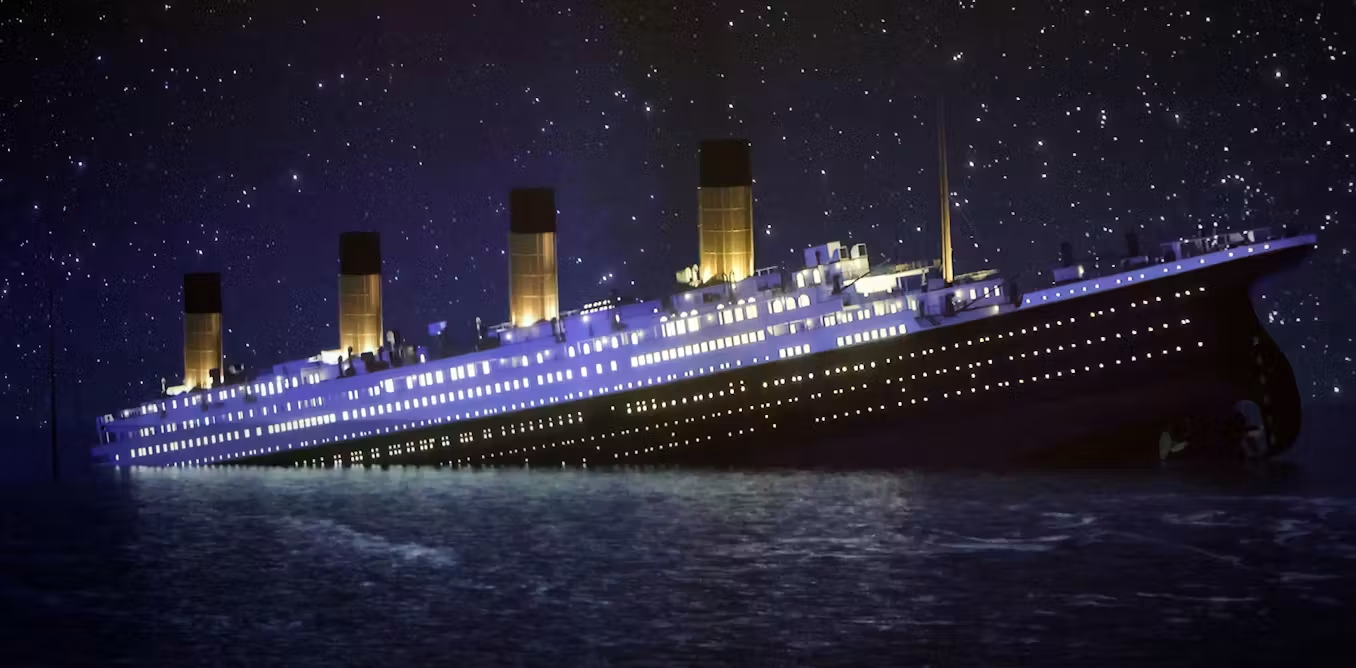
A supposedly unsinkable ship, an iceberg and a catastrophe that circulates through popular culture – the Titanic disaster is one of the most retold events in modern history. But familiarity comes at a cost. Repeated retellings tend to simplify what happened and reduce the real people involved to a basic story.

Retellings of the Titanic disaster often focus only on the sinking itself and forget what happened afterwards. Many lives were deeply affected by the disaster long after it ended, including people who were not even on the ship.

One such life is that of Helen Melville Smith, daughter of Captain Edward Smith, the man who commanded Titanic on its maiden voyage. While researching my new novel Daughter of the Titanic, I became increasingly struck not by the scale of the disaster itself, but by the quieter afterlives that followed it. Melville was 14 when her father went down with the ship in April 1912. Overnight, she inherited not only personal grief, but a public identity she had not chosen: the captain’s daughter, permanently attached to a disaster she did not witness but could not escape.

What followed has often been framed through the language of fate. Over the next decades, Melville’s husband died in an accident, her mother was killed in a road incident, her son died during the second world war and her daughter died of polio.

Advertisement

Taken together, these events could be interpreted through the language of a “Titanic curse”. As recently as July 2025, a Daily Mail feature revisited Melville’s life through this logic, treating unrelated tragedies as part of a doomed narrative arc.

Survivors of the Titanic talk about their experience.

Psychological research and research into narrative meaning-making have long shown that humans are predisposed to look for patterns, particularly after traumatic events. As psychologist Jerome Bruner has argued, we make sense of experience through narrative, organising events into stories that impose coherence. When multiple tragedies occur, we connect them into meaningful sequences.

The Titanic intensifies this impulse. Because the disaster occupies such a prominent place in public memory, it exerts a kind of narrative gravity. Lives connected to it are drawn into its orbit, interpreted through its lens and reduced to extensions of its story. The Titanic has become, in many ways, a modern myth: a historical event transformed into symbolic narrative, through which later lives are interpreted.

Advertisement

But Melville was not defined solely by catastrophe. She learned to fly aircraft at a time when aviation was still new and dangerous. She drove fast cars, moved within social and artistic circles and remained famous in ways that complicate the image of a life overshadowed by tragedy. Photographs from later life show a poised, fashionable woman who continued to participate in public life despite the losses she had endured.

Flying and motoring were associated with modernity, glamour and risk, and her enthusiasm for both suggests someone drawn to experience rather than retreat. The picture that emerges is not simply of a bereaved daughter, wife and mother, but of a woman who remained curious, socially engaged and determined to continue living fully.

While public narratives may attempt to fix people in place – particularly those connected to major historical events – they continue to reshape their lives in ways that exceed those frameworks.

Melville’s story is therefore not simply one of loss, but one of negotiation between private experience and public expectation, between inherited identity and self-determined action.

Advertisement

The afterlife of disaster

Melville’s life also points to a wider problem in how we tell history. Disasters do not end when the immediate crisis is over. They continue to shape meaning long afterwards, influencing reputations, identities and interpretations across generations. Yet popular retellings tend to focus on the moment of impact rather than its aftermath. Titanic is repeatedly reconstructed as spectacle – the sinking, the heroism, the failure – while quieter, long-term consequences are marginalised.

When we privilege the event over its aftermath, we reduce history to a series of dramatic moments rather than recognising it as a continuing process. Melville’s life offers a corrective, shifting attention from the disaster itself to its enduring effects.

Why are we so drawn to narratives of fate, curse or inevitability when we encounter repeated loss? And what happens when those patterns are imposed on real lives?

Advertisement
Footage of the Titanic leaving Belfast.

In Melville Smith’s case, the idea of a Titanic curse imposes coherence where there may be none, compressing decades of lived experience into a single, legible narrative. In doing so, it recasts survival itself as misfortune.

This is not a neutral process. Historians, journalists and novelists like myself shape how lives are remembered and, in some cases, reduced. With that comes an ethical responsibility: to resist imposing patterns that make lives appear more coherent or narratively satisfying than they were, and to remain attentive to contradiction, complexity and reality.

Melville’s life resists that kind of closure. It contains independence, persistence and contradiction that sit uneasily alongside the narrative imposed upon her. To take that seriously is not only to recover an overlooked figure, but to recognise the limits of the frameworks through which we understand her.

The story of the Titanic disaster continues in the lives shaped by it – lives that cannot be reduced to the tragedy alone without losing what made them human.
Advertisement

Source link

Continue Reading

NewsBeat

Traitors star on rejecting conversion therapy and why a ban sends “clear signal”

Published

on

Belfast Live

He said he considers himself “one of the lucky ones” because he was able to walk away, but that had not come without its hardships

A bid by the Government to ban conversion practices sends a “clear signal” to LGBT+ people that they are “not broken, you don’t need to be cured”, a former Traitors contestant who once faced such so-called therapy has said.

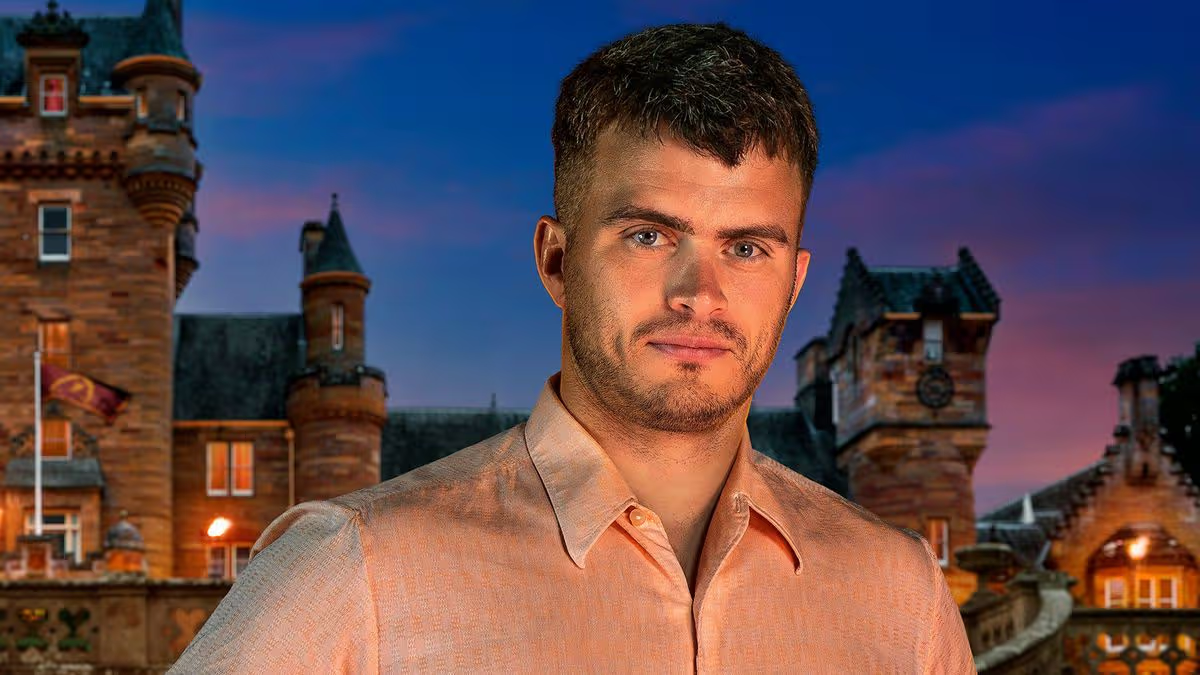
Matthew Hyndman said he was asked in his 20s to “publicly repent” for being gay or leave his evangelical Christian community behind.

Hyndman, who was also known as Matty during January’s series of the gameshow, said no to going through counselling and has now backed a ban on such practices which could see people fined or imprisoned for carrying them out.

Advertisement

Speaking at an event in London as a draft Conversion Practices Bill was published on Thursday, he said he had been an evangelical Christian missionary on a ship sailing around the world as he wrestled with his sexuality.

He said: “I was so embarrassed that I was gay. I was so deeply embarrassed and ashamed, and I didn’t tell a soul. This was not something that I was willing to even utter, because as far as I was concerned, it was the worst sin.”

He said he had for a long time been “completely in denial about my sexuality”, but when it became known he was gay, he was confronted with the prospect of conversion practices.

“I was basically given a choice to publicly repent in front of the entire ship’s community and agree to go through counselling, or go.”

He said he considers himself “one of the lucky ones” because he was able to walk away, but that had not come without its hardships.

“In order for me to walk away, in order for me to say no, there was such a huge risk,” he said. “The risk was that I would lose everyone I know and love. My vocation, my community, everything was so intertwined, particularly when you have a faith, it’s so intertwined.

“So for me to say no was for me to reject the belief of my entire community and walk away. And I did, thankfully. I consider myself one of the lucky ones because I did, I walked away, and I said ‘no, actually, I think I know who I am’.”

Advertisement

He spoke of his belief in the importance of a ban on such practices – which are aimed at changing someone’s sexual orientation or transgender identity and can involve anything from exorcisms to prayers.

Hyndman added: “I think it (a ban) just sends a really clear signal, as well.

“Anyone who is currently experiencing this, anyone who has, they’re hearing from the highest point that this is wrong and that it should not be happening to you. You’re not broken, you don’t need to be cured.”

The draft Bill covers England and Wales only and was a Labour manifesto commitment from 2024.

Advertisement

Hyndman, who is originally from Northern Ireland, appeared at the Alliance Party conference in March to back the party’s bid to ban conversion practices there.

For all the latest news, visit the Belfast Live homepage here and sign up to our daily newsletter here

Source link

Advertisement
Continue Reading

NewsBeat

Two men to be deported after discovery on Bolton street

Published

on

Manchester Evening News

The pair have been jailed

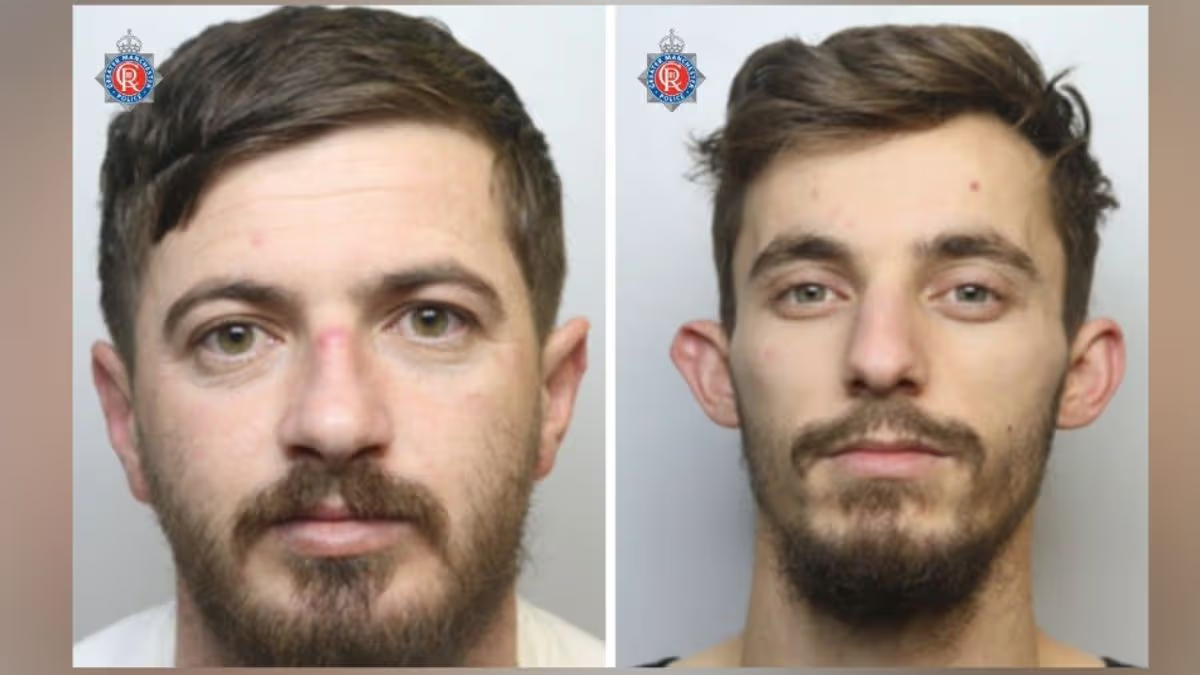
Two men have been jailed and are due to be deported after a ‘large-scale’ cannabis grow was discovered in Bolton. Neighbourhood officers raided a property on Newport Street back on December 23 last year, after receiving intelligence.

Advertisement

Greater Manchester Police says it uncovered a ‘substantial and fully operational’ cannabis farm at the property, which had been ‘professionally adapted’ – including the illegal bypass of the electricity supply to power the grow. CCTV footage was observed as part of enquiries which identified a black van attending the property in the days before the raid.

Two men were captured on camera accessing the secured building, and the vehicle was subsequently traced to Leonard Tota. The now-26-year-old was arrested the following day at his home address, where Ridgan Taga, 26, was also located.

Click here to hear the latest from Manchester’s courts in our newsletter

A search of the address uncovered additional cannabis plants, sophisticated growing equipment, a significant quantity of cash, mobile phones, a suspected debtors list, and keys linking both men directly to the Newport Street premises. GMP says the investigation highlighted a coordinated and organised effort to cultivate cannabis at scale.

Advertisement

Tota, of St George’s Road, Bolton, pleaded guilty the production of cannabis, while Taga, of St George’s Road, Bolton, pleaded guilty to production of cannabis, being concerned in the supply of cannabis and possession of criminal property. Tota was sentenced to 14 months’ imprisonment, while Taga was jailed for a year. Both are due to be deported following the completion of their custodial terms.

Police Sergeant Jessica Prudence, of Bolton town centre neighbourhood policing team, said: “This is an excellent result and demonstrates the dedication and effectiveness of our neighbourhood officers in tackling serious drug-related crime. By acting on intelligence and carrying out thorough enquiries, the team has successfully removed a significant cannabis grow from the community and brought those responsible before the courts.

“We rely heavily on information from the public, and the intelligence you provide plays a vital role in enabling us to take action like this. Drug supply is not a victimless crime – it is often linked to wider, harmful criminality that can have a serious impact on our communities. We would continue to encourage anyone with concerns or information about suspected drug activity to come forward and speak to us.”

Source link

Advertisement
Continue Reading

NewsBeat

Who is Brooke George? British TikTok influencer who could face death penalty in Dubai

Published

on

Who is Brooke George? British TikTok influencer who could face death penalty in Dubai

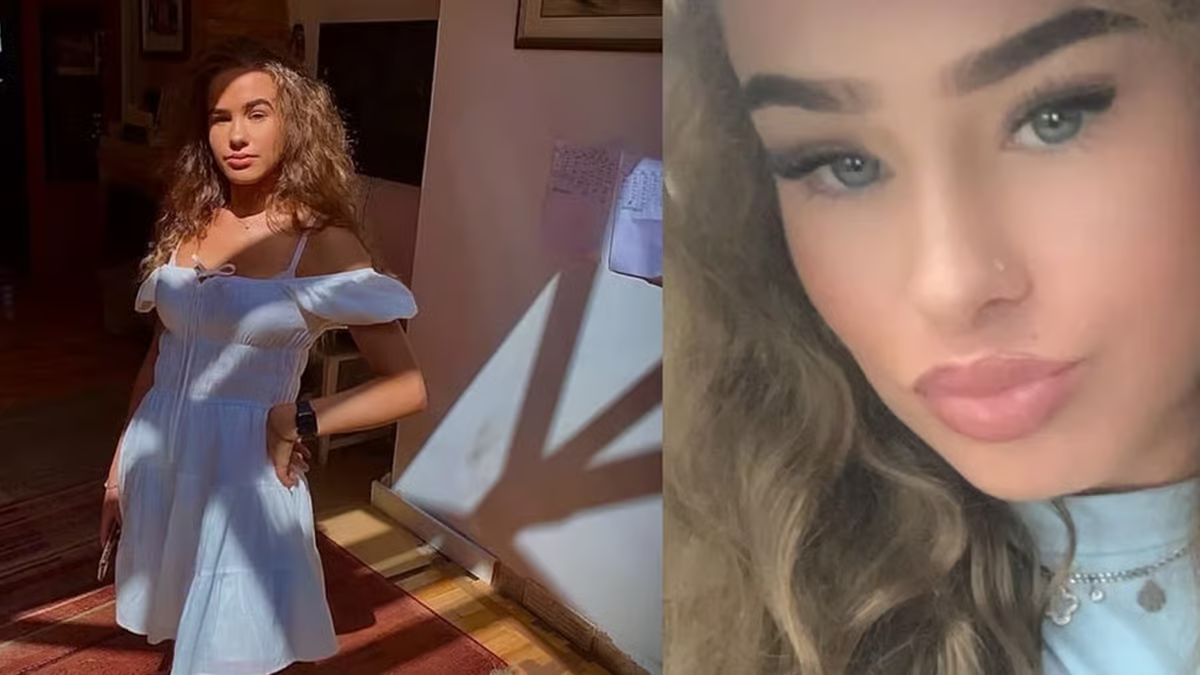
A TikTok influencer with almost 100,000 followers is facing the death penalty in Dubai after being charged with the murder of her boyfriend.

Brooke George, 23, from Gravesend in Kent, claims she grabbed a knife in self-defence after being violently assaulted by a British man in the UAE.

Source link

Advertisement
Continue Reading

NewsBeat

Watch Scotland’s skies explode with spectacular thunder and lightning as storm strikes Central Belt

Published

on

Daily Record

Spectacular thunder and lightning storms lit up the sky throughout the night in Scotland

Lightning strikes clatter Scotland during thunderstorm warning

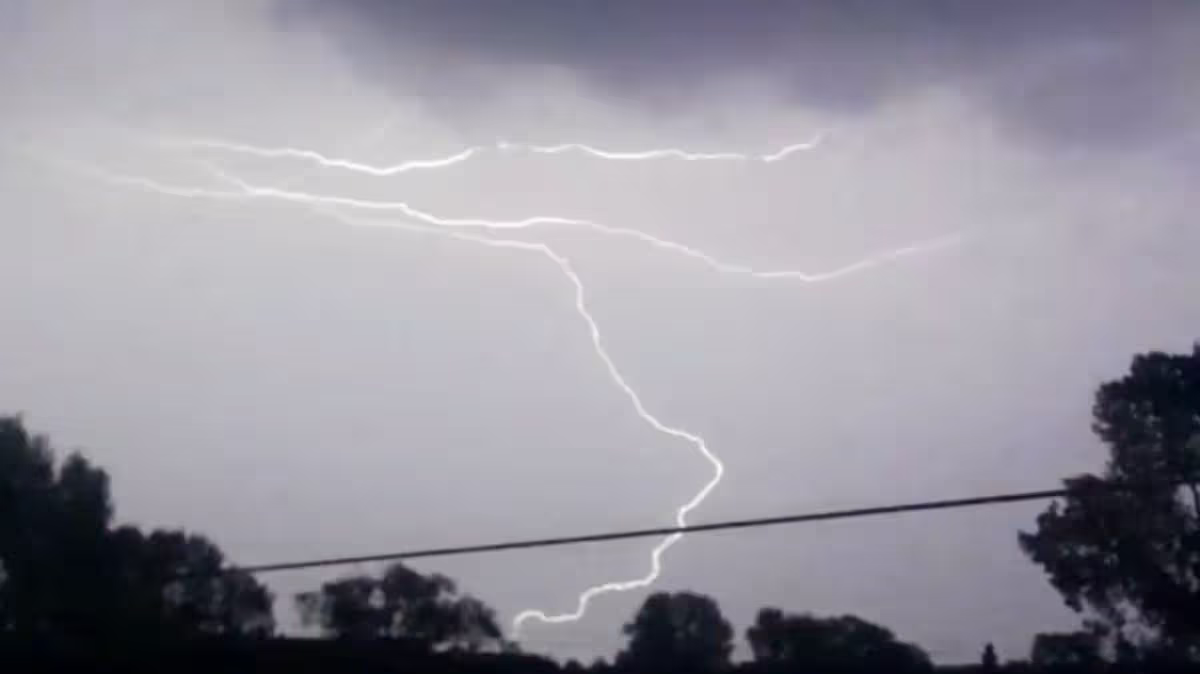
Incredible footage captured by Scots across the country shows spectacular thunder and lightning storms illuminating the night sky during the early hours of Friday, June 26.

The dramatic display unfolded as a powerful storm swept across East Central Scotland between midnight and 3am, with repeated strikes of lightning lighting up the skies above Edinburgh, Fife and surrounding areas. The intense flashes, accompanied by rolling thunder, turned the darkness into daylight in a breathtaking overnight display.

Scots across the country took to social media to share videos and photographs of the extraordinary scenes, with many describing the storm as “crazy” and unlike anything they had ever witnessed before. Meanwhile others said the lightning, which lit up the sky every few seconds in some areas, was some of the most impressive strikes they had ever seen.

Stunning snaps taken over Fife in the early hours of Friday morning show spectacular bolts light up the night sky. The photos, shared by Fife Jammer Locations, are just some evidence of the spectacular weather event that was experienced across Scotland.

Advertisement

In one video which was posted onto X, formally known as Twitter, a huge bolt of lightning strike across the Edinburgh sky, illuminating the landscape for a split second and flooding the room where the person filming is sitting with bright white light.

Advertisement
Content cannot be displayed without consent

The powerful fork of lightning cuts diagonally through the sky, while the low rumble of thunder can be heard rolling moments later. An accompagning caption read: “The thunder storm has been hovering over Edinburgh & Fife for the last 30 minutes. I managed to capture a lightening bolt.

Making a light hearted reference to the ancient Greek god of the sky and thunder, she joked: “Zeus is wide awake.”

Meanwhile another clip shows the lightening clatter over Edinburgh Castle. In what looks like it could be a scene from a film, the bolts light up the castle for a few seconds showing the beauty of the capital city. The strikes almost look like they are hitting directly into the castle grounds.

Content cannot be displayed without consent

At times the lightning appears to strike extremely close to the castle grounds, while deep rumbles of thunder can also be heard echoing over the city.

Advertisement

It comes as a yellow thunderstorm warning remains in force across large parts of Scotland after the Met Office extended the initial weather warning, which was in place in till 23:50 tonight, to 3am on Saturday, June 27. The extension is due to slower clearance of rain across the far north of the country.

Forecasters warns that thunderstorms and heavy rain may cause some disruption throughout large parts of Scotland.

The Met Office states: “Spells of heavy rain and thunderstorms initially over northwest Scotland are likely to become more widespread during Friday morning.

“Further thunderstorms and spells of heavy rain are possible in the afternoon before becoming confined to more northern areas of Scotland later in the day.”

Advertisement

The forecast continues: “Rainfall amounts will be highly variable but narrow corridors of 20-30 mm falling in 1 hour and potentially 30-50 mm in 3 hours is possible. Frequent lightning, large hail (2-4 cm diameter) and locally gusty winds with stronger storms.”

Source link

Continue Reading

NewsBeat

New Alzheimer’s drugs offer hope for some, but good dementia care protects the humanity of those they cannot help

Published

on

New Alzheimer’s drugs offer hope for some, but good dementia care protects the humanity of those they cannot help

Disease-modifying drugs for Alzheimer’s offer a meaningful glimpse of hope for many people who fear dementia. Alzheimer’s disease is the most common cause of dementia, but dementia itself is an umbrella term for symptoms such as memory loss, confusion and changes in thinking.

Unlike older dementia drugs, which help with symptoms but do not change the underlying disease, disease-modifying treatments are designed to slow the disease process itself. So far, these treatments appear to delay symptom progression by several months rather than years. They also carry a small but serious risk of side-effects, including swelling and bleeding in the brain. At present, they are suitable only for some people in the early stages of Alzheimer’s disease, meaning that many others will still face dementia with no cure on the horizon.

The fact that scientists are now achieving some degree of disease modification has generated enormous interest in dementia research. That attention is essential if these advances are to continue. But public excitement can also narrow the conversation, drawing attention towards the biology of dementia and away from the lives of the people experiencing it.

For many years, social scientists have argued for a broader understanding of dementia. Dementia begins with changes in the brain, but it affects the whole person. It can change how someone remembers, communicates, relates to others and makes sense of the world.

Advertisement

That means dementia care has to do more than slow biological decline. It also has to ask what helps a person feel recognised, connected and still themselves. Even when medicine cannot offer a cure, care can still reduce distress, support identity and create moments of meaning. Music, poetry, storytelling, theatre, visual art, dance and museum work can give people with dementia ways to respond and connect, especially when ordinary conversation becomes difficult.

The value of this work can be hard to measure. A person singing along to a familiar song, recognising an image, laughing at a shared joke or becoming briefly more engaged with others does not fit neatly into the same evidence framework used to assess a drug.

As these interventions become more common, and increasingly extend beyond the very early stages of the disease, they make visible the humanity of people living well into the dementia process. Such work can challenge harmful stereotypes in print and social media, where dementia is often portrayed as a “living death” and people with dementia are reduced to “zombies” or “empty shells”. Language like this encourages the idea that a person with dementia has already disappeared, even while they are still alive, responsive and capable of connection.

Yet there is a further risk. If public attention focuses mainly on people who can still speak, sing, paint, perform or respond in recognisable ways, those with very advanced dementia may be treated as unreachable. They are already frequently considered unsuitable for research, and sometimes even unsuitable for creative or relational engagement.

Advertisement

In dementia, this can create a damaging divide between those who can still communicate in familiar ways and those whose communication has become harder to understand.

Author, Kate Irving, shares a laugh with a project member during research.
Alex Kornhuber, Author provided (no reuse)

In a recent publication, we explored the limits and possibilities of engaging with people living in the very late stages of dementia. The paper examined two ideas that can help us think about this problem: narrative dispossession and critical fabulation.

Narrative dispossession means being deprived of control over your own story. As dementia progresses, people may become less able to explain themselves, describe memories, correct misunderstandings or tell others what matters to them. Their life does not stop being meaningful, but their ability to narrate that life in conventional ways may become diminished.

This creates a serious ethical problem. How should carers, researchers, artists or family members respond when a person can no longer tell their own story clearly? What should we do with the fragments that remain: a gesture, a glance, a touch, a sound, a facial expression, or even an absence of response?

Advertisement

Critical fabulation offers one possible approach. The term comes from work on history, archives and silence. It describes a careful form of imaginative reconstruction, used when direct evidence is partial, missing or impossible to recover. In dementia care and research, it can help us think about how to engage ethically with the inner lives of people whose communication has become profoundly limited.

At its best, critical fabulation is tentative and restrained. It allows us to ask what a person might be feeling, remembering or communicating, while remaining honest about the limits of interpretation.

That interpretation must be humble. A caregiver may know a person’s history, habits, preferences and fears better than anyone else. This familiarity can deepen understanding, but it does not guarantee accuracy. Even those closest to a person with dementia must remain alert to the risks of projection, over interpretation and reading their own assumptions into another person’s experience. Or, even, taking over someone else’s story entirely.

If we refuse all imaginative engagement, we may leave people in the latest stages of dementia in silence. That silence can become a form of erasure.

Advertisement

For this reason, critical fabulation in dementia care and research must remain anchored in restraint and relational care. It means examining our own assumptions, motives and power, and requires us to ask what this person might be experiencing, but also what right we have to narrate that experience.

New drugs may help some people stay in the earlier stages of Alzheimer’s disease for longer. But dementia care also requires us to think about those for whom these drugs will do little or nothing, and those who are already far beyond the point at which they can tell us their stories in familiar ways.

Their lives still require attention. Their silence should not be mistaken for absence.

Advertisement

Source link

Continue Reading

NewsBeat

North York Moors: Don’t Spark Disaster campaign launched

Published

on

North York Moors: Don't Spark Disaster campaign launched

The ‘Don’t Spark Disaster’ campaign is being delivered by the North York Moors National Park Authority in partnership with North Yorkshire Council, the Yorkshire Dales National Park Authority, Forestry England and North Yorkshire Fire & Rescue Service. North Yorkshire Council funded the campaign, which is also being supported by the authority’s destination marketing and management service, Visit North Yorkshire.

The campaign comes as organisations continue to deal with the long-term impacts of last year’s devastating wildfire on Fylingdales Moor, which became the largest wildfire in the history of the North York Moors National Park.

Running throughout the summer months, Don’t Spark Disaster will deliver clear and impactful messages to residents and visitors about the simple actions that can help prevent wildfires. Campaign activity includes targeted social media advertising, e-newsletters, outdoor advertising and digital communications across North Yorkshire and beyond.

Advertisement

The campaign highlights how seemingly small actions – such as discarding cigarettes and leaving glass bottles behind, alongside behaviours such as lighting barbecues and campfires – can have devastating consequences for wildlife, landscapes, local communities and the emergency services. However, visitors are still encouraged to get outdoors and make the most of all that North Yorkshire has to offer. There are plenty of tasty local picnic options that don’t require on-site cooking, helping people to enjoy a safe day out while reducing the risk of wildfires.

As well as raising public awareness, the campaign is calling on businesses, community organisations and local groups to help spread the message by displaying campaign materials in their premises, on websites and across social media channels.

A free toolkit containing posters, digital graphics and social media assets is available to download, making it easy for organisations to support the campaign and reach residents and visitors alike.

Jim Bailey, Chair of the North York Moors National Park Authority, said: “Most wildfires are preventable. That’s the simple but crucial message at the heart of this campaign.

Advertisement

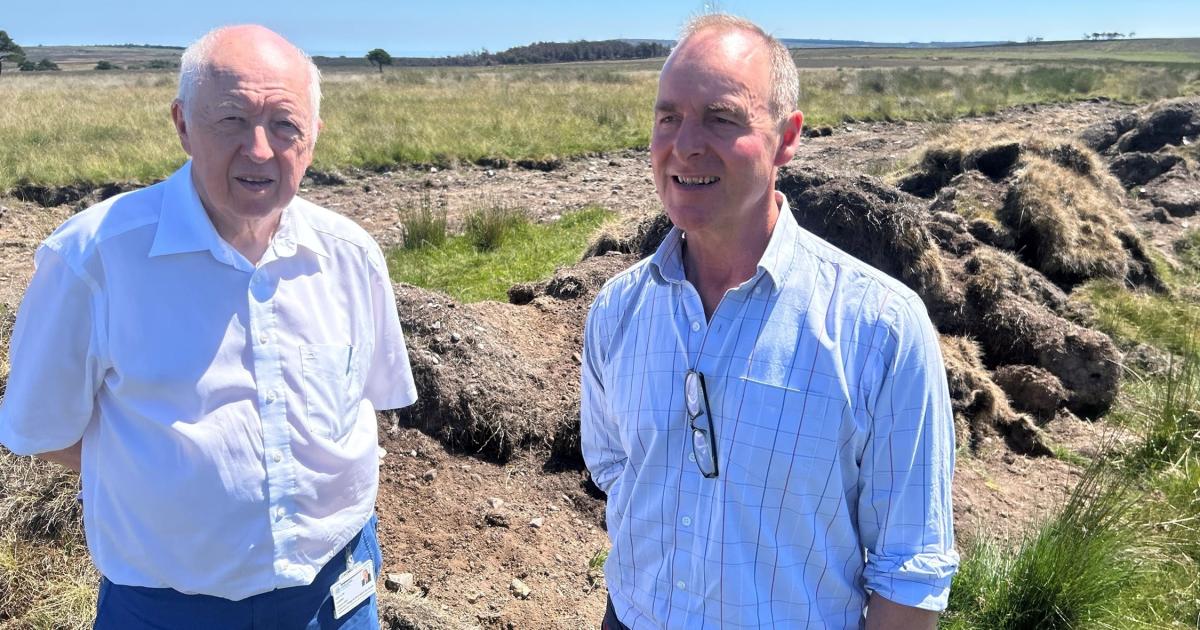
“The fire may have happened a year ago, but we continue to deal with the aftermath on a daily basis. Farmers and graziers have been unable to return sheep to parts of Fylingdales Moor, while the landscape remains visibly scarred by both the fire and the large earth trenches that were dug to stop it spreading further.

“We urge everyone to think carefully about their actions when enjoying the countryside this summer. A moment’s carelessness can have consequences that last for generations, but a few simple precautions can help prevent another devastating wildfire from happening in the first place.”

North Yorkshire Council’s leader, Cllr Carl Les, said:

“We welcome visitors here in North Yorkshire and our stunning landscapes attract millions of people every year, but we need everyone to understand the risks and take care of the environment.

Advertisement

“A barbecue in the sunshine or a carelessly discarded glass bottle or cigarette can have serious impacts for people and places for years to come, as we saw last year.

“This campaign is vital to making sure that we do not see a repeat of the biggest wildfire we have ever witnessed in North Yorkshire.

“Our message is clear – please come and enjoy all that North Yorkshire has to offer but be aware that careless actions can cause a catastrophic impact on our communities and the natural environment.”

Lizzie Bushby, Deputy Chair and Member Champion for Recreation Management at the Yorkshire Dales National Park Authority, said:

Advertisement

“We are proud to support this campaign after witnessing the devastation caused by the Fylingdales Moor wildfire in the North York Moors. Moorland habitat is becoming more vulnerable as our climate changes. Once it burns, we lose essential habitats, wildlife and peatland that has taken hundreds of years to form. These fires are often the result of human actions, so it’s vital that everyone who visits our National Parks takes simple steps to help protect these precious landscapes.”

For campaign resources and further information, visit the Don’t Spark Disaster campaign page at northyorkmoors.org.uk/dontsparkdisaster.

Source link

Advertisement
Continue Reading

NewsBeat

SNP accused of ‘deception and betrayal’ after axing Monklands hospital replacement plan despite election pledge

Published

on

Daily Record

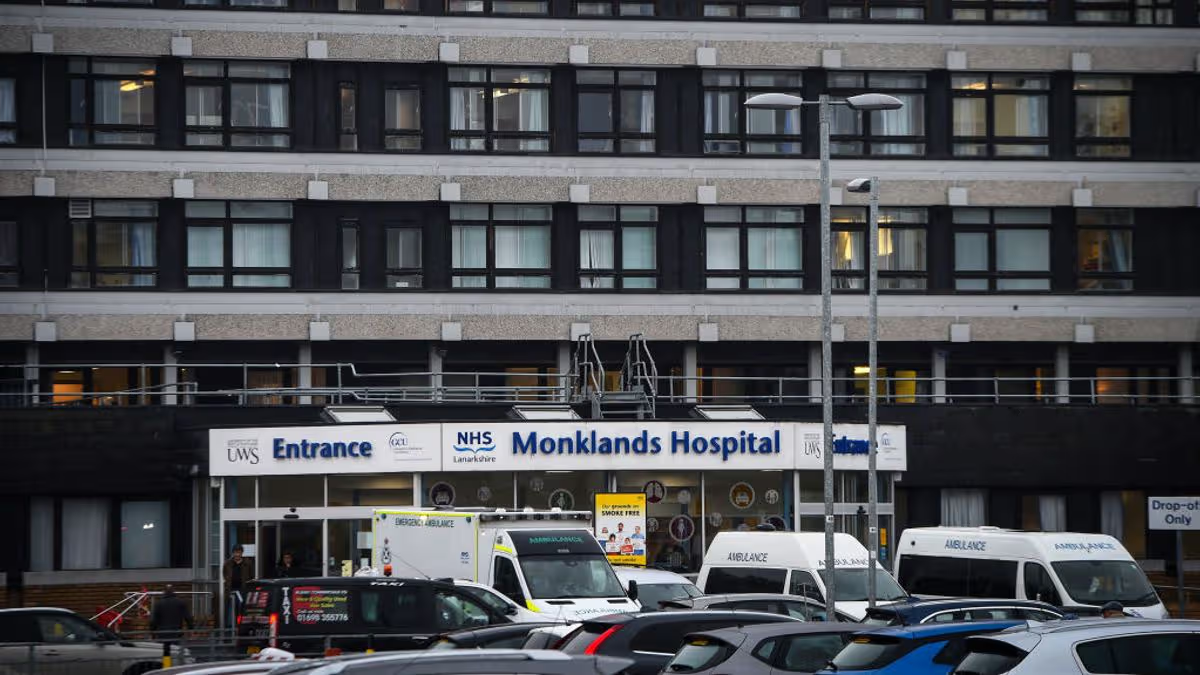
A former health secretary warned the decision to axe a £2.1 billion plan to build a new hospital in North Lanarkshire was a “hammer blow to one of the poorest communities in Scotland”.

The SNP Government has been accused of “utter betrayal” after ministers axed plans to build a long-awaited replacement for the crumbling Monklands hospital in Lanarkshire.

Alex Neil, a former health secretary, said the decision to reject an NHS plan to construct a new £2.1 billion health campus in Airdrie was a “hammer blow to one of the poorest communities in Scotland”.

An SNP spokesperson claimed in April – just days before the recent Holyrood election – that it was “not true” to suggest the project would be scaled back or delayed.

Advertisement

The party’s 2026 manifesto also stated “work is already well underway” to build a new hospital for Airdrie and Coatbridge – despite there being no start date for when construction will begin.

The Monklands replacement is politically sensitive as the current hospital, which is plagued by maintenance issues, falls in the Airdrie constituency of SNP minister Neil Gray – who was until last month Health Secretary.

Former Labour MSP Neil Findlay today asked: “Was Neil Gray shuffled out of the health job so he didn’t have to bin the Monklands hospital project that would affect his constituents?”

Alex Neil, a former MSP for Airdrie, called on Gray to resign from Government over the decision.

Advertisement

He said: “The SNP government originally planned to have a new Monklands hospital built by 2016. Then it was delayed until 2032. Now it appears to have been delayed indefinitely.

“Not only is this unacceptable, it is a hammer blow to one of the poorest communities in Scotland.

“During the election campaign, when it became public knowledge that the Scottish Government had not approved the business plan for the new hospital presented to it by NHS Lanarkshire, I stated publicly that this was a clear sign that this project was now in doubt.

“The SNP issued a statement suggesting that this was not the case. Clearly that was a lie. They engaged in deception of the worst kind.

Advertisement

“As a former Health Secretary I am absolutely sure that the Scottish Government would have been aware of the estimated costs of the hospital long before 2026 so why did they not redesign the business plan for the hospital to allow it to be delivered by the promised timeframe of 2032?

“This decision is a hammer to the people of the Monklands and the rest of Lanarkshire.

“I am also sorry to say that my friend Neil Gray has no choice now but to resign from the Scottish Cabinet. Not to do so will totally undermine his position as the local MSP for Airdrie and Shotts.”

The board of NHS Lanarkshire met in December and approved the full business case for a new hospital, which was submitted to the Scottish Government for ministerial approval. But health chiefs were then met with silence.

Angela Constance, who was handed the Health brief by John Swinney last month, chose the final day of the Holyrood term before the Parliament’s two-month summer break to announce it had rejected the business case.

She told MSPs there was now an “ambition” to redesign the plans and suggested work could begin in 2028 instead.

Constance said: “This is not a decision I have taken lightly. The case for replacing Monklands is well established. The current hospital estate is ageing, it presents ongoing operational challenges, and it constrains the delivery of modern models of care.

Advertisement

“Staff have worked in difficult conditions for many years, and they deserve better. Patients deserve better.”

The MSP added: “It is my responsibility to ensure that major investment decisions are affordable, deliverable, and aligned with the future direction of our health and care system.

“The proposal before us, with an estimated cost of around £2.1 billion, would represent an unprecedented concentration of capital investment in a single health project.”

The Record asked the Scottish Government for comment.

Advertisement

Source link

Continue Reading

NewsBeat

Person taken to hospital after incident in Coundon

Published

on

Person taken to hospital after incident in Coundon

Emergency services were called to the East Avenue area of the village on Thursday (June 25) after reports of a person becoming unwell. 

The Great North Air Ambulance Service sent one of its helicopters to the scene just after 5.30pm alongside two ambulance crews from the North East Ambulance Service (NEAS).

One person was taken to the Darlington Memorial Hospital by road for further treatment, the NEAS has confirmed.

Advertisement

Their current condition remains unknown. 


A NEAS spokesperson said: “We received a call at 5.37pm on Thursday (June 25) to reports of a person unwell in the East Avenue area of Coundon, Bishop Auckland. 

“We dispatched two ambulance crews to the scene and requested support from the Great North Air Ambulance Service (GNAAS). 

“One patient was taken to Darlington Memorial Hospital by road for further treatment.”

Advertisement

Source link

Continue Reading

NewsBeat

Ben Stokes incident sparks row between Saracens and ECB over 19st rugby player

Published

on

Wales Online
Ben Stokes incident sparks row between Saracens and ECB over 19st rugby player | Wales Online

Advertisement
reach logo

At Reach and across our entities we and our partners use information collected through cookies and other identifiers from your device to improve experience on our site, analyse how it is used and to show personalised advertising. You can opt out of the sale or sharing of your data, at any time clicking the “Do Not Sell or Share my Data” button at the bottom of the webpage. Please note that your preferences are browser specific. Use of our website and any of our services represents your acceptance of the use of cookies and consent to the practices described in our Privacy Notice and Terms and Conditions.

Source link

Continue Reading

Trending

Copyright © 2025