



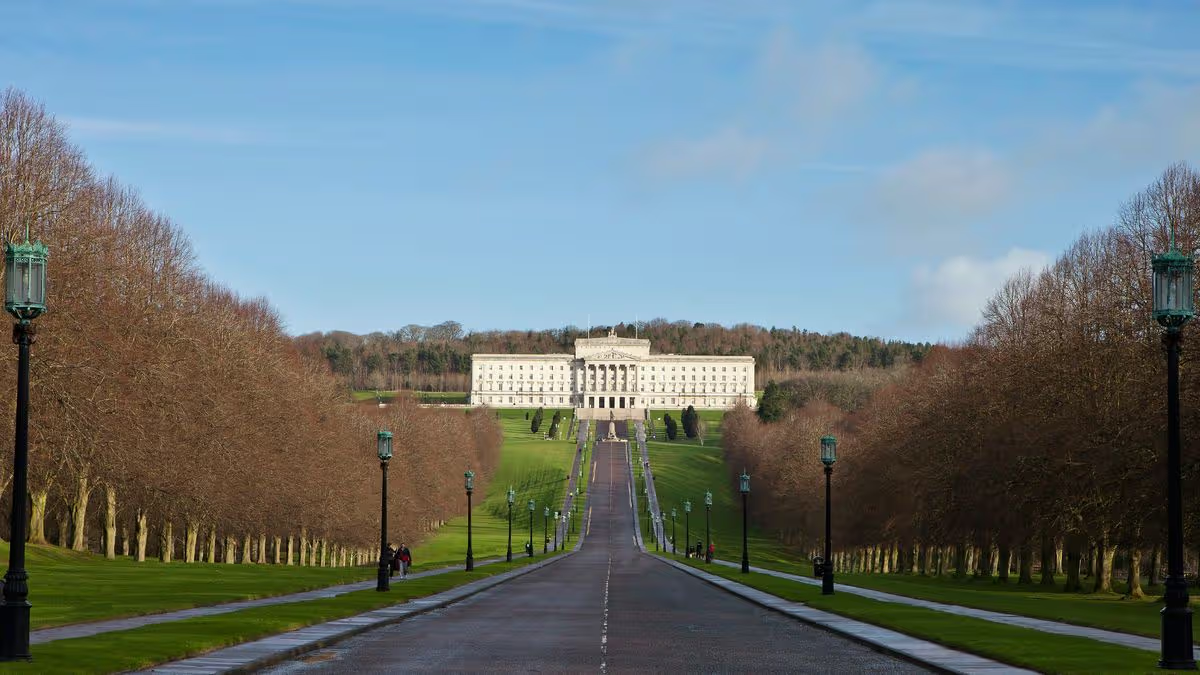
Writing for Belfast Live, Professor Stephen Farry explains the implications of Stormont having no agreed budget
Setting a budget is the most fundamental duty of any government. We are now over a month into the current financial year, and we continue to await Executive agreement on a budget.
It remains unclear if and when Northern Ireland will see a budget, and further if that budget will be multi-year or single-year. The legal backstop measure of the Permanent Secretary in the Department of Finance authorising expenditure at 95 per cent of last year’s allocations has already been put in place.
The backdrop to this budget impasse is deep financial crisis. Public services in NI are not sustainable under their current guise and configuration, bearing considerable opportunity costs.
The pattern of recurring overspends over the past four financial years, which have been addressed by short-term interventions, such as better than expected Barnett Consequentials or the reserve claim from Treasury, are testament to this situation. Further overspends are already projected for the current financial year.
Indeed, there is a danger that not agreeing a budget becomes a politically easier outcome than the difficult decisions and compromises in reaching formal agreement on allocations over one or more years.
Continued delay or even failure to agree entails negative consequences for Departments, alongside Arms-Length Bodies and the community and voluntary sectors, which deliver crucial services for government.
The outcome of the multi-year UK Spending Review has been in place since June 2025. This provides the Executive with the opportunity to put in place NI’s first multi-year budget since the 2011-2014 period. Prior opportunities for such a multi-year budget were hampered by the absence of working institutions.
There is, of course, a process for the Department of Finance to undertake with the NI Departments to shape local draft proposals. Further, the relatively late UK Budget last autumn, with the potential to alter allocations on the margins, created further uncertainty.
However, both Scotland and Wales did announce their budgets for 2026-2027 in January this year. In one respect, it is easier for NI to introduce and sustain a multi-year budget, notwithstanding the missed opportunities in the recent past. Whilst Scotland and Wales are engaged in elections with uncertainty as to the make-up of the incoming administrations, given our particular system of government, there is a considerable consistency of parties in power.
For reference, in early 2011, the outgoing Executive agreed the 2011-2014 multi-year budget even though all of those relevant financial years would fall into the subsequent mandate.
Whilst a multi-year budget doesn’t in itself place more resources on the table, it would allow a more strategic approach to spending, enable renewed investment and reform, address market failures, and safeguard future outcomes.
However, merely agreement of a multi-year budget that is just a set of numbers does not in itself equate to a strategic outcome. That comes from a clear focus upon transformation and alignment of resources in line with a Programme for Government.
Further, it is worth noting that there is an ongoing misalignment between the timing of opportunities for multi-year budgets and the agreement of Programmes for Government.
This could be improved if the Executive returned to an outcomes-based framework and put in place a rolling and evolving programme, which on paper could be much easier to maintain given the consistency of parties in power.
Yet the delay regarding agreement on any budget brings many immediate challenges. When Departments and Arms Length Bodies cannot adequately plan ahead, this brings uncertainty on workforce plans and service delivery, and even entails some staff being placed on protective notice in the community and voluntary sector.
Where savings and efficiencies do need to be made by Departments to remain within budget allocations, it is challenging enough to make and implement those measures over a 12- month horizon, never mind a reduced 11-month window or less.
Without agreement on a budget or agreement on a budget where it is commonly recognised that the budget would be broken by significant overspends by many departments, NI would limp to the next Assembly Election with greater chaos and distance from a strategic approach that is ultimately required for financial sustainability and better outcomes.
The hope may be for a further Treasury response. Notwithstanding the moral hazard, this is unlikely in the current UK fiscal context. This begs the question as to what the UK Government would do in response to overspends and the scale of negative impact from this short-termism.
Stephen Farry is a Professor of Strategic Policy in Practice at Ulster University.
For all the latest news, visit the Belfast Live homepage here and sign up to our daily newsletter here.



















































You must be logged in to post a comment Login