

Business
India underperforms Asian rivals amid earnings and valuation strain

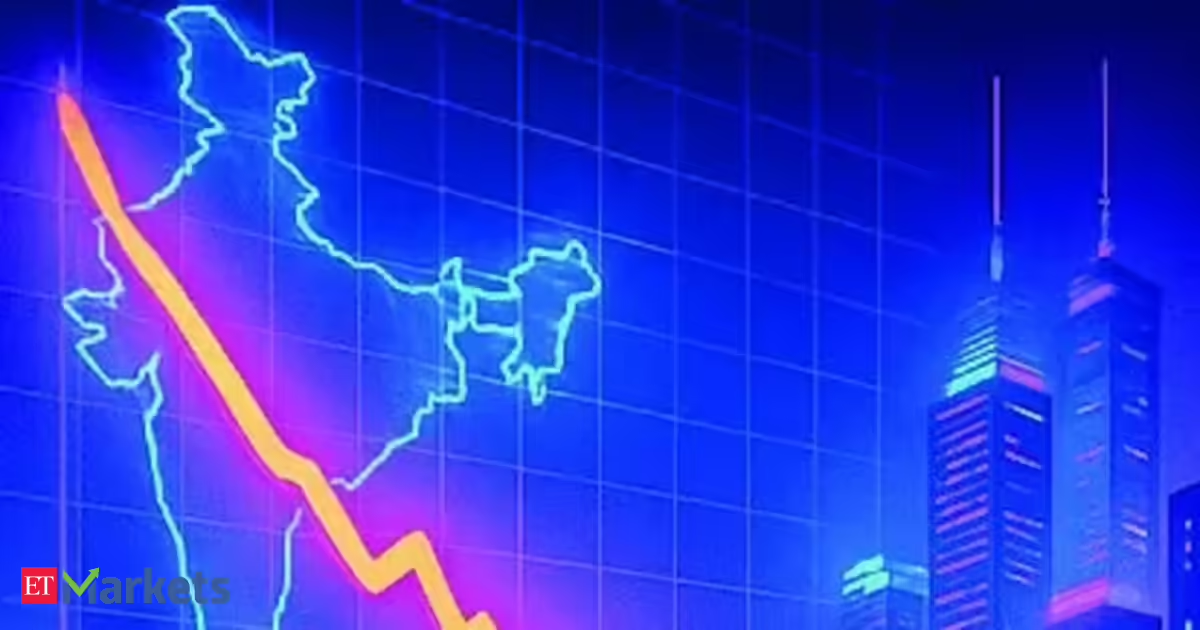
It is perplexing for some as to why Indian equities are down 7.5% this year while South Korea, whose economy is projected by the International Monetary Fund (IMF) to grow at half of India’s – at 3.3% – has rallied 74% drawing global investors. The answer lies in corporate earnings and not economic growth.
Every few years, a fever grips the investing community and that drives a set of stocks to dizzying heights even while others in the same market languish. The current theme is that of Artificial Intelligence (AI) . While most of the companies like OpenAI and Anthropic that are driving the transformation are still in private markets, the desire to grab a share of that pie is driving the average investor to listed companies securing revenues from those pioneering AI.
Silicon chips are the foundation on which the AI revolution stands. Any company producing them is a winner. Nvidia Inc., a chip maker, is valued beyond $5 trillion, which is more than the GDP of India. This craze to own the future is spilling over to South Korea and Taiwan where a few companies such as Samsung Electronics are involved in producing the chips for AI.
The rush to own chip makers has pushed South Korea’s market value to $4 trillion, double that of its GDP. In contrast, India’s market capitalization is at around $4.9 trillion while the GDP is around $4.15 trillion.

What is making the difference? Samsung Electronics and SK Hynix, the chip makers!
The revenue and profit potential of companies developing Large Language Model AIs may still be on paper, but the earnings for those supplying chips are real.The unprecedented demand for chips is forcing analysts to forecast earnings growth of 220% for Korea and 58% for Taiwan. By contrast, India that doesn’t have a direct AI play is at 18%.
Some analysts project Samsung to earn a profit of $250 billion this year and SK Hynix $150 billion. Taiwan’s TSMC is projected at $100 billion. The entire Indian listed corporate system may earn around $200 billion. When Korean and Taiwan companies are growing, Indian companies are staring at a cut in their earnings estimates.
Even if the earnings are skewed with just a handful of companies, investors chase value where those assets are still cheap compared to Indian companies. While Korea is trading at around 9.5 times, Taiwan is at 19 times forward year earnings. In contrast, India is still at 19.5 times which makes the local market unattractive even to other peers – reflected in MSCI EM at 12.5 times.
“Global markets are pricing in 20-40% EPS growth, 12-18 times price-to-earnings, versus India’s 18% EPS growth,” says a strategist at Motilal Oswal Securities. “A sustainable earnings growth delivery is critical for reversing the underperformance.”
Apart from the relatively poor corporate earnings growth and steep valuations, India’s long-term dependence on capital flows for meeting its imports is translating into a weaker financial market.
The US-Iran war has not only pushed up energy prices by more than 40% steeply raising import bills, it is also threatening to disrupt supplies in the medium term if the war doesn’t end soon.
Indian rupee is trading at historic lows as foreign investors pull out record funds as they chase assets that are attractive in terms of valuations as well as earnings growth.
“The most exposed macro variable to the current shock is the balance of payment, followed by fiscal position,” says Aastha Gudwani, economist at Barclays. “Administered prices mute immediate inflation pass-through, but at the cost of growing fiscal strain if supply risks persist. Balance of Payments is likely to reel under the stress of shrinking capital inflows.”
This is a further blow to overseas investors who read their returns in US dollar terms. Looking through that prism, the Nifty is down about 8% since its January peak in Rupee terms, and 12% in USD.
To be sure, warnings have been sounded on Wall Street’s highly skewed AI investments.
The key to reversing India’s underperformance lies in boosting corporate earnings and easing macro pressures. Or, in the bursting of the AI bubble.


In a holiday-shortened last week, the BSE benchmark Sensex dropped 639.61 points, or 0.84 per cent, and the NSE Nifty declined 171.55 points, or 0.72 per cent.
From the top 10 pack, Reliance Industries, HDFC Bank, Bharti Airtel, ICICI Bank, Tata Consultancy Services (TCS), Bajaj Finance and Hindustan Unilever faced erosion in their valuations, while State Bank of India, Larsen & Toubro and Life Insurance Corporation of India (LIC) were the gainers.
The market valuation of Reliance Industries dropped by Rs 46,078.3 crore to Rs 17,87,039.40 crore.
HDFC Bank’s valuation eroded by Rs 33,333.06 crore to Rs 11,46,641.84 crore.
The valuation of Bharti Airtel tumbled Rs 25,408.96 crore to Rs 11,14,886.53 crore and that of TCS dived Rs 22,920.58 crore to Rs 8,15,480.75 crore.
The market capitalisation (mcap) of Hindustan Unilever diminished by Rs 13,169.46 crore to Rs 5,04,210.54 crore.Bajaj Finance’s valuation declined by Rs 7,253.24 crore to Rs 5,63,262.33 crore and that of ICICI Bank dipped by Rs 6,311.41 crore to Rs 9,00,589.91 crore.
However, the mcap of Larsen & Toubro jumped Rs 20,608.43 crore to Rs 5,60,836.64 crore.
State Bank of India’s mcap climbed Rs 13,753.62 crore to Rs 8,89,831.54 crore and that of LIC went up by Rs 6,040.37 crore to Rs 5,20,484.06 crore.
Reliance Industries remained the most valued domestic firm followed by HDFC Bank, Bharti Airtel, ICICI Bank, State Bank of India, TCS, Bajaj Finance, Larsen & Toubro, LIC and Hindustan Unilever.

Revenue from operations increased 17% year-on-year (YoY) and 6% sequentially to Rs 11,217 crore during the quarter. Despite the strong top-line performance, margins remained under pressure due to rising input costs.
Gross profit stood at Rs 1,398 crore, translating into a margin of 12.47%. The company said profitability was impacted by a sharp rise in packaging material costs during the latter half of March, particularly for PET bottles and polyester films, driven by crude oil volatility and higher freight expenses.Cost of goods sold increased by 294 basis points as a percentage of revenue on a YoY basis. EBITDA, excluding exceptional items, came in at Rs 502 crore with an EBITDA margin of 4.48%.
The edible oils business remained the largest contributor to revenue. The segment reported revenue of Rs 8,324 crore during the quarter, up 23% YoY and 13.5% sequentially. Segment EBITDA stood at Rs 215 crore, with margins of 2.58%.
Branded edible oils accounted for nearly 75% of total edible oil sales and continued to drive growth.
The company said palm oil prices strengthened sharply during the quarter, with refined palm oil prices rising nearly 20% between January and March 2026. The increase was driven by higher import costs from Malaysia and Indonesia, elevated freight charges, rising insurance costs and expectations of tighter global supplies.
Soya oil prices also moved higher, rising 23% during the quarter.
The FMCG segment continued its strong performance and generated revenue of Rs 2,890 crore, up 14% YoY. Segment EBITDA rose 14% to Rs 292 crore, while margins stood at 10.1%.
The FMCG business contributed nearly 26% of quarterly revenue and almost 58% of segment EBITDA during the quarter, underscoring its growing importance in the company’s earnings mix.
Within FMCG, biscuits remained a key growth driver. Quarterly biscuit revenue rose nearly 14% to Rs 478 crore. For FY26, biscuit revenue crossed Rs 1,907 crore, growing 16%.
The company said its Doodh biscuit brand has now become a Rs 1,300-crore-plus annual sales brand, while Nariyal biscuits continued gaining market share.
The Staples portfolio generated quarterly revenue of Rs 849 crore, while the home and personal care business posted strong growth of 35% to Rs 840 crore. The skincare category emerged as one of the fastest-growing segments, with revenue rising 58% YoY.
The ghee business reported quarterly revenue of Rs 339 crore, while textured soya products contributed Rs 106 crore.
Beverages and juices also witnessed improved demand toward the end of the quarter as summer consumption recovered after an initially delayed season.
The company’s nutraceutical business generated revenue of Rs 18 crore following internal restructuring initiatives. Exports contributed Rs 32 crore during the quarter, while annual export revenue stood at Rs 187.8 crore. Patanjali Foods exported products to 37 countries during FY26.
For the full year, Patanjali Foods reported its highest-ever annual revenue from operations at Rs 40,170 crore, representing growth of 19% over FY25.
The edible oils business generated annual revenue of Rs 29,313 crore, while the FMCG segment reported annual revenue of Rs 11,188 crore, up nearly 20%. The company also continued expanding its oil palm plantation business under the government’s edible oil self-sufficiency push.
As of March 2026, the total oil palm cultivated area under the company’s network stood at 1.11 lakh hectares across 12 states, reflecting growth of 24% YoY.
Patanjali Foods spent around 2% of quarterly revenue on advertising and brand-building activities during the quarter.
(Disclaimer: Recommendations, suggestions, views, and opinions given by experts are their own. These do not represent the views of the Economic Times.)
Eleven confirmed dead in Washington state chemical accident, all bodies recovered

Durable Goods Orders Jump 7.9% In April, More Than Expected
Japan rejects China’s ’new militarism’ criticism, defense minister says

This is the forum for daily political discussion on Seeking Alpha. A new version is published every market day.
Please don’t leave political comments on other articles or posts on the site.
The comments below are not regulated with the same rigor as the rest of the site, and this is an ‘enter at your own risk’ area as discussion can get very heated. If you can’t stand the heat… you know what they say…
More on Today’s Markets:
Moderation Guidelines:
We remove comments under the following categories:
- Personal attacks on another user account
- Anti-Vaxxer or covid related misinformation
- Stereotyping, prejudiced or racist language about individuals or the topic under discussion.
- Inciting violence messages, encouraging hate groups and political violence.
Regardless of which side of the political divide you find yourself, please be courteous and don’t direct abuse at other users.
For any issue with regards to comments please email us at : moderation@seekingalpha.com.
Seeking Alpha’s Disclosure: Past performance is no guarantee of future results. No recommendation or advice is being given as to whether any investment is suitable for a particular investor. Any views or opinions expressed above may not reflect those of Seeking Alpha as a whole. Seeking Alpha is not a licensed securities dealer, broker or US investment adviser or investment bank. Our analysts are third party authors that include both professional investors and individual investors who may not be licensed or certified by any institute or regulatory body.

Xeris Looks Ridiculously Cheap If Growth Forecasts Are Even Halfway Right
China factory activity slips in May as economic momentum softens
Epsilon Energy: Just In Time Expansion Into Oil


Japan refutes ’new militarism’, accuses China of rapidly arming

Pep Guardiola ‘tells friends’ the manager’s job he wants next after Man City exit

Acer Chromebook 315 (2026) Review

‘My daughter was left in a coma after horror gap year scooter crash in India’


-

 Business6 days ago
NYT Strands Answers May 24 2026 Revealed for Puzzle No. 812 Theme Summer Essentials
-

 NewsBeat4 days ago
Israel says it has killed new Hamas military leader in Gaza City airstrikes
-

 Politics6 days ago
Bridgerton Season 5: Cast, Release Date And Everything We Know So Far
-

 Business4 days ago
Selena Gomez Reportedly Upset Over Benny Blanco’s Comments on Her ‘Terrible’ Diet
-
 Crypto World4 days ago
Micron Crosses $1 Trillion Market Cap as AI Demand Reshapes Memory Sector
-

 Business6 days ago
BTS Sells Out Four Las Vegas Shows at Allegiant Stadium for ARIRANG World Tour
-

 Tech6 days ago
Microsoft’s quiet Claude Code retreat and the real cost of enterprise AI
-

 News Videos4 days ago
XRP *JUST* SUCCEEDED!!!! CLARITY ACT EXPOSED!!! (SHE EXPOSED IT)
-
 Tech5 days ago
China assigns ID codes to 28,000+ humanoid robots
-
Crypto World6 days ago
Brian Armstrong Outlines Crypto Vision for the Future Financial System
-

 Tech2 days ago
Waymo dominates autonomous vehicle registrations as Tesla trails behind
-
Tech4 days ago
The Samsung pay deal is the moment Korean unions changed register
-

 Tech6 days ago
Westone Audio and Etymotic Acquired by Fidelity Collective in Major IEM Market Move
-
 NewsBeat5 days ago
Hottest May day ever as London hits 34.8C in 2C leap from previous records
-
 Entertainment5 days ago
‘Breaking Bad’ Star’s Easy-to-Binge 6-Part Crime Series Spin-Off Is Finally Heading to Free Streaming
-

 Tech4 days ago
Millions of AI agents imperiled by critical vulnerability in open source package
-
Crypto World4 days ago
SpaceX’s $2 Trillion IPO: Why Tech Giants Nvidia (NVDA), Apple (AAPL), and Microsoft (MSFT) May Face Pressure
-
 Crypto World6 days ago
Nvidia (NVDA) CEO Calls on Super Micro to Strengthen Export Controls Amid Smuggling Probe
-

 Tech4 days ago
NASA taps Blue Origin to deliver lunar rovers for Moon Base initiative
-

 NewsBeat6 days ago
Crowds find riverside shade in York as temperatures soar
You must be logged in to post a comment Login