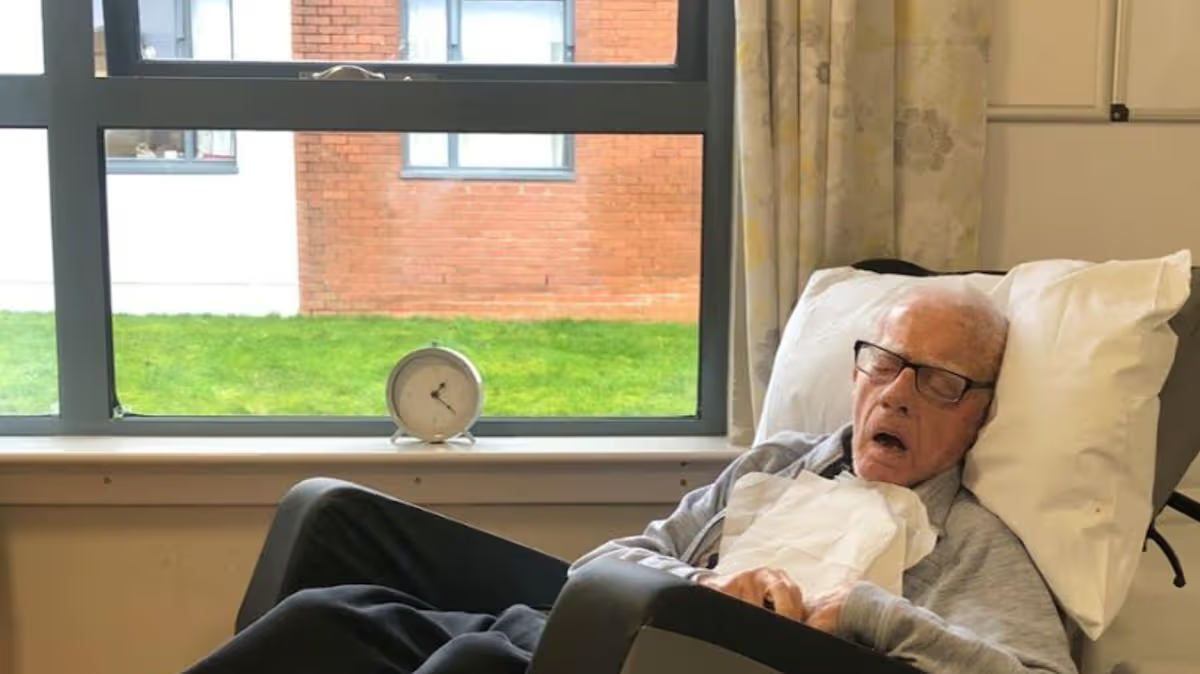
Families claim their loved ones were doped so often they were unable to eat or walk and suffered serious falls.
Lawyers have launched a legal battle against hospital bosses after families claimed dementia patients were left like doped-up “zombies” on a ward.
Advertisement
The family of former boxer George Maguire is suing NHS Greater Glasgow and Clyde after he was given unprescribed painkillers – which are only for meant use in cases of extreme pain or end of life care.
The Daily Record has now spoken to several families who claim their loved-ones were heavily sedated at the Jura Ward in Glasgow’s Stobhill Hospital.
The Maguire family, from Bishopbriggs, have given statements to police, laying down their belief that George, 91, was unduly sedated for weeks earlier than one weekend that the hospital has stipulated in February this year.
And now they intend to sue hospital chiefs.
Advertisement
Their lawyer has told the Daily Record he believes the illegally administered drugs, believed to be morphine, may have been given to many more patients at the ward.
Jonathan Howat said the families involved in the scandal deserve answers on how strict legal protocols in the administration of the drugs appear to have been repeatedly broken by multiple medical staff.
Howat, head of Thompsons Solicitors Scotland’s medical negligence unit, said: “Reporting from the Daily Record about the care of elderly dementia patients in Stobhill Hospital in Glasgow is deeply disturbing. For families who entrust their frail and very vulnerable family members to care at Stobhill this is the stuff of nightmares.
Advertisement
“It seems clear from reports that elderly dementia patients have been plied with extremely powerful opiates. It appears these drugs were unprescribed and their use was unauthorised.
“This is illegal and it is right there is now a police investigation into what exactly has been going on.”
Howat added: “The health board have assured the families affected, including our clients, that the illegal drugging of their relatives was simply a one off.
“I believe that the family’s are right to suspect that the illegal drugging may well have been more widespread and have gone on for longer. We believe the families are right to be sceptical of any internal investigation which is now ongoing.
Advertisement
“Our legal action against the health board will help provide the families with a greater degree of clarity. They are right to demand answers and we will do all we can to make sure they get them.“
The Daily Record first told of the scandal at the Jura Ward – a 20 bed dementia ward – in February, when NHSGGC admitted that several patients had been given unprescribed opiates.
The Maguire family noted that George was left “like a zombie”, barely able to open his eyes and unable to eat.
Advertisement
Several other families have approached the Record to say their own loved ones experienced the same pattern of care – being given so many sedating drugs that they could not talk or eat, which led them to waste away before their eyes.
Families have also reported that the sudden sharp decline in their loved ones’ condition led to repeated falls and head injuries.
Several families have reported that their loved ones were dressed in random clothing which did not belong to them – with an alleged acceptance in the ward that they would wear anything that fits.
Families affected by the conduct of staff were summoned to the unit to receive apologies and were told that a Serious Adverse Event Review had been launched.
George Maguires’ situation only came to light after he suffered falls and was transferred to Glasgow’s Royal Infirmary – where analysis of his blood revealed the shocking presence of the opiates.
Advertisement
His family claim a doctor said he could have died within days if the inappropriate medication had continued.
Three months on, George is now living in a care home, where his condition improved dramatically.
His daughter Maureen Cahill, a former psychiatric nurse, claimed that after being moved from the Jura ward George showed clear signs of “cold turkey” – a slang term for severe opiate withdrawal symptoms.
Maureen said that when they asked nurses why he was so exhausted all the time she was told – like other families – it was just a symptom of the dementia.
Earlier this week The wife of a former Scottish champion cyclist claimed his last months were destroyed by constant “doping” in the Jura ward. Ernie Scally suffered from Alzheimer’s but wife Helen believes he was still able to enjoy life until he was admitted to the Jura Ward, at Glasgow’s Stobhill Hospital in July 2024.
After he entered the ward, his family claim he showed clear signs of having been given heavy sedation.
A spokesperson for NHS Greater Glasgow and Clyde said a Serious Adverse Event Review (SAER) remains underway following an incident involving a small number of patients within Jura Ward at Stobhill Hospit.
Advertisement
They added.: “We would be happy to meet with any other families who may have concerns.”
Get more Daily Record exclusives by signing up for free to Google’s preferred sources. Click HERE.

The UK’s largest warship, HMS Prince of Wales, has experienced a technical issue while docked at a port in Norway, the Ministry of Defence (MoD) has confirmed.
The £3.5 billion vessel had set sail earlier this month from Loch Long, Argyll and Bute, Scotland. Its deployment to Nordic waters was intended to provide security across the Atlantic and High North regions.
“A minor technical issue” was identified on the Royal Navy’s most powerful vessel during its latest stop in Stavanger, a port city in south-western Norway, the MoD said.
The aircraft carrier is expected to sail in the coming days, the ministry added.
Advertisement
HMS Prince of Wales also broke down in 2022 while travelling to joint exercises with the US Navy.
An MoD spokesperson said: “HMS Prince of Wales is currently conducting a port visit to Stavanger as part of the Carrier Strike Group’s deployment across the North Atlantic and Arctic, we expect her to set sail in the coming days.”
The Daily Mail quoted a senior Navy source as saying the latest breakdown was ‘devastating for morale’.
The Royal Navy flagship HMS Prince of Wales returning to Portsmouth Naval Base (PA)
The ship, which is generally based in Portsmouth, was joined by Type 45 destroyer HMS Duncan and tanker RFA (Royal Fleet Auxiliary) Tidespring on its way to Nordic waters.
It has worked with Nato and the Joint Expeditionary Force throughout the deployment.
Advertisement
What to know about HMS Prince of Wales
HMS Prince of Wales and HMS Queen Elizabeth are the largest and most powerful vessels ever constructed for the Royal Navy.
HMS Prince of Wales weighs 65,000 tonnes, and has a top speed in excess of 25 knots per hour and a range of 10,000 nautical miles.
It can carry up to 72 aircraft, including a maximum of 36 F-35B fighter jets, and has an expected service life of up to 50 years, according to the Royal Navy.
Advertisement
The ship can operate on a crew of 678, but can accommodate up to 1,600 people.
Commanding officer Captain Ben Power said before it set sail: “HMS Prince of Wales stands ready as the nation’s flagship to demonstrate the United Kingdom’s commitment to Nato and the Joint Expeditionary Force.
“My thanks go to our families who continue to show unwavering support as we deploy for a period away from home waters.”
Commander James Mitchell, commanding officer of the HMS Duncan, added: “As a Type 45 destroyer, HMS Duncan brings world-class air defence capability to the Carrier Strike Group, providing essential protection to HMS Prince of Wales and other high-value units.
Advertisement
“Training alongside our allies in the North Atlantic and High North strengthens our ability to operate as an integrated and resilient force.”
For Phyll Opoku-Gyimah, better known as Lady Phyll, advocacy feels less like a choice and more like something woven into who she is: “Activism really found me, when I didn’t have the language for it, growing up as a Black queer woman.”
She traces the connection back to being 12 years old, when she remembers a British National Party march taking place nearby, and an elderly woman urged her to go into a shop before they arrived as they “didn’t like your sorts”. The comment was directed only at Lady Phyll, not the blonde-haired, blue-eyed friend she was standing beside.
“It made me think there is something very different about me that people don’t like,” she recalled. The moment stayed with her and helped ignite what would become a lifelong commitment to campaigning.
“At my core, activism has always been about dignity and people wanting to feel safe, visible, and worthy of joy.” Joy is a word Lady Phyll returns to constantly throughout the conversation. For her, it’s key to have joyful moments, and it’s an essential part of her work.
Advertisement
Lady Phyll pictured on stage for the finale of UK Black Pride 2024 (Getty)
That attitude to activism eventually led to the creation of UK Black Pride in 2005, which celebrated its milestone 20th anniversary last August. Lady Phyll now marks her third year as CEO after previously holding the role of executive director, and she has been included in The Independent’s Pride List 2026 for the fourth consecutive year for her decades-long work on race, gender and LGBTQ+ rights.
“UK Black Pride came from a need, frustration and desire to see ourselves in spaces where we could be fully ourselves,” she said. “Without having to fragment parts of our identity of being Black and being queer.”
At the time, she said many Black LGBTQ+ people felt pressured to choose between their Blackness and their queerness. Lady Phyll was then running Black Lesbians UK (BLUK), and organised a coach trip to Southend-on-Sea, which became something much bigger. “It felt joyful, liberating. We understood that shared commonality we had with each other,” she explained.
As they walked back to the coach, Lady Phyll floated the idea of creating a UK Black Pride similar to events in Chicago and Washington DC. A few people laughed it off, thinking it was just a “wacky idea”. The idea, of course, turned out to be anything but wacky.
Building UK Black Pride was far from easy, though. Lady Phyll said she struggled to find support and advice, faced resistance, and even received death threats in the organisation’s early days. Two decades later, she is still frequently asked why a Black Pride is needed at all. “It’s not something I feel the need to justify,” she said.
Advertisement
Lady Phyll has been named on The Independent’s Pride List 2026 for the fourth consecutive year (Getty)
Part of the problem, she explained, was that Black queer communities often felt invisible within wider Pride spaces, or “tokenised with one Black speaker who’s supposed to speak on behalf of everybody… We’re not a monolith,” she said.
For Lady Phyll, intersectionality remains central to the organisation’s mission, and she’s encouraging people to look further than just the need for ‘diversity’, which she said is important, but doesn’t cover the full picture. “We should not have to separate our identities,” she added, explaining the lived experiences of race, gender, class, disability, age and more all matter.
Now 20 years on, the anniversary event was attended by25,000 people at Queen Elizabeth Olympic Park in Stratford. Beyond London, events also took place elsewhere in the UK, including Cymru Glitter in Wales, recognising that not everyone can travel to the capital. Queer Britain (the UK’s first LGBTQ+ dedicated museum) also hosted an exhibition showcasing items from UK Black Pride’s archive. “When I walked in, I almost felt like breaking down and crying,” Lady Phyll said.
The anniversary wasn’t just about celebrating the past, but the momentous milestone meant the team began to look at how to sustain this event for the future, and as a result, UK Black Pride will be taking a break this year and will return in 2027. “It’s not because of a lack of sponsors or funding,” she explained. “It’s more about how we sustain UK Black Pride in an increasingly hostile environment, and make sure we can maintain it as a free event for the future.”
Lady Phyll traces her connection to activism back to when she was 12 years old (Getty)
Over its two decades, UK Black Pride has grown into the world’s largest celebration for LGBTQ+ people of African, Asian, Caribbean, Latin American, Middle Eastern and Indigenous descent. Though she knew the event would be big, as there was already “the traction and the need for it”, she didn’t envisage it would grow to the size it has done. “What it’s become today, I just think, ‘wow’,” she said, while stressing the importance of the work, efforts and dedication of the wider team behind the event. “I may be the face behind it, but it’s the people that make it happen.”
What moves her most about UK Black Pride’s success is not the scale of the event, but what it represents. “When parents come with their queer children, or seeing generations of global majority people [Black, Asian, brown, dual-heritage or indigenous people] dance together and when trans people feel safe enough to just exhale.”
Advertisement
Lady Phyll also believes Pride must remain political at its core, particularly at a time when some feel events have become overly corporate or sanitised. “Pride can’t just be a party when we’re still fighting to survive… it was born out of disruption from people who had been criminalised and marginalised,” she said. “You can’t take the politics out of Pride.”
Despite growing hostility toward LGBTQ+ communities globally, Lady Phyll, who seems to be endlessly full of positivity and joy, feels hopeful about the future. “I come from communities that have always found ways to survive,” she concluded. Adding that she “finds hope in young people and definitely our trans activists who refuse to disappear.”
In 1966, England won the World Cup- and has never since. During that time, children in the then village of Blackrod held a carnival, one float celebrating the victory.
A picture capturing the event circulated on social media, asking for the names of the children on the float.
Alan Summers, 65 and from Manchester Road in Blackrod, said: “I was five years old at the time and I remember the carnivals going up and down Manchester Road, and various other floats going on.
Alan Summers and his wife Ratna. (Image: Alan Summers)
“We had a jolly carnival on that day.
Advertisement
“I’m on the back row, third from the right as you are looking at it. The “goalie” next to me is Billy Dootson.
“On the front row left to right, as far as I can remember. Phillip Trevor, David Mawdsley, Holding the Cup is Charles Rainer, next to him is Bernard Morgan and on the front right-hand corner is Carl Bullow.
“I recognise some of the other Lads’ but as 60 years have passed, I’m afraid their names escape me.”
His estimations are based off his memory, and after he saw a colourised image using enhancing software by his grandson.
Advertisement
Blackrod Carnival of 1966 sees some children being named in the picture. (Image: Supplied)
The match played in England from 11 to 30 July 1966, with Wembley Stadium hosting the final.
The final score was England 4–2 West Germany after extra time, with the match level 2–2 after 90 minutes.
English footballer Geoff Hurst scored the first and, so far, only hat‑trick in a World Cup final.
Alan moved to Oxfordshire in 1971 with his siblings and mother, after his parents divorced.
Hit Netflix show Trust Me: The False Prophet laid bare the crimes of Samual Bateman and how he was able to exert control over his ‘followers’, including the parents of his child ‘brides’
Cult leader Samuel Bateman is serving 50 years in jail after taking 20 ‘wives’, some as young as nine years old, as a self-styled ‘prophet’. But he continues to exert his dark control from behind bars.
Advertisement
Indeed, some of his loyal followers have argued that imprisonment has only strengthened his power; he is considered a ‘martyr’ amongst his believers, an idea he reinforces through his daily calls with his ‘wives’.
Bateman’s rise to power within the Fundamentalist Church of Jesus Christ of Latter-Day Saints has been documented in the hit Netflix series Trust Me: The False Prophet. The series is built around extraordinary material captured in real time by cult researcher Christine Marie and her husband, videographer Tolga Katas as Bateman assembled a polygamous splinter sect that promoted child sex abuse.
Their close proximity to Bateman’s inner circle provided federal investigators with direct evidence of his activities, including a recording in late 2021 in which Bateman described what he called an ‘Atonement’ ceremony, which he said involved “giving away” his “wives” – nine of whom were minors – to his followers and ordering them to have sex while he watched.
Advertisement
Another filmed interaction shows a sweaty Bateman – wearing an Elvis-style white leather jacket – reclining on a sofa, with his wives wearing 19th-century-style prairie dresses, fawn over him, stroking his chest, giggling and addressing him as ‘King’, ‘Master’ and ‘Father’.
Bateman’s ascension within the FLDS – a breakaway sect of the Mormon church – came after its former leader Warren Jeffs was convicted in 2011 of sexually assaulting two girls and sentenced to life in prison. With no leadership structure in place, Bateman proclaimed himself a prophet, and said that Jeffs was now speaking through him.
Followers were encouraged to demonstrate their loyalty through testimony, financial contributions, and, in some cases, by giving Bateman their daughters to be one of his “wives”.
“Through coercion and manipulation, Bateman regularly forced his victims to participate with him in individual and group sexual activities with adults and other children,” the Department of Justice said. “He gave one of the victims to an adult male follower to be sexually abused, and on another occasion transmitted a live video stream of child sexual abuse to his followers. Bateman and others transported the victims between states to facilitate the sexual abuse, which continued until Bateman’s arrest on federal charges in September 2022.”
Advertisement
Bateman was arrested when he was discovered hauling a trailer containing multiple women – and three young girls aged between 11 and 14. Someone alerted authorities after spotting small fingers reaching through the slats of the door. The Netflix series culminates with Bateman being taken into custody and his eventual sentencing. But it also ends with a chilling warning: many of his adult wives still believe he is their prophet.
It’s no surprise to psychotherapist Gillie Jenkinson, who has spent more than 30 years working with former cult members. Gillie was in a cult herself back in the 70s and went on to set up Hope Valley Counselling in 2006 to help others navigate life after leaving. Key for these warped ‘leaders’, she says, is ‘thought reform’ – a process identified by Robert Lifton which is used to break down an individual’s identity and reconstruct it under the cult’s ideology.
“Whether you’re born into it or whether you join it as an adult, they do a job on you with your identity, because you have to be the person they want you to be,” she told the Mirror.
Advertisement
“They’re having to obey, comply, they’re terrified, and they’re, you know, submissive. And if they rebel, and show elements of something other than what’s expected, they get into big trouble. It’s cutting you off from the outside and the idea that so nobody else has the truth. No one else knows in the way we know,” Gillie notes. “So we don’t need to listen to them. And it also includes cutting off communication with yourself.
“That internal conversation gets suppressed, and it’s a control of, so the leadership controls that internal communication. So you start monitoring yourself, this is doubt, doubt is a sin. So you can’t have an internal conversation with yourself.”
By setting up a system where people confess their sins, “followers start being way too open about what they’re thinking, which gives ammunition to the leadership. They only know because you’ve told them. But there’s also an internal confession where you reiterate how sinful and bad you are and so, you know, you do a job on yourself as well as internally and externally.”
After Bateman’s arrest, the underage girls he had considered to be his ‘wives’ were removed from his custody and placed under state protection. But two months later, he conspired with some of his followers to kidnap the children from protective custody.
Eight of the girls later disappeared from foster care in Arizona, and were found hundreds of miles away in Washington state, in a vehicle driven by one of the adult ‘wives’. Bateman later admitted his involvement in the kidnapping plot.
Furthermore, he continued his pattern of sexual abuse and control even after his arrest. While being held at the Core Civic/Central Arizona Florence Correctional Complex, he was accused of trying to intimidate a government witness and using the jail phone to have “explicit sexual conversations” with children, federal court documents revealed.
During a conversation on November 26, Bateman called a 13-year-old girl identified only as Jane Doe 4 a “sexy darling” and asked if she remembered their “sacred times” together, according to the documents. He also had inappropriate conversations with a 16-year-old girl identified as Jane Doe 11, the filing states.
Advertisement
“Despite Bateman’s knowledge that his non-legal communications are monitored, he brazenly engaged in explicit sexual conversations with children, including with 13-year-old Jane Doe 4,” prosecutors wrote. At the time, Bateman was prohibited from communicating with Jane Doe 4.
Bateman was also alleged to have made calls to some of his ‘wives’, directing them to send “intimidating messages” to a government witness. His phone privileges at the facility were ultimately restricted and he was told he could only communicate with his attorneys. But court documents stated that he had tried to find ways around it by using the pin number of another inmate to make calls.
His adult wives, who were aware of the restrictions, also made new email addresses and got new phone numbers to attempt to contact Bateman, according to the documents.
Advertisement
In April 2024, Bateman pleaded guilty to conspiracy to transport a minor for criminal sexual activity and conspiracy to commit kidnapping, according to the U.S. Department of Justice. He was sentenced in December 2024 to 50 years in federal prison, followed by lifetime supervised release.
At the time of sentencing, Bateman was 48, making it effectively a life term. Federal prosecutors said he will spend the remainder of his days in custody.
Seven of Bateman’s adult ‘wives’ have since been convicted of crimes related to coercing children into sexual activity or impeding the investigation. Some acknowledged they also coerced girls to become Bateman’s spiritual ‘wives’, had witnessed Bateman sexually abusing girls, or joined in kidnapping them from foster care.
Following their imprisonment, former wives like Naomi “Nomz” Bistline and Moretta Johnson, left the FLDS sect, along with Bateman’s underage victims But others continue to communicate with Bateman and support him.
Advertisement
Christine, who along with her videographer husband Tolga helped bring Bateman down, says that his continued access to his followers through daily phone calls helps him maintain control. “That communication with him is like an IV of indoctrination,” she said. “It’s like they’re getting fed certainty right into their veins — their belief that he is talking to God.”
She told Netflix’s Tudum that she is convinced that freedom for these women begins with breaking contact. “Once they break from him and from the other people who believe in him, then they can say, ‘Wait, maybe I’m not so certain. Maybe he did make all this up so that he could get money, power, and sex — like every other cult leader,’” she said.
According to Gillie, while it could take years, many of Bateman’s remaining followers will likely also fall away. “They must take back control of their environment; previously everything was dictated, from what they could wear, what they ate, who they had sex with, how they spent their free time, and their social lives.
Advertisement
“It’s a vital part of understanding for survivors who come out, ex members, to understand this is the system you were part of,” Gillie says. “It’s very often people will be blaming themselves and thinking, “How was I so stupid?”
But both Gillie and Christine know that all the women who came under Bateman’s power deserve a life of freedom. “They deserve to find true love. They deserve to know what reality is. You can’t be free if you’re living in a world of fiction,” Christine says.
Her husband put his arm around her, sharing a caring word or glance, as she relived the worst day of her life. Friday, June 12, 2026 was a day of contradictions.
Although it was a day when she finally saw justice in court in her case, it was also a day to reflect on the untold harm and misery caused by that notorious night more than 20 years ago.
In court that day, while sat feet away from the man who had so brutally and viciously attacked her, the circumstances surrounding her ordeal were rehearsed again.
Click here to hear the latest from Manchester’s courts in our newsletter
Advertisement
This was a man who had not only horrendously violated his victim in what a judge described as ‘direct, physical evil’, but also committed ‘indirect evil’ against an innocent man who found himself in the wrong place at the wrong time.
In 2003, the woman, then 33, had been making her way home through the streets of Little Hulton in the early hours. She had been at her boyfriend’s home, but decided to make her way home on foot. Suddenly, she was swept off her feet and pushed down a motorway embankment.
There, she was subjected to horrors which have remained with her for the rest of her life. She was knocked unconscious, raped, and brutally attacked. What would follow would become one of the worst miscarriages of justice in the English criminal justice system.
Andrew Malkinson, a wholly innocent man, was wrongly picked out as the attacker and ended up serving 17 years in prison before he was eventually cleared.
Paul Quinn, the true attacker, had watched on for almost two decades. His internet search history revealed he was aware of Mr Malkinson’s plight, and was actively researching it as he remained a free man.
“You knew that his conviction was wrongful. You also knew that it was extremely useful to you. It must have preyed on your conscience that another man was in prison, in effect serving your sentence; it certainly should have preyed on your conscience. But you were only too willing to sit back and take advantage of his misfortune.
“It is true that you never did anything positive to implicate Mr Malkinson. However, but for your offending, he would never even have been questioned.”
The woman said in her victim impact statement: “After 20 years, I now have justice but that does not change the fact that two lives have been impacted in such a way. I am aware that someone has had 17 years robbed as a result of this case and that stays with me.”
Advertisement
For the first time, the victim told in detail how her ordeal has affected her and remained with her every day for those two decades, as she was lauded as a ‘hero’ by the judge.
“Every day I look at my face and see the disfigurement, the scarring,” she said in a statement read on her behalf by prosecutors in court.
“It is a permanent reminder of that night and what I experienced. I have to live with that. I have always been a little reserved, take time to come out of my shell but following those events, everything changed.
“I live in constant fear that someone is behind me, even in places that others wouldn’t consider a risk, like the supermarket. The permanent state of anxiety which has stopped me feeling able to socialise, always wanting to get home and shut the door as quickly as possible.
“With work, home and a couple of appointments with known individuals being the only places I can muster up enough courage to attend alone. For everything else, I have my family or husband who escort me and reassure me, try and make me feel safe.
“The impact has been massive but the ripple effect on my family has also been hard to watch, not being able to stay more than a couple of hours at family gatherings, wanting to head back to the room after tea on holiday instead of enjoying the scenery, not opening up about how I feel for fear of not being able to put everything back in its box.”
She looked on ahead as Quinn, to her right, wearing a blue navy jumper, white t-shirt and glasses, listened intently. Before passing sentence, the judge paid tribute to the bravery of the victim in Quinn’s case as well as other rape survivors.
He said: “Much has been said in the last several years about how uncomfortable our processes are for people who have endured rape, having to tell their story over and over again, to the police, to the CPS and ultimately to the jury.
“I am well aware that, in fact, there are, nowadays, scores of carefully trained and sensitive professionals, in the police, in the CPS, in witness support, and in several other bodies, who go to great lengths to care for and help the people affected. I wish that the excellent work they do were better publicised.
Advertisement
“Nevertheless, it is an undeniably uncomfortable process. The people who put themselves through it are, in my view, heroic. For me, the only word for them is not complainant or victim; nor, even, survivor. It is hero.
“That is how I choose to think of the woman at the heart in this case. She, not you, Paul Quinn, is the person, from this case, whom I will remember for the rest of my days. She is, truly, a hero.”
‘Insulted’
Mr Malkinson issued a statement after the hearing, telling how he felt ‘insulted’ by the judge’s sentencing and believed Quinn had ‘gotten off lightly’.
He said: “I am insulted that this violent, depraved individual – who was content to let me suffer two decades of vilification and more than 17 years wrongly imprisoned for his crime – has received a softer sentence than was imposed on me, an innocent man.
Advertisement
“I got sentenced to life imprisonment and served more than 17 years inside. Throughout that time I didn’t know if I would ever be released.
“Paul Quinn, who has a track record of violence and sexual offences, and who let me rot whilst he enjoyed his freedom, could now be out after just 14 years, and will certainly be out after 21 years. I hope that this man does not get parole and that he serves longer than me. Anything less is not justice.
“I am also appalled for the victim, who has suffered so gravely and whose real attacker has today gotten off lightly. My thoughts are with her and her loved ones – who I hope today nevertheless brings some peace.”
Advertisement
Just the beginning
Following the conclusion of Quinn’s criminal case, the focus turns to an inquiry set up to examine how such a grave miscarriage of justice took place. The inquiry, led by Old Bailey judge Sarah Munro KC, was paused while Quinn’s trial was ongoing.
An update on the inquiry’s website said: “Now that the Jury at Manchester Crown Court have returned their verdicts on 17 April 2026 in a trial presided over by Mr Justice Bright, the Inquiry can recommence and continue its work to discharge and address the Terms of Reference which will ultimately result in the publication of the Andrew Malkinson Inquiry Report. Further updates will be provided as soon as the Inquiry is able.”
An investigation by the Independent Office for Police Conduct (IOPC) remains ongoing. The watchdog previously said four retired GMP officers were under investigation for potential gross misconduct in connection with the case. That number is now five. Another officer, who is still serving, is being investigated for possible misconduct.
Advertisement
One of the former officers is also under criminal investigation for potential offences of misconduct in public office and perverting the course of justice.
In an update released following the trial, IOPC director Amanda Rowe said: “A team of highly experienced investigators continues to carefully consider Mr Malkinson’s complaints, relating to the actions of GMP during the investigation and the trial in 2004.
“This is a hugely complex and time-consuming process, in part because of the passage of time and the large amount of evidence and lines of inquiry to consider, but our work is vital to get Mr Malkinson the answers he deserves and give the public confidence that, when things go wrong like this, there will be scrutiny and lessons will be learned.
“Now that the criminal matters have concluded, we will consider how any evidence heard during the trial may affect our investigation and resume paused lines of inquiry, including approaching witnesses we believe may be able to assist us.
Advertisement
“We understand the impact this investigation will have for those involved and we will do everything in our power to conclude matters as soon as possible, while ensuring all of Mr Malkinson’s complaints are thoroughly investigated.”
Appeal for other potential victims
GMP are also investigating whether Quinn may have committed similar offences between 2003 and his prosecution in this case. No evidence has currently been found, but it is a line of enquiry which detectives are pursuing.
After the hearing, Detective Chief Superintendent Rebecca McKendrick, senior investigating officer on the case, said: “When Paul Quinn attacked and raped a lone woman late that night in July 2003, he knew what he had done. He knew his crime was horrific and he knew how cowardly he was for watching another man go to prison.
“Twenty years later, he denied it – telling us he would have been ashamed of committing such an offence. Well tonight I hope that shame runs deep to his core.
“We know this outcome has come two decades too late for those impacted by this case. However, we will not allow time to be a barrier to justice for anyone who has further information about Paul Quinn and any further potential sexual offending. To commit such a violent attack raises concerns that there may be other victims out there.
“If you believe you have been a victim or have information you have not yet shared with us, please know we want to hear from you. We promise you that we will support you and we will listen to you.”
With this most recent outbreak, US agriculture and health officials have outlined a plan to release hundreds of millions of genetically altered sterile flies to try to halt the population growth, along with using sniffer dogs to identify the parasite in cattle. Some experts questions whether these tactics will be enough to halt the spread, though.
The presenting duo revealed plans for the fresh project during an appearance at SXSW London, where Declan Donnelly hinted that the idea could include a real-time simulcast across television and social media.
Mr Donnelly said: “We’d like to launch something ourselves pretty soon.
“We’re working with ITV closely at the minute.
Advertisement
“We’ve got lots of thoughts and we feel like we may have another live format.
“We’d love to explore the possibility of TV and a social media platform simulcast in some kind of way.
“We just want to reach everybody all at once.”
Ant and Dec in talks for brand new live show
While the details remain under wraps, the news comes as the duo recently announced their latest ITV series, Holey Moley – a family entertainment show centred around a wild and oversized crazy golf course.
Advertisement
Announced earlier this year, Ant McPartlin described the show as a perfect fit for their style of presenting.
He said: “This show is absolutely perfect for us.
“It’s all about pure fun and entertainment for the whole family from start to finish.
“Anyone who knows us knows we are adore golf, but you don’t need to be a golf fanatic to enjoy it, there’s something for everyone!”
Advertisement
The series will feature both amateur and professional players as they take on imaginative obstacles and outrageous physical challenges in a bid to win the Holey Moley golden putter, green plaid jacket and a “fantastic prize”.
Declan Donnelly said: “Holey Moley blends the game with huge entertaining moments that the whole family can sit down together, watch and enjoy.
“It’s epic, bold and full of laughs.
“We’re really excited to bring the show to the UK.”
Recommended Reading
Advertisement
Katie Rawcliffe, director of entertainment, reality and daytime commissioning for ITV, said: “We couldn’t be more excited to announce a brand-new entertainment format presented by Ant and Dec.
“Holey Moley is brilliantly competitive and enormous fun, making it a compelling watch for all.”
Charlie Irwin, managing director for Talkback Thames, described the format as “big, funny and unapologetically entertaining.”
MPONDWE BORDER, Uganda (AP) — Leah Masika was on the verge of tears as she thought of her valuable consignment of plantain stuck in a long convoy of trucks on both sides of the Uganda-Congo border. Her cargo, destined for Uganda, was starting to leak water, and would go bad within hours if there was no movement.
The Ugandan trader was awaiting clearance from authorities for trucks to pass through the Mpondwe border post on Thursday after they were prevented from entering or leaving Uganda as part of escalating measures to prevent cross-border Ebola contagion.
“Our things are here rotting,” she said.
On May 28, about two weeks after Congo declared an outbreak of Ebola in the eastern Ituri province, Uganda closed its western border in a decision that reflected growing fears of cross-border contagion. Exceptions were made only in emergency cases, including for the outbreak response, humanitarian, cargo or security reasons.
Advertisement
But in recent days, as the spread of Ebola in eastern Congo appeared to outpace the response, authorities in the Ugandan frontier district of Kasese have tightened the measures.
Traders say they are frustrated by the slow movement of cargo trucks. Some at the Mpondwe border post told The Associated Press that while they knew the tough measures are provoked by fear of Ebola contagion, they felt that holding up the trucks was excessive.
Sylvia Asiimwe, a clearing agent, pointed to the queue of trucks stretching over a mile on the Ugandan side. At least seven were carrying fish imported from China and destined for the Congolese cities of Beni and Butembo.
Asiimwe was adamant those Congolese towns are in the province of North Kivu, not the Ebola epicenter of Ituri. “The fish is going to spoil,” she said. “So much money.”
Advertisement
‘Ebola has wasted our work’
The Uganda-Congo border is several hundred miles long and crossed by numerous footpaths beyond formal border posts. Trade is often booming along the route up to Mpondwe, and there is kinship between the Bakonzo people on the Ugandan side and the Banande on the other side.
Mpondwe is Uganda’s top border post for informal exports that were valued at an estimated $131 million in 2023, according to the Uganda Bureau of Statistics.
After the recent border closure, some shops were shuttered and young men, deprived of casual work, sat on stools dolefully.
“The situation is bad,” said Ismail Mumbere, who often works as a vendor of roadside snacks on the Ugandan side. “A lot of people earn from here, in many businesses. But now the government has told us there is Ebola. Ebola has wasted our work.”
Advertisement
The current outbreak in Congo is suspected to have infected over 1,000 people. The number of confirmed cases is much lower because many suspected victims succumb to their symptoms outside hospitals and without firm proof they had Ebola.
Advertisement
Sign up for Morning Wire:
Our flagship newsletter breaks down the biggest headlines of the day.
The World Health Organization, while declaring the current outbreak a public health emergency of international concern, discouraged border closures. But the U.N. agency also acknowledged that neighboring countries are at high risk of contagion.
Advertisement
“With movement of cargo, and maybe trucks, is mobility of people, and we want to reduce that,” said Arafat Bwambale, a surveillance officer for Kasese, defending the measures.
Officials were trying to stop Congolese nationals from crossing to Uganda by way of more than two dozen footpaths along the Mpondwe border, he said.
All available vaccines and treatments for Ebola don’t work for patients with the rare Bundibugyo type spreading in Congo, making the outbreak worrisome.
Ugandan authorities are cautious after 15 confirmed cases
Uganda has confirmed 15 Ebola cases, all linked to the outbreak in the neighboring country after some Congolese nationals sought treatment in the Ugandan capital of Kampala before it was known there was an outbreak.
Advertisement
The disease was believed to have been spreading for days or weeks before the outbreak was declared May 15.
Uganda has had multiple Ebola outbreaks of its own since 2000, when the disease killed more than 200 people.
Ebola, named for a tributary of the Congo River, was first discovered in 1976 in simultaneous outbreaks in Congo and present-day South Sudan. Outbreaks are believed to start with the virus spilling over into humans from an infected animal such as a fruit bat. These cross-species infections often happen when people handle and eat wild meat, according to experts.
Once Ebola has infected one person, the virus then spreads through close contact with sick or deceased patients’ bodily fluids, such as sweat, blood, feces or vomit.
Advertisement
Tracing and isolating contacts is seen as key to stopping the spread of Ebola, in addition to getting medical workers proper protective equipment.
Bwambale, the surveillance officer, said the nearest referral hospital in Kasese has an isolation center and is equipped with a lab that can return results on a sample within six hours. In recent days, samples taken from 41 people in the Kasese area tested negative for Ebola, which manifests as hemorrhagic fever.
Still, authorities appeared to be planning more restrictions.
A meeting of the local Ebola task force was likely to come up with “a more restricted way on how both the cargo or the trucks get into the country in a systematic way,” Bwambale said.
Advertisement
That alarms traders for whom the Mpondwe border post is the primary route of business.
Masika, the plantain dealer, said she would not order more goods from Congo until the current outbreak was over. But she would be in trouble if the cargo already in transit didn’t reach various locations in and around Kampala, where the fruits, deep fried or boiled, are a staple of breakfast menus in restaurants.
Masika said she couldn’t countenance a loss of 50 bags, each worth roughly $44.
“We are begging them to help us and open (the border),” she said. “We will not go back to Congo.”
The Associated Press receives financial support for global health and development coverage in Africa from the Gates Foundation. The AP is solely responsible for all content. Find AP’s standards for working with philanthropies, a list of supporters and funded coverage areas at AP.org.
Hundreds of supporters of the Cockroach Janata Party, an online joke that drew millions across India, gathered for the first time in the national capital on Saturday, taking the social media movement off screens and into its biggest real-world test yet.
The protest at Jantar Mantar in New Delhi, marks the movement’s first foray into street politics after weeks of dominating social media feeds and news headlines, attracting millions of online followers and widespread support among young Indians.
Hundreds of mostly young Indians gathered in the heart of New Delhi’s protest zone near Parliament, some with placards and cockroach masks. How many ultimately would join remained unclear, making the event an early test of whether the movement can channel its online popularity into a broader grassroots support around growing frustration among young Indians over education, jobs and economic prospects.
Abhijeet Dipke, founder of the online movement, arrived in the capital from the US on Saturday to participate in the protest. Police laid steel barricades at arrivals at New Delhi’s international airport.
Advertisement
Dipke said in a social media post that police granted permission to the Cockroach Janta Party, or CJP, to hold the protest, saying: “Cockroaches gather at Jantar Mantar.”
Supporters of the Cockroach Janta Party (CJP) gather during a sit-in protest demanding the resignation of Indian Education Minister Dharmendra Pradhan (Reuters)
CJP organisers used social media to rally supporters for Saturday’s march, demanding the resignation of education minister Dharmendra Pradhan. The demand grew out of an exam irregularity controversy in May that quickly became a broader outlet for frustration over India’s education system and limited job opportunities.
Supporters chanted slogans including, “Cockroaches are coming, Dharmendra Pradhan is going!”
Participants were encouraged to bring India’s national flag and a book, which organisers said symbolised the right to education and equal opportunity for all. Organisers also urged demonstrators to remain peaceful and avoid any confrontations with police.
“Time to turn this tiny joke into a revolution,” the official CJP account on X posted on Friday.
Advertisement
The CJP emerged only three weeks ago to become an unlikely outlet for discontent among supporters who proudly call themselves “cockroaches.”
India’s Chief Justice Surya Kant likened critics and some unemployed youth to cockroaches during a May hearing, sparking backlash among frustrated young Indians. Dipke, a political communications strategist and Boston University student, used the insult as inspiration for a parody political party. Within a week of launching a website and social media accounts, CJP’s Instagram page had amassed more than 15 million followers.
Abhijeet Dipke, head of the Cockroach Janta Party (CJP), holds a copy of ‘My Autobiography’ by Dr B R Ambedkar upon his arrival at Delhi airport from the US (Reuters)
The party has turned the cockroach into a wry badge of endurance and political articulation. Videos and memes lampooning unemployment, corruption and political dysfunction have drawn millions of views online. Parody CJP accounts also have adopted the cockroach as a political symbol and use memes, mock campaign slogans and satirical commentary.
The movement’s tongue-in-cheek messaging blends self-deprecating humour with political criticism. Supporters jokingly describe themselves as unemployed, perpetually online and shut out of meaningful influence. Beneath the humour lies a broader criticism of Prime Minister Narendra Modi’s government, as CJP supporters argue that ordinary Indians, particularly young people, have been left with fewer opportunities.
Young people in India make up more than a quarter of the population but face limited job opportunities, rising unemployment and growing disillusionment with traditional politics. Many young voters also are critical of Modi’s ruling Hindu nationalist ruling Bharatiya Janata Party, citing concerns over rising religious polarisation, widening inequality and mounting economic pressures.
Advertisement
The movement’s skeptics, particularly supporters of Modi’s party, dismiss the phenomenon as little more than a social-media gimmick. They argue the movement’s online popularity may not translate into street mobilisation and that its rapid rise is likely fleeting.
The group’s rise echoes a similar trend across South Asia of youth movements born out of social media playing a central role in anti-government protests, including uprisings in Sri Lanka and Bangladesh and unrest in Nepal.
The movement still faces significant hurdles. Over the past decade, Indian authorities under Modi have sought to stamp out protests against his government, including demonstrations against a controversial citizenship legislation and yearlong farmers’ protests.
Some protest movements also have faced legal action against organisers and activist arrests, which is part of what critics describe as a broader effort by authorities under Modi to suppress dissent.
A popular business is opening its first restaurant in a Cambridgeshire city
A pair who lost their business after being told their burger van must close for “safety concerns” are opening their first restaurant in a Cambridgeshire city. Higgsy’s opened in a layby on the A15 near Peterborough in 2022, but closed this year after Huntingdonshire District Council refused to renew its licence.
Advertisement
The local authority said it had “serious health and safety concerns” about the number of vehicles using the facility on the layby. Owners Adam Miller and Amber Higgs are preparing to open their permanent restaurant on Cowgate in Peterborough city centre.
The menu is due to remain similar to before with a range of burgers to choose from. Higgsy’s plans to open for two split shifts a day during the lunch and evening hours. A confirmed opening date and hours are expected to be announced soon.
Following the setbacks, Adam said: “It feels quite validating because there have been lots of times when Amber and I have thought that we don’t know what the solution is.”
“To be in the position we are in now, it feels absolutely fantastic and absolutely stronger,” Adam added. The business has faced other challenges, including being affected by three suspected arson attacks in 2025.
Advertisement
Describing the environment the owners would like to create at Higgsy’s, Adam said: “We want somewhere that feels relaxed and natural and not like a chain.
“So, people will be able to come in with a menu that they know. Music will be playing and beers. We just want it to be really great quality food, no stress and a nice environment.”
He also feels like their restaurant will fill a gap in the market by offering a dedicated burger establishment for customers. The business has earned a strong reputation with an average of 4.9 stars out of five on Google reviews.
Advertisement
One person said that they were “mind blown” by the burger while another customer said it was the “best burger in Cambridgeshire”.
Another wrote: “Wow burgers! We’ve heard a lot about Higgsy’s and it does not disappoint. Extremely friendly service with a smile and good chat.”
You must be logged in to post a comment Login