

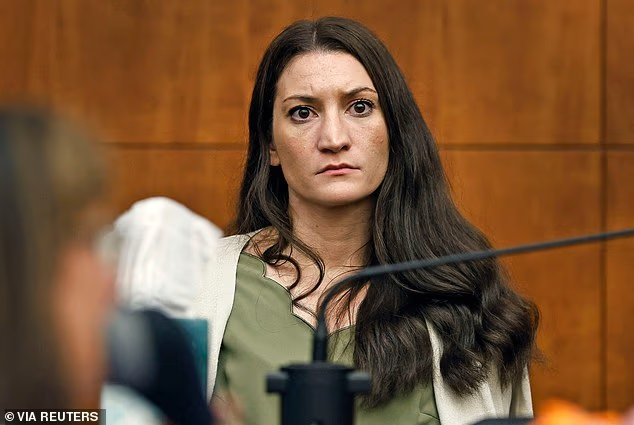
Lindsay Clancy‘s murder case was today declared a mistrial by the judge overseeing it after the jury remained deadlocked – leaving the mother facing another trial after strangling her three children.
In what was dubbed ‘America’s saddest trial’, Clancy, a 36-year-old former labour and delivery nurse from Duxbury, Massachusetts, was accused of murdering her three children, all under six years old, in January 2023.
The panel of 12, nine women and three men, deliberated for seven days but could not agree on whether Clancy is guilty of murder, manslaughter, or not criminally responsible for her actions.
A note from the jury read in court said: ‘It is with a heavy heart that we are unable to come to a unanimous decision and will not be able to.’
Judge William Sullivan told the jury they would be discharged, adding: ‘At this point, I’m going to declare that the jury is deadlocked, and I’m going to declare a mistrial’.
A status hearing has now been set for September 29, 2026.
The almost incomprehensible violence – the details of which were so disturbing that the accused spent much of the five-week trial in tears – and the difficult questions the case raised about postpartum mental health not only captivated America but made headlines across the world and sparked endless online debate.
However, prosecution and defence lawyers agreed on many issues including that Clancy carried out the killings – throttling five-year-old Cora, three-year-old Dawson and eight-month-old Callan with exercise bands – and that she was struggling with her mental health.
Instead, the trial hinged on the central question of whether she was ‘criminally responsible’ for the killings or whether she had a rare mental condition, known as ‘postpartum psychosis’, at the time of the crimes and so lacked the capacity to fully understand what she was doing.
Defence lawyers argued she was not guilty by reason of insanity and that her postpartum psychosis condition was exacerbated by ‘lousy medical care’. They said she killed her children in a state of psychosis because she heard a voice telling her to do it.
Lindsay Clancy, a 36-year-old former labour and delivery nurse from Duxbury, Massachusetts, was accused of murdering her three children, all under six years old, in January 2023

Clancy had cut her wrists and neck before jumping out of the window, falling some 20ft on to frozen ground
The prosecution rejected the notion that Clancy – now confined to a wheelchair after her fall left her paralysed – was psychotic at the time and insisted that she knew precisely what she was doing.
She is hardly the first mother to be tried for maternal infanticide – a crime considered so dreadful that for centuries it was always a capital offence – but the trial sparked a passionate debate about whether such women are criminals or victims.
The killings occurred less than three weeks after Clancy was discharged from a psychiatric hospital, and she became a cause celebre for some – mainly women – who argued that her plight highlighted public and health service ignorance about the seriousness of postpartum depression and psychosis.
Hundreds of Clancy’s supporters, dressed in pink shirts, would protest each day outside the court in Plymouth, Massachusetts, arguing that she should never have been put on trial at all. On social media, young mothers posted videos holding their babies alongside the caption, ‘Me too, Lindsay.’
She was also backed by work colleagues. Almost as soon as prosecutors announced they were prosecuting Clancy, a group of her fellow nurses set up an online group called LAOL, for ‘Lindsay’s Army of Love’, to coordinate support for her. Nearly 100 local women wrote to the judge, vowing to stand by her ‘in her darkest hour as we wish any other mother would do for us’.
However, others accused Clancy’s supporters of inserting identity politics into the tragedy and falling into the trap of assuming that, just because the idea of a mother killing her young children is so repellent, the accused must have been out of her mind when she did it.
Attitudes towards the case often divided down political lines – as so much else has in Trump’s America – with conservatives dismissing Clancy’s supporters as Left-wing zealots whose arguments, in seemingly putting her rights before those of her dead children, amounted to a thinly veiled pro-abortion campaign.
Clancy’s critics argued that, far from being driven to postpartum insanity, she had simply tired of the demands of bringing up three young children while trying to hold on to her nursing job.

The prosecution rejected the notion that Clancy – now confined to a wheelchair after her fall left her paralysed – was psychotic at the time and insisted that she knew precisely what she was doing

Clancy’s husband Patrick returned home on the night of the killings to find his wife lying barely conscious outside their house
Some online sleuths, who picked apart every detail of the televised trial, even advanced a bizarre conspiracy theory that Clancy’s husband, Patrick, actually committed the murders and then framed his wife.
Under Massachusetts law, the burden is on the defence to persuade jurors that, because of a severe mental disease or defect, Clancy lacked criminal responsibility at the precise moment the children were killed. Lawyers had predicted that this would be a challenge for her legal team.
The events of that fateful day, as relayed at the trial, certainly didn’t exactly smack of a woman who had lost control of her mind. On January 24, 2023, Clancy told her 36-year-old husband, who worked in software sales for Microsoft, that she’d had an exhausting day looking after the children so she hoped he didn’t mind going out on an errand. He just needed to pick up some children’s medicine and a takeaway dinner order as she’d been too tired to cook, she told him.
He was happy to oblige. But when he returned to their home in the well-to-do seaside town of Duxbury – locally nicknamed ‘Deluxebury’ – less than an hour later at around 6pm, he discovered the house was strangely quiet.
After going upstairs to find his wife, who he imagined was giving the children a bath, he discovered their second-floor bedroom door was locked and had to force his way inside. There was blood on the floor, a bloody knife on a bedside table and the room was chilly as a window had been left open.
He ran downstairs to find his wife lying barely conscious outside. She had cut her wrists and neck before jumping out of the window, falling some 20ft onto frozen ground. She told him she’d tried to kill herself, adding – when he asked – that the children were in the basement.
Patrick stayed by her side for the next ten minutes after dialling 911, convinced that she might die before the paramedics arrived.
Only when they turned up did he hurry inside to find the children in the basement. Cora and Dawson were pronounced dead that night while the toddler, who was airlifted to hospital, died a few days later.

The Clancys’ home in the well-to-do seaside town of Duxbury, Massachusetts, which is known locally as ‘Deluxebury’
Prosecutors portrayed Clancy as a perfectionist who was controlling when it came to managing the children’s lives, saying she acted with ‘deliberate, premeditated and extreme atrocity and cruelty’.
Assistant District Attorney Shanan Buckingham told the court that Clancy was the ‘classic overachiever – in school, in her personal life, in her nursing career’.
With her children, ‘food was planned carefully, sleep was scheduled to the minute’.
The prosecution outlined how the calculating Clancy carefully planned the killings, arranging for her husband to be out of the house. They said she was sufficiently compos mentis that day and she managed to take her daughter to a paediatric appointment in the morning.
They also said that she’d looked up the takeaway restaurant’s location online to calculate how long her husband would be gone, so she would have ‘the time and privacy needed to commit these murders’.
Clancy had previously Googled the phrase ‘ways to kill’, the court heard. And four days before the children died, their mother allegedly had searched the phrase ‘can you treat a sociopath’ on her phone.
Although prosecutors initially claimed that Clancy didn’t intend to kill herself and may have staged the cuts on her wrists and neck, at trial they argued she had been intent on suicide – only taking her children with her.
Motive was a particularly challenging issue for prosecutors given considerable evidence that she was a loving and devoted mother who’d never laid a hand on the children.

The Clancys with their children Cora, five, Dawson, three, and eight-month-old Callan
Assistant District Attorney Jennifer Sprague portrayed Clancy as selfish and disillusioned with motherhood, her perfectionist inclinations snapping under the combined pressure of a growing family and her determination to go back to her hospital job.
‘This was a woman who no longer liked the life she thought she wanted. It was getting harder and harder to control,’ Shanan Buckingham told jurors.
Her colleague, Sprague read out a note in court at an earlier hearing that Clancy wrote herself five months before Callan’s birth, in which she said: ‘I think I sort of resent my other children because they prevent me from treating Cal like my first baby… I want to feel love and connection with all of my kids.’
Online critics of Clancy also pointed to a post on a parenting forum in which she described middle child Dawson as ‘the most difficult human I have ever encountered’.
However, defence lawyers – and Clancy’s husband, who says he has forgiven her – countered that her behaviour had been severely affected by more than a dozen medications – some of them, such as Ambien, Prozac, Klonopin and Valium, very powerful – that she’d been prescribed over several months as she experienced depression, insomnia and intense anxiety.
Prosecutors argued that Clancy had extensive access to mental health care but kept changing doctors and didn’t always follow medical advice.
Clancy’s writings in the months before the children’s deaths became key pieces of trial evidence. Her diary entries described her feeling overwhelmed by caring for her toddler, experiencing ‘brain fog’ and being ‘desperate to get a mental break from taking care of everyone’.
The court heard she began seeking mental health treatment several months after Callan, her youngest, was born.
However, the trial heard that experts struggled to work out exactly was the cause of her condition, first diagnosing her with anxiety disorder and then saying she was bipolar.

A page from a notebook kept by Clancy which details the medication she was taking as well as her mental state
As her mental state worsened and she even mentioned suicide, she was diagnosed with severe depression, defence witnesses told the court.
‘This is a woman that did not get the medical treatment that she so deserved,’ said defence lawyer Kevin Reddington.
‘The government says that this is a situation that’s not a referendum on women’s having babies and having postpartum psychosis, postpartum depression, but it sure as hell is.’
But did she have postpartum psychosis, prosecutors questioned. The serious condition occurs in only about one or two of every 1,000 births. But even then, research suggests that, if untreated, there is only a 4 to 5 per cent chance of a mother killing herself or a child.
The condition usually strikes within the first few weeks following childbirth and symptoms, reflecting the sufferer’s drastic break with reality, including hallucinations, delusion, extreme confusion and paranoia. Experts say it requires immediate medical intervention and hospitalisation.
However, prosecutors emphasised that none of the doctors, nurses and psychologists who examined Clancy before the killings judged her to be manic or psychotic, so ill that she posed a danger to herself or her children.
In court, psychiatrists for both sides differed over Clancy’s state of mind when she killed her children.
Forensic psychiatrist Dr Phillip Resnick testified that she reported feeling an ‘external force’ take over her body before the murders. The court was told she had heard a ‘compelling and unrecognisable singular male voice’ telling her that ‘she should die, that this is her last chance and that her children would suffer if she was gone’.
But prosecutors pointed out that Clancy never told anyone else she was hearing voices. Meanwhile, psychiatrist Dr Avram Mack, who examined Clancy earlier this year, testified that he believed she was depressed but not experiencing psychosis at the time of the killings.
For some observers, there was also a question mark over why Clancy should be suffering from any sort of postpartum effects given she hadn’t just had a baby – her youngest was eight months old.
However, Dr Susan Hatters Friedman, an expert on postpartum psychosis and depression, told the Daily Mail the psychosis can be triggered later, for example by a mother cutting down on breastfeeding, thereby going through hormonal changes.
Even postpartum depression, which is far more common, can lead to homicidal tendencies when a self-harming mother becomes convinced that she has to take her offspring with her, she said.
Despite a mistrial being declared, the debate about whether a mother who murders her children is also a victim has hardly been settled.




























































You must be logged in to post a comment Login