I’ll just start here: I was late to the Takomo party.
I knew the name. I’d seen the irons. I’d seen them all over YouTube and Instagram. I knew Takomo was one of those direct-to-consumer brands that had managed to build a pretty serious following without playing by the traditional golf-equipment rulebook. But knowing about something and actually hitting it are two very different things. There are plenty of golf clubs I’ve looked at, read about and formed an opinion on before ever putting one behind a ball. Then you actually hit them and realize the opinion you had was based on absolutely nothing. Which, to be fair, is kind of how the internet works.
So when I finally got some time with the Takomo irons, I went into it with one question: What’s the catch? Because golf equipment has conditioned us to think that way. If an iron looks premium, feels premium and performs like the stuff hanging on the wall at your local golf shop, we generally expect the price tag to reflect it. That’s just how this has worked for a long time. Good golf equipment costs good golf-equipment money.
Takomo doesn’t really play that game. And after spending some time with the irons, I understand why people are paying attention.
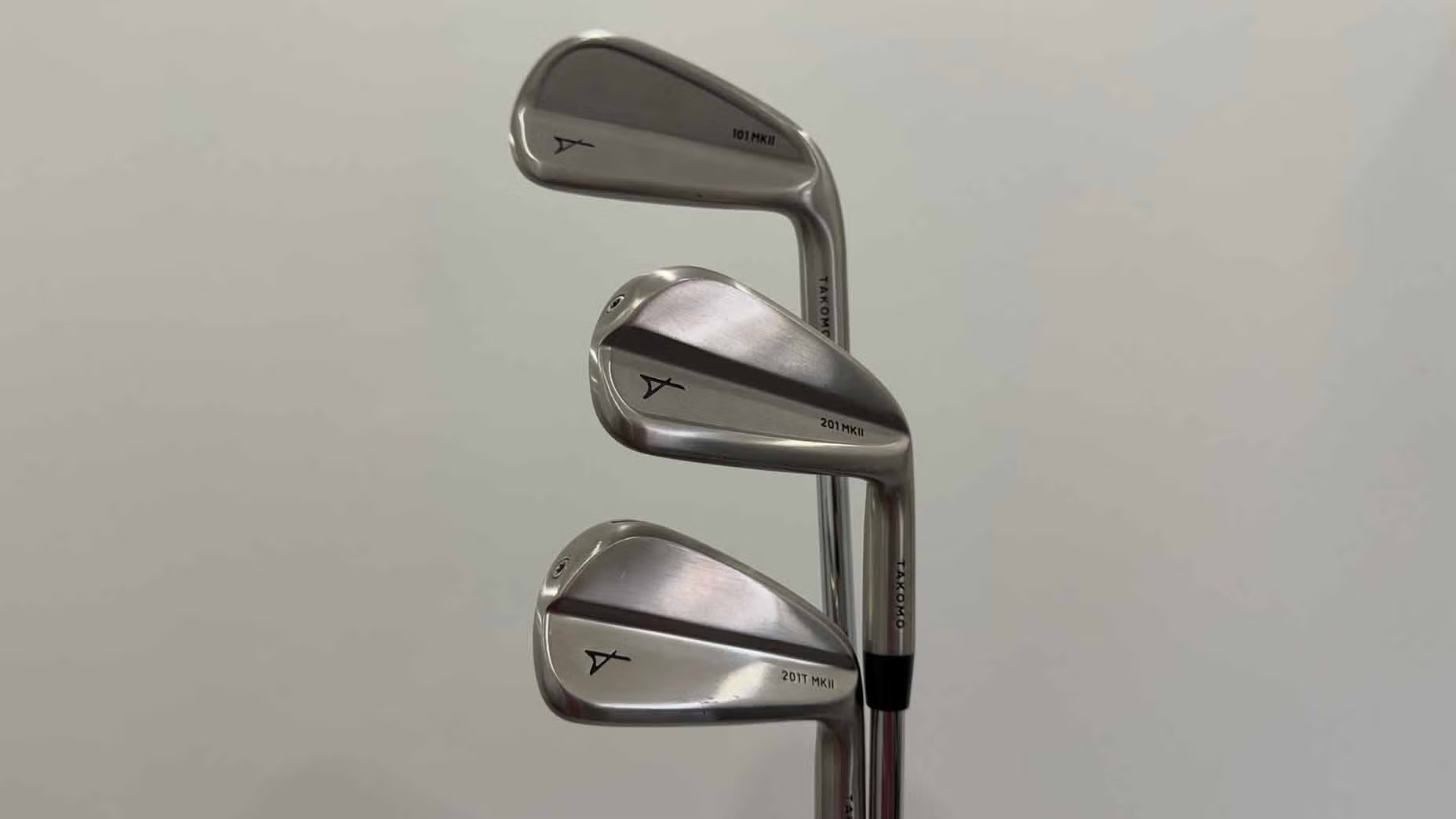
The first thing that got me was the way they look. There’s a tendency with value-driven equipment to grade the looks on a curve. You know what I mean: “It looks really good … for the price.” That little qualifier does a lot of work. I don’t think you need it here. Take the price completely out of the equation and these are just good-looking golf clubs. Clean. Simple. Not overly badged up. Nothing screaming at you from the cavity. There’s a restraint to the designs that I appreciate because, frankly, I don’t need my 7-iron to tell me its entire life story before I hit it.
At address, especially when you get into the more player-oriented models, there’s enough shape and detail there to make a golf equipment nerd start doing that little head nod. You know the one.
And looks matter more than we probably want to admit. Golfers are irrational creatures. Give us something that sits behind the ball and makes us feel confident and suddenly the swing feels a little easier. Put something behind the ball that makes us question every equipment decision we’ve ever made and, well, good luck. That’s science. Don’t fact-check me.
Then I hit them.
That’s where things got interesting.
The biggest takeaway I kept coming back to across the lineup was just how normal they felt. And I mean that as a compliment. There wasn’t some strange sound at impact. No funky sensation that made me wonder what exactly I had just hit. I wasn’t looking at the launch monitor wondering why my 7-iron had suddenly decided it wanted to be a 5-iron.
They just performed.
The 101 MKII is obviously the more friendly option of the group. There’s some real horsepower there, it wants to get the ball up, and there’s enough club behind the ball to give you some confidence without making you feel like you accidentally wandered into the super-game-improvement section.
That distinction matters. There’s a difference between an iron that helps you and an iron that makes you feel like you need help. The 101 is firmly in the first camp. If you want forgiveness, there’s forgiveness. If you need a little help getting the ball into the air, it’s there. And if you’re the kind of golfer who doesn’t spend his evenings looking at offset measurements and center-of-gravity locations on the internet, congratulations. You are probably having a much healthier relationship with golf than I am.
The reality is that golf is hard enough. There’s no prize for making the equipment harder.
Then you move into the 201 MKII and things get more interesting for the better player. This was probably the model where I started thinking, OK, Takomo isn’t just trying to win the value conversation.
The 201 MKII has that players-distance recipe golfers have become pretty familiar with. You get a cleaner overall package, there’s speed and forgiveness built into it, but visually it still looks like something I’d happily put behind the ball. Think P790. Think ZXi5. Think XF Max.
That category of iron is not easy to get right. You can make an iron fast. You can make it forgiving. You can make it look good. Getting all three to coexist without one of them taking over the conversation is where the good stuff happens.
Takomo can add itself to that conversation.
Then there’s the 201T MKII.
Now we’re speaking my language.
Smaller. Cleaner. More precise.
This is the one for the golfer who still wants to feel like he has some say in the conversation. You want to flight one down? Cool. Turn one over? Have at it. Hit a little cut into a tucked pin? Go ahead and make your day harder than it needs to be.
That’s probably what I liked most about the T. It doesn’t feel like Takomo is trying to make an iron for one very specific golfer. It feels like they understand that better players still want some help. We like to pretend we want complete control over the golf ball, but most of us would also like the club to bail us out every once in a while.
Hit it directly off the planet because you made an awful swing? Well, Takomo can’t fix everything. Nobody can.
And then you get to the part that really changes the conversation: the price.
As of this writing, Takomo lists the 101 MKII at $579, the 201 MKII at $649 and the 201T MKII at $679. For the set.
That is where this gets disruptive.
We’re living in a golf-equipment world where a premium set of irons can easily run north of $1,000. Get into the $1,400-ish range and nobody really falls out of their chair anymore. Somehow, spending the price of a very nice used car on eight golf clubs has become a relatively normal conversation.
So when you hit something that looks like this, performs like this and then see a price starting with a five or a six, you start asking a different question.
It’s no longer, “Are these good for a DTC iron?” It becomes: Are these just good irons?
For me, that’s the more interesting story.
I think the mistake is looking at a company like Takomo and immediately putting it into the “cheap golf clubs” category. Cheap and inexpensive are not necessarily the same thing. There’s a difference between cutting corners and finding a different way to get a product into the golfer’s hands.
That doesn’t mean there aren’t tradeoffs. There are.
The obvious one for me is the fitting experience. I’m a fitting nerd. I believe in getting the right shaft, the right length, lie, loft and overall setup whenever possible. There’s a real value in standing next to a good fitter, hitting balls and watching somebody who knows what they’re doing dial in the equipment around you. I’ve seen enough fittings over the years to know that the right setup can make a bigger difference than the name stamped on the sole.
That part hasn’t changed.
But not every golfer shops that way. Some golfers know their specs. Some have a pretty good idea of what shaft profile works for them. Some have been playing the same shaft for 10 years and have absolutely no interest in starting that conversation over again. And some people just want a really good set of irons without having to explain a $1,500 charge to their significant other.
For that golfer, Takomo starts making a lot of sense.
That’s ultimately what surprised me most. I expected to hit an inexpensive set of irons and walk away saying, “These are really impressive for the money.” That’s the compliment you expect to give something like this.
Instead, I walked away thinking: These are really impressive irons. And I’d recommend them to the right person.
The money just makes the conversation a lot more interesting.
Make no mistake, spending more money on golf equipment can absolutely get you more. The bells and whistles matter to a lot of us. The fitting process matters. Customization matters. Shafts matter. Grinds matter. The entire ecosystem around buying equipment has real value, particularly if you’re somebody who enjoys that part of the process as much as I do.
But there’s a huge section of the golfing population that doesn’t care about any of that. They just want to buy a set of irons, put them in the bag and feel good when they hit them.
Takomo speaks directly to those golfers.
And maybe that’s the part of this I underestimated. You don’t necessarily have to convince golfers that the traditional way of buying equipment is wrong. You just have to give them another option.
Then you have to make that option good enough that they start asking themselves why they should spend more.
That’s a much harder question for the traditional equipment companies to answer.
So, yeah.
I was late to the Takomo party.
I get it now.






















































You must be logged in to post a comment Login