


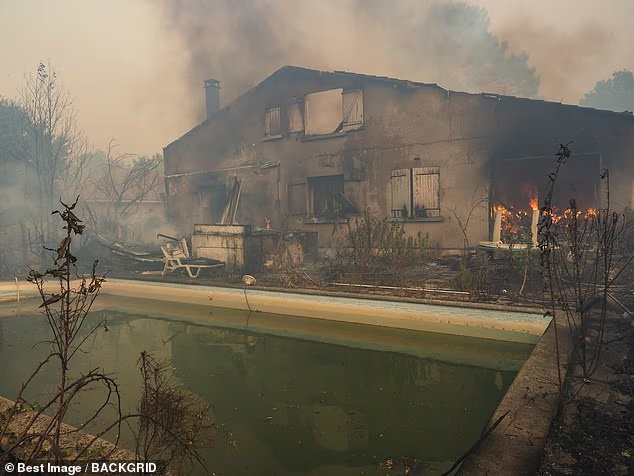
Luxury holiday homes are erupting in flames as desperate tourists flee down a single road off the ‘French Hamptons’ peninsula amid gigantic wildfires.
Lège-Cap Ferret in southwestern France is in the middle of a total evacuation with thousands of hectares of forest burning and sprawling villas going up in smoke.
The fires, which began on Tuesday in Saumos, Gironde, continued to burn overnight with 8,700 hectares (around 21,500 acres) consumed by the flames.
French Interior Minister Laurent Nuñez said 40,000 people had either been or were in the process of being evacuated from the upmarket Cap Ferret peninsula, which has the Atlantic on one side and the Bay of Arcachon on the other.
‘A total of 80 homes have burnt, around 50 of which have been completely destroyed,’ he told reporters.
A 90-minute drive from Bordeaux, the string of fishing villages is a popular destination for Paris’ elite, with miles of sandy beaches and windswept dunes.
But now, distressed tourists are anxiously fleeing the beloved getaway either on boats or by the only road linking the area with the mainland.
Residents have described the inferno as ‘mega-fire’ and ‘apocalyptic’, while French President Emmanuel Macron has requested urgent help from the European Union as the country’s growing battle against wildfires intensifies.
Pictured: The remains of a property in Lège-Cap-Ferret after a fire tore through the outskirts of the French commune

Lège-Cap Ferret in southwestern France is in the middle of a total evacuation with thousands of hectares of forest burning and sprawling villas going up in smoke

The fires, which began on Tuesday in Saumos, Gironde, continued to burn overnight with 8,700 hectares (around 21,500 acres) consumed by the flames
‘France has requested the activation of the European Union’s civil protection mechanism. We will soon be able to count on reinforcements from two Croatian Canadair aircraft, two Portuguese Air Tractor planes, as well as two heavy Black Hawk helicopters from the Czech Republic and Slovakia,’ wrote Macron on X on Friday.
Sophie Brocas, the prefect for the Nouvelle Aquitaine region, ordered the ‘final phase’ of the peninsula evacuation early on Friday morning.
People are being told to leave via the main D106 road towards Bordeaux while vessels were being made available for others between 7am and 10am local time (6am BST and 9am BST) from four piers.
Aircraft from Croatia, Portugal, the Czech Republic and Slovakia are on their way to assist in the emergency, which the local prefect has described as an ‘XXL fire’.
The Cap Ferret peninsula has a year-round population of just under 8,000 but that can swell by 10 times that number in peak summer season.
A firefighter was injured after a gas cylinder exploded in a burning house. Shocking footage shows the moment a reporter at the scene reacted to the blast.
Headmaster David Morton, 53, from Gloucester had been on holiday with his wife and sons when they received an emergency text alert overnight on Thursday telling them to evacuate.
They were staying in a house in Petit Piquey, along the peninsula, when they were jolted awake at 3am local time (1am GMT) by emergency texts and an alert on the property’s landline.
‘We got in our car, packed everything up as quickly as we could… and then set off and joined a very long, slow-moving queue of traffic,’ he told the BBC.
‘Everyone was driving with their lights on, driving very slowly – there was lots of fire service people, ambulances, police on the other side of the road controlling things and we could see several fires in the distance as we drove.’
As they drove past the blaze near Lège, Mr Morton described the inferno as ‘enormous’.
‘You could see the whole forest was on fire and that really brought it home what a major fire it was.’
He said the evacuation was ‘well-controlled’ with people being ‘very respectful and sensible’.
‘It’s different from seeing it on the television… seeing it blazing out of control despite hundreds and hundreds of firemen and women helping.’

Headmaster David Morton, 53, from Gloucester had been on holiday with his wife and sons when they received an emergency text alert overnight on Thursday telling them to evacuate
Some 20,000 people within the Gironde region had already been evacuated on Thursday, many of whom were visitors to campsites on the peninsula.
Patrick Martineau, a 69-year-old resident of Le Porge, south of Bordeaux, said: ‘The gendarmes came and knocked on every door, the fire was about 500 metres away – we grabbed some things and left.’
Further down the Atlantic coast, around the town of Biscarrosse in France’s Landes region, another major blaze that began on Thursday afternoon has triggered the evacuations of more than 23,000 people.
About 18,000 people in Biscarrosse and 5,000 in Parentis-en-Born had to flee from their homes, campsites, a nursing home and a summer camp.
Videos taken in Biscarrosse captured scenes of chaos, showing several cars rushing down roads to get away from nearing flames.
Separate footage showed horses frantically running down a street as a huge black cloud of smoke engulfed the town.
Minister of the Interior Laurent Nuñez said on Friday that the fire in Biscarrosse is ‘difficult to control’, adding that around 100 homes had been burned or damaged by the flames.
It comes as the Landes prefect, Gilles Clavreul, expressed concern due to the fire’s ‘exceptional intensity’, noting that the blaze had affected industrial areas, commercial zones and homes.
Some 550 firefighters were battling the Biscarrosse fire on Friday and received support from two Canadair water bombers.
Firefighters have also resorted to using bulldozers to ‘create lines of defence’, according to the local municipality.
Meanwhile, residents of a Biscarrosse care home have been evacuated to Dax.
The town’s mayor Julien Dubois on Friday welcomed evacuees in a Facebook post, saying: ‘As mayor of Dax, I want to tell our neighbours in the northern Landes region that they are not alone.’

Aerial view of the wildfire spreading toward Lège-Cap-Ferret, in Gironde, on July 23

Sophie Brocas, the prefect for the Nouvelle Aquitaine region, ordered the ‘final phase’ of the peninsula evacuation early on Friday morning

This handout satellite photograph taken on July 24, 2026 and released by 2026 Planet Labs PBC shows smoke rising from the wildfire in Le Porge and Lège-Cap Ferret

A fast-moving wildfire reaches the outskirts of Lège-Cap-Ferret after worsening weather conditions fuel its rapid spread

People are being told to leave via the main D106 road towards Bordeaux while vessels were being made available for others between 7am and 10am local time (6am BST and 9am BST) from four piers

Aircraft from Croatia, Portugal, the Czech Republic and Slovakia are on their way to assist in the emergency, which the local prefect has described as an ‘XXL fire’

The Cap Ferret peninsula has a year-round population of just under 8,000 but that can swell by 10 times that number in peak summer season

Lège is the only one of the peninsula’s 11 villages that is currently threatened by the fire
The Cap Ferret peninsula, often likened to the upscale Hamptons in the United States, is home to expensive properties where wealthy Parisians and Bordelais come to sip white wine and feast on oysters.
Lège is the only one of the peninsula’s 11 villages that is currently threatened by the fire.
The flames later reached the edge of Lège, forcing the evacuation of several campgrounds and neighbourhoods close to the forest.
Camper Elizabeth Carron said she was having dinner when she saw the flames.
‘The sky turned red. Black and red. Then little by little, we could smell it. There were ashes on the car, on the caravan, on my grandchildren’s little tent. Then two hours later, they advised us to leave.’
France’s southeast was also being hard hit, with dozens of fires flaring up and being fanned by the Mistral wind around the historic village of Cotignac.
Officials said around 25 houses had been destroyed since Tuesday.
Two firefighters died on Tuesday tackling another blaze near Bordeaux airport.
Skies over Le Porge turned orange as smoke rose from charred and crackling pine trees, while helicopters made repeated runs over deserted neighbourhoods.
Fires in 2022 damaged a massive area of the same forest, forcing around 50,000 people to flee.
The authorities said the fire had been contained on its northerly flank but was not yet totally under control further south.
EU crisis management commissioner Hadja Lahbib said Thursday that the bloc was providing three water-bombing planes to France.
In Spain, the government declared a state of emergency in the Madrid region, where more than 10,000 people have been evacuated in recent days.
Emergency services said alert messages had been sent to people in Aldea de Fresno, a town west of Madrid, ordering them to leave.
It is the first time such a measure has been taken due to a wildfire.
The last time Spain declared the same level of emergency alert was during a massive nationwide power blackout last year.
Eighteen firefighting units with specialist troops were working to contain the blaze near the city of Toledo, close to another wildfire that forced the evacuation of several villages on Wednesday.

Luxury homes are erupting in flames as desperate tourists flee down a single road off the ‘French Hamptons’ peninsula amid gigantic wildfires

A volunteer gives indication to holidaymakers from Lège-Cap-Ferret upon their arrival in Arcachon by boat during an evacuation operation of the entire Cap-Ferret peninsula

The order for a total evacuation of the area of Lège-Cap Ferret underlined the severity of the fire that has been burning since Wednesday

Screen grab of video showing several cars rushing down roads to get away from nearing flames

People watch smoke from the beach in Andernos-Les Bains during a fire in Lège Cap-Ferret forest

People in Lege Cap-Ferret watch as flames tear through a forest

One video on social media showed the moment horses ran away from incoming flames
Firefighters battled through the night, and most residents were allowed to return Thursday.
Hundreds of firefighters and troops were still struggling to contain a much larger wildfire in Guadalajara province, north of Madrid.
In Navaluenga in Avila province, residents wearing masks because of the smoke stood watching firefighting helicopters scoop up water from the town’s river late on Thursday.
Spanish Prime Minister Pedro Sanchez said on Friday morning that ‘Spain and neighbouring countries’ were experiencing a ‘dramatic situation’ due to the massive fires that spread simultaneously across western Europe.
‘The forest fires are ravaging thousands of hectares and affecting numerous towns and villages,’ the Spanish leader wrote on X on Friday.
He also urged Spaniards to ‘follow the instructions’ of officials.
‘Climate change is what kills, what destroys our villages and our natural and cultural heritage,’ civil protection chief Virginia Barcones told Spanish radio.
She warned some fires become so intense that, despite the deployment of aircraft and ground crews, firefighters stand ‘no chance’.
Barcones said conditions at the Guadalajara blaze were improving but that strong winds and extreme heat remained a danger.
Thousands of emergency workers in Italy battled scores of fires in Sicily and in the Calabria region, where a local official said arsonists had started fires by tying rags soaked in flammable liquid to the tails of stray cats to spread the flames.
Along with the stray cats, investigators found candles and delayed ignition devices
Domenico Costarella, of Calabria’s civil protection agency, said: ‘These animals were released into the fields, running around and spreading the fire.’

A water bomber drops water while fighting wildfires In Ares, western France, Friday July 24

The fire is said to have broken out Saumos on July 22 around midday before it moved toward Lège-Cap-Ferret

A couple carries a few belongings while evacuating a residential area during a wildfire near Lège-Cap-Ferret, southwestern France, on July 23, 2026

French President Emmanuel Macron has already requested help from the European Union as the country’s growing battle against wildfires intensifies

A firefighter douses a burned house at a residential area during a wildfire near Lège-Cap-Ferret, southwestern France, on July 23, 2026

A firefighter sprays water on a burning forest close to a residential area during a wildfire near Lège-Cap-Ferret

Residents in the department of Gironde watch as a massive cloud of smoke billows in the distance

Firefighters respond to a wildfire in Lège-Cap-Ferret in the Gironde department amid worsening drought conditions

Firefighters drive around a burning forest while monitoring a wildfire close to a residential area near Lège-Cap-Ferret

Across Europe, three heatwaves in succession this season have intensified drought, strained water supplies, and left vegetation tinder-dry, helping wildfires scorch more land

France’s southeast was also being hard hit, with dozens of fires flaring up and being fanned by the Mistral wind around the historic village of Cotignac. Pictured: A house devastated by a wildfire in Cotignac

Officials said around 25 houses had been destroyed in Cotignac since Tuesday. Pictured: A damaged property in the historic French village
The heat has also been blamed for thousands of deaths.
France has been particularly hard hit, with the intense heat pressuring its capacity to handle the situation.
‘Our security forces are engaged in a genuine battle against the wildfires,’ Interior Minister Laurent Nunez said on Thursday evening.
‘The nation stands with you.’ The pressure on fire departments in southwestern France has been increased by another wildfire that began on Thursday afternoon near Biscarrosse, just 25 miles south of Cap Ferret.
That fire, which is still not under control, has devastated 2,500 hectares, the prefect for the Landes area, Gilles Clavreul, said in a statement.
He added that fighting arson would take a ‘shift in mindset… These are inhumane acts. Sadly, men are their own worst enemies’.
One firefighter died after falling ill while battling the flames in Sicily, the interior minister said.
Across Europe, three heatwaves in succession this season have intensified drought, strained water supplies, and left vegetation tinder-dry, helping wildfires scorch more land than the annual average over the past two decades.

This screen grab from a video posted on the X account of Spain’s Military Emergencies Unit UME (@UMEgob) on July 23, 2026, shows UME personnel fighting a wildfire in San Martin de Valdeiglesias, Madrid

The Spanish government declared a state of emergency in the Madrid region, where more than 10,000 people have been evacuated in recent days

Hundreds of firefighters and troops were still struggling to contain a much larger wildfire in Guadalajara province, north of Madrid
‘Winds are blowing, and the situation remains highly dynamic and unfavourable,’ he said.
More than 23,000 people were evacuated from the Biscarrosse district, mainly in campsites and homes, and a children’s summer camp and a residential care home for the elderly were also evacuated.
He asked farmers to contribute with water tanks.
European droughts are now more severe, climatologists from the World Weather Attribution group said in a study published on Thursday.
The total area of land burnt so far this year in EU countries is the second largest on record, according to satellite data from the European Forest Fire Information System (EFFIS).















.png)













































You must be logged in to post a comment Login