Voters in the Greater Manchester constituency went to the polls on Thursday, with their decision having huge implications for Keir Starmer, the Labour Party, and the UK as a whole
Peter Hennessy UK & World News Editor and Adam Care
03:11, 19 Jun 2026
Results for the Makerfield by-election, in what could be one of the most decisive moments in recent British political history, have been announced.
Voters in the Greater Manchester constituency went to the polls on Thursday, with their decision having huge implications for Keir Starmer, the Labour Party, and the UK as a whole.
Advertisement
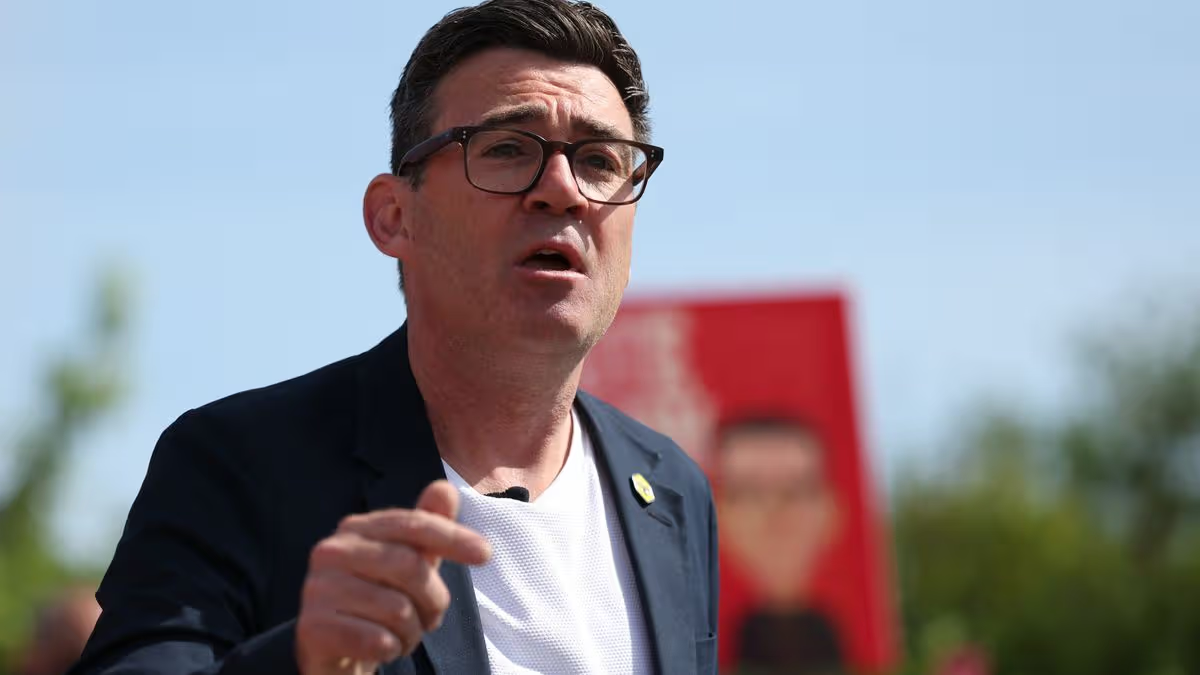
It was announced on Friday morning that Andy Burnham won the seat with 24,927 votes – Reform and Rob Kenyon finished on 15,696 votes.
The election was triggered by the resignation of Labour MP Josh Simmons, who stood aside to allow Andy Burnham, the mayor of Greater Manchester, the chance to return to parliament as an MP.
Burnham, who was previously barred by the Labour Party from standing in the recent Gorton and Denton by-election, which was won by the Green Party, was the favourite to win the seat.
However, he faced opposition from Reform UK candidate Robert Kenyon, a plumber and Wigan councillor who had faced criticism over historic social media posts.
In total there were 14 candidates contesting the seat.
Burnham previously served as MP for Leigh from 1997 to 2017, and was Culture Secretary and briefly Health Secretary under Gordon Brown.
He was elected Mayor of Greater Manchester in 2017, winning three terms.
Advertisement
Before polls opened, Prime Minister Sir Keir Starmer said he was willing to offer Burnham a “big” job in his Government, should he win.
However Burnham is widely expected to challenge Starmer for leadership of the Labour Party, and seek to replace him in No 10.
The Makerfield poll was one of the three parliamentary by-elections taking place today, with voters in two Scottish constituencies also selecting new MPs.
Advertisement
The contests in Aberdeen South and the Arbroath and Broughty Ferry constituency were triggered following the election of local SNP MPs Stephen Flynn and Stephen Gethins to Holyrood last month.
They were won by the Conservatives in Aberdeen South and held by SNP in Arbroath and Broughty Ferry.
The full list of candidates in the Makerfield by-election were (in alphabetical order by surname):
Jake Austin, Liberal Democrats
Count Binface, Count Binface Party
Andy Burnham, Labour and Co-operative Party
Dan Clarke, Libertarian Party
John Dyer, Independent
Ed Gemmell, Climate Party
Paul Gould, Independent
Alan ‘Howlin’ Laud Hope, The Official Monster Raving Loony Party
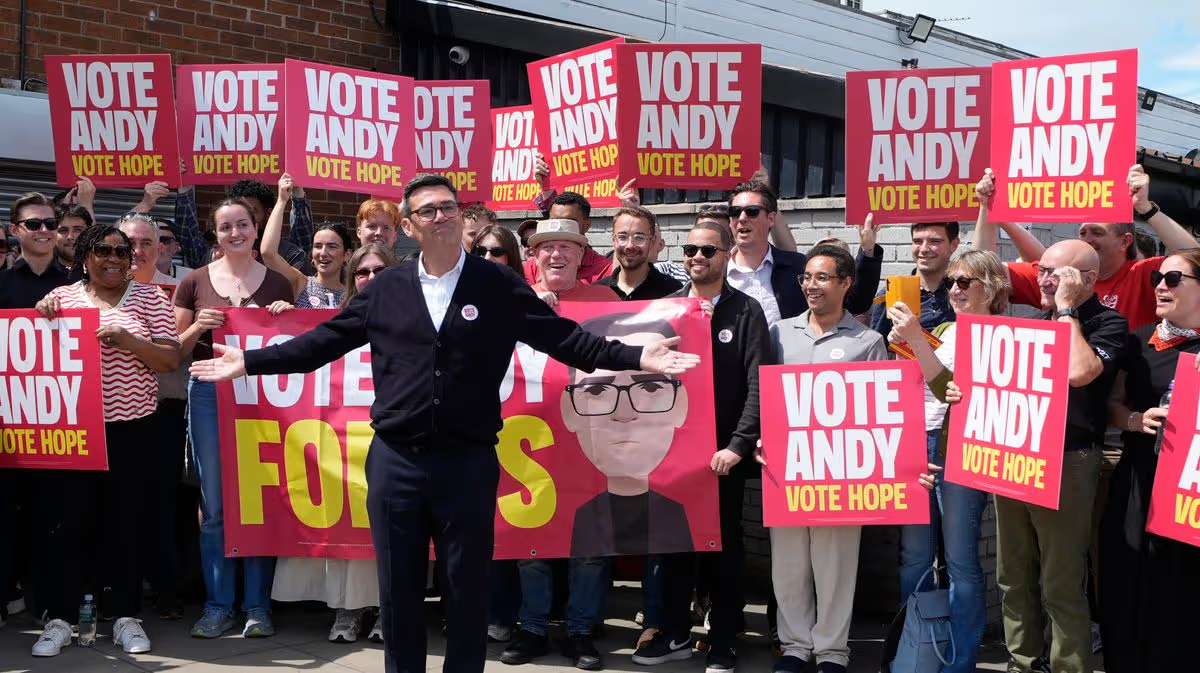
Labour’s Andy Burnham wins the Makerfield by-election, paving the way for him to challenge Sir Keir Starmer as Labour leader.
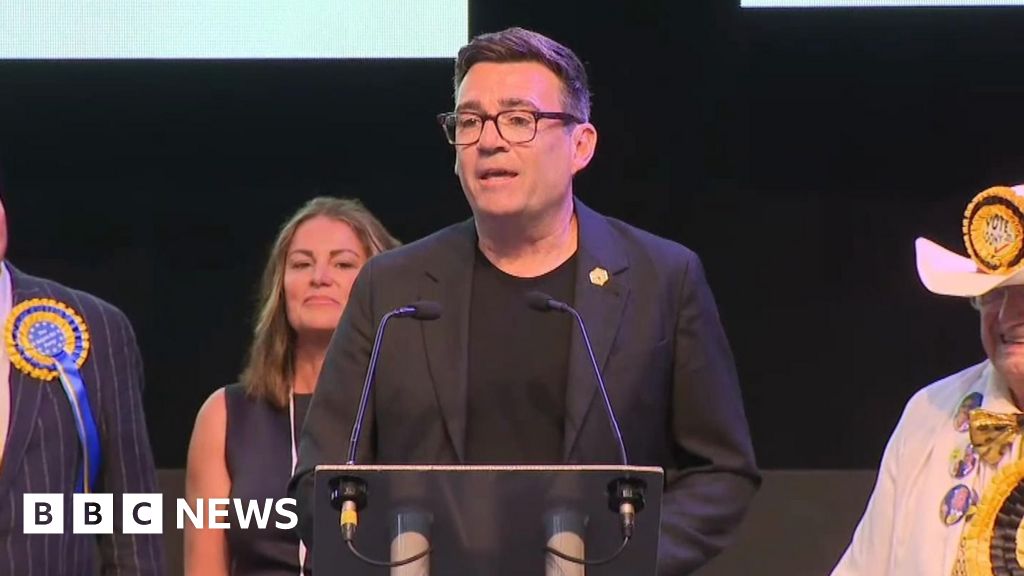
“Everyone knows that politics isn’t working,” he says in his acceptance speech. “Tonight could, just could, be the turning point”.
Burnham previously said he would seek to enter any Labour leadership contest – he would need the support of at least 81 Labour MPs to join the race.
The newly-elected MP for Makerfield, who held cabinet positions under Tony Blair and Gordon Brown, says he always knew he would seek to return to Westminster to “complete that unfinished business” so the north of England could fulfil its “potential”.
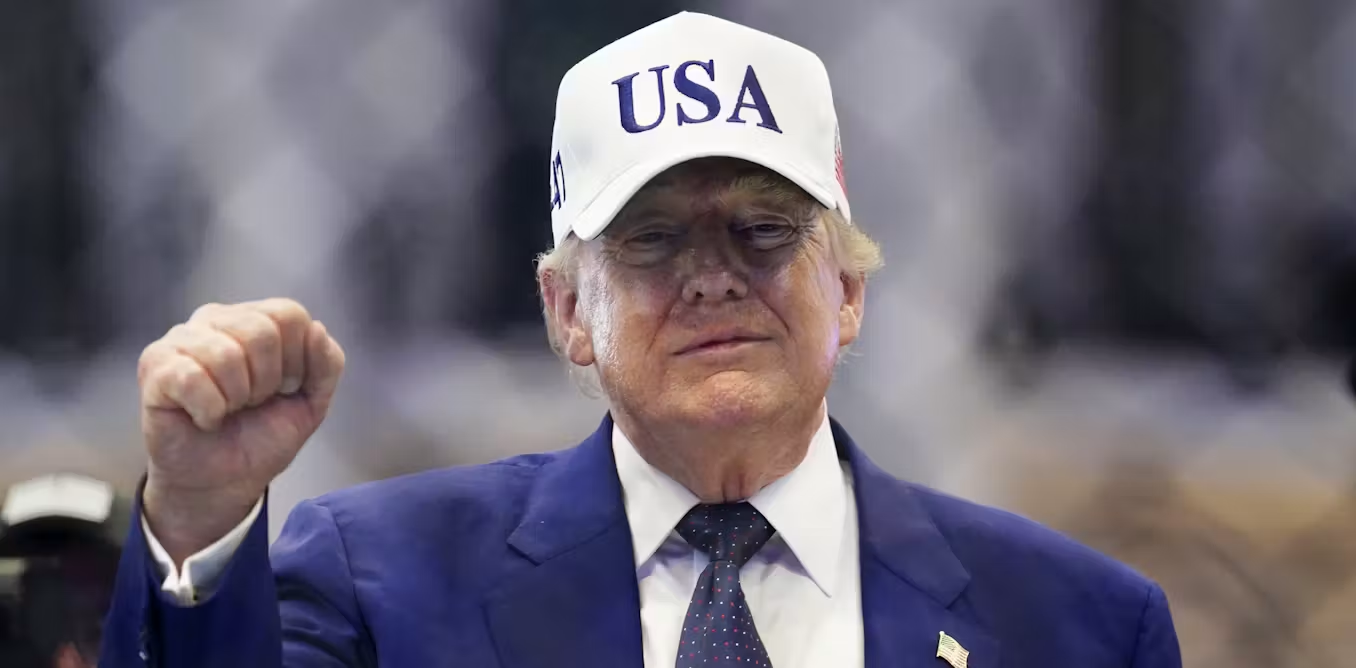
In his first term of office Donald Trump achieved the lowest average job approval ratings (41%) among Americans since the end of the second world war. In his second term he has fallen well below that with an approval rating of only 35% in a recent Economist/YouGov poll.
Much of this can be explained by voter perceptions of the state of the US economy. The chart below shows the relationship between the percentage of Americans who approve of the president’s handling of his job and consumer confidence. It covers almost 50 years of monthly data with the consumer confidence data coming from surveys conducted at the University of Michigan.
Presidential approval and consumer confidence in the US, 1978 to 2026
Sources: Gallup Poll archives and University of Michigan, Author provided (no reuse)
The two series track each other closely and so demonstrate a moderately strong relationship with a correlation of 0.44 (If they were unrelated the correlation would be 0 and if they were exactly the same it would be 1). In both cases higher scores denote greater approval and increasing consumer confidence. This confirms the well-known fact that the state of the economy is a big driver of presidential approval.
If we look closely at the consumer confidence index, the average score over the entire period was 84. In the late 1970s Jimmy Carter had low and falling approval ratings and consumer confidence scores. This goes a long way to explaining why he was a one-term president who lost to Ronald Reagan in the 1980 election.
A decade later, when Republican George HW Bush was president between 1989 and 1993, consumer confidence plummeted as an official recession in the US economy was declared in July 1990, leading to declining growth and rising unemployment. The Federal Reserve, which is responsible for US monetary policy, exacerbated a weak financial situation by raising interest rates in order to combat inflation. The result was that Bush senior became another one-term president and lost the 1992 election to his Democrat rival, Bill Clinton (whose campaign motto was famously: “It’s the economy, stupid.”).
However, the largest fall in consumer confidence over this period occurred after the financial crash of 2007-2008, which in turn produced a serious recession and rapidly declining consumer confidence. On this occasion George W Bush was in his second term as US president and his collapsing approval ratings paved the way for the victory of Barack Obama in the 2008 presidential contest.
Advertisement
Finally, when Donald Trump won the presidential election in November 2016, consumer confidence was relatively high. In January 2017 at the time of his inauguration the consumer confidence index stood at 99. Four years later in January 2021 when Joe Biden was inaugurated as president the index was at 79, a dramatic decline in historical terms.
The midterm elections for the House and the Senate take place in November this year and currently things do not look good for the Republicans. Pollsters have been asking what is called a “generic” question in their surveys about who respondents would vote for if the midterm elections took place today. They are virtually unanimous in their agreement that the Democrats will win control of the House of Representatives. In addition, it is possible, though less likely, that the Democrats will win control of the Senate.
A thought experiment
An interesting thought experiment is to suppose that we were looking at a presidential election in November rather than the midterms. What light does the current consumer confidence data throw on such a hypothetical election?
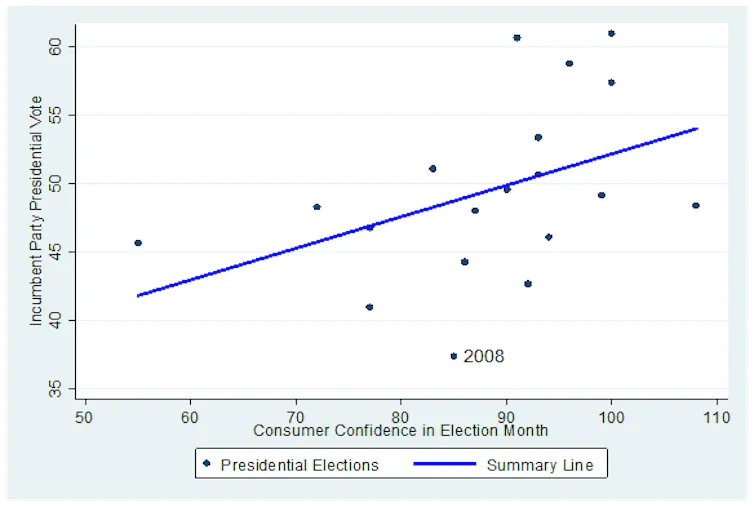
The second chart shows the relationship between voting for the incumbent’s party in the 19 presidential elections since 1978 and consumer confidence in the month of these elections.
Advertisement
Incumbent vote shares and consumer confidence in presidential elections since 1978
Sources: Gallup Poll archives and University of Michigan, Author provided (no reuse)
Once again, the relationship is moderately strong between the two series with a correlation of 0.43. Voters reward or punish the incumbent president or his party’s candidate depending on how they feel about the economy. As we observed in the first chart, the consumer confidence score was at its lowest at 55 in the 2008 election which Obama won. But the score on the index in June 2026 was 49, so – if consumer confidence continues to fall – then in a hypothetical presidential election in November Trump would lose very badly.
This is a thought experiment rather than a prediction of what is likely to happen in the presidential election of 2028. But when the war in the Middle East launched by the US and Israel threatens to produce a global recession it seems unlikely that consumer confidence in the US will improve any time soon.
Trump will not be on the ballot in 2028. But the Republican candidate in that election is likely to take a historical beating if the US and world economies do not improve in the meantime.
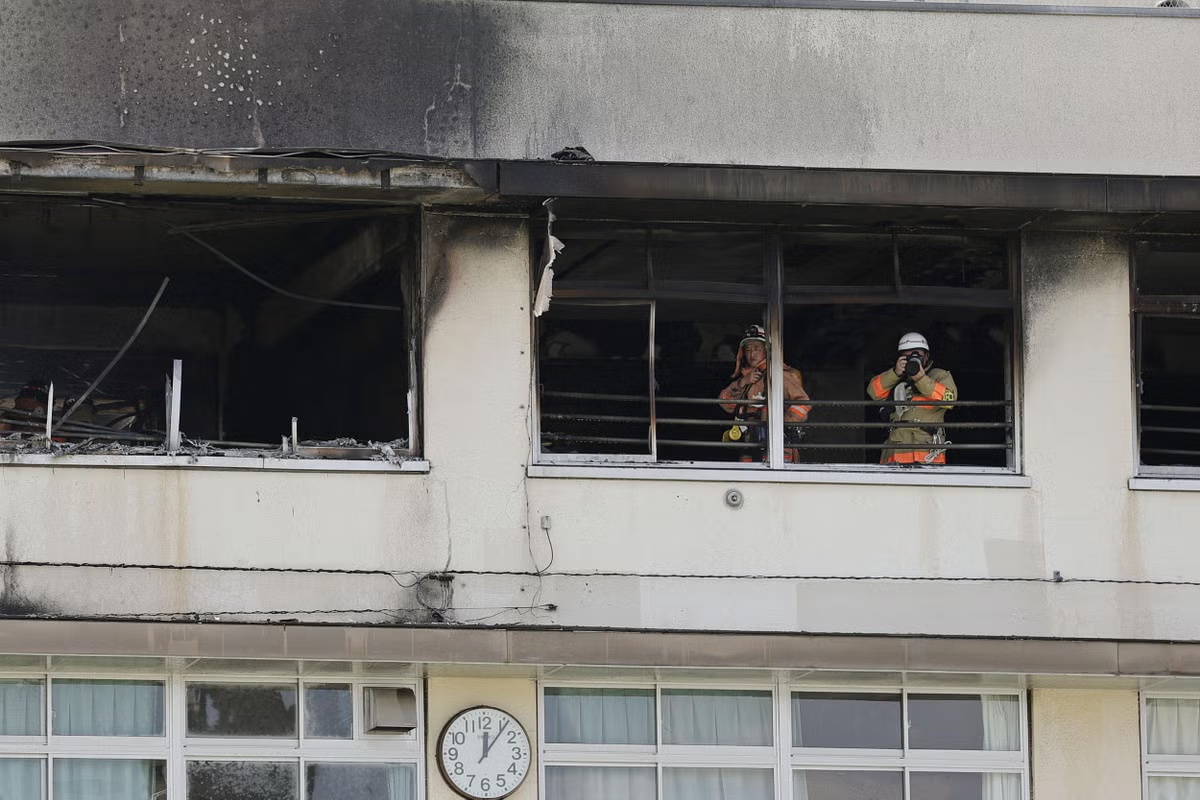
A fire broke out at an elementary school in downtown Tokyo Friday, but all of about 300 students and teachers were evacuated or rescued, officials said.
The Tokyo Fire Department said the fire at the Takinogawa No. 3 Elementary School broke out near a music room on the top floor of the four-story building late morning Friday.
Firefighters rescued one teacher and several schoolchildren out of the building, with non-life-threatening injuries, the department said.
Television footage showed black smoke billowing out of windows on the fourth floor, as firefighters combated the fire at the scene. Dozens of fire engines were deployed.
Advertisement
All others inside the building when the fire broke out had evacuated to a nearby park on their own and no one was left behind, officials said.
The cause of the fire is still under investigation.
Andy Burnham is heading back to Parliament after winning the Makerfield by-election.
The newly elected Labour MP easily beat Reform UK candidate Robert Kenyon.
It marks the end of weeks of campaigning in the constituency based south of Wigan, and the start of the next political race in Greater Manchester for Andy Burnham’s old job as mayor.
Click here for the latest on Greater Manchester’s politics in our newsletter
Advertisement
Becoming an MP disqualifies Burnham from being Greater Manchester mayor, so a replacement needs to be found for the region’s top political job.
That means another by-election is about to take place, with voters across Greater Manchester choosing the next mayor.
It is set to be a massive operation, with 2.1 million people registered to vote in the contest, and around 400,000 expected to do so by post.
Ahead of the crucial race, the Manchester Evening News takes a look at what happens next and when the mayoral by-election will be held.
Advertisement
What date will the by-election for Greater Manchester mayor take place?
The Greater Manchester Combined Authority (GMCA) has confirmed July 30 as the date for the mayoral by-election. The GMCA’s returning officer, Caroline Simpson, told the Manchester Evening News earlier this month: “If the Makerfield by-election result triggers a mayoral by-election, Greater Manchester will be legally required to hold a by-election within 25-35 working days.
“To ensure we are ready, we have identified July 30 as the date which will allow the maximum number of people to vote, whether in person, by post or by proxy.
“This will avoid holding an election during the peak holiday period in August and will mean that postal votes will arrive just before, or only a day or two into, the school holidays.
“While Greater Manchester’s returning officers are very experienced at running elections, the lead time for a mayoral by-election would be shorter than for a scheduled poll.
Advertisement
“So, following legal advice, and with support from government and the Electoral Commission, we have begun essential preparation work such as booking polling stations. We are doing this in advance of, not in anticipation of, the Makerfield by-election outcome on June 19.”
The by-election touches all corners of Greater Manchester, so expect to see candidates campaigning across all ten boroughs of the city-region.
Counting for mayoral elections usually takes place the day after polling day, so the result should be known by Friday, July 31.
What voting system will be used?
The government has just changed the voting system for how mayors are elected.
A system called supplementary voting will be used to elect Greater Manchester’s next mayor, rather than the previous first-past-the-post method.
The change came into force on June 18 after passing through Parliament wrapped up in the English Devolution and Community Empowerment Act.
Advertisement
It could have a huge impact on deciding who becomes the next mayor of Greater Manchester. Voters choose a first and second preference among candidates in supplementary voting.
If no candidate gets 50 per cent of vote in the first round of voting, a second round of voting is held between the two candidates with the most support.
That’s the stage where secondary votes are added and could flip the entire result on its head.
One potential scenario could see party A win more votes in the first round of voting, but still go on to lose the mayoral by-election if party B picks up more second preference votes in round two.
Advertisement
Reform UK said earlier this week that the change was a ‘cynical attempt’ to sway the race in Labour’s favour. Labour didn’t comment when asked about the claims from Reform.
The change in voting system was debated in the House of Lords on June 16.
Lord Hayward, a Conservative, said: “Let us be honest about this order. It is not normal to identify who would be affected by a particular change of law, but this order is an attempt to prevent Reform winning the possible Greater Manchester mayoralty by-election.
“There is no other justification for the haste with which this order has been introduced, other than that it solves the Labour Party’s problems and prevents Reform winning a mayoralty.”
Advertisement
Baroness Taylor of Stevenage, for Labour, responded: “The Government were very clear during the passage of the English Devolution and Community Empowerment Act that we intended to make this change for mayoral and PCC elections after May 2026. There is now the potential for such an election; I will come on to more about that in a moment. We are therefore acting to deliver on our commitments made to Parliament.”
What happens next?
Political parties will choose their candidates to stand in the mayoral by-election before campaigning begins.
The rumour mill about who could stand for each party has already kicked in, with names being suggested by sources. Official announcements and campaign launches are expected to happen in the next few days.
What follows will be weeks of campaigning to try and convince voters to back their various visions for Greater Manchester.
Advertisement
The scale of the by-election means parties will be out and about across the region, from Wigan to Stockport and everywhere in between.
Whoever wins the race will be handed one of the most important political jobs in the country, running Greater Manchester.
The mayor of Greater Manchester has a huge range of responsibilities, from deciding the transport budget for the region from government, including over the future of bus services, to being the public’s voice on policing matters, and being in charge of funding for housing and regeneration schemes.
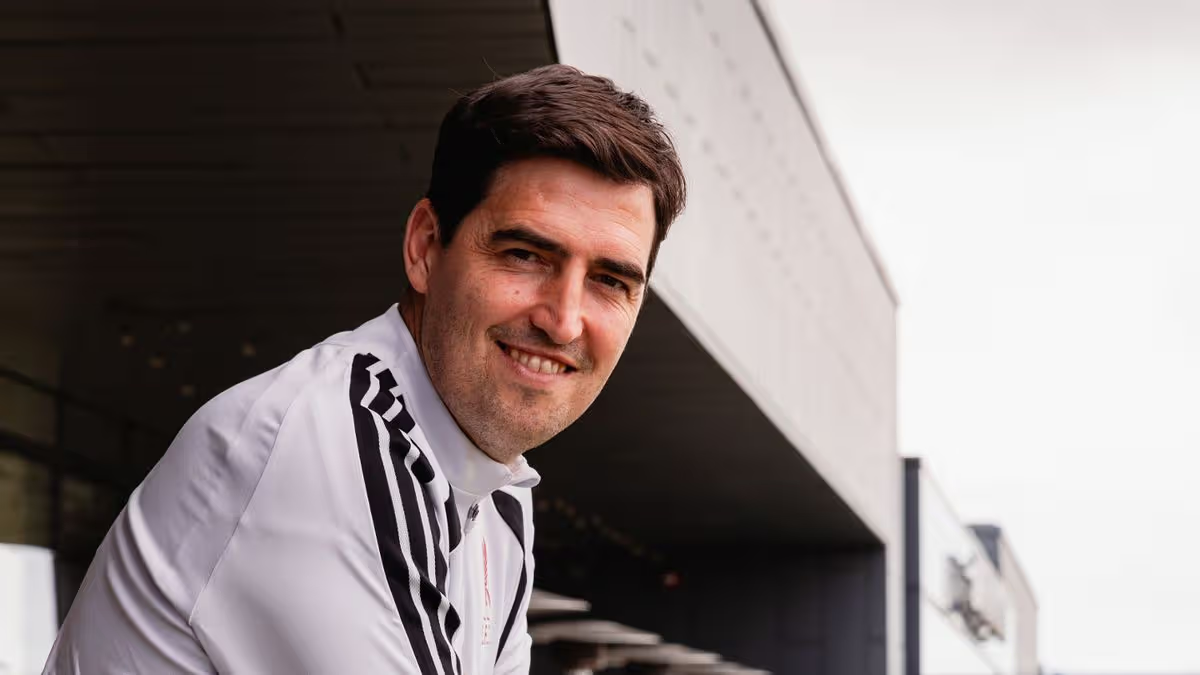
Andoni Iraola and his Liverpool team face a big season after the Basque coach took over from Arne Slot but transfer progress is being made
Liverpool will discover their Premier League fixture schedule on Friday, bringing their summer transfer plans into sharp focus. The Reds are embarking on a first window with Andoni Iraola at the helm and have already been busy.
Advertisement
Jeremy Jacquet became the Reds’ first new arrival, with a move from Rennes agreed long before Iraola agreed to replace Arne Slot in the dugout. Victor Munoz looks to be next and there is plenty to say about the pursuit of the young Spaniard.
There have also been a number of departures, with out-of-contract pair Andy Robertson and Ibrahima Konate finding new clubs. Robertson’s move to Tottenham was confirmed before the transfer window opened, while Real Madrid confirmed on Thursday that they would add Konate to their ranks for the 2026/27 season.
Today, though, our attention has turned to potential incomings before Liverpool begin their pre-season campaign in July. Here are our latest lines from around Anfield.
According to reports in Spain, Liverpool’s move for Osasuna star Victor Munoz includes a sell-on clause. However, it doesn’t relate to the Pamplona club but rather to Real Madrid.
Los Blancos were reportedly paid around £4.3m by Osasuna for 50 percent of Munoz’s rights in 2025, with Madrid also enjoying a buy-back clause. Liverpool are reported to have approached Jose Mourinho’s side to ensure they didn’t use the clause to re-sign the 22-year-old forward.
Liverpool are also understood to be paying Munoz’s £34.7m release clause in full but allowing Real Madrid to retain an unspecified buy-back clause which they could use in 2027. The fee paid between for the youngster will be split between the two Spanish clubs.
Advertisement
Reds pip Newcastle again
A move for Munoz would see history repeat itself. Newcastle United had also been pushing for the Spaniard but their failure to immediately meet his release clause has allowed Liverpool to enter the chase.
It’s an all-too-familiar situation for Eddie Howe’s side. Last summer, the Magpies made an early push for Hugo Ekitike at the start of the summer window only to see the Frenchman move to Anfield.
Newcastle also saw star striker Alexander Isak move to Liverpool on deadline day and looked as though they would also lose out to the Reds for defensive target Marc Guehi. Ultimately, though, Guehi’s move to Anfield fell through and he ended up joining Manchester City midway through the season.
Join our LFC WhatsApp community and get all the latest LFC news, views, transfer gossip and more, as it happens We also treat our community members to special offers, promotions, and adverts from us and our partners. If you don’t like our community, you can check out any time you like. If you’re curious, you can read our Privacy Notice.
Advertisement
Get Liverpool’s new 2026/27 home kit
This article contains affiliate links, we will receive a commission on any sales we generate from it. Learn more
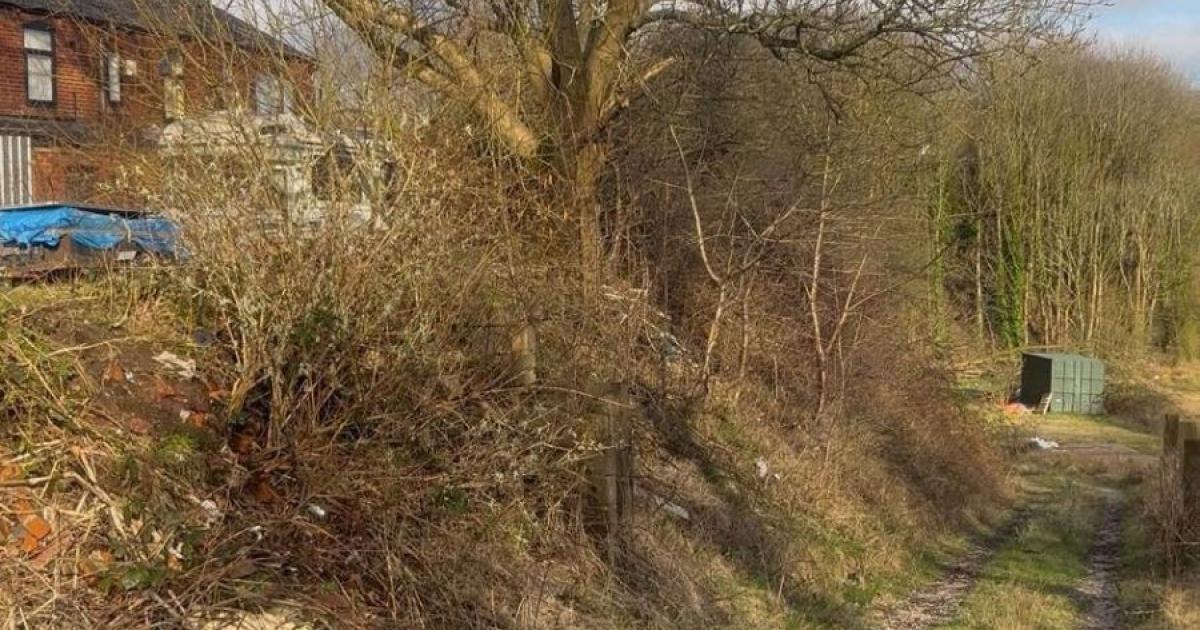
It was the property’s designation as ‘affordable’ that swung the vote in their favour, with several councillors noting the importance of affordable housing in the Bolton area.
Also important was the fact that Bolton cannot demonstrate a five-year housing supply.
A range of houses have been proposed (Image: BTP Architects)
The council officer noted: “The benefits of the development demonstrable outweigh the potential harm, and therefore we recommend the development should be approved.”
Advertisement
Cllr Martin Donaghy – who is not on the planning committee himself – came to the meeting to oppose the plans as a representative of his ward Tonge with the Haulgh.
Cllr Donaghy said: “The wildlife on the site will be significantly disturbed and lost.
“Access to the site is on the narrow Colenso Road and Bury Road. The residents of my ward asked me to come before you and ask that you reject the application.”
The plans aim to build 30 new houses over the land (Image: Newsquest)
A representative of Be One Homes said: “We are very pleased to be partnering with local developers Forshaw to create these properties.
Advertisement
“We are looking to deliver 50 per cent of the properties under a social rent scheme. So far we have had over 1400 expressions of interest in the properties.”
Councillors then had a chance to ask questions to the planning officer Jodie Turton.
Cllr John McHugh asked: “Are there any waterways next to the area that have been contaminated? Will the new trees that are planted in the area have TPOs on them?”
The planning officer said: “The land used to be the site of a bleachworks. And no, the trees will not immediately have tree protection orders on them when they first go in – this can only be done at a later date.”
Advertisement
Cllr Glen Clarke said: “What measures are being taken to protect the waterways?”
The officer said: “The environment agency have asked us to monitor the construction process sure that no pollution goes into the waterways as a result of it.”
The plans will go to a vote at town hall (Image: BTP Architects)
Cllr David Grant made a statement: “I think what is important is that it is 100 per cent affordable housing. There is a huge need. I don’t see anything in the reports that would warrant refusal.
Cllr McHugh agreed: “I think the key thing is that it is affordable.
Advertisement
I think it sad that a community is affected by this, but it is the key that it is affordable. I second the motion to approve.
The planning committee then voted to approve the application.
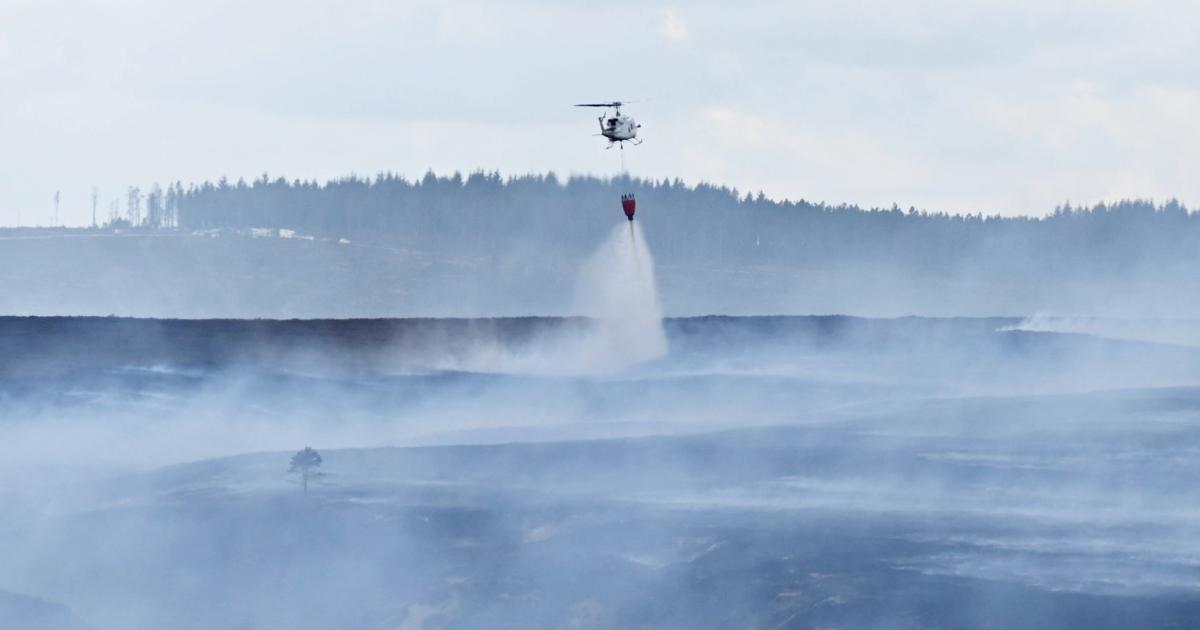
The report provides a clear review of how last year’s Fylingdales Moor/Langdale End wildfire was handled, based on operational data, decision records and feedback from staff involved.
The wildfire happened in summer 2025 and required a long, coordinated response involving many organisations working together. At its peak, it affected a large area (over 20km) of moorland and forest.
The report provides a clear review of how last year’s Fylingdales Moor/Langdale End wildfire was handled, based on operational data, decision records and feedback from staff involved.
The incident was particularly complex as the fire occurred in a remote area with limited water supplies and difficult access.
Parts of the site had previously been used as a military training range, meaning crews also had to work around the risk of unexploded ordnance.
Advertisement
Despite these challenges, there was no loss of life, no serious injuries and no damage to homes. Critical infrastructure at RAF Fylingdales was also successfully protected.
The report highlights several key strengths, including teamwork between more than 30 partner organisations, successful protection of communities, homes and infrastructure and clear command structures and use of specialist wildfire expertise
It also sets out where improvements can be made, including enhancing wildfire pre-planning and sharing of wildfire and other risk information, strengthening resilience for long-running incidents
and developing scalable welfare and support for staff over extended periods
Advertisement
(Image: North Yorkshire Fire & Rescue Service)
Chief Fire Officer Jonathan Dyson said: “I would like to take this opportunity to again thank our staff, partner agencies, other fire and rescue services, landowners and farmers and local communities for the support they provided both during the incident and since.
“This debrief provides a clear account of our response to one of the most significant wildfire incidents we have faced. It highlights what worked well, but also where we need to improve, so we can continue to strengthen how we prepare for and respond to incidents of this scale.
“Since the incident, we have already taken steps to strengthen our safety messaging working more closely with partners. We have also improved our ability to operate in remote areas by developing new water supply arrangements with farmers and we are working with landowners and partners through a North Yorkshire Fire Operations Group to improve coordination and shared understanding of wildfire risk.
“The remaining areas identified in the debrief will be taken forward through a structured improvement programme to ensure learning is fully embedded and put into practice.”
Advertisement
David Skaith, Mayor of York and North Yorkshire said: “The Langdale wildfire was a defining moment for our region, highlighting both the scale of the challenge we face and the importance of being prepared for it.
“Jo and I have spoken to businesses and landowners in the area and understand the impact they still face. This was a truly North Yorkshire response and I will always be in awe of the bravery and commitment of our firefighters, farmers, landowners and everyone that came together to tackle this unprecedented incident. We are seeing the impact of more extreme weather in the countryside, our communities, and our economy. Incidents like this reinforce the need to think long-term about resilience, how we manage our land, how we support our emergency services, and how we work together to reduce risk.
(Image: North Yorkshire Fire and Rescue Service)
“This debrief helps build that bigger picture. It’s not just about learning from one incident, but about shaping how we respond to a changing environment. I will continue to work with partners and government to ensure North Yorkshire has the recognition and investment it needs to meet these challenges head-on.”
Jo Coles, Deputy mayor for policing, fire and crime said: “This was one of the most significant incidents North Yorkshire Fire and Rescue Service has ever faced, and I want to once again recognise the extraordinary efforts of fire fighters, partners such as farmers and landowners as well as the local community whose combined effort was instrumental in tackling this extraordinary fire. It’s vital that lessons are learned following an incident on this scale so that we can improve the prevention and protection work that will keep people safe from future risks across the county – this debrief is a crucial part of that process. The work to improve prevention of future wildfires is already underway and I will continue work closely with Mayor David Skaith to hold the fire and rescue service to account for those changes on behalf of the public.”
Advertisement
The report can be read in full at Fylingdales Moor/Langdale Wildfire – North Yorkshire Fire & Rescue Service
The Holywood man wanted more after moving to three under with a fabulous eagle five holes from home
21:30, 18 Jun 2026Updated 21:39, 18 Jun 2026
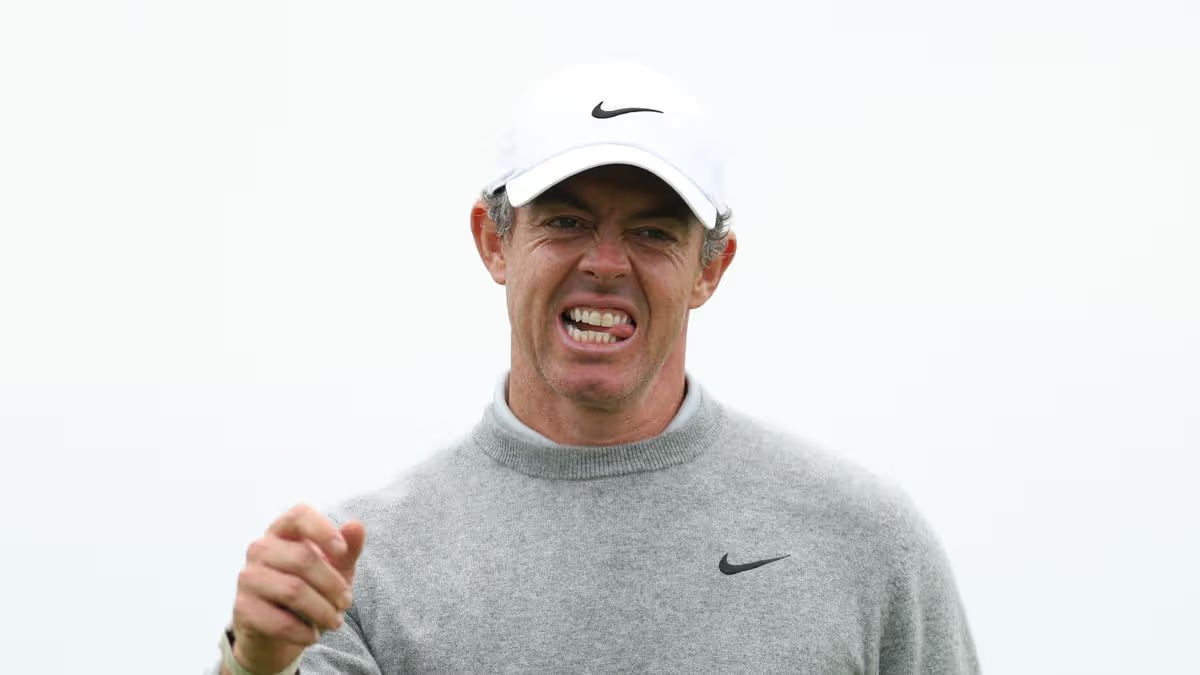
Rory McIlroy was left frustrated after dropping two shots at his last two holes – but he still managed to break par at Shinnecock Hills to lay the foundations for a shot at a second Major of the season.
On a day of toil for most of the field at one of world golf’s toughest courses, the Masters champion squeezed out a one-under-par opening 69.
He wanted more after moving to three under with a fabulous eagle five holes from home but he walked off the course only one stroke adrift of surprise clubhouse leader Sam Stevens.
Advertisement
It is certainly a distinctly better start than McIlroy made the last time the US Open was held at Shinnecock Hills in 2018. On that occasion he shot 80.
“With the conditions today, anything around even par is a good start. It was a day to keep yourself in the tournament and not shoot yourself out of it which is exactly what I did eight years ago,” said McIlroy.
“It was really about minimising mistakes and for the most part I did that today.
“It’s a challenging golf course as it is but when you put 30 mph wins on top of that it tests the best.
Advertisement
“It’s so hard, it’s so difficult. I didn’t think I hit two bad iron shots but I couldn’t get up and down.
“Overall a really good day.”
Links-like in its looks and murderous in its intentions, Shinnecock has the capacity to ruin golfers. So it was a case of keeping out of the trouble that lay around every corner for McIlroy and he did so in hitting ten out of 14 fairways in the wind.
It is not the sort of golf he would once have been capable of. These days though he is a man for all seasons.
Advertisement
The fireworks at the fifth – his 14th hole of the day – saw him post a three after a booming downwind drive of 396 yards.
After that the errant approaches to eight and nine which cost him bogeys late on were a disappointment.
Under par though at Shinnecock Hills is a great place to be.
In the five previous US Opens held at the New York course a grand total of three players have finished the championship in red numbers. It is that hard.
Advertisement
A two-hour fog delay early on pushed back tee times but when McIlroy’s turn eventually came he made a flying start with birdies at two of his first three holes.
He gave them back after being caught up in the rough at the 13th and par-five 16th but made his move with a birdie at the third after a glorious approach to two feet.
With the wind at his back he ate the 597-yard fifth alive, holing out from 11 feet for his three before his slips late on
McIlroy’s playing partners Ludvig Aberg and Tommy Fleetwood also made solid starts. Aberg also shot a 69 while Fleetwood – runner-up to Brooks Koepka in the 2018 US Open – produced a fightback late on with back-to-back birdies to card a 70
Advertisement
Tyrrell Hatton, who won on the LIV tour at Valderrama earlier this month, double bogeyed his final hole to sign for a 74.
Northern Ireland’s Graeme McDowell, playing his first Major for six years, unravelled after a promising start to shoot a 76.
Canada, 40 years after playing in their first World Cup, secured their first-ever win at the tournament in emphatic fashion, thrashing Qatar 6-0 in front of a packed and loud Vancouver Stadium.
They are almost certain of a place in the last 32. But celebrations were overshadowed by a dreadful injury to Ismael Kone.
The incident happened eight minutes into the second half, with Canada leading 3-0. Their former Watford midfielder Kone, shortly after receiving the ball, was caught late and badly by Assim Madibo as he challenged for possession.
Advertisement
Kone’s reaction, and that of the players around him, said it all.
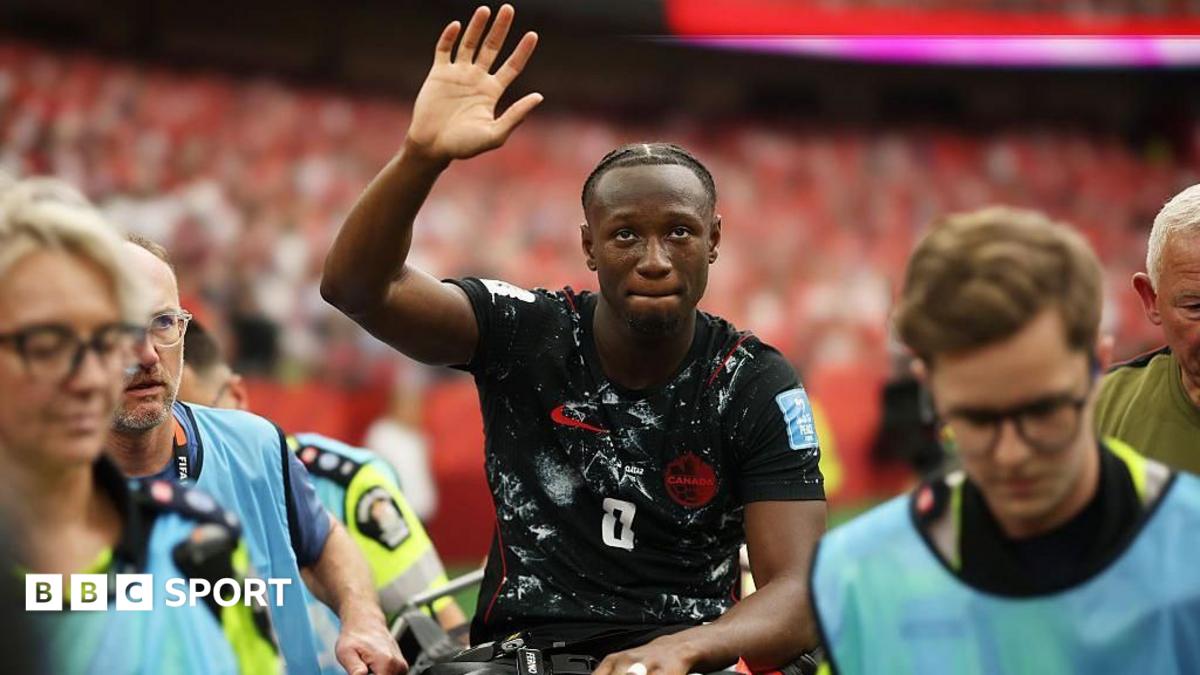
The 24-year-old Sassuolo midfielder looked anguished and in shock, with his leg visibly broken. His distraught team-mates rushed to him as the referee halted play so the medical staff could come on, while Madibo had his hands on his head.
A scuffle broke out between the two teams as frustration and anger over what had happened bubbled over.
Kone, though, despite suffering an injury that has ended his World Cup, lifted his thumb to the crowd as he was taken off on a stretcher.
Advertisement
“You saw that he was waving to the crowd and almost making everyone at ease,” boss Jesse Marsch said after the game.
“It is a statement about Ismael, but also this is an incredible team. I have been telling people for years about the character of this group.
“You got see how everyone was crushed but we had to find a way to stay focus.”
Focus they did – as from then on, the crowd and the players were united as Canada pushed on to score three further goals.
Advertisement
During the second-half hydration break, Marsch was in tears. Nathan Saliba – who had replaced Kone – held up his team-mate’s shirt after he scored his side’s fourth.
“He will be back stronger than ever and he will continue to have a great career,” said Marsch of Kobe.
“I said at the water break that he would want us to finish this game – and that is what the guys did.”






































You must be logged in to post a comment Login