

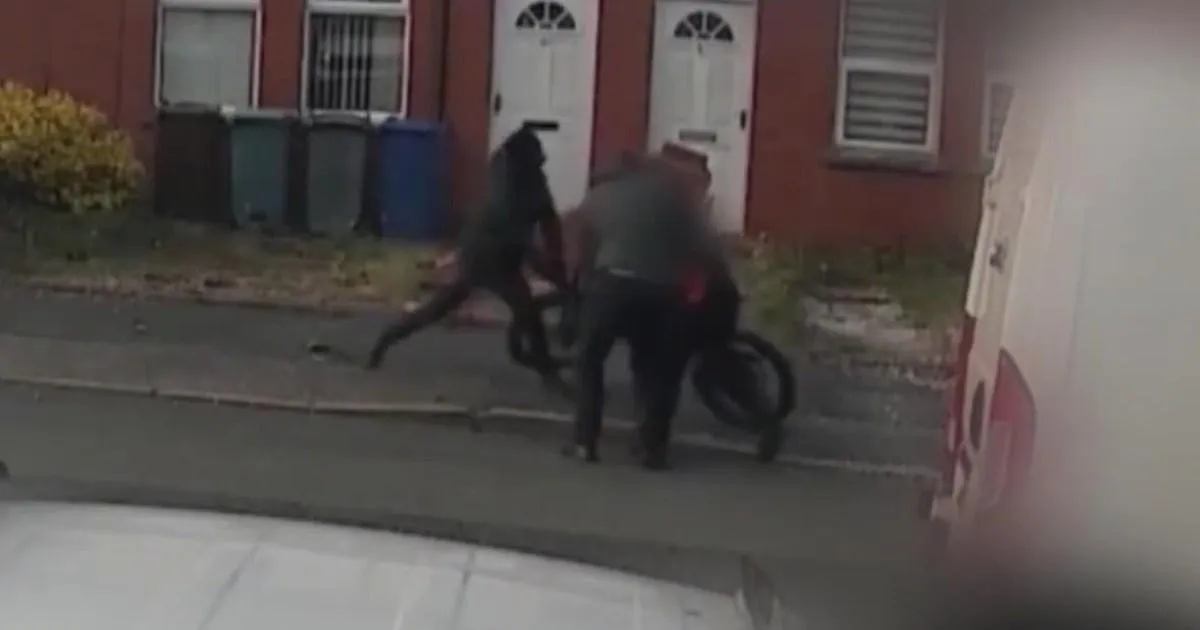




By 10am it was eerily quiet. The previous day saw market traders, hundreds of shoppers and families enjoying lunch alfresco in the late summer sun. But by Thursday morning Braintree in Essex was a ghost town.
And then, shortly before 11am, the first minibus arrived like clockwork from Wethersfield asylum accommodation site and a group of young men disembarked, smartphones in hand, one wearing a Covid-style mask to hide his face.
‘They hang around the bus station and they whistle at the schoolgirls coming off the buses,’ complained 66-year-old local Mike Readon. ‘It’s horrendous. Lots of women just avoid the town entirely on a Thursday because it’s a totally different environment.
‘You see them hanging around the cash machines and then going into charity shops, haggling for a shirt that only costs a pound, trying to get it for 50p.
‘My wife and her friends, they wouldn’t come in on a Thursday, certainly not alone anyhow.’
The Wethersfield site – 12 miles from Braintree and operated by Clearsprings Ready Homes on behalf of the Home Office – is the largest facility of its kind in Britain and currently houses 800 men awaiting the outcome of their claims to remain in the UK.
The majority of the men are in their twenties and thirties and have travelled from Africa, the Middle East and Asia, many arriving on small boats from across the Channel.
This summer it was announced the site will stay open beyond 2027 and the capacity will rise by more than 50 per cent to 1,245.
Many female residents find migrants hanging around the town of Braintree intimidating

Migrants from the Wethersfield camp are dropped off in Braintree by minibuses

Migrants are seen in Braintree town centre. They are housed at the Wethersfield site, 12 miles away
Earlier this week, the leader of Essex county council, Peter Harris, writing in this newspaper, described Wethersfield as a ‘holiday camp’ noting luxuries included a fully kitted-out gym complete with a fitness studio, a full-sized football pitch, indoor sports hall, television room and pool table.
Reports from inside Wethersfield also paint a picture of violence, with one 25-year-old, Adnani Mohammed, sentenced to 150 hours of unpaid work earlier this year for ‘violently’ attacking staff in a drunken rage.
And while the former RAF base, once home to Allied forces launching raids on the continent during the Second World War, is rural and secluded, local people in Braintree, Colchester and Chelmsford feel its presence acutely.
For every week, minibuses ferry the migrant men into these neighbouring communities where residents and workers accuse them of intimidating the elderly, harassing young women, theft and violence.
At the same time, however, hard-Right protesters, calling themselves ‘auditors’, harangue them in public, film their movements, hurl abuse and ultimately provoke further unrest.
Local people have found themselves in the centre of a social maelstrom and are on constant high alert.
Yesterday council leader Mr Harris announced a new plan, Operation Vanguard, to introduce security to these town and city centres to reassure residents.
Regardless of whether the migrants or protesters are the architects of the trouble, this is the story of how the Wethersfield site became a byword for the nation’s divisive asylum system.

Earlier this week, the leader of Essex county council, Peter Harris, writing in this newspaper described Wethersfield as a ‘holiday camp’

Locals in Braintree said you see migrants hanging around cash machines in the town
And it appears that three years after RAF Wethersfield was first converted into an asylum accommodation site by the government, relations between local people and the migrants have soured so much that assimilation into local towns is ruled all but impossible.
When the Daily Mail visited Braintree on Thursday – a day when migrants are brought in – only one minibus arrived carrying just a small group of migrant men, far fewer than the reports of up to 50 earlier this year.
Two local bus drivers in Braintree – neither of whom have anything to do with the migrant coaches – did not mince their words. ‘I want to kick their heads in,’ said one, who the Daily Mail has chosen not to name.
‘Three of ’em tried to get on my bus and honest to God I just drove on past and watched as they dived out of the hedge.’
‘They intimidate elderly people,’ added the second driver. ‘Disabled people have to walk all the way around the outside of town just to avoid them. But nothing will change, it never does.’
‘Put them on a boat and send them back,’ the other driver concludes to groans of agreement from his colleague.
Unpleasant opinions, perhaps, but then feelings are running high in the town.
Along the walk between the bus terminal where the migrants are dropped off and the high street, five panels of glass at the Sue Ryder charity shop have been smashed.
Inside, staff revealed that this is the second time the panes will have to be replaced in two months. While the culprit is yet to be identified, there are legitimate concerns that an asylum seeker from Wethersfield may be to blame after a previous incident in the shop.
Earlier this year, police advised the store to put a sign up declaring that no groups over the size of three should enter and that they were, ‘open for business, closed for crime’.

Accommodation units are pictured at Wethersfield migrant camp

Protesters demand the ex-military base at RAF Wethersfield is closed during a demonstration in September last year
It comes after gangs of up to ten asylum seekers had been caught entering the shop and stealing the donated goods, leaving young volunteers powerless and afraid.
The Care4Calais charity which typically provides the men with support and supplies from the Salvation Army building in this town, also told this newspaper that their operations had been suspended due to ‘security reasons’.
It’s even worse at the Danaher Animal Home charity shop nearby, where store worker Hannah, in her twenties, has been scarred by an altercation she witnessed on a Thursday in mid-May.
‘I was working in the shop alone,’ she said. ‘A group of men came in – we’re the first charity shop from the bus station you see. They were initially polite and said hello. Then a group of Right-wing women were filming them inside and the men became agitated.
‘One of them threatened to lash out… and then he did. He smashed the camera out of the lady’s hand and I had to keep the two groups apart. There was a huge bruise coming up on the lady’s arm and I had to call the police.
‘It was absolutely horrendous,’ Hannah continued. ‘I only started the job in February. I hate this town. Working here alone as a woman is scary. On Thursdays there are no women, no kids, no locals. Just hundreds of men.
‘I’m not biased either way, but I think the protesters should target the Government, because they’re the ones allowing this to happen,’ she added.
When it comes to these so-called protesters, the agitator-in-chief in Braintree goes under the name ‘AY Audits’ on Instagram, where he has over 36,000 followers.
Real name Anthony Barnes, the man, who appears to be in his forties, has shared over 300 videos of himself harassing migrants and marching with other far-Right demonstrators.
In one typical video shared on August 16, the rotund Barnes films a group of migrant men in Braintree waiting to get back on the minibuses to Wethersfield, at one point mocking a man for picking up prescription medication from a pharmacy.
Perhaps unsurprisingly, there are similar scenes in nearby Colchester and Chelmsford, where buses also deliver migrants from Wethersfield.

The Government has applauded itself for shutting more than 200 asylum hotels since 2023. Pictured: Home Secretary Shabana Mahmood
David Warren, 68, has lived in Colchester all his life and describes the asylum seekers living at Wethersfield as ‘dangerous’.
‘We don’t know what they’re up to,’ he says, ‘the community wants to see it stopped. Legal migration is fine but through unofficial channels is not okay. I worry.’
Garry Siddall, also 68, and who has lived in the city since 1993, described the young men as having ‘medieval views’. ‘They’re dropped off in the minibuses: it’s intimidating.’
Despite locals’ concerns, the Home Office – while acknowledging the fears of the communities – insists there is ‘no evidence’ that the asylum seekers have disproportionately increased levels of crime in Essex.
It is a similar scene in Chelmsford where Mike – who has lived here for four years – expressed his growing frustrations. ‘It annoys me that homelessness is a problem for British people but they house people who come over here illegally in their vanloads,’ he complained.
‘It’s concerning for children and women. The trouble is escalating, there are safety concerns.’
Kevin Taylor, 54, originally from east London but who has lived in Chelmsford for more than 15 years described the presence of migrants as ‘overwhelming’ for his community.
‘The men hang around in gangs. Women and children are intimidated by the court house; there are big groups of them there,’ he explained. ‘I feel the UK has lost its way; they should respect our environment. Letting anyone in, mostly men, it’s too many handouts. Everyone is scared. It’s sad really.’
As the Daily Mail witnessed while in these Essex towns, the main problem appears to be that the migrants from Wethersfield have very little to do.
With a £9.95 weekly allowance, they are unable to make meaningful purchases or eat in cafes and restaurants. Instead, they suck at cigarettes on street corners or lounge around enjoying the fresh air and giving off an air of idleness that feels – at least to the people of Essex – provocative at best.
The wider irony in all of this is that our politicians are aware of the issue. Shortly before the 2024 General Election, then Labour leader Sir Keir Starmer recognised that the Wethersfield camp ‘needs to close’.
‘I do know how keenly this is felt locally and understandably so,’ the former Prime Minister added.
But two years on and with a new PM in place – one who has already told the British people that more communities will have to absorb the shock of asylum seekers on their doorsteps – it seems the problem is set to get worse.
The Government has applauded itself for shutting more than 200 asylum hotels since 2023 and allegedly reducing the asylum bill by a £1billion a year.
But this is rather to miss the point, because once locals no longer feel secure in their towns, it doesn’t matter where migrants are housed or at what cost.
What is clear is that the people of Essex feel the true cost of asylum accommodation is to their safety – and with the Wethersfield site set to welcome 400 additional migrants in the coming months, many are now wondering what will become of these historic local towns already buckling under the weight of fear and suspicion.
– Additional reporting: Isaac Crowson




















































You must be logged in to post a comment Login