

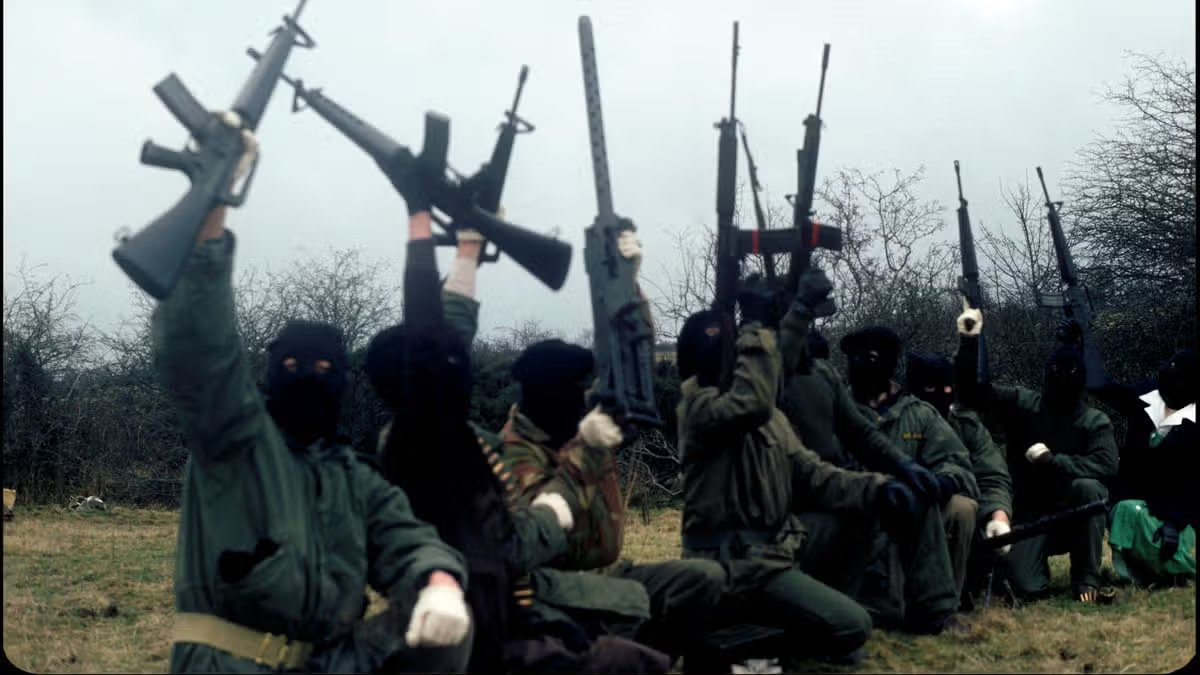
The 124-page report found it was not possible to identify those responsible for Mr O’Kelly’s murder, but reached some findings about how it was carried out.
The murder of prosecutor Rory O’Kelly in Co Tyrone in 1977 was “carefully planned by the Provisional IRA”, a report has found.
The 59-year-old father of five was shot by the terror group at Lyttle’s Bar in Coalisland on March 4 after returning to his home town to attend a funeral.
Mr O’Kelly had twice acted as election agent for TD and MP Austin Currie and joined the SDLP in 1970. He worked for the Office of the Director of Public Prosecutions for Northern Ireland (DPP) as an assistant director.
In its first published report, the Independent Commission for Reconciliation and Information Recovery (ICRIR) found he was the fifth person connected to the administration of justice to be murdered by PIRA, with the aim being to “undermine it by terrorist threat”.
The 124-page report found it was not possible to identify those responsible for Mr O’Kelly’s murder, but reached some findings about how it was carried out.
These included that his murder was a “one of a series of carefully planned attacks by the Provisional IRA”, and that Mr O’Kelly was selected as a target because he worked for the Director of Public Prosecutions (DPP).
In a statement, Mr O’Kelly’s daughter Anne commended the work of the ICRIR.
She said the report comes 11 months after the death of her brother Roger, who pursued the case throughout his life.
She added that three members of the ICRIR sat by his bedside in a hospice last year and related the details they had found.
She said it was a “sacred and transformative” meeting, and she and her brother had been “moved into a space of serenity and light, all anger taken away”.
“I would never have expected to know this sort of release,” she said.
Ms O’Kelly said she had always had a “feeling of irrecoverable loss and distress” and could never talk about her father’s killing to anyone.
“I can never thank the members of the ICRIR enough for working so hard to piece together the facts of the death of our father, and the three lovely persons who came over to England to tell us what they had found; all done just in time,” she said.
“Roger died barely a week later. It was that he had now found a great peace.”
She added they will “probably never know who the operative was”.
“There is one hero in this story, or heroine, I should say – our mother. Silently and bravely, she accepted her place in the ranks of the lonely widows, still young herself, mother of five, with two little ones still to rear,” she said.
“She kept the home warm and cheerful, and encouraged us to get qualified and be independent.
“She never got over the loss of her husband. She missed his kindliness, his humour and his story-telling. She thought of him every day of her life.”
Ms O’Kelly said she hopes for a “just and satisfactory outcome for everyone who has come to the ICRIR for answers”.
She said while theirs was a “straightforward case”, digging up the simple facts 50 years later was a “difficult task”.
“Truth takes precedence and nothing short of the truth in full will work. Truth is the foundation for real forgiveness and a lasting reconciliation,” she added.
ICRIR chief commissioner Sir Declan Morgan said he is grateful to Ms O’Kelly for her confidence in the panel.
He said the publication of its first report after two years in operation was a “significant moment”, adding that a number other late-stage investigations and draft reports are developing.
A further report is being checked by Secretary of State Sir Chris Bryant, and several others are being readied for that process.
“I recognise that the commission must keep improving and building its credibility across all parts of society. I hope that the commitment of the two governments to further partnership and progress on legacy can assist us all in that goal,” Sir Declan said.
“It is 12 months since two colleagues and I spoke with Rory O’Kelly’s son Roger as he lay dying in a hospice, and where we outlined our interim findings into his father’s murder,” he said.
“I was humbled by that poignant encounter before Roger died. That moment reiterated for me the vital work being undertaken by the commission.
“I am grateful to Roger’s sister Anne for placing ongoing confidence in the commission.
“Uncovered truths can help create a mosaic of reflection on the horrors of our past. Uncomfortable truths can help us promote reconciliation and understanding for future generations.
“That process requires continued courage and commitment from us all.”
The commissioner for investigations, Peter Sheridan, said: “After almost 50 years, today’s focus is rightly on the O’Kelly family’s tragic loss.
“There are well over 300 other families already with the commission, with over 140 live investigations. These cases come from every community background across Ireland, Northern Ireland, the UK and Europe.
“Investigating the legacy of Northern Ireland’s Troubles/Conflict is complicated and complex work. I want to recognise the patience of Rory O’Kelly’s family, and the persistence of the commission’s investigators and findings team.
“Today is not a time for anyone to play politics with legacy. It is a day to remember the families of all those bereaved through the Troubles/Conflict, and to remind everyone that the commission’s door is open to all.
“The commission has provided as many answers as possible in this report. However, like many legacy cases, there will be people who can still shed light on Rory O’Kelly’s murder. I am calling on those people to use this moment to engage with the commission for the sake of those members of Mr O’Kelly’s family who are seeking further information.
“Timelines for security checking and family representations in the commission’s processes are requirements of law to ensure fairness and appropriateness in our published findings reports. But society cannot wait any longer. Every family, victim and survivor deserves dignity, truth and acknowledgement.”
Secretary of State for Northern Ireland Sir Chris Bryant said it was a “momentous day” for Mr O’Kelly’s family.
He said: “Reading Anne O’Kelly’s deeply moving personal statement, I was struck by the transformative impact the information provided by the Independent Commission for Reconciliation and Information Recovery (ICRIR) has had on her and her family.
“Many families have waited too long to find out what happened to their loved ones during the Troubles, but I strongly believe that the work to uncover this information is of vital importance.
“I look forward to a steady rhythm now being established for the publication of ICRIR’s reports, as we work together to prepare for its transition to the Legacy Commission as set out in the NI Troubles Bill.”
For all the latest news, visit the Belfast Live homepage here and sign up to our daily newsletter here.













































You must be logged in to post a comment Login