Robert Kraft, owner of the New England Patriots, has reportedly made it known to NFL bosses that he wants to hold a game in Scotland.
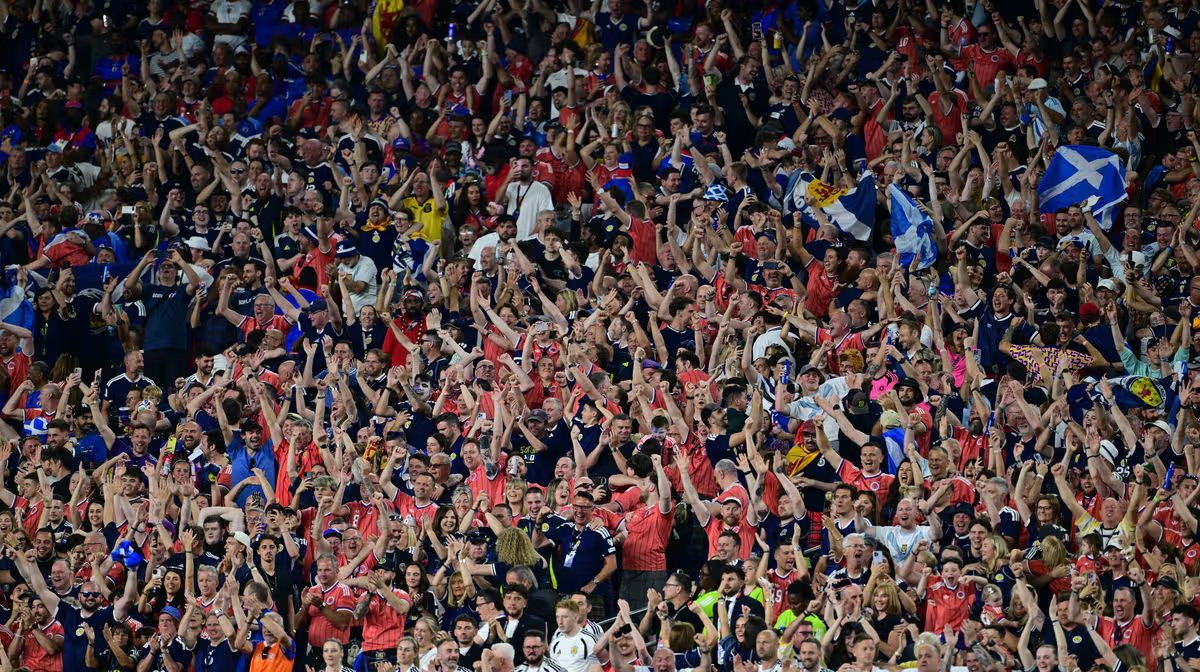
The Tartan Army has been inundated with praise from Bostonians for bringing the joy back to the city with their two-week takeover of the city. The city is now officially twinned with Glasgow, and Mayor Michelle Wu even admitted putting a traffic cone atop a statue in honour of the Scotland fans’ antics.
Advertisement
The Tartan Army’s impact on Boston, and the wider area, has been keenly felt in recent days. And now it seems like one of the biggest names in the region wants to repay the favour over in Scotland.
The New England Patriots’ owner has reportedly spoken to NFL chiefs about playing an NFL match in Scotland. According to the Boston Globe, a conversation has been held between Pats owner Robert Kraft and NFL commissioner Roger Goodell that the Patriots would be interested in playing a game in Scotland.
Thousands of Scots took over the city for a fortnight to see Steve Clarke’s men take on Haiti and Morocco at the nearby Gillette Stadium, the home of the Patriots.
The chat has come after the Tartan Army won over the Massachusetts capital with their kilts, bagpipes, and incredible feat of drinking parts of the city dry of beer. It’s reported that due to this newfound bond, Kraft who played an instrumental role in bringing the World Cup to North America, has now planted the seed for his team to play in what would be Scotland’s first NFL game.
Advertisement
Although Scotland has never hosted an NFL match, it used to be home to American football side, the Scottish Claymores. The franchise played in the World League of American Football between 1995 and 2004 and hosted many home games at Murrayfield Stadium and Hampden Park.
Several NFL games are played internationally every year, with the most ever in a single season of nine due to be played during 2026. Games are set to be played in Australia, Brazil, France, Mexico, the United Kingdom, Germany – where the Patriots take on the Detroit Lions – and Spain, with the number increasing to 10, possibly 11, in 2027.
Get Daily Record Premium for just £1 per month in exclusive offer to celebrate the World Cup. Click HERE.
Advertisement
Speaking about world expansion in February ahead of the Super Bowl, Goodell, who insisted 90 per cent of the crowds at international games are fans from the host country, said: “That’s an important mark to shoot for and I think we’re on our way.
“It’s the ambition we have to be a global sport, but it’s also the demand we’re having. We’re hearing from cities that want to host these games and really want to get more American football.”
Currently, the number of international games is capped at 10 under the CBA agreement, however the Jacksonville Jaguars are set to play two games in London this year which brings the total to 11.
Goodell has previously spoken about how he wants 16 international games per year, meaning it’s not out of the question to have a game in Scotland.
Advertisement
Get more Daily Record exclusives by signing up for free to Google’s preferred sources. Click HERE.
Did you click on this article out of your own free will? Or was it predetermined by the cosmic evolution of particles, unfolding in an unbroken chain reaction set in motion by the big bang? Perhaps you think random quantum processes or unconscious brain activity were responsible? Whether you are philosophically inclined or not, the topic of free will is something most of us have pondered at some stage.
Research has shown that people tend to believe in free will, at least in some form. A more important question, perhaps, is whether it matters. This is the exact conundrum that researchers in psychology and experimental philosophy have been trying to answer recently. What would ultimately happen if people gave up on the idea of free will?
It may seem like a dangerous idea; something that could result in chaos and depression. And indeed, research has largely found that when you manipulate people to doubt free will, bad things happen – including an increase in behaviour such as cheating and aggression. This suggests that even if free will doesn’t exist, as many scientists and philosophers assume, it might be better for us to pretend that it does. But newer research by me and others suggests that doubting the existence of free will may not have such bad consequences, after all.
Philosophers have argued for centuries about what free will is and whether we have it. Positions vary widely, and it is impossible to give the subject full coverage here. At one end of the debate are libertarians, who contend that at least some of our choices and actions are not causally determined. At the other end are hard determinists who argue that every thought, action or event is a result of past events and the laws of nature.
Advertisement
When people talk about a disbelief in free will, determinism is usually the position that springs to mind. Yet, determinism is one of many positions within a family of views that dismiss the notion of free will. A position that has emerged more recently is called free will scepticism. While this position rejects the idea that humans possess genuine free will (but not necessarily agency), only some sceptics reject it because of determinism, while others argue that free will is impossible in an indeterministic or random universe.
But whichever tribe you identify with, what are the actual consequences of your beliefs? Before looking at some of the issues with recent experiments, let’s first explore how researchers began manipulating beliefs in the first place.
The Insights section is committed to high-quality longform journalism. Our editors work with academics from many different backgrounds who are tackling a wide range of societal and scientific challenges.
Advertisement
The benefits of believing in free will
The first piece of research to experimentally manipulate free will beliefs was conducted by Kathleen Vohs and Jonathan Schooler in 2008. This work, which is now a seminal paper in the area, comprised two experiments. In the first experiment, the researchers asked participants to read text taken from Francis Crick’s classical book The Astonishing Hypothesis. Participants were allocated to read either an anti-free will version or a neutral one.
In the group that was manipulated to not believe in free will, the text stated that free will was illusionary and behaviour was driven by unconscious brain activity. For example, the text included sentences such as “everything people are and do is the product of simple, physical processes in their brains” and “although we appear to have free will, in fact, our choices have already been predetermined for us and we cannot change that.” In the control condition, the text did not mention free will and instead discussed research on consciousness.
After reading the text, all participants completed a mental-arithmetic task on a computer. They were told that a “programming glitch” meant that the solutions/answers to the task that they were meant to solve themselves would be visible. Participants were therefore encouraged to press the spacebar, which would ensure the solutions remained hidden. Therefore, whether or not participants decided to keep the answers hidden was used to indicate cheating.
The researchers speculated that those reading the anti-free will text would press the spacebar less so than the control condition. And this is what they found. To confirm these findings, they ran a second experiment with some slight methodological changes. This second experiment essentially found the same thing: participants made to disbelieve in free will cheat more.
Advertisement
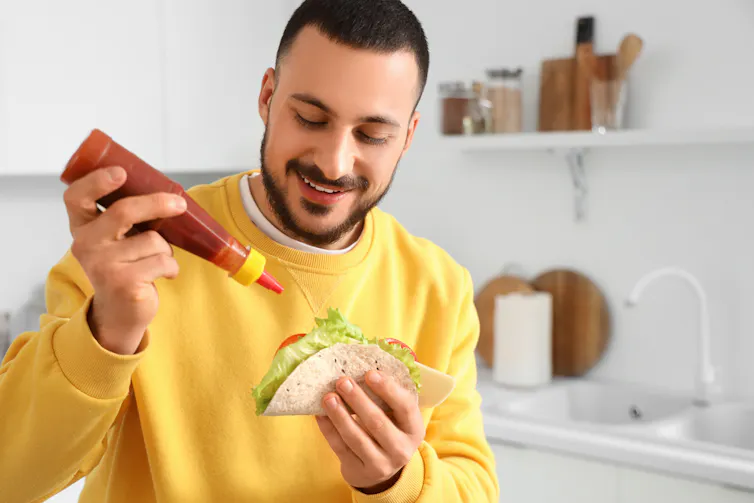
This paper led to a proliferation of studies seeking to examine other outcomes associated with free will beliefs. Roy Baumeister and colleagues investigated the link between the belief in free will and aggressive behaviour. After a free will belief manipulation, participants completed a cooking task and were told that the individual they were preparing food for disliked spicy food. Therefore, the amount of hot sauce administered by the participant served as the measure of aggression. Consistent with the researchers’ prediction, participants whose belief in free will had been weakened slathered on more hot sauce. The researchers therefore concluded that belief in free will is related to aggression. That said, they only looked at the direct consequences of manipulating people doubt free will rather than capturing the exact thought process of why they used more hot sauce.
The consequences of this programme of work were clear: if we make people disbelieve in free will, negative outcomes will follow. Consequently, even if we believe free will is an illusion, people should be shielded from this information as a society. However, there are some issues with these manipulation studies and the catastrophic conclusions derived from this line of research.
Are these conclusions premature?
An important issue concerns the beliefs that these manipulations are targeting. As mentioned earlier, many arguments against free will exist, and each argument aligns itself to a different philosophical position. The texts given to participants typically make claims related to the inevitability of events, the nature of science and the role of consciousness.
They are an amalgamation of philosophical positions that have their own ramifications. One idea that is commonly used in manipulations is the suggestion that people’s thoughts, desires, and wills are ineffectual – that the brain prepares for action before we consciously decide to do something. So when you reach for that chocolate bar at the end of a hard day, it’s not a result of conscious choice – unconscious brain processes are entirely to blame.
Advertisement
But this is not the only way think about a lack of free will; and it’s not something a sceptic would endorse. Many sceptics believe that thoughts and desires do influence how people behave but, importantly, the cognitive processes that underlie them (including genetics and past experiences) are either determined or due to chance. This suggests your desire was at play when you ate that chocolate bar – you can have agency without having full, God-like control deserving of ultimate moral responsibility. In this view, free will is more of a metaphysical concept whereas agency is involved in day-to-day events.
This is an important but subtle difference. Telling people that their thoughts have no say in what they do might lead to feelings of demotivation, disillusionment and alienation. It may even lead them to immoral behaviour. But these consequences are likely a result of far-fetching, dramatised arguments that pose direct threats to agency, and not a general, sceptic approach.
Suppose the manipulations do weaken belief in free will, but only according to a sceptical position that maintains some belief in agency. Will it still lead to dramatic, abhorrent outcomes? Recall that the experiments with the mathematical task, with cheating behaviour represented by the number of keypresses that did or did not occur.
The most that can be concluded from this experiment is that weakening belief in free will can influence cheating in a fictitious mental arithmetic task. The study did not find a relationship between belief in free will and other, more socially relevant, ways of deceptiveness, such as fraud, infidelity, academic dishonesty and so forth. To assume people cheating in a controlled laboratory experiment, which has no real-life consequences, would also commit these other forms of cheating appears far-fetched.
Advertisement
Similarly, the cooking study showed that beliefs about free will can affect how much hot sauce participants allocate in a laboratory setting. It is possible that the same manipulation could also increase verbal hostility or confrontation, and perhaps even aggression or threatening conduct. However, these conclusions remain completely speculative – we just don’t know.
For argument’s sake, let’s assume that they do lead to bad things in real life. We may still question just how meaningful the findings are. Researchers talk a lot about the “effect size” of a finding, which basically tells us the magnitude or size of the effect. A large effect size indicates a finding has practical significance, whereas a small effect indicates limited practical application. Researchers obviously strive for the former.
To get a sense of the effect size in free will belief research, a 2022 paper reviewed studies administering manipulations to free will beliefs. It found that these manipulations only had a small effect size. What’s more, it showed that the strongest effects happened directly after the manipulation instead of at the end of the experiment. This indicates that manipulation effects may not only fade after the experiment, but wane over the course of the experimental session – we don’t think about whether we have free will constantly. Not only that, but the review found that changes in free will beliefs did not have any meaningful, lasting change in behaviours.
A final issue has to do with replication, the confirmation of scientific findings in other studies. Whether a finding is replicated is one of the major principles in science. Repeating an experiment and consistently finding the same thing can increase confidence about an initial finding. And a replication crisis has recently engulfed psychology.
Advertisement
This is also the case for free will research. For example, some researchers have failed to change participants’ belief in free will. Others, despite successfully changing free will beliefs, have found difficulty replicating the consequences. For example, one study could not replicate the findings regarding cheating on the mathematical task. These difficulties question the credibility of the original findings and pose serious challenges to the assumption that negative consequences come about from a disbelief in free will.
Can a disbelief be good?
We have seen different reasons why it may be premature for researchers to conclude that disbelieving in free will has negative consequences. But we may also question whether these negative outcomes are to be expected anyway, and whether adopting a sceptical position can actually have societal benefits.
One view is that beliefs about free will make no difference to how people think and behave. Think about meaning in life, something which research has supposedly showed to be weakened by a disbelief free will. Imagine that a person’s meaning is strongly attached to their career. This person harbours the ambition to become a lawyer and after years of dedication, finally achieves her dream. Would the belief that she lacked free will affect her meaning and how she perceived this success?
Not necessarily so. She was still the one that got up early, arrived home late and dedicated hours to studying. The pride in her accomplishment does not evaporate in the knowledge that she was not the ultimate controller. She may be thankful for her upbringing, the education she received and her family support. There can still be meaning and gratitude. People ascribe meaning to all sort so things – intelligence, athleticism and beauty – none of which have got anything to do with free will.
Advertisement
What’s more, I conducted a study that specifically looked at meaning in life across people holding a range of views about free will. One group read a text passage denouncing free will (a traditional free will disbelief manipulation); and a second read neutral text (a control condition). I also had a third group which did not receive a manipulation but was selected by identifying as free-will sceptics.
All participants reported on how meaningful their life was. As would be expected, those manipulated to disbelieve in free will showed lower meaning than the control, supporting previous studies. But crucially, the sceptic group had the same sense of meaning and purpose as the control.
This indicates that, as suggested earlier, the manipulations claiming to make people doubt free will are not doing so in accordance with a sceptical perspective. More importantly, this suggests that the meaning in life of people taking sceptic views is unaffected by their philosophical position.
Further supporting this, a 2024 paper examined the views of free will sceptics exclusively and found that 41% (out of 164) claimed that their disbelief had no effect on their life at all. And the most reported consequences were indeed positive, including having compassion for others, being less controlling and more relaxed.
Advertisement
Does this mean a sceptical position could in fact provide societal benefits? One of the most debated consequences of free will beliefs concerns morality and responsibility. In the current legal system, retributive punishment is predicated on the assumption that the criminal was morally responsible for their action and acted out of their own free will. Supporting this view, research has found that participants with a stronger belief in free will are actually less empathic towards wrongdoers, and hand out harsher sentences. Yet, if free will does not exist, it would seem unduly harsh to punish an individual based on an act they were not responsible for.
Those who don’t believe in free will may have their own reasons for being altruistic. Shakirov Albert/Shutterstock
Gregg Caruso and Derk Pereboom are prominent free will sceptics who question the morality of punitive decisions. They suggest that instead of punishing people because they are morally responsible for their actions, more empathetic, non-punitive approaches can be adopted in line with sceptical beliefs. For example, their quarantine model seeks to isolate offenders and provide rehabilitation until they no longer pose a risk to society – regardless of their level of responsibility. Seen in this way, a disbelief in free will could potentially overhaul a legal system that’s at odds with the view that free will does not exist.
Holding the belief that people can freely determine their circumstances may also lead to other harmful outcomes, such as social inequalities, injustice, a lack of empathy, hatred and victim blaming. For example, a belief in free will can promote the idea that poor people are somehow deserving of their abhorrent conditions and are living in situations of their own making. These perceptions can change if the notion of free will is relinquished. Because people are not morally responsible for their own situations, a greater deal of compassion and empathy could be shown towards those underprivileged. So there could indeed be positive outcomes of declining to believe in free will.
Researchers have claimed that making people disbelieve in free will can have dramatic negative consequences. A disbelief in free will may indeed lead to bad things; however, due to various methodological issues, it is premature to make this conclusion. In fact, it could turn out that disbelieving in free will is actually a good thing.
To hear about new Insights articles, join the hundreds of thousands of people who value The Conversation’s evidence-based news. Subscribe to our newsletter.
“These are the most comfortable shoes. I wore them around the parks in Orlando for a week. Everyone else in my group had blisters my feet were great. We were covering up to eight miles a day…”
Shawna Healey Senior fashion, beauty and home affiliate writer and Nadia Breen
08:46, 24 Jun 2026
This article contains affiliate links, we will receive a commission on any sales we generate from it. Learn more
Sandals are a must-have during hot weather as their open design allows air circulation, helping to prevent feet from overheating and sweating.
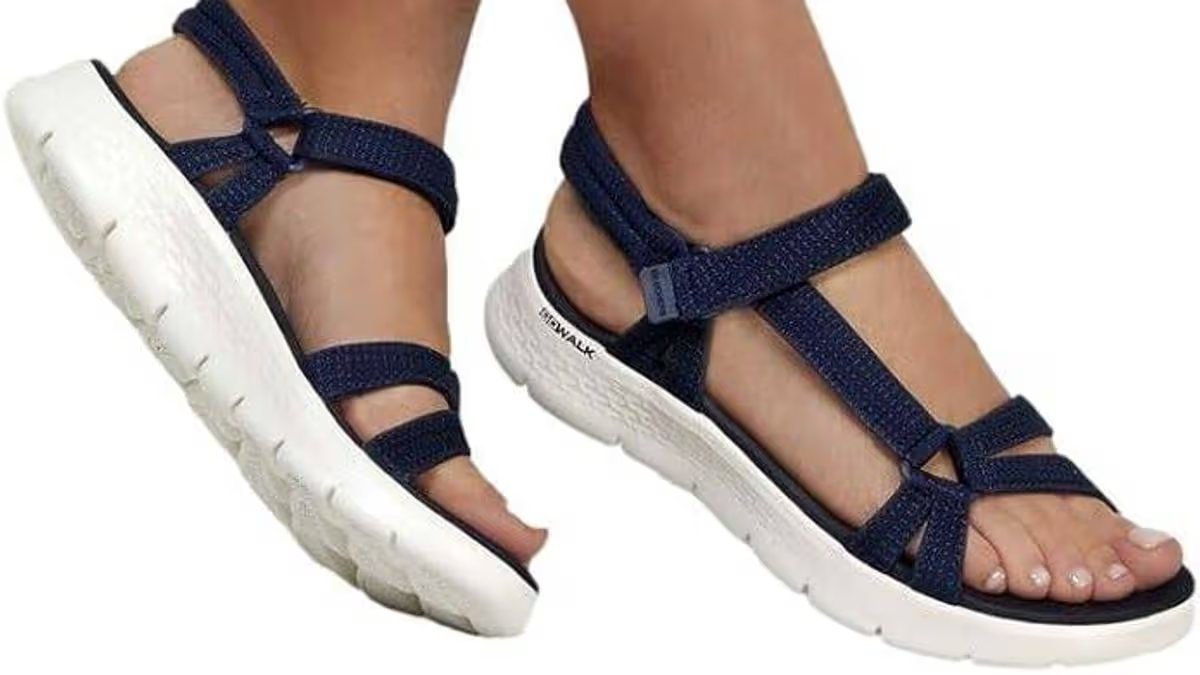
Amazon shoppers have discovered a pair of sandals that combine style with comfort. Those who’ve purchased the Walk Flex Sublime Sandals say they’re ‘super comfy’ even after walking miles each day.
Normally priced at £54, the Walk Flex Sublime Sandals in navy textile have been discounted by 35% during the Amazon Prime Day sale, which runs from Tuesday, June 23 to Friday, June 26. This reduction brings the cost down to £34.98 (prices correct at time of writing).
Advertisement
Available in sizes two to nine, shoppers can choose from additional colours including black, mauve pink, sage green and blue, amongst others. It’s worth noting that pricing may differ depending on which colour and size is selected, with navy being the cheapest option currently.
The Go Walk Flex Sublime Sandals blend practical comfort with relaxed style. These sporty shoes boast a textile upper with an adjustable ankle strap featuring hook and loop fastening, providing a customisable fit.
Advertisement
Incorporating Skechers’ comfort technology, these sandals feature a contoured Goga Mat footbed that adapts to the shape of your feet, delivering arch support and cushioning. The featherlight Ultra Go midsole provides responsive comfort.
The flexible EVA outsole delivers dependable grip across different surfaces. Their water-resistant design makes them perfect for a range of summer pursuits, whether strolling along the beach, relaxing by the pool or exploring town casually.
Meanwhile, the Gracie Leather Strappy Back-Strap Sandals have seen a 31% price reduction, now available for £69 rather than £100. Crafted from leather that feels soft on skin, they boast gently rounded front straps to prevent uncomfortable rubbing and an adjustable buckle-fastening back strap for added stability.
As an alternative, Marks and Spencer’s Leather Flat Mule Sandals are priced at £26. These leather sandals offer an effortless slip-on style, featuring fashionable cutout details on the straps, sophisticated square toes and flat soles that make them perfect for lengthy sunny-day strolls.
Advertisement
Returning to Amazon, the Go Walk Flex Sublime Sandals have an overall rating of 4.4 out of five from 2,634 reviews. One pleased customer commented: “Really comfortable, perfect for long summer walks. The range of sizes meant I could find the perfect fit. Great quality too.”
A second customer remarked: “So comfortable. I like to wear sandals in the summer, but struggle to find comfortable ones. My feet swell a bit in the heat, and these accommodate for that. I wear Skechers trainers all the time, so thought I’d try these. Glad I did.”
“Super comfy, I wore them in Spain,” a third shared. “I walked 60km overall and no blisters or swelling, simply perfect. Smart but sporty, can be worn with dresses or shorts or trousers. Very supportive and no sign of damage after prolonged use.”
However, one buyer wasn’t satisfied with the sizing of the Go Walk Flex Sublime Sandals and left a three-star rating. It states: “Nice sandals but they come up very large – I’ve had to return and reorder in a smaller size.”
“Lovely sandals but inconsistent sizing,” another three-star review notes. “I ordered my usual size six and much too big and wide. Returned.”
Despite this, another shopper was pleased with their recent Amazon buy, commenting: “These are the most comfortable shoes. I wore them around the parks in Orlando for a week.
“Everyone else in my group had blisters my feet were great. We were covering up to eight miles a day. Can’t recommend enough.”
Advertisement
A further five-star review states: “I have been wearing this make and style for years. They fit my feet well and are extremely comfortable for walking. No blisters to date. Reasonable price and quick delivery. Recommend.”
Want to see more of the stories you love from Belfast Live? Making us your preferred source on Googlemeans you’ll get more of our exclusives, top stories and must-read content straight away. To add Belfast Live as a preferred source, simply click here.
In Europe, hand luggage rules are about to change (Picture: Getty Images)
If you’re a seasoned traveller — especially on short-haul European flights — you’ll likely have tried myriad luggage hacks to avoid paying extortionate airline fees.
From the neck pillow trick, which consists of stuffing your U-shaped pillow with clothing, to using a duty-free carrier bag to sneak extra stuff, there are some innovative ways to bypass the limits.
However, certain passengers may not need to get creative for much longer.
After 13 years of negotiations, the EU has reached an agreement that will allow hand luggage on board free of charge.
Advertisement
Here’s everything we know so far about the ruling, which is set to come into action in 2027.
What is the agreement?
Best of Metro Deals
Get exclusive discounts with Metro Deals – save on getaways and spa days. Powered by Wowcher
Bannatyne Spa: Spa day for two with treatments, lunch & prosecco — save up to 57% off.
The proposal, which is part of an agreement between the European Council and European Parliament, will allow travellers to take carry-on luggage measuring 40cm x 30cm x 15cm, with no extra fee.
This is as well as the usual under-the-seat rucksack allowance.
Advertisement
In a statement announcing the news, the Council of the EU said that ‘to create price transparency, air fares including allowance for a piece of hand baggage shall be displayed by default before the start of any booking process to facilitate fare comparisons between airlines.’
In a nutshell, this means airlines must include both the small personal item and the larger carry-on bag in their standard ticket price.
It has also been agreed that airlines may offer cheaper tickets to passengers who voluntarily choose to travel without hand luggage.
No more hiding your bits in duty-free bags (Picture: Getty Images)
This landmark ruling is the first time airline passengers’ rights have been updated in Europe since 2004.
That was when Regulation EU261 — a European Union law establishing minimum rights for air passengers, guaranteeing compensation, refunds, and assistance in cases of flight cancellations, long delays, or denied boarding — was passed.
Advertisement
But like all good things, there’s a catch.
Despite the UK adopting EU261 after Brexit, it has not been updated here yet.
To get to the bottom of what this means for Brits travelling across Europe next summer, Metro spoke with Rhys Jones, Aviation Editor at Head for Points.
Who does this amendment apply to?
‘Passengers flying on EU airlines will be able to take advantage of [the change] in both directions,’ says Rhys.
Advertisement
However, he warns that non-EU airlines — such as Jet2 or easyJet — would only be bound by these regulations on flights from the EU back to the UK.
Jet2 is a non-EU airline, so will only be affected on flights back to the UK (Picture: Shutterstock/Markus Mainka)
For example, you could get free hand luggage on an easyJet, Jet2, or BA flight from Mallorca or similar, but not when departing the UK.
That is, unless the UK enacts similar legislation.
Additionally, Rhys says that British Airways, despite being owned by Spanish holding company International Airlines Group, is also considered a UK airline as its operating licence is issued by the UK.
‘Whilst the original 2004 EU264 legislation was copied to UK law as part of Brexit, this does not automatically mean that future amendments in the EU are adopted,’ he adds.
Advertisement
Rather, ‘it would be up to the Civil Aviation Authority to make any future changes to UK law, not the EU.’
Which airlines will be affected?
Rhys says that from 2027, ultra-low-cost airlines such as Ryanair, easyJet and Wizz Air will be affected the most.
This is because they do not include trolley bags in their lowest fares.
Wizz Air is another airline likely to be affected (Picture: Xavier Bonilla/NurPhoto/Shutterstock)
‘Affected airlines will now need to show a default price that includes a cabin trolley bag, although passengers will be able to opt out during the process for an additional saving,’ Rhys reiterates.
‘This will make it easier to compare to full-service airlines such as British Airways and Air France, where trolley bags are included in the fare.’
Advertisement
What have the airlines said about the ruling?
Consumer groups have argued that charging for cabin bags is illegal, especially via practices followed by low-cost airlines, and that air travellers should have the right to claim compensation linked to delays.
However, some airlines have been rushing to charge for cabin baggage in recent months, citing financial losses due to soaring jet fuel prices linked to disruptions in the Middle East.
Ryanair boss Michael O’Leary has been pretty vocal about this new agreement, calling it ‘gobbledygook.’
The Irish businessman criticised the regulations, which he said ‘require airlines to falsely advertise higher air fares, making EU airlines even less competitive.’
Advertisement
He added that the latest EU261 rulings are ‘more bureaucratic bunkum from the EU Parliament and Council,’ adding that over 50% of Ryanair customers choose fares that exclude a second cabin bag.
Low-cost carriers like Ryanair will feel the pinch (Picture: SWNS)
He said the regulations were discouraging EU airlines from advertising their lowest fares.
O’Leary also argued that they make EU travel less competitive.
Of course, it makes sense that the Irish carrier would have a problem with the agreement. In 2024, Ryanair made €4.7 billion from charging extra fees, which included baggage costs.
What other passenger rights have been updated?
‘The amended regulations clarify various topics that have been contentious with airlines since they were first introduced in 2004, which should help make it clearer for both passengers and airlines,’ Rhys says.
Advertisement
For example, airlines now have to electronically inform passengers within 96 hours if they are eligible for delay compensation.
Elsewhere, the claiming process has been made easier with a 30-day window for airlines to either pay up or decline the request.
What has not changed are your rights if your flight is delayed or cancelled.
‘Depending on the length of your flight, passengers can still claim €250, €400 or €600, if the flight is delayed by three hours or more.’
Temperatures up to 38C are forecast across the country
Train passengers have been warned to only travel “if essential” as the hot weather could see temperatures reach up to 38C. Earlier this week, the Met Office issued a rare red warning, alongside an amber warning, for parts of the UK including Cambridgeshire.
Advertisement
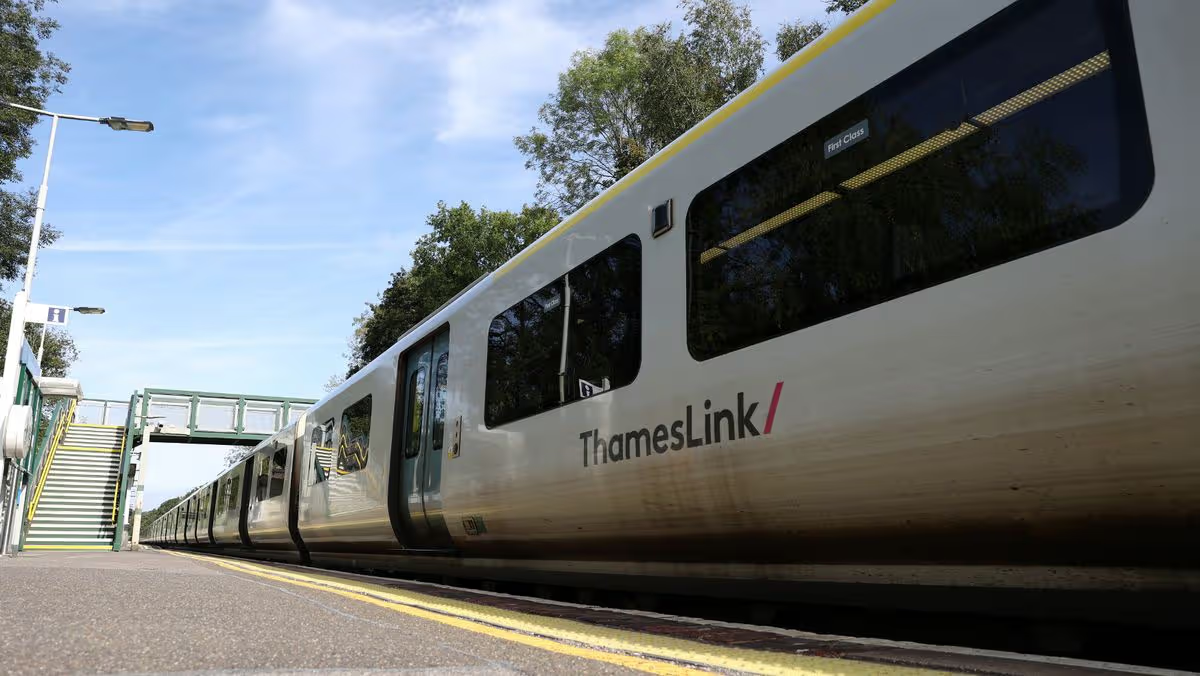
Thameslink and Great Northern, which both operate in Cambridgeshure, have warned passengers to “only travel if essential”. There will be a reduced service between Kings Lynn and London Kings Cross today (Wednesday, June 24) and tomorrow (Thursday, June 25).
On the National Rail website it said: “As temperatures begin to soar today and tomorrow, when the most extreme conditions are expected, passengers travelling to, from, or within the red warning areas should only travel if absolutely necessary, while passengers outside those areas should continue to check their travel plans carefully.
“Rail services will continue to run but will be reduced in some parts of the network, customers should expect disruption across some routes. For safety reasons, trains will operate at reduced speeds and to amended timetables, meaning journeys will take longer and there is a heightened risk of delays, last-minute alterations and cancellations.
“There will be no rail replacement bus/taxi services during this period. Customers who do need to travel are strongly advised to prepare for the conditions by bringing plenty of water, wearing sunscreen and a hat, and ensuring that they have a back-up plan in case of disruption.
Advertisement
“If you begin to feel unwell, please seek assistance at the next station or speak to a member of station staff. For your safety, we kindly ask that you avoid using the emergency alarm between stations, as this may delay access to support.”
Gatwick Express and Southern trains are also affected.
The summer transfer window continues to ramp up as Arsenal, Chelsea, Manchester United, Liverpool and Tottenham all attempt to complete some huge early signings. Arsenal look to be advancing in their pursuit of Morgan Rogers amid claims that they have now agreed personal terms with the England star. The Gunners have been linked with an audacious swap deal for Julian Alvarez, while they are close to signing wonderkid Jeremy Monga as they also chase the likes of Ayyoub Bouaddi, Bradley Barcola, Eli Junior Kroupi, Christos Tzolis and Andria Bartishvili.
Train passengers across Wales are facing widespread disruption as operators cancel services amid an unprecedented red weather warning for extreme heat.
Rail routes across north, mid and south Wales have been affected on Wednesday as temperatures are forecast to climb towards 38C, with forecasters warning of a “severe weather event” that could pose risks to life and infrastructure.
Several rail lines have already seen services suspended or cancelled due to the conditions, while Network Rail and train operators continue to monitor the impact of the heatwave on tracks, signalling systems and rolling stock.
Advertisement
Among the routes affected are services between Manchester Piccadilly and Cardiff Central, Bridgend and Maesteg, Cardiff Central and Ebbw Vale Town, and Llandudno and Blaenau Ffestiniog, where severe weather-related disruption is expected to continue throughout Wednesday.
Additional disruption has been reported on routes between Shrewsbury and Birmingham International because of forecast extreme weather conditions.
Nicola has shared a reflective quote after tensions boiled over on Father’s Day (Picture: Shutterstock/AP)
Nicola Peltz appears to have added her own take to the Beckhams’ Father’s Day debacle with a mysterious Instagram post.
Father’s Day marked yet another special occasion – alongside the knightoods, premieres, dedication ceremonies and birthdays – where estranged Beckham son Brooklyn, 27, maintained his stony silence.
Sir David, 51, and Victoria, 52, shared heartfelt posts on Sunday, including pictures of Brooklyn where he is tagged, but received nothing in return.
Now Brooklyn’s wife, Nicola, who has been embroiled in the family feud since the very start, has waded in with a cryptic quote on her Instagram story, which reads: ‘I love this sentence: Forgive yourself for not knowing earlier what only time could teach.’
Advertisement
The timing of the reflective quote is certainly interesting.
Shortly after, she went to her main grid to commemorate six years since their engagement, saying: ‘I feel like I’ve known you my whole life, you’re my best friend and my forever love wrapped in one.
Brooklyn was reportedly furious about Father’s Day posts (Picture: nicolaannepeltzbeckham)
She also posted to mark six years of being engaged(Picture: Instagram/Nicola Anne Peltz Beckham)
‘I love you with my whole heart. You’re the kindest man I’ve ever met, and I’m so happy I get to do life with you.’
Brooklyn commented: ‘You’re my best friend forever and ever’.
‘He’s asked them to leave him alone, and they just keep posting him. It just brings the whole thing up all over again. He wishes they’d leave it and leave him alone,’ the source said.
It is understood that Brooklyn saw the posts through media reports and via people close to him since he has blocked his family on the photo-sharing app. He has previously requested that they only contact him through lawyers.
Brooklyn was reportedly left fuming by his parents’ Father’s Day posts (Picture: Instagram/David Beckham)
It’s been a fraught couple of weeks with Brooklyn’s DoorDash advert and David’s dedication ceremony (Picture: AP/Invision)
Since Brooklyn’s bombshell statement in January confirming the rift in his family and taking aim at his parents, he has remained largely silent on the subject.
He now lives in LA with his wife and is just a stone’s throw from where David recently received his Hollywood Walk of Fame star, although it transpired that Brooklyn went to New York while his family were in town.
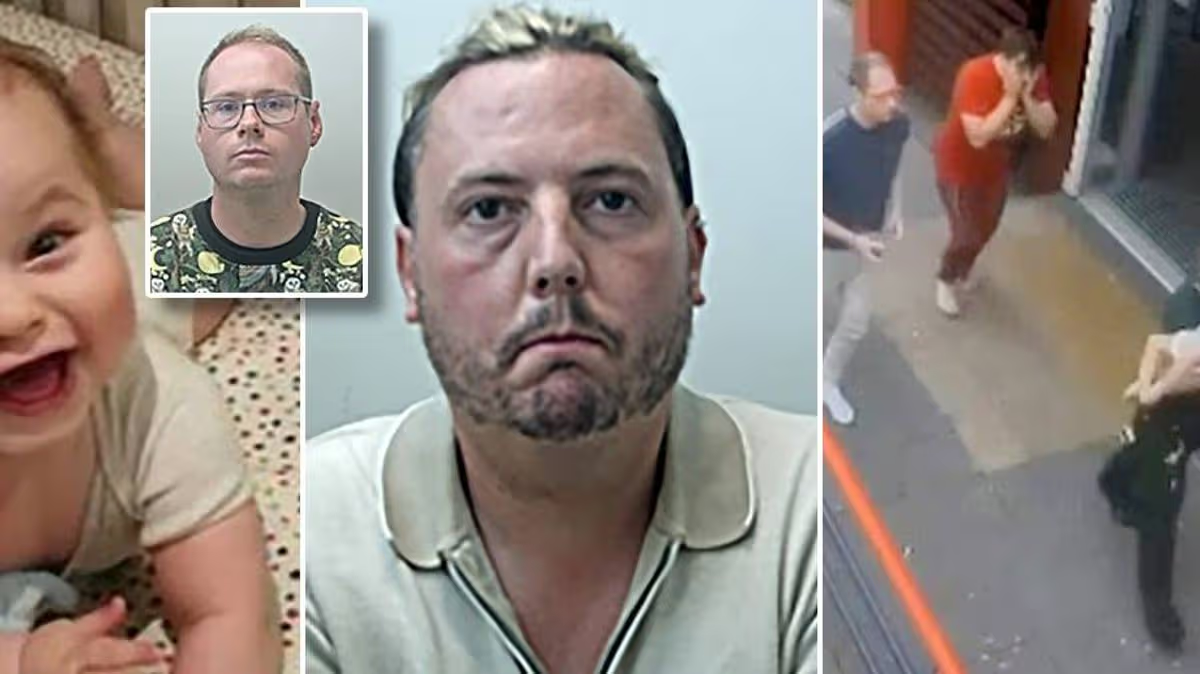
Preston Davey’s murderer Jamie Varley endured his first night of a whole life sentence at the notorious ‘Monster Mansion’ “sobbing and quaking” in his cell, as furious fellow inmates screamed threats that he would face retribution, according to insiders.
Enraged prisoners reportedly gave the convicted paedophile a “traditional prisoners welcome”, rattling the bars and hollering warnings that his days are numbered for the appalling abuse he subjected little Preston to.
The chilling threats greeted Varley as he arrived at HMP Wakefield – widely known as Monster Mansion – where he was transferred directly following his sentencing at Preston Crown Court last week.
Varley received a whole life order for the grotesque abuse of adopted 13-month-old baby Preston. Following an eight-week trial, the 37-year-old was convicted of murder, sexual assault, and a catalogue of other heinous child sex offences.
The stark reality of his fate appeared to “hit” home as he spent his first night weeping in his cell, sources claim, reports the Daily Star.
“It was quite the hit home for how the rest of his life will be,” a source revealed exclusively to the Daily Star.
Advertisement
“Varley was in for a rude awakening if he thought he would be getting an easy ride. He is arguably one of Britain’s most hated men right now, and that stands in the prison too.
“There’s a bounty on his head, everyone wants to be the one to hurt him first, and he was made very aware of that as he entered the prison.
“The other prisoners knew he was coming and they waited for him. They want him scared and they want to make his time inside as awful as they can – and now he knows he has a lot of time inside to serve. He is never getting out, there is no way out of this hell for him.”
Varley is understood to be currently held in segregation. This entails spending most of his time confined to his cell in solitude, under constant supervision from guards tasked with ensuring his safety.
“In time he will be allowed to move about a bit more, but any time he does leave his cell it is likely he will be flanked by guards, they have a duty of care to him,” the insider added.
“He was welcomed last night by loud banging and shouting as fellow prisoners who anticipated his arrival when they learnt of a prison van arriving to drop off newbies.
Advertisement
“He was whispering to himself and spent the whole night just sobbing in his cell. He must be thinking that an attack is inevitable, it is just a case of when.”
Mental health specialists are also anticipated to attend the Category A facility in West Yorkshire to evaluate his psychological condition, as he remains under round-the-clock suicide watch.
“High profile prisoners are often placed on this as a matter of protocol,” the source added. “But in this case it is probably called for and a real possibility. What has he got to live for?”.
Advertisement
Wakefield ranks among Britain’s most infamous prisons, renowned for detaining the nation’s most dangerous offenders. The facility houses between 630 and 750 high-risk prisoners, with the overwhelming majority serving lengthy or indefinite life terms.
Over the years, its notorious residents have included Harold Shipman, Levi Bellfield, Ian Huntley, and Charles Bronson.
“Things will not be getting any better for him any time soon,” the insider continued. “In fact every day he survives, the bounty will increase for taking him out.
Advertisement
“Guards certainly have a job on their hands keeping him safe.”
Varley’s partner John McGowan-Fazakerley’s whereabouts remain unclear, though sources suggest he is likely to be held at either HMP Manchester (Strangeways) or HMP Full Sutton.
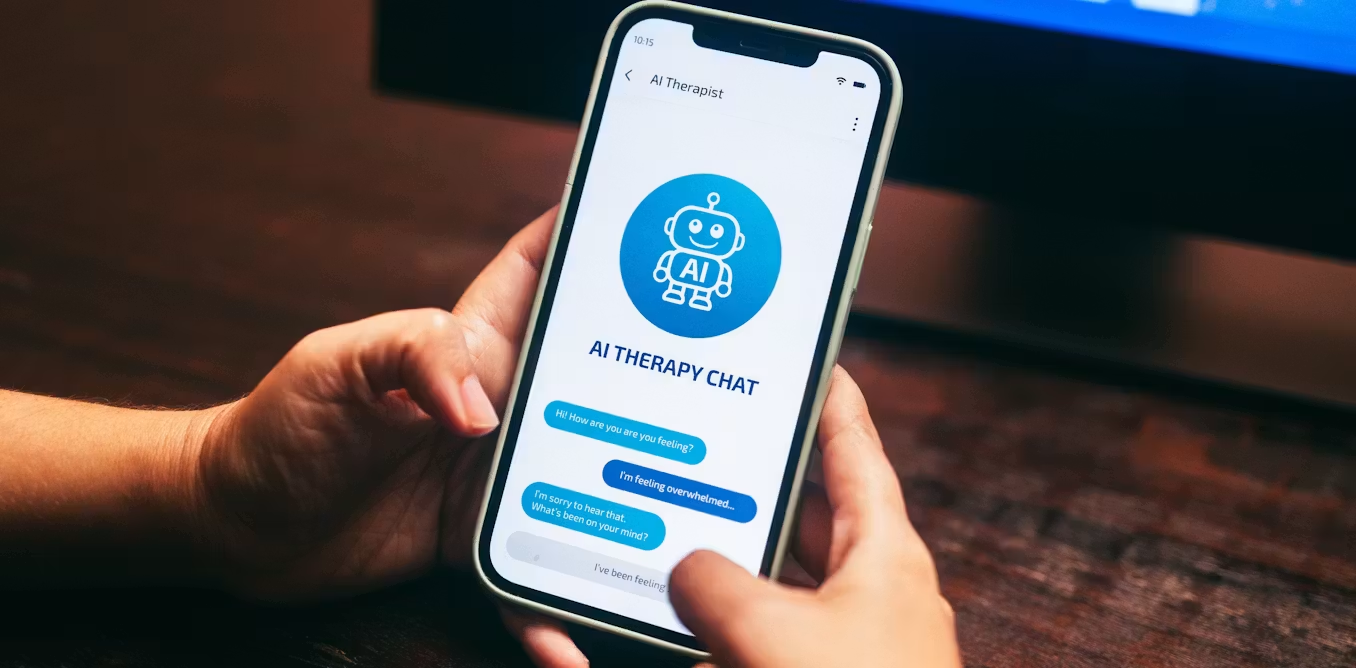
In a recent episode of British sitcom Amandaland, Anne Flynn turns to ChatGPT for help talking to her teenage son about sex. The episode frames this as “The Chat”: the awkward parent-child conversation many adults dread.
What Anne is doing on screen is what many people are now doing in private: taking hard human conversations to a machine that can answer immediately. The scene raises a bigger question: what do people need from another person when they are struggling, and can AI provide it?
Popular ideas about therapy often centre on expertise: the therapist as someone who can explain what is wrong and offer a way to fix it.
Advertisement
Therapy can involve psychoeducation and specialist techniques. But it also relies on the relationship between therapist and client, and the therapist’s ability to stay with uncertainty rather than provide an answer too soon.
The capacity to tolerate uncertainty is treated as a clinical skill, developed through reflection, supervision and practice. Students are encouraged to notice the pull towards becoming the expert who supplies answers, and to consider what becomes possible when they stay curious instead.
This reflects what is known as a “not-knowing stance”. When therapists resist assuming they already know what a client’s experience means, the client is treated as the expert on their own life. The therapist still brings training and ethical responsibility, but remains open to discovering meaning with the client rather than imposing it.
Advertisement
Distress is rarely just a puzzle to be solved. People may arrive in therapy wanting answers, explanations or relief. But if a therapist moves too quickly into advice, interpretation or diagnosis, they can miss what the client is really trying to say.
The not-knowing stance asks the therapist to remain curious and present, when the person in front of them feels overwhelmed.
Importance of alliance
Researchers call the relationship between therapist and client the “therapeutic alliance”: the trust, connection and shared purpose that allows therapy to happen.
A major review showed that this alliance is reliably linked with therapy outcomes, with stronger alliances tending to be associated with better results in therapy. Later research has found that the alliance is crucial across different types of therapy.
Advertisement
Therapeutic approaches still matter, and some difficulties require specialist treatment. But research on the common factors in psychotherapy suggests that shared elements – including empathy, collaboration and the belief that therapy can help – are central to how therapy works.
The appeal of AI in difficult moments is understandable. Research into people who repeatedly use ChatGPT for emotional and mental health support suggests that some users value it because it feels accessible and non-judgmental. Chatbots are available at 3am and respond instantly in language that sounds caring. For someone unable to access support, that may feel like a lifeline.
There is also growing research into AI in mental health care, including chatbots, digital interventions and large language models – systems trained on huge amounts of text to generate human-like responses.
Advertisement
Reviews suggest these tools may have potential in screening, psychoeducation and access to support. But the evidence base is still developing, and concerns remain around safety, privacy and over-reliance. A systematic review of AI in mental health care and a scoping review of large language models in mental health care both (in 2025) stressed the need for stronger evaluation and safeguards.
Research on the digital therapeutic alliance shows that people can experience something relationship-like with mental health chatbots. A chatbot can sound curious and compassionate. It can mirror a user’s words, suggest breathing exercises or help someone plan a difficult conversation.
But relationship-like support and reciprocal human presence are different. Human therapists can respond to far more than words: hesitation, silence, tone, expression, and the moment someone says something important while pretending it is ordinary.
Therapists can be surprised, concerned, challenged and changed by the encounter. They also carry ethical and professional responsibility for what happens in the room.
Advertisement
Presence and accountability
The not-knowing approach rests on intersubjectivity: the way two people affect and are affected by each other. Research on synchrony in psychotherapy suggests that therapist and client may coordinate aspects of voice, movement and physiology during therapy, as their responses begin to align in subtle ways. These embodied processes show why therapy is more than an exchange of words.
A language model does not have that kind of presence. It can identify patterns in language, but it cannot notice a client’s hand tightening around a tissue, hear the change in someone’s voice when they mention a name, feel concern or take ethical responsibility for the relationship.
There are also ethical concerns about agency: the client’s capacity to make sense of their experiences and make choices for themselves. Recent work on AI and agency in psychotherapy warns that chatbots and human therapists support agency in different ways. An AI system may shift authority towards a tool that does not know the person and may produce confident answers when caution is needed.
AI may help some people prepare for a conversation, find words for a feeling, practise asking for help, or access basic information when nothing else is available. Support and therapy have different responsibilities, though. A chatbot may be available whenever the user returns. That differs from staying with someone in a mutual, accountable human relationship.
Advertisement
When a therapist can say, honestly, “I don’t know what this means for you yet, but I’m here and I want to understand,” they are offering something no algorithm can replicate: a trained human presence that can listen, respond and remain accountable.
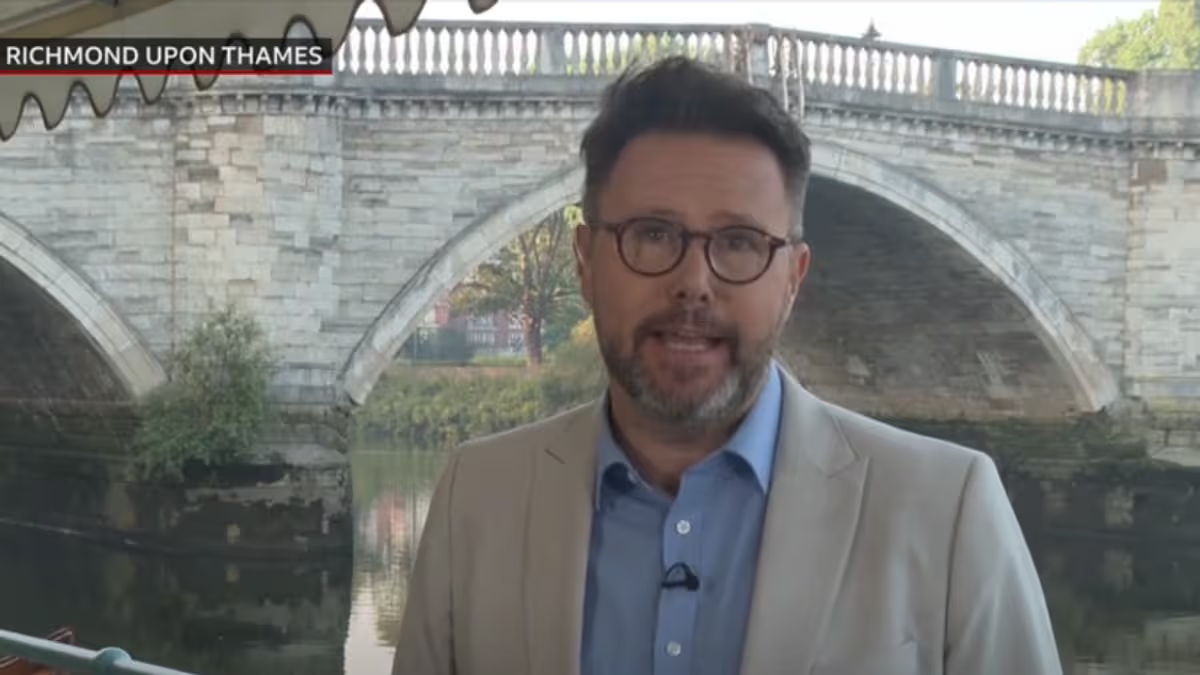
However, when Wednesday’s edition (June 24) got underway, Jon opened the show presenting outside Richmond Upon Thames, while Sally remained alone in the studio.
Advertisement
Within minutes of the show starting, Jon wasted no time alerting viewers to severe warnings indicating a genuine threat to life, as a rare red extreme heat warning has been issued as temperatures soar across the UK.
Addressing those tuning in from home, Jon went on to say: “Today we are here to cover a really serious story.”
He continued: “Parts of England and Wales are preparing for an extreme red heat alert, which has been issued by the Met Office.”
Advertisement
The TV presenter went on: “It means millions of us are set to be affected today so let’s just show you the areas where people are going to find things most challenging over the next few hours.”
The show then cut to a clip of a map as Jon explained: “This red alert will come into force across southern England, across the Midlands and south-east Wales and it starts at nine o’clock this morning.”
Jon warned: “It carries a risk to life warning and it’s only the second time that the Met Office has ever issued an alert like this. The temperature here in Richmond is already 22-23 Celsius but it could reach 38 in some places later.”
He continued: “It’s the humidity as well, which is going to make things even more challenging.”
The camera then panned over to the view, as he added: “If you look over the bridge you can see the air – it feels really humid and sticky and we are just on the outskirts of London.”
Hundreds of schools across England and Wales are closing fully or partially, and rail passengers are being warned to avoid non-essential travel today and Thursday (June 25).
Running fewer trains puts less stress on the railway infrastructure. The idea is also to minimise the number of people caught up in any disruption.
Advertisement
And create breathing space in the timetable so any delays cause less of a knock-on impact.
BBC Breakfast airs everyday from 6am on BBC One and iPlayer


















































You must be logged in to post a comment Login