North Yorkshire Council is looking to alter the terms of the Tadcaster and Selby District Business Support Scheme, which was set up in 2022 to help businesses affected by flooding.
The authority wants to change the fund, which is administered by Two Ridings Community Foundation (TRCF), to help companies across the county.
It is also proposed that the fund helps businesses affected by any extreme weather-related event, not just flooding.
Advertisement
The original scheme was established in 2022, when former Selby District Council allocated £122,500.
With demand in the original target area now reduced, more than £43,000 remains unspent.
Adele Wilson-Hope, the council’s East communities area manager, said in a report: “In the meantime, there have been extreme weather-related events across North Yorkshire, including the flooding in Knaresborough and Kirkbymoorside and surrounding area in May and December 2024 respectively.
“In both instances, the National Flood Recovery Framework was triggered providing financial support in the form of grants, rate relief, and property flood resilience measures for residential properties.
Advertisement
“Most notably, in summer of 2025, Fylingdales Moor experienced a large-scale wildfire which went on for a substantial number of weeks, impacting significantly on local communities.
“Although no residential properties were directly affected, the farming and local hospitality sectors have experienced significant losses due to the fire destroying the moorland and associated infrastructure and road closures prohibiting visitors accessing local caravan sites, hotels, cafés and restaurants.”
The officer said there was no national framework in place to financially support areas impacted by wildfires.
She added: “After on-going discussions with TRCF, it is felt that this fund would benefit from a variation so that it can be more flexibly used, and to more accurately reflect demand that has been felt across North Yorkshire in recent years.
Advertisement
“It is proposed that the area of benefit is broadened to include the entirety of North Yorkshire, and that support should be offered to businesses experiencing the impact of any extreme weather-related event.”
It is proposed that the new North Yorkshire Extreme Weather Business Support Scheme would be offered on a rolling programme, as and when extreme weather events occur.
This would be confirmed and triggered by North Yorkshire Council.
Businesses would need to demonstrate damaged property or contents and/or a significant loss of income because of an extreme weather event.
Advertisement
Priority will be given to businesses with a turnover of less than £500,000.
Decisions on the awards will be made by TRCF officers, with all funding decisions ratified by trustees.
The 43-year-old, wearing a grey zip-up fleece and with glasses on, appeared via videolink from HMP Liverpool for the plea hearing at Liverpool Crown Court on Tuesday.
He pleaded not guilty to causing grievous bodily harm with intent to Kevin Lynch, 51, at Fairway, Huyton, on March 8.
Barton’s co-defendant Gary O’Grady, 50, of Huyton, Merseyside, was not asked to enter a plea to the charge on Tuesday.
Advertisement
An earlier court hearing was told the defendants had been drinking with Mr Lynch at Huyton and Prescot Golf Club before the alleged attack.
Mr Lynch, a former non-league football manager and founder of special education school NexGen Academy, was said to have suffered serious injuries to his eye.
Honorary recorder of Liverpool Judge Andrew Menary KC set a trial date for September 1, with the case expected to last seven days.
The 15-minute hearing also dealt with administrative matters.
Advertisement
Barton, of Widnes, Cheshire, was remanded in custody, while the judge renewed conditional bail for O’Grady, who was supported in court by several family members.
Former Manchester City and QPR midfielder Barton has one England cap and also played for Newcastle, Rangers, Burnley and Marseille.
He now hosts podcast Common Sense With Joey Barton, which is described as an “unfiltered” look at issues in sport, society, politics and more.
A staff member told The Bolton News they “hadn’t seen anything,” in contrast to previous occasions when resident doctors had gathered at the top of the road, where Redgate Way meets Plodder Lane.
Bolton resident doctors in 2023 (Image: NQ)
A spokesperson for Bolton NHS Foundation Trust confirmed they had not been made aware of any picket lines during the six-day strike action.
In recent action, resident doctors have reportedly operated at the MRI unit as part of a ‘hubbed’ response.
Advertisement
Dr Rauf Munshi, Medical Director at Bolton NHS Foundation Trust, said: “Our Emergency Department is always here to help in a life or limb-threatening emergency, and our teams will make sure the sickest patients get the help they need first.
“We have robust plans in place to manage any increase in demand over the Easter weekend and during industrial action, but it’s important people choose the most appropriate service for their needs so that our urgent care services are ready to help those who need it most.
“Even once industrial action is over, we’ll continue to face pressure as our services resume to full levels of activity so please do make sure you know the best way to access services for your health needs during this challenging time.
“If you are ever unsure about where to go, NHS 111 online can provide advice for your symptoms.”
Advertisement
The British Medical Association (BMA) has been contacted for comment.
Gold Digger singer Kanye West has been blocked from travelling to the UK by the Westminster Government
American rapper and record producer Kanye West has been denied permission to travel to the UK by the Westminster Government.
Advertisement
The Gold Digger singer had recently come under fire following his controversial planned headline set at the Wireless Festival later this year.
According to the BBC, the Home Office has decided to refuse permission for West to enter the country as his “presence would not be conducive to the public good”.
Yesterday, the singer who legally changed his name to Ye in October 2021, applied to come to the UK via an Electronic Travel Authorisation (ETA).
West has previously caused outrage for a string of antisemitic, racist and pro-Nazi comments.
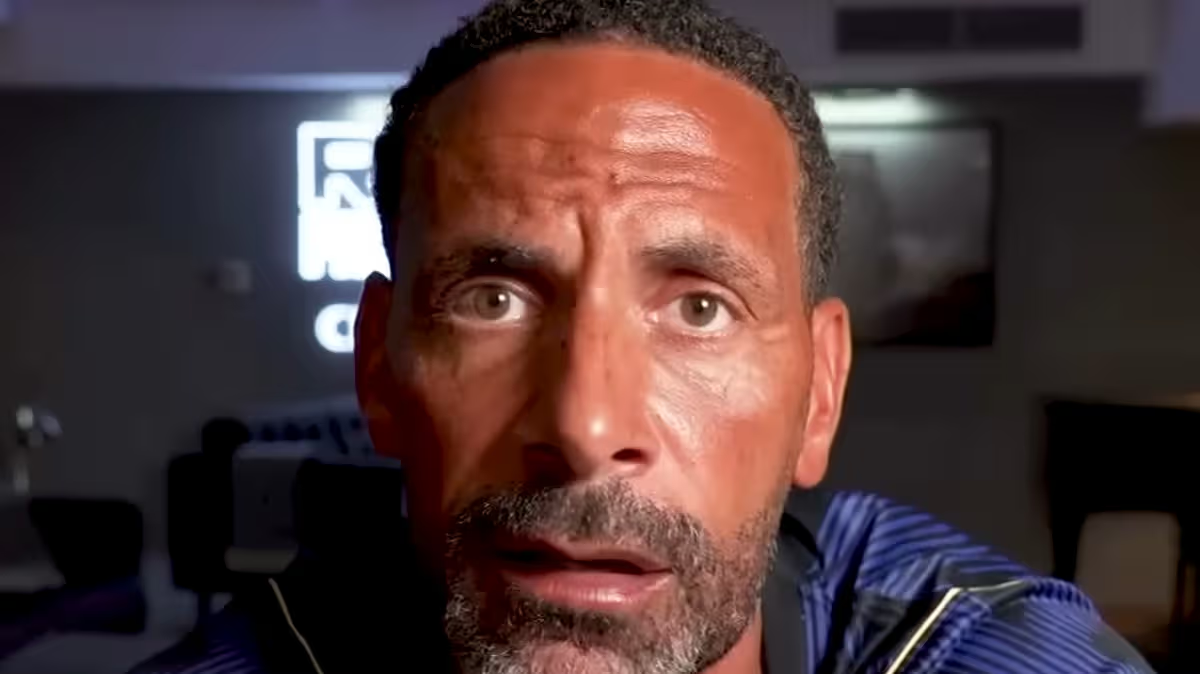
Barcelona signing Marcus Rashford from Manchester United for just £26m this summer would be an ‘absolute robbery’ and ‘a steal’, according to Rio Ferdinand
Rashford, 28, is only on loan at the Catalan club for this season, but they do have an option to make that move permanent for £26million this summer. The England international equalised for them against Atletico Madrid in their 2-1 comeback win last weekend.
That goal is his 11th of this loan spell, and Rashford has also assisted another 10 for his teammates. The latest strike left Ferdinand impressed and led to a discussion about his future at United.
Advertisement
Get MEN Premium now for just £1 HERE – or get involved in our United WhatsApp group by clicking HERE. You can also join our United Facebook page by clicking HERE, and don’t miss out on our brilliant selection of newsletters HERE.
On the YouTube channel Rio Ferdinand Presents, he said: “Oh, what a goal, what a good goal, man.” Asked if he would have Rashford back at United, Ferdinand replied: “Absolutely if Marcus Rashford is playing like that.
“That goal there is Marcus Rashford, right? That isn’t a surprise. We’re not sitting here going, ‘Oh my God, did you see Marcus Rashford, what he did the other day? Never knew he could do that.’
“No, no, that’s what we expect. That’s what Marcus Rashford has made us feel is the norm with him, because he’s that good, potentially, he’s that good, right? It’s just that we hadn’t seen it for a while at Manchester United, and there are obviously reasons behind that, but let’s forget that now, that page has turned, right?
Advertisement
“He’s now at Barcelona, 10 goals, 10 assists this season. What a loan signing he has been for Barcelona, if you look at it like that, and, so, would you have that Marcus Rashford back? 100%, right? But I think that ship has sailed and I think Marcus Rashford is looking forwards.
“I think deep down, he’ll want to go to Barcelona, and I just hope that actually materialises for him, because I think when you look at it like that, is he playing consistently like the Marcus Rashford that we knew before? I’d argue probably not.”
Rashford has made 40 appearances across all competitions this season for Barcelona, but just over half, 22, have been starts. He also featured in just one of their last three matches before the international break.
Ferdinand, however, believes they should still sign him permanently from United this summer. He explained: “We’re seeing more glimpses of it that would be making me go, ‘I’ll bet on that’, and if I’m at Barcelona, I’ll take him.”
Advertisement
Factoring in the set price they have to do that deal for. Ferdinand believes it would be a bargain and hopes it happens for the player’s sake, too.
He added: “If Barcelona get him for the reported £26million that we’re talking about, and they get that version of Marcus Rashford, that is an absolute robbery, it’s a steal.
“So, as I said, I’ll just say good luck to him, I want him to do well, you know what I mean? Because I’ve seen him grow as a young player at Man Utd, and good luck to him in that sense.”
Content cannot be displayed without consent
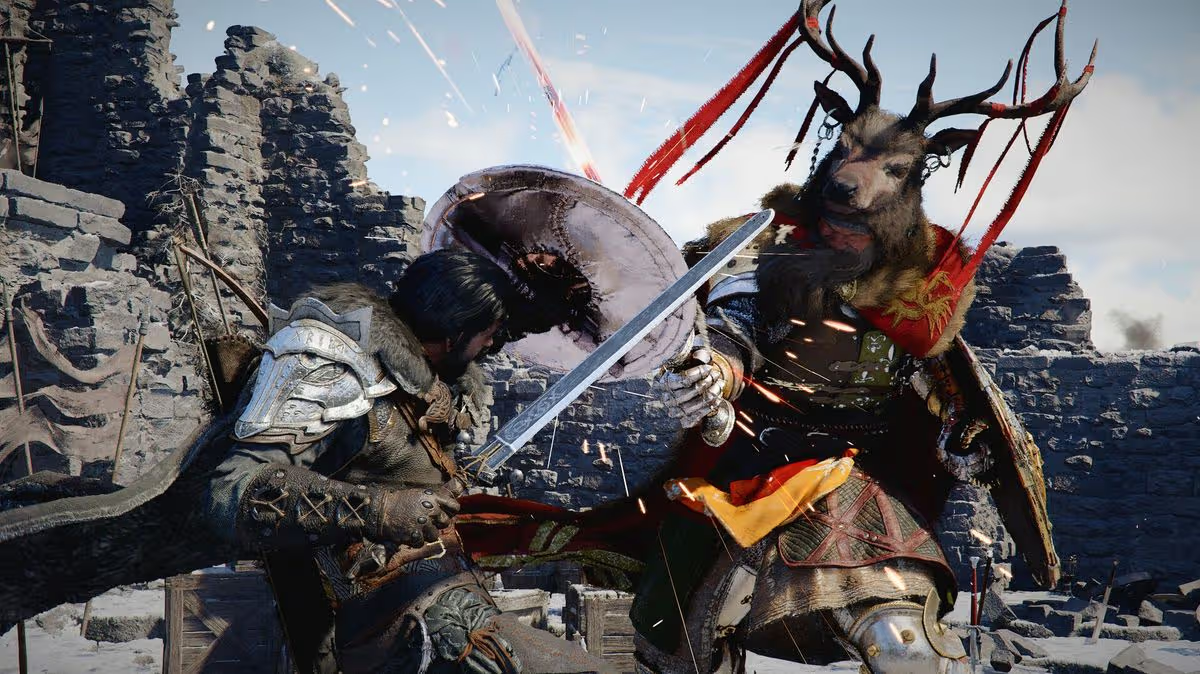
Pearl Abyss adds additional storage options in Crimson Desert with the latest update.
Crimson Desert might be a few weeks old, but it’s still receiving regular updates from developer Pearl Abyss to further improve on the already impressive open world game.
Advertisement
While previous updates have added new mount options and offered improvements to the crime system, the latest update promises to further expand on storage options. There’s also a feature that’s often used in RPGs coming to Crimson Desert that’s almost hard to believe wasn’t included in the first place.
For the full Crimson Desert 1.02.00 patch notes and a rundown of the big changes to know, read below:
The headline update for Crimson Desert this time is the ability to toggle headgear visibility. This means you can benefit from a helm’s armour stats, but it will appear invisible during gameplay and conversations.
This is a popular option to enable in a lot of RPGs where players are keen to see their custom character’s face. Of course, Kliff isn’t customisable in the same way, but it’s nice to have the option to see his grizzled complexion during gameplay.
Elsewhere, Pearl Abyss has added new storage expansion slots depending on how much the Greymane camp is levelled up. The higher the level, the more things you’ll be able to keep in the storage chest.
The new storage cap is 1,000 items, which should be plenty for even the most dedicated of players.
Crimson Desert enjoyers might have noticed that the last update changed the way Kliff controls slightly. While this was intended to make the game more responsive, not everyone was a fan of the new system.
With update 1.02.00, there’s now an option to toggle back to the old movement mechanics.
For more granular updates on what’s changed in Crimson Desert with this patch, here are the full notes:
Crimson Desert update 1.02.00 full patch notes
Content
Advertisement
Depending on your progress with the Greymane camp expansion, the capacity of your private storage can now be increased from 240 slots up to a maximum of 1000 slots. Through the expansion of your camp, which consists of 5 stages in total, you can expand your private storage as follows: Start with 240 slots First camp expansion +100 slots Second camp expansion +100 slots Third camp expansion +100 slots Fourth camp expansion +100 slots Final camp expansion +360 slots
Added an Abyss Nexus in Pailune.
Improved the visibility of explosive barrels when using the “Light Reflection” skill or when shining the lantern on them.
Fixed an issue with combat missions, where comrades would not return until the mission timer expired if the mission was completed before the time limit.
Fixed an issue where the Abyss puzzle state would reset when viewing detailed information of nodes via the map “Details” menu while in the Abyss.
Fixed an issue where the character would become invisible if an Abyss Artifact was obtained before the Abyss completion cutscene played.
Fixed an issue where the skills Healing Force Palm and Aerial Force Palm were also reset when resetting all skills.
Changed the designs of certain gimmick monsters.
Added 1 new armor set and helmet for cats.
Improved Abyss Skybridge Gates so that restored Gates can be teleported to. (This change was applied in Patch 1.01.00)
Fixed an issue where the bank investment refresh time would remain stuck in the “Refreshing” state and not update. (Added: 2026/04/04 05:00 UTC)
Controls & Combat
Added a “Movement Controls” option. The option can be selected via Main Menu > Others > Settings > Input > Movement Controls, and offers two options: Basic and Classic. Detailed descriptions can be found in the in-game options menu. Basic movement controls: Hold the sprint key to accelerate. Classic movement controls: Repeatedly press the sprint key to accelerate.
The stamina consumption for mounts has been adjusted. With Basic movement controls, holding the sprint key consumes stamina at set intervals. With Classic movement controls, stamina is consumed each time the sprint key is pressed.
Improved the conditions for using the Abyss Nexus, allowing them to be used even while moving slightly except in certain situations such as while mounted or while using Flight. We plan to improve this further in the near future so that the player character can fast travel even while on certain mounts.
Improved so that the Flight skill can be activated even when holding the jump key in mid-air.
Improved responsiveness when inputting a jump after an attack.
Added an Escape key guide when affected by elemental status effects.
Fixed an issue where the Focus state would not be canceled when using Aerial Roll during flight.
Fixed an issue where weapons could not be drawn inside Demeniss Castle under certain conditions.
Fixed an issue where some bosses would teleport too far away during combat.
Fixed an issue where the ‘Double Boost’ horse ability would not activate properly.
Fixed an issue where parry would not activate properly during ‘Focus’ when a two-handed sword was equipped.
Fixed an issue where the camera would turn toward nearby enemies when aiming with a tool.
Fixed an issue where certain interactions were unavailable while specific tools were equipped.
Fixed an issue where repeatedly pressing the sprint key would allow a horse to run at maximum speed regardless of its stats.
Quests
Fixed an issue in Chapter 6 where quest progression became unavailable after defeating a boss following a save/load under certain conditions.
Fixed an issue where quest progression became unavailable if a related item was sold before starting the ‘A Rumor Fueled by Greed’ quest.
Fixed an issue in Chapter 11 where the Inserted Key could disappear from the bag, preventing related quest progression.
NPC & NPC Dialogue
Fixed an issue where certain quest-related NPCs would not appear.
UI Fixes & Improvements
Improved the item use notification in the bottom-right corner so that using it will select the item directly.
Improved the shop UI so that sellable items are prioritized on display.
Reorganized certain positions and content of the key guide displayed in the bottom-right corner to improve visibility.
Improved the UI so that the Save Game and Load Game menus are separated, and added save slot number labels.
Fixed an issue where the minimap scale would reset while riding a mount at maximum speed.
[Keyboard/Mouse] Fixed an issue where the mouse cursor would disappear in the storage menu.
Fixed an issue where item movement would not work properly when entering the horse inventory menu in certain circumstances.
Fixed an issue where certain menus would occasionally not respond to interaction or appear visually awkward.
Fixed an issue where crashes occured when entering or using some UI/menus in certain circumstances.
Improved the game so that the “Stow Weapon” key guide is displayed while in combat when mounted.
Graphics & Settings
Added a “Headgear Visibility” option in Settings > Language & Gameplay. The following options are available to choose from: Always Show / Show in Combat / Hide in Cutscenes / Always Hide. Additionally, a feature to hide weapons shown on the character’s back, which many players have requested, is also planned to be added in the near future.
[PC] Fixed an issue where GPU memory usage would increase when the DLSS RR option was configured.
[PC] Improved GPU load and shimmering in certain circumstances when FSR-RR / DLSS-RR was enabled.
[PC] Fixed an issue where foliage and certain other elements were not rendered properly in ray-traced reflections when FSR-RR / DLSS-RR was enabled.
[PC] Fixed an issue where the top of the screen would flicker when DLAA and HDR options were enabled.
[PC] Fixed a rendering issue affecting the character’s face indoors when the graphics preset was set to Low.
[PlayStation 5] Applied the Upgraded PSSR Sharpen feature on PlayStation 5 Pro, improving image sharpness.
[PlayStation 5] Applied Upgraded PSSR Native AA to Quality Mode on PlayStation 5 Pro.
[Xbox] Fixed an issue where V-Sync behavior would change when pressing the Home button.
[Xbox] Added a 4K upscaling option to Performance Mode on Xbox Series X.
Performance, Stability, Gameplay
Fixed several stability, performance optimization, and crash issues across PC, console, and Mac.
Localization
Fixed various localization errors and improved localization quality (game advice, etc.) across all languages.
Others
Fixed an issue where certain walls in Corridors of the Void were missing.
Improved the sound so that the sound position changes together with the camera perspective.
Fixed various other in-game issues.
Other Fixes
Fixed an issue where the weapon would not be visible when using the ‘Stab’ ability while ‘Unarmed’ was equipped as a secondary weapon.
Improved the UI so that license information can now be viewed in the Credits.
Fixed an issue the audio volume would become low when an NPC won in minigames such as Duo.
Fixed an issue where the background audio would become distorted in certain locations and situations.
Ensure our latest headlines always appear at the top of your Google Search by making us a Preferred Source.Click here to activateor add us as your Preferred Source in your Google search settings.
Joe – who penned the script of the original Basic Instinct, as well as the likes of Flashdance and Showgirls – explained he’s almost done with writing a new spin on the original 1992 erotic romance.
He claimed: “The producers are negotiating with a really interesting director – a Brit, Emerald Fennell – who did Promising Young Woman and Wuthering Heights.”
Advertisement
“Her sensibility is exactly right,” Joe continued. “She’s someone who is not afraid of controversy and sexuality. So I’m thrilled by that. I hope it works out.”
After working both behind and in front of the camera on screen, Emerald made her feature-length directing debut in 2020 with Promising Young Woman, which was nominated for five Oscars and won one in the Best Original Screenplay category.
She followed this with Saltburn, a dark comedy thriller set in the mid-2000s, which got everyone talking thanks to its many twists and rather graphic sex scenes upon its release in late 2023.
Barry Keoghan in Emerald Fennell’s Saltburn
The original Basic Instinct was a box office smash upon its release, with Sharon Stone and Michael Douglas in its lead roles.
Advertisement
A much-panned sequel eventually followed in 2006, winning Worst Picture and Worst Actress at that year’s Razzies.
Thai food has been rising in popularity over recent years with great spots popping up all over Cambridgeshire.
Celebrations for Thai New Year or Songkran are taking place from Monday, April 13, to Wednesday, April 15. Many people who celebrate will be getting involved in huge water fights, family gatherings, and cleansing rituals to mark a fresh start.
Advertisement
You might also want to celebrate the occasion by enjoying some traditional Thai food. From piles of noodles topped with a range of vegetables and meats to fragrant curries packed with herbs and spices, Thai cuisine is versatile and growing in popularity.
Luckily, Cambridgeshire has plenty of food spots to try out with Thai dishes available. You can find Thai food in traditional British pub settings or in a cosy restaurant for more special occasions.
If you are looking for somewhere for a quick lunch or want to enjoy a relaxing dinner with friends, you should be able to find a food spot that suits you.
CambridgeshireLive wants to know where we can find the best Thai food in the county. Whether you love a restaurant because of its wonderful staff or love the affordable prices, there are many reasons why you keep returning to a Thai restaurant.
Advertisement
You can tell us where your favourite Thai spot in Cambridgeshire is by using our survey below. If the survey does not appear for you, you can open it in a new tab here.
The leader of Taiwan’s largest opposition party arrived in China at the invitation of Xi Jinping on Tuesday for a “peace mission” at a time of increased military tensions between the self-governed island and the mainland.
Cheng Li-wun’s trip marks the first visit by a Kuomintang (KMT) leader to China in a decade, although Beijing is yet to confirm whether the Chinese president will definitely meet her.
Cheng said at her party headquarters in Taipei she had embarked on a “historic journey for peace”, but added that some people feel uneasy about the visit. “If you truly love Taiwan, you will seize even the slightest chance, every possible opportunity, to keep Taiwan from being ravaged by war,” the KMT chief said in defence of her visit. China sees Taiwan as its own territory and has not ruled out reunification by force, if necessary.
The trip, which comes just weeks ahead of US president Donald Trump’s May visit to Beijing, has sparked concerns among the Taiwanese people who anticipate a territorial conquest by China sometime in the near future. The threat of invasion has been a major concern for Taiwanese president Lai Ching-te’s administration as well.
Advertisement
Kuomintang chairperson Cheng Li-wun shakes hands with Song Tao (R), Director of the Taiwan Work Office of the Communist Party of China (CPC) Central Committee and Taiwan Affairs Office of the State Council in Shanghai Hongqiao International Airport (Central News Agency (CNA)/AFP)
Lai, viewed as a separatist figure by Beijing, has called for ramping up Taiwan’s defence capabilities and bolstering the self-governed island’s defence budget, drawing lessons from multiple conflicts around the world, including the Russia-Ukraine war.
The Cheng-led opposition bloc, which dominates parliament, has also been accused of blocking a $40bn special defence budget since November 2025, which Lai has been pushing for to bolster Taiwan’s military muscle against China’s People’s Liberation Army.
Before leaving for China, Cheung said: “So I would rather believe that all Taiwanese people hope this trip will succeed, because we can transform the most dangerous place in the world into the safest place in the world.
“I believe that through this journey for peace, everyone is even more eager to see the sincerity and determination of the CPC (Communist Party of China) Central Committee to use peaceful dialogue and exchange to resolve all possible differences between the two sides,” she added.
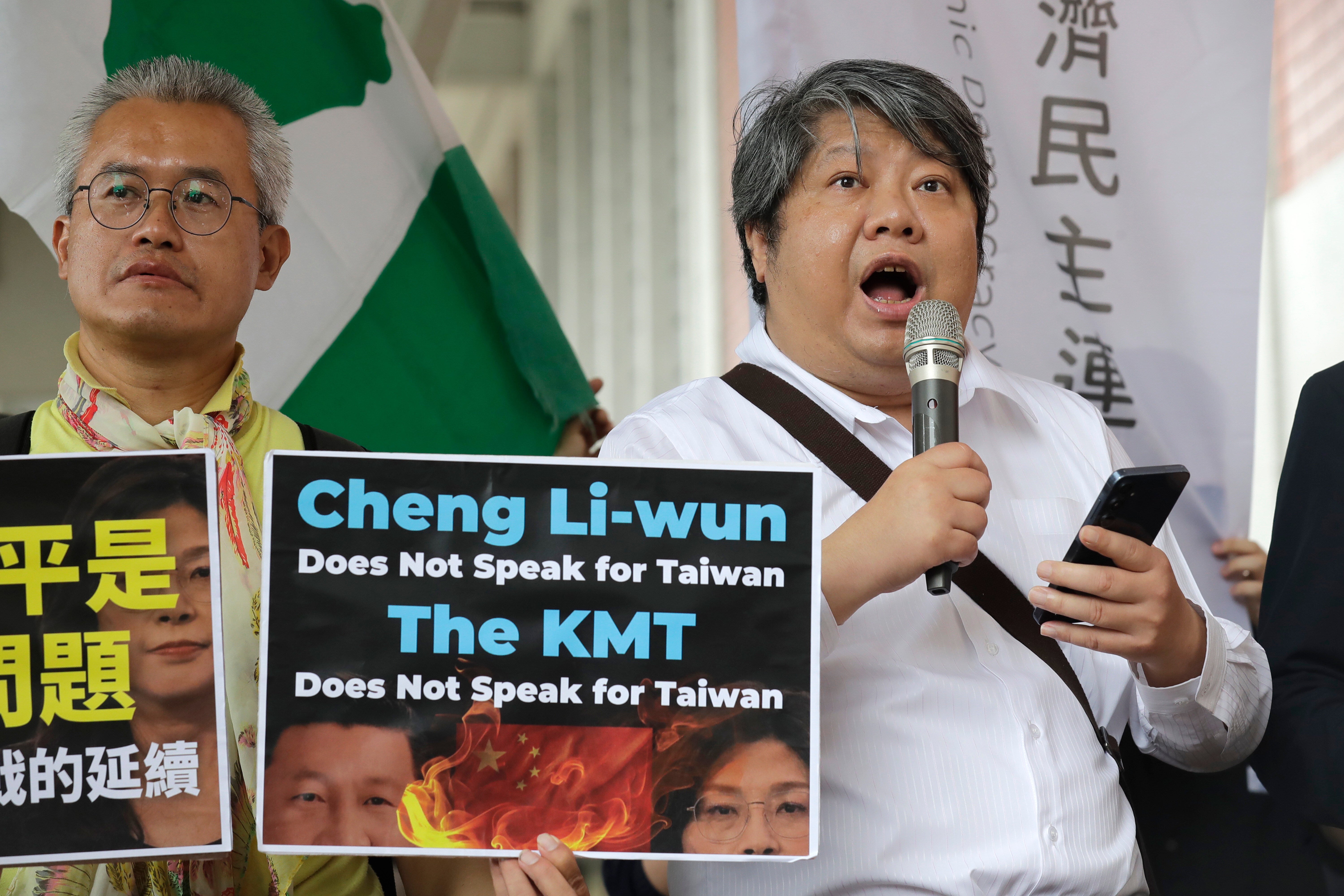
A protester delivers a speech as Taiwan’s main opposition Nationalist Party, or Kuomintang (KMT) chairperson Cheng Li-wun leaves for China (AP)
The Taiwanese official took a train to Nanjing, which hosts the mausoleum of Chinese revolutionary leader Sun Yat-sen. Sun, the father of the revolution that toppled China’s last emperor in 1911, died in 1925, and is a hero in China despite being the former leader of the Kuomintang, or Nationalist Party, defeated by the Communists in 1949.
The head of China’s Taiwan Affairs office, Song Tao, and Cheng “chatted cordially like friends” on the train, with the KMT leader calling her trip “especially rare and precious”, the party said.
Advertisement
Cheng did not address the increasing military escalation from across the Taiwan Strait where China has been sending warplanes and naval vessels around the smaller island on a near-daily basis. China’s PLA forces have also recently staged two major military exercises around the island, with the most recent one in December, after the US announced arms sales to Taiwan and involved the deployment of air, naval and missile units for a joint live-fire drill.
The US State Department said PLA’s exercises “increase tensions unnecessarily” and called on Beijing to cease military pressure against Taiwan.
Late on Monday, Kuan Bi-ling, head of Taiwan’s Ocean Affairs Council, which runs the coast guard, posted a picture on her Facebook account of current Chinese warship deployments around the island – two off the east coast, and one each to the north, northwest and southwest.
“When you depart, you are doing so from within what they see as the ‘Taiwan cage’,” Kuan told reporters at parliament on Tuesday, referring to how China’s military has termed Taiwan’s planned T-Dome air defence system and talking about Cheng’s trip.
Advertisement
Lawmakers in Taiwan slammed the visit, saying that the opposition leader is following the steps China wants her to. “From the fact that the accompanying journalists were chosen by China’s Taiwan Affairs Office, to the use of a Chinese aircraft, and even the uncertainty before departure over whether she would be able to meet president Xi, KMT chairwoman Cheng Li-wen’s visit to China was, from the moment she boarded the plane, locked into the ‘One China’ framework,” said Fan Yun, a lawmaker from the ruling Democratic Progressive Party (DPP).
Cheng, she said, could very well be a model figure for Xi’s propaganda on “One China” policy.
The opposition, according to the lawmaker, is ignoring the obvious ground reality as public opinion polls in Taiwan show that support for unification has fallen below 10 per cent.
“The mainstream view in Taiwan is that Taiwan (Republic of China) and China (People’s Republic of China) are not subordinate to each other,” she tells The Independent, adding that while peace is “something all Taiwanese people support, but we learn from history that peace must be backed by strength”.
Advertisement
Chinese flags fly on fishing boats in Tailu village, on the Chinese coast opposite Taiwan’s Matsu islands, in China’s southeast Fujian province on in 2024 (AFP/Getty)
Regional experts say the trip serves Cheng little but benefits China more.
“Cheng’s visit won’t fundamentally change China’s calculation and preparation for a potential reunification with Taiwan. For Beijing, her trip primarily serves propaganda and diplomatic signalling purposes,” says William Yang, the International Crisis Group’s senior analyst.
For Xi’s domestic audience, the visit will display the government’s progress on the mission of reunification with Taiwan, he says.
“Cheng’s remarks during the trip, which will focus on calling for peace and reiterating her opposition to Taiwan independence, will be amplified by Chinese state media to try to exacerbate division within Taiwan,” he says.
Some leading figures in her own party are also worried that her rhetoric during the trip could damage the party’s prospects in the local election in November. “Despite these criticisms and diverging views within her party, there are also some in Taiwan who view her trip as a necessary step to help reduce the level of tension across the Taiwan Strait,” Yang says.
Advertisement
China will use the trip to demonstrate to the US “that there are still political leaders in Taiwan who are willing to conduct cross-strait exchange and pursue peace across the Taiwan Strait”, he says.
Today’s best National Express discount codes and offers
To help you save more on your coach travel, The Independent’s deals team has sourced the very best National Express discount codes and the top ways to save, including £5 tickets and student discounts. Keep scrolling for all this and more.
Browse cheap ticket offers
Advertisement
National Express’ cheap ticket offers start from less than £5. Explore more of the UK’s top destinations for a fraction of the cost, with journeys to Bournemouth, Birmingham, Manchester and beyond starting from just £4.90.
Get airport travel from just £8
If you’re catching a flight from Stansted, National Express offers a reliable mode of transport to the aviation hub. The direct 1 hour 10 minutes journey departs Liverpool Street for Stansted airport, with up to 49 coaches running per day. With airport tickets starting from just £7 and drop-off at the terminal, securing your seat for your holiday couldn’t be easier.
National Express student discounts
Advertisement
Students travelling between university and home for the holidays can save up to 25 per cent on the cost of their coach travel through Unidays, Totum or Student Beans. Think direct journeys to and from university campuses with wifi for working on last-minute deadlines and a great luggage allowance for the bags of washing.
Save a third with a coachcard
For those travelling by coach regularly, a coachcard is a no-brainer. There is an upfront cost of just £15, but a coachcard saves you a third off all standard and flexible fares, meaning it will pay for itself in no time. Below are the cards currently available to purchase:
Young persons – for those aged 16-26 years
Senior – for those 60 or over
Disabled – anyone with a registered disability
Refunds and amendments
Standard tickets are non-refundable and incur a £5 fee if you need to amend any of your travel details. Alternatively, you can pay a fraction more for a flexible ticket, which allows you to change or cancel your booking up to 24 hours before with no extra costs.
Advertisement
What’s on board?
All National Express coaches come with free wifi and USB ports for charging devices, as well as air conditioning. Each passenger has a generous 20kg luggage allowance, as well as an extra piece of hand luggage, which is ideal for longer trips.
To provide you with the best discount codes from our carefully selected travel providers, we have a dedicated team of bargain hunters constantly on the lookout. From flights and hotels to holiday packages and travel gear, we recommend bookmarking our dedicated deals page to access the latest and greatest money-saving discount codes. We only highlight offers from our favourite and trusted retailers and brands.
The Independent has been a trusted consumer champion since 1986, using years of expertise to advocate for our readers by finding the best deals and discounts. Whether you’re planning a holiday or taking advantage of major shopping events like Amazon Prime Day, Black Friday, or the Boxing Day sales, our skilled team is dedicated to helping you save money. We strive to present the very best deals from brands we love ourselves.
Advertisement
*See the National Express website for full terms and conditions for all offers featured on this page. Information verified and correct at time of last publication date.
Few fashion trends in 2026 split opinion like trainer Mary Janes. A fusion of feminine ballet flats and sporty silhouettes, the hybrid shoe has been championed by the likes of Puma, Onitsuka and Nike. But it’s Adidas’s samba Mary Janes that have won favour with the fashion crowd.
The unexpected shoe launched in 2025, riding the wave of samba’s enduring popularity and the resurgence of Mary Jane flats. The reimagined shoe features the trainer’s signature low-profile, leather upper and suede overlays, with a single velcro strap replacing the traditional laces.
Love them or loathe them, they’ve dominated social media feeds, prompting Adidas to release new colourways earlier this year – think on-trend burgundy, metallic finishes and even a floral print style. The 2026 version of the “ugly” dad trainer trend, I’ve seen the Adidas Mary Jane sambas styled with everything from matching track tops and trousers, jeans and white poplin midi skirts to capri pants and cargo trousers.
True to form, the high street has been quick to catch on with affordable alternatives – including M&S, which is going from strength to strength with its new spring collection. Be it a bag that nods to Chanel, a perfume that riffs on Le Labo or basics that rival Skims, M&S is among the best destinations for designer dupes.
Advertisement
Now, it’s jumped on the controversial Mary Jane trainer trend with two suede shoe styles. Featuring the same streamlined silhouette and velcro strap as Adidas’s trainers, here’s everything you need to know.
Available in two neutral colourways, M&S’s trainer Mary Janes are designed in either a beige or chocolate brown finish. The shoes feature the same low-profile, slim silhouette as Adidas’s samba shoes, complete with a gum sole and contrast panelling. There’s also similar T-toe detailing and velcro strap that nods to traditional Mary Jane shoes. Costing £50, sizes are selling out fast.
M&S samba Mary Jane
If you’re after the OG Adidas samba Mary Jane shoes, the sports brand offers them in several colourways. The white is classic and easily styled, with the burgundy and floral print finishes adding intrigue to your everyday look.
Designed with all the samba signatures – including the three stripes, leather upper, suede panelling and T-toe – the trainers boast a slip-on design and velcro strap.















































You must be logged in to post a comment Login