Most types of ibuprofen can be accessed without prescription
NHS inform is highlighting when people may need to contact their GP or dial 111 after using ibuprofen.
Advertisement
Ibuprofen is available in various forms including tablets, capsules, liquid and granules. It’s commonly used to relieve mild to moderate pain, such as toothache, to manage fevers, and to reduce inflammation and swelling. Most types of ibuprofen can be purchased from supermarkets or pharmacies, although certain types require a prescription. Regardless of which form of ibuprofen you’re using, you should always read and follow the instructions on the label or leaflet.
Typical side effects of ibuprofen include nausea (feeling sick), vomiting, indigestion, stomach pain, diarrhoea, and constipation. NHS inform advises you should speak to a GP or contact 111 if someone has used ibuprofen and:
they continue to experience pain
they have a high temperature that doesn’t improve
their symptoms worsen
their symptoms persist for more than three days
they feel unwell
People who should avoid ibuprofen
You shouldn’t take ibuprofen if you’ve ever experienced a severe reaction to aspirin or other nonsteroidal anti-inflammatory drugs (NSAIDs), or if you have a stomach ulcer, or have suffered from one previously. You should also avoid ibuprofen if you’ve been using low-dose aspirin to prevent cardiovascular disease, or if you have severe heart failure or severe liver disease.
Ibuprofen should be “used with caution” if you’re 65 or older, breastfeeding, or suffer from asthma, lupus, Crohn’s disease or ulcerative colitis, high blood pressure, kidney or liver issues, narrowing of the arteries (peripheral arterial disease), or any heart problems, such as angina, heart attacks, or mild or moderate heart failure. The same applies if you’ve previously had a stroke.
If you have any concerns about taking ibuprofen, you should consult a pharmacist. You can also contact your GP surgery or ring 111.
The supermarket giant has recalled three handbags which pose a risk to customers due to excess phthalates.
The Office for Product Safety and Standards (OPSS) warned that phthalates can harm the health of children, and could cause damage to reproductive systems.
The spokesman added: “The product has been recalled from end users by ASDA.
— Office for Product Safety and Standards (@OfficeforSandS) August 28, 2026
An Asda spokesman added: “The product presents a serious chemical risk as it contains excessive concentrations of Di(2-ethylhexyl) phthalate (DEHP), Phthalates are harmful to health and may cause damage to the reproductive system.
Advertisement
“The product does not meet the requirements of the REACH Regulations.
“If you have purchased any of the above bags, please bring it back to your nearest store where you will be given a full refund. You do not need your receipt. We are very sorry for any inconvenience caused.
“If you would like any further information, please contact: Asda Customer Relations – 0330 053 0111.”
The actor will be joined by a string of professionals as he unpacks how the system got people wrongfully convicted.
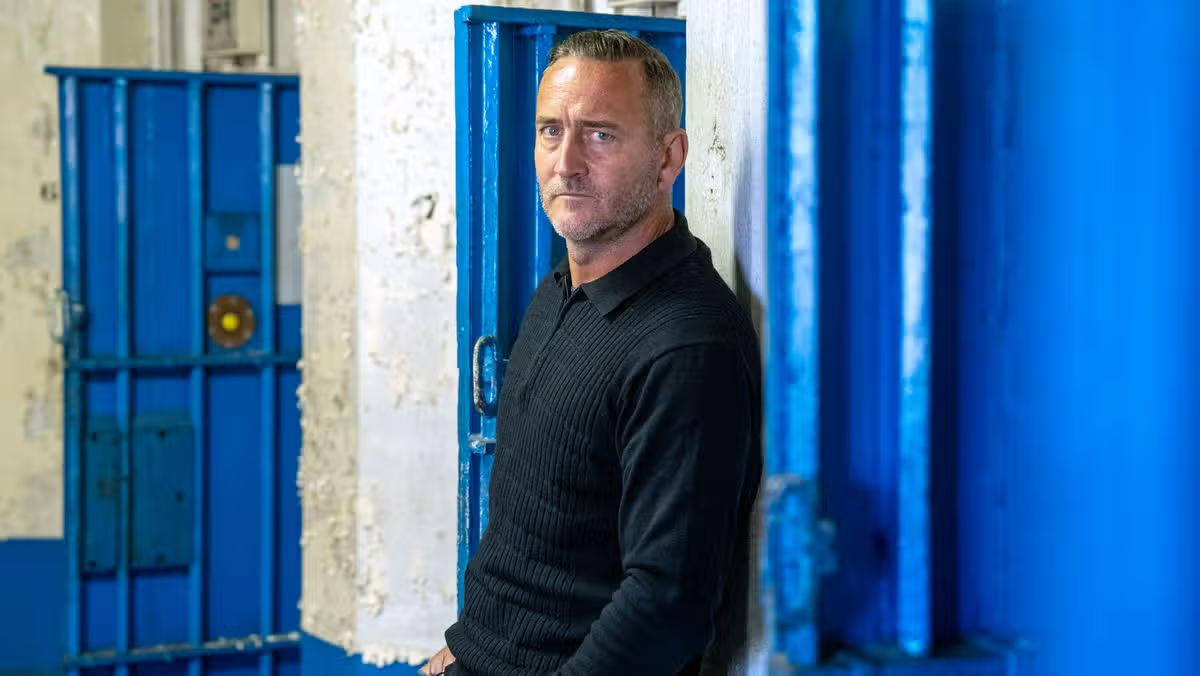
Will Mellor will be hearing from those falsely accused in a brand new series.
Advertisement
True crime fans are in for a treat as the actor, who has starred in the likes of Broadchurch, The Teacher and A Woman of Substance, will be taking a closer look at how the legal system has failed some people.
After investigating Cops Who Kill and Cops Gone Bad in the past, he’s now returning to Crime+Investigation for Convictions Gone Bad. The five-part series will see Will delve into some of the most shocking miscarriages of justice in legal history.
Throughout the series, Will is joined by a range of professionals, including a seasoned former detective, a top forensic scientist and a legal expert. In the programme, he’ll be unpacking how the system got it so disastrously wrong.
The star will also reveal the crucial new evidence that finally set the wrongfully convicted free. A synopsis for the show reveals that in the episodes, Will will be hearing from those falsely accused.
Advertisement
In their own words, they’ll be ‘Providing an insight into what it’s like to be arrested, tried and convicted of the most horrendous of crimes; and the subsequent battle to clear their name.’ One of the people Will speaks to is Justin Plummer, who served over 27 years in prison for a murder he didn’t commit and Kevin Richardson of the Central Park 5.
Other cases featured include Andrew Malkinson, Sam Hallam, and Angela Cannings, who collectively served over 25 years in prison whilst maintaining their innocence.
An overview reads: “Alongside former Detective Inspector Howard Groves , Will takes a fresh look at the original crime, retracing the steps of the investigators and exploring how the case was built.
Advertisement
“Will meets forensic scientist Carol Rogers to examine the crucial evidence used by the prosecution to secure a conviction. They break down the complex science, revealing where the evidence was flawed and the expert advice was unsafe.
“He’s joined by legal expert Professor Claire McGourlay to chart the twists and turns of the appeal, until finally – the wrongfully convicted get their day in court.”
The programme, which has been produced by ITN for Crime+Investigation, will see the actor examine what happens when the justice system fails, and the wrong person ends up going to prison for a crime they didn’t commit.
Advertisement
In the past, Will has also delved into cops who have killed, but also fraudsters, swindlers, sexual predators and drug dealers. In the seven-part series at the time, he looked into former metropolitan police officer David Carrick, former Cheshire police constable Martin Forshaw, former Metropolitan police officer Rodney Whitchelo and a former Met officer, Kashif Mahmood.
It also looked into Michael Coulton, a police officer assigned to royal protection duties at Buckingham Palace, who hatched an elaborate plan to murder his wife. The programme also went abroad to shine a spotlight on US cop Drew Peterson and ex-chief investigative officer Mark Standen from Australia.
Speaking about his true crime series, Will commented: “I’m really pleased to be back for Cops Gone Bad. In this series, we’ll be examining cases of corrupt officers from the UK, US and Australia, and whilst the majority of cops do an amazing job every day, it’s important to hold those that don’t, to account.”
Advertisement
Convictions Gone Bad with Will Mellor premieres on Monday, October 5 and airs 9pm weekly exclusively on CRIME+INVESTIGATION
Lindsay Clancy‘s defense lawyer addressed speculation of a plea deal outside of court on Tuesday.
When asked by a reporter if he had considered a deal, Kevin Reddington responded: ‘Ask Mr Cruz if he’d offer one. It’s the only thing I can tell you because I have no control over it,’ referring to Plymouth County District Attorney Timothy J Cruz.
The jury in Clancy’s murder trial will enter its fifth day of deliberations today after returning deadlocked on Tuesday.
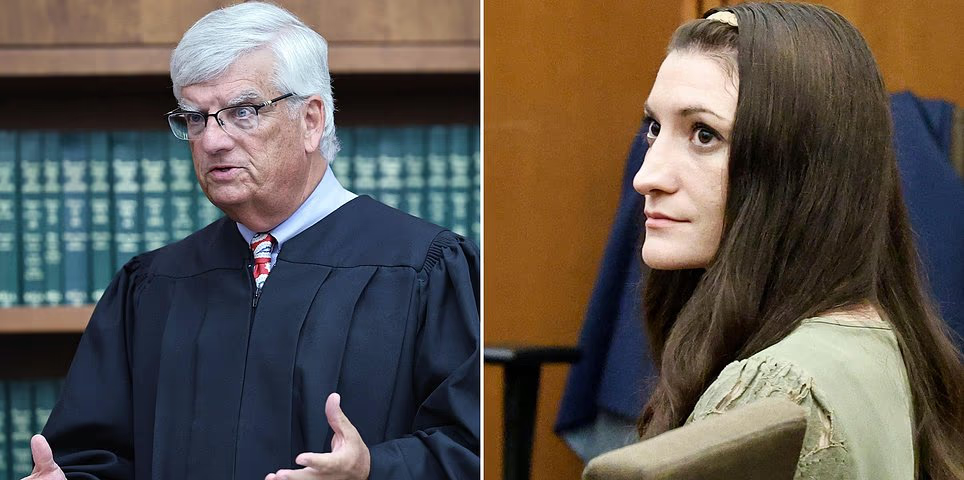
The nine women and three men were unable to reach a unanimous decision before Judge William Sullivan ordered them to continue to weigh up evidence yesterday.
Advertisement
Clancy is on trial for killing her three children Cora, five, Dawson, three, and Callan, eight months, using exercise bands at her Duxbury, Massachusetts, home in January 2023. She has admitted to the slayings but pleaded not guilty to murder.
On Tuesday afternoon a woman was arrested outside of court for allegedly ‘filming jurors.’
Dawn Light, 56, was taken into custody and charged with intimidation of a witness, jurors or person furnishing information in connection with criminal proceedings, Massachusetts State Police announced.
Light’s arrest came just 10 minutes after the jury was excused for the day as a stalemate continues.
Advertisement
Follow the Daily Mail for more updates…
Clancy’s defense attorney responds to questions over plea deal
Lindsay Clancy’s defense attorney Kevin Reddington criticized District Attorney Tim Cruz for pursuing the first-degree murder charges against her.
‘You should ask Mr Cruz why he did not reduce the charges to second degree so that the matter could be waived by a jury and tried by a judge,’ he told reporters as he left court on Tuesday.
‘You should ask Mr Cruz why we’re trying a case on triple homicide, first degree, not me. You cannot try jury waved first degree murder in Massachusetts it has to be by a jury, and he drives the bus.
Advertisement
‘The judge has no control over it; I have no control over it; it’s entirely up to the DA.’
When asked by a reporter if he would consider a plea deal for Clancy, Reddington replied: ‘Ask Mr Cruz if he’d offer one. It’s the only thing I can tell you because I have no control over it.’
WATCH: How the Lindsay Clancy trial unfolded as jury deliberates murder
Judge kicks off court issuing reminder of the rules
Judge Sullivan opened court today by reminding everyone of the rules in this case.
‘I just want to remind everybody here and elsewhere that there has been an order that has been issued in regards to the conducting of this case, as well as statutes in this Commonwealth which relate to jurors, witnesses, attorneys and others in regards to this proceeding,’ he said.
‘Everybody should be well aware that order and that statute are being enforced and will be enforced. So I just wanted to put that out there with no follow-up or editorial comment.’
Advertisement
The judge then called a sidebar with the attorneys, and now each juror appears to be called up to the stand and sworn in.
Each juror so far has only been at the bench for a matter of seconds – sworn in, asked something by the judge, then leave again.
We have seen this happen once before – after the huge rally held outside the court.
The jurors were each called to the bench and asked individually the questions they are asked each morning – about whether or not anything has impacted their ability to be a fair and impartial juror.
Advertisement
Inside the courtroom
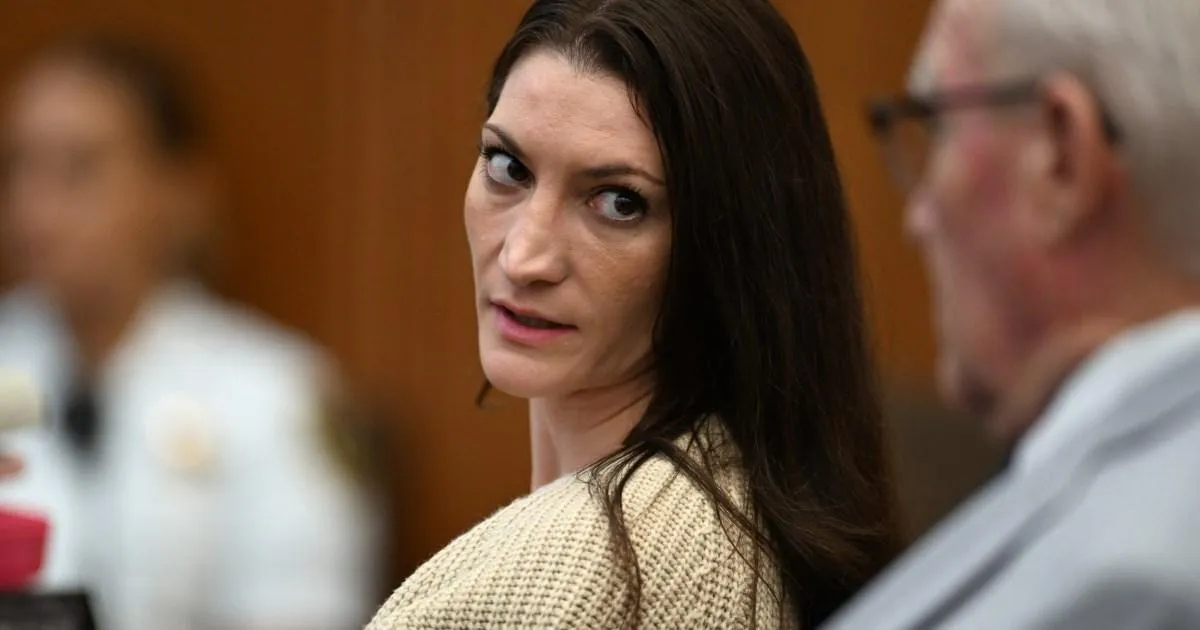
Lindsay Clancy wears a baby-blue blouse, and her long, dark hair falls in loose waves around her shoulders.
Defense team arrives at court
Kevin Reddington and his team members have arrived and gone inside the courtroom.
Lindsay Clancy’s priest, Father Bob, also here today.
Her parents and sister have just entered the courtroom as well.
Jury deliberations resume
The nine women and three men selected to determine Lindsay Clancy’s fate have now deliberated for around 23 hours over four days.
Tuesday morning, they told the judge they were deadlocked and unable to reach a unanimous verdict.
Judge Sullivan told them to continue deliberating. Hours later, they asked to go home for the day.
Advertisement
The jury must reach a unanimous decision on whether Clancy is guilty of murder, manslaughter or not criminally responsible for her actions.
If they are unable to reach a verdict, the judge will eventually be forced to declare a mistrial.
The group has not be sequestered during discussions.
Woman arrested outside Lindsay Clancy trial for intimidation
Just minutes after the Lindsay Clancy jury was excused for the day on Tuesday, a woman was arrested outside the courthouse and charged with intimidation.
Dawn Light, 56, of Sutton, was taken into custody outside Plymouth District Court at 3.40pm on Tuesday and charged with intimidation of a witness, jurors or person furnishing information in connection with criminal proceedings, Massachusetts State Police announced.
Advertisement
Police wouldn’t confirm if the charge is related to the Clancy trial, but Light’s arrest came just 10 minutes after the jury was excused for the day as a stalemate continues.
Light is set to be arraigned today inside the same courthouse where jury deliberations will resume to determine Clancy’s fate.
It remains to be seen if Judge William Sullivan will bring the incident up this morning – or if security is ramped up for the jury from now on.
There are two parking lots at the courthouse – one to the left of the doors and one to the right.
Advertisement
The one to the right is where all the media is set up and general public parking. The left side is where court staff and the jurors park – and where everyone has been warned they cannot film.
Share or comment on this article:
Lindsay Clancy’s lawyer addresses possible plea deal as verdict is thrown into chaos by woman accused of ‘filming jury’: Live updates
Clancy does not dispute killing her children but has pleaded not guilty to murder, with her lawyers arguing she was in the throes of postpartum psychosis and taking powerful drugs to cope with depression at the time, leaving her not criminally responsible for her actions.
After more than five weeks in court, over 70 prosecution witnesses and 10 for the defence, the jury has yet to reach a unanimous verdict.
Advertisement
Deliberations began on Thursday last week after closing statements were made, but so far no decision has been made.
Yesterday, Judge William Sullivan ordered the jury — made up of nine women and three men — to go home after pausing the deliberation clock at 23 hours and officially declaring a deadlock.
‘My understanding is that you requested to be excused until tomorrow [Wednesday] at 9am. I just want to thank you for your hard work and commitment,’ the judge said.
Clancy strangled her three young children to death in January 2023, during an alleged postpartum psychotic episode (Picture: via REUTERS)
Symptoms include insomnia, delusions, hallucinations, severe confusion, and dangerous thoughts regarding self-harm, suicide, or harming the infant. The condition is treated as a medical emergency.
Therefore, the defence state that Clancy could not distinguish right from wrong.
However, the prosecution claims she made a calculated decision to kill her children.
During the trial, Reddington — who has become somewhat of an internet celebrity over the past few weeks — has consistently told reporters that Clancy has found the experience harrowing.
Clancy reportedly ‘begged’ for help during her mental health crisis (Picture: Facebook)
Clancy has broken down in court multiple times, including wailing, ‘I can’t do this’ during testimony about the injuries her children suffered in their deaths.
The mother-of-three has also appeared vacant in court, often staring into space or holding her head in her hands.
When asked outside court on Tuesday about how Clancy is feeling, Reddington replied: ‘She had a flat affect, she’s sad.’
A flat affect is a total or near-total absence of outward emotional expression, even if the individual is feeling emotional from the inside.
Advertisement
Reddington also responded with an immediate ‘no’ when asked whether he thought Clancy could deal with another trial — a real possibility should the jury fail to reach a verdict.
Clancy, a former labour and delivery nurse in Massachusetts, pleaded not guilty by reason of lack of criminal responsibility.
Clancy has repeatedly broken down in court (Picture: AP Photo/Josh Reynolds)
Reddington has argued that Clancy loved her children, but committed the murders — before attempting suicide — during a psychotic episode where she lost grip on reality.
Clancy also claims she heard a man’s voice on the night of the murders telling her to kill the children.
Defence expert Dr Phillip Resnick backed this up, telling the jury that Clancy was ‘frankly psychotic’ when she carried out the killings, having experienced a command hallucination.
Advertisement
This is an auditory verbal hallucination where a person hears a voice that instructs them to perform a specific action.
However, prosecutors have said Clancy strangled her children with exercise resistance bands because she was depressed and tired of living, and made a conscious choice to kill them before attempting suicide by self-harming and jumping from a second-storey window.
The suicide attempt left her paralysed from the waist down.
Reddington also brought Clancy’s attempts to seek help for her worsening mental health to the jury’s attention.
Advertisement
It was reported that Clancy checked herself into a psychiatric hospital, and was ‘begging for help.’
Susan Clancy, the mother of Patrick Clancy, testified that her former daughter-in-law was ‘struggling’ and that they were ‘all concerned’ about her welfare.
Susan Clancy, Clancy’s former mother-in-law, said she was ‘struggling’ (Picture: via REUTERS)
Clancy also called a suicide hotline and was prescribed a cocktail of medications in the months before the killings.
Reddington says that these powerful drugs, taken to cope with her depression at the time, left Clancy not criminally responsible for her actions.
Ultimately, the psychiatrist formed the opinion that Clancy was suffering from a major depressive episode.
He told jurors: ‘While depressed, her mental state was relatively stable.’
Clancy’s defence attorney Kevin Reddington is arguing that Clancy could not distinguish right from wrong at the time of the murders (Picture: Greg Derr/Pool The Patriot Ledge)
What are the possible outcomes of Lindsay Clancy’s trial?
The jury has five ways to decide Lindsay Clancy’s fate, as deliberations continue.
These are:
Advertisement
not guilty
not guilty by reason of insanity
first-degree murder
second-degree murder
manslaughter
Although Clancy was charged with three counts of first-degree murder, the jury is being allowed to consider alternative charges of second-degree murder and manslaughter.
If they find Clancy guilty of first-degree murder, which requires ‘premeditation’ or ‘extreme atrocity or cruelty,’ according to Massachusetts state law, she would face life in prison without parole.
If convicted of second-degree murder, she would be eligible for parole.
For lesser manslaughter charges, Clancy could still face up to 20 years in prison for each count.
There is also the option of not guilty by reason of lack of criminal responsibility, which is a complex outcome in itself.
Advertisement
This would mean a judge could confine her to a mental health facility.
There is also the not guilty verdict, in which Clancy would walk free. However, that is considered highly unlikely.
Clancy’s suicide attempt left her paralysed (Picture: Greg Derr/Pool The Patriot Ledge)
If the jury returns with another note indicating they are deadlocked, the judge will likely consult the lawyers and read the ‘Tuey Rodriguez’ charge.
This is Massachusetts’ version of what is commonly called an Allen charge.
That instruction would encourage jurors to continue discussing the evidence and make every reasonable effort to reach a unanimous verdict. The judge would still remind them to not abandon an honestly held position simply because other jurors disagree.
Advertisement
If they tell the judge again that they cannot agree, that’s when the possibility of a hung jury and mistrial becomes even more serious.
Should a mistrial be declared, the case essentially goes back to the same status as before the trial.
Clancy would be charged with murder and would continue to be held at a psychiatric hospital awaiting a resolution of the case.
In a statement, DUP leader Gavin Robinson said: “A scrap metal recycling facility is currently on fire in the Harbour Estate. Belfast Harbour Police are currently assisting NIFRS and PSNI.
“A large plume of smoke is affecting parts of Inner East Belfast, including Victoria Park.
“Two fire appliances are currently at the scene of another fire at Clearway.
Advertisement
“Belfast Harbour Police are supporting the response and tugs have also been deployed.
“Residents in the surrounding area should keep windows and doors closed as a precaution if affected by smoke.
“Please avoid the immediate area and allow the emergency services to carry out their work safely.
“I’ll share any further confirmed updates when available.”
Defendant Frankie Nielsen was said to have initially sent sexually explicit messages to the secondary school-aged girl.
But his abuse escalated and he then went on to twice sexually assault her.
The girl has now described how she has gone from feeling “safe in her everyday life” to being “disgusted and too scared” to inform her family.
The long-term impact of Nielsen’s offending was heard at Newcastle Crown Court in the victim-survivor’s personal statement, which was read before the 38-year-old defendant was sentenced on Tuesday (September 1).
Advertisement
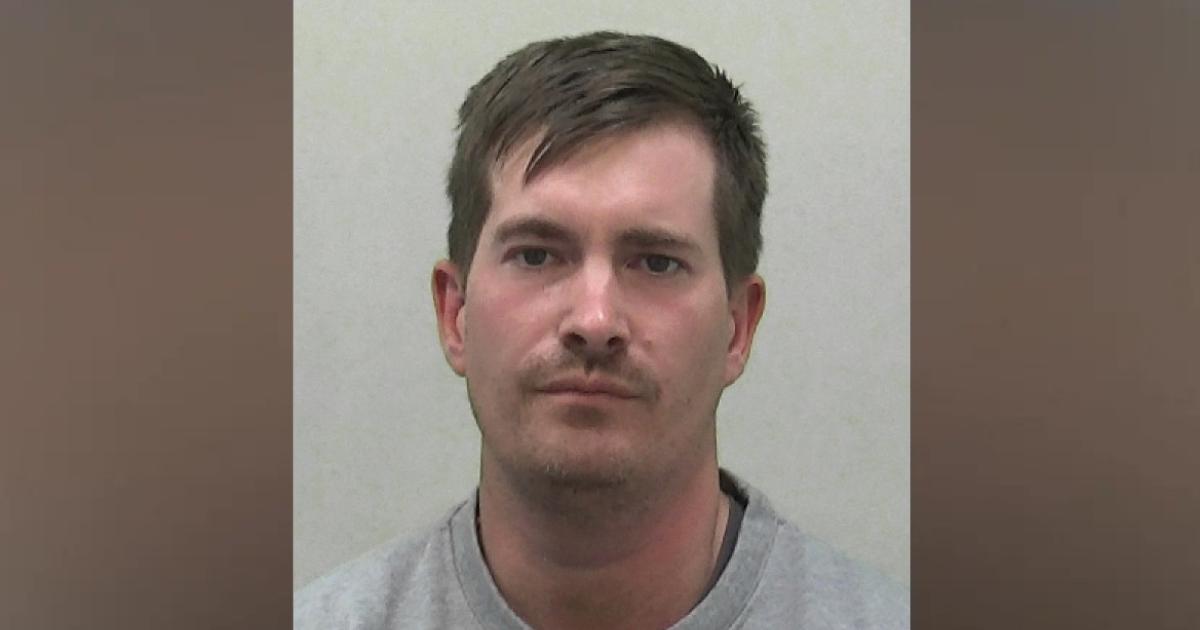
Frankie Nielsen given suspended sentence for sexually assaulting and communication with a secondary schoolgirl (Image: Northumbria Police)
She said: “I no longer feel safe. I still cannot walk past the place where this happened on my own and I have never returned there alone.
“My trust in people, especially males, has never been the same.
“My self-confidence has dropped very low.
“The biggest change in my life has been living with this trauma every day and trying to put it behind me.
Advertisement
“What the defendant did was wrong. He has given me trauma that I will carry for the rest of my life.
“I want the court to know that the harm did not end when the crime finished.
“It continues to affect me, my family and the way I live my life.”
The court heard that when arrested by police and interviewed, Nielsen told them: “I hold me hands up to sending some stupid messages”, but he denied the assaults.
Advertisement
Following a complex investigation by Northumbria Police’s Safeguarding Department, in January last year, Nielsen, of Bentinck Villas, Newcastle, was charged in connection with the abuse.
He was convicted of three offences, two charges of sexual assault and one count of sexual communication with a child, at Newcastle Crown Court, in July.
The case was sent to the city’s crown court for sentence, where Nielsen received a 20-month prison sentence, suspended for two years.
As part of his sentence, Nielsen will spend 10 years subject of notification requirements on the Sex Offenders’ Register, and he must observe the terms of a Sexual Harm Prevention Order (SHPO) for a similar period.
Advertisement
A lifelong restraining order was put in place prohibiting him from contacting or approaching the victim.
Detective Constable Kerry Kane, of Northumbria Police, said: “It’s clear that Frankie Nielsen is a sexual predator who has an interest in girls.
“As always, my thoughts and appreciation go towards the ‘victim-survivors’.
“Here, she has shown immense courage, from making that first report all the way through to sentencing today.”
Advertisement
She said: “As a force, we’ll relentlessly pursue justice against anyone who looks to take advantage of children, who are some of the most vulnerable in our society.
“No-one should ever have to experience this type of offending, but please know if you have, we’re here and we’re ready to listen.”
Anyone who has experienced any form of sexual abuse, whether recent or non-recent, should contact police using the ‘Report’ pages on the Northumbria force website, or send them a direct message on social media.
In this sixth and final part in our series on how the UK has changed in the past 25 years, we focus on tech, culture, religion and entertainment.
Media
Adrian Bingham, professor of modern British history, University of Sheffield
In December 2001 the Parliamentary Office for Science and Technology published a report entitled E is for Everything? Public Policy and Converging Digital Communications. With “E” standing for electronic, prefixing everything from email to e-commerce at the time, the report outlined the rapid changes in the world of communications. It noted: “More than seven out of ten UK adults have mobile phones, over a third have home internet access and a similar proportion have digital television.”
It also observed, with a tone of wonder, the trend of convergence: “As faster internet connections become available to home users, it will increasingly become possible to view film clips and television programmes, listen to the radio and to play games over the internet on a home computer”.
Advertisement
How has the UK changed since the start of the century? From Blair to Burnham, from the dotcom era to AI agents, time has certainly not stood still. In this six-part series, a team of some 35 experts look at everything from defence spending to species populations to the rise of populism to try and make sense of the intervening years.
Twenty-five years later, this world has arrived and gone further than the report’s authors could ever have predicted. Indeed, looking back, the digital world of 2001 looks laughably basic: of the 39% of adults with internet access, almost all were using painfully slow dial-up connections.
Advertisement
We can identify four key shifts across the period. First, the UK has witnessed a dramatic decline of the print press. National daily newspapers were at the heart of British public life throughout the 20th century, and in 2001, sales remained substantial: The Sun’s circulation was over 3 million, the Daily Mail and Daily Mirror over 2 million, and even the Daily Telegraph had only recently dipped below 1 million.
Circulation data is harder to come by now, but the UK’s most popular newspaper now is the Daily Mail, with sales of just over 600,000; The Sun sells around half a million copies, the Daily Mirror 166,472, and papers like The Times, Daily Telegraph and Guardian less than that. The print newspaper is very much on life support.
The broadcasting environment has fragmented and globalised. In 2001, for the first time, half of UK viewers had access to more than the five terrestrial television channels, through digital, satellite or cable platforms. It was also the year that Sky launched its first Sky+ television recording box. Nevertheless, the broadcasting environment was still dominated by the big beasts of the BBC, ITV and, to a lesser extent, Channel 4, and governed by the daily schedule.
Twenty-five years later, YouTube has a bigger audience than the BBC, and UK broadcasters are struggling to keep up with the streaming giants of Netflix, Amazon, Disney+ and Apple. Viewers are now in charge: they have access to hundreds of digital channels providing more content than they can consume, and they can determine when and where they watch programmes through apps and catch-up services.
Advertisement
Spotify to the rescue?
The music industry has been transformed by streaming. In 2001 CD sales peaked in the UK – some 123 million were sold, more than five per household (the best-selling album was Dido’s No Angel. The threat to physical music sales was already clear, though.
The year also saw the launch of Apple’s iPod, a device offering listeners the ability to store around 1,000 songs in a pocket-sized device, while music executives were increasingly alarmed about the capacity for illegal file-sharing. The industry was saved by the rise of legal music streaming services such as Spotify (launched in the UK in 2009), Amazon Music and Apple Music.
By 2025, almost half of the UK population had access to streaming services, playing over 200 billion digital tracks – only 10% of music consumption was now through physical formats. Here was convergence in its purest form; even iPods died out because mobile phones became the device of choice for music listening.
Finally, and least anticipated by the authors of the 2001 report, social media has transformed the whole media ecosystem. Facebook and Twitter (later X) became open to the public in 2006, Instagram in 2010 and TikTok in 2018.
Advertisement
With the rise of internet-enabled smartphones (Apple’s game-changing iPhone launched in 2007), engagement with social media not only became supremely convenient, it has been hard to resist. As of 2026, 89% of adult internet users are engaged in at least one social media platform, with as many as 97% of 16-34-year-olds doing so. Two-thirds of users admit they sometimes spend too long on their devices, 40% that this happens most days.
In 2001 the UK media environment was still largely controlled by a series of key players, particularly the main broadcasters and the leading newspapers. Twenty-five years later, big tech (Apple, Microsoft, Alphabet (Google), Amazon, Meta (Facebook) and Bytedance (TikTok) operate global platforms that enable individuals to consume, share and sell in their own personalised worlds.
These tech firms are now facing lawsuits alleging that their platforms are deliberately designed to be addictive, just as artificial intelligence is providing cheap new ways to generate endless fresh content. “E is for everything” is perhaps a more timely slogan than ever before.
Entertainment
Andrew Russell, lecturer in film and animation, University of Portsmouth
Advertisement
In 2001 the way we consumed entertainment felt broadly shared. Primetime television drew millions of viewers watching simultaneously, enabling endless discussion around the watercooler. Chart music defined the sound of the year, with compilations such as the Now series collating the most popular songs. Twenty five years later this sense of a homogeneous mainstream has weakened, driven by technological change.
In the early 2000s television scheduling mattered, and competing options were limited. Popular taste was dictated by broadcasters who largely decided what Britain saw, with audiences having few alternative choices. A show like The Office or Big Brother could become a cultural barometer in a way that doesn’t happen so easily today.
By the early 2010s this model was eroding. The rise of streaming services such as Netflix and BBC iPlayer placed less onus on terrestrial scheduling, allowing viewers to shift to a watch-when-you-want approach that encourages binge watching.
Advertisement
Now algorithms push content that services believe we would like. This has the effect of making viewers less likely to step outside their comfort zones. Overwhelmed by the huge number of options available, we tend to stick with what is familiar. Big hits have included teenage crime drama Adolescence (2024), as well as Bridgerton and Stranger Things.
Algopops
Music consumption has followed a similar path. The UK singles chart used to reflect what people were buying in stores. By the mid 2010s, streaming had transformed both how music was discovered and how success was measured.
Artists such as Lil Nas X or Central Cee gained prominence not through being played on radio but by trending on social media. A recent report from TikTok claims that in 2025, all 13 UK #1s had a viral TikTok moment first. Playlists have replaced charts as the primary mechanism of discovery. Just like with TV algorithms, this allows listeners to inhabit highly personalised musical worlds with limited overlap.
Advertisement
Thanks to algorithms, short-form content is playing a more pronounced role in our lives in the 2020s. Viral clips now seem to be as important as mainstream appeal. Social media makes us feel like this is curated, yet arguably we are seeing a flattening of culture. The tech author Kyle Chayka argues persuasively that media consumers now have very little agency because of the extent algorithms dictate our choices.
This has also had a positive effect, though, especially for musicians, with older songs finding renewed interest after viral exposure. Fleetwood Mac benefited from this a while ago, for instance, and the same thing has happened more recently with Dire Straits. Meanwhile in the world of TV, [German sci-fi thriller Dark](https://en.wikipedia.org/wiki/Dark_(TV_series) recently went viral nearly ten years after it began.
Film consumption has gone through a comparable transformation. With 68% of UK households subscribing to a streaming service, these are increasingly the first port of call for moviegoers, with the likes of romcom Office Romance (2026, Jennifer Lopez) and the remake of action movie Road House (2024, Jake Gyllenhaal) among the most popular. Cinema attendance dropped from 155.9 million admissions in 2001 to 123.5 million in 2025.
Advertisement
This said, there are indications that blu-ray sales are increasing again with boutique companies such as the Criterion Collection and Indicator on the rise. Some see this as a form of cultural rebellion, with these viewers relishing having a collection on their shelves. Generally streaming is also of a lesser quality than a 4k disc.
Importantly, however, there are also instances where films have been censored on streaming services, from God’s Own Country (2017) having sex and nudity removed to The French Connection (1971) having a racist insult edited out. This feels like an especially pertinent issue with censorship of history seemingly happening in real time.
Lincoln Geraghty, professor of media cultures, University of Portsmouth
In 2001, 23 million viewers were asking “who shot Phil Mitchell?” in EastEnders in what was the UK’s most watched TV show of the year. In the list of the top 50 shows, BBC One took the top two spots, though ITV had the most entries. Ricky Gervais and Steve Merchant’s The Office on BBC Two captured the nation’s attention with mockumentary hilarity, while music fans were introduced to pop group Hear’Say (including Myleene Klass), who were created on ITV reality show Popstars.
Advertisement
The two big franchise releases that year were Harry Potter and the Philosopher’s Stone and The Lord of the Rings: The Fellowship of the Ring. They dominated the box office and would set the pattern for years to come. Book lovers rejoiced in seeing the hugely popular novel, Bridget Jones’s Diary, adapted for the big screen, becoming the most successful non-fantasy film of the year.
Fast forward to 2026 and one might be forgiven for thinking UK audience tastes have not changed that much. Last year saw the release of Bridget Jones: Mad About the Boy, the fourth film in the franchise, which received a favourable score of 88% on Rotten Tomatoes.
EastEnders showed its continued popularity and longevity by winning Best Soap at the Bafta Television Awards. Peter Jackson recently revealed that not only will there be a new Lord of the Rings film coming to cinemas in 2027 – The Hunt for Gollum – but there will be a second one some time after. It’s got the working title Shadow of the Past and is being developed by recently unemployed talk-show host Stephen Colbert.
Advertisement
By year’s end we will also have a brand-new TV version of Harry Potter made by Warner Bros and streamed on HBO (available in the UK through the likes of Sky and Amazon Prime).
So does this mean that a whole generation later, we have not changed our viewing and reading habits? Short answer: no.
Nostalgia is peak just now. In an era of global uncertainty, audiences are reflecting on more confident times. Through films and series like these, we see characters coming back, franchises rebranded and traditional formats reimagined.
To a similar end, popular offerings like The Great British Bake Off (since 2010), The Great British Sewing Bee (2013) and The Repair Shop (2017) are a shift towards lifestyle television that soothes rather than excites. It allows audiences to reminisce vicariously about food, fashion and favourite objects from their own past.
Advertisement
Having said all that, the types of stories we want to read and watch are similar to those on offer in 2001. Comedy and irony are still present: the American version of The Office (from 2005) was just as big in the UK thanks to Netflix. Romance is still romance, even if it has shifted to include reimagined history in Bridgerton (from 2020) and “romantasy” like the Twilight films (from 2008) and book series A Court of Thorns and Roses starting from 2015.
Tastes are more global as we have greater access to content across multiple streaming platforms and the internet. From Korea we’ve seen drama (Squid Game (from 2021), kids’ blockbusters (KPop Demon Hunters (2025) and music such as boyband BTS. We’ve seen Nordic noir – TV’s The Killing (2007-12) and The Bridge (2011-18) were global hits and adapted for other markets. And Japanese animation has appeared not only in cinemas (such as Demon Slayer: Mugen Train (2021) but London theatre, where Studio Ghibli’s My Neighbour Totoro has been very successful since 2022.
For the past ten years we have been intrigued just as much by retro visions of the 1980s seen in Stranger Things (from 2016) as what the series gave us in terms of horror and science fiction. In 2025 the latest episodes became Netflix’s most viewed Christmas Day offering ever. So even while we are told that audiences are more divided than they have ever been, the combined popularity of nostalgia and global series suggests that less has changed than has stayed the same.
Advertisement
Tech and culture
Steven Buckley, lecturer in media digital sociology, City St George’s, University of London
The internet made the world smaller, faster and more interconnected. It has given us the ability to access everything, everywhere, all of the time. But with this has come a range of issues that have helped make many feel disempowered and disconnected.
Multiple aspects of society have come to feel like a game. One example is the way people seek validation through likes and followers on social media, which has been shown to have a direct effect on their self-esteem. Combined with everything from trying to succeed on dating apps to more recently prediction websites like Polymarket where you can bet on anything, it’s not surprising the public feel disconnected from the real world.
Back in 2001 it was far easier to have collective, watercooler moments through the shared experience of watching a particular TV event. Streaming networks and other digital content have enabled everyone to find content for their own niche interests, and less likely to have witnessed what our friends and family have.
This is especially true of news content, which we receive from an increasingly diverse selection of sources. The difference between younger and older generations is particularly pronounced, with younger people consuming content from a wide array of creators on places like TikTok and Instagram while older people still rely on traditional institutions like the BBC or newspapers.
This speaks to a cultural gap between the generations that seems far worse than a quarter century ago. The old social contract that “if you work hard, you can afford a home and start a family” has been broken in relation to today’s younger people.
Large parts of the digital environment are now based upon meta-references and ironic detachment. There is now a generation with a “lol nothing matters” nihilistic mindset, who feel they might as well have a laugh while posting about the downfall of society.
Advertisement
Surveillance society
One final area where our culture has shifted is how our sense of privacy has been whittled down. At the turn of the century, we still assumed there was some level of anonymity online and that we were at little risk of having any of our actions caught on camera.
This changed with people’s willingness to hand over personal data to social media platforms, the introduction of digital IDs, and the fact that everyone now can record a video of anyone out in public. It has brought about a version of Orwell’s panopticon from Nineteen Eighty Four (1949), where not only is the state surveiling you, but corporations and fellow citizens are as well.
Welcome to a world in which young people are now fearful of dancing in public. The looming social media ban for under-16s risks alienating teens further from attempting to find connections within society.
The question our culture has asked us over the past 25 years is “Could I interest you in anything and everything, all of the time?” Most people answered yes. It’s hard to be enthusiastic about the consequences.
Chris Rojek, professor of sociology, City St George’s, University of London
People now regard being attached to their smartphones and tablets as a standard part of getting from A to B. You only have to take a walk along any British street to see this in action.
In universities these devices have become a universal feature of lecture halls and seminar rooms. Here and in so many other parts of society, the first casualty is the art of conversation. Small talk and passing the time of day increasingly takes the form of texting and streaming. Online attention means bracketing out and devaluing physical face-to-face interactions.
Digital data flow has become the arbiter of facts and truth telling. If an authority challenges us for some reason, it is not the quality of our personality but the browsing and messaging history on our smartphone or tablet that is the best line of defence.
Unquestionably, digitalisation can make difficult decisions faster and sounder. But the effective use of the technology also depends upon digital competence. These days in universities we often work on the presumption that everyone has an internet account and a smartphone.
This may make sense when as many as 95% of British people use the internet, and the same percentage are estimated to own smartphones. But this still leaves 2.8 million non-digitalised citizens, most of them aged 75 and over.
Consider further the number of our fellow citizens that are classified as functionally illiterate: one in six adults, over 6 million people. An additional 8.5 million are estimated to have difficulties with reading. They do not have the knowledge or skills to fill in an online medical form, a job application, a council tax or passport document.
Advertisement
When I think of culture and citizenship in 2026 I often find myself concluding that the smartphone and tablet have become a prosthetic device. They enhance our communication skills and have become a precondition for full and effective citizenship. Conversely, they add new exclusionary dimensions to life with others.
Religion
David Voas, emeritus professor of social science, University College London
A question on religion first appeared in the census in 2001 (except in Northern Ireland, where it was being asked already). The results were a surprise: 72% of people in England and Wales selected “Christian”, considerably more than the 54% of adults classified as such by the British Social Attitudes survey in the same year. Perhaps Britain was a Christian country after all?
The census figure was probably inflated for various reasons and said more about the quasi-ethnic character of religious identity than belief or practice. Nevertheless, it led to some exhilaration among church leaders: having consoled themselves with the notion that Britain was at least believing, they now saw some hope that belonging – nominal as it might be – would persist.
Advertisement
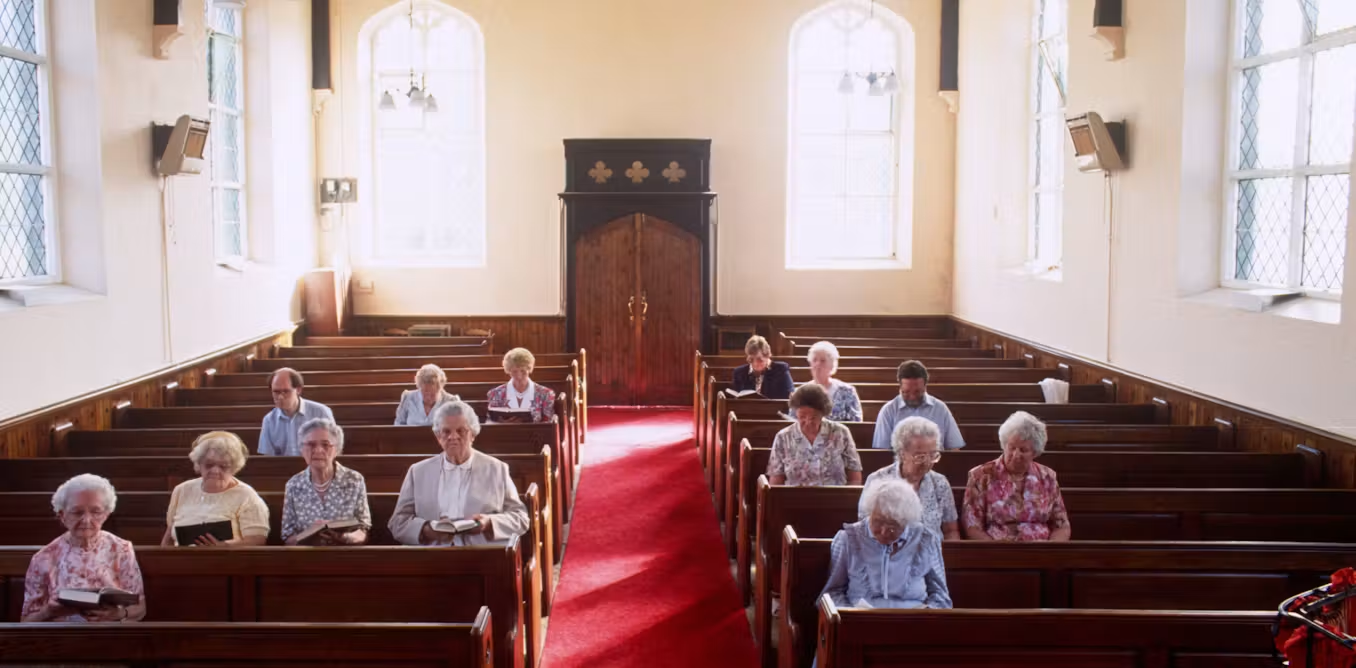
Hopes were raised in the church by the 2001 census. PA Images
That hope did not survive subsequent data collection. The Christian share of the population in England and Wales fell to 59% in 2011 and then 46% in 2021, according to the census. Using a slightly different question, the British Social Attitudes survey put the Christian share below 50% in every year since 2009, with estimates as low as 38% by 2018.
In Scotland, where the wording of the religion question on the census is slightly different and the tick-box options refer to specific denominations, the Christian figure was 39% in 2022; a majority of the population chose “no religion”.
The rise of religious minorities
Although the growth of “no religion” is largely responsible for the Christian decline across Great Britain, there has also been significant growth in minority religious groups. In 2001 just over 5% of the population of Great Britain was Muslim, Hindu, Sikh, Buddhist, Jewish or other. By 2021-22, the figure was almost 10%. The relative youth of non-Christians means that in decades to come their share of the overall population will rise to at least 16%, Muslims being two thirds of the total, even in the absence of immigration.
Advertisement
Northern Ireland is a case apart: nearly 80% of its people identify themselves as either Protestant or Catholic. Non-Christian religions are growing but barely exceed 1%. Non-religion is also on the rise in the province, however, largely as a result of Protestant disaffiliation, and reached 17% in the 2021 census. The major news is that Catholics now outnumber Protestants for the first time since the partition of Ireland in 1920-22, even using the “community background” measure, which focuses on which religion you were brought up in.
Protestants are now in the minority in Northern Ireland. CAZIMB
Of course religion is not just about identity, whether strong or weak. Belief and practice are important aspects of religious commitment. Some high-quality social surveys include questions on belief in God, life after death, and so on, and also on attendance at worship services and frequency of prayer. On nearly every indicator, religiosity is waning.
The engine of religious decline is generational replacement, not adult defections. Elderly people who are mostly Christian are dying out, and being replaced in the population by young adults who are typically less religious or non-Christian. Claims that young people are leading a revival of churchgoing caused renewed excitement among some church leaders in 2025, but the story was too good to be true. The evidence shows that the decline continues.
Interestingly, the royal family shows Britain in microcosm. The late Queen Elizabeth was a committed Christian. King Charles is interested in religion and spirituality but famously declared that he intended to be the defender of faith, rather than the faith. Prince William is well disposed to the Church of England (of which he will become the supreme governor) as long as he does not have to attend or think much about it.
Advertisement
In terms of religious change, the royals are just an ordinary family. Britain continues to undergo a long, slow secular transition.
The Insights section is committed to high-quality longform journalism. Our editors work with academics from many different backgrounds who are tackling a wide range of societal and scientific challenges.
At a glance: Locals recommend the places where Bajan music is at its best
What: How to get an authentic musical experience in Barbados
Where: The best beach bars, festivals and rum shops on the island
Don’t miss: Live reggae that makes that first rum punch taste even sweeter
Advertisement
Highlight: Crop Over, a summer-long celebration of Barbadian music, masquerade, food and culture
Travel tip: Book with Virgin Atlantic Holidays and the expert team will share even more tips for experiencing Barbados’s vibrant music scene
Alongside soca, calypso, reggae and jazz, the island gave rise to spouge, a distinctly Barbadian genre developed by musical innovator Jackie Opel in the 1960s.
The focal point of Barbados’s cultural calendar is Crop Over, pictured above, a three-month celebration of Barbadian music, arts, food and heritage that culminates in the Grand Kadooment finale in August.
Advertisement
But music is the Bajan way of life, and you’ll be treated to killer sounds whether you’re at a cocktail bar after dark or a beach shack the morning after. Expand your musical knowledge of this island paradise: traditional tuk bands, calypso tents, vibrant Pic-O-De-Crop and Foreday Morning events, and Landship folk traditions are all here for you to explore.
Discover where to feel the rhythm and join the locals in a little Bajan shuffle, as recommended by island experts, including the Virgin Atlantic Holidays team.
And if you book your Barbados getaway with Virgin Atlantic Holidays, the party starts even before you land on the island — from the excitement of planning your trip with knowledgeable agents to getting the five-start treatment when you step onboard your flight. Cue sun-soaked soca rhythms…
The best music venues and bars in Barbados
Advertisement
From international grooves to homegrown ska-inspired rhythms, in clubs and at beach bars, music and dancing are part of Barbados’s DNA
Getty Images
A beach bar with mirror balls among the palms
“I adore La Cabane on Batts Rock, St. James. It hosts the best in international grooves that fit perfectly with its beach bar tiki aesthetic. You’ll find reggae, bossa nova, electronica, house, disco and even jazz here. There are mirror balls in the palm trees, feet in the sand and great cocktails. They even have special events: one Christmas, I was asked to do a guest performance and we moved a grand piano onto the sand for me to play for the night. I had the whole beach requesting songs and singing along, even the servers.” — Jeremy Goddard runs the live music-focused jazz bar and dance venue Jeremy’s, Barbados
Advertisement
Reggae worth going out on a Sunday for
“Rite Side of Red is a band whose members come from different cultural backgrounds but share one thing in common: they play and sing straight from the soul. Their music captures the warmth, rhythm and spirit that makes Barbados so special. They play at Surfers Bay beach bar in Silver Sands on a Sunday. It’s the perfect spot for anyone who wants to let loose, meet great people and enjoy some of the best live reggae on the island.” — Papa Jules is co-founder and head of vibes at La Cabane, Barbados
Whether they are laid-back or lively, Barbadian beach bars are great places to soak up local sounds and good vibes
Barbados Tourism Marketing Inc.
Late-night karaoke with the locals
Advertisement
“We have a rum shop culture in Barbados, which is very much like British pub culture — everyone has their local. They’re very casual, and a lot of them will go on late at night and then turn into a kind of karaoke bar. Lemon Arbour in the parish of Saint John is a more well-known one — it’s turned into more of a restaurant. It’s still super-casual, but you’ll see everyone from the prime minister to the farmer next door there.” — Malou Morgan is a Bajan mum who runs Skip to Malou, a family travel and lifestyle blog
Where to dance in Barbados
The annual Crop Over festival is an island-wide celebration of Bajan music and culture
Barbados Tourism Marketing Inc.
Experience Crop Over, Barbados’ biggest festival
Advertisement
“During Crop Over, you can feel the buzz as soon as you land on the island. There’s something to do everywhere you turn, as well as endless soca and calypso parties. My best experience was at an event called 10-to-10 at Wadadah Club, which literally ran from 10pm to 10am. I left at 9am, but only because I had to go to a press conference!” — DJ Martin Jay is a Caribbean music specialist
Dance until the early hours at a lime
“When Bajans want to de-stress, they go liming. Liming is a cornerstone of Bajan social life: spending unhurried time with friends and family, whether over drinks at a rum shop, beside the beach or out dancing after dark. In Carlisle Bay, locals and tourists party until the wee hours at Harbour Lights, a Bridgetown beachfront club that puts together a full-blown Beach Extravaganza Dinner Show on Mondays and Wednesdays, with stilt walkers and fire-eaters adding to the atmosphere.” —From the editors of The Ins and Outs of Barbados
Join the party at the cricket
Advertisement
“Book a ticket in the Party Stand of the Kensington Oval to watch the West Indies play cricket. There’s sand, loungers, bars, food, a pool and some sport happening in the background. Take sunscreen if you go in the day. You’ll need your dancing trousers if you go to a game under lights.” — Rhiannon Jones is a customer care advisor for Virgin Atlantic and has a house in Half Moon Fort, Saint Lucy, in Barbados
Courtesy of Virgin Atlantic Holidays
Dream, plan and book Barbados with Virgin Atlantic Holidays
Whether your idea of Barbados is switching off on a beautiful beach, getting stuck into island adventures or experiencing as much authentic Bajan food, music and culture as possible, Virgin Atlantic Holidays can help you make it happen.
With Virgin Atlantic Holidays, you can create a Barbados holiday that feels completely yours, thanks to direct Virgin Atlantic flights, hand-picked hotels and holiday experts ready to help you plan the details.
A woman was left “seriously injured in hospital” following a crash on the A10, according to Cambridgeshire Police. The incident happened at about 10am on Thursday, August 27.
Advertisement
A grey Skoda Fabia was being driven northbound towards Waterbeach when it was involved in a crash with a white Isuzu D-Max, with a cherry picker lift fitted on the back, heading in the opposite direction.
The driver of the Skoda, a 69-year-old woman from Milton, was taken to Addenbrooke’s Hospital in Cambridge with serious injuries, according to the force. The injured woman remains at hospital. The driver of the Isuzu, a 41-year-old man from Oakington, was uninjured and was interviewed at the scene by officers.
An investigation has been launched and anyone with any information, including dash cam footage, is urged by the force to report this online or by calling 101, quoting incident 152 of August 27.
He pushed the victim to the floor before biting her and kicking her in the stomach
A man attacked his former partner and continually breached a restraining order. James Upton was handed the restraining order in March 2024, which meant he was not allowed to contact his former partner or visit her home in St Neots for five years.
Advertisement
However, the 26-year-old breached the order by making several attempts to contact the victim. He also turned up at her house on different occasions.
During one of those visits, in February 2024, an argument broke out between the pair which quickly became physical. Upton pushed the victim to the floor, bit her, and kick her in the stomach. Upton also damaged the victim’s iPhone, smashing the screen.
He was arrested and charged with ABH and four counts of harassment – breach of restraining order, which he admitted.
At Peterborough Crown Court on Friday (August 28), Upton, of Coventry Road, Bedford, was jailed for one year and five months after the activation of the previous suspended sentence.
Advertisement
DC Madie Mayers-Brandrith, who investigated, said: “Upton is a very dangerous individual, who shows no regard for the law and the restrictions imposed on him by the courts. To attack his former partner in her own home when the pair’s young son was present is despicable so I am pleased Upton will now serve time behind bars for his actions.”






























































You must be logged in to post a comment Login