

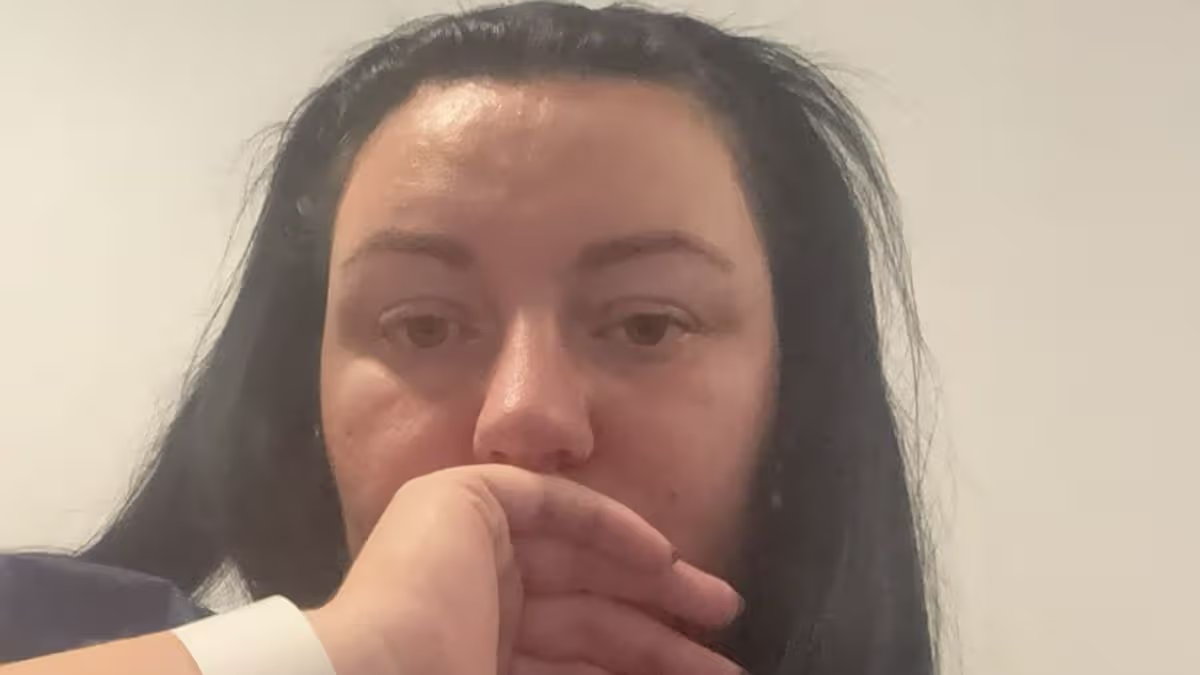
“I would rather give birth to five kids at the same time than go through with the pain again”
A Northern Ireland woman claims weight loss injections turned her tongue jet black – and left her needing her gallbladder removed.
Sarah-Jayne Crawford, 32, started taking Wegovy in August 2024 after reaching 19 stone 9 lbs, a size 20. The mum-of-one was hoping to shed a few pounds before her wedding day in November, 2025 and paid £199 through an online pharmacy for a month’s supply of the jabs with a 0.25mg dosage.
But 12 weeks – and another £350 later – after increasing to 1 mg, things took a worrying turn when Sarah began suffering “sharp pains” in her upper stomach along with frequent bouts of vomiting, before waking up one morning in December to find her tongue had turned jet black.
The strange symptom left her unable to eat spicy foods – including peppers and onions – alongside severe mouth pain and foul “egg-smelling” sulphur burps.
Fearing the worst, she took herself to A&E at Antrim Area Hospital, where CT and MRI scans revealed “multiple” gallstones blocking her bile duct, as well diverticulitis – an inflammation of irregular bulging pouches in the wall of the large intestine – and she stopped taking the jabs completely.
In February 2025, she underwent a cholecystectomy to remove the organ entirely – after the gall stones were discovered
Now almost recovered and off the jabs, Sarah – who weighs 18st 8lbs – is still baffled by the bizarre black tongue symptom, and is speaking out to warn others about the potential risks of weight-loss injections.
Sarah, a personal secretary for the NHS, from Antrim, Northern Ireland, said: “Wegovy was my last resort. I know a lot of people who are on the jabs and it worked like a dream for them.
“I had been battling my weight for what felt like forever and I was dying to slim before my wedding – but dieting, exercising and starving myself never worked.
“Before, I had heard stories about the dangers and my friend even joked about gallstones. But when the pain left me unable to leave my bed I knew something was up.
“The black tongue seemed like a cherry on top and a warning of what was to come. Never did I think this would happen to me.”
Sarah had “always struggled” with weight her entire life.
But it wasn’t until she was proposed to by her partner, Curtis, 30, a mechanic in September 2022 that it prompted her to drop a few sizes.
Knowing “traditional methods never worked” for her, Sarah paid £199 through an online pharmacy for two-months supply of Wegovy at 0.25mg dosage.
“At the start, everything seemed fine,” she said.
“My appetite slowly disappeared and I felt great for the wedding. But I wasn’t noticing a huge amount of change.”
Over the following weeks, Sarah paid a further £350 on Wegovy and eventually upped her dose to 1mg. But after 12 weeks on the jabs, she started experiencing “episodes of intense pain” in her upper stomach and “bouts of vomiting.”
The stinging had quickly progressed to an “excruciating” trapped wind sensation and she was left bed bound.
And within a 24-hour period, the mum was shocked to discover that her tongue had turned black – and she was left unable to eat spicy foods.
“It all happened so quickly,” Sarah said.
“It went from really sharp pains that were enough to leave me bed bound. To having sulphur burps, that smelt of egg, and a black tongue. It was terrible.
“I have a child, so it was very difficult to take time off work. But the pain was so unbearable I couldn’t walk.
“I would rather give birth to five kids at the same time than go through with the pain again.”
According to the National Center for Biotechnology Information, semaglutide (the active agent in Wegovy which boosts glucose control and weight loss) is known to cause dry mouth, halitosis (bad breath) and sulphur-smelling burps from slowed digestion – and can reportedly contribute to a black-coated tongue.
Concerned, Sarah immediately stopped taking the jabs and went to A&E at Antrim Area Hospital where an emergency MRI and CT scan revealed she had multiple gallstones blocking her bile duct – leaving her at risk of pancreatitis.
She was booked in for a total cholecystectomy – a procedure to remove the gallbladder – on February 10, 2025, and her surgeon encouraged her to stay off Wegovy so she could go under the anaesthetic.
“By this point, I was 18 stone and had hardly lost any weight,” she said.
“The procedure was about an hour and I cracked on with the recovery. I’m slowly transitioning back to normal and eating more food now – but I’m still far from normal.”
Over a year later, Sarah has married and now weighs 18 stone 8lbs. Since coming off the jabs back in December 2024 her tongue has regained its colour.
She credits the majority of her weight loss to being ill rather than the jabs themselves – and is still unsure how the Wegovy caused her tongue to turn black as no doctors could explain.
“I did my research and thought I’d be OK,” she said.
“But it was the complete opposite. It’s not worth it. Weight loss jabs are a temporary fix.
“I’m proof that anything can happen once you inject yourself and I have now changed my mindset. Please do you research before you commit – I can’t stress enough how much women are putting themselves at risk.”
A spokesperson from Novo Nordisk, a Wegovy manufacturer, said: “Patient safety is of the utmost importance to us at Novo Nordisk.
“To ensure healthcare professionals have a detailed understanding of our medicine’s safety profile, the adverse reactions we have observed in clinical trials are detailed in our medicine’s Summary of Product Characteristics (SmPC).
“In the registrational trials for this medicine, cholelithiasis (acute gallstone disease) was reported in 1.6% of patients and led to cholecystitis in 0.6% of people living with obesity treated with semaglutide 2.4 mg.
“For this reason, acute gallstone disease (cholelithiasis) is listed as a “common” potential adverse reaction for Wegovy (semaglutide injection) in the product’s UK SmPC and should be considered when patients are being evaluated for this medicine.
“As part of this work we also monitor reports of adverse drug reactions through routine pharmacovigilance. If you know of someone who might be experiencing side effects from any medicine, we would advise you to report it to your healthcare provider, and via the MHRA Yellow Card Scheme.”
For all the latest news, visit the Belfast Live homepage here and sign up to our daily newsletter here.

















































You must be logged in to post a comment Login