



From Rurik Jutting and Ian Huntley to Harold Shipman, I have covered hundreds of depraved male killers during a crime-reporting career spanning more than 30 years for the Daily Mail.
But there is an added morbid curiosity with women who kill, the press and public galleries are often more full than if a man is in the dock.
There are six notorious female murderers who, in my opinion, were so evil, I have little doubt they would have been executed had they committed their offences when the death penalty was still in place.
Here I revisit their crimes and the trail of agony they left behind…
Rena Salmon
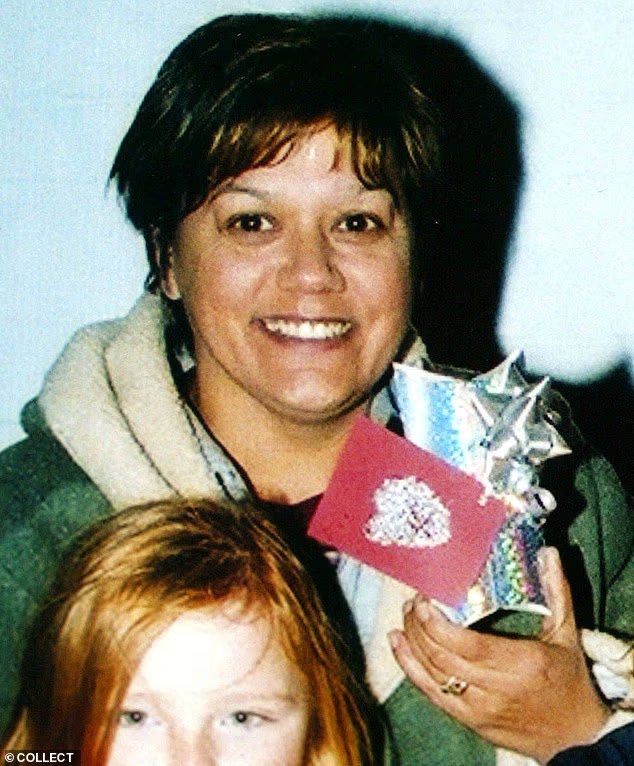
Rena Salmon stood trial in 2003 for shooting dead her estranged husband’s pregnant lover Lorna Stewart
Spurned housewife and mother of two, Rena Salmon was 43 when she stood trial in 2003 for shooting dead her estranged husband’s pregnant lover Lorna Stewart, 36, in Chiswick, west London.
I reported on the case from the outset and spent months researching the middle-class upbringing of former Army sharpshooter Salmon, who had walked into the beauty salon owned by her rival carrying a double-barrelled shotgun.
A bookkeeper who witnessed the shooting said she heard Ms Stewart say, ‘Hello, Rena’ then looked round to see Salmon calmly holding a shotgun no more than nine inches from the salon owner. Ms Stewart asked, ‘Have you come to shoot me?’, and the defendant replied, ‘Yes’.
Just as mother-of-two Ms Stewart asked Salmon what would become of their children, she was blasted with the shotgun. ‘Emotionless and unflinching’, Salmon waited ten seconds before firing another shot. The victim stood no chance.
After the shooting, Salmon sat down in the salon and smoked two cigarettes. She made a series of phone calls and sent text messages to her estranged husband, an IT consultant. One said: ‘I have shot Lorna. You pushed me to it.’
It was never a whodunnit, but it was a sensational trial nevertheless.
In a case of betrayal and revenge, the Old Bailey heard how Salmon’s husband had an affair with Ms Stewart in December 2001 which led to the breakup of their two marriages in the village of Great Shefford, near Hungerford in Berkshire.
They lived within a few minutes’ walk of each other and frequently socialised at children’s parties, their homes, the village hall or in the local pub. But Salmon could not contain her rage at her husband’s betrayal and the countdown to the murder in September 2002 began.
Salmon, who had been trained in the use of firearms during her ten years in the Army, blamed her actions on her ‘troubled’ childhood. She denied murder but admitted manslaughter on the grounds of diminished responsibility.
The jury decided that she acted out of a cold-blooded and calculated desire for revenge. She was jailed for life but released on licence in 2016 after serving a minimum term of 14 years.
Detectives said Salmon had shown no remorse about shooting Ms Stewart. One told me at the time of her trial: ‘Forget her sob story in the witness box, Salmon is a cold, calculating manipulator.’
Jane Andrews

Jane Andrews, a former aide to Sarah Ferguson, went on the run after she stabbed and beat to death her wealthy boyfriend Tom Cressman after he refused to marry her
Like Salmon, Jane Andrews was a jealous, vengeful woman who could not bear the thought of someone else being with the man she professed to love. Like Salmon, she was an unlikely killer but one who put her victim’s family through added torment by not confessing to murder.
I can still recall the shock on the Mail crime desk one day in September 2000 when, hours before it became public knowledge, we were tipped off that the former aide to the Duchess of York was on the run after killing her wealthy boyfriend, Tom Cressman.
The so-called ‘Fatal Attraction’ killer stabbed and beat to death Mr Cressman with a cricket bat after he refused to marry her.
Andrews was ordered to serve a minimum of 12 years after an Old Bailey jury found she murdered Mr Cressman, 39, at the home they shared in Fulham, south-west London. Jurors rejected her claims that she awoke to find Mr Cressman hitting her and that in self-defence she hit him with a cricket bat and ‘he must have come forward on to the knife in the dark’.
In reality she had embarked on a revenge to rival that of Glenn Close’s obsessed character in Fatal Attraction. After attacking Mr Cressman, she left her lover dying in his bed as she went on the run, contacting friends on her mobile to pretend she knew nothing of his fate.
The manner of Andrews’ defence at her trial, in which she accused Mr Cressman of raping her hours before she killed him, dismayed his family and the detectives who investigated his death. Former Met Detective Superintendent Jim Dickie, who led the murder inquiry, said: ‘She murdered him in life and murdered him again in death by trying to ruin his reputation.’
Following her jailing in May 2001, details emerged of a woman who desperately needed the attention of men – but could not handle rejection.
It was also reported by the Mail that royal aides believed Andrews ‘fleeced’ the Duchess of £10,000 in the nine years she spent travelling with her.
The discovery that she had helped herself to significant amounts from Sarah’s private accounts only came to light after she left royal service in the late 1990s. The pair had enjoyed an extremely close bond. Although technically Sarah’s dresser, Andrews’ main task was to shop for the Duchess.
I caught up with Andrews outside a probation hostel in Leeds in June 2015, days after her controversial release from jail after serving just 14 years behind bars. Sporting a new blonde look, Andrews, then 48, said ‘no comment’ when I asked her if she’d like to publicly apologise to her victim’s family.
Sharon Carr

At the age of just 12, Sharon Carr stabbed 18-year-old hairdresser Katie Rackliff at least 29 times in an unprovoked and random attack on a Surrey street before mutilating her body
The upbringing of Sharon Carr, Britain’s youngest murderess, was the most dysfunctional of any female killer I have reported on. It is not an excuse for her truly monstrous behaviour, but it does provide some important context. From birth, she had been raised in a world of crime, drugs, abuse and hatred. She initially drank the blood of animals before her craving turned to humans.
At 12, she stabbed 18-year-old hairdresser Katie Rackliff at least 29 times in an unprovoked and random attack on a Surrey street before mutilating her body. It was not until five years later, in 1997, that justice finally caught up with her – by which time she had carried out a near fatal knife attack on another girl.
I led the Mail’s acclaimed coverage of this historic case, including months of painstaking background inquiries both in the UK and in Carr’s native Belize in Central America.
Our investigation revealed the horrific childhood of a girl left in the care of a mother who practised the black magic art of voodoo. While still a toddler growing up in Belize, she witnessed a neighbour burned alive when he was doused with kerosene and the ritualistic killing of animals – a slaughter she would later inflict on local pets after moving to Camberley in Surrey.
At the age of seven, she saw her mother Molly pour boiling fat over her stepfather. By 11, she was drinking, smoking and taking drugs.
Given her depraved background, many believe she was destined to kill.
In her diary three years after murdering Katie, Carr wrote: ‘If only I could kill you again. I promise I would make you suffer more this time. Your terrified screams turn me on, you slag.’ She added: ‘I bet she’s all bone and maggots now.’
Because of Carr’s refusal to admit her guilt, Katie’s parents endured all this being made public in court.
Sentencing the smiling murderess to life at Winchester Crown Court in 1997, the judge told her it was clear that ‘killing, as you put it, turns you on’.
As she started her sentence, a senior detective told me: ‘In a one-to-one situation, Sharon Carr is the most dangerous woman in Britain, there can be little doubt about that.’
Rose West

Rose West was convicted of murdering ten girls and young women including her daughter Heather and stepadaughter Charmaine
Detectives who investigated serial killer Rosemary West might dispute the view that Carr was the most dangerous woman in the UK.
I attended every day of West’s seven-week trial, also in Winchester, in 1995, when some of the most harrowing evidence ever heard in a British courtroom was presented to an appalled jury and the real Rosemary West was clear for all to see.
Hi, I’m Alex Matthews, Editor of The Crime Desk.

In 2014, we revealed the bombshell evidence identifying Aaron Kosminski as the fabled Jack the Ripper. Now, we can reveal his astonishing connection to the Freemasons and claims this motivated his killings and protected him from life in prison.
<!- – ad: https://mads.dailymail.co.uk/v8/de/truecrimeuk/none/article/other/mpu_factbox.html?id=mpu_factbox_1 – ->
A serial liar as well as a prolific killer, she was convicted of murdering ten girls and young women – including her daughter Heather and stepdaughter Charmaine.
Following the prison suicide of her serial killer husband (and co-defendant Fred West), the mother-of-eight stood trial alone in the autumn of 1995. Seeing her wearing a gold crucifix around her neck was particularly offensive.
Having spent 18 months investigating her background and crimes, interviewing her siblings and meeting the parents of some of her victims, I knew even before the trial started that West was a sex-obsessed psychopath. Could she, by trying to portray herself as a Godly person, pull the wool over the jurors’ eyes?
Some victims were kept alive just for hours, others for days, during which, bound and gagged, they endured repeated sexual assaults at the Wests’ Gloucester ‘House of Horrors’ home.
Then they were brutally murdered, their bodies hacked to pieces and crammed into shallow graves under the kitchen and cellar floors or in the garden. West’s own mother and stepdaughter Anne Marie gave evidence against her, in the most dramatic trial I have ever covered.
When the defence case started, West’s counsel Richard Ferguson QC, made out that Rosemary was another ‘victim’ of Fred. From the witness box, her subsequent testimony was full of lies and crocodile tears. Guilty verdicts were never seriously in doubt. But she could not bring herself to confess all.
How painful that must have been for the real victims of West, those she slaughtered and their grieving relatives and friends. But also for West’s own children including her son Barry.
Two years ago, in an article on the fate of the ‘West children’, I revealed how he had died aged 40 after trying for decades to escape the ghosts of his childhood at the ‘House of Horrors’.
For years he’d suffered from post-traumatic stress, anxiety, stress and long-term drug addiction, before being found slumped over a desk by a mental health support worker.
In 2019, Rosemary West’s former defence lawyer Leo Goatley told me that the serial killer, now 72, is ‘enjoying’ life behind bars, and would never want to come out.
Mr Goatley also confirmed my front-page scoop in the Mail in November 1995 that while on remand in prison awaiting trial, West had had a short-lived love affair with Moors murderess Myra Hindley.
He told me that West was ‘quite taken’ with Hindley and was ‘impressed by her knowledge and ability’, but dumped her after a few months after concluding she was ‘dangerous and very manipulative’. Has there ever been a viler sexual relationship between inmates behind bars?
Myra Hindley

Myra Hindley tortured and killed five youngsters, including Keith Bennett, with her lover Ian Brady
Even in her dying days, Myra Hindley could not bring herself to reveal everything she knew about the child killings she carried out with her lover Ian Brady, let alone her sordid affair with West.
A police contact tipped me off that she had died, aged 60, in November 2002, in West Suffolk Hospital, hours before the official announcement, to allow me time to prepare the Mail’s extensive coverage of her death.
I knew Winnie Johnson, the mother of missing Moors victim Keith Bennett, would be devastated that Hindley had passed away without revealing the whereabouts of his remains. Over the years, I had interviewed Winnie on many occasions – she was a truly courageous woman – and she was desperate to give her treasured son a proper funeral and final resting place.
That Hindley denied her that wish says everything you need to know about her controlling, psychopathic mind.
Keith vanished off the streets of Manchester in 1964 – one of five youngsters tortured and killed by Brady and Hindley.
The 12-year-old was abducted as he made his way to his grandmother’s and the haunting photograph of him in his wire-rimmed NHS glasses was to become one of the most enduring images of a crime so shocking it became a byword for evil.
It also explains why police tried everything they could to locate his remains and bring some closure to his family.
In 2008, I revealed in the Mail how a US spy satellite had been used as part of a top-secret police operation to find Keith.
A specialist Army team – normally involved in finding the graves of terror victims in Northern Ireland – had scoured an area of Saddleworth Moor for the remains of Keith.
It is thought Brady buried Keith in a shallow grave on the Moors and carbon vapours, believed by scientists to have been emitted from a corpse, had been found at a location of ‘great interest’ to the police on the hills high above Oldham.
Sadly, the groundbreaking mission – overseen by the late chief constable of Greater Manchester Police, Michael Todd – failed to find his corpse and brave Winnie died in 2012, without fulfilling her dream of bringing her son ‘home’ to Manchester.
Marie-Therese Kouao

Marie-Therese Kouao and her boyfriend Carl Manning subjected eight-year-old Victoria Climbie to the worst abuse imaginable
The murder of little Victoria Climbie was among the most heartbreaking, and scandalous, that I have reported on in my career.
Her loving parents had let her come to Britain from her home in the Ivory Coast on the promise that she would receive a good education and have a better life.
But the great aunt who was the eight-year-old’s carer instead became her merciless killer.
Blunders by three health authorities, two hospitals and up to eight police officers allowed Marie-Therese Kouao, 44, and her boyfriend Carl Manning, 28, to subject Victoria to the worst abuse imaginable.
Kouao’s only reason for taking her in was to pretend Victoria was her daughter in a benefits fraud. The little girl soon outlived her usefulness and within a year she froze to death after suffering cruelty beyond belief.
Her hands and feet were bound with masking tape and she was forced to eat food from a plate like a dog. She was beaten regularly with a belt and bicycle chain, and for months in winter slept naked in a bath, where she was left for up to three days at a time.
Shortly before her death in February 2000, Victoria was seen by a neighbour in Tottenham, north London. The child was bent like a little old woman and barely able to walk, so deformed were her legs from the length of time she had been imprisoned.
That same day Kouao took the child to the Universal Church of the Kingdom of God in Seven Sisters, where the pastor was due to carry out an exorcism on her.
But he was unable to find a pulse and insisted she be taken to hospital. Kouao refused and ordered a taxi home. As he set off, however, the driver noticed the girl appeared to be unconscious and insisted on driving her to the nearest ambulance station from where she taken to North Middlesex Hospital.
Her temperature was ten degrees below normal and her body felt like ‘a block of ice’. She died the next day and doctors found 128 separate injuries on her body. The Home Office pathologist concluded she had died from hypothermia caused by severe neglect and malnutrition.
Kouao and Manning were both convicted of murder. Manning had admitted manslaughter and child cruelty but denied murder. Widowed Kouao, a French citizen with three grown-up sons in Paris, denied murder, manslaughter and cruelty to Victoria, whom she brought to London in 1999 having fled a benefits investigation by French police.
It was a murder that rewrote the history book on child abuse scandals and 26 years on from the case, it remains wicked beyond belief.
Of the female murderers’ cases I have covered, Rena Salmon and Jane Andrews have long since been released from prison to rebuild their lives.
Rosemary West and Sharon Carr will never be allowed back on our streets, and I hope the same applies to Victoria Climbie’s killer Marie-Therese Kouao.
- To read about Jack the Ripper’s astonishing link to the Freemasons and a chilling cover up sign up to The Crime Desk newsletter HERE
- What kind of cases do you want to read more about? Let us know at: crimedesk@dailymail.co.uk
























































You must be logged in to post a comment Login