Connect with us
DAPA Banner

NewsBeat

‘No family should experience this pain and tragedy’ says dad of dead meningitis teen

Published

on

Belfast Live

Juliette Kenny died one day after first showing symptoms – now her family is calling for better protection for young people.

The dad of a teenager who died in Kent following a meningitis outbreak has spoken about the family’s utter devastation at their loss.

Juliette Kenny died on Saturday March 14, just one day after first showing symptoms. Now the 18 year old’s family is calling for better protection for young people.

Advertisement

Juliette’s father Michael Kenny has spoken about the loss which his family are dealing with, saying that his daughter had been “fit, healthy and strong” before her death.

She had completed the practical assessment for her PE A-level on Thursday, March 12 – and just a day later, was showing symptoms including vomiting, and discolouration in her cheeks. Juliette, who was described by her father as having a “beautifully positive energy”, is one of two students who have died following the outbreak of meningitis B in the county.

Mr Kenny said “no family should experience this pain and tragedy” and that “this can be avoided”, adding that he wanted his daughter’s legacy to be “lasting change”. It comes as more than 100 students in Kent were turned away while trying to get a meningitis vaccine after officials closed the queue on Thursday.

In a statement to the Press Association, Mr Kenny said: “We are incredibly proud parents to two wonderful daughters. Juliette is a force in this world. With her beautifully positive energy she spread fun, love and happiness to those around her and she continues to do so now.

“The devastation of her loss to us, her family and friends is immeasurable. Sharing stories of the empathy, warmth and fun that she created is helping her family and friends through at this time. Her energy continues to make the people who love her find a way.

“The illness took her from us so quickly.”

Mr Kenny said he first became aware that his daughter was ill when she vomited in the early hours of Friday, March 13. Juliette, a year 13 student at Queen Elizabeth’s Grammar School in Faversham, exhibited no other symptoms at that time, he added.

Advertisement

“In the morning on Friday, she was taken, by us, to our local emergency drop-in as a discolouration appeared on her cheeks,” Mr Kenny said.

“She was given antibiotics and sent by ambulance to A&E. Juliette fought bravely for hours, but despite the fantastic NHS hospital staff fighting alongside her, meningitis took her from us less than 12 hours later.

“We were with her at the end, and the last sounds that she heard were the voices of those who loved her telling her how very much loved and cherished she is.”

Along with the Meningitis Research Foundation, Mr Kenny and his family are calling for the UK to take urgent action to improve access to the menB vaccination for teenagers and young people.

Advertisement

“No family should experience this pain and tragedy,” he said.

“This can be avoided. There are young people currently battling this and young people still at risk.

“As parents, we knew our children would change the world and be a force for good. The work to protect young people has started. It needs to be more.

Advertisement

“Juliette’s impact on this world must be lasting change. Now is the time to ensure families are safe from the impact of meningitis B.”

Vinny Smith, chief executive of Meningitis Research Foundation, said in 2015 the charity’s calls for the menB vaccination to be “routinely available” on the NHS for all at-risk age groups was “not taken forward” as it was “judged not to be cost-effective”. The menB jab was introduced on the NHS for babies in 2015, meaning the majority of young people born before then are not protected against it unless they have had the jab privately.

The Kenny family were not aware that the vaccination is not routinely available on the NHS for teenagers and young adults, and that to have this they would need to pay for it privately. Mr Smith called on the Government to “decide now to save lives” and highlighted menB’s “lifelong impact”, including disabilities caused by the bug.

He said: “When we made the case for menB vaccination to be routinely available on the NHS in 2015 for all at-risk age groups, wider protection for teenagers and young adults was not taken forward (it was judged to not be cost-effective within the criteria used at the time). Our concern, then and now, is that this has not fully reflected the impact of menB or the full value protection from a vaccine brings.

Advertisement

“It hasn’t accounted for the severity of meningitis, its lifelong impact, or the trauma and bereavement experienced by families. People across the country will have seen that impact this week; we believe the UK Government can decide now to save lives and limit the lifelong disabilities caused by meningitis, protecting people for generations to come.”

The UK Health Security Agency (UKHSA) said that as of 5pm on Wednesday, 15 cases of meningitis have been confirmed and a further 12 are under investigation. This takes the total to 27 cases of either confirmed or suspected meningitis, up from 20 on Wednesday.

Currently, nine of the 15 confirmed cases are known to be caused by menB. On Thursday, 40 MPs signed a letter addressed to the Health Secretary calling on the Government and health officials to work with universities across the country on catch-up vaccination programmes, and to improve awareness.

Advertisement

It also said the joint committee on vaccination and immunisation (JCVI) review of eligibility for meningitis vaccines should be conducted at pace. As of Thursday, the vaccine programme in Kent has been rolled out to anyone who attended the Club Chemistry venue from March 5 to March 15, year 12 and 13 pupils at affected schools, students and staff at the University of Kent and Canterbury Christ Church university, and close contacts of confirmed or suspected cases.

Want to see more of the stories you love from Belfast Live? Making us your preferred source on Google means you’ll get more of our exclusives… To add Belfast Live as a preferred source, simply click here.

Source link

Advertisement
Continue Reading
Click to comment

You must be logged in to post a comment Login

Leave a Reply

NewsBeat

More rapid electric vehicle chargers for South Shields

Published

on

More rapid electric vehicle chargers for South Shields

South Tyneside Council has placed the units at South Shields seafront as part of its ongoing programme to improve EV infrastructure.

The chargers are part of a wider programme with Connected Kerb and the North East Mayor Kim McGuinness.

Councillor Tracey Dixon, leader of South Tyneside Council, said: “We are committed to making it easier for people to choose cleaner and greener ways to travel.

Advertisement

“Through our work with Connected Kerb and the Combined Authority, we are bringing more modern, reliable charging options to communities right across South Tyneside.

“This investment is part of a wider regional programme to expand the network and ensure residents and visitors have access to the right infrastructure as demand continues to grow.”

Five of the new rapid chargers are being installed at South Shields seafront, with two more at Jarrow Focus.

The new chargers are currently awaiting grid connection and are expected to be operational in the coming weeks.

Advertisement

Once live, they will offer a rapid charge of around 30 minutes.

The installation is part of Mayor McGuinness’ plan to deliver 92 new charging points across the North East to support the transition to electric vehicles, including in rural areas.

South Tyneside currently has 68 public charging points.

Councillor Ernest Gibson, lead member for neighbourhoods and climate change, said: “These chargers will make a real difference to people who rely on electric vehicles for day-to-day travel or who are visiting the foreshore.

Advertisement

“Quick and convenient charging helps give people confidence that they can make the switch to cleaner transport.


Read more:


“We will keep working with partners to bring more charging points online and make sure the network is reliable and easy to use.”

The council is also working with Connected Kerb on a long-term partnership to deliver up to 2,000 additional charging points over the next 20 years.

Advertisement

More information about electric vehicle charging in South Tyneside can be found on South Tyneside Council’s website.

Source link

Advertisement
Continue Reading

NewsBeat

Iran war energy crisis is a renewable energy wake-up call

Published

on

Iran war energy crisis is a renewable energy wake-up call

HANOI, Vietnam (AP) — The war in Iran is exposing the world’s reliance on fragile fossil fuel routes, lending urgency to calls for hastening the shift to renewable energy.

Fighting has all but halted oil exports through the Strait of Hormuz, the narrow waterway that carries about a fifth of the world’s oil and liquefied natural gas, or LNG. The disruption has jolted energy markets, pushing up prices and straining import-dependent economies.

Asia, where most of the oil was headed, has been hit hardest, but the disruptions also are a strain for Europe, where policymakers are looking for ways to cut energy demand, and for Africa, which is bracing for rising fuel costs and inflation.

Unlike during previous oil shocks, renewable power is now competitive with fossil fuels in many places. More than 90% of new renewable power projects worldwide in 2024 were cheaper than fossil-fuel alternatives, according to the International Renewable Energy Agency.

Advertisement

Oil is used in many industries beyond generating electricity, such as fertilizer and plastics production. So most countries are feeling the impact, while those with more renewable power are more insulated since renewables rely on domestic resources like sun and wind, not imported fuels.

“These crises regularly occur,” said James Bowen of the Australia-based consultancy, ReMap Research. “They are a feature, not a bug, of a fossil fuel-based energy system.”

China and India built renewable buffers, but China’s is larger

China and India, the world’s two most populous countries, face the same challenge of generating enough electricity to power growth for over a billion people. Both have expanded renewable energy, but China did so on a far larger scale despite its continued reliance on coal-fired power.

Today China leads the world in renewables. About one in 10 cars in China are electric, found the International Energy Agency. It’s still the world’s largest importer of crude oil and the biggest buyer of Iranian oil. But electrifying parts of its economy with renewables has reduced its reliance on imports.

Advertisement

Without that shift, China would be “far more vulnerable to supply and price shocks,” said Lauri Myllyvirta of the Centre for Research on Energy and Clean Air. China also can rely on reserves built when prices were low and shift between using coal and oil as fuel in factories, he said.

Advertisement

India also has expanded its use of clean energy, especially solar power, but more slowly and with less government support for manufacturing renewable energy equipment and connecting solar to its power grid.

After Russia’s invasion of Ukraine in 2022, India prioritized energy security by buying discounted Russian oil and boosting coal production. It also ramped up solar and wind, helping to cushion supply disruptions but not avoid them entirely, said Duttatreya Das of the think tank Ember.

“Everyone cannot be China,” Das said.

India is now facing a shortage of cooking gas. That’s driving a rush to buy induction cooktops and raising fears of restaurant shutdowns. Fertilizers and ceramics industries may also be hit.

Advertisement

Rich countries fallback on fossil fuels

The energy shock is familiar to wealthy countries in Europe and East Asia.

Advertisement

In 2022, some European governments tried to cut dependence on fossil fuels. But many soon focused on finding new fossil fuel suppliers instead, said Pauline Heinrichs, who studies climate and energy at King’s College London.

Germany rushed to build LNG terminals to replace Russian gas with mostly American fuel while the energy transition, including efforts to cut demand, slowed, she said.

Europe’s excess spending on fossil fuels since the Russia-Ukraine War amounted to about 40% of the investment needed to transition its power system to clean energy, according to a 2023 study.

“In Europe, we learned the wrong lesson,” Heinrichs said.

Advertisement

In import-dependent Japan, policy responses to past shocks have focused on diversifying fossil fuel imports rather than investing in domestic renewables, said Ayumi Fukakusa of Friends of the Earth Japan.

Advertisement

Solar and wind make up just 11% of Japan’s energy production, on a par with India but behind China’s 18%, according to Ember. Japan’s energy use is much lower than both nations.

The Iran war led the agenda during Japanese Prime Minister Sanae Takaichi ‘s meeting this week with U.S. President Donald Trump. Trump, who has long urged Japan to buy more American LNG, recently called on allied nations like Japan to “step up” in assisting secure The Strait of Hormuz.

South Korean President Lee Jae-myung said the crisis could be “a good opportunity” to shift faster to renewable energy.

Poor countries are the most exposed

Poorer nations in Asia and Africa are competing with wealthy European and Asian countries and big buyers like India and China for limited gas supplies, pushing up prices.

Advertisement

Import-dependent economies — such as Benin and Zambia in Africa and Bangladesh and Thailand in Asia — could face some of the biggest shocks. Costly fuel makes transport and food more expensive, and many countries have limited foreign-exchange reserves, restricting their ability to pay for imports if prices stay high.

Africa may be especially exposed because many countries rely on imported oil to run their transport and supply chains.

It makes strategic sense for African countries to build their long-term energy security by investing in cleaner energy, said Kennedy Mbeva, a research associate at the Centre for the Study of Existential Risk at the University of Cambridge.

Advertisement
FILE - Women push wheelbarrows atop a coal mine dump at the coal-powered Duvha power station, near Emalahleni east of Johannesburg, Nov. 17, 2022. Humanity still has a chance, close to the last one, to prevent the worst of climate change’s future harms, a top United Nations panel of scientists said Monday, March 20, 2023. But doing so requires quickly slashing carbon pollution and fossil fuel use. (AP Photo/Denis Farrell, File)

Women push wheelbarrows on a coal mine dump at the coal-powered Duvha power station, near Emalahleni east of Johannesburg, Nov. 17, 2022. (AP Photo/Denis Farrell, File)

Advertisement
A shepherd watches livestock near Khi Solar One, a solar thermal plant that converts the sun's light energy into electricity, outside Upington, South Africa, in the Northern Cape province, Friday, Aug. 29, 2025. (AP Photo/Themba Hadebe)

A shepherd watches livestock near Khi Solar One, a solar thermal plant that converts the sun’s light energy into electricity, outside Upington, South Africa, in the Northern Cape province, Friday, Aug. 29, 2025. (AP Photo/Themba Hadebe)

Advertisement

But not all are opting for renewables: South Africa is considering building an LNG import terminal and new gas-fired power plants.

Others, like Ethiopia which banned gasoline and diesel fueled cars in 2024 to promote electric vehicles, are doubling down on renewables.

The real challenge is not just to withstand the next shock, but to ensure it doesn’t “derail the country’s development trajectory,” said Hanan Hassen, an analyst at Ethiopia’s government-linked think tank, the Institute of Foreign Affairs.

Advertisement

Renewables provide a cushion for some

Increased use of renewable energy has helped shield some Asian countries from the energy shock.

Advertisement

Pakistan’s solar boom has preempted more than $12 billion in fossil fuel imports since 2020 and could save another $6.3 billion in 2026 at current prices, according to think tanks Renewables First and the Centre for Research on Energy and Clean Air.

Vietnam’s current solar generation will help the country save hundreds of millions of dollars in potential coal and gas imports in the coming year, based on current high prices, according to the research group, Zero Carbon Analytics.

Other countries are stretching tight supplies.

Bangladesh has closed universities to save electricity. It has limited storage capacity to absorb supply shocks, so the government started rationing fuel after a flurry of panic buying at filling stations, said Khondaker Golam Moazzem, an economist with the Centre for Policy Dialogue in Dhaka.

Advertisement

For now, governments must just manage shortages and control prices. Thailand has suspended petroleum exports, boosted its gas production and begun drawing on reserves.

Advertisement

If the conflict bleeds into April, Thailand’s finite reserves and limited budget for subsidies mean prices will shoot higher, warned Areeporn Asawinpongphan, a research fellow with the Thailand Development Research Institute.

“The time for promoting domestic renewables should have happened a long time ago,” Asawinpongphan said.

___

Delgado reported from Bangkok, Thailand, and Olingo reported from Nairobi, Kenya.

Advertisement

___

The Associated Press’ climate and environmental coverage receives financial support from multiple private foundations. The AP is solely responsible for all content. Find AP’s standards for working with philanthropies, a list of supporters and funded coverage areas at AP.org.

Advertisement

Source link

Continue Reading

NewsBeat

Netflix Boss Shuts Down Prince Harry And Meghan Markle Rumours

Published

on

Netflix Boss Shuts Down Prince Harry And Meghan Markle Rumours

Netflix is once again shutting down speculation about its relationship with Prince Harry and Meghan Markle.

The streaming giant famously signed a big-money deal with the Duke and Duchess of Sussex in 2021, around a year after their announcement that they were stepping away from their responsibilities as senior royals.

In the five years since, the couple have collaborated with Netflix on a number of occasions with varying levels of success, most notably on the documentary Harry & Meghan, a behind-the-scenes series about the Invictus Games and the polarising lifestyle series With Love, Meghan.

Earlier this week, Variety published a lengthy piece suggesting there’d been a “falling out” between Netflix and the Sussexes, which it blamed on poor viewing figures for the couple’s projects and bosses supposedly being “blindsided” when Meghan chose to do a sit-down TV interview with Oprah Winfrey in 2021.

Advertisement

Bela Bajaria, the chief content officer at Netflix, responded on Wednesday, urging people not to “believe whatever you read”.

Bela Bajaria at the Golden Globes earlier this year

“Maybe we should all do a little fact-checking,” she said, as reported by People magazine, insisting that the two parties still have a relationship and that Netflix is currently developing multiple films with Harry and Meghan.

She also pointed out that Netflix deals “come and go all the time”, but few have received as much attention in the media as Harry’s and Meghan’s “for obvious reasons”.

“I guess there’s no juicy story there,” she added.

Advertisement

Meanwhile, a spokesperson for Harry and Meghan said earlier this week that it was “categorically false” that Netflix was not made aware of the couple’s plans to be interviewed on network television by Oprah Winfrey.

In Variety’s original reporting, a Netflix spokesperson also said it was “not accurate” that details from the documentary Harry & Meghan were requested to be removed so that they would be fresh in the subsequent release of Prince Harry’s memoir Spare.

Undisclosed “sources” told the outlet instead that these details were asked to be omitted from the doc out of respect for the Royal Family in light of Queen Elizabeth II’s death.

Advertisement

Source link

Continue Reading

NewsBeat

Dad of girl killed by meningitis says she died just 12 hours after showing symptoms | News UK

Published

on

Dad of girl killed by meningitis says she died just 12 hours after showing symptoms | News UK
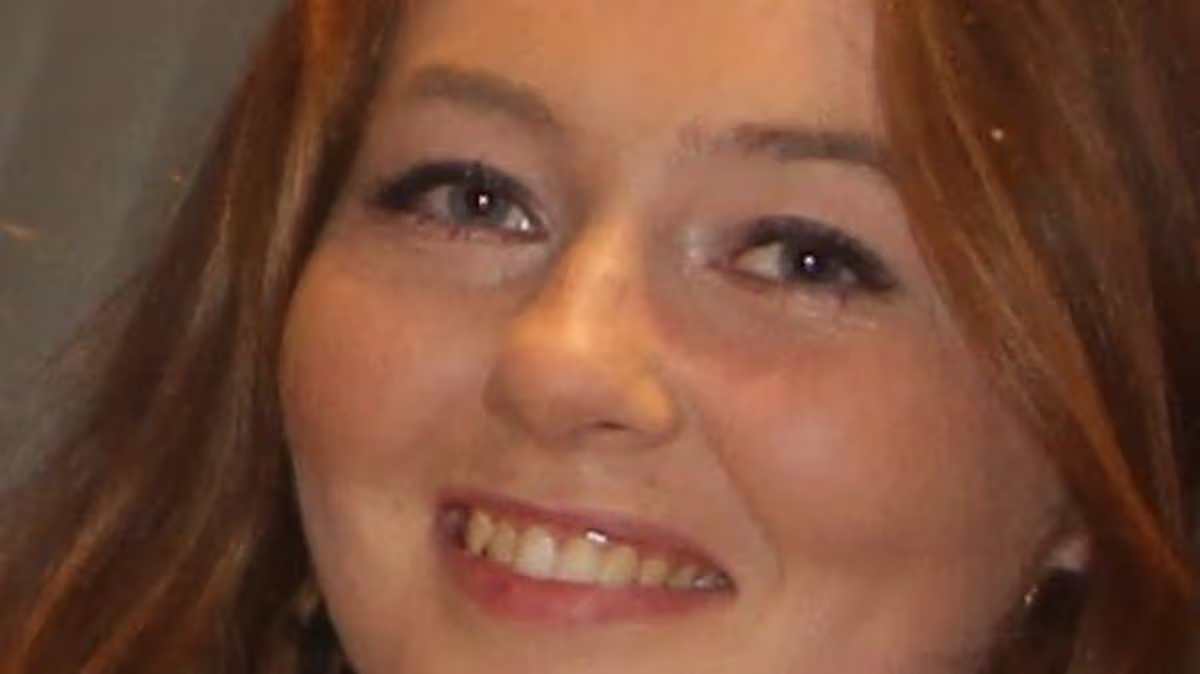
Juliette Kenny’s meningitis B infection became life-threatening quickly after her first symptoms appeared (Picture: Family handout/PA)

The family of a sixth form student killed by the Kent menB outbreak have spoken about her last moments trying to fight the infection.

Juliette Kenny, 18, was the second victim of the outbreak which began to spread in Kent last week after a University of Kent student died of the infection linked to the same strain of meningococcal  B.

Juliette, a Year 13 student at Queen Elizabeth’s Grammar School in Faversham, died on Saturday, March 14, just one day after her first symptoms appeared.

Her dad, Michael Kenny, said she was ‘fit, healthy and strong’ before her death.

Advertisement
Students queuing to receive vaccines and antibiotics at the University of Kent campus in Canterbury as the number of cases of meningitis being investigated by the UK Health Security Agency (UKHSA) in Kent has risen to 27.
Thousands of people have received antibiotics against menB preventatively across Kent (Picture: Gareth Fuller/PA Wire)

Sign up for all of the latest stories

Start your day informed with Metro’s News Updates newsletter or get Breaking News alerts the moment it happens.

Students receive the Meningitis B vaccine in the University of Kent sports hall on March 19, 2026 in Canterbury, England.
Students were given the meningitis B jab at the University of Kent sports hall yesterday (Picture: Getty Images)

She had even completed a practical assessment for her PE A-level on Thursday, March 12.

Mr Kenny said: ‘In the morning on Friday, she was taken, by us, to our local emergency drop-in as a discolouration appeared on her cheeks.’

The teen was not showing any symptoms at the time, but she was given antibiotics and taken to an A&E in an ambulance.

Advertisement

But her condition worsened quickly, which is typical for meningitis as it can progress from mild to life-threatening within hours.

To view this video please enable JavaScript, and consider upgrading to a web
browser that
supports HTML5
video

Advertisement

‘Juliette fought bravely for hours, but despite the fantastic NHS hospital staff fighting alongside her, meningitis took her from us less than 12 hours later,’ her dad said.

‘We were with her at the end, and the last sounds that she heard were the voices of those who loved her telling her how very much loved and cherished she is.’

He said the ‘devastation’ of her death is ‘immeasurable’ and something ‘no family should experience.’

‘Sharing stories of the empathy, warmth and fun that she created is helping her family and friends through at this time. Her energy continues to make the people who love her find a way.

Advertisement

‘The illness took her from us so quickly.’

Mr Kenny said his daughter had ‘beautifully positive energy,’ and he wanted her legacy to be ‘lasting change.’

Juliette’s grandmother, Linda Kenny, told the Daily Mail said she struggles to talk about the tragedy or ‘otherwise I will cry.’

Advertisement

‘We are all on antibiotics because we were with Juliette in hospital when she passed away,’ she added.

Vaccination sites and pharmacies have reported dwindling supply, with some places in Kent having to close lines early after medicines ran out yesterday.

In Kent alone, more than 8,500 antibiotics and 1,600 jabs have been given out to eligible people.

Juliette’s family have joined the Meningitis Research Foundation in calling for the government to improve access to menB vaccinations for teens and young people.

Advertisement

The majority of young people born before 2015 are not protected against menB infection unless they have had the vaccination privately. A private vaccination can cost up to £240 for the full two doses.

Get in touch with our news team by emailing us at webnews@metro.co.uk.

For more stories like this, check our news page.

Advertisement

Source link

Advertisement
Continue Reading

NewsBeat

Government borrowing sees surprise surge amid fears of squeeze from Iran war

Published

on

Government borrowing sees surprise surge amid fears of squeeze from Iran war

“Higher oil and gas prices would lift North Sea revenues, and stronger inflation could boost receipts from VAT and frozen tax allowances, but those gains would likely be outweighed by the damage to tax revenues from weaker growth and higher public spending on welfare, debt interest costs, and pressure for fiscal support for households and energy-intensive businesses.”

Source link

Continue Reading

NewsBeat

BBC Expert Explains Why Iran War Is Going Wrong For Trump

Published

on

BBC Expert Explains Why Iran War Is Going Wrong For Trump

A BBC expert has explained why the war is going wrong for Donald Trump – and why there appears to be no end to the conflict in sight.

Frank Gardner, the corporation’s highly-experienced security correspondent said American officials would have expected the regime in Tehran to have been defeated by now.

The US and Israel began bombing Iran nearly three weeks ago, and Trump has already declared victory on several occasions.

Nevertheless, the fighting is still going on, with Iran rataliating by attacking neighbouring countries in the Gulf.

Advertisement

Speaking on Radio 4′s Today programme, Gardner said “the Israelis have still got a pretty long list of targets they want to work their way through” in Iran, meaning the war is set to continue for a long time.

“They seem to be more aggressive than the Americans on this campaign,” he said.

“Donald Trump has got constraints on him that the Israelis don’t have.

“He was elected into office precisely not to do this kind of thing, to get dragged into a conflict with no easy off-ramps that’s got huge unintended consequences, like the partial closure of the Strait of Hormuz, the driving up of oil and gas prices and instability in the area.

Advertisement

“He’s got his Gulf Arab allies saying ‘what are you doing? This is mayhem in our area’.”

Gardner added: “There must have been a presumption in both US central command and the White House that the sheer shock and awe of US military firepower, which is vastly superior to what Iran can muster … and yet the Islamic republic regime has neither crumbled nor capitulated.

“There must have been expectation that by hitting so many commanders, so many [Iranian regime] bases, taking out all their missile launchers, that they would just throw up their hands in despair and say ‘OK, we give up, what are your demands’. That hasn’t happened.

“Iran has been defiant right from the beginning.”

Advertisement

Source link

Continue Reading

NewsBeat

Northumberland market town among UK’s best places to live

Published

on

Northumberland market town among UK's best places to live

It’s the second year in a row that Morpeth, situated near the coastal areas of Ashington and Bedlington, was crowned among the UK’s top spots in the publishers’ widely recognised guide, which saw Skipton in North Yorkshire claim the winning title.

The area, known as a “place of pilgrimage” for those coming to pay their respects to suffragette Emily Wilding Davison, has also recently been hailed one of England’s most underrated county towns by The Telegraph.

You can read more about that in our previous article.

Morpeth’s ‘community-spirited residents have plenty to shout about’

But why has Morpeth been named among the best places to live in the region for 2025 and 2026?

Commenting on this year’s findings, The Sunday Times judges shared: “Morpeth’s community-spirited residents have plenty to shout about: a new £21 million leisure centre, easy access to Newcastle and Northumberland’s best beaches and some excellent schools.

Advertisement

“The town’s choir groups and book festival are thriving and there are also crafting groups, dance and basketball clubs, a bouldering centre and a panto society.”

This follows last year’s praise from the publisher, which hailed Morpeth as “Britain’s friendliest market town”.

It said: “Every shopkeeper treats you like a long-lost friend, and the tails of the dogs (there are lots of them) are constantly wagging.

Advertisement

“Tranquil, yes. Backwater-ish, no. Even on a Monday morning in February, there is a purposeful bustle in the air and a lunchtime queue has already built up outside the Italian restaurant Lollo Rosso.”

The Telegraph also revealed that the most popular houses were to the north, on streets such as De Merley Road, Kings Avenue and Dacre Street.

Recent Rightmove data for house prices in Morpeth shows the market town had an overall average of £292,492 over the last year.

The property experts added: “The majority of properties sold in Morpeth during the last year were semi-detached properties, selling for an average price of £258,071.

Advertisement

This North East market town has made The Sunday Times’ annual property guide in 2025 and 2026 (Image: Getty Images/iStockphoto)

“Detached properties sold for an average of £398,376, with terraced properties fetching £223,422.

“Overall, the historical sold prices in Morpeth over the last year were similar to the previous year and similar to the 2023 peak of £289,725.”

Best places to live in the North and North East of England for 2026

Here are all the best places to live in the North and North East of England for 2026, as revealed by The Sunday Times:

  • Skipton, North Yorkshire 
  • Howardian Hills, North Yorkshire
  • Leeds city centre
  • Morpeth, Northumberland
  • Newcastle: Gosforth
  • Saltburn-by-the-Sea, North Yorkshire 
  • Slaithwaite, West Yorkshire
  • York

In total, 72 places across the UK were selected by The Sunday Times to showcase the best of Britain, with Norwich, Norfolk named the overall national winner.

You can see the full Sunday Times Best Places to Live 2026 guide online now.

Advertisement

The Sunday Times’s expert judges visited all the locations and assessed factors from schools to transport, broadband speeds and mobile signal to amenities, as well as access to high-quality green spaces and the health of the high street.

There are more new entries than ever before in this year’s guide.

As always, the judges looked for thriving locations with a strong sense of community rather than famous names with high house prices. 

Advertisement

Helen Davies, editorial projects director and Best Places to Live editor, commented: “This guide is a great opportunity to highlight the best places in Britain.

“It is full of places that show that our village, town and city centres can still be full of life, as well as places bursting with natural beauty, culture, connectivity and most importantly a sense of community. 

“Our expert team of judges visit every location on the list and talk to the locals to find out what they love about the place they live.

“These judges have traveled the length and breadth of the UK, from the Scottish Highlands to the Cornish coast, selecting the top towns and villages, suburbs and cities for the 2026 guide.

“One thing all our chosen locations have in common is that the people who live in them are proud to call them home.”  

Advertisement

The guide is published online today (March 20), with an abridged version appearing as a magazine supplement on Sunday (March 22).

Have you visited Morpeth recently or do you live there now? Let us know in the comments below.

Source link

Advertisement
Continue Reading

NewsBeat

Historic West Lothian town named as Scotland’s best place to live

Published

on

Daily Record

Linlithgow has emerged as the top choice in the 2026 Sunday Times Best Places to Live guide.

A historic West Lothian town has been named as Scotland’s best place to live.

Advertisement

Linlithgow has emerged as the top choice in the 2026 Sunday Times Best Places to Live guide.

The town is perhaps best known for the ruins of Linlithgow Palace, where Mary, Queen of Scots was born. Judges praised it as a “family-friendly hotspot that’s the perfect spot for commuters to Edinburgh or Glasgow who want clean air and a village mentality”.

Describing it as a “central belter”, the Sunday Times said residents “can’t get enough of the medieval high street, outstanding schools and the great outdoors”.

READ MORE: West Lothian man fined after keeping 12 cats in dark and dirty sheds

Advertisement

The judges added: “It’s the kind of town where the lollipop men know everyone’s names and have treats for the dogs, and competition is fierce in the famous annual cardboard boat race down the pretty Union Canal.

“Non-commuters have all the more time to enjoy the 180 shared interest groups, community-owned ski slope, theatre productions and jazz concerts or get involved in the community development trust.”

Linlithgow was one of seven Scottish places to make the Sunday Times list.

Helen Davies, editorial projects director and Best Places to Live editor, says: “This guide is a great opportunity to highlight the best places in Britain. It is full of places that show that our village, town and city centres can still be full of life, as well as places bursting with natural beauty, culture, connectivity and most importantly a sense of community.

Advertisement

READ MORE: People living with glaucoma in West Lothian can access support within community

“Our expert team of judges visit every location on the list and talk to the locals to find out what they love about the place they live.

“These judges have travelled the length and breadth of the UK, from the Scottish Highlands to the Cornish coast, selecting the top towns and villages, suburbs and cities for the 2026 guide.

“One thing all our chosen locations have in common is that the people who live in them are proud to call them home.”

Advertisement

READ MORE: Permission granted for construction of new Craigshill Primary in Livingston

Don’t miss the latest news from the West Lothian Courier. Sign up to our free newsletter here.

Source link

Advertisement
Continue Reading

NewsBeat

Belarus releases 250 political prisoners to lift some US sanctions

Published

on

Belarus releases 250 political prisoners to lift some US sanctions

TALLINN, Estonia (AP) — Belarus’ authoritarian President Alexander Lukashenko on Thursday ordered the release of 250 political prisoners as part of a deal with Washington that lifted some U.S. sanctions, the latest step in the isolated leader’s effort to improve ties with the West.

Lukashenko pardoned the prisoners after meeting with U.S. President Donald Trump’s special envoy for Belarus, John Coale, in the Belarus capital of Minsk. Coale hailed the release as a “significant humanitarian milestone” and a testament to Trump’s “commitment to direct, hard-nosed diplomacy.” It marked the largest one-time release of political prisoners in the country.

Coale told reporters that the U.S. will lift sanctions from two Belarusian state banks and the country’s Finance Ministry, and that the top Belarusian potash producers have been removed from a sanctions list.

Belarus’ opposition leader-in-exile, Sviatlana Tsikhanouskaya, hailed the prisoners’ release as “a moment of great relief and hope.”

Advertisement

“After years of isolation, people are now free and can finally embrace their loved ones,” Tsikhanouskaya told The Associated Press. “There is nothing more powerful than seeing someone who endured unjust imprisonment reunited with their family.”

She thanked Trump and his officials for their “tireless efforts to secure the release of political prisoners,” adding that “these humanitarian efforts are saving lives.”

The last time U.S. officials met with Lukashenko, in December, Washington announced the easing of sanctions on Belarus’ potash sector, a key source of export revenue, and 123 prisoners were released and sent to Ukraine and Lithuania.

A close ally of Russia, Minsk has faced isolation for years. Lukashenko has ruled the nation of 9.5 million with an iron fist for more than three decades, and the country has been sanctioned repeatedly by Western countries — both for its crackdown on human rights and for allowing Moscow to use its territory in the full-scale invasion of Ukraine in 2022.

Advertisement

Lukashenko’s rule was challenged after a 2020 presidential election, when tens of thousands poured into the streets to protest a vote they viewed as rigged. They were the largest demonstrations since Belarus became independent following the 1991 collapse of the Soviet Union.

In an ensuing crackdown, tens of thousands were detained, with many beaten by police. Prominent opposition figures either fled the country or were imprisoned.

Five years after the mass demonstrations, Lukashenko won a seventh term last year in an election that the opposition called a farce.

More recently, Belarus has freed some political prisoners to try to win favor with the West. Since Trump returned to the White House last year, Lukashenko has released dozens of prisoners, including Nobel Peace Prize laureate Ales Bialiatski and key dissident figures Siarhei Tsikhanouski, Viktar Babaryka and Maria Kolesnikova.

Advertisement

Trump spoke to Lukashenko by phone in August 2025 after one such release and even suggested a face-to-face meeting in what would be a big victory for the Belarusian leader, who has been dubbed “Europe’s Last Dictator.”

Dzianis Kuchynski, an adviser to Tsikhanouskaya, said that 15 of the 250 prisoners arrived in Lithuania following their release.

They included Valiantsin Stefanovich and Marfa Rabkova of the prominent Belarus human rights group Viasna. Stefanovich was serving a nine-year sentence on charges of smuggling money to finance activities violating the public order after his arrest in 2023. Rabkova was sentenced to 14 years and nine months following her 2020 arrest and conviction on charges of organizing riots and inciting hatred, accusations widely seen as a punishment for documenting human rights abuses.

Nasta Loika, 37, an activist with the international rights group Human Constanta, was also released. She was sentenced to seven years in prison after her arrest in 2022 on charges of organizing mass unrest and inciting hatred – charges widely seen as retaliation for her activism.

Advertisement

Also freed was Katsiaryna Bakhvalava, 32, who also goes by the last name of Andreyeva, a journalist of the Polish-funded Belsat TV channel who was arrested in 2020 while covering mass anti-government protests in Minsk. She was sentenced to more than eight years in prison on convictions for violating public order and treason.

Eduard Palchys, a 35-year-old opposition blogger, was also among those pardoned by Lukashenko. He was convicted of causing harm to Belarus’ national security and organizing mass unrest over his role in coordinating the demonstrations in 2020. and sentenced to 13 years in prison.

Like previously released prisoners, they were all sent to Lithuania without passports or other identity papers. Kuchynski denounced it as a “mockery” by Belarusian authorities seeking to make the lives of the released prisoners more abroad more difficult.

Just before the latest announcement of releases, the Viasna group had estimated that there were more than 1,100 political prisoners in the country.

Advertisement

Tsikhanouskaya emphasized that “many people are still behind bars” and “our goal remains unchanged — to free them all and to put a final end to repression, so that every Belarusian can live freely in their own country.”

Source link

Advertisement
Continue Reading

NewsBeat

BBC Comic Relief start time and finish time as presenters tease ‘best opening ever’

Published

on

Wales Online

Red Nose Day returns to BBC One on Friday, March 20 with Davina McCall, Joel Dommett and Catherine Tate presenting Comic Relief: Funny for Money from 7pm – here’s everything you need to know about the telethon

Red Nose Day is making a comeback this week with Comic Relief: Funny For Money.

Advertisement

The annual charity spectacle will be broadcast live on BBC iPlayer and BBC One from MediaCityUK in Salford, promising a night filled with humour and entertainment to raise funds for providing food, shelter, and safety.

The telethon is set to feature live performances, fantastic prizes, surprise guest appearances, and must-watch sketches. In a first for Comic Relief, the show will also be live-streamed on the official BBC YouTube channel.

This year’s special guests include Idris Elba, reprising his role as DCI John Luther, joining Alison Hammond and Dermot O’Leary in the hilariously suspenseful sketch The Bank Job.

Catherine Tate will co-host the show alongside regular presenter Davina McCall, appearing as Nan from The Catherine Tate Show. Here’s everything you need to know ahead of the renowned telethon, reports the Mirror.

Advertisement

Comic Relief start and finish time

Comic Relief: Funny for Money will air live on BBC iPlayer and BBC One on Friday, March 20, and for the first time ever, it will be simultaneously live-streamed on the official BBC YouTube channel.

Viewers can tune in at 7pm to watch the spectacle unfold, with co-host Joel Dommett promising one of the “best openings to Comic Relief ever.”

The telethon will run for three hours on BBC One, then at 10pm, the Red Nose Day fun will move over to BBC Two where Romesh Ranganathan will host a special episode of Comic Relief Does The Weakest Link.

Advertisement

Comic Relief presenters

Returning to present once more is Davina McCall, who will anchor the entire evening’s entertainment.

She will be accompanied in hosting responsibilities by Katherine Ryan, Nick Mohammed, Joel Dommett, and Catherine Tate (as Nan from The Catherine Tate Show).

Discussing the presenting lineup, Davina remarked: “What’s so nice is that I’m hosting with Joel Dommett, and Joel’s actually one of my best friends! So, it’s so nice to be presenting with him. Knowing that I’m with him whilst also presenting with Nan (Catherine Tate) is very reassuring, because actually, I am mildly terrified of Nan if I’m honest!”.

Advertisement

“How I’m going to stop her from swearing, I just don’t know! Obviously ‘please do not swear’ was my catchphrase – so I’m going to have to stay on my toes. Katherine Ryan, I love. I mean, Nick Mohammed, I was obsessed with Ted Lasso so I’m so excited about working with him. It’s going to be an amazing, amazing night.”

Comic Relief sketches and cameos

The BBC has pledged “some very special cameo guests” and comedy segments. Thus far, the broadcaster has announced sketches featuring several of its most popular programmes, including The Traitors, and Amandaland, alongside The Bank Job, starring Alison Hammond and Dermot O’Leary.

The sketch will feature the duo devising a plan to generate enormous sums of money in an incredibly swift, absurd manner by robbing a bank. They’ll be accompanied on the robbery by Chris McCausland, Stephen Mulhern, Shona McGarty, Niko Omilana, Gladiator’s Sabre, and Natalie Cassidy.

The BBC stated: “Who will stay on the right side of the law? Who will put their (questionable! ) intelligence, strategic prowess and artful deftness to the test in a bid to become 2026’s most-wanted bank robber? And how will they fare now that DCI John Luther is on the case?”.

Advertisement

The programme will also showcase the remarkable challenges undertaken by celebrities in the run-up to Red Nose Day, including Radio 1 DJ Greg James, who is presently tackling a 1,000km tandem bicycle journey across the UK to raise funds.

On how to get involved in Red Nose Day, you can visit the Red Nose Day website.

For the latest showbiz, TV, movie and streaming news, go to the new Everything Gossip website.

Source link

Advertisement
Continue Reading

Trending

Copyright © 2025