Connect with us
DAPA Banner
DAPA Coin
DAPA
COIN PAYMENT ASSET
PRIVACY · BLOCKDAG · HOMOMORPHIC ENCRYPTION · RUST
ElGamal Encrypted MINE DAPA
🚫 GENESIS SOLD OUT
DAPAPAY COMING

NewsBeat

Notoriously strict Samuel Smith’s brewery boss who banned mobile phones, music and swearing in his pubs dies aged 81

Published

on

Humphrey Smith (pictured), the notoriously strict brewery boss who banned mobile phones, music and bad language from his pubs, has reportedly died aged 81

Humphrey Smith, the notoriously strict brewery boss who banned mobile phones, music and bad language from his pubs, has died aged 81.

The former chairman of Samuel Smith’s Old Brewery was one of the most controversial figures in the British pub trade.

To admirers, he was a determined guardian of the traditional public house – protecting historic interiors and the lost art of conversation from the relentless march of smartphones and fruit machines.

To critics, he was an uncompromising and sometimes fearsome figure whose rigid rules left some landlords terrified.

Advertisement

Smith, who was born on December 17, 1944, headed the family brewery in Tadcaster, North Yorkshire, which traces its history back to 1758 and claims to be Yorkshire’s oldest.

Under his leadership, Samuel Smith’s grew into one of Britain’s most distinctive pub companies, operating more than 200 establishments across the country.

Many occupy handsome historic buildings and retain traditional features including open fires, wooden panelling and Victorian fittings.

But it was the extraordinary list of things Smith refused to tolerate that made his pubs famous far beyond North Yorkshire.

Advertisement

Humphrey Smith (pictured), the notoriously strict brewery boss who banned mobile phones, music and bad language from his pubs, has reportedly died aged 81

Pictured is the Samuel Smith brewery in Tadcaster, North Yorkshire, where Mr Smith ran his 200-pub strong chain

Pictured is the Samuel Smith brewery in Tadcaster, North Yorkshire, where Mr Smith ran his 200-pub strong chain 

Mr Smith (pictured) who was born on December 17, 1944, headed the family brewery in Tadcaster which traces its history back to 1758 and claims to be Yorkshire's oldest

Mr Smith (pictured) who was born on December 17, 1944, headed the family brewery in Tadcaster which traces its history back to 1758 and claims to be Yorkshire’s oldest

Advertisement

Smartphones were forbidden, as were laptops, televisions, music and fruit machines. Dogs, muddy boots and children were also unwelcome in many premises.

Swearing could lead to drinkers being thrown out – and landlords could reportedly find themselves out of a job if Smith believed they had failed to enforce his rules.

Smith was known for making unannounced visits to pubs across the country to ensure managers were maintaining his exacting standards.

One of the most notorious incidents came in 2019, when he reportedly overheard a customer tell a joke containing a swear word at the Fox and Goose in Droitwich Spa, Worcestershire.

Advertisement

The pub’s landlords, Eric and Tracey Lowery, had been running the premises for just seven weeks when they found themselves without their jobs – or the flat above the pub.

At the Cow and Calf in Sheffield, manager Louise Brownhill and her husband Steve claimed they were dismissed after Smith discovered his preferred dessert was not in stock (a chocolate fondant).

Mrs Brownhill said the couple had been unable to stock the dessert because the brewery had not provided them with a freezer.

At an employment tribunal involving two former Edinburgh pub managers, Smith was characterised by a judge as ‘combative and argumentative’.

Advertisement

Employment judge Murdo Macleod said Smith appeared dismissive of the proceedings and gave the impression that they were either ‘a waste of his valuable time or beneath him’.

Yet the formidable reputation contrasted sharply with the unassuming figure regularly seen walking through Tadcaster in tweed and wellington boots, often carrying a worn towel as he made his way to the local swimming pool.

Despite presiding over a valuable brewing and property empire, Smith was not known for displays of personal extravagance.

Residents said he gave up driving not a Ferrari or Rolls-Royce, but a modest Austin Allegro.

Advertisement
Pictured: The Princess Louise pub on High Holborn in Central London - a Samuel Smith's pub

Pictured: The Princess Louise pub on High Holborn in Central London – a Samuel Smith’s pub

Pictured: A coaster in one of the Sam Smith pub's which encourages people to talk - and bans devices

Pictured: A coaster in one of the Sam Smith pub’s which encourages people to talk – and bans devices

In later life he was said to travel by public bus, sometimes appearing unexpectedly at distant pubs with a portfolio tucked under his arm.

His habitual lunchtime swim took him past many of the empty shops, boarded-up houses and closed pubs that made him such a divisive figure in his home town.

Advertisement

Smith was reported to control as much as 70 per cent of Tadcaster’s commercial property through the brewery and associated interests.

Locals variously described him as the town’s ‘laird’ and a ‘Dickensian figure’ who inspired fierce loyalty and equally fierce resentment.

Critics accused him of allowing properties to deteriorate while refusing to let large chains occupy his buildings.

They argued that his control over land and commercial premises had prevented new homes, restaurants and businesses from coming to the town.

Advertisement

Smith’s relationship with Tadcaster came under intense scrutiny after the historic bridge over the River Wharfe collapsed during devastating floods in 2015.

Residents were initially forced to make a lengthy diversion between the two halves of the town.

Smith reportedly refused to allow brewery-owned land to be used for a temporary footbridge unless he was given input into the permanent replacement.

A temporary crossing was eventually erected on council-owned land, while the road bridge was later rebuilt following intervention by then-prime minister David Cameron.

Advertisement

Cllr Richard Sweeting said Tadcaster was ‘in mourning’ over the death of Mr Smith, who had been unwell for some time.

Cllr Sweeting, the town mayor, said: ‘It’s the end of an era. Mr Smith has been part of Tadcaster for many years and has done a lot for this town.

‘But he wasn’t one for publicity. He would like to do things behind the scenes. We wouldn’t have a lot of the facilities in the town if it wasn’t for Mr Smith and the brewery.

‘I knew Mr Smith extremely well. There was one thing he did have. He did have the town at heart. He was a Tadcaster person.

Advertisement

‘I have known him all my life and his mother. He has done a lot for the church and the community. To me, he’s just Mr Smith. They do a lot of unseen things.

‘Talking to people in the town, Tadcaster is in mourning. It’s the end of an era. My thoughts and prayers are with his family at this sad time.’

Tadcaster is known for its three breweries. John Smith’s was set up by members of the same Smith family in the 19th century, though it has long been separate from Sam Smith’s and now part of Heineken.

Molson Coors also has a plant in the town, where ‘Spanish’ beer Madri is brewed.

Advertisement

Companies House records show Smith resigned as a director of Samuel Smith Old Brewery on June 17, 2026.

News of his death was first reported by York Press, which said it had received a verbal confirmation of his passing over the phone from the notoriously media-averse brewery.

The British Pubs Facebook site posted: ‘An absolute titan of the British brewing world has passed away. Humphrey Smith, the famously traditionalist and eccentric owner of Yorkshire’s Samuel Smith’s Brewery, has died.’

The post continued: ‘Love him or hate him for his strict rules – banning smartphones, tablets, music, and even swearing – he ran his pubs entirely his own way to preserve the classic, tech-free British Pubs experience.’


Advertisement

Source link

Continue Reading
Click to comment

You must be logged in to post a comment Login

Leave a Reply

NewsBeat

Venezuela quake survivor pulled out alive after eight days on

Published

on

A woman with shoulder-length blonde hair talks into a microphone

Hundreds of rescuers had been working against the clock to free Gil since he was found on Saturday.

Teams from Venezuela, Chile, Costa Rica, El Salvador, Mexico, Portugal and the United States helped to free him.

Parts of the access ducts rescuers built to reach him collapsed several times, highlighting the dangers the work poses to the rescuers as well as Gil.

Overnight, the search teams were finally able to establish visual contact with Gil.

Advertisement

In footage recorded by a small camera inserted into the rubble where Gil was trapped, a Chilean firefighter could be heard asking Gil to turn his head towards the camera.

One of his eyes was bloodshot and he was wearing a face mask, which rescuers had earlier passed to him through a small hole to protect him from the dust and debris created by their efforts to free him.

The firefighter also asked him to don goggles to protect his eyes as rescuers continue to carefully dig away at the rubble surrounding him.

Source link

Advertisement
Continue Reading

NewsBeat

How to create a username on WhatsApp for new feature

Published

on

How to create a username on WhatsApp for new feature

The messaging platform’s new privacy feature will mean you can message others without using phone numbers, but through usernames.

The new feature is being rolled out to more than three billion users over the next few months.

However, those looking to secure a username will be able to create and reserve one from this week – here’s how.

Advertisement

WhatsApp new username feature explained

WhatsApp says that usernames are the app’s “latest step to make WhatsApp even more private”.

Those wishing to contact you will need to know your exact username, as there will be no directory to browse and no suggestions.

Once usernames are launched, when you message a person or business for the first time they will no longer see your phone number if you have enabled your username.

Head of product for WhatsApp, Alice Newton-Rex, posted to LinkedIn: “For the first time in WhatsApp’s history, you’ll be able to message someone without your phone number.

“Starting this week, you can reserve a username to use later this year when we launch this feature.

Advertisement

“We’re opening reservations globally at the same time, so everyone has the opportunity to select the username they want.

“People have been asking for this for years and we’re excited to finally get it into their hands.”

Usernames are being gradually rolled out over the coming months, and users will receive an in-app notification when the feature becomes available.

How to choose and secure a WhatsApp username

You can already secure your username from this week, and here is how.

Advertisement

Before anything, you will need to have the latest update of the app installed.

Once done, head to Settings > Account > Username, where you can select one.

Usernames must be between three and 35 characters and WhatsApp has a generator to help anyone who needs inspiration.

Reserving a username can be done through users’ accounts or profile settings in the app, and can only be done on a phone, not on WhatsApp Web or Desktop.

A select number of usernames are also being held back for high-profile people or groups to prevent any risk of impersonation.

Advertisement

Usernames can also be changed or deleted at any time, but if you change your username, the original one you chose may become available to others.

What do you think of WhatsApp’s new username feature? Let us know in the comments.

Source link

Advertisement
Continue Reading

NewsBeat

Teen rapists spared jail by ‘soft justice’ judge in case which shocked the nation are finally locked up after Appeal Court decides original sentences were too lenient

Published

on

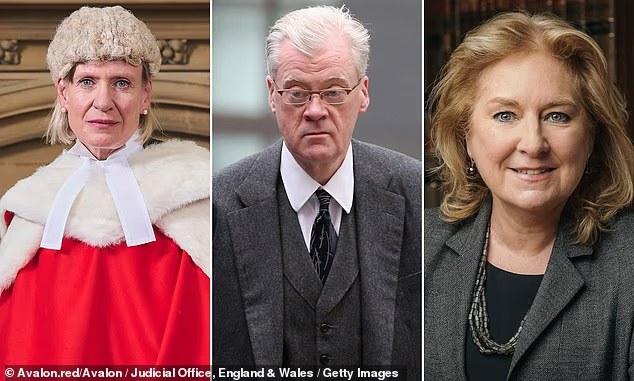
Appeal Court judges (left to right) Ms Justice Norton, Lord Justice Edis and Lady Chief Justice Baroness Carr ruled the two older teenagers should go into custody

Two boys initially spared custody after being convicted of raping two girls have been jailed after their original sentences were quashed.

The Court of Appeal ordered the two 15-year-olds to be sent to young offender institutions after their violent attacks in Fordingbridge, Hampshire.

Two boys known as X and Y were initially given community sentences with rehabilitation requirements after being convicted of 10 counts of rape and seven indecent image offences relating to the victims, ‘vulnerable’ girls aged 14 and 15.

The boys were involved in both attacks and received three-year youth rehabilitation orders, while a 14-year-old, who encouraged the rape of the second victim, was handed an 18-month term. Parts of both assaults were filmed on the boys’ mobile phones.

Advertisement

Court of Appeal judges Lady Chief Justice Baroness Carr, Ms Justice Norton and Lord Justice Edis today ruled to increase the older boys’ sentences after the Attorney General Lord Hermer referred them under the ‘unduly lenient’ scheme.

The trio – who cannot be named because of their ages – appeared at the London court via video link from Southampton Crown Court, where they were originally sentenced in May.

X and Y were given four-year sentences in youth detention. The youngest boy’s sentence remained unchanged. 

Baroness Carr told the boys: ‘We have thought very hard about everything we have read, and everything we have been told. 

Advertisement

Appeal Court judges (left to right) Ms Justice Norton, Lord Justice Edis and Lady Chief Justice Baroness Carr ruled the two older teenagers should go into custody

‘Having done so, we have decided that we do need to change your sentences, and that both of you do need to go into detention. 

‘We have made this decision because we think that what you both did was so bad that we have no other choice.

Advertisement

‘You both raped two girls on two different occasions. You were enjoying it and egging each other on. You made it worse by filming what you did, which was a horrible thing to do.’

Addressing Z, Baroness Carr said: ‘We have decided that because you were very young and find some things really very difficult to understand, and because you were only involved on one occasion, we do not need to change your sentence.’

She added that trial judge His Honour Judge Nicholas Rowland’s ‘assessment of seriousness’ was the issue at the heart of the appeal. 

But she said he had erred in this regard, because he did not properly consider the age and vulnerability of the girls, or the ‘severe’ psychological harm caused to them.

Advertisement

X and Y would have each been jailed for terms ‘substantially in excess of 10 years’ had they been adults at the time, she said.  

Yesterday, Tom Little KC, for the Attorney General, said Judge Rowland was ‘wrong’ to spare the trio custody, and said detention was the ‘only appropriate sentence’ for them.

One of the rapes took place in this underpass in Fordingbridge in Hampshire, in November 2024

One of the rapes took place in this underpass in Fordingbridge in Hampshire, in November 2024

Judge Rowland had said the offences of the two 15-year-olds ‘crossed the custody threshold’, but he should ‘avoid criminalising these children unnecessarily’.

Advertisement

Mr Little said the judge failed to properly consider the psychological impact on the young victims, or the girls’ vulnerability, as he set out the case for harsher punishments.

He said the judge also appeared not to properly consider the ‘clear evidence of extensive harm’ suffered by the girls.

Addressing the Appeal Court judges, Mr Little said parts of Judge Rowland’s approach to sentencing were ‘fundamentally flawed’ and that he demonstrated a ‘failure to grapple with the seriousness of the offending’.

Mr Little added: ‘A community sentence could simply not be justified for each of these child offenders despite their ages and any intellectual limitations.’

Advertisement

He said ‘no sentence other than detention was appropriate’ for the trio.

Edward Henry KC, for Y, told the Court of Appeal the strength of public outcry was in part down to an error in a Crown Prosecution Service press release which wrongly stated a knife was used during one of the rapes.

He said Y, whose IQ is in the bottom 1% of children his age, had ‘behaved deplorably and disgracefully’, but that ‘the opprobrium, the sheer force of hatred on social media’ had made his punishment worse.

The boys' sentences were considered at the Court of Appeal

The boys’ sentences were considered at the Court of Appeal

Advertisement

Tracy Ayling KC, for Z, the youngest defendant, said publicity based on inaccurate information was ‘particularly unfortunate’.

And Clare Wade KC, for X, said that Judge Rowland ‘approached the sentencing exercise correctly’.

The Lady Chief Justice Baroness Carr – the most senior judge in England and Wales – criticised the CPS for including inaccurate information and demanded answers, particularly given claims the errors were not corrected until two weeks after they were spotted.

Baroness Carr said: ‘I would like to know what steps are being taken to prevent things like this ever happening again.’

Advertisement

She said that the court was ‘considering what our options are’ in relation to the error.

A CPS spokesperson said: ‘Following the trial, the CPS issued a press release which reflected the prosecution case at trial, but did not accurately reflect the judge’s findings in relation to the offending. We later amended the release to correct this and regret the error.

‘It is essential that our public communications accurately reflect court findings. We have reviewed the circumstances of this case and we will identify lessons for the future.’

The case provoked a strong reaction from politicians and members of the public aghast that the teens had been spared jail. 

Advertisement

Shadow Home Secretary Chris Philp said afterwards: ‘These despicable youths should have been jailed. 

‘This is a sickening case of soft justice.’

Boys X and Y were also handed lifelong restraining orders not to contact either victim again.  

Source link

Advertisement
Continue Reading

NewsBeat

Belarus jails journalist Kiryl Pazniak in free speech crackdown

Published

on

Belarus jails journalist Kiryl Pazniak in free speech crackdown

TALLINN, Estonia (AP) — A court in Belarus has convicted a journalist and sentenced him to 3 1/2 years in prison in the latest step against free speech in the country, the Belarusian Association of Journalists reported Thursday.

Kiryl Pazniak, 49, who hosted a popular political show on YouTube, has been convicted on the charges of discrediting Belarus and forming an extremist organization, the group said — accusations widely used by authorities to stifle critical voices. Pazniak has also been ordered to pay a fine, roughly equivalent to $8,500.

Pazniak was arrested in September 2025. His ex-wife Elena said he has fallen seriously ill behind bars, suffering from pneumonia and COVID-19, and was placed in a prison hospital in serious condition.

He has been designated a political prisoner by human rights defenders.

Advertisement

Belarus’ authoritarian president, Alexander Lukashenko, has governed the nation of 9.5 million with an iron fist for more than three decades. The country has been sanctioned repeatedly by Western nations — both for its crackdown on human rights and for allowing Moscow to use its territory in the full-scale invasion of Ukraine that began on Feb. 24, 2022.

Lukashenko’s government was challenged after a 2020 presidential election, when hundreds of thousands took to the streets to protest a vote they viewed as rigged. In an ensuing crackdown, tens of thousands were detained, with many beaten by police. Prominent opposition figures fled the country or were imprisoned.

Since U.S. President Donald Trump returned to the White House in January 2025, Lukashenko has released hundreds of political prisoners as part of American-brokered deals that lifted some U.S. sanctions, part of the isolated leader’s efforts to improve ties with the West.

Human rights groups say, however, that Belarusian authorities have continued their crackdown on dissent. Belarus still has 863 political prisoners, according to the Viasna human rights center.

Advertisement

“Pazniak nearly died behind bars, but was convicted and is forced to continue suffering simply for fulfilling his professional duty,” said Andrei Bastunets, leader of the Belarusian Association of Journalists. “Repressions against journalists in Belarus are not abating, and the situation with freedom of speech remains the worst in Europe.”

A total of 21 journalists remain behind bars in Belarus, according to the group.

Advertisement

The Committee to Protect Journalists reported this week that six Belarusian media outlets in exile regularly face DDoS attacks that aim to overload their websites with traffic and make them impossible to access.

“While it can be difficult to pinpoint those responsible for DDoS attacks, editors and journalists at the outlets targeted in the recent wave told CPJ they believed Belarusian authorities might have sought to squash reporting on particular political topics, including events linked to Belarus’ exiled opposition,” CPJ said in an online statement.

Advertisement

Source link

Continue Reading

NewsBeat

Many teens come up empty-handed in their summer job search

Published

on

Many teens come up empty-handed in their summer job search

NEW YORK (AP) — Jaelyn Chester will wait your tables or stock your shelves. She’ll wash your dishes or scrub your toilets. If only someone would give the 17-year-old a chance.

“I’ve been looking everywhere,” says Chester, an A+ student, high school basketball star and aspiring engineer who has blanketed her community with dozens of applications. “I’m not unemployed because I’m incompetent. I’m unemployed because nobody’s hiring.”

The summer job, a rite-of-passage for generations of American teenagers, isn’t so easy to come by.

About one-third of 16- to 19-year-olds in the U.S. were employed last summer, federal data show, down from a peak of about 60% in the late 1970s. Experts’ pessimistic forecasts are combining with reports from frustrated jobless young people around the country to form a seasonal outlook far from bathed in sunshine.

Advertisement

“The opportunities for workers at the start of the career ladder started to dry up,” says Nicole Bachaud, an economist for ZipRecruiter, saying teens are among the labor market’s “most marginalized groups.”

Without a job, Chester worries her summer will be ruined. She wonders how she’ll fill her tank with gas and what she’ll do if she wants to go to a concert. A trip to look at colleges in North Carolina with some friends would be destined to be canceled. So her hunt continues.

Chester keeps copies of her resume in her car and has a 30-second spiel memorized when she decides to pop into a restaurant or store and try to talk with a manager. She and her friends help ready one another when they set out on their job hunt, trading tips and professional-looking clothes from their closets. Positions that once sounded awful to her, like dishwashing, no longer seem so.

“At this point,” says the teen from Lake Mary, Florida, “it would be hard to say no to anything.”

Advertisement

Analyzing data from the U.S. Bureau of Labor Statistics, the outplacement firm Challenger, Gray and Christmas found the number of jobs secured by teens fell 25% last summer from the year prior. The firm says inflation, oil prices and cautious hiring are likely to lead to even fewer jobs this year, resulting in the lowest summer hiring total for teens since the federal government began tracking it in 1948.

Teens most commonly work in food preparation and serving jobs and sales, according to BLS data. But Jaune Little, director of recruiting services at the human resources company Insperity, says some entry-level jobs have been eliminated and teens now compete with more experienced candidates for the remaining ones.

“A lot of the entry-level roles that once existed simply do not any longer,” Little says. “Those that do exist are on leaner teams that have less ability and desire to develop and train someone. In many instances, they are prioritizing more skilled workers even if they are overqualified.”

Max Stephenson began looking for a job last year after graduating from high school. Nothing turned up all summer. Once she began at the University of Arkansas-Pulaski Technical College, she got a work study position in the cafeteria, still keeping an eye out for a more permanent gig.

Now, school’s out again, and Stephenson is again jobless.

The 19-year-old from Little Rock, Arkansas, lost track of how many jobs she’s applied for, but thinks it’s somewhere between 50 and 100. She can’t help thinking it’s tougher than previous generations had it to find work paying around the minimum wage.

Advertisement

“I thought it would be much easier than it’s been,” Stephenson says. “Old people say, ‘Just walk in there and give them a firm handshake.’ That doesn’t work so well now.”

A 2022 report by Pew Research Center found summer employment of teens fell during the early 2000s dot-com bubble, and dropped even more during and after the Great Recession of 2007 to 2009. White teens are more likely to have a job than teens from any other racial group, Pew found.

Across demographics, though, teens are reporting difficult job searches, taking to Reddit and TikTok with rants about phantom postings, managers who ghost them and applications that go nowhere.

It’s a struggle Connor Vukelich knows well.

Advertisement

After he turned 16, he applied anywhere he could find in a 30-mile radius of his home near Vancouver, Washington. No offers followed and Vukelich’s friends were similarly coming up empty-handed.

“There’s all these ‘We’re Hiring’ signs but no one’s actually hiring,” Vukelich says. “What’s going on? Why can’t any of us find jobs?”

When his search turned fruitless, he ended up working on his parents’ lavender farm. But the frustration of the experience led Vukelich – who is now 20 and a student at Embry–Riddle Aeronautical University – to launch Poppin’ Jobs, an employment search site launched this year and aimed at teens and 20-somethings.

Vukelich believes artificial intelligence is robbing teens of some potential jobs and that laws to boost the minimum wage in some states have pitted first-time job-seekers against more experienced candidates.

Advertisement

“They don’t see the value in hiring someone without any experience,” he says of employers, “they’re not as willing to give someone that shot.”

Some teen applicants find painful job searches eventually pay off. Demie Njea, a 16-year-old from Lexington, Kentucky, started applying for jobs once she turned 14, her state’s legal working age. A search centered on fast food spots and stores turned to one that included jobs as a janitor, daycare worker and more.

Nothing went anywhere the first summer. Or the second. Njea estimates she applied for more than 100 jobs in all. She started wondering if she’d ever get a first job.

Finally, an offer came and Njea started working at Sonic. She is thrilled. But when a friend who turned 15 started applying for work, Njea had to be honest.

Advertisement

“I had to calmly put her down and say, ‘You’re not going to get it,’” Njea says. “It’s just not going to happen.”

___

Matt Sedensky can be reached at [email protected] and https://x.com/sedensky

Advertisement

Source link

Continue Reading

NewsBeat

Taylor Swift and Travis Kelce wedding LIVE: Date confirmed as guests arrive in New York

Published

on

Daily Mirror

13 is Taylor’s lucky number – and it’s been rumoured she’ll be having 13 bridesmaids.

“The bridesmaids are likely to be Lena Dunham. Taylor was a bridesmaid at her wedding in 2021, so she’s likely to return the favour,” biographer Anna Pointer tells us.

(Image: FILE)

“Selena Gomez I think is a shoo-in for bridesmaid. They’re inseparable really. The Haim sisters, – Esther, Danielle, and Alana have all been mentioned as possible bridesmaids, as have Emma Stone and Gigi Hadid.

Advertisement

“And then the cutest I’m sure will be Jason and Kylie Kelce’s daughters. Taylor and Travis are both really close to their nieces. There are four of them, Wyatt, Elliott, Bennett, and Finley and they’re all super cute, and they’ll be the scene stealers.

“And then Taylor’s best friends from high school days. There’s Abigail Anderson. Taylor was a bridesmaid at her wedding and another of her best friends, Ashley Avignone is likely to be there as well. That takes you to the magic number 13.”

Source link

Advertisement
Continue Reading

NewsBeat

Britain’s Arthur Fery produces tenacious display fit for a princess at Wimbledon

Published

on

Britain’s Arthur Fery produces tenacious display fit for a princess at Wimbledon

Hello and welcome to coverage from Wimbledon as Arthur Fery plays Finnish qualifier Otto Virtanen.

Frey earned his place in the second round after beating Bosnian opponent Damir Dzumhur ‌3-6, 6-2, ​6-2, 6-1. The match ⁠was overshadowed by Fery being called dishonest by Dzumhur.

But Fery, one of 12 British wildcards, kept his cool and even used earplugs while Dzumhur complained to the umpire. 

Advertisement

“It was expected, to be honest,” said Fery, who is through to the second round for a second straight year. “He does that with everyone. I guess I was just ready for it before the match. If it’s a let, it’s a let for everyone, right, it’s not just a let for him. Whether the point carries on or not, it’s the same for both of us.

“He obviously wants to make a problem with the umpire and then is trying to speak to me about it. But there is nothing to really speak about. Just trying to get the other player involved for no reason.”

Fery is now on the verge of breaking into the top 100 after also reaching the quarter-finals at Queen’s Club earlier this month.

The British No 3 is the higher-ranked player but Virtanen has also shone on grass this summer and knocked out fourth seed Ben Shelton in the biggest upset of the tournament so far.

Advertisement

“It’s a surprise, definitely,” said Fery. “But it’s an opportunity. He’s obviously a great grass-court player.”

Fery grew up five minutes from Wimbledon and would often visit the tournament as a child. He is the heir to an estimated £275m fortune thanks to his father, Loïc Fery, a hedge fund manager and president of Brittany-based Ligue 1 club FC Lorient.

Source link

Advertisement
Continue Reading

NewsBeat

Prehistoric plague could have caused population collapse in stone age Europe

Published

on

Prehistoric plague could have caused population collapse in stone age Europe

Did a major epidemic of plague trigger a prolonged collapse in Europe’s population in late neolithic times – from around 5,600 to 4,000 years ago?

In Europe, the neolithic is part of the stone age, spanning the time from the introduction of agriculture by migrant groups from Anatolia, up until the bronze age.

Scientists now know that prehistoric plague infected neolithic farmers in Europe.

What hasn’t been clear until now is whether these early strains of the plague bacterium were even deadly. New evidence shows that they were, but other factors still don’t line up to support the evidence for a late neolithic epidemic.

Advertisement

Plague DNA found in human remains from over 4,000 years ago is genetically quite different to the plague strains which caused the Black Death in Europe. Prehistoric plague strains lack a gene that allows the bacteria to effectively hijack fleas, turning them into bubonic plague delivery systems.

They also have ancestral forms of other genes that are known to be important in promoting virulence. Detections of prehistoric plague cases were also quite scattered across archaeological contexts, without evidence of mass mortality accompanying outbreaks – until very recently.

All this has meant that researchers have hotly debated whether these infections caused by the plague bacterium Yersinia pestis would have been a death sentence in prehistory, or something more like a stomach bug that only occasionally causes severe complications, like plague’s ancestor, Yersinia pseudotuberculosis.

Plague was recently discovered in neolithic remains from Orkney, where stone age farmers built a complex settlement (Skara Brae).
RobNaw / Shutterstock

Nonetheless, the detection of many cases of plague in Europe at around the same time as a major inferred population slump – the late neolithic demographic decline – has led some to implicate these plague outbreaks as the cause of around 500 years of prolonged population decline.

Advertisement

New results published in Nature show extensive plague outbreaks among prehistoric hunter-gatherers 5,000km east of Europe, at Lake Baikal in southern Siberia. The findings clearly show that early plague strains could indeed cause mass death.

Baffling deaths

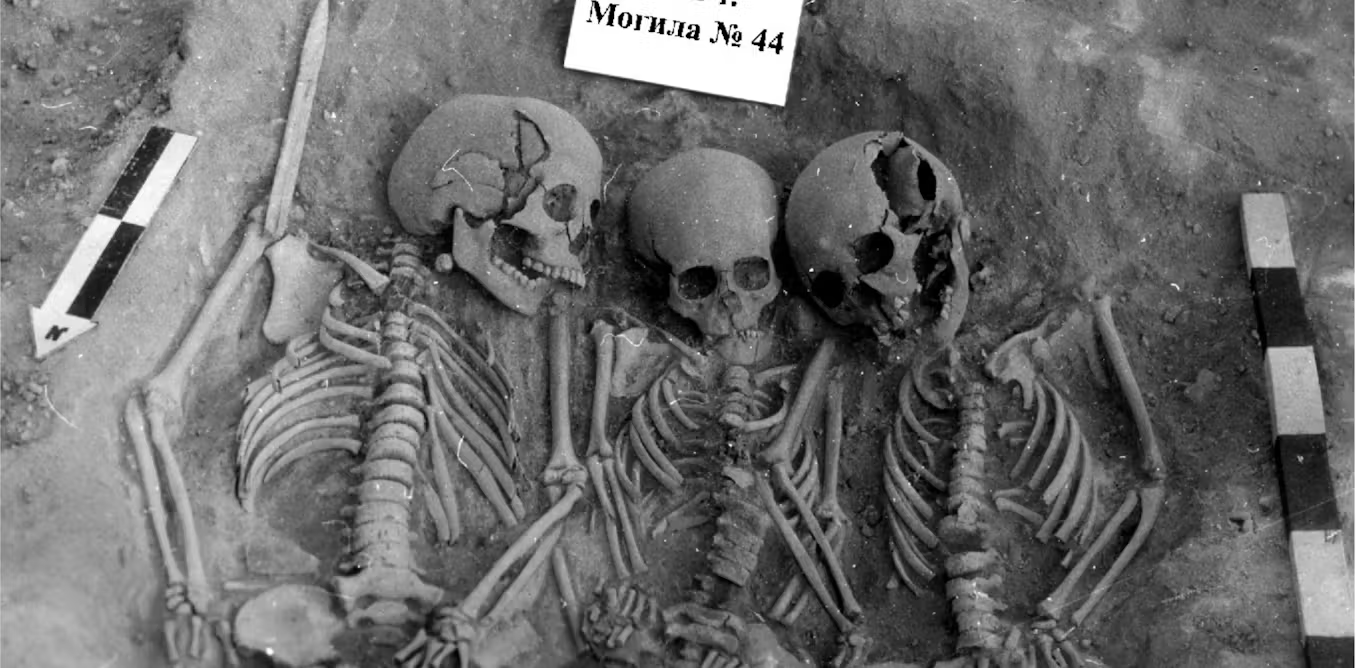
The two outbreaks at Lake Baikal took place around 5,500 years ago and 5,000 years ago. The largest of the hunter-gatherer cemeteries analysed in the study, called Ust’Ida I, had previously baffled archaeologists.

Radiocarbon dating showed that the deaths occurred at the same time and that there was an unusually high proportion of dead children and adolescents. However there was no clear indication of a cause (such as mass violence).

Scientists retrieved plague DNA from the skeletons and carried out genetic analysis of the individuals buried in the cemeteries. The latter analysis revealed that small family groups were affected, which is indicative of human-to-human transmission of the disease.

Advertisement

The genetic findings emphasise the human impact of these outbreaks: young siblings died of plague infection and were buried in shared graves, with parents buried close to their children.

As far as we know, these hunter-gatherers were isolated from contemporary neolithic cultures in Asia, and certainly had no means of contact with late neolithic farmers in Europe. One interpretation, given in that study, is therefore that plague independently spilled over from wild animal “disease reservoirs” in both Europe and at Lake Baikal. Catching the disease from a wild animal still happens very frequently today (both in parts of Asia and in the US.

Artistic reconstruction of Lake Baikal hunter-gatherers burying the plague dead in shared graves.

Artistic reconstruction of Lake Baikal hunter-gatherers burying the plague dead in shared graves.
Kelvin Wilson.

Discovering that the first evidence of deadly mass outbreaks of prehistoric plague comes from isolated hunter-gatherer communities is important because it challenges our assumptions about disease in the past. For one thing, it shows that plague infections by themselves were not a unique factor in the late neolithic decline. For an epidemic to have happened, other factors would have to be involved. People travelling around more would have spread the disease, and higher population densities would have maintained it in populations.

Yet while population densities were certainly higher in the neolithic, we know that overall mobility actually fell among neolithic farmers compared with the hunter-gatherer populations that preceded them, at an individual level (based on ancient genome data). It’s also puzzling that we don’t have similar evidence of mass mortality from plague in Europe yet, despite vastly more sampling for ancient DNA having been undertaken here than in Asia.

Advertisement

A drop in density?

The most obvious hole in the evidence for a late neolithic plague epidemic is that the dates of the plague cases detected so far don’t match the timing of the late neolithic decline. Based on thousands of radiocarbon dates, the modelled population density in the late neolithic follows a boom-then-bust trajectory in north west Europe, with a peak around 5,600 years ago, followed by a series of sharp declines.

If plague were the cause of this, then we would expect to find the most cases soon after 5,600 years ago, when population collapse is at its most dramatic. Instead, we still only have evidence of plague cases from around 400 years after this date.

Comparison of the population density in late neolithic north west Europe with mean radiocarbon dates of plague infections in prehistoric individuals. Hunter-gatherers are in red (dotted lines are outbreaks at Lake Baikal), late neolithic farmers in blue. Inferred population density changes are from summed calibrated radiocarbon date distributions.
Adapted from Figure 1 published by Colledge et al., 2019.

Before plague was proposed, the main explanation for the late neolithic population decline across Europe was that it resulted from a decline in agricultural production associated with climatic deterioration. Researchers analysed data on the distribution of cereals and weeds across north west Europe during a period of boom and bust following the arrival of farming. They found a correlation between population decline and decreasing cereal production.

For different parts of the British Isles, the same pattern emerged in more detail, and its beginning coincided with a shift to cooler, wetter conditions. The fact that there has been no evidence of plague in Britain and Ireland at this time seems like further evidence against plague as an explanation.

Advertisement

However, a very recently discovered case of plague from Orkney, in Scotland, dated to between 4,961-4,833 years ago, might change that.

The population decline from 5,600 years ago is also not the only one archaeologists have found – earlier instances from central and south east Europe suggest that these could have been part of a more cyclical pattern of boom and bust across the neolithic.

Finally, another explanation for the late neolithic decline could also be that we’re interpreting the data for this incorrectly. A possibility, suggested by archaeologist Amy Bogaard, is that it could be evidence of prolonged population dispersal, rather than an absolute decline in numbers: people being forced to move elsewhere, into lower population densities, due to too much strain on resources.

There are also many other reasons why we should be cautious about inferring demographic processes based on substantial datasets of radiocarbon dates.

Advertisement

Right now, we think that a lot more evidence is still needed to support the idea that a plague epidemic lies behind a late neolithic decline in population, or population density.

Source link

Advertisement
Continue Reading

NewsBeat

Updated eGate travel rules coming to 13 UK airports

Published

on

Updated eGate travel rules coming to 13 UK airports

It will mean that up to 1.5 million more children will be able to use eGates, therefore speeding up journeys for them and their families.

The change will help families returning from their holidays with young children.

Here is all you need to know and when the change takes effect.

Automated e-gates with electronic screens at an airporteGates are used at airports across the UK and Europe for border control (Image: Getty Images)

eGate rules to change for children next week

Children aged eight and nine, who are at least 120cm (3ft 11in) tall and accompanied by an adult, will become eligible to use eGates in the UK.

Advertisement

Under current rules, children need to be 10 to use the eGates, and before 2023, it was 12 years old.

Height restrictions are due to children needing to be able to see and be captured by biometric screens.

The change will speed up the process for children and their families, as they typically have to see a border force officer.

Based on 2025 UK arrival figures, an estimated 1.5 million more children will be eligible to pass through eGates with their families over the next year as a result of the age change.

Advertisement

The expanded access is set to begin from next Wednesday (July 8).

Minister for Migration and Citizenship, Mike Tapp, said: “Travel with young children can be stressful for parents.    

“By expanding eGate access, more families can experience a swifter and smoother journey home – freeing up precious time this summer holiday season. 

“We are delivering continued improvement to the passenger experience, while keeping our borders safe and secure.”

Advertisement

The 13 UK airports that will have updated eGate rules

There are 13 airports that use eGates across the UK that will see the updated rules come into effect.

These are:

  • London Heathrow
  • London Gatwick
  • London City
  • London Luton
  • London Stansted
  • Manchester
  • Birmingham
  • Bristol
  • East Midlands
  • Newcastle
  • Cardiff
  • Edinburgh
  • Glasgow

It will cover more than 290 eGates in the UK and accompanying ports where border checks take place in Europe.

There are also 48 EU airports that are allowing British holidaymakers to use eGates.

Advertisement

These include places in Spain, France, Italy and Portugal.


Recommended reading:


The rules will also impact other travel methods such as Eurostar and the Eurotunnel.

People travelling from non-Schengen countries in Europe, along with the US, Australia and Japan, can also use the eGates.

Advertisement

What do you think about the new eGate change? Let us know in the comments.

Source link

Advertisement
Continue Reading

NewsBeat

Arrest after police vehicles involved in collision to stop suspected drug dealer

Published

on

Belfast Live

The incident took place in the Donegall Quay area on Wednesday

A man has been arrested as police seized suspected drugs worth £225,000 after two police vehicles were involved in a collision as they stopped a vehicle in Belfast.

Advertisement

Officers from the PSNI’s Paramilitary Crime Task Force made the arrest on Wednesday, July 1, after they signalled for a vehicle to stop in the Donegall Quay area. The vehicle attempted to make off from officers and collided with two police vehicles.

Police say they then recovered a “large quantity of suspected Class A controlled drugs” from the vehicle with follow-up searches in the Newtownabbey and Mallusk areas uncovered further drugs.

Detective Inspector Maguire said: “While conducting a proactive policing operation yesterday in the Donegall Quay area in relation to the supply of Class A controlled drugs, officers signalled for a vehicle to stop. It failed to do so, attempting to make off instead, which resulted in a collision with two police vehicles.

“Thankfully, there were no reports of any injuries and a subsequent search of the vehicle uncovered a large quantity of suspected Class A controlled drugs, which were then seized.

“The driver, a man in his thirties, was arrested on suspicion of possession of a Class A controlled drug, possession of a Class A controlled drug with intent to supply, providing money or property for the purposes of terrorism, failing to stop for police and driving without due care and attention.

“He remains in police custody at this time.

Advertisement

“Follow-up searches conducted in the Newtownabbey and Mallusk areas resulted in further suspected drugs being seized, along with a number of vehicles, with the total estimated street value of all drugs seized as a result of the searches £225,000.

“These searches and the arrest demonstrate the PCTF’s commitment to tackling the harm caused by illegal drug use and supply in our communities.

“Our enquiries are ongoing and I would encourage anyone with information about the supply or use of illegal drugs to contact police on the 101 number.

Advertisement

“You can also report to police online, via www.psni.police.uk/report or contact Crimestoppers anonymously on 0800 555 111 or online at http://crimestoppers-uk.org/.

For all the latest news, visit the Belfast Live homepage here and sign up to our daily newsletter here.

Source link

Advertisement
Continue Reading

Trending

Copyright © 2025