A bitter power struggle is engulfing Ukraine, spilling from the corridors of power onto the streets as President Volodymyr Zelensky faces mounting public anger.
The crisis has already claimed two of the country’s most senior military figures.
Last week, Zelensky abruptly dismissed Mykhailo Fedorov, the mastermind behind Ukraine’s devastating drone campaign after a feud with the army’s more conventional military leadership, triggering one of the biggest political backlashes of the war.
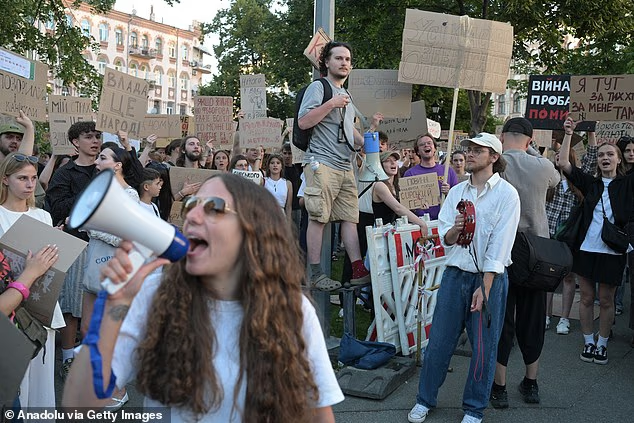
The decision sparked mass protests in Kyiv and other cities, with thousands taking to the streets in support of the popular official, whom many credit with transforming Ukraine’s battlefield fortunes through innovative drone warfare after years on the defensive.
Demonstrators were gathered outside the presidential office from Thursday carrying signs reading ‘Hands off Fedorov’ and ‘Stop sabotaging victory!’, while chants of ‘Shame!’ echoed through the capital as protesters demanded Zelensky reverse course.
Zelensky’s government reshuffle and dismissal of Fedorov, after just half a year in office, stirred concerns among analysts that Ukraine’s recent battlefield momentum could be lost.
And as pressure mounted, the Ukrainian president bowed to the growing unrest and on Tuesday dismissed Soviet-trained army chief Oleksandr Syrskyi, nicknamed ‘The Butcher’ for his ruthless reputation and widely blamed for heavy losses on the frontline.
In his place, Zelensky appointed the younger and widely respected battlefield commander Mykhailo Drapatyi, a move welcomed by Fedorov.
Ukrainians attend a rally to protest President Volodymyr Zelensky’s decision to dismiss Defense Minister Mykhailo Fedorov, July 17
People protest against the dismissal of Defense Minister Mykhailo Fedorov
Former Ukrainian Defence Minister Mykhailo Fedorov
Ukrainian President Volodymyr Zelensky (L) and former Commander-in-Chief Oleksandr Syrskyi
The feud erupted after Fedorov, 35, accused Syrskyi of blocking reforms needed because ‘the war has changed completely’ due to new technology like drones.
Fedorov said he was willing to work with Syrskyi, ‘but we encountered a situation in which all the initiatives we proposed began to be blocked.’
‘Under this arrangement (with Syrskyi as commander), I personally do not know how the war can be won,’ he said.
Zelensky initially defended his decision, saying he was forced ‘to choose between sides [when honestly] what I want most is unity’.
But after days of protests, the Ukrainian leader eventually relented, choosing to fire Commander-in-Chief Syrskyi and offer a ‘prominent position’ to the young defence minister he previously sacked.
Zelensky said on Tuesday that he offered him a ‘decent post’ to oversee the technological component of the state, but the former minister has previously said that he only wants his old job back.
Before becoming defense minister in January, Fedorov headed Ukraine’s digital transformation policies.
He won popularity by spearheading the rapid development and deployment of drone technology and introducing several successful e-government platforms.
As minister, he moved to combat corruption, an issue that carries particular weight with Ukrainians who have repeatedly protested graft.
Fighting corruption meant working against the interests of groups that had long profited from programs within the ministry, he said in interviews.
He was seeking to overhaul weapons procurement to make it more transparent.
He also promised sweeping military reforms, saying the military had faced about 200,000 desertions and draft-dodging by some 2 million people.
The mostly young protesters who took to the streets of Kyiv and other cities to support Fedorov made crude remarks about the current military commander, chanting, ‘Syrskyi go away!’ and ‘A European army for a European country!’
Kyiv resident Bohdan Huryak said he was ‘deeply outraged’ by Fedorov’s exit.
‘I’m not deeply invested in the internal political debates, but this is a person who shows results on the battlefield, we see results, we feel the fighting spirit and confidence in victory rising,’ Huryak told The Associated Press. ‘And then, six months later, he is removed from office? Come on.’
Last week, Zelensky chose Yevhenii Khmara, who was acting head of Ukraine’s domestic security service, to become acting defence minister.
‘We all want the same thing: to defeat the enemy and create the conditions – on the front line and through pressure on Russia – that would allow us to force Russia into peace,’ Zelensky added.
The changes come as Ukraine today targeted logistics centres belonging to the Russian equivalent of Amazon, with the drone strikes early Wednesday sparking huge infernos.
Warehouses of the country’s largest online retailer Wildberries were attacked in Krasnodar and Nevinnomyssk, said Tatyana Kim, the head and co-founder of the company.
Kim said employees had been evacuated before the strikes, but several people were still wounded.
‘I wish you a speedy recovery, and we will definitely provide all the necessary assistance,’ she wrote on Telegram.
Footage circulating on social media, verified by Reuters, shows gigantic clouds of black smoke rise up into the sky above the burning warehouses.
Ukraine has recaptured 270 sq miles of its territory this year, a defiant Syrskyi said on Wednesday defending his legacy after his ousting, confirming he was leaving the top military job.
‘I am handing over to my successor an army that is not only holding the defence but is also on the offensive,’ Syrskyi said in a statement on Telegram.
‘I am not authorised to talk about some of the operations we carried out over these years, even today. History will tell about them,’ he added.
After firing chief of staff Syrskyi, Zelensky replaced him with Mykhailo Drapatyi, 43, a respected and experienced commander who led the country’s land forces from 2024 to 2025 and is described as a general of a new generation.
Ukraine has been trying to gain the upper hand in the war by heavily striking Russia’s energy sector – its main source of budget revenue – and logistics.
‘The operations of the Ukrainian Defence Forces are ongoing and must continue steadily. Ukraine’s plan for long-range sanctions and our program of middle-range strikes will be carried out with absolute precision,’ Zelensky said as he introduced Drapatyi.
Drapatyi, whose career was shaped fighting Russian troops for more than a decade, is seen as a voice of change.
Meanwhile, Syrskyi played a key role in Kyiv’s defence in the early days of the war and has been in his post since early 2024.
But he has also faced harsh criticism for a rigid command style which some service members have said resulted in unjustifiably high troop losses.
For a while, Zelensky – seen as mistrusting of those with political ambitions – had relented pressure to sack Syrskyi, a career military man.
Analysts said that Syrskyi was not a threat to Zelensky, unlike his predecessor, the ultra-popular Valery Zaluzhny, who was also removed.
But Syrskyi was criticised for not caring about the scale of human losses and stalling reforms to procurement, equipment and mobilisation.
Voices against him have surfaced periodically, but last week’s reshuffle brought out into the open the deep divisions in the Ukrainian defence leadership.
Critics had accused Zelensky of favouring Syrskyi over Fedorov in a conflict between the two, and analysts questioned whether Ukraine could win the war, now well into its fifth year, under Syrskyi’s leadership.
‘I will work responsibly, with full focus, and with respect for the people who are defending our country today,’ Drapatyi said on Facebook.
Drapatyi has now become Ukraine’s third commander-in-chief since Russia invaded in February 2022.
Fedorov, whose return to office was one of the protesters’ main demands, welcomed the appointment.
‘This is a breath of fresh air and a new source of hope in the fight of free people for freedom and justice. It is the voice of change that could no longer be ignored,’ Fedorov said on X.
Thousands of Ukrainians took to the streets to protest President Volodymyr Zelensky’s decision to fire his popular defence minister
Deputy Commander of the Joint Forces, Brigadier General Mykhailo Drapatyi,
Ukraine’s President Volodymyr Zelensky, newly appointed Commander-in-Chief of the Ukrainian Armed Forces Major General Mykhailo Drapatyi, his predecessor General Oleksandr Syrskyi, and Acting Defence Minister Yevhenii Khmara
Ukraine has targeted logistics centres belonging to the Russian equivalent of Amazon, with the drone strikes early Wednesday sparking huge infernos
Peter Dickinson, Editor of the Atlantic Council’s UkraineAlert Service, said: ‘I think it is now clear that Zelenskyy’s decision to remove his defence minister Mykhailo Fedorov was a disastrous mistake, but he appears committed to correcting this error.
‘The removal of commander in chief Oleksandr Syrskyi and his replacement with 43-year-old Mykhailo Drapatyi is something many Ukrainians have been demanding for years and goes a long way to repairing the damage done by ousting Fedorov.
‘However, it remains unclear whether Fedorov can return to government as he is currently insisting on reclaiming his old job as defence minister, which may be too much of a U-turn for Zelenskyy to swallow.
‘Unless Fedorov is back in a senior position, many Ukrainians will still feel that their security has been weakened for no clear reason. This will fuel speculation that Fedorov’s removal was primarily meant to safeguard corruption and entrenched business interests within the defence sector. ‘
Oleksandr Monchak, 38, sergeant in Ukrainian army and military journalist, added: ‘Drapatyi is a living legend. He’s been fighting Russia since 2014 and has worked his way up through the ranks to where he is today. That is extremely impressive. Over the years, he’s built a stellar record.
‘In 2014, he took part in the operation to free the hostages in Mariupol and managed to get his unit out of the encirclement.
‘In 2022, he helped stop the Russian advance towards Kryvyi Rih and played a key role in liberating parts of the Kherson and Dnipropetrovsk regions.
Monchak lauded Drapatyi for being the ‘chief architect’ of the defence of Dnipro in 2023, adding that he was ‘straightforward, competent, a good friend to the people around him, easy to work with, not confrontational, and tactically sound.’
‘In general, the younger generation of officers has always been much more down-to-earth than the old Soviet-school generals. That’s why the people who know him trust him. Whether he can unite the army and lead it to greater success depends on a lot of things, not just on his own abilities as a commander,’ he added.
‘But the soldiers in the trenches are definitely more hopeful now. They believe the war could be fought in a more modern way, with fewer unnecessary casualties.
‘What does this mean for the Russians? First of all, it’s deeply demoralising. They were cheering for the removal of Fedorov, but now they see what’s happening in Ukraine and know they don’t have anything comparable.
‘They’re still stuck with the same old faces, people like Gerasimov and Shoigu. They understand that this kind of renewal, the possibility of bringing through a new generation of commanders, simply doesn’t exist in the Russian army.
‘As long as the war continues, they’ll remain hostages to what you could call the ‘Gerasimov caste.”

















































You must be logged in to post a comment Login