Ms Campbell KC questioned the officer on the use of CCTV in the missing person investigation, including the need for immediate trawls for footage, seizing key images quickly, how this material fitted in with other lines of inquiry and ensuring that the timings on the material was accurate.
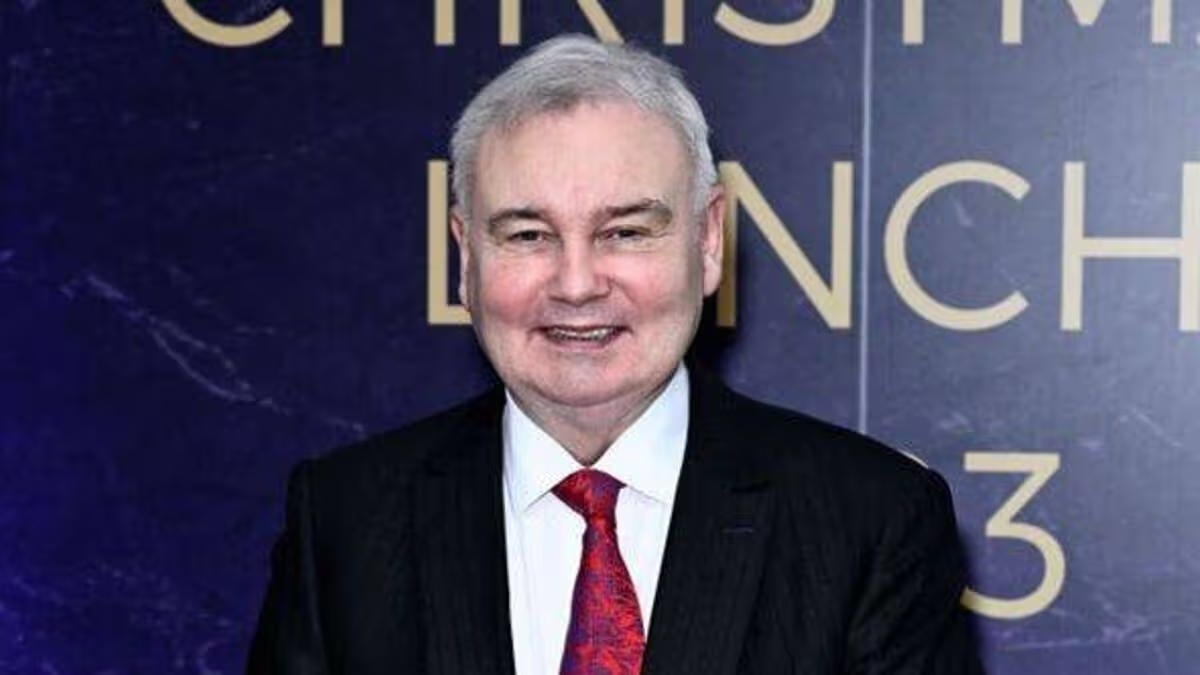
In a statement online, GB News said: “Eamonn was taken ill last week and it was later confirmed he had suffered a stroke. He is currently responding well to treatment.
Advertisement
“Eamonn has asked for privacy as he focuses on getting better.
“His colleagues and everyone at GB News wish him a speedy recovery and look forward to welcoming him back to the People’s Channel when he is ready to return.”
Angelos Frangopoulos, the CEO of GB News, added: “Eamonn is a loved member of the GB News family, and we’re with him every step of the way as he recovers.”
Eamonn had been due to return to GB News Breakfast next week – Alex Armstrong will step in to present in his absence.
Advertisement
Eamonn has been open about his health struggles and battle with chronic pain for years. He underwent major spinal surgery in 2022 to tackle years of pain from slipped discs and subsequent complications, a procedure he has admitted “went wrong” and left him with limited movement.
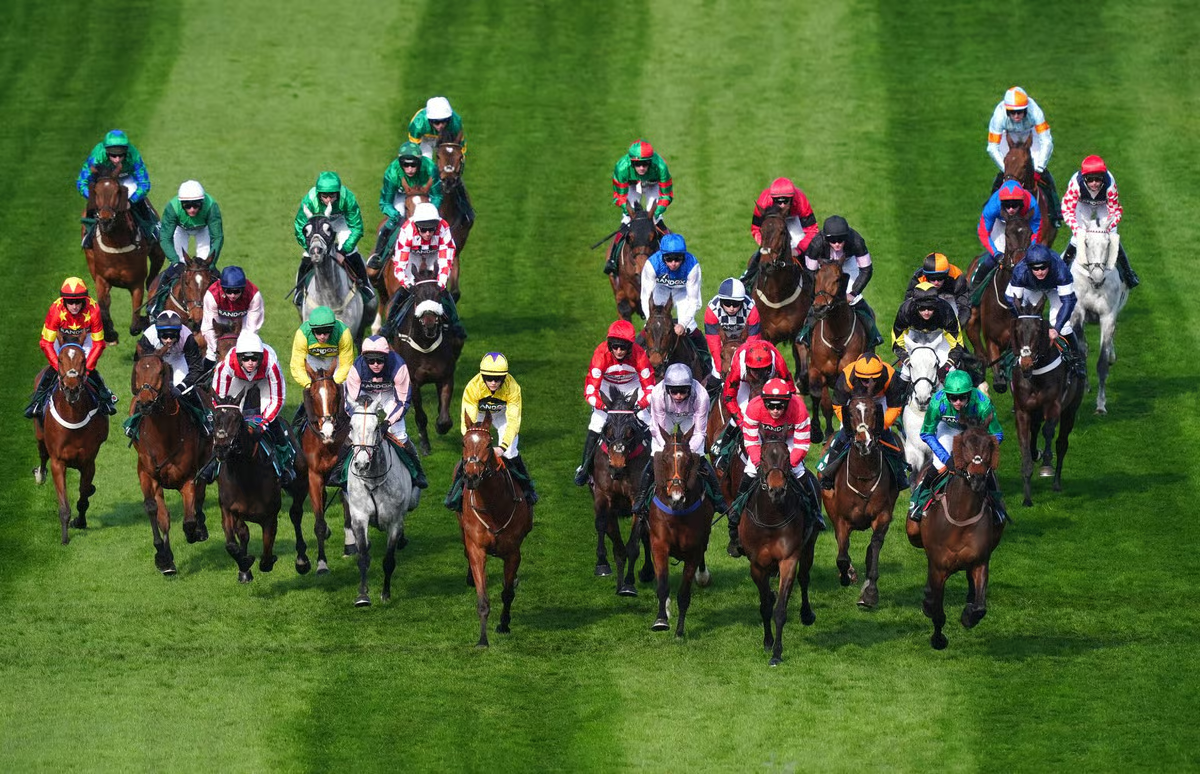
The pinnacle of the National Hunt racing season is upon us, with the Grand National taking place today at Aintree.
Only three weeks on from the Cheltenham Festival comes another highlight of the British sporting calendar as Liverpool plays host to the world’s most famous steeplechase.
The three-day meeting is headlined by the feature race, which will include 2024 winner I Am Maximus.
The action at Aintree began on Thursday, followed by Ladies’ Day on Friday and then the showpiece comes today at 4pm.
Advertisement
Here’s everything you need to know…
When is the Grand National 2026?
The 2026 Grand National meeting runs from Thursday, April 9, to Saturday, April 11, with the Grand National steeplechase taking place at 4pm BST on the third day.
A new, earlier time for the feature race of the meeting was introduced in 2024, bringing the race forward by 75 minutes, and remains in place for the 2026 edition.
Advertisement
As ever, the famous Aintree Racecourse near Liverpool will host the race.
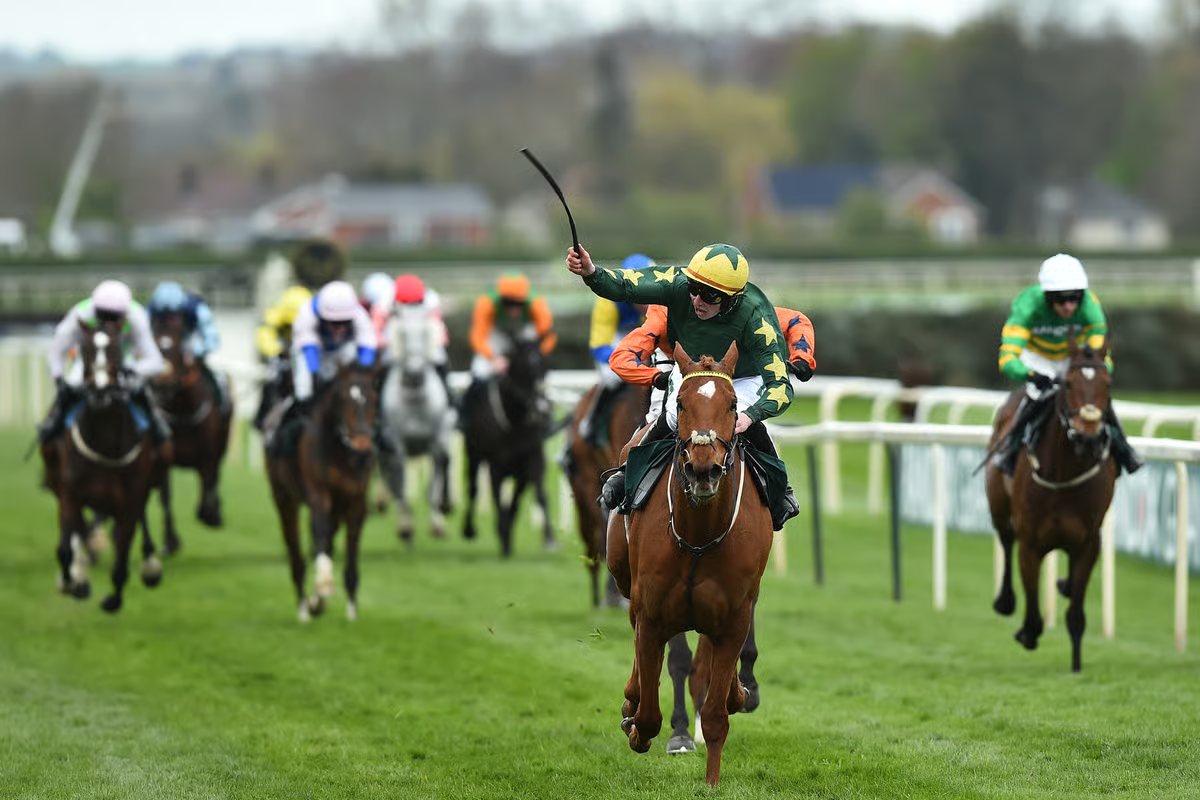
Nick Rockett won last year’s race
Peter Byrne/PA Wire
How to watch the Grand National 2026?
Advertisement
TV channel: In the UK, the Grand National meeting is being shown live and free-to-air on ITV1, with coverage starting at 12.45pm BST, today, Saturday.
ITV will broadcast every race bar the final of the day, with subscription channel Racing TV the only place to watch all the action across the three days.
Coverage of the National itself is from 3:15pm BST with the race getting underway at 4pm.
Live stream: The race will also be available to watch live and for free online via the ITVX app and website.
Advertisement
Live blog: You can follow every race live from Grand National Day at Aintree with Standard Sport’s live blog.
Grand National 2026 weather forecast
The UK has been blessed with sunshine of late, but there is expected to be showers across all three days of the meeting.
Hitting a high of just 12C, expect overcast conditions with occasional sun at Aintree.
Advertisement
Grand National 2026 prize money
The total prize fund for the race is £1 million, the highest amount of money that any race over obstacles is contested for, and it breaks down as follows:
“The Grand National is the main reason I got into the sport, it has always been a great spectacle. It is a dream, it is the most prestigious race, it’s worldwide, it is very exciting to have a ride in the race alone, if you’re not in then you can’t win and it doesn’t matter what price they are, hopefully they have a good chance and I am really looking forward to it.”
The incident happened at the supermarket on the Causeway, in Billingham town centre, around 2.25am this morning (April 11).
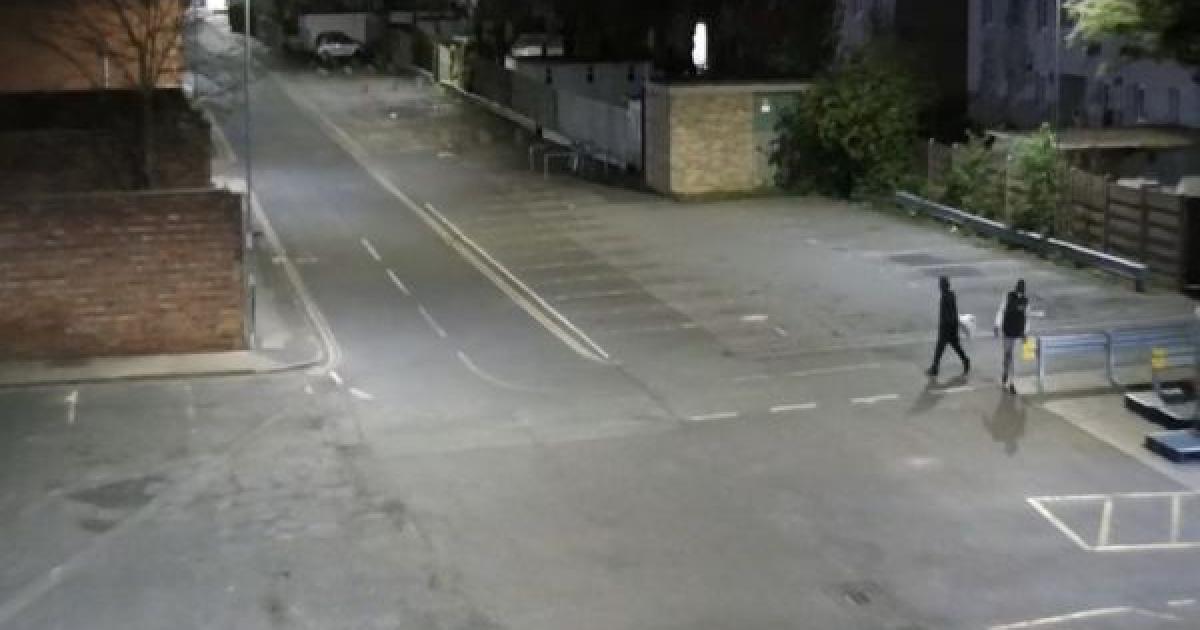
Two men in dark clothing were caught on CCTV forcing entry before leaving with a large quantity of goods, including alcohol and scratch cards.
Police launched a search but the suspects had fled the scene.
Advertisement
Cleveland Police say one of the men was wearing a grey tracksuit with a black gilet and a black face covering, and was carrying a duffle bag.
The second man was wearing all-black clothing.
Enquiries are ongoing and officers are urging anyone who may have captured the two men on doorbell or dash cam footage to get in touch on 101, quoting reference number 067408.
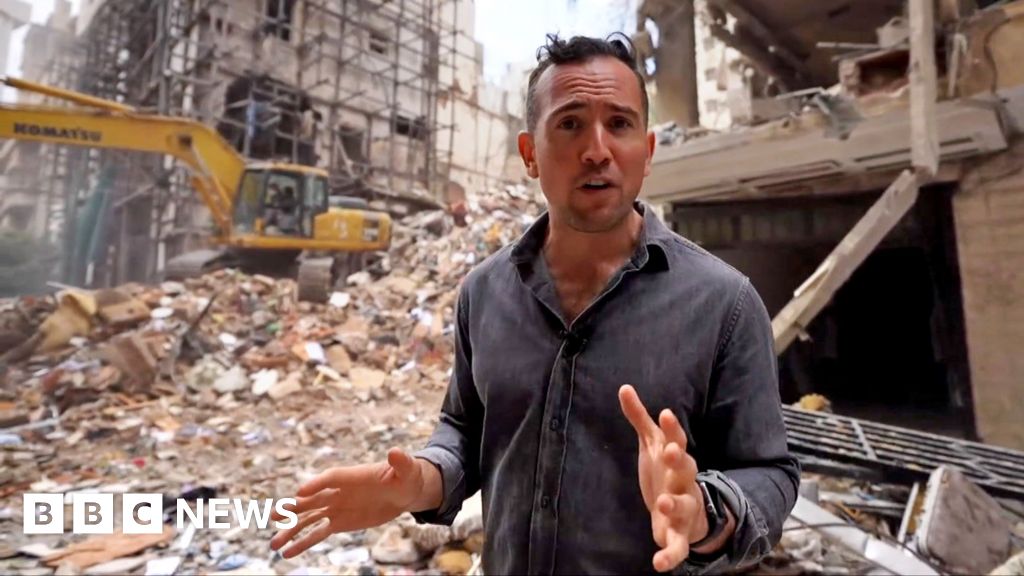
Lebanon experienced one of the deadliest days in its recent history, as widespread Israeli air strikes brought horror and destruction to the country on Wednesday, just hours after a ceasefire was announced in Iran.
The attacks, that came in the middle of the day without warning, killed more than 300 people, a third of them women, children and the elderly, according to the Lebanese health ministry. Some of the attacks hit busy, densely populated neighbourhoods, places that had not been targeted before and where people felt they were safe.
Israel said it carried out more than 100 air strikes in just 10 minutes on what it described as targets linked to the Iranian-backed group Hezbollah.
BBC Middle East correspondent Hugo Bachega has spoken to residents in Beirut, a city that is still in shock.
When Soviet president and Communist party secretary Mikhail Gorbachev introduced the policies of perestroika (reconstruction) and glasnost (openness) in the mid-1980s, it marked the beginning of cautious reforms of the Soviet Union. Georgia, or the Georgian Soviet Socialist Republic, to give it its full name at the time, was on the periphery of the union.
Far from Moscow, it lay hidden on the other side of the Caucasus mountain range on the edge of the Black Sea. As a doctoral candidate in linguistics on a research grant to Tbilisi University, I spent one year living there, between 1987 and 1988. I was conducting research on the Georgian language.
Travel at the time was very difficult, and could only happen via Moscow. I did not return to Sweden for the duration of my stay. In the recent publication, We Witnessed the Soviet Break-Up: Five Scandinavian Researchers on the Final Years of the USSR, Seen From the Caucasus, I detail how this gave me a front-row seat from which to observe the speed at which society was shifting – and how language was key to that transformation. I also observed how old cultural traditions had endured despite decades of Communist propaganda and harsh Sovietisation.
The 1987 May Day parade. Karina Vamling, Author provided (no reuse)
Rapid transformation
The May Day parade was long one of the key moments in the Soviet calender. I witnessed the last time it was held in central Tbilisi, in 1987. People were carrying red flags. Banners declaiming “Glory to the Communist party” and “Glory to our multinational Soviet Fatherland” were draped on the main buildings.
Advertisement
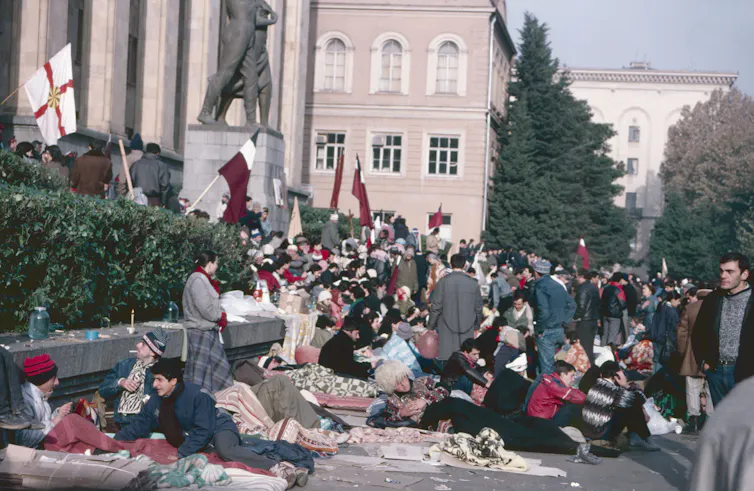
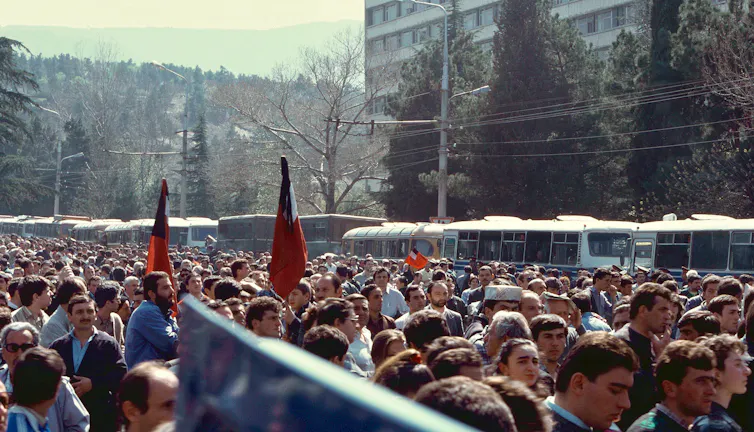
Next year, however, the national movement across the republic was pushing for a free Georgia. In November 1988, many took part in a hunger strike in front of the Georgian parliament against changes in the constitution that would reduce the rights of the Georgian republic. Protesters wanted what they termed the “Russification of Georgia” to come to an end.
Georgian society was multiethnic and multilingual, counting Russians and Georgians alongside Armenians, Azerbaijanis, Abkhaz, Ossetians, Greeks and many others. Georgian was the main language within the Georgian education system as well as in broadcasting and the press and, technically, according to Article 6 of the Constitution of Soviet Georgia recognised as the republic’s official language. However, during the Soviet period, Russian speakers could easily live and work in Georgia without knowing Georgian: Russian was the lingua franca for inter-ethnic communication within the republic and the Soviet Union at large.
The hunger strikes of 1988. Karina Vamling, Author provided (no reuse)
As a non-Indo-European language, Georgian boasts its own script and a written history that dates back to the 5th century AD. It is a cornerstone of the Georgian identity. Within the wider push for greater political freedom, Georgians now fought for the implementation of the constitutional status of Georgian. This included increased demands for knowledge of Georgian in workplaces and administration, while also investing in teaching Georgian as a second language.
Efforts were made to develop Georgian terminology in technology, science and other fields where Russian had been dominant. Citizens who had little or no knowledge of Georgian were under pressure to learn.
During my time in the country, I was welcomed with more openness and engagement, and less suspicion, than during the three years I had spent in Moscow. I experienced the extent to which hospitality was an ancient Georgian virtue. “A guest is a gift from God,” local people would say.
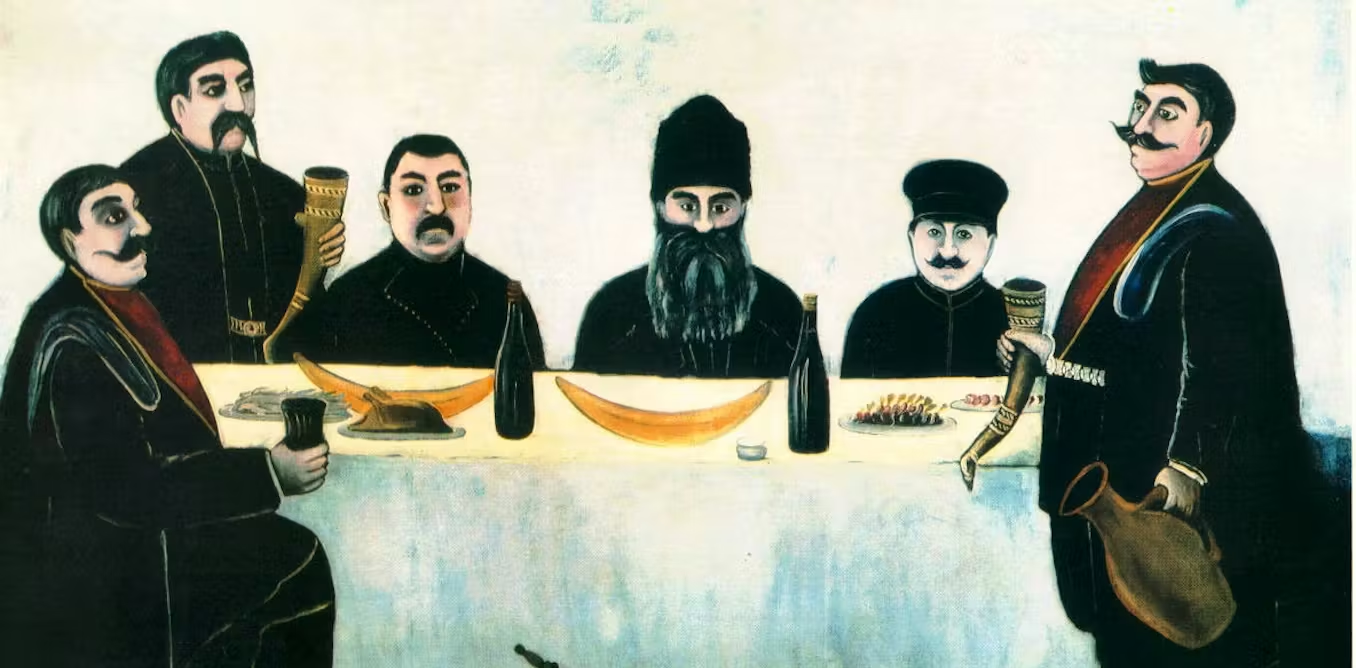
Georgians were proud of their cuisine and ancient wine production. When a guest entered a home, the dinner table would quickly transform into a feast, what is know as a “supra”. This came with its own specific structure and rules. The man of the house would assume the role of toastmaster (tamada), and the wife and female members of the family would prepare and serve the food. They would be called in from the kitchen for a toast in honour of the women. In some traditional families, the men would sit at one end of the table, and the women and children at the other.
These traditions were discernible across the different cultural communities within Georgia. Tensions at the time were growing between Tbilisi and the central Soviet authorities in Moscow, and within Georgia itself, with minorities in the autonomous entities of Abkhazia and South Ossetia.
Advertisement
In the summer of 1989, the first violent Abkhaz-Georgian clashes took place. I was on a day trip, travelling from Sokhumi, the capital of the Autonomous Republic of Abkhazia, to a wedding in a small town called Zugdidi in the Megrelia region when violence broke out. Unable to return to Sokhumi as planned, I ended up spending one week with a family on the outskirts of the town.
Being there was like stepping back in time. The household was run by a young woman called Tsira, who, as a widow, dressed all in black. According to tradition, she would remain in black for the rest of her life. Her eldest son, who was 12-13 years old at the time, appeared to be seen as the man of the house.
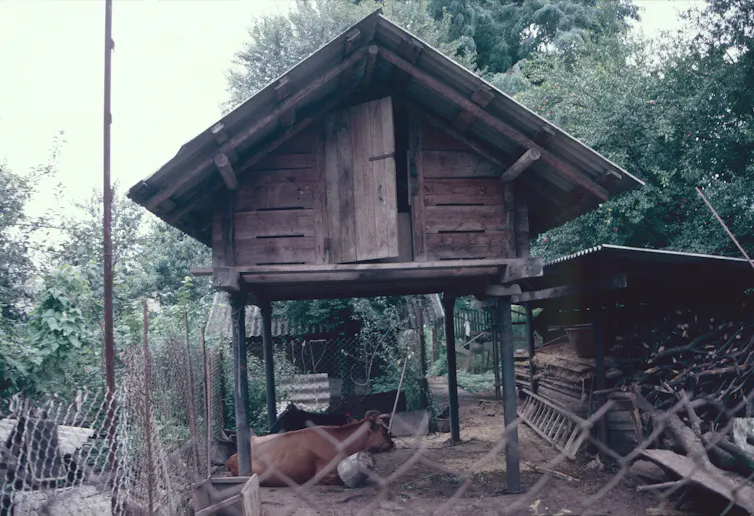
A journey back in time. Tsira’s yard in Zugdidi. Karina Vamling, Author provided (no reuse)
Tsira’s neighbours came round and my friends from Sokhumi sat with them, discussing the conflict in Megrelian, the local language. Tsira prepared food, chicken and maize porridge over an open fire in a small wooden hut in the yard. Smoked cheese hung from the ceiling.
At one point, we visited the cemetery. Tsira sat on a stone bench by a black marble bust of her husband while relatives and guests sat around the grave. The women brought out Soviet champagne and food. I observed how toasting and eating bread dipped in wine were important in a ritual of honour and remembrance.
These religious practices showed how, within the official atheism of Soviet society, Georgian Orthodox traditions persisted – as they still do today. Another such religious practice common in Georgia during Soviet times was to hold a commemorative supra 40 days after a person had passed away. During this period, the men were not supposed to shave. The 40 days are considered the time it takes for the soul to reach heaven and God.
Advertisement
In 1990, I heard the crowd shouting “occupiers, occupiers” in front of the general staff of the Caucasian Military District in Tbilisi. The newly adopted Soviet law, dubbed the “law of non-secession” made the idea that the Soviet Union might break up feel a utopian dream. And yet it did, merely a year later. Georgia declared independence from the Soviet Union on April 9 1991 and the split was finalised on December 26 with the dissolution of the USSR.
Protests in 1990. Karina Vamling, Author provided (no reuse)
In the intervening decades, the ethnopolitical conflicts that were fomenting during this early post-Soviet period have only deepened, not least following the Russo-Georgian war of 2008. Today, they remain largely unresolved and the situation in Georgia, highly volatile.
The Georgian language, however, has reclaimed the media, education and the streets. Russian has been replaced by English among the young generation of Georgians who do not carry this Soviet heritage.
The PSNI has issued traffic and travel advice for those travelling through Lisburn city centre on Saturday evening.
Advertisement
Road users and members of the public are advised of potential traffic disruption until 11pm on April 11 due to a planned parade.
A PSNI spokesperson said: “The outward parade is expected to leave at 6.45pm from Rathvarna Drive and will then take the following route: Ballymacash Road, Prince William Road, Ballymacash Road, Antrim Road, Antrim Street, Bow Street, Market Square (with a short stop) and Railway Street/Wallace Avenue.
“The return parade is expected to leave Wallace Avenue at 8pm and will take the following route: Railway Street, Market Square, Smithfield, Market Place, Chapel Hill, Longstone Roundabout, Chapel Hill, Bow Street, Market Square, Railway Street and Wallace Avenue.
Advertisement
“It is expected to finish at approximately 11pm. Police officers will be present to manage traffic and public safety throughout the parade.
“To avoid potential delays, please seek an alternative route for your journey where possible during these times.”
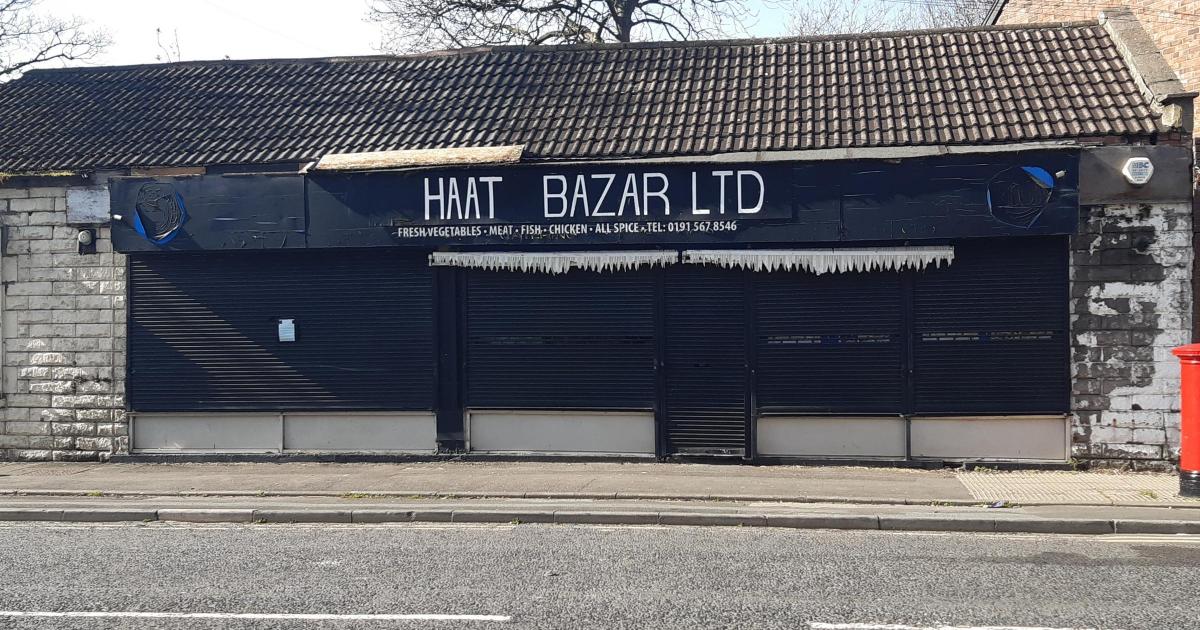
Sunderland City Council’s licensing sub-committee met on Thursday to discuss the application for 2 Eden Terrace, a property previously used as food store Haat Bazar Ltd.
Applicant Lojan Ramesh wanted permission for a planned new convenience store at the site to be able to sell booze between 8am-11pm.
Information from the applicant in council reports said “alcohol is not the intended focus of the business” and that alcohol sales would have a “limited impact on the area.”
Initial proposals sought permission to sell alcohol for longer hours, but this was altered to 8am-11pm, seven days a week, following talks with Northumbria Police and the council.
Thursday’s City Hall meeting to decide the application was attended by Barnes ward councillors Antony Mullen and Fiona Tobin.
As there was no representation from the applicant, the licensing sub-committee were told they had several options in the circumstances.
Advertisement
These included either refusing the application, adjourning a decision, or only hearing evidence from council licensing officers and objectors before making a decision.
A legal adviser for the committee said there were concerns about the third option in terms of conducting a “fair hearing”, and it was noted that the refusal option would allow the applicant the right of appeal, or the chance to resubmit the application.
A committee report also noted the matter had been adjourned before at a separate meeting earlier this year, with a decision “postponed” because the applicant was unable to attend due to “ill health.”
Following deliberations, the licensing sub-committee agreed to refuse the application “on the basis of the absence of the applicant”.
Advertisement
Councillor Michael Hartnack, presenting the committee’s decision, said this was “a consequence of their failure to attend or give reasons for their failure to attend but also to give the opportunity to present their application at some point in the future”.
It was noted that if the applicant wanted to reapply for the alcohol licence, the licensing process would start again and public objections would need to be resubmitted.
Here are the three best places to live outside Cambridge
Cambridge was recently named as one of the best places to live in the UK by the Sunday Times. While Cambridge is a beautiful city to live in thanks to its many restaurants on offer and independent shops to explore, there are plenty of other areas in the county that could battle for the title of best place to live.
Advertisement
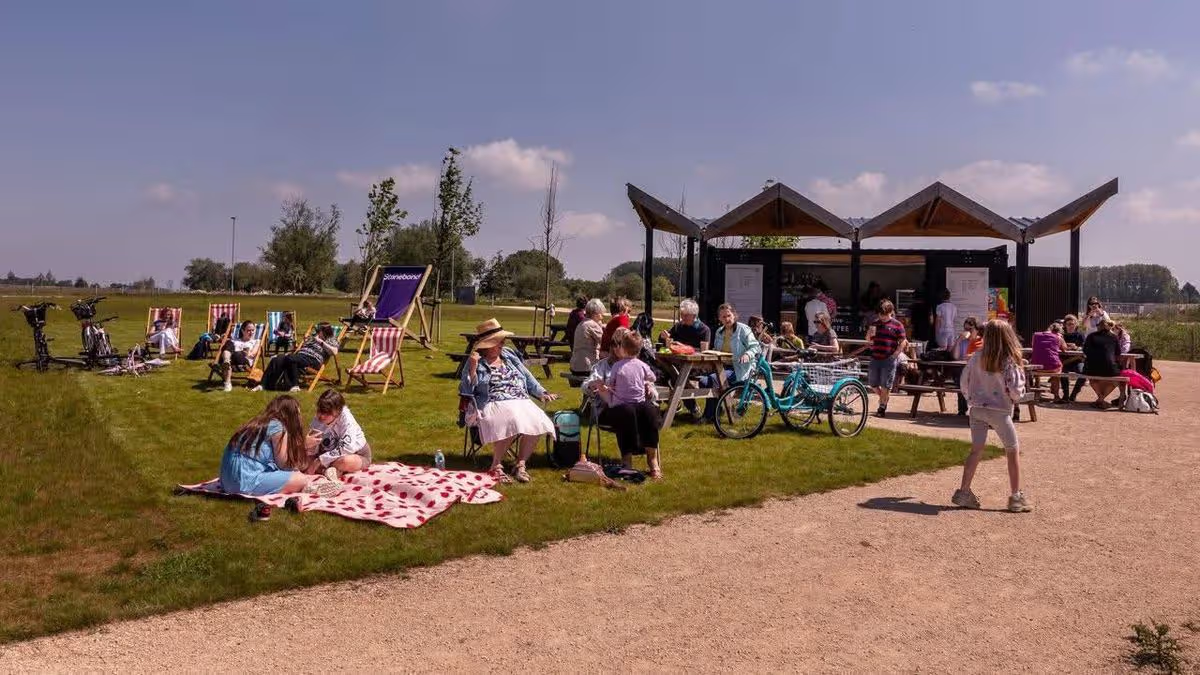
Whether you are looking for a smaller city to call home or a village surrounded by the countryside, Cambridgeshire has options for whatever you need. Outside Cambridge, there are so many places to see with cafés to relax in, outdoor spots to enjoy, great schools for kids, and activities to get involved in.
CambridgeshireLive asked our readers to share where they think is the best place to live in the county aside from Cambridge. These three places came out on top as the best places to live outside Cambridge.
3. St Ives
Unlike its coastal counterpart, St Ives in Cambridgeshire is not next to the sea but many people still love living there. People who live in the town or are just visiting love the historic centre and the beautiful views of the River Great Ouse you can enjoy.
St Ives also has an impressive range of restaurants including the Teller’s Table and the Whisky Café with a new Sushi and Salad location coming in June. If you want to live in St Ives, the average house price in the area is £319,989, according to Rightmove.
Advertisement
2. Ely
In second place is the city of Ely. The city is steeped in as much history as Cambridge, as the foundations of the area date back to 673. It was once the home of Oliver Cromwell between 1636 to 1646 after he inherited St Mary’s vicarage.
Ely has plenty of things to see and do such as taking a trip to the market, where you can find a range of fresh produce and homemade gifts, and visiting the historic Ely Cathedral. Rightmove says houses in the city cost an average of £382,047.
1. Waterbeach
In the top spot is a village not too far away from Cambridge. Waterbeach is an easy 30-minute drive or nine-minute train ride away from the city, offering people a quieter place to live while still being close to the action in Cambridge.
The village has a few different pubs including the Bridge, which is known for its riverside views and Sunday roasts, and Boswell Bakery where you can pick up a range of pastries and rolls. Properties in Waterbeach are slightly more expensive at an average cost of £451,447.
A man has appeared in court charged with causing serious injury by dangerous driving and driving whilst disqualified
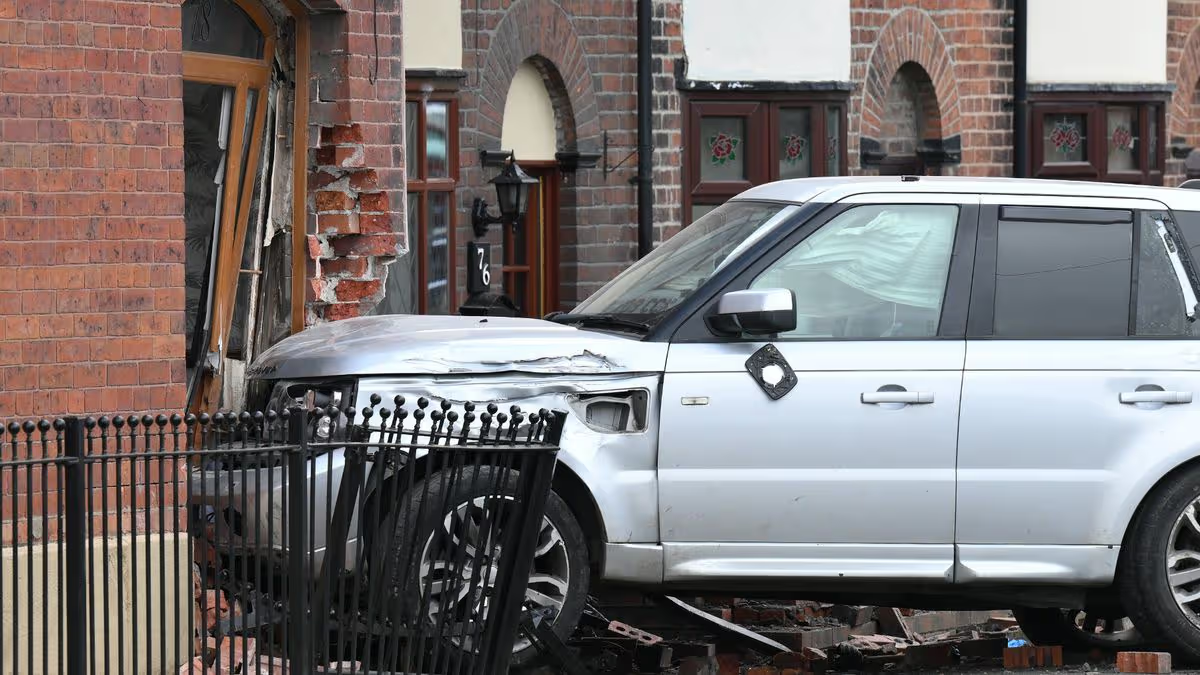
A man has been charged following a Range Rover crash. The incident happened on Market Street in Stoneclough at around 4.50am on March 28.
Advertisement
A Range Rover hit a man, before ploughing into a house, police said. The pedestrian, a 47-year-old man, was rushed to hospital from the scene with ‘severe injuries’. He remains in a critical condition.
Get MEN Premium now for just £1 HERE – or get involved in our WhatsApp group by clicking HERE. And don’t miss out on our brilliant selection of newsletters HERE.
Nicholas Partington, 42, of Barrett Court, Bury, has since been charged with causing serious injury by dangerous driving; and driving whilst disqualified, a Greater Manchester Police spokesperson said in an update issued today (April 11).
He appeared at Manchester and Magistrates’ Court on April 10. He has been remanded into custody to appear in court again later this year.














































You must be logged in to post a comment Login