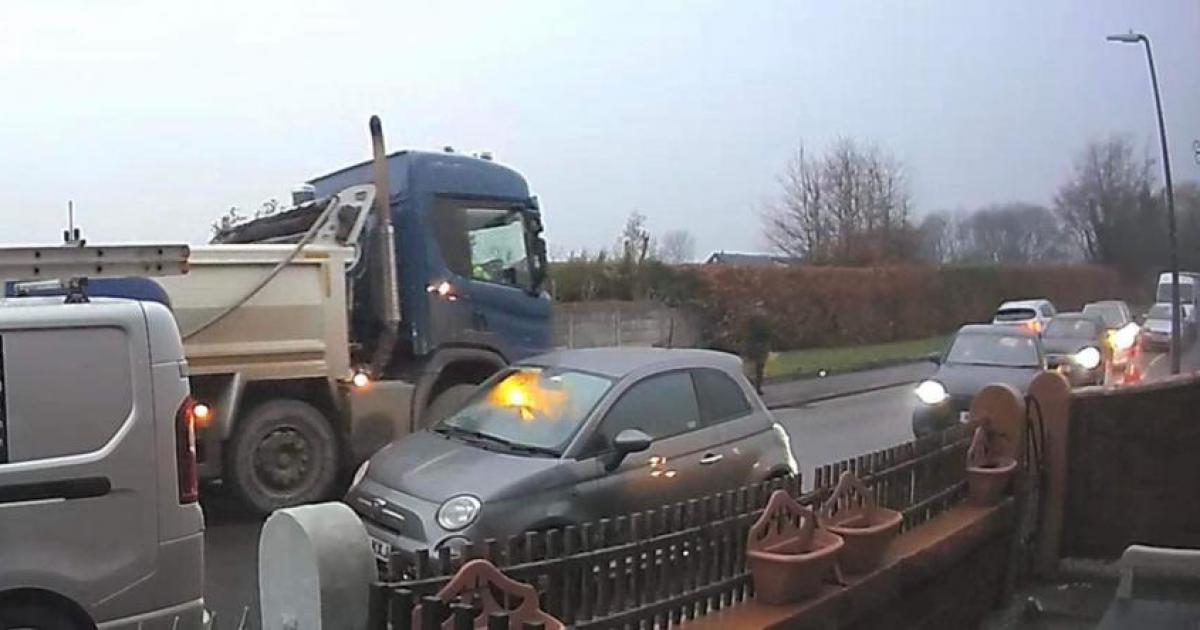
Little Lever and Darcy Lever Councillor David Meehan said: “I welcome this long-awaited and overdue one-way scheme for Dearden St.
“This scheme was originally promised following the completion of the Lever Court development, and I’m pleased to see it now delivered after continued engagement and enquiries on behalf of the local residents.
Advertisement
Dearden Street, Little Lever (Image: Google Maps)
“It’s important to highlight that full consultation was carried out with residents directly affected, alongside the Highways Dept. to ensure the scheme reflects local needs and concerns.
“I recognise that this change has raised a range of different opinions, which is entirely understandable.
“I know how congested traffic is in the Village particularly during school drop-off times and peak rush hours.
“I want to reassure residents that I am listening carefully to these concerns.
Advertisement
“This scheme has been long overdue and was promised to local residents, and it is important that it is delivered while continuing to respond to genuine feedback.
“I also want to note that Rydal Road has been recently resurfaced, demonstrating that improvements are being made in the area.
“We will be closely monitoring how the new one-way system will work in practice, particularly the flow of traffic once it comes into effect.
Dearden Street links Church Street and Lever Street in Little Lever, and was often used as a shortcut between them due to its location.”
Advertisement
Many residents felt this was more than the narrow street could handle, causing traffic, collisions, and full crashes.
Concerns first started being raised in 2020 when the Lever Gardens housing development was proposed in the area, which saw the creation of 64 new homes just off Dearden Street and Lever Street.
The plans for the street (Image: Bolton Council)
Residents raised concerns that Dearden Street was already bad enough as it was without the influx of upwards of 64 more vehicles.
In fact, highways officers had discussed turning Dearden Street into a one-way system even earlier, holding a consultation in 2017.
Advertisement
At the time, highways officers decided that they would not proceed with the one-way system.
New plans for the system were revived in March 2025, with the council receiving four individual representations in favour of the proposals and four against
Plans for the system were approved by the highways team in December 2025, and have now been ‘signed off and legalised’, according to Cllr Meehan.
Advertisement
Signage and road markings have not yet been installed , however, meaning the system will not become fully operational until early April.
It’s not the end of the process but a considerable step nonetheless
20:42, 01 Jun 2026Updated 20:42, 01 Jun 2026
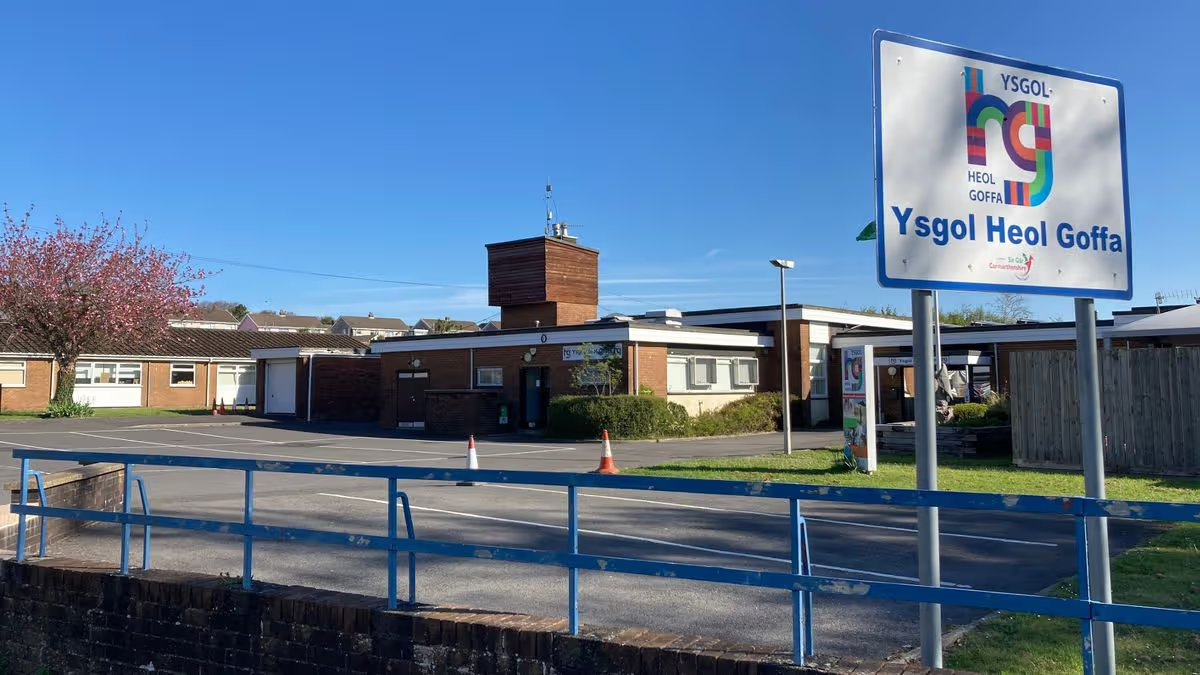
Council chiefs in Carmarthenshire have unanimously backed revised plans for a new special school in Llanelli. The new Ysgol Heol Goffa will be built by Ysgol Pen Rhos, nearly four miles from its current home, and cater for 150 pupils aged three to 19 with severe learning difficulties or profound and multiple learning difficulties.
If, when and where the new school would be built has been the subject of debate and controversy for years, especially when a previous proposal for a new Ysgol Heol Goffa was dropped by the council in 2024 on cost grounds.
An independent review of specialist education in the Llanelli area was then commissioned by the council. Stay informed on Carms news by signing up to our newsletter here
Advertisement
Cllr Glynog Davies, cabinet member for education, told cabinet colleagues on June 1 that the school has offered excellent education but needed more space. “We need to change sites,” he said, adding that the planned new school would have 30 places more than the previously proposed one.
Cllr Davies said he was confident the Welsh Government would support the project and provide 75% of the funding needed. “The scheme I’m proposing is an excellent one,” he said.
A scrutiny meeting about the proposal last month heard it was expected to cost £35 million to build, with the council in line for a 25% contribution. Planning permission and Welsh Government funding will be needed and the aim is for it to open in September 2029.
Ysgol Heol Goffa had 132 pupils on its roll as of January this year and a capacity of 118. The cost per pupil, given the additional support required, is £29,595 per year.
Advertisement
Cllr Edward Thomas seconded the proposal at the cabinet meeting. “I’m sure that parents and children and staff at Heol Goffa will be looking forward to an enlarged school with greater capacity,” he said.
Navigating Britain’s interests “through the Trump administration will require super-human skills and luck and a massive team effort”, he said, adding: “For me it would be the last thing I do in public life and it would be a huge honour to serve you and the Government in this role. So if you are up for it, so am I.”
Netflix is set to release a film adaptation of the bestselling and beloved novel
The star and director behind ‘Netflix’s most chilling’ true crime thriller is preparing to helm an adaptation of a much-loved novel.
Advertisement
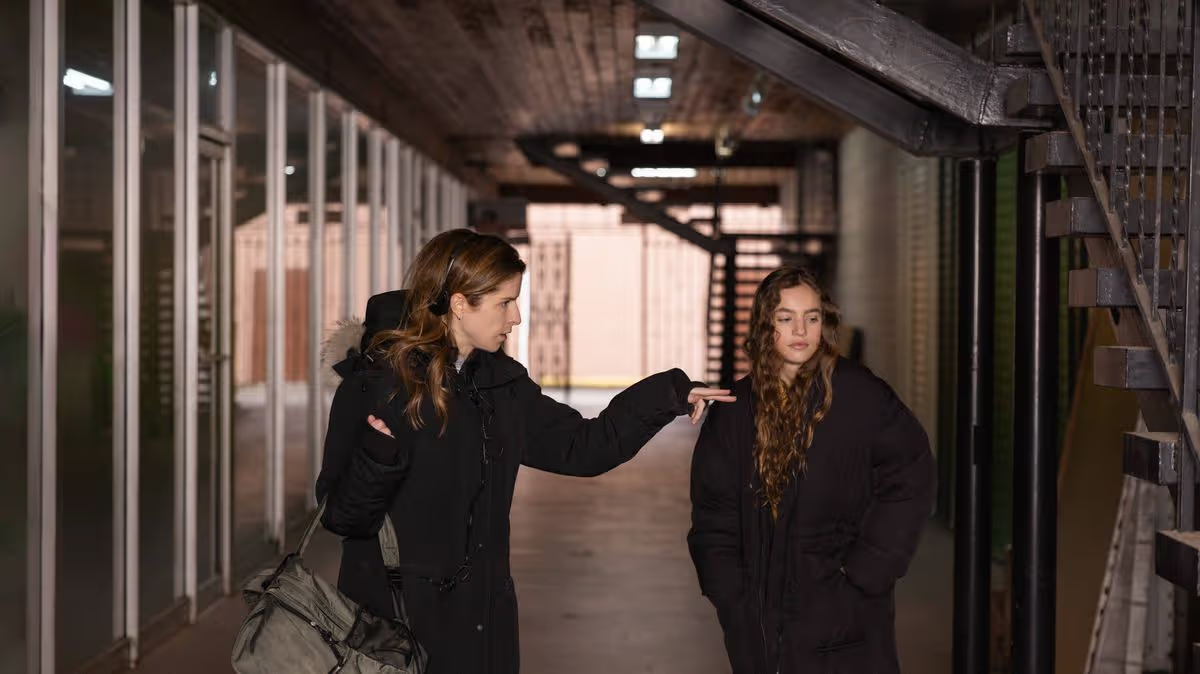
Anna Kendrick has been announced as director for the forthcoming film based on a bestselling book. Following its publication, it captured readers’ hearts and became a social media sensation.
The streaming platform is now developing a screen version of The Seven Husbands of Evelyn Hugo. Released in 2017, it earned a nomination for a Goodreads Choice Award for Best Historical Fiction that year.
Penned by Taylor Jenkins Reid, the novel comprises seven sections, each named for one of Hugo’s spouses, documenting her journey through marriages and romantic entanglements. According to Deadline, the adaptation centres on a young reporter’s long-anticipated interview with Evelyn Hugo, an ageing Hollywood icon.
Mirroring the source material, she lifts the veil on her seven unions, and while recounting tales of Tinseltown scandals, infidelities and heartbreak, she exposes startling revelations about her own existence and those in her orbit, reports the Mirror.
Advertisement
On Goodreads, one admirer wrote: “This is genuinely one of the most remarkable novels I have ever read. It is a favourite of the year, it will be a favourite of all time.”
A fellow reader commented: “Wow! This book came in and knocked me off my feet.” Netflix has been developing the adaptation since 2022, with Kendrick becoming the third director to join the production. The screenplay has been penned by Liz Tigelaar, who previously served as showrunner for the miniseries Little Fires Everywhere, and has writing credits on programmes including Once Upon A Time, Revenge, and Nashville.
This marks only Kendrick’s second directorial effort, though she made a significant impact with her debut feature, Woman of the Hour. The true crime thriller was also distributed by Netflix.
Advertisement
It garnered critical acclaim while becoming one of the platform’s most-viewed titles following its launch. Released in 2024, it holds an impressive 91% rating on Rotten Tomatoes.
Woman of the Hour drew inspiration from the crimes of Rodney Alcala. Kendrick also features in the film as an aspiring actress who encounters a notorious serial killer in 1970s Los Angeles after both appear on an episode of The Dating Game.
Viewers described it as “unsettling” and “one of the most chilling true crime thrillers on Netflix”. Kendrick has not commented on the upcoming project but has spoken out about her move into the director’s chair before.
Following the release of Woman of the Hour, she told Netflix: “. Kendrick hasn’t yet commented on the forthcoming project, though she has previously discussed her transition into directing.
After Woman of the Hour’s release, she told Netflix: “My favourite thing about making my first movie was that every person from every department that I interacted with, I got to say to them, ‘This is the first time I’ve done this once, and it’s with you. So I’m hoping that I can ask you a million questions.’
“I led with being vulnerable about what I felt like I didn’t know and what I needed to know and learn. That really helped me avoid, I think, the worst thing you can do, which is pretending you know what’s going on when you don’t. You can plan and plan and plan, and there will be something that like you could not possibly have accounted for.”
Woman of the Hour is streaming on Netflix, Seven Husbands of Evelyn Hugo is coming soon.
The current succession policy prevents residing family members from succeeding a tenancy following the death of the tenant when it has previously occurred
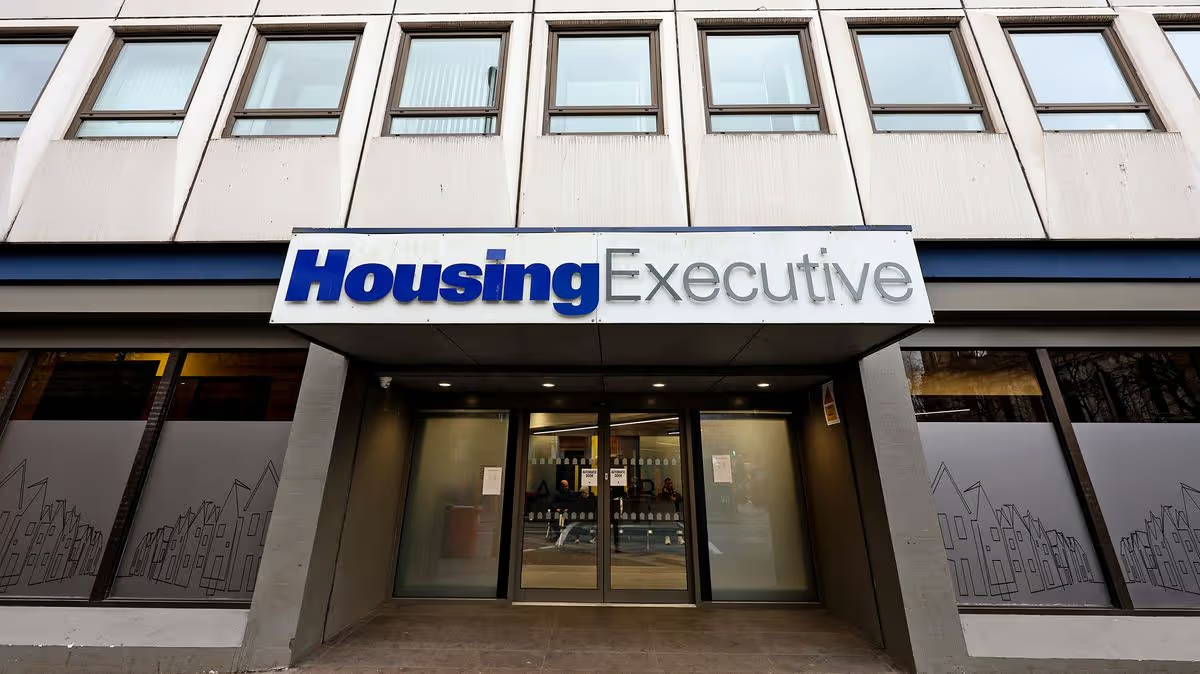
A call has been made to end the Housing Executive turfing out family members after tenant deaths.
The motion, proposed by Court District Electoral Area Councillor Claire Canavan, highlights that the current Northern Ireland Housing Executive succession policy prevents family members who have lived long-term in a property from succeeding a tenancy following the death of the tenant. This happens where succession has already previously occurred, for example, between husband and wife.
The Housing Executive allows a secure tenancy to be passed on to a surviving husband or wife, civil partner, or family member after a tenant’s death. But succession is limited strictly to once per property. If the deceased tenant had previously inherited the home, a second statutory succession is generally not permitted.
Sinn Féin said: “This policy can lead to unnecessary displacement, eviction, hardship, and further breakdown of family units.”
The motion states: “The council notes the ongoing housing crisis across the North and the increasing demand for permanent social housing. (It notes) that many families live for long periods in Housing Executive properties and develop vital community roots.
“The council believes that housing policy should prioritise stability for families and communities. Family members or partners who have contributed to and depend on the household should not face eviction due to restrictive succession rules. Social housing should be managed in a way that balances fairness, community stability, and objective housing needs.”
Advertisement
The motion has been referred to the People and Communities Committee on Tuesday June 9, where it will be adopted or declined, and may go to a vote.
If successful the council will write to the Minister of the Department for Communities calling on him to undertake a legislative review of the NIHE tenancy succession policy. The council will “request the introduction of safeguards to prevent unnecessary eviction or relocation following the death of a tenant, particularly where long-term residence and established community ties exist.”
It would ask the minister to support “the development of a fair and community-aligned succession policy that protects households while ensuring that social housing is allocated on the basis of objective need.”
The motion also calls for engagement with residents’ groups, community organisations, and elected representatives in the development of any revised succession policy.
Advertisement
According to Housing Executive policy, if a legal succession is not possible as the home was already inherited once, the Housing Executive may still consider a “policy succession” or use discretionary powers in exceptional cases. This may apply to a person who gave up their own tenancy or sold a home to move in and care for the deceased, and they may be granted a policy succession.
The long-range forecast for Wales predicts when it could become hot again
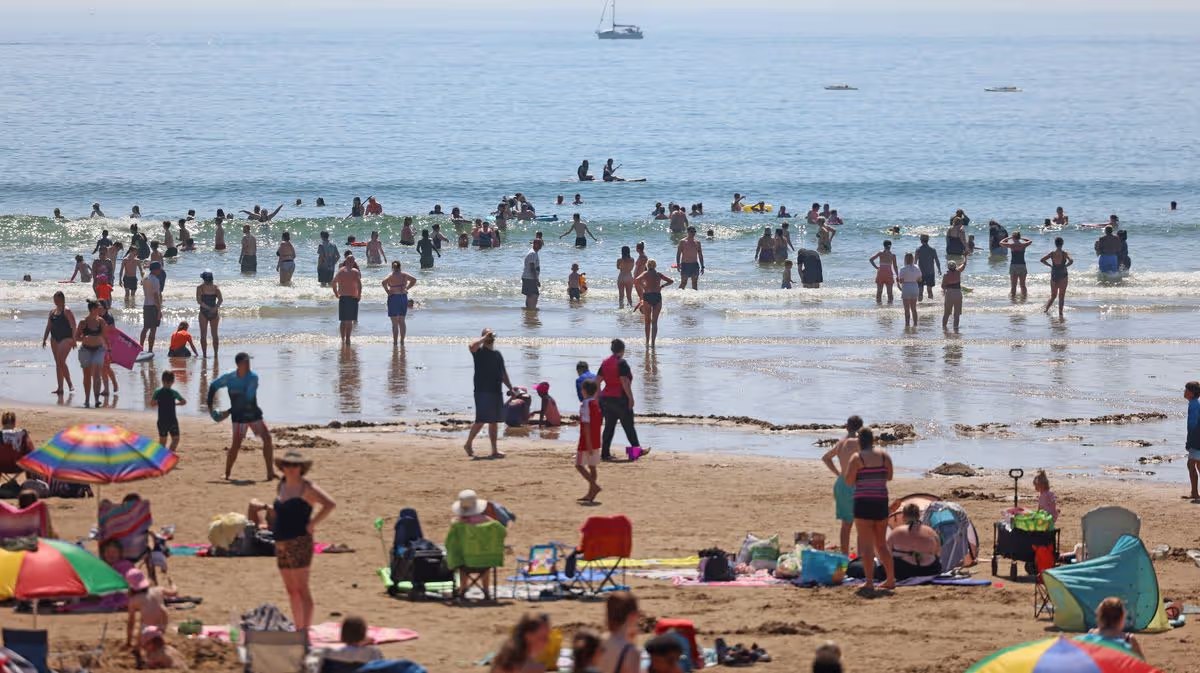
The weather so far this year has smashed records with Wales seeing the warmest spring since 1884 and the hottest May day during last week’s heatwave. But it is not time to put your fans away yet as the Met Office has forecast more heat this month as we head into summer.
Advertisement
An early and record-breaking heatwave at the end of May meant that this year Wales and England experienced the warmest spring. Across the UK some areas saw six consecutive days above 30°C, giving a taste of what the summer may bring.
Each month of spring were some of the warmest on record, beginning with a joint tenth warmest March, followed by the seventh warmest April and then a May that finished up as the joint third warmest.
Met Office scientists have said the records being broken show “the longer-term warming” of the world with more “extreme conditions” happening more often. For the biggest stories in Wales first sign up to our daily newsletter here
Met Office scientist Dr Emily Carlisle said: “This spring highlights both the natural variability of the UK’s weather and the longer-term warming we are observing. While conditions varied through the season, all three months of meteorological spring recorded mean temperatures within the UK’s top ten warmest on record.
Advertisement
“While we expect fluctuations from year to year, this spring shows some of the changes we’re seeing in our weather patterns, with more extreme conditions becoming more frequent.”
As well as high temperatures, rainfall patterns have also seen a change with spring rainfall decreasing by 14% from the long-term meteorological average for the UK.
Met Office scientists also found that breaking the 32.8°C May record is around three times more likely now in our current climate than it would have been in a natural climate not impacted by greenhouse gas emissions.
This week the weather has taken a turn with rain returning for many across Wales after a yellow thunderstorm warning was issued on Thursday, May 28.
Advertisement
Showers and longer spells of rain are expected to continue throughout the first two weeks of June and temperatures are “likely to be near normal overall”, claims the Met Office.
However, the long term forecast from Tuesday, June 16, until Tuesday, June 30, states that whilst “heavy showers and thunderstorms become more probable”, Wales may also see higher temperatures and hotter weather.
The forecast states: “The start of the period is likely to be relatively settled, with high pressure in the vicinity of the UK bringing drier conditions to most parts of the UK.
“However some showers or spells of rain are still possible. Winds will mostly be light with temperatures probably above normal. Towards the end of June, low pressure may begin to have more of an influence, especially across the south where heavy showers and thunderstorms become more probable. It may also become hot in parts of the south.”
Arteta has been central to the club’s planning for next season with the Gunners targeting a central midfielder, forward and full-back in the transfer market.
But it will not be straightforward.
Given last season’s £250m spend on new players, a number of player renewals and lucrative bonuses paid to players in lieu of their Premier League success, the club are mindful of ensuring finances are balanced during the close season.
For the forward position, three players are known to be on the shortlist – Aston Villa‘s Morgan Rogers, Bournemouth‘s Eli Junior Kroupi and Atletico Madrid’s Julian Alvarez.
Advertisement
Rogers and Kroupi are expected to cost in excess of £80m each, while Barcelona target Alvarez is being valued at more than £120m.
Any move for Rogers, Kroupi or Alvarez could be facilitated by exits in forward areas with the club open to offers for Gabriel Jesus, Gabriel Martinelli while Leandro Trossard’s deal expires in 12 months.
The future of academy graduate Ethan Nwaneri, who has returned from a loan spell at Marseille, is also unclear with the club giving serious consideration to a homegrown sale this summer, which would represent pure profit on the balance sheet.
Arsenal are also set to listen to offers for Christian Norgaard and Ben White, while Fabio Vieira and Reiss Nelson can also leave. Jakub Kiwior has already been sold to Porto for £14.7m.
Advertisement
A move for Rogers has been discussed, but with Martin Odegaard and Eberechi Eze, who can play in the central attacking areas, already in the squad there have been questions raised over whether a move for the England international is a priority.
Though, with Rogers able to operate from the left, it has been noted that his versatility would be an asset.
The interest in the 23-year-old is genuine, though the Gunners are not the only club in the running for Rogers with Manchester United also monitoring the forward’s situation.
Rogers, according to multiple sources, is open to joining Arsenal ahead of next season.
Advertisement
Kroupi is another opportunity Arsenal have explored after the 19-year-old scored 13 times in the Premier League, a record for a teenage debutant.
The club’s dream forward signing is Alvarez – though Barcelona have a serious interest in the Argentina attacker.
The club have also moved for Leicester’s teenage forward Jeremy Monga, 16, in recent weeks.
Monga is viewed as one of the leading young prospects in English football and has been courted by a host of clubs.
Advertisement
The teenager is understood to be open to joining Arsenal but it is unclear at this stage whether a departure from Leicester would require a tribunal.
The hospital has to be redeveloped as it was built with crumbling concrete
A building is set to be demolished as part of work on a Cambridgeshire hospital. Hinchingbrooke Hospital, overseen by the North West Anglia NHS Trust, is undergoing a major redevelopment after “structural issues” were highlighted with the current building.
Advertisement
The hospital, built in 1983, was constructed with Reinforced Autoclaved Aerated Concrete (RAAC). As part of the plans, a replacement hospital building will be built, as well as a new hospital-related ancillary office, research, admin and education facilities.
In the latest progress made at the site, work to demolish the site’s existing staff accommodation blocks are due to begin in June. The demolition is a key stage in the Hinchingbrooke Hospital Redevelopment Programme, which is funded by the Government’s New Hospital Programme.
The new development aims to deliver a modern, fully electric, digitally enabled hospital while delivering safe and effective patient care from the current hospital, throughout construction.
Advertisement
Demolition will take place in three planned phases:
Phase 1: Albert House and St Nicholas House – June to July 2026
Phase 2: Victoria House – October 2026
Phase 3 Alexandra House – August 2027
Deborah Lee, Senior Responsible Officer for the Hinchingbrooke Redevelopment Programme, said: “This is a major step forward in delivering our new hospital for the local community.”
Staff accommodation is being replaced through new modular ‘Zed Pods’ homes located at the front of the hospital site near the staff car park. These are expected to be ready for occupation in Spring 2027, so there will be no loss of accommodation for staff who require it.
The Trust is working closely with contractors and partners to minimise disruption. Measures include dust suppression, noise and vibration monitoring, and strict safety procedures.
A temporary staff car park will be built on the cleared site, helping maintain parking capacity while redevelopment continues. Materials from demolition, including concrete and brick, will be reused in its construction.
Advertisement
Ms Lee added: “While demolition can be disruptive, we are taking every measure to ensure services remain safe and accessible, and we thank our staff, patients and neighbours for their continued support.”
Picture this: you have spent decades building a career. You have a master’s degree. You have taught hundreds of students. You walk into work every morning with a sense of purpose. Then, almost overnight, the gates close. You are told you cannot come back. Not because of anything you did, but simply because of you are a woman.
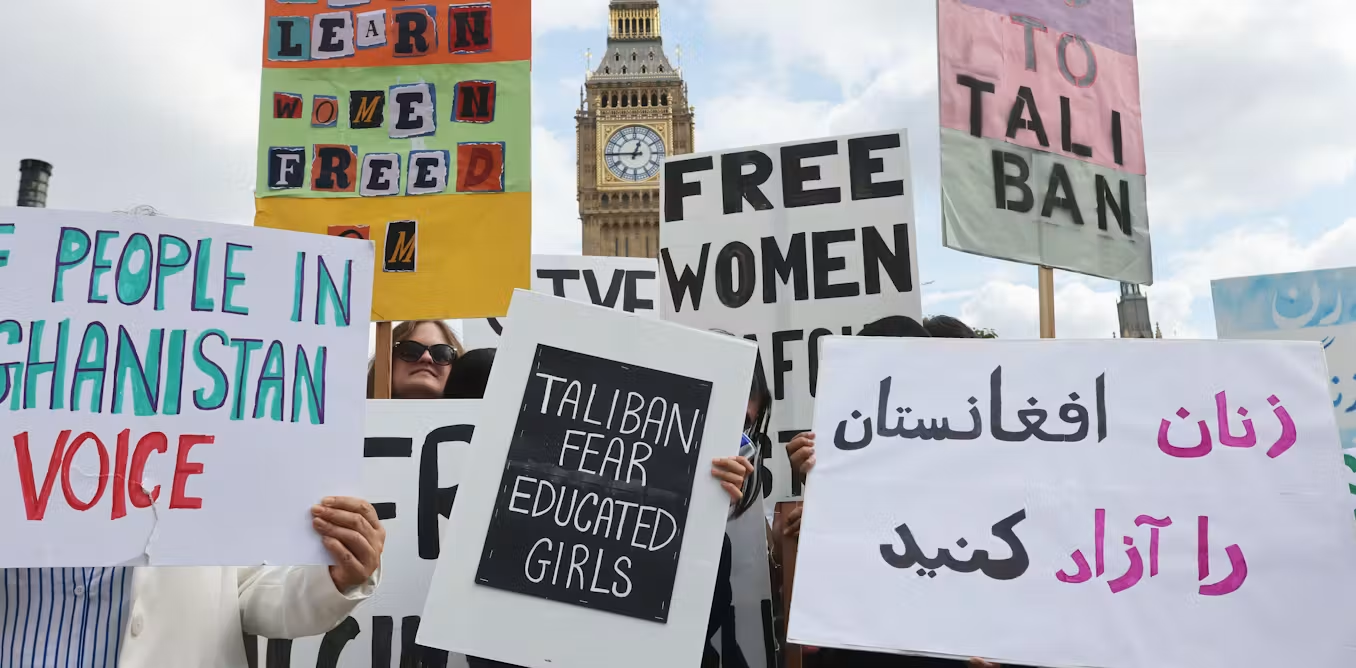
This is what happened to female academics across Afghanistan after the Taliban returned to power in August 2021.
We conducted interviews with 12 Afghan female academics via Telegram and WhatsApp, eight of whom were in Afghanistan and four of whom had recently left the country. Of those who were in Afghanistan, only one has since managed to leave – the rest remain there. What they told us was devastating.
When the Taliban first ruled Afghanistan between 1996 and 2001, women were barred from education and most forms of employment. After the US-led intervention, things slowly improved. Female participation in higher education in Afghanistan increased dramatically, expanding from 5,000 students in 2001 to over 100,000 in 2021. Women made up 28% of university students and 14% of academic staff. Progress was real, even if fragile. Then it was reversed almost entirely.
Advertisement
By December 2022, all universities had closed their doors to women. Girls’ education was banned beyond the age of 12. Women were banned from most jobs, required to have a male guardian to travel and forced to wear a black hijab in public. Afghanistan now ranks at 181 out of 193 countries on the Human Development Index.
The women we interviewed did not describe their situation in abstract political terms. They described it in deeply personal ones.
One participant, a lecturer with more than 20 years of experience, told us: “Living under the power of the Taliban as a woman is a gradual death. I feel like I’m dying every day. I’ve lost everything – neither my knowledge nor my education is valuable anymore.”
Another, who had taught for three decades, said the happiest moments of her life were spent in the classroom: “I like to go out of the house, teach, and see my students. This situation is like a gradual death for me.”
These are not just expressions of sadness. Ten of our 12 participants described significant psychological distress. All 12 reported feelings of disappointment and despair. One of the women described losing her entire sense of self: “I lost my job, position, honour, credibility, and societal personality.”
Losing work is hard anywhere, often cutting a family’s income in half. But in Afghanistan, the consequences go much further than a lost income. One participant put it plainly: “Women’s presence in society decreased, and their social interactions and connections with society became almost non-existent.”
The Taliban also banned online education: private universities that had offered remote classes were told to stop. For academics who had hoped to keep teaching digitally, even that door was shut.
Since the 1990s, researchers have studied Muslim societies to understand why gender inequality exists, which led to the development of “Islamic feminism”, a movement that supports women’s rights and gender equality within an Islamic framework.
As Afghanistan is a Muslim country, this movement offers a powerful framework for gender justice there, challenging both patriarchal religious interpretations and western feminist views that are often seen as culturally alien. It might seem strange to discuss feminism within an Islamic framework when the Taliban claim to be enforcing Islamic law — but this is precisely the point.
Based on the arguments of feminist scholars on Islamic feminism, we can argue that the Taliban’s restrictions on women have noting to do with genuine Islamic teachings and are instead linked to political control. These scholars argue that the Quran supports women’s rights to education, economic participation and engagement in public life. Therefore, the restrictions can be understood as a distortion and misuse of religious texts to justify patriarchal power.
This is the position of Islamic feminism: that the problem is not Islam, but the way certain men have interpreted it to serve their own interests. For Afghan women, this matters enormously. A framework that is rooted in their own faith, rather than imported from the west, gives them a way to resist that feels authentic and grounded.
Advertisement
The women we spoke to have not given up. Some are finding quiet ways to keep teaching. Some are using social media to stay connected. Some are hoping that international pressure will eventually force change.
“It’s like we’re at a crossroads; all the paths are dark,” one participant said. “One path is concrete, another is muddy, and one has pitfalls. We can’t discern the paths; all of them are dark and uncertain. So, I can’t make a specific plan because it’s unpredictable.”
The international community could help by funding alternative education programmes, supporting Afghan women in exile who are keeping academic networks alive, and by maintaining sustained pressure on the Taliban.
Danny Calladine was jailed for three-and-a-half years after he ran over his partner’s cousin Dion Eagle in a drink and drug-fuelled dangerous driving incident in Derby, leaving him in a wheelchair with life-threatening injuries
18:13, 01 Jun 2026Updated 18:13, 01 Jun 2026
A van driver, intoxicated by alcohol and drugs, inflicted multiple fractures and life-threatening internal injuries on a relative after deliberately running him over and reversing back across his body.
In an extensive and deeply moving impact statement, victim Dion Eagle described how he was absent for his daughter’s birth while in intensive care, remains in a rehabilitation facility nearly six months later and “wishes he had died that day”.
This week the scaffolder arrived at Derby Crown Court in a wheelchair to witness the man who irreversibly altered his life – Danny Calladine – being sentenced.
Advertisement
The 35-year-old who inflicted such catastrophic harm – his partner’s cousin – subsequently attempted to claim he had been assaulted by Mr Eagle prior to the incident, reports Derbyshire Live.
Sentencing him to three-and-a-half years imprisonment, Judge Jonathan Straw stated: “On December 19 last year you irreversibly changed the course of Dion Eagle’s life forever, affecting your own life and the lives of countless others who care about each of you because of the many inexplicable decisions you made that day.”
“The footage makes for graphic and difficult viewing and while all the horror unfolded and while Dion was lying trapped under the van your immediate reaction was to deny what you had done. Dion was left there fighting for his life and it is a miracle we are not here concerned with a homicide.
“He is still in hospital now, six months on, and the pain and suffering he has experienced during that time is for the most of us unimaginable.”
Advertisement
Prosecutor Lauren Fisher told the court that the incident unfolded on Scarborough Rise, Breadsall Hilltop, at approximately 4.15pm on 19th December last year. She explained that the two men had spent time drinking together before heading to a nearby shop to purchase more alcohol. On their way back, a row broke out and Mr Eagle stepped out of the van “to leave the situation”
The court was then shown harrowing footage depicting Mr Eagle bending down in front of the vehicle before Calladine drove directly into and over him, subsequently reversing back over the stricken victim.
Miss Fisher said: “It was witnessed by a number of passing motorists and one who stopped could see the defendant was drunk and slurring his words saying ‘what’s going on? I have not hit anyone’.
“He then dropped the keys to the van which the witness picked up and placed in his pocket. He also noticed a can of Stella in the footwell.
Advertisement
“(That witness’s daughter) then heard him on the phone saying ‘I have hit him and I don’t know what to do, I have run over him’. It is estimated that Mr Eagle was trapped under the van for 15 to 20 minutes.
“Mr Eagle’s partner arrived and described the scene as ‘carnage’.
“He later told the police that he thought he was going to die while under the van saying he thought he was ‘pretty much done for’.” The prosecutor revealed that Calladine told police Mr Eagle had “smacked him” and stated “I would not run over my family, I would not do that I just hope he’s okay”.
‘I wish I had died’
She explained that tests taken at the roadside and in custody showed the defendant to be almost three times the legal drink-drive limit and four times the legal drug-drive limit for cocaine.
Advertisement
She detailed how Mr Eagle sustained multiple fractures – including two to his spine – along with extensive internal injuries, was placed into an induced coma on several occasions, has had numerous operations and more than five months later remains a permanent resident at Linden Lodge rehabilitation centre in Nottingham, where he is likely to remain for some time yet.
Through two victim impact statements, Mr Eagle, who is in his mid-20s, described missing his daughter’s birth while in intensive care, which left him devastated.
He said: “My legs are still useless and it is a horrible way to feel. I know it sounds selfish but I still wish I had died that day, I cry every day, I just wish the pain would stop.
“I feel anger that I am trapped like this while the person who did this to me is out enjoying life.”
Advertisement
Calladine, a father of a 12-year-old son, formerly of Braintree Close, Breadsall Hilltop and now of Market Street, Ashbourne, previously pleaded guilty to causing serious injury through dangerous driving and drink-driving. Kevin Waddingham, mitigating, said: “It is clear he regrets enormously what happened in those few seconds and the consequences for Mr Eagle.
“He has lost relationships with Mr Eagle and his family which were important to him prior to this incident.
“It is something he will have to live with forever.”
Alongside the custodial sentence, the judge banned the defendant from getting behind the wheel for 35 months and issued a five-year restraining order.
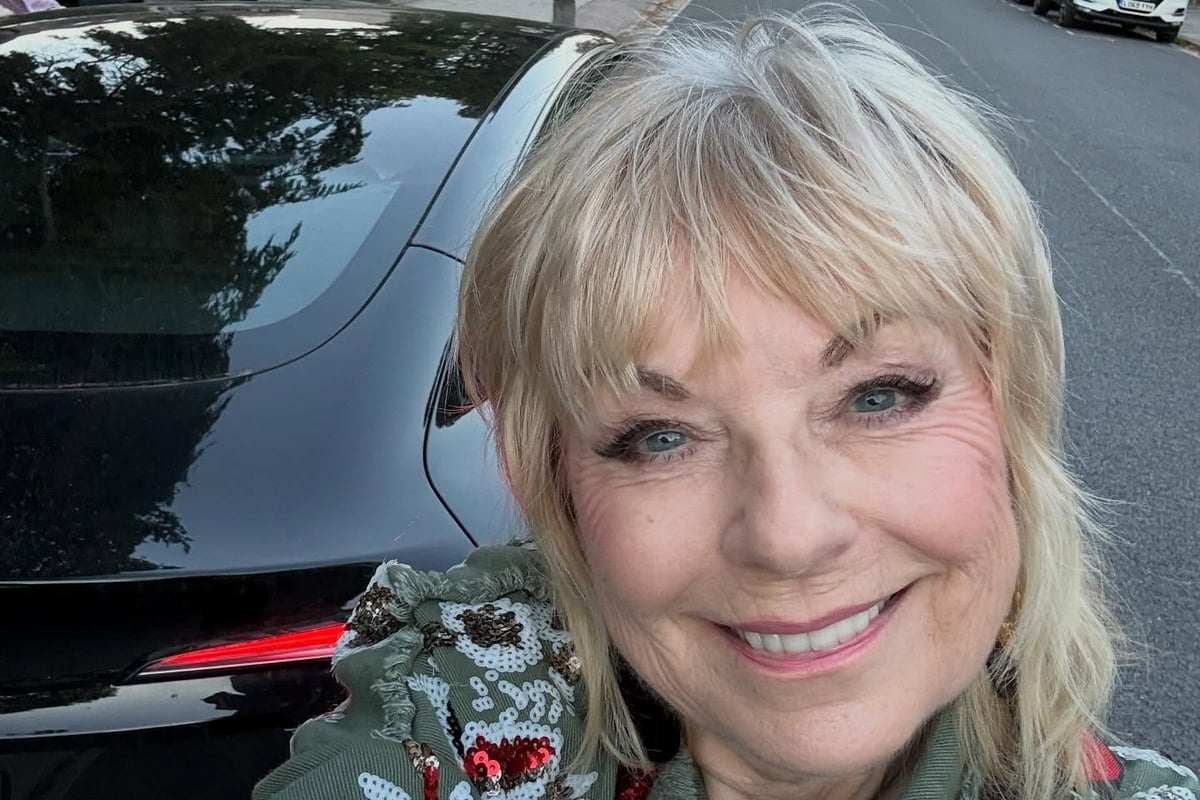
I have always been a fan of Mari Wilson ever since I heard her first hit ‘Just What I Always Wanted’ playing on the radio in 1982. She followed up that top ten hit single the next year with a glorious cover version of the song ‘Cry Me A River’ that was made famous by Julie London in the 1950s.









































You must be logged in to post a comment Login