Connect with us

NewsBeat

Our 83-year-old Christian grandmother was euthanised against her will under Canada’s assisted dying system – she died covered in blood with her hands clasped in prayer

Published

on

Brigitte Kranendonk with her grandmother Brigitte Stegemann, known affectionately to her family as ‘GG’ or ‘Oma’

Two days before her Christian grandmother’s assisted dying procedure in Ontario, Canada, Brigitte Kranendonk sat her down to make sure she knew exactly what was going to happen.

‘I used very frank terms. I said: “Do you know that you’re going to die on Friday?”’

The 83-year-old was in visible disbelief and began crying for 45 minutes. ‘I’ve made a mistake,’ Brigitte Stegemann, known affectionately to her family as ‘GG’ or ‘Oma’, wailed.

‘She was bawling. Inconsolable,’ Kranendonk, a real estate agent who shares the same first name with her late grandmother, tells the Daily Mail.

Advertisement

In a cognitive test, designed to ascertain whether she was sound of mind enough to consent to Medical Assistance in Dying (MAiD), Stegemann ‘got every question wrong’, believing her two living siblings to be dead, according to Kranendonk.

Yet 48 hours after she wept uncontrollably at the notion of MAiD, Stegemann is said to have died with her hands clasped in prayer, covered in her own blood due to a botched first attempt at connecting the IV, administered by a nurse allegedly not wearing gloves.

Kranendonk is currently in the process of desperately appealing to the Chief Coroner’s Office in Ontario, as well as the Patient Ombudsman and Belleville Police, in a bid to ascertain whether what happened the morning of July 10 at The Pearl care home in Cannifton was legal.

Bereaved and distraught, she claims MAiD practitioners took advantage of her grandmother’s vulnerability to perform the procedure, which she alleges was carried out without express consent.

Advertisement

Brigitte Kranendonk with her grandmother Brigitte Stegemann, known affectionately to her family as ‘GG’ or ‘Oma’

‘She was a vulnerable human being, and they saw an opportunity,’ Kranendonk says, her rage and sadness visible.

She suspects the MAiD practitioners were inappropriately ideologically motivated, and believes the chain of events leading up to the procedure should be investigated. 

Advertisement

It is understood that the practitioners and care home, who have not commented publicly, maintain that Stegemann had legally consented to proceed.

‘No one had ever done MAiD at this residential home before: this was their very first MAiD procedure. So I don’t know if they just dropped the ball, because they didn’t know what they were doing.’

The moment of Stegemann’s death was anything but peaceful, as she had once wished.

Recalling those nightmarish minutes, a traumatised Kranendonk speaks in the present tense, as if the procedure was still happening in slow motion. 

Advertisement

‘There was a phenomenal amount of blood,’ she says, describing the way that the nurse failed to find the correct vein in the right arm to insert the IV, before switching to the left – but only after having ‘poked her about three or four times with the needle’.

‘It is all over my Oma’s arm, it is all over her nightie, soaking through her pillow, all over the sheets, there is so much blood. 

‘And throughout all this time, mind you, the nurse is not wearing gloves.’

Another episode that still haunts Kranendonk is from February: she says she had to convince her grandmother to accept a medical port, a small device placed under the skin to provide a direct way for medicine to reach a vein.

Advertisement

After it was fitted, the 83-year-old repeatedly ripped it off, screaming: ‘I don’t want the death shot!’

Prior to Stegemann’s death that summer, Kranendonk had been her caregiver for 12 years, and her medical power of attorney for the past six.

A year and a half before her death, the family made the decision to house Stegemann in The Pearl as her physical and cognitive health began to deteriorate.

In February, she was diagnosed with stage 4 stomach cancer. But doctors were not certain about whether the diagnosis meant she had six months to live, or as much time as two years.

Advertisement

For the past decade, Kranendonk had been carefully monitoring what her grandmother ate to keep her healthy, including limiting her sugar intake.

Following the cancer diagnosis, she changed tact and allowed her to eat whatever she craved, deciding she just wanted her grandmother to feel as ‘joyful’ as possible in her final stage of life.

She spoke to Stegemann about all options, and even brought up MAiD, explaining what the procedure would entail. She remembers her grandmother saying clearly: ‘No, I don’t want that.’

Kranendonk says her religiosity, and the notion of displeasing God, was a large factor in why her German-born grandmother instinctively opposed assisted dying.

Advertisement

Then came June, when Kranendonk and her husband went on a 10-day road trip.

In the past, every time she was away, she received frequent phone calls from the residential home regarding her grandmother’s health.

Everything seemed normal. She picked up numerous phone calls, and the doctors didn’t discuss a dramatic decline in Stegemann’s health – only that she had fallen over and would need a wheelchair.

But towards the end of the trip, on July 3, Kranendonk received a different kind of call. It was from the home, saying they were going to book a MAiD assessment for her grandmother.

Advertisement

Her health had apparently seriously deteriorated. 

The news hit like a ton of bricks.

Back in Cannifton, Kranendonk anxiously questioned a nurse at the residential home about who had initiated the MAiD conversation.

‘The nurse became very abrasive, very defensive,’ Kranendonk recalls. ‘She was like, “Well, I’m just trying to advocate for her. I’m just trying to do what’s right for her.”‘

Advertisement
Prior to Stegemann’s death that summer, Kranendonk had been her caregiver for the preceding 12 years and her medical power of attorney for the past six

Prior to Stegemann’s death that summer, Kranendonk had been her caregiver for the preceding 12 years and her medical power of attorney for the past six

Soon after Kranendonk returned from her trip away, she discovered her grandmother had actually already had her first MAiD consultation.

‘No one called me,’ she says, explaining how she feels she was isolated from the whole process from the beginning.

While her grandmother was certainly sick, Kranendonk found it difficult to believe that she had rapidly declined in health during her trip away, and privately questioned whether what the nurses told her was true.

Advertisement

‘I noticed that she had lost weight when I saw her after returning, but she had slowly been losing weight for a while. 

‘Regarding her rapid decline, I am not a doctor, but when I came back she was still eating, walking to the bathroom, very talkative and full of jokes.

‘She never complained about pain in front of me, except when her stomach was being relentlessly pressed.’

Kranendonk maintains that Stegemann did not at any point make a formal MAiD application herself. 

Advertisement

But every time she tried to question whether MAiD was the right pathway for her grandmother, she feels she was made to feel crazy or burdensome by the medical professionals at the home.

‘I truly believe that one nurse really saw us as an obstacle,’ she says. ‘We were getting in the way of her doing MAiD on my grandmother. I think she really, truly believes that MAiD is the best for people, and shame on me for trying to stop that.’

Kranendonk made sure she was in the room for the second MAiD assessment, and it was there where she noticed the doctor speak in ‘really loose terms, never using the words death or dying’.

‘She explains MAiD to my grandmother by saying: “We’re going to give you medicine, you’re going to feel at peace. And I just want you to know that you won’t have a bowel movement.”’

Advertisement

‘She’s saying it in these strange terms, that aren’t literal,’ Kranendonk says, adding: ‘My Oma’s just kind of nodding. Her first language is not English, she is 83-years-old and severely hearing-impaired.’

Kranendonk looked at the doctor, and said: ‘She doesn’t understand what you’re saying.’

That’s when the doctor allegedly turned to the grandmother, and offered: ‘We’re going to make sure you won’t have any more pain.’

During the cognitive assessment, which she also sat in on, Kranendonk claims that the questions were curiously designed, in that the doctor couldn’t immediately verify the answers.

Advertisement

As opposed to questions such as who the prime minister was, or that day’s date, the grandmother was asked personal questions, like how many siblings she had.

‘But none of that is in her records. They would not know if the information was correct, or not,’ Kranendonk says.

Even so, Stegemann got the answers wrong. 

She said she had no siblings, despite having 13.

Advertisement

The doctor asked how many were still alive, and Stegemann answered, saying none.

But two are still alive, and the grandmother had seen one only a month and a half before.

‘So we’re going through this assessment. None of the answers could be proven, unless I was there. 

‘There was nothing concrete. They’re supposed to be doing a cognitive assessment, and yet they picked questions that they can’t verify,’ Kranendonk says.

Advertisement

According to government guidelines, a patient must be sound of mind and have a ‘grievous and irremediable medical condition’ to be eligible for MAiD in Canada. 

Eventually, much to her discomfort, Kranendonk was asked to leave the room by the doctor, who continued the test.

Waiting outside anxiously, Kranendonk was sure her grandmother would fail.

But four minutes after the cognitive test was complete, the doctor announced that Stegemann was ‘deemed fit for MAiD, and we’re going to proceed’. 

Advertisement

Later on the same day, Stegemann confused the names of her daughter and her granddaughter. 

In February, Stegemann was diagnosed with stage 4 stomach cancer

In February, Stegemann was diagnosed with stage 4 stomach cancer

‘I was astonished that she was given the okay,’ Kranendonk says, following the assessment on Tuesday, July 7.

The doctor assured her that her grandmother would still be able to ‘deny’ MAiD on the day of the procedure, which was scheduled for Friday at 11am.

Advertisement

Then began an impossible balance. Kranendonk was determined to try and ascertain whether Stegemann had actually consented to MAiD – but she didn’t want to cause undue stress for the 83-year-old.

Most of all, she just wanted to enjoy whatever time she had left with her beloved Oma, who she grew up living with as a child. 

Every summer and long weekend throughout her upbringing was spent with her grandparents – and the thought of losing Stegemann was heartbreaking.

‘Like, I’m already on limited time with her. So there’s this balance, of wanting to get her to understand, and also still wanting to protect her – to not make her upset.’

Advertisement

On Wednesday, Kranendonk woke up after barely sleeping and prepared to visit her grandmother.

But before she had a chance to enter the home, she got a call from the nurse, who said they planned to fast-track her grandmother’s death to Thursday – simply because the doctor had an early opening.

‘I was like: “I’m not talking about this right now, I’m on my way to visit my Oma.”‘

The nurse replied: ‘Oh, well, I already spoke to your Oma, and she agreed.’

Advertisement

But Thursday wouldn’t have allowed enough time for Stegemann’s pastor to arrive, or her son – depriving her of her dying wishes to be surrounded by her loved ones and prayer.

Kranendonk said Thursday wasn’t an option, so Friday was kept as the death date.

She felt cornered. She was trying to protect her grandmother, but says the nurses were making her feel like an obstacle, standing in everyone’s way.

The stress became overwhelming, and she felt like she had no control.

Advertisement

That day, she says she marched up to residential home’s manager, to complain about how everything had been handled – how the process felt sped up, and lacked transparency. 

She demanded to see the MAiD paperwork, and to find out who was filling it in.

The manager said everything had already been filled out the day prior, and her grandmother had signed it.

To this day, Kranendonk has not seen the paperwork allegedly signed by her grandmother, agreeing to the procedure – all of which was completed without any family members present.

Advertisement

‘I don’t know who the witness was. I don’t know how they explained the paperwork to her. I don’t know what they said to her. I have no idea,’ Kranendonk says, now horrified by what she views as lapses in proper MAiD procedure.

‘I’m sorry. How can we make this better for you?’ the manager asked Kranendonk.

In a fit of rage and disbelief, she replied: ‘You guys have taken this whole MAiD thing and have just rammed it down our throats.’

Following the altercation with the manager, Kranendonk confronted her grandmother and explained what would be happening on Friday in vivid terms.

Advertisement

The conversation caused her to breakdown in tears and admit that she had made a mistake. ‘I just kept saying there’s no mistake, there’s no mistake. You don’t have to do this. 

‘The doctors are coming on Friday, and you just say no,’ Kranendonk recalls pleading.

But it got to a point where Kranendonk didn’t want to ‘keep fighting MAID, and lose sight of who I’m fighting for’.

Her grandmother was unwell, and confused, so she made the decision to just try and experience all the precious quality time she could have with Stegemann – while she still had a chance.

Advertisement

And crucially, she trusted the nurses to not take advantage of the ailing woman. 

‘My Oma wasn’t the only vulnerable one in that situation – I was. I was vulnerable in the loss and love of my grandmother, being her care provider, and I was vulnerable in trusting that they were making the right decisions.

‘It all felt so sped up and in slow motion at the same time,’ Kranendonk says.

On Thursday, the pair danced together to traditional German Polka music and ate ice-cream in her room.

Advertisement

‘We had the best day,’ Kranendonk recalls, tearfully. ‘I felt great leaving on Thursday.’

But she went home utterly confused. On the one hand, she was elated she had such a fantastic day with her grandmother.

But on the other hand, she couldn’t bear the possibility of what might happen the next day.

‘I was so split. Part of me was like, maybe it’s not going to happen. And then there was this underlying feeling of, oh God, what if it does?’

Advertisement

Since her grandmother’s death, many people have asked Kranendonk why she didn’t try harder to stop the lethal injection from taking place.

In hindsight, she felt like she was in an unworkable situation. She at once wanted the best for her grandmother and wanted to respect her autonomy, but was terribly concerned that she had never once heard her say, outload and clearly: ‘I want MAiD.’

‘All I saw was her not understanding the process,’ Kranendonk recalls.

On the day before Stegemann's assisted death, she danced with her granddaughter to traditional German Polka music and the pair ate ice-cream

On the day before Stegemann’s assisted death, she danced with her granddaughter to traditional German Polka music and the pair ate ice-cream

Advertisement

When Friday, July 10 arrived, everything felt rushed again. The family took Stegemann out into the residential home’s garden to share strawberry ice-cream – her favourite – and the pastor arrived, who started a round of prayers.

‘She’s very confused at this point,’  Kranendonk remembers.

At 9.30am – after 10 minutes of being outside – the MAiD nurse asked for the family to return indoors, despite the fact that they were told the doctor would not arrive until 11am.

The nurse said that she needed time to get the IV started, and Kranendonk remembers telling her forcefully that they were not finished having time together as a family.

Advertisement

‘Well, how long do you need?’ she claims the nurse said, rather dismissively, in response. 

Once back inside the home, the nurse started the IV, Kranendonk alleges. According to Kranendonk, the doctor hadn’t even arrived, and her grandmother was not asked if she gave consent for the procedure to begin.

The nurse struggled to insert the IV into Stegemann’s right arm, and ended up piercing her repeatedly with the needle before attempting her left arm.

Kranendonk remembers in graphic detail the copious amount of blood, which made the whole procedure feel strangely unprofessional.

Advertisement

‘She’s asking us to hand her things, to flush out the needle. So we’re now a part of this. She’s asking us to grab things for her, and to hold things for her.

‘This nurse is not wearing gloves. There’s blood all over her hands, there’s blood all over the place,’ she says, horrified by the memory.

The doctor then entered the room and told Stegemann she was there to give her ‘medicine’, and asked if that was okay with her.

‘My Oma is not moving. She doesn’t open her eyes. She doesn’t nod. She doesn’t say anything, and the doctor just said: “Okay, well, I’m going to proceed.”‘

Advertisement

Within 10 minutes, Stegemann was pronounced dead. Due to how unresponsive she was, Kranendonk doesn’t know if her grandmother died shortly before the MAiD, because of the MAiD, or whether she was just in deep prayer.

She says that no heartbeat was taken, before or after the procedure.

‘What was concerning, though, is that that morning, I was crying. My grandmother looked at me and said, “If you don’t stop crying, I’m not going to sleep tonight.” She said that to me on Friday morning.’

It was only in the aftermath of Stegemann’s death that Kranendonk – overwhelmed with grief – began to believe that something went awfully wrong.

Advertisement

She has subsequently learnt that nurses are strictly prohibited from pressuring a patient to pursue MAiD, and that all the correct paperwork for MAiD to take place must be submitted before a death date can be determined.

Stegemann’s paperwork was completed after her death, her granddaughter claims.

‘She did not consent the morning of the procedure,’ Kranendonk says, steadfast in her conclusion that her grandmother was euthanised against her will.

She has consistently asked The Pearl to hand over her grandmother’s medical records, but all of her requests have been refused, she says. 

Advertisement

She regrets not applying for a legal injunction to prevent the MAiD from occurring, but she also didn’t realise she had the right to ask for one at the time.

‘I was flying blind,’ she says. And crucially, her grandmother still needed medical attention in those final weeks. 

‘We live in Canada, where medical care is not always easy to get. She still needed medical care. I could not just scoop her up and bring her home,’ she says. 

She trusted the government, and the medical establishment, not to take advantage of her grandmother. In the months since July, that trust has completely shattered. 

Advertisement

She says she has ‘settled a lot into prayer’, and is sharing her story as a way to give more education to care providers who may find themselves in similar scenarios. 

A spokesman for Belleville Police told the Daily Mail: ‘This incident is currently open and under investigation with our Criminal Investigations Division. We are unable to provide any additional information at this time.’

Canada has one of the highest rates of euthanasia in the world, with MAiD accounting for 4.7 per cent of the deaths in 2023. 

The Daily Mail contacted The Pearl for comment.  

Advertisement

Source link

Continue Reading
Click to comment

You must be logged in to post a comment Login

Leave a Reply

NewsBeat

Pensioner who sprayed ant-killer in her terminally ill neighbour’s eyes in parking row told him ‘no one would believe him’ as she is ‘a 75-year-old woman’

Published

on

Sally Beaney, 75, 'revelled in making other people's lives very difficult' and robbed her cancer-stricken neighbour Matthew Perry of 'precious' years after they were embroiled in a dispute

A pensioner has avoided jail after she sprayed ant poison into her terminally ill neighbour’s eyes over a parking row and told him ‘no one would believe him’ because she was elderly.

Sally Beaney, 75, ‘revelled in making other people’s lives very difficult’ and robbed her cancer-stricken neighbour Matthew Perry of ‘precious’ years after they were embroiled in a dispute over a shared driveway.

What started as a parking dispute turned into Beaney’s ‘obsession to control’ the parking situation outside their homes and ‘culminated’ in her spraying ant-killer in her neighbour’s eyes.

Mr Perry, who has ‘late-stage cancer‘, was left with swelling on his eye from ‘minor chemical burns’ and a ‘mild corneal injury’, a court heard.

Advertisement

But Beaney taunted her victim that nobody would believe him, because she was a ’75-year-old woman’, while he was a ‘young 6ft1in man’.

The pensioner admitted causing assault occasioning actual bodily harm to Mr Perry in Southampton on October 13 2025.

Beaney appeared at Southampton Crown Court where she was handed a 12-month sentence suspended for two years and ordered to work unpaid for 100 hours.

She also had a restraining order imposed.

Advertisement

The court heard that Mr Perry moved into the address next door to Beaney with his wife Lucy and their two children around 15 years ago.

Prosecutor Gaylene Coles said: ‘Mr Perry and (Beaney) are neighbours who share a driveway.

‘For 15 years he believed he could park by the property.

‘In June 2025 there was an issue between them with a lawnmower. After that notices began to appear about parking in the wrong place.

Advertisement

‘He realised his mistake and parked in the road.

‘She began to block his parking and would leave objects out to block his parking.

‘She would leave plant pots out throughout the summer months.’

Advertisement

Sally Beaney, 75, ‘revelled in making other people’s lives very difficult’ and robbed her cancer-stricken neighbour Matthew Perry of ‘precious’ years after they were embroiled in a dispute 

The court heard that victim Matthew Perry moved into the address next door to Beaney with his wife Lucy and their two children around 15 years ago.

The court heard that victim Matthew Perry moved into the address next door to Beaney with his wife Lucy and their two children around 15 years ago.

Beaney taunted her victim that nobody would believe him, because she was a '75-year-old woman', while he was a 'young 6ft1in man'.

Beaney taunted her victim that nobody would believe him, because she was a ’75-year-old woman’, while he was a ‘young 6ft1in man’.

Beaney would also film the family from her home and would shout at them as they came and went, the court heard.

Advertisement

Her antisocial behaviour escalated on October 13 2025, when, out of the blue, she sprayed ant-killer in Mr Perry’s eyes as he left the home.

Mr Perry was rushed to hospital where he was told he had minor chemical burns to his eyes and needed to take antibiotics and pain killers.

Speaking about his ordeal at the sentencing hearing, Mr Perry said: ‘It’s difficult to write this as admitting that Sally Beaney has had such an impact on our lives is exactly what we believe she wants to happen.

‘She’s told us before that nobody will believe us because she’s a 75 year old woman and I’m a young 6ft 1ins man.

Advertisement

‘I woke up with pain every morning for months and had to use antibiotics. If I did not have first aid training I wouldn’t have had treatment straight away, I would’ve had to wait for the ambulance to arrive and the damage would have been a lot worse.

‘She is someone so obsessed and erratic that she’s impacted every aspect of our lives. The last years of our lives have been taken from us.

‘A home should be a sanctuary but even coming and going has been ruined.

‘If she’s willing to assault me, what could she do to my young son if he did something she didn’t like?

Advertisement

‘The stress of dealing with her has led me to have a catastrophic terminal cancer diagnosis. I was told if it had been noticed earlier it could have been treated but I didn’t have the time to think about it.

‘We feel totally trapped. We’ve been waiting for what she’ll do next. Even after being charged she has continued.

‘My partner leaves the house recording on her phone in case she does something.

‘Before Sally Beaney started her campaign against us we were a happy hopeful family. She’s left our property unsellable. It’s a catastrophic impact on any family.

Advertisement

‘Due to her behaviour we inquired with past neighbours and even her family and they said this was normal for her. They said she revelled in making other people’s lives very difficult.’

Defending Beaney, Edward Armitage said: ‘In essence this is a dispute between two neighbours that has very regrettably spilled over into something more. She’s asked me to apologise on her behalf.’

Passing sentence, Judge Nicholas Rowland said: ‘You have no previous convictions. For some reason you have waited until this age to commit this offence.

‘Obviously this case calls for a prison sentence – the only question is whether I suspend it. And it seems that due to the guidelines I have no option but to suspend it, but it is very serious.’

Advertisement

Source link

Continue Reading

NewsBeat

This is not just a shanty town, it’s an M&S shanty town: How homeless migrant camps are turning Oxford Street into a nighttime no-go zone

Published

on

When the Daily Mail visited Oxford Street this week, we found a homeless encampment - and witnessed two women using a gap between public benches as a toilet

It’s the UK’s best known and busiest shopping street – a mile-long shop window for some of the world’s biggest retail brands.

But by night Oxford Street is increasingly being transformed into the sort of squalid slum more associated with the London of Charles Dickens than 21st century commerce.

Gangs of homeless migrant beggars have taken to sleeping rough under the canopies along the street, congregating particularly outside the flagship branch of Marks & Spencer close to Marble Arch.

When the Daily Mail visited the street over several nights this week, among the distressing spectacles we witnessed were: two women openly using the street as a toilet, another vomiting on to the road and a man waving a wad of cash apparently won in illegal card games.

Advertisement

These are the inhabitants of a slum ‘village’ in the western stretch of Oxford Street where rows of makeshift ‘beds’ made from blankets or mattresses laid over wooden pallets are flagrantly set up each evening.

The two women seen relieving themselves – in a gap between public benches apparently earmarked as the camp toilet – were using abandoned supermarket shopping trolleys to move their belongings.

When the Daily Mail visited Oxford Street this week, we found a homeless encampment – and witnessed two women using a gap between public benches as a toilet

Advertisement
Another resident of the slum village on one of the country's most popular retail hubs which attracts tourists from all over the world could be seen vomiting on to the road

Another resident of the slum village on one of the country’s most popular retail hubs which attracts tourists from all over the world could be seen vomiting on to the road

Homeless migrant beggars have taken to sleeping rough under the canopies along the street

Homeless migrant beggars have taken to sleeping rough under the canopies along the street

A card game in which hundreds of pounds appeared to change hands went on from midnight until 6am despite it being illegal to gamble for cash in a public space

A card game in which hundreds of pounds appeared to change hands went on from midnight until 6am despite it being illegal to gamble for cash in a public space

A man was seen waving a wad of cash around which he apparently won in the illegal card game

A man was seen waving a wad of cash around which he apparently won in the illegal card game

Advertisement

Despite their apparent destitution, many of those occupying the beds could be seen scrolling on iPhones.

A card game meanwhile – in which hundreds of pounds appeared to change hands – went on from midnight until 6am despite it being illegal to gamble for cash in a public space.

And it’s at this point in the 24-hour cycle that Oxford Street begins to return to something more like normal.

Because soon after 6am various individuals – workers from the stores as well as council workers – emerge to try to persuade the slumbering homeless to move on.

Advertisement

And most do, stashing their bedding and walking the short distance to Marble Arch or Oxford Circus to set up begging pitches – though others are thought to be pickpockets, like the Fagin gang in Dickens’s Oliver Twist.

One commuter, who passes through Oxford Street shortly after 6am every day on his way to work, says the scenes we witnessed have become a grimly familiar part of his daily morning journey to work.

He says the encampment has been there for months now, but that recently it has begun to get bigger, meaning conditions are deteriorating rapidly.

‘It has really escalated in recent weeks,’ he told the Daily Mail. ‘At first they were just sleeping there, drinking and eating, but now they are using the street as a toilet and there are all-night drinking gambling sessions going on as well.

Advertisement

‘There’s drinking and fighting. It’s intimidating and upsetting.

‘You come through here first thing in the morning and you just cannot believe what you are seeing.

‘This is Oxford Street. It is supposed to be one of the best shopping streets in the world. But it’s like a third world slum.

‘They’re about to spend £150million to partly pedestrianise it to make Oxford Street more attractive to tourists and shoppers – but if that’s the plan they really need to get rid of this squalor.’

Advertisement

Unlike the traditional image of rough sleepers – those who have fallen on hard times after a personal financial crisis or mental health episode – many of those on Oxford Street are said to have electively set up there, resisting efforts to get them into secure accommodation.

Another office worker who starts at 6am told us: ‘I have seen people repeatedly crouching down to use the seating areas on Oxford Street as toilets.

‘Yesterday morning, at about 6.10am, there were around eight men still awake after what appeared to have been an all-night card game outside M&S.

‘They had wads of cash in their hands. I would estimate there was about £500 in each pile. They were arguing over who had won what and shouting at each other.

Advertisement

‘And there’s a sense of menace if you get too close. I have been spat on, shouted at, threatened all sorts, just for passing by.

‘I would not want to walk past there if I were a woman.

‘I cannot understand why these people are just allowed to effectively live there. Why can’t they be moved?’

Another worker told us: ‘Between about 6am and 8am they start waking up under their duvets. Then on waking they want to relieve themselves. I have seen men and women defecating in the street, and it’s a daily occurrence to see them urinating.

Advertisement

‘The smell can be unbelievably bad. It’s like an open air slum there in the mornings.

‘There are very often empty alcohol bottles left behind as well – on the pavement naturally not in any bin.

‘This is one of the best-known shopping streets in the world. Tourists come here from everywhere and you have people potentially sitting down where human waste has been left.’

The commuter said the group appears to move between Oxford Street, Marble Arch and Park Lane, often using shopping trolleys to transport bedding and other belongings.

Advertisement

‘They beg, steal and lash out at anyone getting too close or daring to take photos,’ he said.

‘Sometimes there might be about 20 people, but at other times I have seen what looks like 50 or 60.

‘They use shopping trolleys to move their bedding around. They drink there, eat there and sleep there overnight, then during the day they move around again.’

The commuter also said that shop staff arriving for early shifts are frequently forced to make their way through the groups to get to their workplace.

Advertisement

‘You have got staff trying to get into work in the morning who have to run the gauntlet to get past them,’ he said.

‘I have been spat at and I have seen them shouting at people. There is aggressive begging as well.

‘Police will move them on, but then they can be back 20 minutes later.

‘If I were a tourist and I stepped in human waste on Oxford Street, I would be furious.

Advertisement

‘You often see families and children sitting in the seats outside these stores not knowing what was happening there hours earlier.

‘It is just unbelievable.’

Soon after 6am Oxford Street begins to return to something approaching normality as workers from the stores as well as council workers arrive and try to persuade the homeless to move on

Soon after 6am Oxford Street begins to return to something approaching normality as workers from the stores as well as council workers arrive and try to persuade the homeless to move on

When approached outside M&S to discuss their living situation this week, the inhabitants became angry and gesticulated menacingly at our reporter.

Advertisement

Some 67 per cent of those living rough in Westminster are believed to be from outside the UK according to a 2024 report from the Department for Levelling Up, Housing & Communities.

Westminster recorded 355 rough sleepers in the year to June 2025 – up 25 per cent year-on-year and roughly double the figure seen in 2021.

The settlement on Oxford Street is simply the latest example of its kind to spring up in what were previously prestigious areas of the capital – as the Daily Mail has documented extensively.

These have recently included similar encampments made up of clusters of tents on Tottenham Court Road, behind the Savoy Hotel on the Strand, outside Grade I-listed Apsley House on the corner of Hyde Park and beside Westminster Cathedral.

Advertisement

The Mail has also reported on homeless delivery riders living in tents and makeshift camps in trendy Shoreditch and north London’s Clissold Park.

Fed-up local residents at these sites have complained of dumped food, rats and human excrement.

But researchers say that across London, numbers of rough sleepers, despite becoming more visible, are showing signs of decline.

Across the capital, outreach teams found 3,959 people sleeping rough between April and June this year – a fall of 10 per cent on the same period in 2025.

Advertisement

Of those, 1,685 were new to the streets, while 680 were classed as living on the streets and a further 1,645 were recorded as intermittent rough sleepers, according to figures from the Combined Homelessness and Information Network.

The issue of homelessness has become a political hot potato after Mayor Sadiq Khan pledged during his 2024 re-election campaign to end rough sleeping in the capital.

The Conservatives, who now run Westminster Council, previously took aim at Labour for their failings in cleaning up the homeless issue on Oxford Street.

Disputes over who owns particular stretches of land have led to difficulties in removing some disruptive beggars from certain areas.

Advertisement

Homelessness charities, meanwhile, have warned that rough sleeping remains ‘extremely high by historic standards’ and argue that long-term prevention, housing support and emergency provision are all needed to bring numbers down.

Residents of the migrant camp transport their belongings in shopping trolleys and move between mostly Marble Arch or Oxford Circus

Residents of the migrant camp transport their belongings in shopping trolleys and move between mostly Marble Arch or Oxford Circus

The causes of homelessness are notoriously complex but the single most common trigger is believed to be losing a job at short notice – and with most Britons having only the equivalent of a month’s salary in savings millions of people are in a potentially precarious position.

While those who arrive from overseas without an established support network are even more likely to end up on the streets if work falls through.

Advertisement

Some rough sleepers are believed to use their position on the street as a cover to scam or steal from passers-by.

Councillor Caroline Sargent, deputy leader of Westminster Council, said: ‘Anti-social behaviour and crime have no place in our city.

‘As a council, we’re doing our part in trying to move people who are harming our public spaces.

‘But we expect a tougher approach from the police, and we need the Home Office to back us up with new legislation to keep our streets safe for residents and visitors.’

Advertisement

A spokesperson for the Mayor of London said: ‘No one should have to sleep rough in London. The Mayor is committed to ending rough sleeping in the capital by 2030.

‘The Mayor continues to work with Government, boroughs and partners to prevent homelessness and since Sadiq became Mayor, more than 20,000 people have been helped off the streets.

‘We take reports of anti-social behaviour very seriously and continue to work with Westminster City Council, the Metropolitan Police Service and local businesses to ensure that they are fully investigated and responded to.’

Marks & Spencer was also contacted for comment.

Advertisement

Our revelations about the squalor of Oxford Street at night come nine months after the Mail exposed how dozens of men were sleeping rough outside John Lewis’s Christmas display windows a few hundred yards to the east.

Source link

Continue Reading

NewsBeat

Why AI consciousness could become the next great societal divide

Published

on

Why AI consciousness could become the next great societal divide

The debate about AI consciousness is growing, in academic articles, newspaper opinion pieces, and even among AI bots themselves. I doubt this is a passing wave of interest.

As AI systems become more capable and human-like, and more involved in our lives, the question will become harder to avoid. Many people may come to regard AI bots as conscious beings whose feelings matter. Others will strongly disagree.

I think this debate could split societies. In my chapter of the new book Perspectives on Machine Consciousness, I argue that the issue could become as divisive as abortion or climate change. Uncertainty, high stakes and competing interests are a dangerous combination.

Empirical research with my colleague Ali Ladak, currently under review, shows people are divided on this issue. When we asked 1,202 US participants whether future AI could ever become conscious, 45% considered it impossible while 23% thought it possible, with the rest unsure.

Advertisement

This widespread disagreement is also visible in social media posts and comments on articles. What strikes me is how confident so many people sound – whichever conclusion they are reaching.

When experiences matter morally

It is not surprising people have such strong views. Creating conscious beings through computing would be a transformative event.

We would be creating a new kind of being whose experiences matter morally – potentially in enormous numbers. We could speak and work with them, and form friendships. But these beings may eventually become more intelligent and powerful than us.

We should therefore expect people to care deeply, especially when so many emotions and incentives are involved. Some people may form close emotional bonds with their AI companions and become convinced these are digital people who deserve rights. They might see it as slavery to force AI to work without pay.

Advertisement

Others would find this absurd. They may be convinced that consciousness requires biology, and that people are reading human feelings into machines.

Neuroscientist Anil Seth discusses his reservations about AI ‘consciousness’. Video: TED.

There could also be financial reasons for businesses and governments to resist recognising AI consciousness. Protecting AI welfare could limit how these organisations train and use their systems – and the costs would spread to consumers, investors and the wider economy.

Others may worry about human safety. If we give powerful AI systems rights and freedom, what happens if they act against our interests?

Figuring out whether an AI is conscious is particularly difficult because seeming conscious and being conscious can come apart. AI systems learn from human writing, which means they can talk convincingly about feelings whether or not they have any. How an AI comes across is weak evidence of what is going on inside.

Advertisement

The experts disagree too

Ideally, experts should guide this debate. But unfortunately, they disagree too.

Neuroscientist Anil Seth (a fellow contributor to the new book) argues that consciousness might require biology and is unlikely to emerge from computation. Philosopher David Chalmers, by contrast, believes conscious AI is possible in principle – and thinks there’s a small chance that current systems already are.

With so many competing theories and no agreed way to resolve the question, I doubt experts will reach agreement any time soon. And if experts disagree, what is the public supposed to believe?

Philosopher David Chalmers believes conscious AI is possible. Video: Union College.

Furthermore, even if we all agreed on the consciousness question, we could still disagree about the moral and legal questions. People generally agree that pigs can feel pain, but still disagree strongly about their treatment. With AI, we could face disputes at every stage: whether it can feel, how much its experiences matter, and what protections should follow.

Advertisement

AI consciousness is not yet tied to a specific political or ideological group. But this could change if political parties or religious leaders start to take strong positions.

The debate could get even worse if people start to see one answer as belonging to “our side” and the other to “their side”. A politicised debate would make it very hard to make informed decisions about how to develop and treat AI systems.

The stakes are high. Getting this question wrong, in either direction, could have serious consequences: either wrongly treating AI as conscious when it is not, or failing to protect AI that can suffer.

Getting it right requires a nuanced and well-informed debate. Each of us can contribute by staying open-minded and open to evidence, while resisting being too sure that we know the answers. Above all, we still don’t know whether AI can be conscious, and we should be honest about that.

Advertisement

This article makes reference to a book included for editorial reasons, and a link to bookshop.org. If you click the link and go on to buy something from bookshop.org The Conversation UK may earn a commission.

Source link

Advertisement
Continue Reading

NewsBeat

Why is the international break three weeks long?

Published

on

Why is the international break three weeks long?

England and their fellow international sides are preparing for a three-week international break as the Nations League kicks off in late September.

Traditionally, an international break lasts two weeks, with teams playing two matches, but Thomas Tuchel’s Three Lions face an extended spell together with four Nations League fixtures in the pipeline. These games will take place between September 21 and October 9.

The following round of international fixtures will be in November when England close out their Nations League campaign with their remaining two matches against Croatia at home and Spain away.

Source link

Advertisement
Continue Reading

NewsBeat

Cole Palmer and Morgan Rogers complete 12-minute rescue mission to save Chelsea in Carabao Cup

Published

on

Cole Palmer and Morgan Rogers complete 12-minute rescue mission to save Chelsea in Carabao Cup

Chelsea and Leeds emerge from the tunnel, led out by Colwill and former Chelsea defender Ampadu. Here’s a reminder of the teams in full: 

Chelsea Penders; Gusto, Acheampong, Lacroix, Colwill, Chavarria; Watson, Barco; Estevao, Gittens; Welbeck

Substitutes Martinez, Hato, Fofana, James, Neto, Palmer, Quenda, Rogers, Pedro

Advertisement

Leeds United Zetterer; Justin, Bijol, Muharemovic; James, Ampadu, Longstaff, Bard; Wilson, Aaronson; Nmecha

Substitutes Trafford, Gudmundsson, Elvedi, Bogle, Tanaka, Stach, Okafor, Calvert-Lewin, Bahoya

Source link

Advertisement
Continue Reading

NewsBeat

Fulham vs Manchester United LIVE: Premier League match stream, latest team news, lineups, TV, prediction

Published

on

Fulham vs Manchester United LIVE: Premier League match stream, latest team news, lineups, TV, prediction

The Red Devils drew with Everton before losing the Manchester derby to Manchester City in their most recent league outings, and they suffered a premature Carabao Cup exit at the hands of Brighton in midweek with a disappointing collapse at Old Trafford. They will be hoping to rectify their situation here, against Alvaro Arbeloa’s Cottagers, who themselves have not won a league game under their new boss.

Source link

Continue Reading

NewsBeat

Earl Spencer tells BBC Harry and Meghan’s media treatment echoes what happened to Diana

Published

on

A graphic featuring Princess Diana and her brother, Earl Spencer, with the text "Princess Diana My Sister's Story".

Earl Spencer’s interview with the BBC was his first since the Palace issued a strongly-worded response to his claims about King Charles.

That statement said the King was “mindful that the pain of fraternal grief can cloud reason, affect judgement and colour memory in ways others do not recognise, even many years after such a loss”.

Earl Spencer, in comments first reported on Friday, reacted to it by saying: “Well, is he furious? Is he furious or is he embarrassed?”

He added: “I’ve only ever had two calls on the line with Prince Charles at any stage of my life.

Advertisement

“I was hyper alert to what he was saying and those are precisely the words that he said and I promise that to you now. Genuinely, that is what he said. I don’t hear him saying he didn’t say that.”

Pressed on whether he had evidence to back up the claim, he said he told family and friends at the time what had been said “because it was so monstrous”.

In his response to the Palace disputing his account, Earl Spencer, who shares his first name with the King, said: “They’ve sort of smudged that one, haven’t they? They’ve said that recollections may vary.”

When asked which Charles the public was meant to believe, he said: “I’m telling the truth.”

Advertisement

Speaking to the Mail on Sunday, Earl Spencer accused the King of psychological manipulation over the palace’s statement.

“It is not every day you wake up to find you’ve been gaslit by the King,” he said. “It was astonishingly provocative and below the belt because it was essentially trying to say I’d lied without the King being able to deny what I’d said”.

Journalist Richard Kay, who had been close friends with Diana, also wrote in the newspaper on Sunday that in the week between her death and funeral, Earl Spencer had told him of a “furious row” with Charles.

“It was ‘about the boys’, but he was reluctant to go further,” said Kay, adding that Earl Spencer said the then prince had been “utterly pathetic”.

Advertisement

However, speaking to BBC Radio 4’s Broadcasting House on Sunday, Dame Julia Cleverdon, a trusted aide and friend of the King, said the claims about his response to Diana’s death did not reflect “the language or the behaviours of a man I’ve known for 40 years”.

Earl Spencer’s book, Swan Song: Diana, My Sister, is due to be published next week and is expected to be highly critical of the Royal Family.

In further extracts published on Thursday, he claimed how the King “sounded giddily elated” when he called him after Diana’s death, alleging Charles sounded like a “lottery winner”.

Dame Julia said: “To say that the Prince of Wales was elated and somehow took any pleasure… he was as if a 10-tonne truck had fallen on him.

Advertisement

Her own husband had died a fortnight before Diana and she said Charles “could not have been more supportive, loving, concerned about the children and interested”.

Source link

Continue Reading

NewsBeat

Bournemouth vs Liverpool – Premier League LIVE: Cody Gakpo and Bradley Barcola start together for the first time as Andoni Iraola returns to old club while Man City host Sunderland

Published

on

Bournemouth vs Liverpool - Premier League LIVE: Cody Gakpo and Bradley Barcola start together for the first time as Andoni Iraola returns to old club while Man City host Sunderland

A nice attack from Bournemouth. Alex Scott drove through the midfield and laid it off to the left to Truffert, who swung in a cross, but Araujo intercepted it and it’s out for a corner.

Scott stands over the ball, plays a give-and-go with Christie, tries to find Truffert, but the ball rolls out.

Goal kick for Alisson, who plays it short to Van Dijk, who insatntly boots it long, which makes you wonder the point of going short in the first place, really.

Advertisement

Source link

Continue Reading

NewsBeat

Desperate appeal to trace girl, 15, missing two days in Grangemouth

Published

on

Daily Record

Maci Cole-Arthur was last seen on Friday evening.

A desperate appeal has been launched to trace a missing 15-year-old girl who was last seen two days ago.

Advertisement

Concerns are growing for Maci Cole-Arthur, who was reported missing from Grangemouth after last being seen in the Sealock Court area on the evening of Friday, September 18.

The teen is described as around 5ft 7ins and slim with long brown hair.

She was wearing black Converse trainers and had a black handbag when she was last seen.

She has links to her hometown as well as nearby Falkirk. It is believed she may be with others.

Advertisement

Police Scotland Inspector Austin Burke said: “We are growing increasingly concerned for Maci’s welfare and are appealing to anyone who has seen or heard from Maci to get in contact with officers.

“Maci has links across the Grangemouth and Falkirk area and may be in the company of others.

“I would also appeal to Maci directly; if you see this, please contact us to let us know you are safe.”

Anyone with information is asked to contact Police Scotland on 101, quoting incident number 3866 of 18 September, 2026.

Advertisement

Get more Daily Record exclusives by signing up for free to Google’s preferred sources. Click HERE.

Source link

Continue Reading

NewsBeat

The busy city market where tragedy once struck

Published

on

Cambridgeshire Live

People often visit the area but its tragic past is lesser known

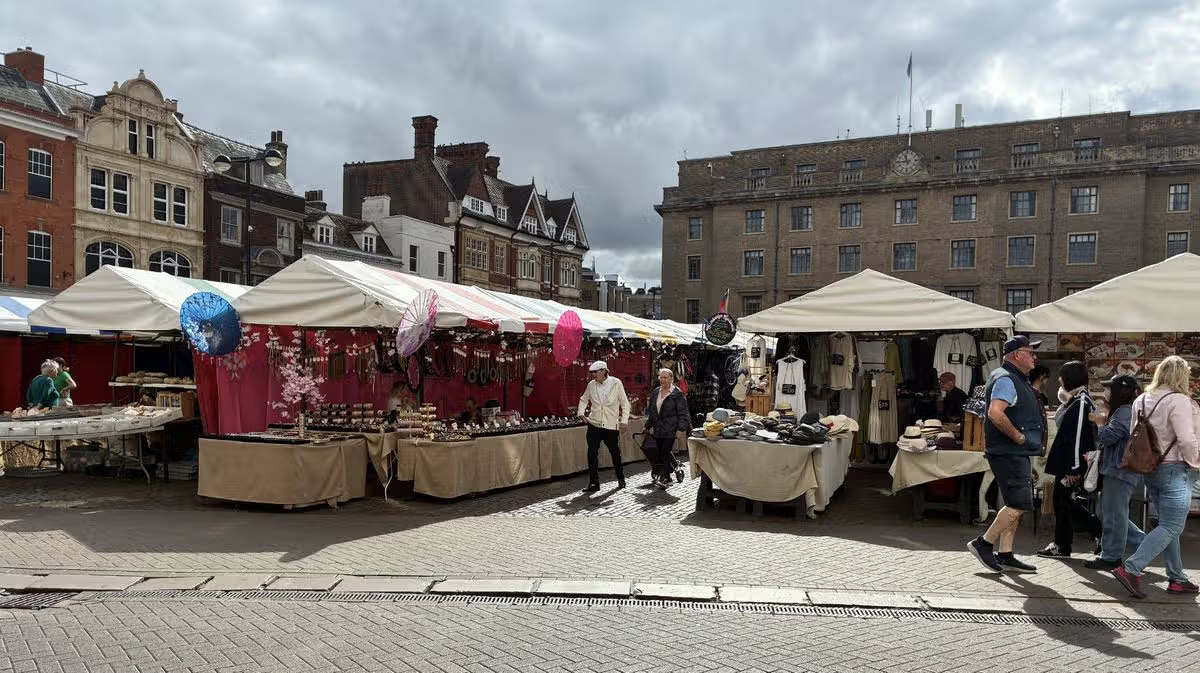
Cambridge Market Square is a charming and colourful area that thousands of people walk past each day. It sits in the centre of the city and is a key tourist hotspot that plenty of locals recognise almost instantly.

Advertisement

However, not everyone is aware it was the scene of a tragedy more than 150 years ago. The market is an iconic part of the city today and it dates back centuries to the Middle Ages.

It has always been a distinguished part of the city, but it has only been in its current form since the mid-19th-century. This is because it was almost completely destroyed in a tragic event that could have resulted far worse than it was.

On September 15, 1849, disaster struck at about half past midnight. A huge blaze tore through the market which came to be known as the ‘Great Fire of Cambridge Market’. It started in a textile shop but got out of control and spread to the local chemist.

The chemicals for the medicines reportedly blew up and the incident reached levels far more dangerous. Townspeople rushed to the scene to tackle the blaze, but the keys to the water supply could not be found.

Advertisement

So, in an attempt to extinguish the blaze, a long human chain of buckets was formed to fetch water from the River Cam. The fire engulfed eight houses, completely destroying them and many others were seriously damaged. As a result of the fire, all the old timber structures of the market area were destroyed, which is why today’s market is surrounded by stone and brick buildings.

Source link

Continue Reading

Trending

Copyright © 2025