Connect with us
DAPA Banner
DAPA Coin
DAPA
COIN PAYMENT ASSET
PRIVACY · BLOCKDAG · HOMOMORPHIC ENCRYPTION · RUST
ElGamal Encrypted MINE DAPA
🚫 GENESIS SOLD OUT
DAPAPAY COMING

NewsBeat

Parasite horror: I had a metre long tapeworm in my gut and 38 more in my brain… these were the warning signs – some of them nearly killed me

Published

on

Lowri Denman travelled through India for two months in 2007 - she's still recovering now

As Lowri Denman holidayed in India, she was thankful she hadn’t contracted ‘Delhi belly’… but in reality, she had picked up something much worse, a metre-long tapeworm that would later nearly kill her. 

In 2007, Ms Denman, now 42, spent two months travelling through the South Asian country but it wasn’t until four years after getting home she discovered she’d brought home a writhing souvenir. 

Up until she passed the huge tapeworm as she went to the toilet at her home in Cardiff, she had had no clue that anything was wrong, and after seeing her GP she was assured that there was nothing else to worry about. 

It was around this time she started experiencing crippling headaches and in 2011 she suffered a tonic-clonic (grand mal) seizure – which is characterised by stiffness, loss of consciousness, and jerking movements.

Advertisement

She immediately sought medical advice and, after waiting three months for a brain scan, Ms Denman learned she had neurocysticercosis, a parasitic infection of the brain caused by the larvae of the pork tapeworm.

There were 38 parasites in her brain, the offspring of the tapeworm she had carried inside her for four years. 

She said: ‘It was just so disgusting to think that these things were in my head.’ 

Neurocysticercosis is developed when a tapeworm infection is left untreated, as larvae build up in the central nervous system, causing cysts to form deep in bodily tissue. It is the most severe form of the disease, and a common cause of seizures.

Advertisement

Lowri Denman travelled through India for two months in 2007 – she’s still recovering now

Neurocysticercosis strikes about 4,000 people a year in the US, making it the most common way that parasites infect the central nervous system. 

The tapeworm Taenia Solium often infects pigs, laying larvae in them. If pork isn’t properly cooked, humans can wind up eating these larvae, which hatch in the intestines. 

Advertisement

If people don’t pass the worms, their life cycle will continue: Taenia Solium will lay its eggs in the person’s body. 

These larvae develop in sacs or cysts, that can travel around the body, in rare cases, reaching the brain.

The irony is that Ms Denman had made a conscious decision to stick to a vegetarian diet to reduce the risk of picking up foodborne illnesses. However, tapeworms and neurocysticercosis can be caused by water contaminated with tapeworm eggs or poor hygiene practices – you don’t have to eat meat to be affected. 

But it wasn’t only seizures that would define this period of Ms Denman’s life; the stress led to her developing psychosis. 

Advertisement

After receiving her diagnosis, Ms Denman was treated for epilepsy while doctors consulted tropical disease experts across the globe to decide on a course of action for eliminating the parasites.

Ms Denman lost her driving licence due to the risks of having a seizure behind the wheel, and her independence took a hit: she was advised not to do certain things, like having a bath while at home alone in case she had a seizure, and since she lived alone she found it particularly difficult.

Ms Denman’s seizures continued as the correct dosage of epilepsy medication was ascertained, and she began to experience anxiety about leaving the house.

She passed a metre-long tapeworm while on the toilet (file photo)

Advertisement
A brain scan revealed that there were 38 tapeworm larvae in her brain, causing headaches and seizures

 A brain scan revealed that there were 38 tapeworm larvae in her brain, causing headaches and seizures 

‘There was one, it was lunchtime, and I was just walking around Cardiff on my own,’ she said.

‘Luckily I was on the phone to my mate, and I said, “I don’t feel well”, then I passed my phone to a stranger on the street. Then the next thing, I come around and my mate who I was on the phone to was there, and she was like, “You’ve had a fit again”.

‘Obviously, I was really cautious then, just scared of being anywhere, and that happening.’

Advertisement

Meanwhile, Ms Denman was given steroids and albendazole, which is used to treat a wide variety of parasitic worm infections. For a time, things calmed down and her seizures reduced, but in 2015 the parasites caused a serious flare up as they ‘weren’t dying off as they’d expected’.

Doctors then tried her on another anti-worm medication, praziquantel, as well as the albendazole and steroids, and while she said the medication would initially start killing the parasites and taking the swelling down in her brain, when she weaned off the medication the swelling would return in a different part of her brain.

‘This went on for at least a year, where I was getting more and more ill, more anxious,’ Ms Denman said.

‘I had to give up work, had to move home to be taken care of, and then it got to a point where I went on Personal Independence Payments (PIP), and I wasn’t capable of filling out the forms on my own.

Advertisement

‘For someone that’s extremely independent and capable and lived on my own most of my life, I was like, what the hell is going on here?’

Ms Denman then started experiencing more severe paranoia, worrying about getting enough sleep, struggling with how the medication made her look and feel – the steroids made her face swell, and she didn’t feel like herself.

‘It was just getting worse and worse and worse,’ she said.

‘I just wanted to go back to work. I just wanted a normal life, and I didn’t feel comfortable being in social settings. I didn’t want to leave the house, really.’

Advertisement
Ms Denman at the peak of her illnesses in 2016
Ms Denman today

Ms Denman at the peak of her illnesses in 2016 (left); and today

‘The swelling was coming back and forth all the time, so they were trying to figure out what medication to put me on,’ she added.

‘They put me on methotrexate, then, which is a chemotherapy drug, so I was worried my hair was going to fall out. It made me really tired, but then steroids would make me really energetic, so there was loads going on, on top of the worries of not getting better.’

In September 2016, Lowri was admitted to a neuropsychiatric ward for three months due to her declining mental health, and was prescribed mood stabilisers and anti-psychotics on top of her other medication.

Advertisement

‘I was having panic attacks, I thought I was going to die, I think, and then that turned into paranoia, and then the psychosis came out,’ she said.

‘I wasn’t stable at all, all these thoughts and crazy things were going on in my head.’

Ms Denman explained that it is difficult to ascertain whether the symptoms were because of the parasites directly, or due to the stress and trauma of her prolonged treatment.

‘It just built into this huge thing at that point, nobody could tell me when I was going to get better,’ she said.

Advertisement

Eventually, in January 2017 Lowri was able to leave hospital and move back in with her dad. By then, she was 34, and desperately wanted her life back.

‘I didn’t look myself, and I was also really paranoid,’ she said.

‘I kept asking my friends, anyone that could come and visit me in hospital, to ask, what did I do?

‘Because I thought I was going to be on the news for doing something terrible.

Advertisement

‘I thought I’d done this mad stuff, and I didn’t know what I’d done.’

Now, Ms Denman is fit and healthy, and her seizures are managed by her medication so she has not experienced a fit for 10 years.

During her recovery, Lowri was desperate to find more information about her illness and to connect with others who had been through the same, but found there was very little information available to her beyond what she learned from her doctors.

Now that she’s feeling stronger, she wants to share her story with the world. She plans to do so with a 12-part podcast, called 38 Parasites, which will delve into her personal journey along with interviews with consultants and experts in tropical diseases, insights on neurology, and more.

Advertisement

‘I spent my whole thirties being ill and anxious and worried, and now I’ve moved into my 40s, I want to do something positive with that negative thing – help other people, and not just feel like I’ve lost all of this time.’

Through Crowdfunder, Lowri and her friend of 20 years, producer Nicola Brown, are raising £25,000 to fund the project, which was shortlisted for 2025’s The Whickers Podcast Pitch Award.


Source link

Advertisement
Continue Reading
Click to comment

You must be logged in to post a comment Login

Leave a Reply

NewsBeat

Lord Botham criticises Hope Moor wind farm proposals

Published

on

Lord Botham criticises Hope Moor wind farm proposals

Lord Botham, who lives near Richmond, is backing a campaign to stop the Hope Moor Wind Farm, which would see 23 turbines at least 200m high installed on land between Arkengarthdale and Teesdale.

The former England cricketer has also launched his own campaign to oppose proposals for Hope Moor and three other sites across the North of England.

Writing in the Daily Mail, he criticised Energy Secretary Ed Miliband for his support of wind energy, claiming that there would be “resounding cheers across the North of England” if Andy Burnham did not include the MP in his cabinet if he became Prime Minister.

Advertisement

Lord Botham said: “Miliband is planning to destroy the gorgeous countryside of four counties here in the North with 94 monster wind turbines.”

He added: “These unbelievably huge contraptions – up to 230 metres tall – would be placed on top of hills around County Durham’s stunning Barningham Moor; wild and desolate Ray Fell in Northumberland; rugged Scout Moor in Lancashire; and Walshaw Moor in West Yorkshire – long associated with the Bronte sisters.

“They would be visible for dozens of miles, ruining the landscape over much of the North.

“On top of that, new access roads would cut through the moors along with miles of pylons as the power would be generated where it is not needed.”

Advertisement

The peer said the landscapes were “part of the wealth of the North”, adding: “Walk through the breathtaking beauty of places like Barningham Moor and, whatever kind of day you are having, life is transformed.”

Claiming the proposed wind farms would damage both the environment and the local economy, as well as threaten bird species and disturb areas of peatland, the former cricketer has launched his own “Not One Moor” campaign to oppose the developments.

“We will concede nothing and fight everything,” he added.

In the column Lord Botham called on Northern Labour MPs including  Sam Rushworth, who represents Bishop Auckland and Darlington MP Lola McEvoy to fight against what he called “monuments to Miliband’s madness”.

Advertisement

The comments have been welcomed by members of the Hope Moor Wind Farm Action Group, which was launched to fight the Hope Moor development.

Suzy Wilson, chair of the group, said: “It is almost exactly 45 years since he led England to that amazing Ashes victory at Headingley against overwhelming odds, and we know that he will demonstrate the same fighting spirit against the planned development of Hope Moor Wind Farm.

“He found it incredulous that the wind farm would be so close to the national park and would blight vast swathes of precious landscape and impact upon the Coast to Coast and Pennine Way footpaths.

“We wish him well in his campaign in Westminster and we will continue to work at a grassroots level to raise awareness and build up support to campaign against the industrialisation of the Yorkshire Dales landscape.”

Advertisement

Fred. Olsen Renewables, which is behind the Hope Moor plans, has said it recognised the proposed wind farm had generated a range of opinions, with some people supporting its contribution to renewable energy, local benefits and energy security, while others raised concerns.

Project leaders say the proposal is undergoing a full environmental impact assessment covering issues such as peat, birdlife, flood risk, landscape and construction impacts, with the findings subject to independent scrutiny.

Source link

Advertisement
Continue Reading

NewsBeat

Why Edouard Mendy is out of Senegal vs Belgium at the World Cup | Football

Published

on

Why Edouard Mendy is out of Senegal vs Belgium at the World Cup | Football

Close Overlay

In The Mixer’s World Cup special

Everything you need to know about the World Cup – England updates, the games to watch and stories you missed – in five minutes, at 1pm, every day.

Source link

Advertisement
Continue Reading

NewsBeat

Wales breaking news plus weather and traffic updates (Wednesday, July 1)

Published

on

Wales Online

Gwent Police has charged a Newport man with seven counts of burglary following several reports of commercial premises being targeted across the city.

Neighbourhood officers investigating the series of break-ins arrested the 33-year-old Newport man on suspicion of multiple burglary offences on Monday 29 June.

Rory Hiscox, of Chepstow Road in Newport, was subsequently charged with seven counts of burglary and one count of theft from a shop – with the reported offences taking place between 15 May – 26 June.

Advertisement

Hiscox appeared at Newport Magistrates’ Court on the morning of Wednesday 1 July, when he was remanded into custody.

Superintendent Esyr Jones, Neighbourhood Policing for Gwent, said: “I want to reassure all businesses, shoppers and residents in Newport that we’re continuing to listen to your concerns.

“We’re working with businesses in the city centre to help make their premises more secure, and provide them with crime prevention and security advice.

“We’re also carrying out a range of visible and covert operations to target offenders and increase safety across the city.

Advertisement

“These operations are often helped by information the public provides us, including the recent arrest of Hiscox in Newport, so we’d continue to ask the public to report their concerns to us so we can act and put plans in place to address the problem head-on.”

Source link

Continue Reading

NewsBeat

How glide bombs will shape the future of the war in Ukraine

Published

on

How glide bombs will shape the future of the war in Ukraine

Russian glide bombs killed two people and injured at least 15 others in an attack on the southeast Ukrainian city of Zaporizhzhia on Tuesday, authorities said.

Regional governor Ivan Fedorov, writing on the Telegram messaging app, said Russian forces had launched seven bombs at the city over a 90-minute period.

In Zaporizhzhia and across Ukraine as a whole, these strikes have increasingly come from glide bombs – the low-cost ordnance that experts say are reshaping the war in Ukraine.

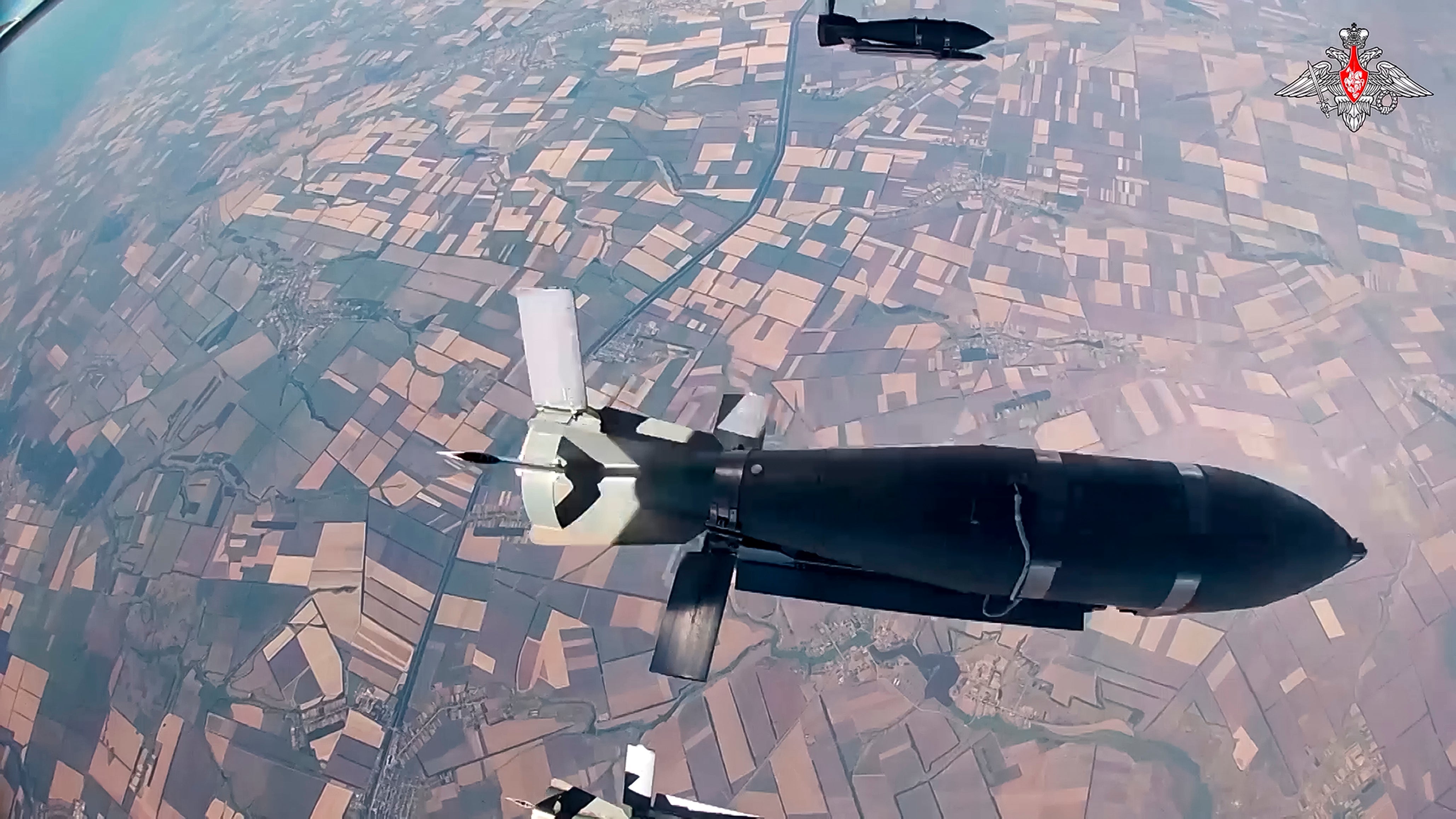
Weighing between several hundred and a few thousand kilograms, these ordinary bombs fitted with wings and a guidance system have been among Russia’s most formidable weapons since its 2022 full-scale invasion of Ukraine.

Advertisement

They have become especially deadly of late, with thousands launched in recent months.

At least three people were injured in this Russian glide bomb strike on Kupiansk last year, according to State Emergency Service of Ukraine
At least three people were injured in this Russian glide bomb strike on Kupiansk last year, according to State Emergency Service of Ukraine (State Emergency Service of Ukraine)

Their capacity to devastate an apartment block in Zaporizhzhia or Kherson with a single strike from dozens of miles away inside Russia and beyond Ukrainian air defences has tormented Ukrainian commanders.

That is, until May this year, when Ukraine announced it had developed its own.

Although Western allies had supplied Ukraine with glide bombs, Kyiv had grown impatient with their unwillingness to supply enough and so spent 17 months domestically producing the Vyrivniuvach, or “Equaliser”.

“For a significant period, there was very little practical defence against Russian glide bombs, and that contributed significantly to heavy Ukrainian casualties along the front line,” said Keir Giles, an associate fellow of Chatham House’s Russia and Eurasia Programme and the author of Who Will Defend Europe.

Advertisement
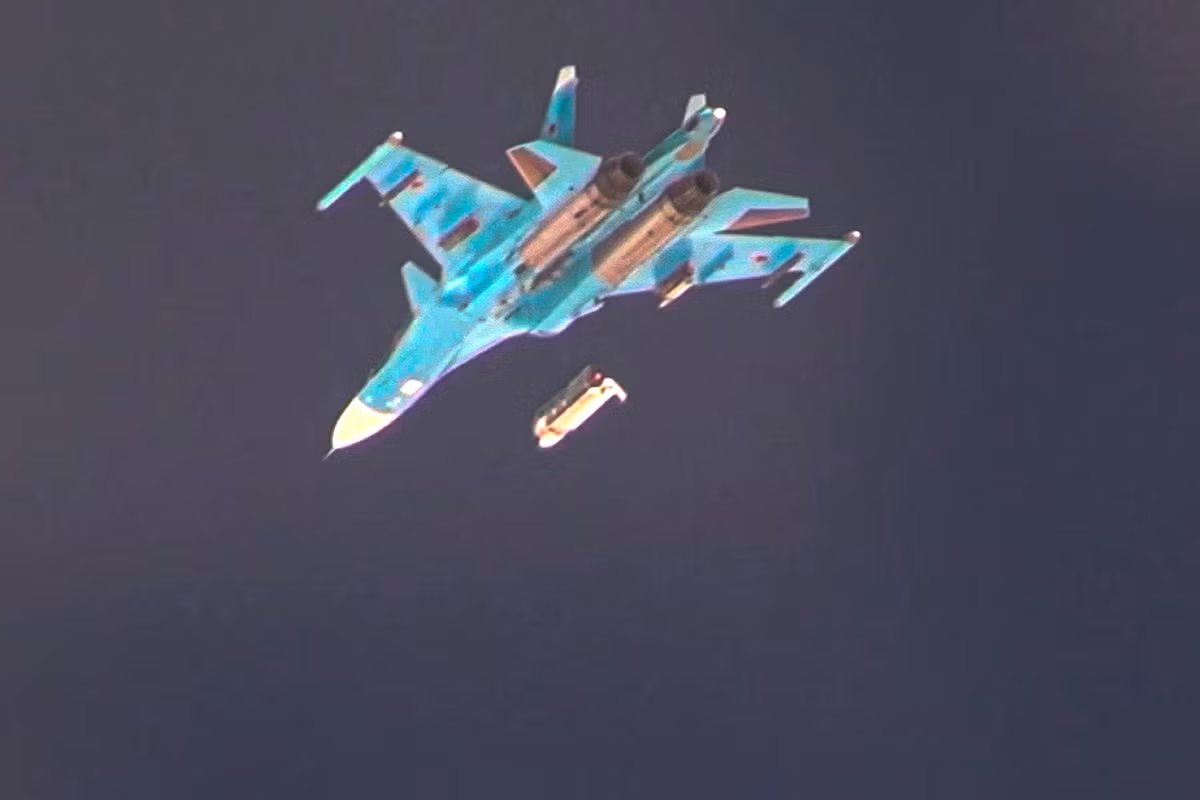
Russian glide bomb launched from a fighter aircraft
Russian glide bomb launched from a fighter aircraft (AP)

Why glide bombs are vital on the battlefield

Although inexpensive and highly reliable, the turn for both sides was largely motivated by necessity, with traditional forms of artillery rendered out of action.

Across the modern battlefields of Ukraine, drones have hunted and destroyed the vast majority of each side’s howitzers, according to Military Balance website.

Their artillery pieces depleted, Moscow and Kyiv saw “stand-off” ordnances like glide bombs as the solution, capable of delivering high-explosives from dozens of miles away.

Recently, their adoption has been accelerated, with Russia reportedly launched more than 1,800 glide bombs in the first week of June alone, according to Forbes.

Advertisement
Ukrainian rescuers working at the site of a Russian glide-bomb attack late at night on a nine-flour residential building in Kharkiv
Ukrainian rescuers working at the site of a Russian glide-bomb attack late at night on a nine-flour residential building in Kharkiv (EPA)

Low cost and easily made

Much like the off-the-shelf drones and inexpensive Bayraktar and Shaheeds which have dominated the war, however, Russian and Ukrainian glide bombs are low cost and easily engineered.

The vast majority of Russia’s supply comes from archaic Soviet-era bombs mounted to a rudimentary cage system with folding wings, inertial measurement unit, and satellite guidance called the Universal Gliding and Correction Module (UMPK).

They are designed to be released from Russian fighter aircraft like the Su-34 flying at an especially high altitude, whereafter it glides for 60 to 95km to deliver a bomb of between 250- and 3000-kilograms.

This distance from launch point to target – as well as the fact they lack a heat signature and can fall quickly from a high altitude moments before striking – make them very difficult to eliminate.

Advertisement

Ukraine’s glide bombs are much slighter than Moscow’s, however, produced at only 250-kilograms.

A screenshot from a video posted by Russian military blogger Fighter Bomber allegedly shows the moment a 3000 kg glide bomb explodes in Kharkiv Oblast
A screenshot from a video posted by Russian military blogger Fighter Bomber allegedly shows the moment a 3000 kg glide bomb explodes in Kharkiv Oblast (Telegram)

More explosive than drones

Crucially, both sides have deployed these strikes not simply as strategic hits on cities and industrial areas meant to hamper morale and interrupt supply lines. Instead, these glide munitions have been employed in support of their “fire-centric doctrine” – when artillery is tactically directed on enemy front line positions such as to soften up defences or eliminate surveillance positions ahead of a troop offensive.

Both sides have been keen to promote this in recent social media videos, posting clips of glide bombs striking each other’s positions during combat operations.

“Virtually any frontline artillery positions the Ukrainians have are at risk of being destroyed,” said Christoph Bergs, a research analyst at the Royal United Services Institute (Rusi).

Advertisement

“While small FPV (first-person view) quadcopters and tactical drones can strike targets, they simply do not have the explosive yield of a 250kg or 500kg bomb.”

Source link

Continue Reading

NewsBeat

Thierry Henry stunned by Harry Kane moment vs DR Congo: ‘I’d break my back!’ | Football

Published

on

Thierry Henry stunned by Harry Kane moment vs DR Congo: 'I'd break my back!' | Football

Close Overlay

In The Mixer’s World Cup special

Everything you need to know about the World Cup – England updates, the games to watch and stories you missed – in five minutes, at 1pm, every day.

Source link

Advertisement
Continue Reading

NewsBeat

The big problems facing Thomas Tuchel after DR Congo scare: The England player who must not start another game, the one fear for goal hero Harry Kane, the ‘broken record’ letting the team down and the statistic that exposes one-dimensional attack

Published

on

The big problems facing Thomas Tuchel after DR Congo scare: The England player who must not start another game, the one fear for goal hero Harry Kane, the 'broken record' letting the team down and the statistic that exposes one-dimensional attack

It wasn’t easy and it wasn’t very pretty.

Watching England labour through a hard and stressful 90 minutes against DR Congo was enough to put anybody off their Wednesday dinner.

But all that matters is that Thomas Tuchel’s England are through to the last 16 of the World Cup, to face Mexico in the early hours of Monday morning in the white heat of the Azteca Stadium – where the co-hosts have lost just twice in 89 competitive matches, winning 70 of them.

Their journey goes on, and here Daily Mail Sport examines all the big issues from a crazy afternoon in Atlanta.

Advertisement

The performance we needed? 

If England couldn’t have the dominant and comfortable performance we hoped they could against a team ranked just above Scotland, then maybe this represents a useful second-best.

A come-from-behind win can do all kinds for a team. Just think about how Brazil will be feeling after they turned it round against Japan at the weekend. Just think how Erling Haaland and his Norway team-mates will be feeling after a late winner in a tight game against Ivory Coast.

Advertisement

It wasn’t pretty – but Harry Kane’s double ensured England have a place in the last 16

A come-from-behind win can do all kinds for a team. This is a little bit of what England will have now, the feeling that whatever goes wrong in a game, it can be overcome

A come-from-behind win can do all kinds for a team. This is a little bit of what England will have now, the feeling that whatever goes wrong in a game, it can be overcome

This is a little bit of what England will have now, the feeling that whatever goes wrong in a game, it can be overcome. That can be very valuable fuel. England conceded a bad goal, almost shipped another, had a clear penalty ignored and then saw the DR Congo goalkeeper have the game of his life.

England were not at their best and could have folded. They were ragged at times. But England kept their heads and their belief and ensured that their quality and their experience got them through in the end. The coaches of Germany and the Netherlands would give an awful lot for some of that feeling as they settle back at home and await, in all likelihood, the sack.

Advertisement

Tuchel was right when he said after this one: ‘We have to have that mindset that if it is getting hard, it is getting hard, but don’t lose patience and don’t lose belief.’

Can Kane’s legs last? 

Harry Kane has been on the pitch for all but six minutes of England’s tournament so far and they were only six that didn’t matter, as Tuchel’s side closed out their 2-0 win over Panama in their final group game.

When England need presence and when England need a goal, he stays on, and usually is the man to deliver. At the moment his form is the best it’s ever been in a big tournament. He has five goals – only one less than Kylian Mbappe – and the winner he scored here was straight out of the great France forward’s playbook.

Advertisement

Wayne Rooney called him England’s ‘superstar’ and he isn’t the only former team-mate singing that tune.

‘When his back is to the wall, Kane is stepping up for his country,’ said Joe Hart on the BBC. ‘I love the aggression and fire in his face. He knows that wasn’t a good performance but when it needed to happen he produced a header in front of goal and then that last finish.’

What Tuchel must hope now is that Kane’s legs stand the pace. England will need him in the rarified atmosphere of Mexico City in the next round and that will represent a completely different test to the one England faced here.

When England need presence and when England need a goal, Kane (left) stays on, and usually is the man to deliver

When England need presence and when England need a goal, Kane (left) stays on, and usually is the man to deliver

Advertisement

Defence still out of tune 

The broken record is still turning in the middle of England’s back four.

The defensive structure and understanding that has been a feature of England’s football under Tuchel has not travelled with them to America and the manager and his coaching staff are no closer to solving the problem. Tuchel – publicly at least – has been in denial about it but he can’t be any longer. The early Congo goal was a mess.

Why had the England defence allowed itself to be dragged over to one side of the field? Why didn’t Jordan Pickford save a routine shot low to a near post that should have been covered?

Advertisement

Pickford’s uncertain tournament goes on but his place in the team remains secure. The other two goalkeepers in the party – James Trafford and Dean Henderson – do not have enough international experience to be dropped in to this team.

There were other instances of vague panic, too. Centre-back pairing Marc Guehi and Ezri Konsa were left shouting at each other after Yoane Wissa got between the two of them to prod Aaron Wan-Bissaka’s cross against a post moments before Kane had his big penalty appeal at the other end. Had that one gone in from the Newcastle striker, England’s World Cup would have been over.

Ezri Konsa and Marc Guehi were all over the place at times against Newcastle's Yoane Wissa

Ezri Konsa and Marc Guehi were all over the place at times against Newcastle’s Yoane Wissa

One-dimensional attack

Advertisement

England created enough chances here in Atlanta but the worry is that they all look the same. Until making a bit of a mess of Kane’s equaliser, the Congo goalkeeper Lionel Mpasi had a worldy. On another day, England would have been level before half-time. 

Equally, there has been a predictability about England’s attacking play at this tournament and it involves a series of overlaps and combinations between England’s full backs and wingers. It is as though England only have one idea – they put in 35 crosses from open play in this match, their most for 60 years in a World Cup match since a whopping 37 against Mexico in the 1966 group stage.

Where is the creativity further infield? Where are the neat passing moves needed to open up defences happy to sit in against the established nations in this World Cup? We haven’t seen Brazil and France rely only on balls from wide positions, so why should England?

Tuchel’s team – jeered at times by their own fans here – dominated possession but the truth is that when Congo did advance forward, they had a greater depth of ideas than their famous opponents.

Advertisement

Twice against Panama and here, finally, against Congo, England scored from a cross. That’s fine. It’s a strength. But they must have other ideas too.

Anthony Gordon puts in one of England's 35 open-play crosses in Atlanta - their most in a World Cup match for 60 years

Anthony Gordon puts in one of England’s 35 open-play crosses in Atlanta – their most in a World Cup match for 60 years

Tuchel’s dilemmas 

Does the England manager know what his best team is? With everybody fit, he probably does. But currently, with first, second and third-choice right backs injured, I am not at all sure.

Advertisement

After playing John Stones slightly out of position in the first game – he played him on the left side of a central pairing – he has completely ignored him. Despite the option of shifting Ezri Konsa across to right back and putting Stones back in, he went with Djed Spence again here and it backfired.

The Tottenham full back has pace to burn getting forward but it’s not enough. Spence doesn’t defend well enough to be an international full back and should not start a game in this tournament again. He just has too much to learn.

Here, after Tuchel made some timely and intelligent substitutions, we ended up with Declan Rice at right back and he then ended the game sitting on the bench applying ice to his left hamstring. There is a thought that Reece James may be fit enough for the Mexico game. My goodness, we hope so.

Djed Spence doesn’t defend well enough to be an international full back and should not start a game in this tournament again

Djed Spence doesn’t defend well enough to be an international full back and should not start a game in this tournament again

Advertisement
Jude Bellingham's lunge on Nathanael Mbuku in the first half was late and reckless and fully deserving of the yellow card that followed

Jude Bellingham’s lunge on Nathanael Mbuku in the first half was late and reckless and fully deserving of the yellow card that followed

Best and worst of Jude

Jude Bellingham remains England best and most dangerous player here in America. He, along with Kane, is the one who looks as though his sheer will and force of personality can shape a game or a big moment.

Here also, however, were flashes of the Bellingham we hoped had been left behind. His lunge on Nathanael Mbuku in the first half was late and reckless and fully deserving of the yellow card that followed. Not long after, as frustration grew, he played a ball straight out of play and then started waving his arms at the team-mate it had been intended for. Maybe he was asking him to grow a foot?

Advertisement

We have said before that Bellingham is at his best when he plays on the edge. The problem with that is that over the other side of that edge lies trouble. With a minute of added time left, he gave away a completely unnecessary free-kick.

Lessons to be learned for everyone, no matter who you are.

Source link

Advertisement
Continue Reading

NewsBeat

Photos of Tadcaster Grammar School prom at Hazlewood Castle

Published

on

Photos of Tadcaster Grammar School prom at Hazlewood Castle

This week has been the turn of Tadcaster Grammar School which staged its end-of-year prom for Year 11 at Hazlewood Castle.

Press reader Kimberley Jakeman, of Tadcaster, sent us photos of her son and his friends attending their Year 11 leaving prom at Hazlewood Castle on June 29.

Taylor, Amber, Darcy & Kaleb (left to right)

The photos show her son Taylor Goddard, aged 16, with Amber Rowsell, Darcy Rowsell, and Kaleb Mcsorley.


More proms photos:

Advertisement

As proms continue, we’d love Press readers to keep sending in their photos for us to share online and in The Press.

Taylor Goddard and Kaleb Mcsorley (left to right) year 11 leavers prom at Hazlewood Castle

Please send them – along with your prom story – by email to maxine.gordon@thepress.co.uk

You can also send your photos and all the information for the story straight to our newsdesk via an easy-to-use online form – just hit the ‘send now’ button below…

Advertisement

Source link

Continue Reading

NewsBeat

National Lottery results live – Lotto and Thunderball numbers for Wednesday, July 1

Published

on

Wales Online

Source link

Continue Reading

NewsBeat

Vintage trucks, tractors and buses on display before Ayrshire tour

Published

on

Daily Record

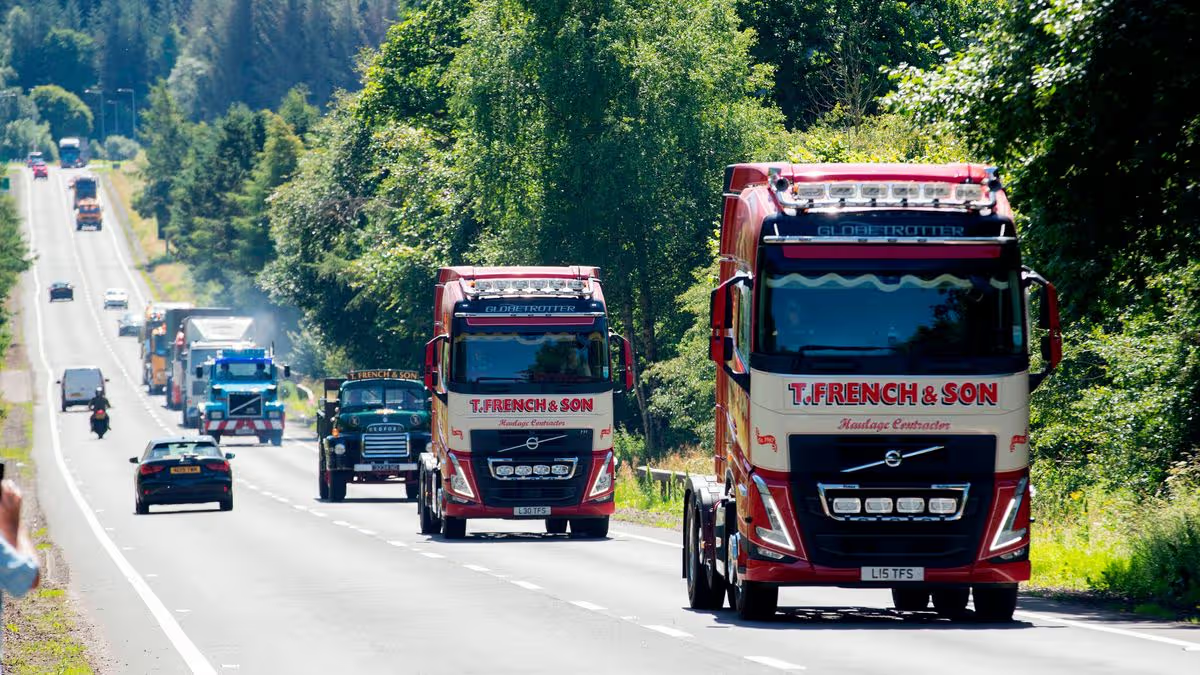
The annual procession of vintage commercial trucks, tractors, buses and more will be on the road and heading through the region over the weekend of Saturday, July 11 and Sunday, July 12.

Fans of vintage transport and vehicles from a bygone era are in for a real treat this month when the Ayrshire Roadrun returns.

Advertisement

The annual procession of vintage commercial trucks, tractors, buses and more will be on the road and heading through the region over the weekend of Saturday, July 11 and Sunday, July 12.

And you can get up close to these amazing vehicles as they’ll be on display at the Barony Campus, in Cumnock, before the convoy sets off.

There will be a static display at the school car park from 9am until 12noon.

The convoy will then set off and head through the region, making a pit-stop at Castle Douglas Cattle Market and then on to Portpatrick.

Advertisement

Spectators can see the convoy on the road at the following (approximate) times and destinations; Skares Road 12.05pm, Benson Smiddy 12.10pm, Dalleagles 12.15pm, Dalmellington 12.30pm, Carsphairn 12.45pm, St John’s Dalry 1pm, Ken Bridge 1.10pm, Corsock 1.20pm, Crocketford 1.30pm, Milton 1.40pm, Haugh of Urr 1.50pm.

The convoy is expected to arrive at Castle Douglas Cattle Market at 2pm when they will again line up for a static display, before leaving at 3.30pm.

The Roadrun participants are expected to be in Portpatrick at around 5pm on Saturday and they will be based at Galloway Point Caravan Park and at the Main Harbour.

On Sunday, July 12, they are due to leave Portpatrick at 11am and will follow the A77 to Stranraer, then head north to Maidens/Turnberry. They will then follow the coastal route to Ayr where they should be seen in the afternoon on the Promenade.

Advertisement

The annual event is organised by the Ayrshire Commercial Vintage Vehicle Club.

To find out more, or to join the Ayrshire Roadrun this year, get in touch with the event organisers on 07980 315932 or e-mail jsm@kerrandsmith.co.uk

Source link

Advertisement
Continue Reading

NewsBeat

England fans left furious as BBC are hit by technical issue during crucial moment of World Cup clash with DR Congo

Published

on

Many fans were left frustrated after the BBC's coverage of England cut out at a crucial moment

Advertisement

Many fans were left frustrated after the BBC‘s coverage of England‘s round of 32 clash against DR Congo cut out unexpectedly for several seconds.

In the 53rd minute of the match, with England behind and fighting for a way back into the game after DR Congo’s early opener in the first half, BBC screens suddenly froze as Jude Bellingham collected the ball inside the penalty area.

Advertisement

Over 15 seconds later, the screens returned to the sound of fans inside the stadium reacting loudly to an important incident, but BBC viewers were left guessing over what had happened.

Replays soon showed that Bellingham had shimmied inside the penalty area and forced an important save out of Lionel Mpasi.

Most fans, though, used it as an opportunity to criticise England’s dismal performance. 

One fan posted on X: ‘Disappointed the BBC feed just went off, even more disappointed its come back on…. #worldcup #england.’

Advertisement

Many fans were left frustrated after the BBC’s coverage of England cut out at a crucial moment

Advertisement
Fans took to social media to hit out at the BBC glitch after missing out on Bellingham's shot

Fans took to social media to hit out at the BBC glitch after missing out on Bellingham’s shot

Many supporters joked that the blackout was better than watching England against DR Congo

Many supporters joked that the blackout was better than watching England against DR Congo

Advertisement

Another added: ‘The game is so bad the BBC can’t broadcast it any longer hehe #England #DRCongo���� #ENGDRC #FIFAWordCup.’

‘The BBC should left on that black screen. Better viewing than England playing,’ a third posted on X.

A fourth stunned fan said: ‘Did BBC glitch?!’ 

Other fans hit out at TV licences in the process.

Advertisement

‘BBC want me to pay tv licence for it to glitch lol,’ an X user added.

Another said: ‘Did we just get a glitch from the BBC? Thank god for replays! We did pay for our TV licence!’ 

Advertisement

Source link

Advertisement
Continue Reading

Trending

Copyright © 2025