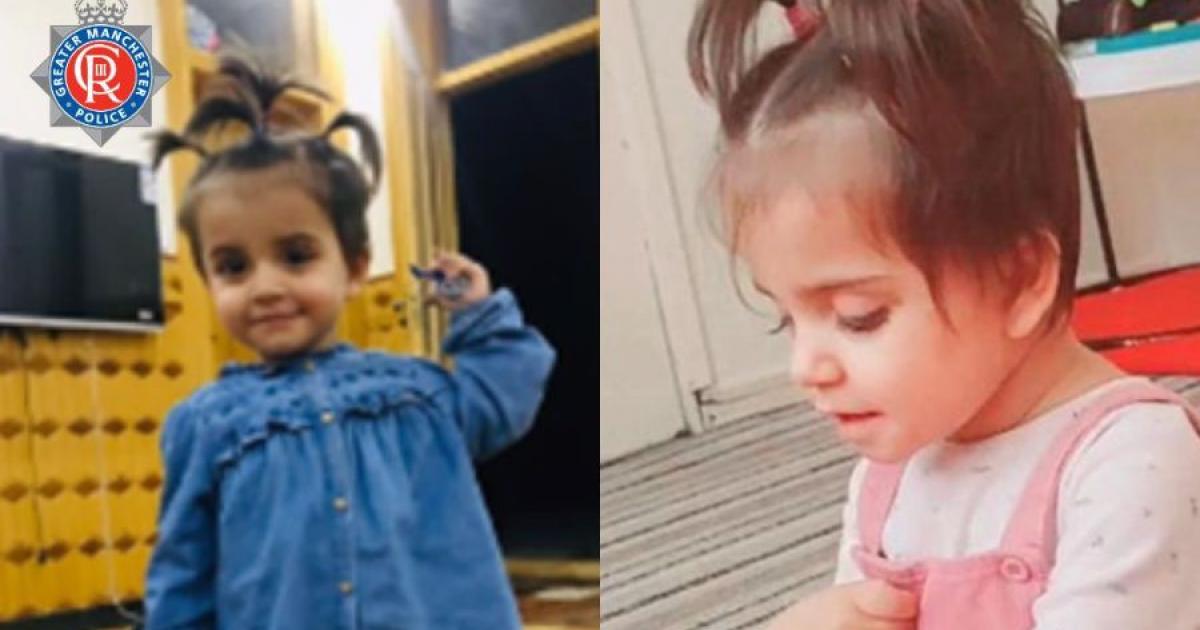
Omra Wali Jan died in February 2024 after suffering a non-accidental brain injury less than three months earlier.
This week, Morsal Mohammed Naim, 32, Omra’s mother, was sentenced to nine years in prison, after pleading guilty to child cruelty in March 2025 and then manslaughter in January.
Firooz Wali Jan, also 32, Omra’s father, was sentenced to six years and nine months in prison after also pleading guilty to child cruelty in March 2025.
Senior investigating officer Philip Reade said: “Everyone who has been involved in this case has been deeply moved by the tragic circumstances of Omra’s death.
Advertisement
“The last few months of her life must have been truly miserable, being hurt by those who were meant to care for and protect her.
Morsal Mohammed Naim (left) and Firooz Wali Jan (right) (Image: GMP)
“This has been a challenging investigation spanning more than two years, involving countless medical and forensic experts.
“I would like to thank everyone for their efforts, which have led to justice for Omra.
“Omra was so young, her parents should have been nurturing her, allowing her to grow into the child she would become. Instead, they completely neglected their moral duty to protect her.
Advertisement
“Their behaviour and attempts to mislead our investigation throughout have made this case even more horrifying, so we welcome the custodial sentences handed down today.
“The investigation team never knew Omra, but we have seen countless images of her when being cared for by others, which show a happy, smiling, beautiful child, and she is in our thoughts today and always.”
The police investigation began in November 2023, when officers responded to reports of an unresponsive young child in Levenshulme, Manchester.
Naim said that Omra had collapsed and choked whilst eating a biscuit in the living room. She was unconscious when paramedics arrived and was taken to hospital.
Advertisement
Doctors who started to treat Omra were concerned about several unexplained injuries to her body, including burns and bruising.
A brain scan showed injuries inconsistent with the account given by her mother.
Further scans showed she had a rib fracture, and experts started to suspect Omra had been shaken with her head, possibly striking a hard, solid surface.
Omra was transferred to the critical care unit whilst detectives, forensic experts and medical professionals started the painstaking work of piecing together the evidence.
Advertisement
The family address was forensically examined, accounts from neighbours and family friends were taken, and forensic examination of mobile phone devices began.
By December 6, 2023, police had the evidence to arrest Omra’s mother.
Naim was arrested on suspicion of assault and interviewed at length, where the picture was building that she was the only adult present when Omra received her head injury.
She maintained her original account but was charged two days later.
Advertisement
On February 9, 2024, Omra died in hospital after life support was withdrawn, having never regained consciousness.
Omra’s father was arrested in April 2024 in relation to the burn injuries and bruising that Omra had suffered.
Alan Richardson of the Crown Prosecution Service said: “Morsal Mohammed Naim not only shook her daughter to death, but then lied about what she had done.
Advertisement
“As her mother, Naim should have cared for two-year-old Omra Wali Jan, and kept her safe. Instead, she inflicted the catastrophic injuries that caused Omra’s death.
“It is a killing almost impossible to comprehend in its cruelty and sheer senselessness.
“The Crown Prosecution Service worked with Greater Manchester Police to build a strong case to put before the court, including witness testimony, phone downloads, expert reports and medical evidence.
“The strength of the evidence led Naim to admit causing her daughter’s death in the early stages of the trial.
Advertisement
“Our thoughts are of Omra, whose young life was cut mercilessly short – and all those affected by her untimely death.”
The skeleton mixed team event is making its debut in these Winter Olympics. Here is how it works: one female athlete and one male athlete from the same country compete together as one team, individually racing at speeds of up to 130km/h face-first on their sleds, steering subtly with their head, shoulders and feet.
The start order will be the female athlete first, followed by the male athlete. Although racing one straight after the other, it is not quite a relay. After completing one run, there is a reaction start once the track is clear for the team-mate – after a countdown of five red lights, the signals change to green, the clock is running and the next competitor must start their run as quickly as possible.
The two run times are added together to give each team a total time. The team with the lowest overall time will be the winners. No second heats like the individual event.
Advertisement
Of the 15 competing duos, Great Britain are one of five nations with two teams. Freya Tarbit and Marcus Wyatt go off fourth from last, possessing an outside chance of a medal.
The USA are the reigning world champions, beating GB’s Stoecker and Weston by 0.10 seconds last March. Germany’s Jacqueline Pfeifer and Christopher Grotheer are also contenders for gold, going off as penultimate competitors.
The DL90 flight from Orlando was heading towards Amsterdam when it made an unscheduled diversion to Dublin airport
Husna Anjum Senior Live News Reporter
18:57, 15 Feb 2026Updated 19:14, 15 Feb 2026
A Delta Airlines flight was forced to land at Dublin airport after a passenger medical emergency. Flight DL90, heading for Amsterdam, was departing from Orlando International Airport on Friday (February 13) at 7:36pm EST.
However after about 7 hours and 28 minutes of flying across the Atlantic, the crew made the decision to divert to the Irish capital. As reported by Air Live, the aircraft touched down at Dublin Airport following a standard descent.
Advertisement
A medical emergency required immediate passenger care on the ground. It was also reported that because the plane’s journey was ending but it still carried significant fuel, pilots likely performed a standard arrival procedure into Dublin Airport.
After a temporary stop the Airbus A330-900 departed Dublin at 9.34am. The flight resumed its journey to Amsterdam Schiphol Airport where it landed at 12.08pm
Ditch the frying pan and eggs and head out to this café for Pancake Day
The best place to get pancakes in Cambridge, as voted by readers
Pancake Day is a hugely popular event in the UK with thousands buying eggs, flour and milk to whip up their own pancakes at home. However, making your own pancakes can be incredibly messy and they rarely taste as good as ones made at a café or restaurant.
As well as traditional savoury choices, Deluna Café is known for its sweet waffles, French toast, and pancakes. I decided to head to the café to see if it is worth putting down the frying pan and celebrating Shrove Tuesday away from the house.
After walking in the cold to reach Deluna Café, it was nice to be hit with a pleasant warmth radiating from the café. I found a cosy corner next to the coffee bar and took a moment to look around at the gorgeous floral decorations covering the walls.
Advertisement
While you can get a savoury plate of pancakes that comes with bacon and eggs, I went for the more traditional option, which was covered in a range of sweet toppings. The dish cost £9.65 and didn’t take too long to be placed in front of me.
The pancakes looked almost magical thanks to the adorable presentation and sprinkling of icing sugar dusted on top. The stack contained three pancakes that were generously topped with mini marshmallows, summer berries, a generous drizzle of Nutella, and pieces of hazelnut.
Advertisement
The pancakes came out warm, which helped the marshmallows to melt a little over the top, and transported me back to childhood in just one bite. The pancakes were perfectly light, fluffy, and well cooked.
The dish came loaded with slices of strawberry, raspberries, and blueberries that were wonderfully fresh and bursting with flavour. The fruit was elevated when covered in the rich hazelnut chocolate sauce and is a natural match made in heaven.
The plate had a few mounds of whipped cream that worked well with the strawberries and helped cut through the heavier flavours of the Nutella. If you want to indulge yourself and feel like a kid again, this dish is definitely a great choice.
Advertisement
I got an iced latte on the side to help wash everything down. The coffee wasn’t too overpowering and was a delicious accompaniment to my nostalgic meal.
My whole experience at the café was warming and allowed me to escape from daily life even if it was for a short time. This year, it might be worth skipping the fuss and heading to Deluna Café for some pancakes on Shrove Tuesday instead.
Deluna Café can be found at 24 Burleigh Street. The café is open from 8am to 6pm on Mondays to Saturdays and from 9am to 5pm on Sundays.
Advertisement
All of our food reviews are paid for by the writer. The establishments do not know we will be reviewing their food, allowing us to make fair judgements on each place.
“The Brigade received the first of 17 calls about the fire at 1428 and Control Officers mobilised crews from Clapham, Battersea, Lambeth, Brixton and surrounding fire stations to the scene. A 32-metre turntable ladder from Clapham Fire Station has also been in attendance and used as a water tower to help extinguish the fire from above.
It was Wales’ lowest ever attendance for a Six Nations match as French fans appeared to take over. These were the unseen moments inside the Principality Stadium
19:23, 15 Feb 2026
Advertisement
They used to roll back the stadium roof so God could watch us play. Wales in Cardiff, it was a religious experience of sorts.
The hymns, the communal spirit, the sense of belonging. Now, as Sunday staple Songs of Praise played on the screens in the press room ahead of kick-off, it all felt a little too on the nose.
Wales needed prayers for this one.
Ensure our latest sport headlines always appear at the top of your Google Search by making us a Preferred Source. Click here to activate or add us as Preferred Source in your Google search settings
Advertisement
The visit of France, title favourites and a class or two above this Wales side, almost constitutes the last rites.
But the Principality Stadium as a cathedral of Welsh rugby is becoming a distant memory.
57,744 the crowd in Cardiff; Wales’ lowest home attendance for a Six Nations match. Once upon a time, you couldn’t get a seat for such a game.
Now, the parish is diminishing. The faith is ebbing away.
Advertisement
Moreover, more of Sunday’s congregation came from afar. More than 30 chartered flights from France arrived in Cardiff over the weekend. Has the Principality Stadium ever seen such a low Welsh contingent?
Joe Dassin’s 1977 hit Dans les yeux d’Émilie, an unofficial anthem of French sport, was played on repeat outside the City Arms, in the shadow of the Principality Stadium, on Friday night.
Berets, with Frenchmen underneath, piled into the stadium – having sampled the delights of Cardiff City Stadium and the Arms Park the previous day. In both the football and U20s rugby, they were treated to more of a contest than today.
Advertisement
In the minutes before kick-off, minds tried to revert to happier times. A montage of Wales’ 1976 Grand Slam triumph over France was drowned out by ‘Allez Les Bleus’.
Five members of that side convened pitchside. Roy Bergiers, Brynmor Williams, Sir Gareth Edwards and Allan Martin all met with cheers.
The fifth and final name, current Welsh Rugby Union president Terry Cobner, was met with a handful of boos.
At least, it sounded like boos amongst the French wall of noise.
Advertisement
Things didn’t get much better when the rugby started. “Blind, blind, blind,” called Welsh voices in defence as Antoine Dupont scanned the fringes.
But it was too late. Moments later, just 90 seconds into the match, France had their first try. By the 14 minute mark, La Marseillaise was ringing around the ground.
If that wasn’t a kick in the teeth, then referee James Doleman’s advice to Dewi Lake probably was. 19-0 down, but on the attack, Wales had worked a penalty in striking range.
Advertisement
“Make sure you tap it,” Doleman said as Lake prepared to take the tap-and-go penalty. Nothing out of the ordinary, although the fact that Lake had been pulled up last week for not tapping it at Twickenham likely poured some salt into the wound.
Thankfully for him and the home side, they would score. For a while, Wales just about held on.
Wales’ defence was being stretched to breaking point time and time again. Yet, they were staying in the fight.
Ellis Mee managed to scrag Louis Bielle-Biarrey into touch with his fingernails, prompting Dafydd Jenkins to scream “Yes, boy,” in the winger’s direction.
Advertisement
On other occasions, the Scarlets man was standing in acres of space, calling for reinforcements as France zeroed in on the narrow defence.
A fourth try was chalked off for offside, after Lake had begged the officials to take another look. “To be fair,” Doleman told Lake after ruling the score out, “we were checking that anyway – it’s the one thing to check after a try.”

Perhaps, but the score had been awarded fairly quickly and the TMO’s intervention only occurred after the Wales captain asked the question.
However, for all Wales’ good work, it was undone with a needless bonus point try late in the first-half. Adam Beard’s grubber, seemingly thinking he had a penalty advantage after Jenkins’ breakdown steal, served up a simple score for Matthieu Jalibert.
Advertisement
Jenkins, feeling he was robbed of a penalty, made his feelings known to the officials as Steve Tandy fumed up in the coaching box.
“The first man wins the ball, he wins it cleanly,” explained Doleman to Lake as the Exeter lock listened in intently. “It’s not a penalty for holding on because he wins it.”
It was all in vain. Away from the pitch, former Ireland wing Simon Zebo – stationed in the front-row of the press box – joined in with the bouncing celebrations of French fans, having once plied his trade there.
Advertisement
Two more in berets raced down the stairs in a bid to see more tries, with one losing his footing right as a steward – complete with a stern look – stepped out in front of him.
His pint glass? Half-full or half-empty? Depends if you’re Welsh or French.
The same goes for Glanmor’s gap. Some fans, more empty seats.
There was the odd flicker of Welsh endeavours towards the end, with even some of the gallant French crowd standing to cheer Mason Grady’s consolation.
Advertisement
By the end, Jenkins dropped to his haunches. How many more heavy defeats can these boys take?
Over the PA, the stadium announcer issued a plea to the departing fans. “Stick with us,” was the gist.

Keep the faith. Unfortunately, there’s not a great deal of that around these parts anymore.
Diversions were put in place but they have since been lifted and the road reopened on Sunday morning.
Ms Jaczyk was a former pupil of Glengormley Integrated Primary School who said staff and students were “deeply saddened” by the news.
“We remember her as a kind, thoughtful and hard-working pupil,” the school added.
Advertisement
She later attended Ballyclare Secondary School and recently started training to become a nurse.
Meanwhile a fundraiser set up to help Ms Jaczyk’s grieving family fly over from her native Poland to attend her funeral and with funeral costs has gathered more than £7,000 within hours.
In a GoFundMe appeal a family member said: “She was only 23 years old and had her whole life ahead of her – full of plans, dreams, and hopes for the future. She had recently started nursing studies, as it was her dream to help others. She was a wonderful, kind, and warm-hearted person who always thought of others.”
They added: “Our thoughts are with the family and loved ones during this incredibly difficult time. We kindly ask for privacy and respect. The funds raised will help the family cover expenses and other unforeseen costs during this extremely challenging and heartbreaking period.”
Advertisement
SDLP South Antrim Councillor Roisin Lynch has described the death of the young woman as another heart-breaking tragedy on our roads.
Cllr Lynch said: “This is heartbreaking tragedy, and my thoughts are with the family and friends of this young woman. Losing a loved one is never easy, but the loss of another young life on the North’s roads is devastating.
“My thoughts are also with the driver of the bus involved in the accident and I hope he makes a full recovery.
“I know that the local community in the Newtownabbey area will be shocked and saddened by this news and will do what they can to support the young woman’s family.
Advertisement
“The police have appealed to anyone who witnesses the collision to contact them, and I would ask people to help in any way they can.”
Anyone who witnessed the collision, or who may have digital footage which could assist with the police investigation, is asked to contact the Collision Investigation Unit on 101, quoting reference number 341 of February 14.
Want to see more of the stories you love from Belfast Live? Making us your preferred source on Google means you’ll get more of our exclusives, top stories and must-read content straight away. To add Belfast Live as a preferred source, simply click here
The local business has been passed through four generations and has pride about serving famous individuals in the past
Cambridgeshire is well known for its historical sites, picturesque villages, and unique shops. But one village located near Huntingdon is home to a business considered one of the oldest family-run businesses in the area.
Advertisement
Kimbolton is a village home to a variety of charming shops and some highly recommended places to eat. One local shop, however, has been run by the same family for more than 150 years, spanning multiple generations.
Abingtons Menswear is a tailor and outfitter located in the heart of Kimbolton and originally opened in 1858 in East Street. This family-run business proudly boasts of serving famous individuals over the course of its life, including the late Prince William of Gloucester, Guy Gibson, Ernie Wise, H.E. Bates, Clark Gable, and John Major.
Four generations of the Abington family have reportedly provided professional men’s tailoring for the shop, which was originally founded by Edwin Ebenezer Abington before relocating from London to Kimbolton.
In present times, the business is run by Richard Abington and his wife, Karen, and is believed to be the oldest family business running in Huntingdonshire. The shop’s stock has evolved over the years to cater to both formal and casual wear, and an in-house tailor on hand to tailor garments perfectly to each individual.
Advertisement
This business is not the only place in the village with an interesting backstory. The village is also home to a famous landmark, Kimbolton Castle. The castle was once the final residence of Queen Catherine of Aragon, the first wife of Henry VIII. It dates back to a wooden motte-and-bailey castle in Norman times, and is now an early 18th-century masterpiece.
Kimbolton boasts some lovely shops, including La Cote d’Or, an antique shop in the centre of the village, and The Kimbolton Flower Shop, dubbed by a Google review as the “very best florist in the world”.
If this didn’t tempt you enough to pay a visit, Kimbolton is also home to a refurbished pub called The New Sun Inn, offering an à la carte menu, an extensive wine list, and a rustic charm that entices you in. The pub boasts about thoughtful cooking with “flavours that feel both familiar and exciting”.
The establishment is not short on high recommendations either. The New Sun Inn holds an overall 4.3 rating out of five on Tripadvisor and has seen some truly raving reviews. One happy diner wrote: “Great traditional pub with brilliant staff, the food couldn’t have been better.” They added: “They have one hell of a chef there” and “I would recommend this place to anyone.”
Advertisement
Another reviewer wrote: “Another delicious dinner at The New Sun Inn in Kimbolton. Proper chips, fantastic fish in crunchy batter and gorgeous homemade puddings.”
A new artificial intelligence video generator from Beijing-based ByteDance, the creator of TikTok, is drawing the ire of Hollywood organizations that say Seedance 2.0 “blatantly” violates copyright and uses the likeness of actors and others without permission.
Seedance 2.0, which is only available in China for now, lets users generate high-quality AI videos using simple text prompts. The tool quickly gained condemnation from the movie and TV industry.
The Motion Picture Association said Seedance 2.0 “has engaged in unauthorized use of U.S. copyrighted works on a massive scale.”
“By launching a service that operates without meaningful safeguards against infringement, ByteDance is disregarding well-established copyright law that protects the rights of creators and underpins millions of American jobs. ByteDance should immediately cease its infringing activity,” Charles Rivkin, chairman and CEO of the MPA, said in a statement Tuesday.
Advertisement
Screenwriter Rhett Rheese, who wrote the “Deadpool” movies, said on X last week that “I hate to say it. It’s likely over for us.” His post was in response to Irish director Ruairí Robinson’s post of a Seedance 2.0 video that shows AI versions Tom Cruise and Brad Pitt fighting in a post-apocalyptic wasteland.
Actors union SAG-AFTRA said Friday it “stands with the studios in condemning the blatant infringement” enabled by Seedance 2.0.
“The infringement includes the unauthorized use of our members’ voices and likenesses. This is unacceptable and undercuts the ability of human talent to earn a livelihood,” SAG-AFTRA said in a statement. “Seedance 2.0 disregards law, ethics, industry standards and basic principles of consent. Responsible AI development demands responsibility, and that is nonexistent here.”
ByteDance did not immediately respond to a message for comment Sunday.
A yellow alert over snow has been issued for the east of England with experts warning residents to be braced for disruption.
The Met Office said that rain which pummelled the UK on Sunday morning is likely to turn to sleet and snow, with up to 4cm of snow expected in some areas.
Forecasters said the heaviest snow would likely be seen in the Lincolnshire Wolds and parts of Norfolk and Suffolk. However, the snow is expected to turn back to rain later on in the day.
A series of warnings have expired throughout the weekend, but a new snow warning is in force covering parts of eastern England until 4 pm on Sunday.
Advertisement
Sunday 15 February – UK weather forecast Met Office (Met Office)
Meanwhile, the Environment Agency has urged the public to remain vigilant amid the ongoing flood risk.
There were 74 flood warnings and 162 flood alerts in place across England on Sunday morning.
In an update on Sunday afternoon, the Environment Agency said: “Ongoing impacts from groundwater are probable for parts of the south of England through the next five days.”
Advertisement
It added that ongoing flooding impacts are also likely from rivers across Somerset and Wiltshire, while river flooding is possible for parts of the Midlands from Sunday until Tuesday.
It warned that properties could flood and there could be travel disruption.
Rainfall forcast 15 February Sunday afternoon (Met Office)
Rain is expected to clear in some eastern areas in the evening but heavy showers will continue through much of the night, according to the Met Office.
Advertisement
The snow warning for eastern England says “a spell of snow may lead to some disruption to travel”.
Met Office meteorologist Liam Eslick said temperatures during on Sunday evening shouldn’t dip below freezing overnight, meaning there isn’t expected to be too much frost in England.
Monday will see sunny spells and showers, with the risk of some hail and thunder in some areas. However, Tuesday is expected to be drier with sunny spells.
Meanwhile, on Wednesday, there will be an increased risk of rain and some “perhaps some snow in the South.
Advertisement
Sunday evening
Rain clearing eastern areas through the evening, but for many heavy showers will continue through much of the night. Some snow possible over the highest hills in the north.
Monday
A day of sunny spells and showers. Some of the showers will be heavy at times, with the risk of some hail and thunder. Snow showers in the far north.
Advertisement
Tuesday to Thursday
Drier on Tuesday, with sunny spells. An increasing risk of rain and perhaps some hill snow on Wednesday and into Thursday in the south. Mostly dry elsewhere. Frosty nights.
The old, rules-based order that evolved from the ashes of the Second World War no longer exists – at least that is the verdict of Germany’s chancellor, and the evidence is clear to see.
The United States signalled at a major security conference in Munich over the weekend that it is ready to go it alone, without its European allies – unless they get serious about rearming.
Russia is showing no real desire to end its war in Ukraine.
And China is gaining a level of strength and influence that can only be rivalled by America.
Advertisement
It all means so-called big power competition – potentially leading to larger-scale conflict – is back, and small and medium-sized countries like the UK and its European allies need each other more than ever.
That was a key message coming from this year’s Munich Security Conference.
It was delivered via speeches by prime ministers, presidents and foreign secretaries on a large stage inside a hotel surrounded by police, barricades and security cordons.
Deborah Haynes discusses Starmer’s speech
Advertisement
Friedrich Merz, the German leader, set the tone with his address on Friday, the first day of the event which stretched until Sunday morning.
“In the era of great powers, our freedom is no longer simply guaranteed. It is under threat,” he said.
“The international order based on rights and rules… no longer exists in the way it once did.”
President Vladimir Putin and President Xi Jinping of China have already been working to undermine this global system that was created by design to favour liberal democracies and restrict authoritarian regimes by enshrining fundamental values such as human rights and the rule of law.
Advertisement
But the end of the Cold War meant that many European governments chose to shift funding away from their respective armed forces that had given them the hard military strength to be able to defend and fight for these values were they ever to be challenged again in the future.
Instead, and especially across western Europe, they relied on the United States to defend them in crisis as part of the NATO alliance.
Image: Ukraine’s President Volodymyr Zelenskyy addresses the audience. Pic: AP
Donald Trump, though, has since made clear this assumption of transatlantic protection can no longer be taken for granted. His administration has also gone further, attacking European leaders on domestic issues such as over immigration and free speech.
In fact, vice president JD Vance, who led the US delegation in Munich a year ago, questioned whether European values were ones America should even be defending anymore.
He did not return this time around.
Advertisement
Washington’s position instead was represented by Marco Rubio, the secretary of state, who struck a more diplomatic, conciliatory tone.
This was welcomed by delegates but his message was no less sharp – Europe needs to take greater responsibility for its own defences as the US steps away to focus on other priorities deemed to be more important to America’s national interests.
“We want Europe to be strong,” he said in his speech on the main stage.
“We believe that Europe must survive because the two great wars of the last century serve for us as history’s constant reminder that ultimately our destiny is and will always be intertwined with yours.”
Advertisement
But he added: “Under President Trump, the United States of America will once again take on the task of renewal and restoration, driven by a vision of a future as proud as sovereign and as vital as our civilisation’s past. And while we are prepared, if necessary, to do this alone, it is our preference, and it is our hope to do this together with you, our friends here in Europe.”
Image: Damaged cars at the site of a Russian drone strike in Odesa. Pic: Reuters
Advertisement
Cooper tells Deborah Haynes: Putin underestimated Ukraine and allies
Sir Keir Starmer, the British prime minister, did his best to say the UK and its European allies are stepping up to fix their hollowed-out defences.
“We must build our hard power because that is the currency of the age,” he told delegates when it was his turn to speak.
“We must be able to deter aggression and, yes, if necessary we must be ready to fight. To do whatever it takes to protect our people, our values and our way of life.
Advertisement
“And as Europe, we must stand on our own two feet.”
Yet, military insiders were quick to point out that his rhetoric was a far cry from the reality of his own country’s defence budget.
Advertisement
The UK is only planning to inch up defence spending to 2.5% of GDP from 2.3% by next year, with no funded plan to lift it to the new NATO target of 3.5% by 2035 and no sign of any intention to accelerate the timeline even though other states are going much faster.
Elbridge Colby, the US under secretary of state for war policy, offered the clearest possible advice in an address he gave to NATO defence ministers in Brussels on the eve of the Munich summit about how they need to demonstrate action, not just words and numbers.
“It means moving beyond inputs and intentions toward outputs and capabilities,” he said.
“Defence spending levels matter, and there is no substitute for it. But what matters at the end of the day is what those resources produce: ready forces, usable munitions, resilient logistics and integrated command structures that work at scale under stress.
Advertisement
“It means prioritising war-fighting effectiveness over bureaucratic and regulatory stasis. It means making hard choices about force structure, readiness, stockpiles and industrial capacity that reflect the realities of modern conflict rather than peacetime politics.”