Connect with us

NewsBeat

Pathetic boast of drunk thug who launched ‘animalistic’ attack on flight to Manchester, biting crew member for ‘three minutes’

Published

on

Manchester Evening News

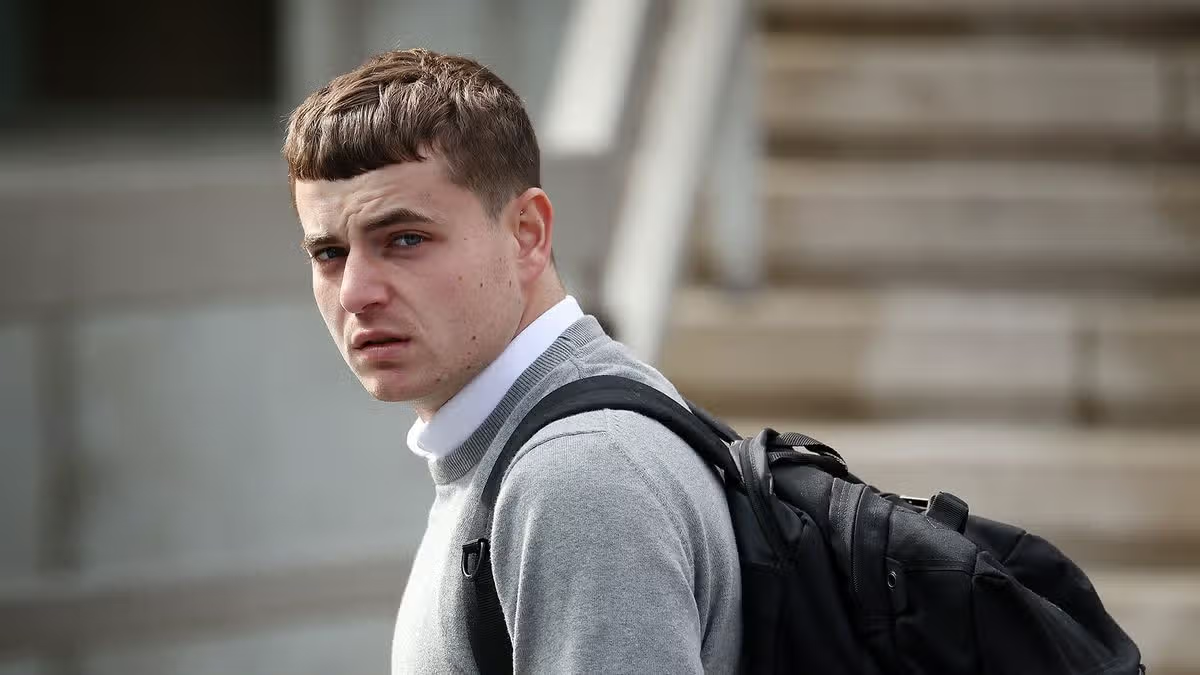
A drunk thug launched an ‘animalistic’ attack on a flight to Manchester – biting a crew member for ‘up to three minutes’ and kicking another.

Kevin Healey told staff his dad was ‘very powerful’ and that staff should ‘be afraid of him’. His barrister said he is not a ‘bullyboy’ after he found himself in the dock following the shocking incident on January 13 this year.

The 26-year-old, from Northern Ireland, was on a 12 hour flight from Shanghai, China, to Manchester having previously being in Australia.

Advertisement

Click here to hear the latest from Manchester’s courts in our newsletter

Hours into the journey, he was seen drinking booze he’d taken onto the flight himself and puffing on an e-cigarette.

Manchester Crown Court heard he appeared to be making threats to other passengers. Cabin crew members intervened, but he did not comply with their orders.

Healey repeatedly threatened staff, saying he would kill them, before being escored to the back of the plane. Blaise Morris, prosecuting, said he was later seen shouting at other passengers.

Advertisement

Healey was restrained after being verbally abusive towards a woman. Passengers were ‘frightened’, the court heard.

“As the defendant was being restrained, he became violent and bit one of the crew members,” Mr Morris added. “It was described as a forceful and aggressive bite lasting up to three minutes, causing a tear in their work uniform and a deep bite injury.

“The defendant then said his dad was very powerful and the crew should be afraid of him. As another member of the cabin crew tried to de-escalate the situation, he kicked her to the thigh causing her to fall to the ground whilst he continuously verbally abusing her.”

The flight landed at Manchester Airport at around 6.35am. Healey was frogmarched off the plane and arrested. As he was taken away he was heard saying: “I’m sorry.”

Advertisement

The court heard Healey, who had no previous convictions, has complex mental health issues. “He was beset by real misfortune of a personal nature, which I will not delve into,” barrister Neil Ronan said.

“He is not somebody who is a bullyboy who is on his way back from a lads holiday to Magaluf. He was someone in a mental health crisis having been extricated thousands of miles away from home. It was a perfect storm.”

The court heard Healey, who is type 1 diabetic, did not have the correct insulin medicine with him on the flight, which caused him ‘acute anxiety and stress’. The barrister said he suffered a ‘psychotic break’ and that he had previously been sectioned.

“He has removed drink and drugs from his life,” Mr Ronan added. “This is an opportunity for him to have a huge wake up call, and for his family.”

Advertisement

Judge Tom Gilbart told Healey: “You were drunk and aggressive and had a seriously concerning presence to other people on that plane, and were behaving in this way on a confined aircraft, which is a frightening thing to do.

“To bite somebody is an animalistic thing to do. It is appalling to do that to anybody, but to bite her, someone at work dealing with your drunken, thuggish and aggressive behaviour, is serious.”

The judge said Healey’s father had passed away when he was eight-years-old and he was diagnosed with diabetes not long after that, which had an ‘ongoing effect on him’. He added that he had since been suffering with ‘complex, unresolved grief’.

But he added: “It was your decision to drink alcohol to excess which had an impact on you. The richness of what you did deserves immediate imprisonment, but under changes in law in March this year, courts must now suspend prison sentences of 12 months or less, unless exceptional circumstances apply. Exceptional circumstances do not apply in this case.”

Advertisement

Healey, of Crieve Court, Newry, was handed a 12-month sentence, suspended for two years. He was ordered to carry out 100 hours of unpaid work and abide by a three-month electronically monitored curfew.

He previously pleaded guilty to assault occasioning actual bodily harm and assault by beating.

Source link

Advertisement
Continue Reading
Click to comment

You must be logged in to post a comment Login

Leave a Reply

NewsBeat

Porto vs Manchester City – Champions League LIVE: Citizens seek to banish ghosts of the past at the Dragao as Enzo Maresca’s men start European campaign

Published

on

Porto vs Manchester City - Champions League LIVE: Citizens seek to banish ghosts of the past at the Dragao as Enzo Maresca's men start European campaign

Advertisement

Advertisement

Source link

Advertisement
Continue Reading

NewsBeat

Harwood bungalow plans rejected over ‘out of character’ windows

Published

on

Harwood bungalow plans rejected over 'out of character' windows

Plans had been submitted to modernise the property on Sandown Road, Harwood, including converting the garage into living space, rendering the property and changing its windows.

The most distinctive part of the scheme was glazing on the front of the bungalow stretching from ground level to the apex of the roof.

Bolton Council refused permission in April, arguing that the combined impact of the increased glazing and render would harm the character and appearance of the area.

Advertisement

The decision was appealed, with an appeal statement arguing that the council had “very substantially overstated” the significance of what was described as a “modest glazing panel” above the entrance.

It also argued that “residential neighbourhoods are not museum exhibits”.

The statement said established neighbourhoods naturally evolve as homeowners adapt and modernise their properties.

It pointed to other properties in Harwood where contemporary alterations had previously been approved, including a bungalow around 500 metres away on Hough Fold Way and a home on Chale Green.

Advertisement

But planning inspector Martin H Seddon dismissed the appeal after visiting the site on August 18.

The inspector did, however, disagree with concerns over the render.

He noted that a significant number of nearby bungalows already incorporated render and said: “I see no reason why it should not be used as an external material at the appeal building.”

The floor-to-roof glazing proved decisive.

Advertisement

Mr Seddon said there were no other bungalows with full-height glazing in the immediate vicinity and that the proposed front elevation would appear “prominent and out of character in the street scene”.

The appeal had highlighted a triangular window previously approved at the bungalow next door, but the inspector said this was smaller and separated from the doors below.

He concluded that the proposed glazing would be “harmful to the character and appearance of the surrounding area because of its scale and extent”.

The appeal was therefore dismissed.

Advertisement

However, much of the planned makeover can still go ahead, with the council approving an almost identical scheme for the bungalow which retains the rendered elevations but removes the disputed glazing above the entrance.

Source link

Advertisement
Continue Reading

NewsBeat

Lindsay Clancy’s lawyer hopes for deal with prosecutors after mistrial

Published

on

Lindsay Clancy's lawyer sits in court during trial in Plymouth, Massachusetts

The lawyer for the Massachusetts woman accused of murdering her three children says he hopes to reach an agreement with prosecutors, after the case ended in a mistrial on Friday.

Kevin Reddington told ABC’s Good Morning America programme that he was upset a lone member of the jury would not acquit Lindsay Clancy.

To find Clancy guilty, jurors had to be unanimously convinced beyond a reasonable doubt that she intentionally killed her children – Cora, Dawson and Callan – and was not experiencing a psychotic break.

On ABC, Reddington also appealed to President Donald Trump to pardon Clancy. Because she was charged by the state, though, only the Massachusetts governor has the power to pardon her.

Advertisement

“I would hope that you [Trump] would consider this young lady, the type of person she is, what she’s been through, and consider a pardon,” Reddington said.

Reddington also said he hoped the district attorney prosecuting the case “would be able to work something out that would be acceptable to both sides”.

The BBC has contacted the district attorney for Plymouth County, Massachusetts.

“I’m willing to listen to Tim,” Reddington said about District Attorney Tim Cruz, calling him a “hard-charging prosecutor”.

Advertisement

The jury – nine women and three men – was weighing a range of options, from not guilty by reason of insanity to manslaughter and first-degree murder.

The 12-member panel appeared to nearly reach a consensus, except for a single holdout who, Reddington said, “would not apply the law of reasonable doubt” as instructed by the judge.

“That’s not right,” he said. “And that’s why I was upset.”

Throughout the trial, prosecutors called dozens of witnesses, including several doctors, seeking to prove Clancy had made a calculated decision to murder her children in the basement of their Massachusetts home in January 2023.

Advertisement

Clancy does not deny killing the three, but says there was no premeditation and she was experiencing psychosis at the time. For her to be convicted of first-degree murder, a jury would have to believe she planned the killings.

The BBC has contacted the governor’s office about a possible pardon request.

Under Massachusetts law, Reddington could also formally ask the judge to rule independently that Clancy was not guilty based on evidence presented during the trial. He has five days to file that motion.

Currently, the case rests with the prosecution, who must decide whether to seek another trial.

Advertisement

With additional reporting from Ione Wells

Source link

Continue Reading

NewsBeat

Patients left with ‘horrific’ disabilities after butcher brain surgeon operations

Published

on

Daily Record

Former MSP Liz Smith told the Eljamel Inquiry that some patients allegedly had the wrong parts of their bodies removed and were left unable to walk or care for themselves.

Patients of disgraced brain surgeon Sam Eljamel were left with “horrific” disabilities following his operations, a former MSP has told an inquiry.

On its first day of evidential hearings, the Eljamel Inquiry was told some patients allegedly had the wrong parts of their bodies removed. Mr Eljamel was a consultant neurosurgeon at Ninewells Hospital in Dundee from 1995 until his suspension in December 2013.

A public inquiry is taking place after patients of Mr Eljamel raised concerns that he had harmed as many as 200 people. The first day of proceedings began in Edinburgh on Tuesday with an opening address from Jamie Dawson KC, the inquiry’s senior counsel.

Advertisement

This was followed by evidence from the former Conservative MSP for Mid Scotland Fife Liz Smith, who represented patients affected by Mr Eljamel’s practice. She said testimony from her constituents had “upset me greatly” and many had asked “why on Earth this was allowed to happen”.

Ms Smith said she had looked into why Mr Eljamel had been allowed to continue practising despite “deep-seated concerns” being raised about him at earlier stages. She said that as she spoke to patients and their families, she found the situation was more widespread than initially thought.

“I realised this was not an event on its own, there were other patients involved in what became a dreadful scandal,” Ms Smith told the inquiry. She also criticised the record-keeping around Mr Eljamel’s medical practice, saying: “It’s absolutely appalling about some of the things that were happening and the lack of accurate medical notes that they (patients) had a right to be able to see.”

Advertisement

Ms Smith continued: “There are allegations that the wrong body parts were removed, and the physical disabilities – well they’re with the patients for the rest of their lives as we know.

“Some of these disabilities are quite horrific. People have lost their mobility, people have lost their means of looking after themselves.”

Speaking ahead of her evidence session, Ms Smith said the hearings have been a “long time coming”. She told the Press Association: “Those patients, who are here just now, have had to suffer for such a long time, and they’re wanting answers.

Advertisement

“They want to know who’s responsible and why certain things happened, and why nobody has yet been held accountable.

“As a former parliamentarian, (my colleagues and I) have been asking questions about this scandal for a very long period of time and not perceiving the answers that patients absolutely deserve to have.”

Former patient Jules Rose, who led the campaign for a public inquiry, said it has been a “long, arduous and emotional journey” to reach this moment, as the inquiry finally got under way.

Advertisement

“I’m here with my fellow campaigners, some of whom have campaigned for 10 years to get this public inquiry, so that we can get to the bottom of why NHS Tayside allowed and enabled Eljamel to commit the harm on innocent patients for 18 years,” she said.

“He was committing harm with life-changing injuries on patients – why did NHS Tayside allow that? Why did they not intervene and stop this monstrous man? We want to get to the bottom of it. We want answers.

“What we’re expecting from this is we want to see real change and a real time change as and when the damning evidence is unfolded.”

In his opening address on Tuesday, Mr Dawson said the inquiry had reached a “significant milestone”.

During the first phase, which will last four weeks, Mr Dawson said the inquiry will hear from a wide range of witnesses including representatives of NHS Tayside, the Scottish Government, the University of Dundee, and regulatory or professional bodies.

Phase two, which is due to begin in December, was expected to focus on evidence of former patients of Mr Eljamel and from independent clinical reviews (ICR).

However, Mr Dawson said some of the planned ICR evidence will now need to be pushed back as a result of delays. The inquiry heard more than 110 patients have had their clinical cases referred to an ICR by the inquiry.

Advertisement

However, the inquiry has so far only received one neurological assessment, despite the fact this was due to be heard as evidence in December.

Advertisement

“It is unrealistic to think that reviews will be advanced in sufficient numbers and to a level which would merit consideration at hearings as soon as December,” Mr Dawson said. “The result is a necessary change of plan for December and beyond, the main goals of which are to try to make what progress we can and to seek to maintain stability for patients.

“Accordingly, the intention is that the December hearings will involve patient and possibly patient representative evidence only.”

An additional solicitor has been funded to try and speed up this work. The inquiry, taking place before Lord Weir, continues.

Get more Daily Record exclusives by signing up for free to Google’s preferred sources. Click HERE.

Source link

Advertisement
Continue Reading

NewsBeat

Prince George attends first day at Eton College

Published

on

Prince George

Prince George has officially started his first term at Eton College.

The 13-year-old, who is second in line for the British throne, was dropped off at the all-boys boarding school by his parents, the Prince of Wales and Catherine, Princess of Wales.

The future king follows in the footsteps of his father in attending the elite private school, which has taught 20 British prime ministers and where fees are around £65,000 a year.

The BBC’s royal correspondent Daniela Relph explains what the prince is likely to expect at his new school.

Advertisement

Source link

Continue Reading

NewsBeat

Cardiff City v Stoke City LIVE: Kick-off time, TV channel and team news

Published

on

Ipso logo

Cardiff are facing another difficult injury at the minute, with Barry-Murphy confirming Isaak Davies is unlikely to feature tonight.

Davies felt his hamstring during training on Friday and is expected to miss the visit of the Potters, further reducing Barry-Murphy’s attacking options.

“I imagine he won’t be available on Tuesday,” the Cardiff head coach said.

There is also no imminent boost expected elsewhere, with Barry-Murphy indicating the club’s other injured players are unlikely to return until around the international break.

Advertisement

Captain Calum Chambers remains unavailable, while Dylan Lawlor and Will Fish are also still sidelined.

“The rest of the guys are back around the international break, I think, so I don’t imagine anything will change between now and Tuesday,” Barry-Murphy said.

Chambers’ situation is slightly more complicated, however, with the Cardiff boss unable to put a firm timescale on his return.

“Calum Chambers is in the same bracket as Dylan and Will Fish. He won’t be available for Tuesday, and his timescale is slightly more complicated because of his injury,” he added.

Advertisement

The situation leaves Cardiff particularly stretched with Stoke arriving just three days after the Portsmouth defeat and with only four players having been added to the squad during the summer transfer window.

Barry-Murphy was asked whether he feels his players have enough to cope with another game at such short notice.

“We have no choice,” he replied.

“The players who are here will have our full support to help them try to produce a performance to win.”

Advertisement

Will Fish, Calum Chambers and Gabriel Osho in the club’s new Castore training gear(Image: Instagram/Cardiff City FC)

Source link

Continue Reading

NewsBeat

Durham County Council to ‘reconsider’ allotment cockerel ban

Published

on

Durham County Council to 'reconsider' allotment cockerel ban

Months after effectively banning cockerels from council-owned allotments, the council is being asked to allow show birds to stay with permission.

Cabinet members will consider the proposal on September 16.

The move follows a campaign by allotment holders and poultry enthusiasts who warned the ban could put birds already on sites across the county at risk.

Advertisement

Among those speaking out was 14-year-old Tom Barker Amos, from Bishop Auckland, who launched a petition calling on the council to rethink the ban.

Tom previously told The Northern Echo that his pet cockerel Brian was an “integral part” of his life and that keeping poultry had helped his mental health.

He warned that owners could struggle to rehome birds displaced by the ban, leaving some at risk of being euthanised.

The teenager’s petition drew hundreds of signatures, while campaigners said there was little evidence cockerels caused widespread nuisance and called for tenants to be consulted before restrictions were imposed.

Advertisement

The council had revised its allotment tenancy agreement earlier this year following a public consultation, removing previous exemptions that allowed show cockerels to be kept on allotments with permission.

Councillor Dawn Bellingham, the council’s cabinet member for communities and resilience, said it had listened to concerns raised since the ban was approved.

She said: “Since then, we have had representations from tenancy holders, fellow councillors and organisations highlighting their concerns around the welfare of current birds.

“As a result, we have reconsidered our approach.”

Advertisement

Under the proposal, show cockerels could return to council-owned allotments with the authority’s permission.

But the council said protecting the birds and the wellbeing of neighbours would remain priorities.

If a cockerel causes a statutory nuisance, a ban would apply across the affected allotment site, overriding any policy allowing the birds to be kept.

Advertisement

Source link

Continue Reading

NewsBeat

The Bayeux tapestry is really an embroidered comic strip

Published

on

The Bayeux tapestry is really an embroidered comic strip

The Bayeux tapestry is many things: a public statement, a massive work of collaborative art, a staple of the teaching of British history. The 70-metre-embroidered cloth depicts the events of the Norman conquest, culminating in the 1066 Battle of Hastings and the death of Harold II.

Since its creation in the 11th century, the Bayeux tapestry has loomed large in English history and shaped the way we think about the events of 1066. However, the tapestry is other things too.

First, it is not actually a tapestry, but an embroidery. The images on the cloth are not woven into it, but worked in crewel threads (worsted wool yarn – crewel is the old Welsh word for wool) on top of a piece of linen.

We should use the correct terminology if we are going to place this piece into its rightful place in the history of women’s creative labour and especially embroidery. Embroidery may be typically considered a solo pursuit of little political importance but this is not the case, as the Bayeux creation clearly shows.

Advertisement

As someone who researches comics, war and violence, I see the Bayeux embroidery as a prime example of the importance of visual narratives for political myth-making and nation-building.

Needlework as historical record

The Bayeux tapestry was, according to historian George Wingfield Digby, “designed to tell a story to a largely non-literate public; it is like a strip cartoon, racy, emphatic, colourful, with a good deal of blood and thunder and some ribaldry”. It is certainly racy – there are 93 visible penises, most of them belonging to horses.

There are many other works from across the world that tell similar stories in this way. For example, Trajan’s column in Rome, completed in 113 CE, is a 30-metre-tall marble column, topped with a statue of St Peter. It features a 190m spiralling frieze that tells the story of the Roman-Dacian Wars (101-102 CE and 105-106 CE). An impressive monument to military prowess, it demands no deep understanding of Latin and the story it tells cuts across the territories of Rome and her trading partners.

Advertisement

We see this in the modern world too: IKEA flat pack instructions, NHS guidance for people taking medication and aeroplane safety leaflets all work in the same way. Pictures – therefore comics – are used to convey universal information.

But how does this connect to women’s creative practice and embroidery? In my previous research, I looked at the way in which needlework and comics come together. Currently I’m researching comics reading methods in narrative needlework.

How can thinking about comics as a reading method open up useful ways to engage with needlework texts? Using needlework as a way to construct one’s own story and create a tangible record of events – especially in times of trauma – has a long and storied history.

Consider the creation of arpilleras in Chile during the military dictatorship under General Pinochet (1973-1990) – burlap pieces created out of scraps of cloth that memorialise the “disappeared”. Or the Hmong story cloths, colourful embroideries made during the Laotian civil war (also known as the “secret war”, 1959-1975), now seen as important cultural and historical artefacts, especially in Hmong diaspora communities.

Advertisement

Though these two examples are not as widely known or recognisable as the Bayeux tapestry, they have a similar purpose. They pictorialise particular episodes in a history of significant events, choosing what we remember, while excluding other parts of the story.

What is particularly interesting is that these modern works, though separated by time and geography, are giving voice to those who do not have access to mainstream channels. These works are created out of defiance and a need to creative a narrative for their story and to remember those who have been lost.

Aelfgyva, the mysterious shrouded woman, just one of three women depicted in the main body of the tapestry, is depicted with a naked man beneath, perhaps to indicate lust or sexual misdemenour.
Wikipedia

While the Bayeux tapestry was created as a narrative of victory, it was still created by women who would have had very little voice in their own communities and whose labour sits in the background of the work itself. The work of the women who embroidered the greatness of William I could be seen as the creative precursor of that of the women who embroidered their murdered loved ones in Chile and Laos.

The women who stitched the Bayeux tapestry in the late 11th century knew that pictures were a marvellous vehicle for narrative and this remains true today. Though they did not have creative control over the story, we see the touches of their creativity and humour throughout the piece itself.

Advertisement

Centuries later, their crafting sisters in Chile and Laos took up their needles to tell stories that only they could, becoming fully the creators of pictorial memories, making visual the violences that still mark our history.

Comics is not just superheroes and spandex; it can be public art, telling public stories. And if we widen the definition just a little bit, there are many more stories waiting to be discovered.

Source link

Advertisement
Continue Reading

NewsBeat

Teen died from fractures and brain injury after B1281 crash

Published

on

Teen died from fractures and brain injury after B1281 crash

Lucas David Littlefair, from Hesleden, died after the Volkswagen Passat he was driving collided with a Citroen C3 on the B1281 Hesleden Road near Blackhall Colliery on August 2. 

The 19-year-old, who has been described as a “treasured” son, brother, grandson, and boyfriend, was pronounced dead at the scene. 

An inquest opened into his death at Crook Coroners’ Court today (September 8) heard how the crash took place near to the entrance to Hardwick Hall.

Advertisement

A post mortem carried out at the Newcastle Freeman Hospital by Dr Tuomo Polvikowski gave the former tree surgeon’s cause of death as multiple skull and vertebral fractures with a catastrophic brain injury and a traffic accident.

Following his death, Lucas’ family released an emotional tribute to him, saying: “Lucas, you have been cruelly snatched from us much too soon, a great hole has been left in your place and life can never be the same again without you.

“Rest in peace, Lucas – the only thing that can keep us going is knowing we will meet again. Lucas was loved more than he can ever know. 

“We will never forget him or ever stop loving him, and will miss him dearly.

Advertisement

“Lucas had a passion for motorbikes and when he wasn’t at work he was always spending time with friends, family and his girlfriend. 

“He brought so much happiness to all our lives and we have so many memories as a family that we will never forget.”

The serious two-car crash took place when the two vehicles collided and left one of the vehicles overturned. 

Three passengers who were in the VW, two boys aged 17 and a 17-year-old girl, were taken to hospital as a precaution before being discharged. 

Advertisement

The driver of the Citroen, a 22-year-old woman, was also taken to hospital and discharged.

Senior Coroner Jeremy Chipperfield adjourned the inquest for a mention hearing on November 17 at the coroners’ court, sitting at The Miners Hall in Durham.

Source link

Advertisement
Continue Reading

NewsBeat

Man found with suspected stab wounds in Bishop Auckland

Published

on

Man found with suspected stab wounds in Bishop Auckland

Officers were called to Wensleydale Square just after 11am on Sunday, September 6, after reports that a man had been attacked.

The man, in his thirties, was taken to hospital for treatment.

Police believe the attack happened on the Woodhouse Estate about an hour before they were called.

Residents have described how a quiet Bishop Auckland street was “flooded” with police after a man was found with suspected stab wounds. (Image: THE NORTHERN ECHO)

One resident said he’d never seen anything like it on the street.

Advertisement

Mr Ogden, who has lived on the street since October 1965, said: “I saw around seven police cars on Sunday morning. I just saw it from my box window upstairs but didn’t pay much attention.

“I haven’t heard much about what actually happened.”

He added: “The area has gone downhill, like everywhere has over the years, you keep your doors locked now just in case, it never used to be like that. I think all us old ones are dying off and new people are coming in.”

Another resident said: “I was cooking dinner for the family when I heard the commotion and saw the police. The street was flooded with them.”

Advertisement

She added: “I’ve been here since the houses were built, from about 1965, and it’s usually a quiet, nice area.”

A woman whose daughter found the injured man said: “It’s usually a quiet area. I’ve never known anything like that to happen on the street.”

Durham Police confirmed an investigation had been launched. after a man was assaulted in Bishop Auckland.

A spokesperson added: “Officers would like to speak to anyone who may have witnessed the incident or who may have information that could assist their investigation.”

Advertisement

A North East Ambulance Service spokesperson said: “We were called to an incident at a private address off Weardale Drive in Bishop Auckland at 10.56am on September 6, 2026.

“We dispatched a clinical team leader and an ambulance crew, who took one patient to hospital.”

Anyone with information is asked to contact Durham Constabulary on 101, quoting crime reference number CRI00705491.

Information can also be passed anonymously to Crimestoppers on 0800 555 111, or online at www.crimestoppers-uk.org.

Advertisement

Source link

Continue Reading

Trending

Copyright © 2025