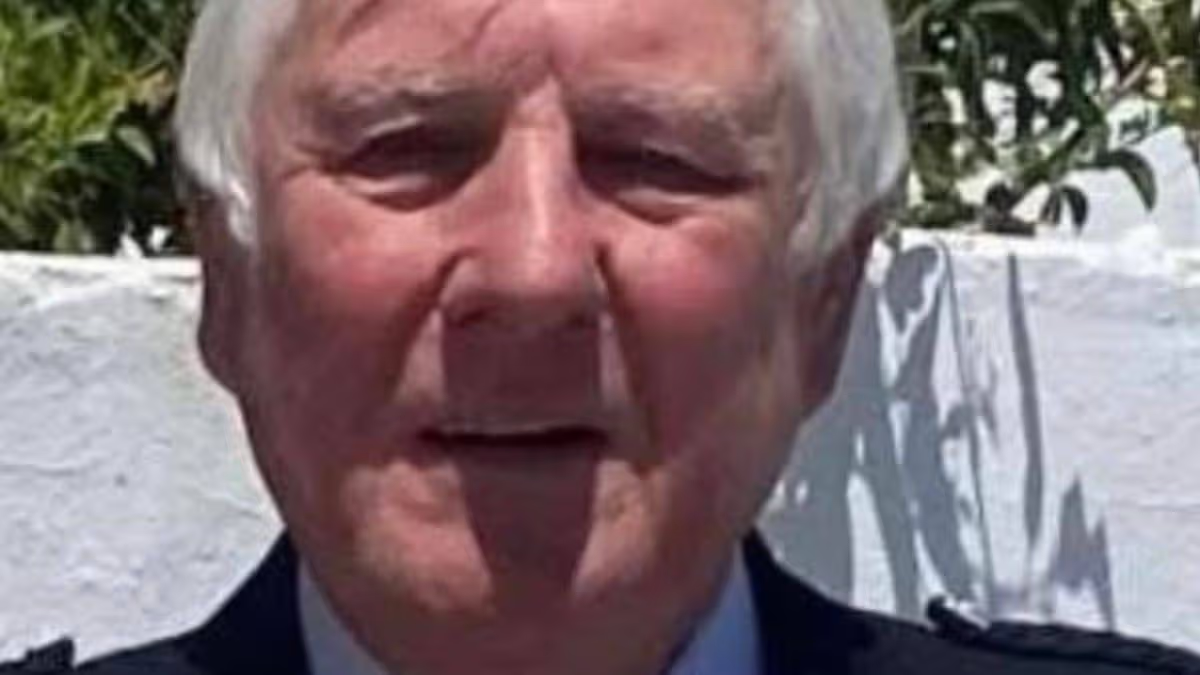
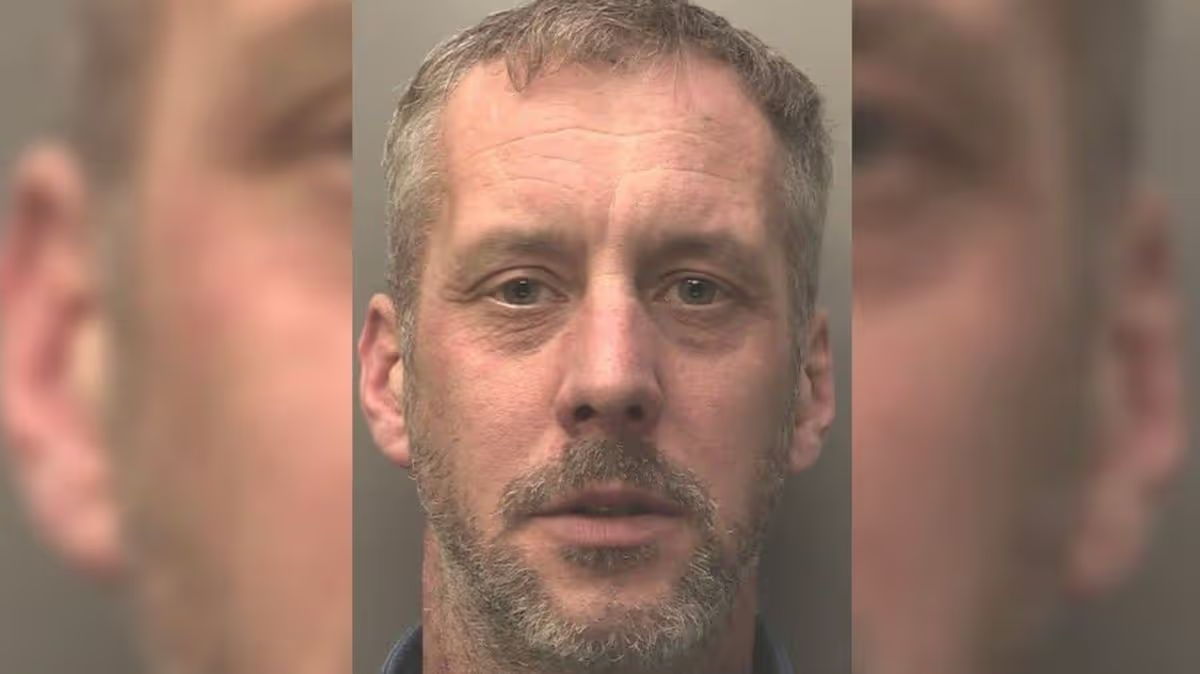
Donny Strathie, from Grangemouth, had travelled to the United States to support Scotland in the World Cup but he died suddenly in Boston on Sunday, June 14, aged 76
A devoted member of the Tartan Army has died in Boston while following Scotland at the World Cup – passing away before he got to see his beloved team kick a ball at the tournament.
Advertisement
Donny Strathie, from Grangemouth, Falkirk, passed away suddenly in Boston on Sunday, June 14, aged 76, reports the Daily Record.
The lifelong Scotland supporter had made the journey to the United States to cheer on Steve Clarke’s men on the grandest stage in football, and had even secured his ticket for Friday night’s fixture against Morocco. Heartbreakingly, he never lived to see the match he had longed to attend.
Now, his family, friends and fellow supporters are calling on the Tartan Army to unite and pay their respects during the game. A poster circulating on social media is urging Scotland fans to join in a minute’s applause during the 76th minute of the World Cup clash, in tribute to Donny’s age.
It reads: “One minute applause tribute to Donny Strathie. Tartan Army footsoldier who died in Boston on Sunday, June 14. Share and spread the word: One minute applause tribute in the 76th minute of Scotland v Morocco.
“Donny sadly passed away suddenly in Boston on Sunday aged 76. He had his ticket to the match and it was his dream to see Scotland in the World Cup but he never got the chance. Lets make him proud.”
Donny was a well-respected figure in his local community and served as captain of the Bowhouse Pool team. His daughters, Denise Strathie and Cheryl Strathie, have both shared cherished photographs of their father in his honour as an outpouring of love and support continues to pour in for the beloved man.
Cheryl Strathie shared the appeal, saying: “Please share on any platform. Let’s see if we can all make this happen Dad.”
Advertisement
Lynne Easton responded to a tribute photo posted by Denise Strathie, saying: “So so sorry about your Dad. We are all gutted and sending our love. A great guy who lived life the right way from his parish walks to his football and his family. Love to you all and here to help in any way.”
Karen Keegan McPheat said: “So very sad. He was so lovely and cheery. He was saying last week to watch out for him on tv. He will be missed.”
Posting in the Falkirk Chit Chat Pool League group, David Jerrett wrote: “Just heard sad news Donny Strathie, a stalwart of the pool league for years, captain of the Bowhouse has passed away. He was in Boston watching his beloved Scotland. Rest easy pal from the pool world.”
Advertisement
Lee Stevenson said: “Oh that’s so sad. I’m glad the last thing he did was doing something he loved. I hope he saw Scotland win their first match.”
Graham Rae added: “Such a shock. He was in ours just before he went away? Great guy as well. RIP.”
Cristiano Ronaldo has urged Portugal to believe they can finally win the World Cup.
Ronaldo will be competing in what will be a record-equalling sixth tournament.
The biggest prize of all also remains the one trophy to have eluded the footballing icon throughout his glittering career.
Advertisement
He knows at the age of 41, this could be his last chance complete his remarkable haul of trophies.
Portugal kick off their World Cup campaign with an opening game against DR Congo in Houston tomorrow (WED).
And Ronaldo wants Roberto Martinez’s men to leave nothing behind in the quest to conquer the world.
He said: “Every time we wear this jersey, we feel the same pride, the same passion and the same sense of responsibility as on the first day.
Advertisement
“Tomorrow begins a new chapter.
“We worked hard to reach this moment, and now it’s time to give everything for our country, and for all the Portuguese communities that support us here and around the world. Believe it like we do.”
Martinez, meanwhile, will face the media later, when he is expected to address speculation he will stand down as Portugal manager at the end of the tournament.
The UK government’s decision to introduce restrictions on children’s access to social media marks a significant moment in the evolution of online safety policy. For supporters, it represents a long-overdue response to growing concerns about children’s wellbeing. For critics, it raises questions about effectiveness, enforcement and unintended consequences.
Yet regardless of where one stands on the policy itself, its announcement provides an opportunity to reflect on a broader question: what exactly has this debate been about?
At one level, the answer appears straightforward. Public concern about children’s social media use has grown steadily over recent years. It has been fuelled by worries about a wide range of issues, from mental health and body image to online exploitation, misinformation and the changing nature of childhood itself. The government’s proposals are intended to respond to these concerns and reduce young people’s exposure to risk.
Yet one of the striking features of the debate is that the phrase “social media harms” has come to encompass an extraordinary range of anxieties. Depending on who is speaking, the problem may be cyberbullying, pornography, misogynistic influencers, loneliness, political polarisation, declining attention spans, excessive screen time, image-based abuse or the feeling that childhood is becoming increasingly mediated through screens.
These concerns are real and deserving of attention but they do not necessarily share the same causes or solutions.
When multiple anxieties become bundled together, it becomes tempting to seek a single response. Yet many of the challenges that worry parents, educators and policymakers are not solely technological in nature.
Young people were navigating body image pressures long before social media. Bullying and social exclusion existed before smartphones. Concerns about unrealistic representations of sex and relationships and success have existed for decades. Young people have always had to negotiate questions of identity, belonging, popularity and status.
Advertisement
Many of the issues that teenagers contend with predate social media. New Africa/Shutterstock
Social media may amplify these dynamics, but it does not create them from nothing. Understanding this distinction is important because it shapes how we understand both the problem and the solution. If online harms are understood primarily as problems of access, restricting access becomes the obvious response. If they are understood as the product of interactions between technology, relationships, culture and wider social conditions, the picture becomes considerably more complicated.
Changing relationships with tech
As a researcher who studies young people’s digital lives, what has struck me most throughout these debates is that many discussions about children and social media are not really about children and social media alone. They are also conversations about how adults feel about technology more generally.
Over the past two decades, digital technologies have transformed how people communicate, access information, form relationships and participate in public life. For much of that period, these developments were discussed primarily in terms of opportunity, innovation and connection. Increasingly, however, public conversations about technology are framed through the language of risk, uncertainty and loss.
Concerns about social media sit alongside wider unease about the power of technology companies. They accompany fears about the commercialisation of attention, the collection of personal data, the spread of misinformation and the growing influence of algorithms over everyday life.
Right now, debates about children’s social media use are unfolding against a backdrop of rapid technological change more broadly. The emergence of generative AI, deepfakes and increasingly sophisticated algorithmic systems has intensified public uncertainty about the role technology should play in society.
Parents, educators and policymakers are being asked to make decisions about technologies whose long-term implications remain unclear. Researchers are trying to study developments that evolve faster than evidence can often keep pace with. Schools are preparing young people for futures that are difficult to imagine.
In this context, proposals to restrict children’s access to social media can offer something that is often in short supply: a sense of certainty and control. They provide a visible intervention that governments can announce, institutions can implement and parents can understand. Faced with complex and rapidly evolving challenges, there is understandable appeal in policies that appear to offer a clear solution.
Advertisement
However, there is an important difference between taking action and resolving a problem.
What happens next?
One of the lessons emerging from international experience, including developments in Australia, is that the effectiveness of such restrictions remains uncertain. Young people may migrate to alternative platforms or create hidden accounts. They may become less willing to discuss their online experiences with trusted adults. Some may lose access to online communities, information or support networks that play an important role in their lives. The available evidence does not yet allow us to confidently conclude that restricting access will produce the wide-ranging benefits that many hope for.
This does not necessarily mean that restrictions are misguided. It does, however, suggest that policies can sometimes provide reassurance before we know whether they will meaningfully reduce harm. In that sense, there is a risk that social media bans become partly performative. They demonstrate that something is being done and may provide a welcome sense of action in the face of uncertainty. Yet they can also encourage the belief that a complex problem is being solved when many of the underlying issues remain unresolved.
Perhaps the greatest danger is not that restrictions fail, but that they succeed just enough to convince us that the work is done.
Even if age restrictions prove effective, young people will still eventually enter digital environments. They will still need to understand how algorithms shape the information they encounter. They will still need to evaluate misinformation, navigate relationships online, recognise manipulation and make sense of increasingly complex digital cultures. They will still require opportunities to develop critical thinking, digital literacy and healthy relationship skills.
More fundamentally, questions about the design of digital environments themselves will remain. If our concerns centre on addictive design, algorithmic amplification, misinformation or the concentration of power among technology companies, then restricting children’s access addresses only part of the issue. The broader challenge concerns the nature of the digital spaces that all of us inhabit.
Council says Stormont programme is primarily resourced to support prevention activity, rather than provision of services for women
A Northern Ireland council is making a call for a large emergency fund for Women’s Aid services, and has criticised Stormont focus on preventative action at the expense of refuge for victims.
Advertisement
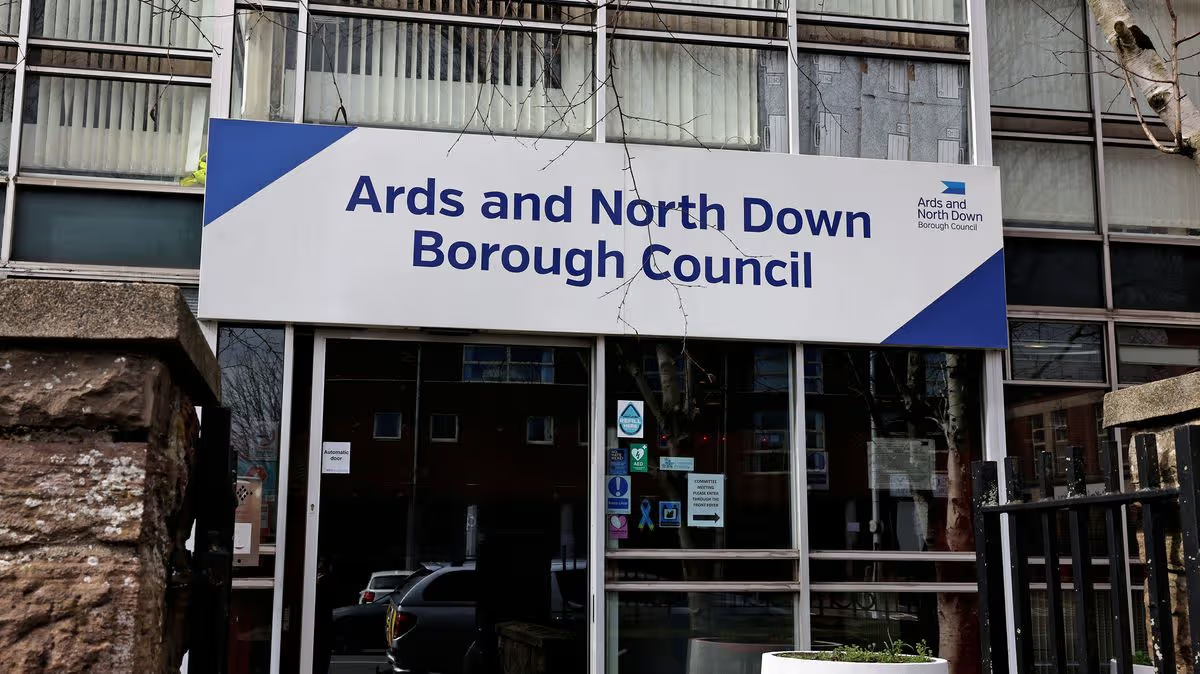
Elected representatives at an Ards and North Down Borough Council committee meeting unanimously agreed a motion this week highlighting increased disclosures and referrals, particularly to Women’s Aid services, as a result of a lack of funding for provision.
The council is asking for a new dedicated emergency fund. The motion will go to the full meeting of the council later this month, where it is expected to pass.
In Ards and North Down, over the last three years referrals for floating support have increased by over 33 percent and referrals for refuge have increased by over 186 percent.
At a meeting in Newtownards of the council’s Active and Healthy Communities Committee on Monday (June 16), councillors agreed to the motion, forwarded by UUP Councillors Peter Wray and Katherine Newman, which acknowledges increased demand for service experienced by North Down and Ards Women’s Aid.
The motion firstly commits to write to the Minister for Communities requesting a review into the funding provided to Women’s Aid through the Northern Ireland Housing Executive Supporting People Grant.
It secondly commits to write to the Northern Ireland Executive welcoming the funding provided so far, but expressing concerns that the Ending Violence Against Women and Girls programme is primarily resourced to support prevention activity, rather than provision of services.
Advertisement
The motion states: “While investment in prevention is essential, it is already resulting in increased disclosures and referrals, particularly to Women’s Aid services. The letter should also highlight the need for multiyear funding, and increased funding allocation for the Tier 3 EVAWG programme, which currently doesn’t cover the cost of one additional member of staff.”
The letter will also propose the establishment of a dedicated emergency fund in Northern Ireland to support women who are fleeing domestic abuse but face immediate financial barriers to accessing safety.
The motion states: “Many women, particularly those who are working or have limited access to benefits, are unable to afford refuge accommodation costs or secure private rental housing due to high upfront expenses such as deposits and rent in advance. As a result, they are often forced to remain in unsafe environments or face homelessness.
“This fund would provide flexible, rapid financial assistance to cover emergency costs, refuge stays, and access to long -term housing, ensuring that no woman is prevented from leaving an abusive situation due to a lack of financial resources.”
The young boy, who was under the age of 18, was pronounced dead at the scene following the fatal cycling accident in Lismore
Emma O’Neill Content Editor and Danny De Vaal
22:14, 16 Jun 2026Updated 22:16, 16 Jun 2026
A young boy has tragically lost his life after colliding with a stationary lorry while cycling in Waterford.
The devastating incident took place in Ballygalane, Lismore, shortly after 11am this morning.
Advertisement
The youngster, who was under the age of 18, was declared dead at the scene. His body has been removed to the mortuary at University Hospital Waterford, where a post-mortem examination will be carried out in due course, reports the Irish Mirror.
The lorry driver was unhurt. The road was temporarily shut to allow for an examination of the scene but has now been reopened.
In a statement, Gardai confirmed they are “appealing for witnesses following a fatal road traffic collision in Ballygalane, Lismore, Co. Waterford this morning Tuesday 16th June, 2026.”
“The collision involved a parked lorry and a pedal cyclist and occurred shortly after 11:00am.
Advertisement
“A juvenile male, pedal cyclist was fatally injured and was pronounced deceased at the scene. His body has been removed to the mortuary at University Hospital Waterford where a post-mortem examination will take place in due course.
“The coroner has been notified. The male driver of the lorry was uninjured.
“The road was closed for technical examination by Garda Forensic Collision Investigators and has since reopened.
“Gardaí are appealing to anyone who witnessed this collision to come forward.
Advertisement
“Road users who may have camera footage (including dash-cam) and were travelling on the N72 between Lismore and Cappoquin, Co. Waterford this morning between 10.30am and 11.15am 16th June, 2026 are asked to make this available to investigating Gardaí.
“Anyone with any information is asked to contact Dungarvan Garda Station on (058) 48600, the Garda Confidential Line on 1800 666 111, or any Garda Station.
A Dad and Grandfather from Purbrook has shared his story this Diabetes Week and Men’s Health Week after losing 4 stone with Slimming World and changing his life by putting his type 2 diabetes into remission, without any medication, just weight loss, and the support from his Slimming World group and Slimming World Consultant, Mel Knibbs.
The UK State Pension age is increasing from 66 to 67 in monthly increments between April 2026 and March 2028
Linda Howard Money and Consumer Writer
21:00, 16 Jun 2026
Individuals are being advised to check their State Pension age following the long-anticipated rise from 66 to 67, which began in April. The gradual increase over the coming two years means those born in the early 1960s may no longer retire at 66, with their State Pension age instead being determined by their precise date of birth.
The State Pension age is set to climb from 66 to 67 between now and March 2028. Those born between April 6, 1960 and March 5, 1961 will find their retirement age pushed past 66, with the exact figure dependent on their date of birth.
Advertisement
For some individuals, this could mean waiting several additional months before they become eligible to receive State Pension payments. The Department for Work and Pensions (DWP) is urging those nearing retirement to confirm their State Pension age so they are fully aware of when they will qualify.
DWP said: “Between April 2026 and March 2028, the State Pension age will gradually rise from 66 to 67, affecting those born on or after 6 April 1960. Use the free State Pension age calculator on GOV.UK to find your exact age – you just need your date of birth. You can also use the Check your State Pension forecast tool to see how much you might get and if you can increase it, for example, by filling any gaps in your record.”
A further key consideration is that the State Pension does not commence automatically – individuals must proactively submit a claim as they approach their State Pension age. The Pension Service typically dispatches an invitation letter approximately four months prior to an individual reaching their State Pension age, outlining how to submit a claim, reports the Daily Record.
DWP said: “Remember, your State Pension doesn’t start automatically. The Pension Service will write to you around four months before you reach State Pension age to invite you to apply.”
Advertisement
Verifying your State Pension age is straightforward and can be completed online by inputting your date of birth into the UK Government’s official State Pension age calculator.
The full New State Pension is now worth £241.30 a week, some £995.20 every four-week payment period. The precise sum an individual receives is determined by their National Insurance record.
Most people need around 35 qualifying years of National Insurance Contributions (NICs) to receive the full New State Pension, while those with fewer years may receive a reduced amount. You need 10 years of NICs to qualify for any State Pension payments.
The rise in State Pension age forms part of long-term UK Government plans intended to account for increasing life expectancy and the escalating costs of pension funding.
Advertisement
Further increases are already scheduled, with the State Pension age anticipated to climb to 68 in the mid-2040s, though the precise timeline for this adjustment remains under review.
For the time being, the DWP states that the focus is on ensuring those approaching retirement are aware of when they will become entitled to the State Pension and how to claim it.
Check your State Pension age Use the free online tool available at GOV.UK to check your State Pension age and find out when you are eligible to retire and begin claiming your State Pension.
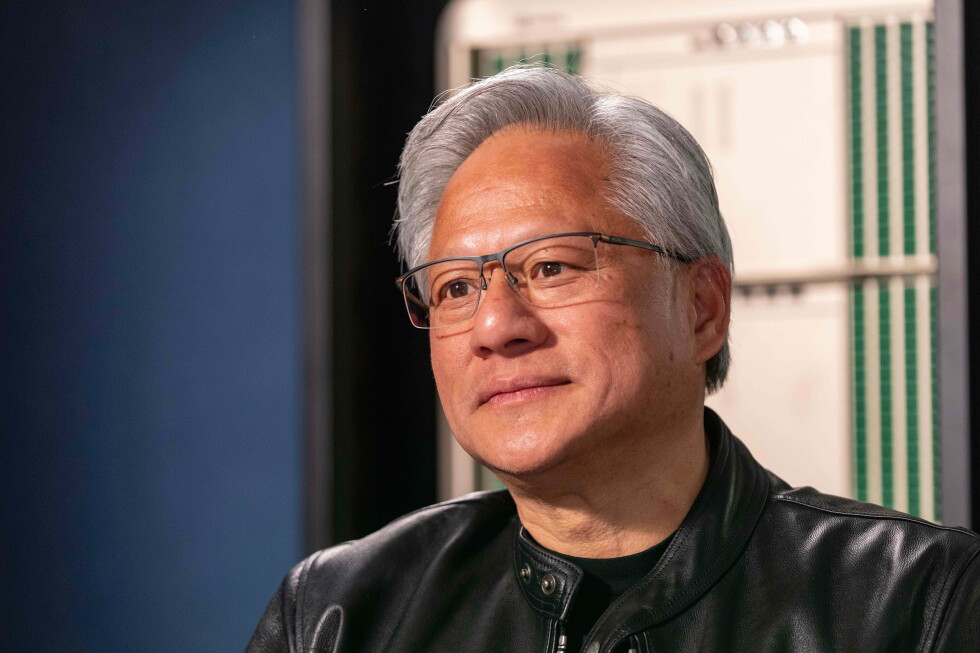
SHERMAN, Texas (AP) — Nvidia CEO Jensen Huang — whose work helped enable artificial intelligence — stressed in an Associated Press interview Tuesday that society has no choice but to change in the advent of AI.
Huang has been optimistic about the technology’s potential to rapidly change society, creating faster economic growth and more scientific breakthroughs. But as the head of a computer chip company now developing AI systems, Huang has felt obligated to respond to critics who warn of job losses and threats to humanity itself.
“We need to create new social norms,” Huang said in an interview. “I would advocate that everybody use AI. Just go engage it.”
Huang made his case as AI has emerged as a political flashpoint, with objections to plans to build more data centers and fears that the speed with which it’s being adopted could spur the layoffs of workers who might not have a safety net. Such questions have threatened public support of the technology.
Advertisement
His close relationship with President Donald Trump has been a source of criticism among Democrats, even as he makes the case that the computing power created by AI is key to adding the factory jobs that have been promised for decades without much enduring success.
Advertisement
He said the ability of AI to build a website, analyze complex documents, guide advanced research or even plan a kitchen remodeling has helped to close the technological divide in America. People can now do advanced work on computers without having to know how to program or write software, he added.
Huang stressed that there is a need for government regulation and safety standards for AI, emphasizing that national security also needed to be a priority for the technology that has been powering stock market gains and much of the U.S. economy in recent years.
The head of the world’s most valuable company said society will adapt to AI just as it did to automobiles. He said cars were once portrayed as killing children, but the world changed its norms by having sidewalks and crosswalks and stopping kids from playing in the streets.
Advertisement
“When I was growing up, I used to play in the streets,” Huang said. “When cars came along, you obviously can’t play in the streets now.”
Huang skeptical of what government ownership of AI companies would achieve
With a market capitalization of roughly $5 trillion, Nvidia has soared in valuation in recent years to become the world’s most valuable company. AI modeling companies OpenAI and Anthropic are potentially set to also clear the $1 trillion mark once their stocks are publicly traded.
That explosive surge in wealth concentrated in AI companies has prompted renewed worries about economic inequality. Trump has tried to defuse those concerns, recently musing about the prospect that the U.S. government could own some shares in AI firms, so any windfalls would be more broadly shared with the public. That idea has also been advanced by Sen. Bernie Sanders, I-Vt., and even OpenAI CEO Sam Altman.
Huang expressed skepticism about the idea, saying he expects the country will already benefit broadly from AI advancements.
Advertisement
“I’m not exactly sure what they’re trying to achieve,” he said regarding government ownership. “I haven’t had a dialogue with them about that. But just remember that these are American companies. Their success benefits the stock price, of which many Americans are investors in. It generates taxes, which helps many Americans. It creates a lot of jobs.”
He noted that AI companies could also lead to higher profits for energy, construction and hardware technology firms.
“Americans have a stake in American companies already, naturally, in a whole lot of different ways,” Huang said.
Huang says national security needs to be a priority on AI
The Trump administration has recently reversed course from using a light touch on regulating AI to taking a heavier hand.
Huang said the government was properly focused on national security issues, but it was important to provide clear guidance when taking restrictive actions, as doing so could lead to unintended consequences.
“National security should always be the top concern of all technologies,” Huang said. “But having said that, you know, you have to be very specific about the risk that you’re concerned about, before setting up policies for export controls.”
During the Biden administration, Nvidia pushed back against export controls that were designed to restrict its ability to sell chips to China, rejecting the administration’s premise that a ban would guarantee an American edge on AI. Huang had warned that the export controls might limit America’s ability to develop the world’s AI ecosystem, as China would respond with its own advanced chips.
Advertisement
Huang says energy is key problem for America’s AI development
Huang stressed that while the U.S. has many strengths on AI, it is vulnerable because of a lacking energy infrastructure. The data centers performing the computations used in AI are creating a huge demand for electricity, which could be a strain on the power grid.
Some data centers will be constructed with their own electricity sources, but Huang said the U.S. is starting from a disadvantage on energy. And without more energy, it can be harder to play to American strengths in its AI infrastructure, models and computer chip development.
“The United States is woefully behind in energy production,” Huang said. “We just suffocated energy production for too long.”
Huang complimented Trump on his approach to seeking to increase energy production. The president has aggressively supported the use of oil, coal and natural gas, but he has scorned the use of solar and wind power.
Advertisement
The Nvidia CEO was not commenting on Trump’s opposition to climate-friendlier energy sources, but the gap he identified goes to some of the fears that U.S. households have about AI increasing their utility bills.
Huang was speaking Tuesday in Sherman, Texas, at an expansion of the Coherent factory to develop a laser for transmitting data among chips, which could cut power use by AI systems by up to 50%.
Trump’s fondness for Huang started at a Mar-a-Lago dinner
Trump, not known for technological expertise, quickly developed a friendship with Huang. The president has called him “smart,” a “friend” and “amazing,” insisting that Huang accompany him on foreign trips. Most recently, Trump had Air Force One pick up the leather-jacketed CEO in Alaska while en route to his state visit to China.
Their relationship started last year with an invitation to dinner at Mar-a-Lago, Trump’s home and private club in Florida. Huang was in the area to receive the Edison Achievement Award for his AI work.
Advertisement
“He says drop by for dinner, and so I did,” Huang said. He went with his wife, Lori.
“He was incredibly engaging, incredibly charismatic, conversational, asked a lot of questions,” Huang recalled. “From the moment that I met him, the only thing that he’s ever talked to me about is creating more jobs, reindustrializing the United States, protecting national security, winning.” He added that Trump “calls me in the middle of the night and wants to talk about one of these topics.”
But his proximity to Trump has also led to criticism from Democratic lawmakers. Sen. Elizabeth Warren, D-Mass., objected to Huang not testifying before a Senate committee even as “he has time to attend a $1 million-a-head dinner at Mar-a-Lago.”
Huang said he wants the U.S. president and other officials — regardless of party — to succeed. “We could differ with politics, but we should want him to succeed,” he said. “Because when President Trump succeeds, our country succeeds.”
Simon McKeown took the divorcee out for fancy meals and lavished her with gifts before subjecting her to a string of cruel assaults
Husna Anjum Senior Reporter and Adam Everett
22:43, 16 Jun 2026
A woman thought she found the perfect man before he ‘threw her around a room’ and called her a ‘slag’.
Simon McKeown initially “presented as the ideal partner”, wooing the freshly divorced woman by taking her out for fancy meals and lavishing her with gifts.
Advertisement
But he then subjected her to a series of cruel and demeaning assaults, which saw him batter her in a hotel and place a soiled puppy pad over her face. LiverpoolEcho reports that having later forced her to flee into a pub in her pyjamas in order to seek refuge, he then turned violent towards staff at the bar for having dared to attempt to protect his victim.
Liverpool Crown Court heard this afternoon, Tuesday, that the woman, who the ECHO has chosen not to name, was newly single following the breakdown of her 16-year marriage when she met McKeown in the Grange pub in Moreton, in December 2024. With the two having exchanged phone numbers and arranged to meet up again, Suzanne Payne, prosecuting, said: “The relationship appeared to be good to begin with.
“The defendant was charming. He took the victim out for nice meals. In those first couple of weeks, things were good. In her words, ‘I fell for him, head over heels’.”
However, the couple were said to have argued over the Christmas period, leading to the victim cancelling a planned meal on New Year’s Eve, when she had intended to introduce McKeown to her son. McKeown, of Edgehill Road in Moreton, instead booked a room at the Baltic Hotel for that night, with the evening having “started well” before he left her alone without explanation at around 9.30pm.
Advertisement
The 46-year-old then returned around 90 minutes later with flowers and a bottle of whisky before she FaceTimed her 21-year-old son shortly after midnight. She was also said to have spoken to one of his friends during this call, wishing him a Happy New Year and “laughing and joking” with him over the phone.
But, afterwards, McKeown “accused her of fancying her son’s mate” before slapping her across the face, causing her to fall off the bed. She split up with him the following day as a result of the assault, although she “eventually ended up forgiving him” and the relationship resumed.
While “things settled down for a short time”, McKeown soon resumed his violence, pulling her back into his garden on one occasion when she attempted to leave by climbing over the back gate following an argument. He then “put a puppy pad soaked in urine over her face”, leaving her struggling to breathe, before “throwing her to the floor” and returning inside.
Advertisement
McKeown was said to have “tried to win her around by buying her things”, including trainers, a hoodie and leggings. But, when she spoke to another woman in Jenny’s Bar during another night out in Liverpool city centre, he went on to drag the victim outside before “telling her it was meant to be their night” and “asking if she swapped numbers with the girl”.
Then, having enjoyed a spa day with friends in September last year, she was awoken in the early hours by McKeown banging on her door and “accusing her of having another man in the house”. Around a week later, he collected her from Hamilton Square Station after she had attended a “pop up DJ” event in the city centre before taking her back to his house.
However, when she showed him a video of her behind the DJ booth, McKeown “became very angry” and “threw her around the room, accusing her of being a slag and sleeping with the DJ”. She repeatedly attempted to flee the property, although he “dragged her back in each time” before he fled when she pretended to call the police at around 6am.
Having been left with her “whole body aching” as a result of the assault, McKeown later attended her home, at which stage she agreed to join him in his van after he made threats against her son. However, when he then stopped in traffic, she managed to jump out of the vehicle, running into the Kings Arms pub in Rock Ferry in order to seek help at one stage.
Advertisement
However, the couple were said to have argued over the Christmas period, leading to the victim cancelling a planned meal on New Year’s Eve, when she had intended to introduce McKeown to her son. McKeown, of Edgehill Road in Moreton, instead booked a room at the Baltic Hotel for that night, with the evening having “started well” before he left her alone without explanation at around 9.30pm.
The 46-year-old then returned around 90 minutes later with flowers and a bottle of whisky before she FaceTimed her 21-year-old son shortly after midnight. She was also said to have spoken to one of his friends during this call, wishing him a Happy New Year and “laughing and joking” with him over the phone.
But, afterwards, McKeown “accused her of fancying her son’s mate” before slapping her across the face, causing her to fall off the bed. She split up with him the following day as a result of the assault, although she “eventually ended up forgiving him” and the relationship resumed.
While “things settled down for a short time”, McKeown soon resumed his violence, pulling her back into his garden on one occasion when she attempted to leave by climbing over the back gate following an argument. He then “put a puppy pad soaked in urine over her face”, leaving her struggling to breathe, before “throwing her to the floor” and returning inside.
Advertisement
McKeown was said to have “tried to win her around by buying her things”, including trainers, a hoodie and leggings. But, when she spoke to another woman in Jenny’s Bar during another night out in Liverpool city centre, he went on to drag the victim outside before “telling her it was meant to be their night” and “asking if she swapped numbers with the girl”.
Then, having enjoyed a spa day with friends in September last year, she was awoken in the early hours by McKeown banging on her door and “accusing her of having another man in the house”. Around a week later, he collected her from Hamilton Square Station after she had attended a “pop up DJ” event in the city centre before taking her back to his house.
However, when she showed him a video of her behind the DJ booth, McKeown “became very angry” and “threw her around the room, accusing her of being a slag and sleeping with the DJ”. She repeatedly attempted to flee the property, although he “dragged her back in each time” before he fled when she pretended to call the police at around 6am.
Having been left with her “whole body aching” as a result of the assault, McKeown later attended her home, at which stage she agreed to join him in his van after he made threats against her son. However, when he then stopped in traffic, she managed to jump out of the vehicle, running into the Kings Arms pub in Rock Ferry in order to seek help at one stage.
Advertisement
“He has been in custody for about eight months now. He is working in the kitchen. He is playing for the prison football team. He is undertaking courses. He does not want to sit in his cell and languish. He has been reflecting for a great deal of time on his behaviour. He has acknowledged his offending behaviour.
“He has accepted that it is conflict resolution that has led to his offending. He does not say, my substance misuse, my drink misuse is the cause of my offending, or I have such PTSD that I don’t know how else I could have behaved. He acknowledges that he has been well brought up. He has got a daughter who he lives for.
“He has got all of those positive aspects in his life, yet he has continued to offend. It is perhaps time for this man to be given proper, targeted, structured intervention. As much as the prison try hard, he is not going to receive that in custody. The reality is, he probably would not spend that much longer [in prison] if your honour was to impose an immediate sentence of imprisonment today.”
McKeown admitted assault occasioning actual bodily harm and four counts of assault. Appearing via video link to HMP Liverpool, he was jailed for 31 months and handed a five-year restraining order.
Advertisement
Sentencing, Recorder Ben Lawrence said: “She describes a lasting psychological impact on her. She found the assault with the puppy pad particularly degrading. She felt particularly helpless, because it restricted her breathing.
“There has been some acceptance of responsibility. You describe there being trust issues in the relationship. You say that there were frequent physical confrontations. You seem to blame your victim for those and say you acted in self defence.”
Ensure our latest stories always appear at the top of your Google Search by making us a Preferred Source. Click here to activate or add us as your Preferred Source in your Google search settings.
WASHINGTON (AP) — The White House has informed supporters that President Donald Trump has accomplished his goals in the war with Iran despite the details of an initial agreement remaining unclear and negotiations on Tehran’s nuclear program still to be held.
In a series of talking points sent to Trump supporters and Republican members of Congress this week, the White House proclaimed major victories, such as Iran agreeing to never have a nuclear weapon, reopening the crucial Strait of Hormuz and fighting in Lebanon ending.
The talking points, on White House letterhead, were obtained by The Associated Press from two recipients of the document and go against some of the realities on the ground, especially regarding what Israel has agreed to in its conflict with Hezbollah in Lebanon.
But the memorandum of understanding between the U.S. and Iran, expected to be signed Friday in Switzerland, is still a closely guarded secret, even among Republican allies in Congress and the Israelis. That has led to confusion, concern and skepticism among all but the most hard-core Trump supporters about what has been agreed to.
Advertisement
Republicans acknowledged that the initial deal, by remaining under wraps, has created a vacuum that is being filled by potential misinformation.
“You don’t know what’s true and what’s not true — is it in there?” said Sen. Shelley Moore Capito, R-W.Va. “My speculation is that it’s probably still being written and fine-tuned, and the administration is not ready to release it until it’s all done.”
Asked why he was not releasing the terms of the initial agreement, Trump told reporters Tuesday at the Group of Seven summit in France that he would “like to get a formal setting first before we do that.”
“I’ll not only release it,” he went on to say, “I’ll probably have a press conference and read it to you word by word, so that the press covers it accurately.”
Advertisement
Comparison with the Obama-era nuclear accord
Trump said he was open to submitting an eventual agreement to Congress for review and approval.
“I like the idea, send it to Congress please,” Trump said. “I mean who wouldn’t approve it?”
Yet submitting a nuclear agreement with Iran to Congress is not optional under a law that was passed following the 2015 Iran nuclear agreement reached by then-President Barack Obama, which Trump abandoned during his first administration. Some congressional aides argue that even the presumed memorandum of understanding to be signed Friday would also be subject to lawmakers’ review.
The talking points claim that the Obama-era Joint Comprehensive Plan of Action, or JCPOA, was never signed, which is partly true but misleading. The foreign ministers who negotiated the agreement did sign a copy of the deal, although it was viewed as an informal document meant to memorialize the occasion.
Advertisement
More important, the JCPOA was endorsed and approved by the U.N. Security Council, which enshrined its provisions into international law.
“President Trump solved a threat Washington spent forty years managing,” according to the talking points. “Iran will never have a nuclear weapon.” Copies of the talking points were provided to the AP by a congressional aide and an outside government adviser.
Iran’s position dating back decades is that it has no desire to develop a nuclear weapon. Many Iran critics doubt that pledge because the country has 440.9 kilograms (972 pounds) of uranium that is enriched up to 60% purity, a short, technical step from weapons-grade levels of 90%, according to the International Atomic Energy Agency.
Reopening the Strait of Hormuz
Meanwhile, the talking points say “the Strait of Hormuz is open again, and energy prices American families pay every day are coming down.”
Advertisement
“American Families Are the Big Winners,” the document says. “Start with what this means at home. American families no longer have to fear a nuclear-armed Iran. They are going to feel relief at the pump and at the grocery store.”
The Strait of Hormuz, where a fifth of the world’s oil passed before the war began, had been open to all maritime traffic until Feb. 28 when Trump and Israel began attacking Iran. That means that an agreement to reopen the strait would start to return the situation to where it was on Feb. 27 before the U.S. and Israel spent billions of dollars to go to war. It could take weeks or even months for some normalcy to return.
Consumer prices in the United States and elsewhere only spiked after the war began and shipments of oil and other commodities through the strait were interrupted by Iran, which insists it will retain control of access to the crucial waterway no matter what.
Sanctions relief for Iran
The talking points say Iran will not receive any American taxpayer money for its eventual agreement with and adherence to an as-yet unnegotiated nuclear agreement and will only get financial incentives if it meets certain benchmarks.
Advertisement
They suggest that Obama’s 2015 nuclear accord cost U.S. taxpayers billions of dollars, when the monetary sanctions relief provided to Iran then actually came from frozen Iranian assets and not the U.S. treasury.
The talking points mention “the pallets of cash” the U.S. sent to Iran after the JCPOA was signed. In fact, the shipment of cash, which came from an Iranian payment for a canceled arms sale to the late Shah of Iran’s government, were unrelated to the nuclear deal.
That money was part of a swap that saw the release of several American citizens detained in Iran and of several Iranians imprisoned in the U.S.
Israel-Hezbollah fighting in Lebanon
The talking points trumpet Trump’s claim that the agreement will end the Israel-Hezbollah conflict in Lebanon.
Advertisement
“This signed agreement ends military operations on every front,” they say. “For the first time, that explicitly includes Lebanon, with a commitment to both Israel and Lebanon’s sovereignty and territorial integrity.”
However, Hezbollah is not party to talks that have been taking place in the U.S. between Israel and Lebanon, and the Iranian-backed militant group has rejected any agreements reached during them. Israeli officials also have said they will not be bound by the terms of the tentative Iran-U.S. agreement and do not know the details of it.
“We’re less encouraged about the fact that it seems that Lebanon has been included in the agreement with Iran,” Israeli Ambassador to the U.S. Yechiel Leiter told NPR. “And we think that that’s unnecessary and unhelpful.”
A senior U.S. official told reporters that Israel’s withdrawal from Lebanon was not a condition of the memorandum of understanding. The official spoke to reporters on condition of anonymity Monday to discuss outlines of the unreleased agreement.
Advertisement
___
Associated Press writers Aamer Madhani in Geneva, Darlene Superville in Evian-les-Bains, France, Koral Saeed in Jerusalem, and Michelle L. Price and Seung Min Kim in Washington contributed to this report.

















































You must be logged in to post a comment Login