Actor Ralph Fiennes is among the anxious homeowners waiting to see if their homes have been destroyed in the Suffolk wildfires.
The National Trust launched a public appeal on Friday to try and raise emergency funds after the wildfire caused ‘total devastation’ and left the landscape ‘unrecognisable’.
The fire started on Dunwich Heath, near Leiston, on Wednesday evening, when temperatures in England soared to 35C in some parts.
The blaze, which took hold near to Britain’s biggest nuclear power station Sizewell B, spread to the size of 371 acres – equivalent to 210 football pitches. Experts believe the heath could take 25 years to recover.
Mr Fiennes, 63, who was born in Ipswich, owns a country home in Suffolk close to the blaze on Dunwich Heath.
The British actor’s property remained inside an exclusion zone on Friday, with access roads shut off by police road blocks.
Hundreds of people who live there have been evacuated and do not know if their homes have been damaged by the wildfire.
The flames came as close as one field away from Mr Fiennes’ property at one point, with a source saying that his home was ‘one of the closest to the fire’.
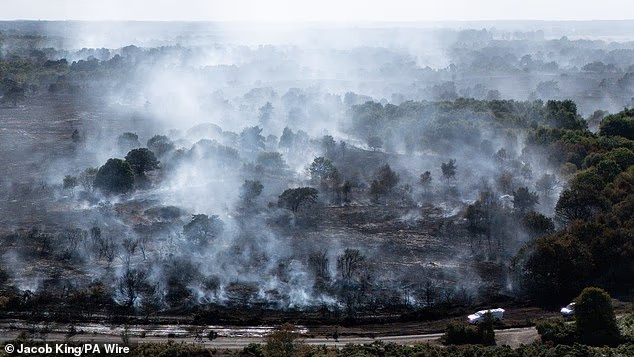
The wildfire on Dunwich Heath (pictured on Friday) is still smouldering. Hundreds of people were evacuated from their homes under police escort
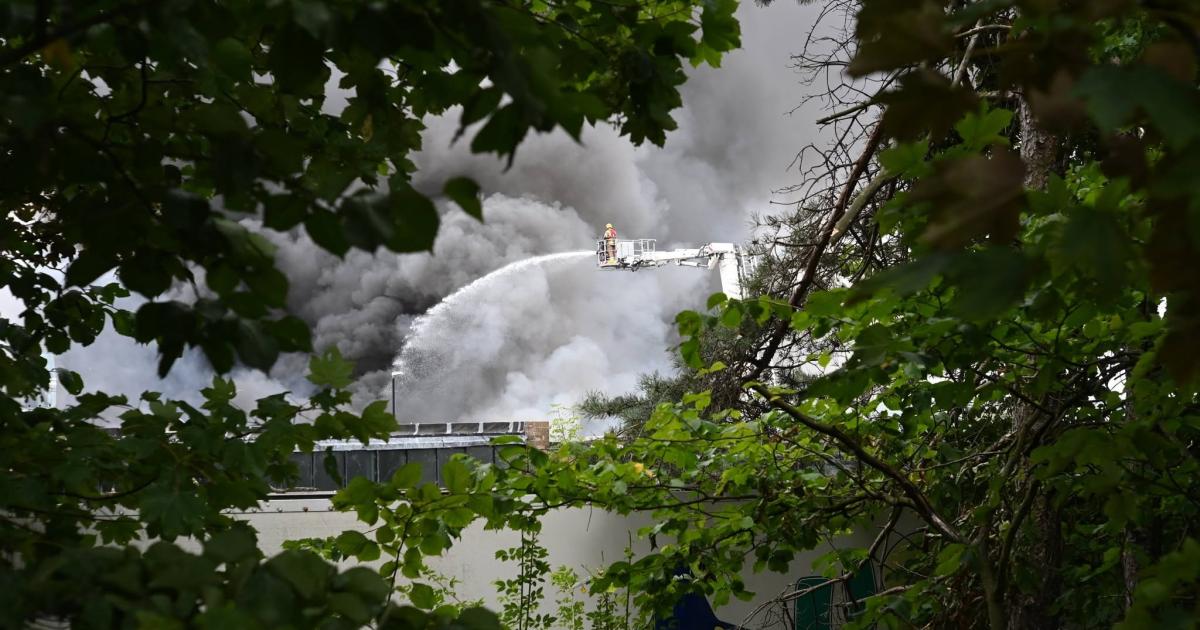
Firefighters remain at the scene on Saturday and told people to continue to avoid the area
Ralph Fiennes, 63, was born in Ipswich and owns a country house near to the heath
The Harry Potter star is being given updates by the fire brigade, who are still at the heath battling the wildfire in reduced numbers for the fourth day.
The source told the Sun: ‘We don’t know if Ralph was at the house on Wednesday as he has a place in London, but it must have been an anxious time for him.
‘He’s lived here for years and we see him out jogging from time to time.’
The National Trust announced a public appeal last night to restore the reserve, launching an emergency fundraising drive to help recover the damage.
National Trust director-general Hilary McGrady described the loss of the important habitat, which was home to rare species, as ‘heartbreaking’.
The charity said the heath was a significant area for wildlife including nightjars, skylarks and the rare Dartford warbler, as well as adders, lizards and slow worms, and butterflies including the rare silver-studded blue.
The lowland heath habitat is one of the UK’s rarest and an estimated 92 per cent of it has been lost in England over the last 120 years, it added.
In a statement on Friday, Ms McGrady said: ‘We are looking at total devastation of a beloved and important landscape.
The National Trust launched an emergency fundraising appeal on Friday night after the fire left the landscape ‘devastated’
Fire engines seen near the front line in the fight against the Dunwich wildfire on Wednesday
The fire was declared a ‘major incident’ earlier this week due to its size and intensity
‘We’ve lost precious habitats, wildlife, trees, and a place where people have made memories over generations. It’s heartbreaking.
‘But together we can and will restore Dunwich and, crucially, make it more resilient and better adapted for the climate we’re facing now, and the climate we’ll be facing in future.
‘We’re working hard to tackle climate change and prepare for more of it, but there’s more hard work to be done.
‘We can’t do it alone. We’re a charity that relies on public support in so many ways. If you can donate, however much, please don’t hesitate.
‘Your money will go directly to the restoration of Dunwich, to regrow habitats and homes for wildlife, build more resilience into the landscape, and return this iconic place to the nation.’
Firefighters were able to reduce the number of appliances tackling the blaze in Suffolk to fourteen on Saturday. It was reduced further to eight for overnight operations after ‘positive firefighting action…and the creation of further firebreaks’ on Friday.
In an update on Saturday morning, Suffolk Fire and Rescue said: ‘With the weekend here, we continue to ask members of the public to avoid the area and keep roads clear for emergency vehicles. Local roads and footpaths remain closed.’
In southwestern France, wildfires have been raging for over a fortnight
Thousands of people have been evacuated from their homes in the region. Pictured: flames spread on the hills behind a home in Montfort-sur-Argens on Friday
Aerial footage of the scene shows the once grassy, coastal area known for its carpet of purple heather reduced to a charred, barren landscape, which is still smouldering.
Crews continued to battle the blaze on Friday, and evacuated residents and holidaymakers were given a short window of opportunity to collect essential belongings under police escort.
Firefighters across the country have been tackling similar but smaller fires.
More than 20 fire services have been responding to fires amid hot and dry conditions which have left half of England and all of Wales in drought.
Crews in Lincolnshire, Derbyshire, Cheshire, London, North Wales, Yorkshire, Co Durham and Darlington, Berkshire, Leicestershire, Bedfordshire, Greater Manchester, Hampshire and the Isle of Wight, Humberside, Dorset and Wiltshire, Devon and Somerset, Nottinghamshire, Cambridgeshire, Kent, Merseyside, West Sussex, Surrey, and Norfolk have all reported dealing with fires in the open.
On Tuesday, the National Fire Chiefs Council said more than 200 wildfires had been reported in England and Wales in less than two weeks, and wildfire risk remained ‘elevated’.
In Europe, wildfires in France, Italy and Spain are still raging and have forced a mass exodus of locals out of their homes.
Wildfires tore through southwestern France this week and became so intense that they triggered a rare fire-generated thunderstorm – a phenomenon never before recorded in the country.
Experts said it was another sign that Europe is entering a new era of extreme wildfires.
While wildfires have long been a part of Europe’s landscape, rising temperatures are making them larger, more unpredictable, and harder to control.
At the start of this week, the D106 highway, a 41-mile route which links the Cap Ferret peninsula with the city of Bordeaux in south-western France, was the epicentre of the unprecedented wildfire.
The blaze ravaged an area four times the size of Paris and forced more than 260,000 people to be evacuated from their homes.
More than 240 properties were completely destroyed – many thought to be holiday homes owned by millionaire Parisiennes and celebrity second homes.
George Clooney and his wife Amal were among those evacuated from their luxury French estate after a fast-moving wildfire raced towards their home.
The Hollywood actor, 65, and human rights lawyer Amal, 48, fled their sprawling property near Brignoles as flames swept through the area on Wednesday evening.
The couple, who have nine-year-old twins, said they feared for the future of their home as France continues to battle some of the worst wildfires in its history.
In a letter to the mayor of Brignoles, Clooney wrote: ‘At this point we have no idea whether our beautiful home makes it through this terrible moment.’
‘Amal and I are committed to making sure that whatever happens to our village, we are part of this community and we’ll be part of making it whole,’ he added.
The mayor of Brignoles, Didier Bremond, said the Clooneys were not ordered to leave but chose to evacuate as a precaution.
The wildfire burning near Brignoles, in south-eastern France, scorched 321 acres and forced more than 600 residents to flee their homes, local officials said.

































































You must be logged in to post a comment Login