

NewsBeat
Plans to turn George Hotel Malton into pizza restaurant

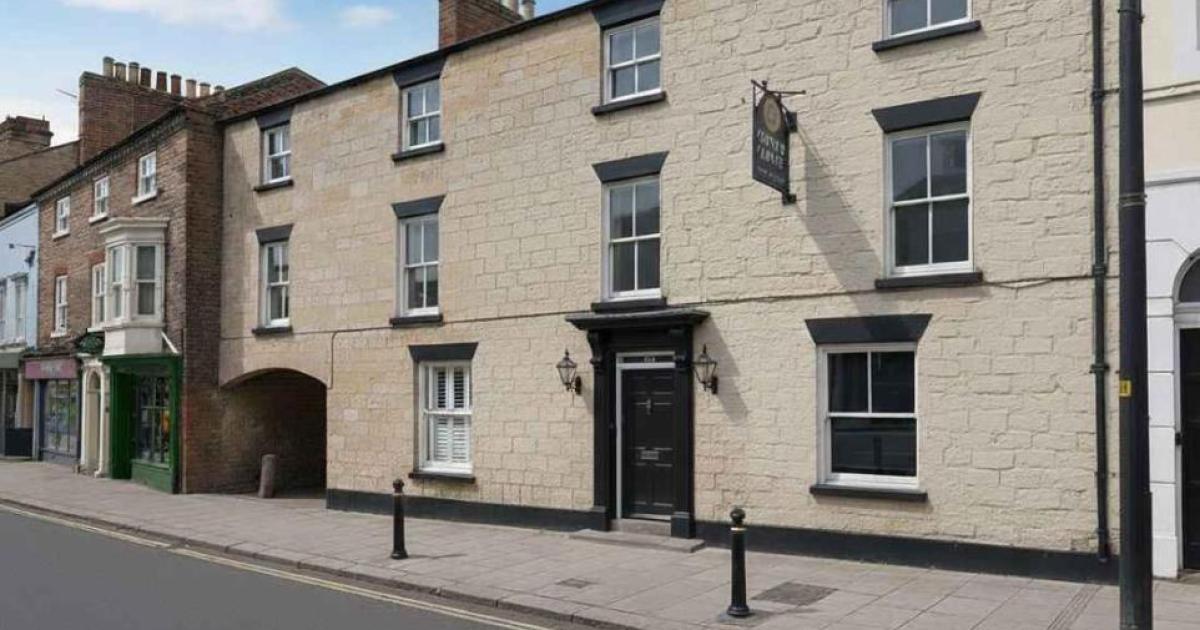
Change of use and Listed Building Consent is being sought for The George Hotel in Yorkersgate, Malton, which has been empty for a number of years.
The plans include the change of use of the building to include a pizza restaurant, licensed bar, takeaway, collection and food delivery.
The application, to North Yorkshire Council, by Ms Mariana Horea, co-owner of Da Elia Pizza & Restaurant in Malton.
Da Elia was recently shortlisted in the Best Restaurant/Food Business category in the UK Small Business Awards.
Originally set up as a food van the business moved to Castlegate in April 2024.
The restaurant has since introduced dine-in, takeaway, and delivery services.
The former George Hotel, a Grade II Listed building, is owned by the Fitzwilliam (Malton) Estate which has previously said it intended to undertake a number of works to the property prior to the start of a new lease.
Marketed by agents Fleurets as a ‘substantial three-storey mid terraced property’ the pub has been extended to the rear with a two storey and single storey sections of mixed construction.
Fleurets said: “The business is ideally suited to a variety of operational styles benefitting from its central location within the town and easy access from public car parks, bus and railway stations. Likely to be a wet focussed operation it has a lot of accommodation above that would be suited to hotel rooms or Air BnB accommodation.
“The ground floor is partly open plan with a “U” shaped bar in three areas all connected to a large servery to one side. Ladies & Gents customer toilets and a small domestic grade kitchen.
“On the first floor are four en-suite letting bedrooms. The second floor has three-bedroom private accommodation.
“In the basement there is a beer store with ground level access from the rear and three store rooms. The annex has three en-suite letting bedrooms accessed from a public car park. At the rear there is a small car park and garden area.”
Fleurets said: “The Landlord intends to undertake a number of works to the property prior to commencement of the lease. These include external repairs including an upgrade of the frontage and ensuring the property is compliant – gas, electricity, fire alarms, emergency lighting and asbestos management.”
Two objections have currently been received for the application which is expected to be decided at officer level.
Continue Reading
NewsBeat
How popular is your – and your child’s – name? Use our search tool to see which baby names truly set you apart from the crowds…
NewsBeat
Noel Gallagher pleads for Man City NOT to be punished with club facing threat of relegation as superfan opens up on his ‘shock’ after learning of bombshell 115 verdict
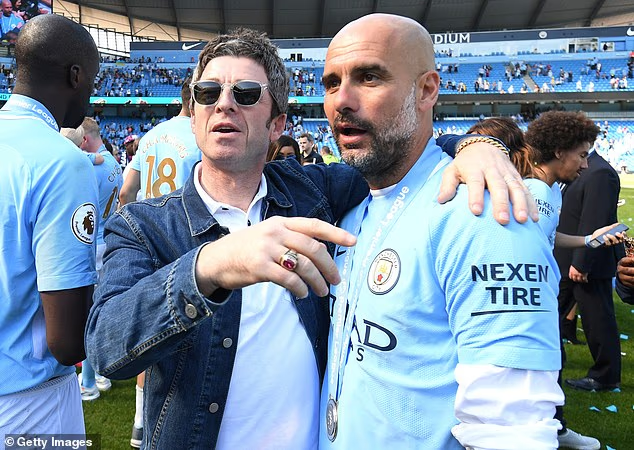
Oasis superstar and Manchester City fan Noel Gallagher has pleaded for mercy after his club were found guilty of the vast majority of the 115 financial charges levelled against them.
Gallagher, alongside brother and bandmate Liam, is a big City fan and regularly attends games with his sons.
He is also close friends with former manager Pep Guardiola, and went into the club’s dressing room after they won the 2018-19 Premier League title.
Gallagher has been left reeling after it was revealed that City have been found guilty of the vast majority of the 115 financial charges against them – casting doubt on the legitimacy of their trophy-laden spell under the club’s Abu Dhabi ownership.
The Oasis songwriter revealed he has been left in ‘shock’ by the verdict, but implored football’s decision-making bodies not to punish the supporters or players for ‘whatever goes on in the boardroom’.
‘A little surprised because only that the club has assured us all along that they would vehemently deny any of these charges,’ he said on the Let Me Talk podcast.
‘So it was a bit of a shock to find out we’ve been found guilty of all but one but really overall quite sad really, sad for the fans and for the players.
Noel Gallagher, a close friend of Pep Guardiola, says the fans and players should not be punished after City were found guilty of the vast majority of the 115 charges
‘Our focus as fans is always on the pitch and we know what we saw: they won it on the pitch. Whatever goes on in the boardroom it’s nothing to do with the supporters or the players, the players won the game and won that (2011-12) title on the pitch.
‘Whether some of those players should have been there or not, that’s nothing to do with the fans. We were there, we know what we saw. Does it taint it? I suppose in the eyes of everybody else in England it would but I know what I saw and I know what I felt.’
City are set to appeal the decision but any punishment is now expected to follow, with some fans calling for the club to be stripped of the trophies they won at the time.
There had initially been confusion around the time period that the charges relate to, with the initial offences ranging from the 2009-10 season to the 2017-18 campaign.
There are then further charges surrounding failure to comply with the investigation, which range from December 2018 to February 2023.
It remains unclear what any punishment could be, though the threat of relegation appears a legitimate possibility.
Gallagher joked a fortnight ago that his ‘heart is full of pride’ after his 15-year-old son flipped his middle finger at Man United fans during City’s derby win at Old Trafford.
Sonny Gallagher celebrated alongside his brother Donovan, 18, and their Oasis rockstar father Noel, 59, in the stands 62 minutes into the game, with City a man down after Phil Foden‘s red card.
The teenager flipped off rival fans in the stands and jeered as star striker Haaland netted in the second-half what later proved to be the winner.
- READ: The clubs who could seek compensation as Premier League sides consider legal action after Man City found guilty of vast majority of rule breaches – and what happens next: Key questions answered
NewsBeat
The clubs who could seek compensation as Premier League sides consider legal action after Man City found guilty of vast majority of rule breaches – and what happens next: Key questions answered
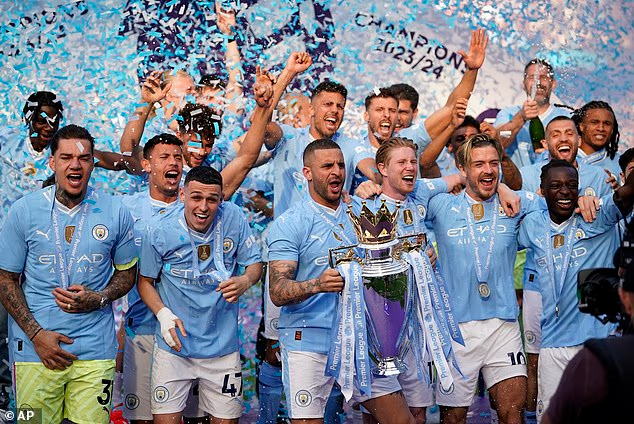
Manchester City have been found guilty of the vast majority of their rule-break charges concerning the Premier League’s financial regulations.
The competition accused the club of widespread financial cheating over an era of sustained success – with an independent panel hearing concluding in 2024.
The long-awaited verdict has now been reached with the belief it is a victory for the Premier League, despite Man City having strenuously denied the charges.
The verdict could lead to a variety of punishments including huge points deductions, financial penalties, and even relegation.
Daily Mail Sport’s Mike Keegan provides answers to the key questions, including the next steps, Man City’s expected appeal and how serious the punishment could be.
Manchester City have been found guilty of the vast majority of their 115 Premier League rule-break charges
WHAT DOES IT MEAN?
This cannot be viewed as anything other than an overwhelming victory for the Premier League.
To see Manchester City found guilty of the ‘vast majority’ of the 115 charges is an outcome that Richard Masters will no doubt see as vindication for what has been a costly, long-running legal battle in which the stakes were incredibly high.
It is safe to assume that had the tables turned the other way, the chief executive would have been in P45 territory.
More important than that, those who City feel were the key protagonists, the so-called ‘Red Cartel’, will also feel vindication.
To put it simply, Manchester City have been found guilty of cheating their way to success between 2009 and 2018, a period when they dominated English football.

The verdict cannot be viewed as anything other than an overwhelming victory for the Premier League and its chief executive Richard Masters
WHAT HAPPENS NEXT?
There has been no statement from the Premier League, while City’s only says that the process remains ongoing and is subject to strict confidentiality.
What is clear is that City will appeal. What is not clear is whether the sanction will drop before any appeal.
WHAT ARE THE PUNISHMENTS?
Take your pick. Hefty points deductions, potential relegation and transfer bans are all on the table. Rule W51 in the Premier League handbook states ambiguously that ‘such other penalty as it shall think fit’ is an option.
There is, however, a scepticism among some, based on a lack of noise from many of the other clubs and the lenient punishment recently handed to Chelsea that whatever penalty lands will not see City stripped of titles or relegated. ‘They’ll get a slap on the wrist and ordered to pay legal costs and not much else,’ one exec predicted.

The verdict could lead to a variety of punishments including huge points deductions, financial penalties, and even relegation
HOW DOES AN APPEAL WORK?
In all likelihood City will appeal and recent cases tell us that they tend to be dealt with expeditiously.
An appeal board would be set up, appointed by the chair of the panel and, again, featuring three people. Some feel that this would be an exercise in the Premier League marking its own homework.
At this early stage, it is worth an assumption that City could argue the panel was not impartial. The bad news for them, however, is that this is a high bar to clear.
Unlike City’s case with UEFA, it cannot go to the Court of Arbitration for Sport (who overturned UEFA’s findings).
WHAT ABOUT COMPENSATION?
Last year, in a move believed to have been instigated by former Arsenal chief executive Tim Lewis, the Gunners, Tottenham Hotspur, Liverpool and Manchester United served legal notices reserving their right to take action.
Should the verdict stand, they will then seek damages for a wide variety of issues. The most costly claims are likely to come from those who say they missed out on Champions League qualification during the period in question thanks to City’s law breaking. But the scope would not end there.
Clubs could also, for example, argue that as a result of the breaches they were unable to sign a calibre of player that would have allowed them to be more successful on the field. Some believe £200m would not be out of the question, but that remains to be seen.

Ex-Arsenal chief executive is understood to have instigated a move last year that saw the Gunners, Tottenham, Liverpool and Man United served legal notices reserving their right to take action
WHAT ABOUT THE INDEPENDENT FOOTBALL REGULATOR?
Perhaps unsurprisingly, the Regulator declined to comment when contacted by Daily Mail Sport. However, David Kogan will be well aware of the situation.
The IFR was brought in for a variety of reasons, not least to ensure that those owning the nation’s football clubs were fit and proper to do so. The IFR would have the power to force City’s owners to sell, but such a scenario is viewed as unlikely.
DIDN’T CITY TRIUMPH OVER THE PREMIER LEAGUE RECENTLY ON SPONSORSHIP RULES?
They did, with three senior judges deeming the rules unlawful. As a result, a series of amendments were made. City again launched a legal challenge, but surprisingly came to an agreement with the Premier League in September. Those cases, however, were always separate to the 115, as it became known.
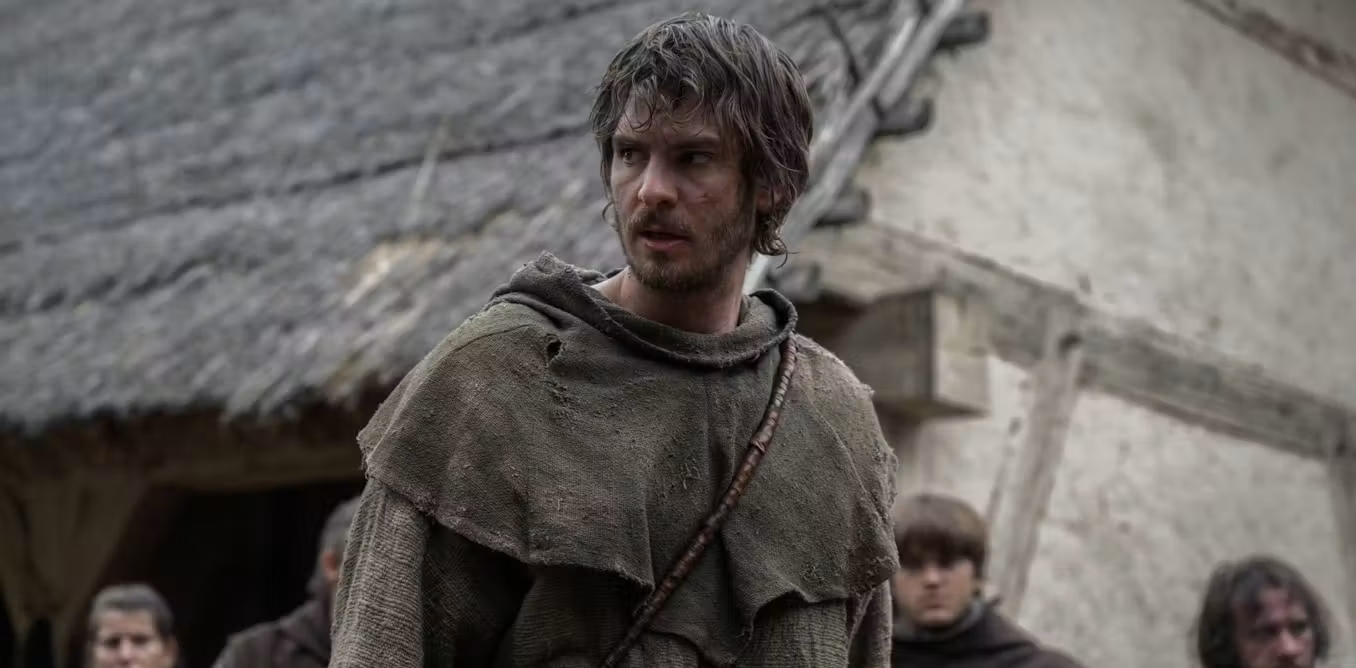
The Uprising, a medieval drama directed by Paul Greengrass and starring Andrew Garfield, is set to hit cinemas this autumn. The film draws its inspiration from the Peasants’ Revolt of 1381 in England.
The studio’s synopsis presents the uprising as a “rebellion against the tyranny of King Richard II”, with Garfield leading “an army of the people to face the king’s might in a fight for justice and survival”. Yet medieval accounts of the uprising describe the rebels as loyal to Richard.
The Anonimalle Chronicle, an anonymous 14th-century account written at St Mary’s Abbey in York by a probable eyewitness of the revolt, reported that the rebels had a watchword among themselves. The challenge was “with whom haldes [holds] yow?” – to which the appropriate reply was said to be: “Wyth kynge Richarde and wyth the trew communes [commoners].” Anyone who provided the wrong answer was said to have been put to death.
What, then, were the aims of the rebels portrayed in the film, and why were they seemingly so loyal to the king?
À lire aussi :
Who were the ‘peasants’ of the 1381 Peasants’ Revolt? New database has answers
The aims of the rebels
The uprising of 1381 was in part caused by widespread discontent at government corruption. Richard succeeded to the throne in 1377 at just ten years old. His young reign was largely overseen by his uncle, John of Gaunt, and royal councillors.
The hundred years war (1337-1453) between England and France was going badly for the English cause, and the crown needed to raise money. It turned to a new form of taxation. The deeply unpopular “poll taxes” were raised three times in five years (1377, 1379 and 1381) – the last of which triggered the uprising.
Medieval chroniclers had little sympathy for the rebels. Yet even the Anonimalle Chronicle reported that it seemed the taxation “had not been properly or honestly collected, but had been raised from the poor people and not the rich to the great profit and advantage of the collectors”.
The rebels did not blame the king himself, but rather those around him who had misspent this money. This was a common political tactic in medieval England, whereby critics of the government blamed the king’s corrupt advisers.
During the parliament of Edward III’s reign in 1376, it had been claimed that various people “have in their hands without the king’s knowledge his wealth and treasure”.
Similar complaints were made in 1381. The Anonimalle Chronicle reported that the rebels said they had risen to save the king, “and to destroy traitors to him and the kingdom”.
The rebels had very specific targets in mind. They destroyed the Savoy Palace in London belonging to John of Gaunt, along with his household possessions. In his contemporary chronicle, Henry Knighton described how one rebel stole a fine piece of silver there – only to be thrown into the fire by other rebels who said “they were lovers of truth and justice, not robbers and thieves”.
British Library
The rebels besieged the Tower of London and managed to enter it. Among others, they seized and beheaded the archbishop of Canterbury, Simon Sudbury, who was also the chancellor of England, and Sir Robert Hales, the treasurer of England. Both men were held directly responsible for the poll taxes by the rebels.
Thomas Walsingham, a 14th-century monk of St Albans Abbey, questioned how the rebels managed to extract them from the tower. He claimed there were 600 men at arms and 600 archers garrisoned there – and accused them of cowardice, saying they were “inclined to appear more like the dead than the living” in allowing the rebels to take the officials.
When the king finally met the rebels at Mile End, the Anonimalle Chronicle reported that the rebels were said to have knelt before him, saying: “Welcome our lord king Richard, if it pleases you, and we will not have any other king but you.”
An end to serfdom
The rebels’ complaints went far beyond government corruption. They also wanted an end to all serfdom.
Serfs were forced to work the land for their lords and had many legal restrictions on their lives. Serfdom was seen as degrading and heavily resented by the peasantry.
Some of the demands of the rebels included that there should be no outlawry – a harsh legal penalty which meant anyone was technically allowed to kill an outlawed criminal. They also demanded that there should be no lords except the king himself; that the goods of the church be divided among the people of the parish; and that there should be no serfdom but that all men should be free.
They also targeted written records. The Anonimalle Chronicle reported that they “burnt all the register books and chancery remembrancers’ rolls” they found at Lambeth Palace. And they destroyed Temple Bar, including the “many muniments which the lawyers were keeping in custody”.
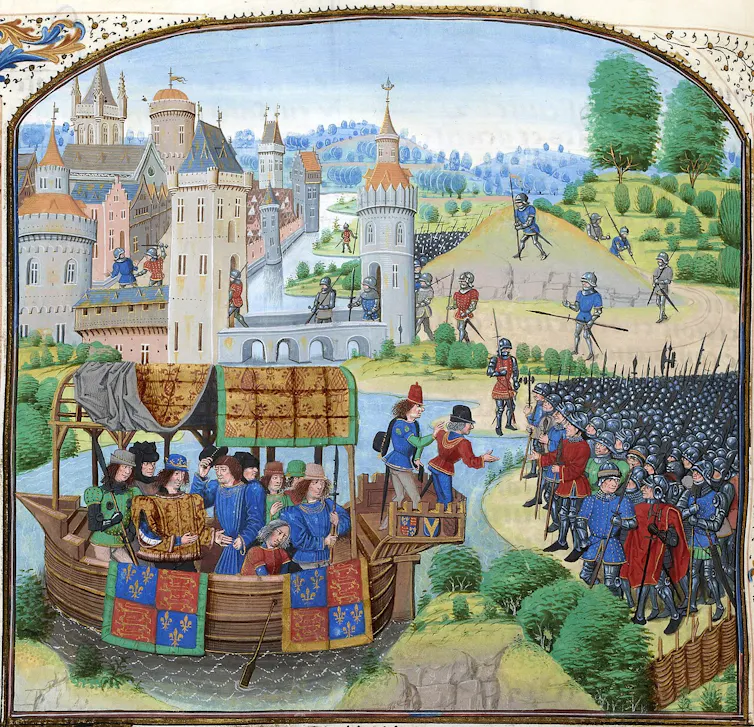
Bibliothèque nationale de France
The young king Richard acceded to many of the rebels’ demands. Knighton described how the king granted a charter under his great seal “declaring that all men in the realm of England should be free”. After the suppression of the uprising, however, the charter was “quashed, annulled and adjudged worthless”.
The uprising was unsuccessful in many of the rebels’ aims. It was harshly suppressed and many of its leaders were tried and executed. Wat Tyler, a key leader of the revolt, was killed by William Walworth, the mayor of London, at Smithfield.
Yet the rebels had found their voice, one which resonated across England. The poll taxes were, after all, discontinued – and would not to be resurrected for centuries. Serfdom, already in decline, withered and died.

Tyson Fury has claimed the fight at the Principality Stadium is now in serious jeopardy and blamed Eddie Hearn
Tyson Fury’s blockbuster fight with Anthony Joshua could collapse in what would be a huge blow to Cardiff and the Principality Stadium.
The long-awaited Battle of Britain was only officially confirmed on Wednesday, with Fury and Joshua due to meet at the Principality Stadium on December 11 in what promised to be one of the biggest sporting events ever staged in Wales.
But just over 24 hours later, the fight has been thrown into chaos after Fury claimed Joshua and his promoter Eddie Hearn are now refusing to fight and a replacement bout is being looked at.
The dramatic developments have raised fresh doubts over whether the heavyweight showdown will actually go ahead in Cardiff, with a dispute over the involvement of UFC president Dana White could threaten the £150m blockbuster.
Respected boxing journalist Mike Coppinger of The Ring reports the fight could be called off because of “issues”, with a replacement fight involving Terence Crawford and Ryan Garcia being considered.
Fury fighting unified cruiserweight champion David Benavidez is also said to be another option being discussed.
Then, overnight, Fury launched a furious attack on Joshua and Hearn in a series of videos posted on Instagram.
“Breaking news, AJ and Eddie are trying to pull out of the fight,” Fury said. “They’re saying they are not going to fight now.
“It’s mainly to do with Eddie Hearn’s ego. He’s making up a million different things.”
Fury then directly addressed Joshua, saying: “AJ, pull your finger out you little white-flagged, yellow-bellied coward.”
He also warned that Saudi boxing supremo Turki Alalshikh was now looking at alternatives.
“Now you’ve got Turki Alalshikh finding alternative real men who will fight at the drop of a hat,” Fury added.
In a second video, Fury again blamed Hearn’s dispute with White for putting the fight at risk.
“So Eddie Hearn’s ego is trying to cost us and all the boxing fans around the world, the fight the whole world has been waiting for over a decade,” he said.
“And it is all because Eddie doesn’t want someone in the building. It’s pathetic and childish.”
Hearn has insisted that White cannot be involved in the contest because of the terms of the contract signed by Joshua.
White, who runs Zuffa Boxing alongside Alalshikh, has been billed as the lead promoter for the showdown, with Wednesday’s official announcement stating that Alalshikh and White “will collaborate to promote this historic showdown”.
However, Hearn was not named in that announcement and has publicly maintained that White cannot be involved.
The dispute has now spilled into the open, with Alalshikh appearing to back White by posting a picture of the UFC boss smoking a cigar on social media.
Fury also posted a mocked-up fight poster featuring himself against Benavidez, appearing to hint at a possible replacement for Joshua.
The possibility of the Fury-Joshua fight disappearing from Cardiff would represent a huge blow to the Welsh capital, which only secured the contest after a lengthy battle over its location.
Hearn had initially pushed for Wembley Stadium, while the Saudi backers behind the fight had explored the possibility of staging it in New York.
But Cardiff’s Principality Stadium ultimately won the race, with its retractable roof and willingness to accommodate a late-night finish securing the event.
The fight is expected to have a ring walk around 2am to suit the American audience for its Netflix broadcast.
It was supposed to be a spectacular night for Cardiff, with tens of thousands of fans expected to descend on the Welsh capital for the first meeting between two of Britain’s biggest heavyweight stars.
Instead, the event has been plunged into uncertainty before the fighters have even faced each other at a press conference.
For Cardiff, the stakes are significant.
The Principality Stadium has previously hosted some of the biggest nights in British boxing, including Anthony Joshua’s world heavyweight title fight against Carlos Takam and Joe Calzaghe’s famous fight against Mikkel Kessler in 2007.
But Fury against Joshua had promised to take things to another level, with the two most recognisable British heavyweights of their generation finally meeting after more than a decade of anticipation.
The contest is understood to be worth around £150m, with Fury and Joshua each expected to pocket around £75m.
The event will also have brought a huge international audience to Cardiff, while providing a major boost for the city’s hospitality sector.
Fury and Joshua are due to attend a pre-fight press conference in London on September 30.
At the weekend, I did my best to include the fullest range of eating out experiences possible.
Saturday morning took me to Newcastle University for a game of hockey. The post-match refreshments were tomato soup and a Greggs sandwich platter. Verdict: Soup perfectly acceptable, sandwiches okay, but I was hungry again half an hour later.
Saturday afternoon, and it was back down the A1 for nine holes of golf followed by a buffet tea at Masham Golf Club. Verdict: Absolutely splendid, with masses of different hot and cold options, salads, meats and fish, including a lovely salmon dish that melted in the mouth.
Onto Sunday, and it was a roast chicken dinner courtesy of my mam. Verdict: excellent, as always. Fluffy Yorkshire puds, tasty sage and onion stuffing, and masses of gravy.
Monday morning found me at Caffe Nero in Northallerton for coffee and a pastry (and to make use of the free Wi-Fi while my car was getting its MoT). Verdict: good service and I appreciated the offer to warm up my pain au chocolat.
MoT done, was I ready to retreat home and do some eating in? Not a bit of it. It was onwards to Thirsk to try out a relatively new café which a friend had mentioned was worth a visit.
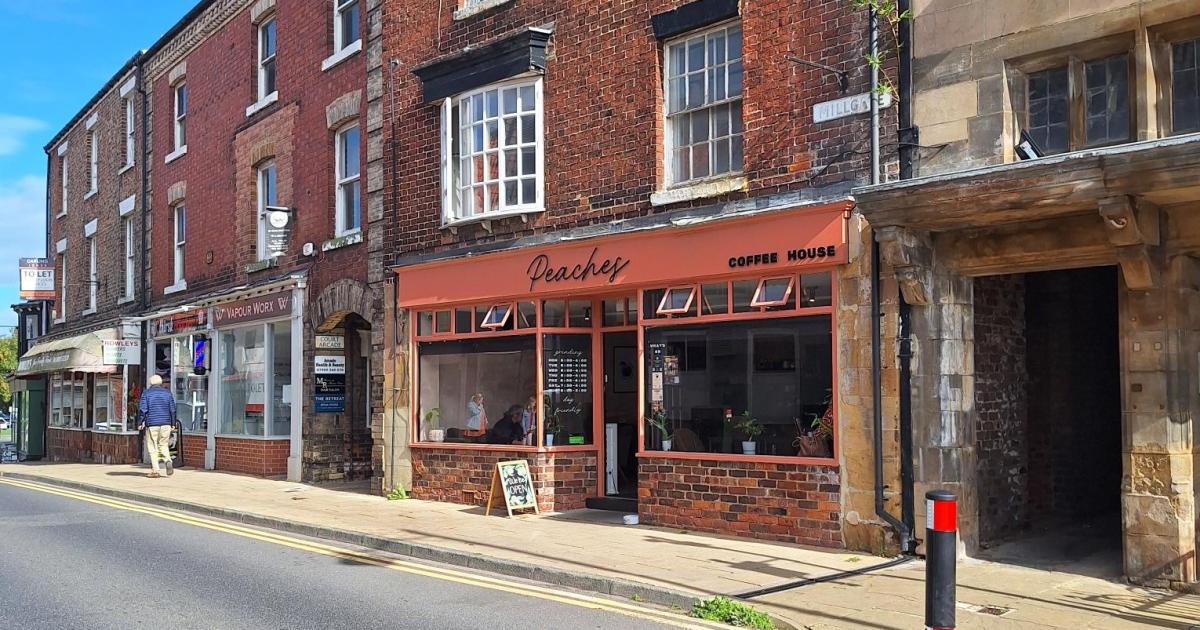
Peaches Coffee House has been up and running on Millgate, almost in the corner of the Market Place, since February.

Millgate is choc-a-block with cafés, but has it reached saturation point? Not if Monday was anything to go by—all were busy with customers, many enjoying the September sunshine on a bustling market day.
Peaches certainly has kerb appeal, because it is so, well, peach, the vibrant colour-scheme standing out from the crowd.
Inside, I got a friendly greeting and sat myself down at the only free table.
At the time I called in (just after 11am) the menu offered various breakfast bowl options, with a plethora of different add-ins, plus flatbreads, bagels, sourdough and croissants, all with choices of a base (avocado, hummus, pesto, chutney, mustard, mayo or butter) and two toppings (five different cheeses, meats, spinach, roasted veg, red onions, sun dried tomatoes etc).
The main counter, meanwhile, offered up a mouth-watering selection of cakes, pastries and bagels.

After a run of meals with limited decision-making being required on my part, I was a bit overwhelmed by the choice. Would a pesto base work with pastrami? Would avocado sit well with feta and gherkins?
My powers of reason deserted me, so pretty much at random, I ordered a flatbread with hummus, mozzarella and roasted vegetables (£10.50) to be served hot, and a coffee. Perhaps not traditional late-morning fare but I reasoned that after an early start, it was near enough lunchtime.
The flatbread arrived after a short wait and, piping hot, it was served with fresh spinach and coleslaw. My random topping choices turned out okay—the melted mozzarella combined well with the roasted peppers, onions and courgette, while the generous covering of nutty hummus stopped the whole thing from becoming too dry.

Filling, but also quite light, it was truly delicious.
The cake counter called to me as I was leaving, and after a thorough examination of the various traybakes, I decided to stick with the theme of the place and got a peach muffin to take away.
Enjoyed later with a cuppa, the chunks of fruit added a lovely flavour to the plain sponge, while the drizzled icing managed not to detract from the sweetness of the peach.

The total bill came to £19, good value I thought, and the service was spot-on. Everyone got a friendly greeting as they arrived, and many people seemed to be on first name terms with the servers.
I hadn’t noticed a couple of crumbs on my table, but between my coffee arriving and my meal being delivered, the chap looking after me came over to give it an extra wipe clean. Many places might not have bothered.
Back out into busy market place, and it was time for the verdict: Peaches is most certainly bearing fruit for Thirsk‘s thriving café culture.
Peaches Coffee House,
2 Millgate, Thirsk YO7 1AA
Open Monday-Friday, 8am to 4pm, 7.30am to 4pm Saturdays and 8am to 2pm on Sundays.
https://www.facebook.com/p/Peaches-Coffee-House-61584980821099/
Ratings (out of ten): Surroundings 9 Value for money 8 Service 8 Food quality 8

Following the success of last year’s Malton Regency Ball, Malton Museum have organised two evenings of Georgian excellence, with proceeds going to the museum.
The weekend will commence on Friday, October 9, in the Milton Rooms with a sumptuous night of Regency music and dance.
Less formal than its city counterpart, a country ball gave people the opportunity to come together to dance and socialise in the eighteenth and early nineteenth centuries.
Recreating the country ball experience, there will be live music from Ebor Quartet and dance expertise from Dance the Past’s Lottie Adcock.
Continuing the Regency experience, York House will host a soirée the following evening.
More intimate than a ball, a Regency soirée is an opportunity to socialise in an informal yet elegant setting. Ebor Quartet will once again provide music, and a light supper will be served, along with period games and entertainment.
Attendees needn’t be dance experts, as Lottie will be leading the steps in each of the dances, and, while Georgian costume is encouraged, it is not essential, in what promises to be two delightful evenings immersing yourself in the Regency era.
Local businesses have generously donated raffle prizes, which includes an afternoon tea for two at the Old Lodge, and two Town Tour tickets from Malton Museum; one of the main prizes includes a first edition of Frederica, a Regency novel by Georgette Heyer and signed by Sir Stephen Fry, whose favourite author is Heyer. Meanwhile, Kemps currently have a resplendent window display ahead of the local Regency events.
Malton Regency Ball organiser, Annette Mitchell, said: “Last year’s Malton Regency Country Ball was such enormous fun that we had to repeat the experience.
“Lottie and the string quartet are ready, and we are busy polishing the 50-plus candelabras, making new dresses, and practising our steps.
“This year, by request, we have extended the Regency revels to include an intimate Soirée the following night with supper and entertainment at York House. (A small Queen Anne Hunting Lodge). No dance experience necessary; all welcome to join in the Regency fun.”
Malton Museum Co-ordinator, Emily Moore, said: “This year’s Malton Regency Weekend is set to be a great one. Whether you are looking for something a bit more intimate like the Soirée or something on a larger scale in the Country Ball, it will be a weekend filled with elegant dancing, proper socialising and period fun.”
Carriages arrive at 7 pm and leave by 10.30 pm.
Tickets are available to purchase on the Malton Museum website, with a discount offered if both nights are purchased. Ticket holders will also receive a special discount at The Talbot Hotel if they seek accommodation.
For more information, call into Malton Museum or visit the website: https://www.maltonmuseum.co.uk/regency-weekend/
All proceeds support Malton Museum’s tireless work in caring for and sharing Ryedale’s past.
NewsBeat
Wars in Europe and the Middle East. An economy in intensive care. Masked mobs inciting violence and AI threatening our very survival. And what does Andy Burnham offer us? Fluff, hype and beers!: MICHAEL GOVE

The world convened this week to scan a horizon bleaker and darker than any we have known for nearly a century.
Economic turmoil. War and rumours of war. Grim intimations of humanity’s erasure at the robotic hands of artificial intelligence.
These were the challenges which pre-occupied the leaders who gathered for the United Nations General Assembly over the past five days.
And our own Prime Minister? Well, Andy Burnham offered his – very personal – view of how to break free from history’s constraints and reshape embattled Britain this week. By announcing he wanted to bring back boozing on football terraces.
Given all the inequalities and injustices scarring our world, the PM had lighted on the one scandal that required action this day. He could down a pint while watching rugby league in the stands at Everton’s Hill Dickinson stadium but not when the round ball game was on.
But he would bring back hope, one glass of Boddingtons at a time.
Martin Luther King marched on Washington because he had a dream of a future free of prejudice. Ronald Reagan went to Berlin and pledged to tear down that wall. Margaret Thatcher emerged from the wreckage of the Brighton bombing to affirm that democracy would never bend to terror. And Andy Burnham returned from the UN determined to get one in for the lads.
Andy Burnham offered his view of how to break free from history’s constraints and reshape embattled Britain. By announcing he wanted to bring back boozing on football terraces
It is hard to overstate how serious are the crises facing our country – and the world. And even harder to credit how inadequate the British Government’s response appears to be.
The country’s vital national interests – our prosperity and security – are engaged and threatened by wars in Europe and the Middle East. Our economy is in intensive care, with our debt problems metastasising. Growth is anaemic and almost all the vital signs are negative. We are haemorrhaging tax income as the wealthy flee and the talented look elsewhere.
The country they leave behind is increasingly polarised, with masked mobs on extreme Left and Right inciting violence while a toxic identity politics spreads online targeting Jews and questioning the patriotism of past prime ministers based on their skin colour.
Artificial intelligence is ushering in changes to how we live, work and perhaps even endure, more momentous than any previous industrial revolution. Scientists call it a Cambrian moment, recalling the geological age when the globe was convulsed, species became extinct and a new world emerged.
Faced with these swirling, accumulating, dangerously connected crises, our Government meets in Liverpool this weekend for the Labour Party conference proclaiming ‘Hope Again’ – but their programme is a confection of irrelevant trivialities and counter-productive nostalgia, without either the intellectual depth or moral grit to meet this moment.
When we faced our Darkest Hour in 1940, Churchill promised we would get through it with blood, sweat and tears. Labour are now offering us fluff, hype and beers.
In his first few weeks in power, Andy Burnham sought to offer balm for our economic pain – capped bus fares, a few quid off the gas and leccy bills, better terms on our Netflix deal. But these interventions do not begin to address, indeed they even seem to belittle, the scale of the storm our finances face.
As a country we owe our debtors £3 trillion, almost equivalent to everything – everything – our country produces in one year. That is £100,000 per household.
The amount we pay just to service that debt is £100 billion every year. That means for every £100 you pay in tax, £10 goes to international financiers with no benefit to Britain at all.
Money that could be spent on health, education or defence only going to make investment institutions richer. And that amount is rising – as the price we pay to service that debt is going up, because those financiers feel our Government is fundamentally unserious about addressing that burden by bringing spending down.
The moment of truth will come at the Budget, fixed for just over a month’s time. So far remarkably little has leaked about the Government’s proposals for that reckoning with fiscal reality.
But that is not because there is Fort Knox-like security over the Chancellor’s masterly planning. It’s because there is no plan. And therefore nothing to leak.
As The Spectator’s Political Editor Tim Shipman revealed this week in a brilliant inside report, Treasury civil servants have been given next to nothing to work with by their political masters to deal with our crises. Instead of the Chancellor pulling rabbits from his hat on Budget day, he is the rabbit – frozen in the headlights of the oncoming debt juggernaut.
One of the biggest weaknesses in our faltering economy is the high level of energy prices. They spiked after the war in Ukraine ended access to cheap Russian oil and gas for Europe. And now oil and gas supplies from the Middle East are choked off as the Islamist ideologues in Iran and their Houthi allies have their bloody grip on vital waterways in the Persian Gulf and Red Sea.
Our position was already perilous: thanks to Ed Miliband’s policies, in Britain we have the highest business energy costs of any developed economy. That is the main cause of manufacturing decline in contemporary Britain. And a daily undermining of Andy Burnham’s nostalgic dream of re-industrialising the country.
But there is some relief visible on the horizon. I can see it from the bedroom of my mother’s home in my native Aberdeen. Thanks to North sea oil and gas, Britain used to be a net energy exporter.
Millions of barrels of both oil and gas are potentially extractable from the Jackdaw and Rosebank fields in Scottish waters. Ed Miliband has, in the past, set his face against any use of those riches because of net zero fundamentalism. Andy Burnham may have moved Miliband from the energy department but he has not moved an inch towards liberating those resources.
Join the discussion
Is our government failing us by prioritising trivial issues over real crises facing Britain today?

Smoke billows above the city after Russia struck Kyiv, Ukraine, in a renewed attack on petrol stations, shipping and railways which left at least two dead on September 23
A decision on both fields has been delayed, yet again, for fear of offending north Londoners who might vote for Zack Polanski in the Holborn and St Pancras by-election because Andy Burnham isn’t Lefty enough.
When Margaret Thatcher was doing what was unpopular, but right for the economy and country, in the early 1980s, she wasn’t deterred by by-election losses: the Lady was not for Turning. Andy Burnham is not so much turning as burning through any credentials for strong leadership he once had.
Because it’s not just on energy that he has put placating the Left ahead of what is right for the nation. The ill-judged sanctions he and Ed Miliband have imposed on Israel may have pleased the Guardian newspaper but they have profoundly disheartened the guardians of our security.
As the Chief Rabbi warned, they have been welcomed by Islamist fanatics. Earlier this week I was in Manchester, speaking to a Jewish community still mourning those killed by terrorist violence at Heaton Park synagogue a year ago.
As we gathered, news had broken of another planned massacre of Jewish citizens in Manchester which had just been averted by swift police action. The third such terrorist atrocity planned against that population in as many years.
It is terrible beyond words that the Government, even as its foreign policy is cheered by Hamas, has to spend millions more on higher walls and more policing to protect our Jewish neighbours.
But none of us are immune from escalating risk. As Tim Shipman also reported, in another chilling dispatch for The Spectator, security chiefs and even diplomats have warned ministers that these sanctions undermine the security and defence co-operation which we and our Gulf allies need in ever more dangerous times. Hamas exultant, Iran defiant, Houthis rampant – but our Government more concerned that it is getting favourable social media clicks from Corbynites. TikToking our way to oblivion.
The security situation we face is not an easily containable single threat which can be massaged away by the new ‘disinformation unit’ the PM announced this week as our contribution to protecting the West.
Both the Polish and French Presidents warned their peoples this week of accumulating dangers from Russia – now locked in an alliance of subversion with Iran and North Korea and bankrolled by totalitarian China.
It was revealed on Thursday that Russia has been preparing the capability to launch drone strikes against France, Italy and Spain from the ships of its ‘shadow fleet’ – an armada of tankers and other vessels which it operates under foreign flags of convenience. The Russian shadow fleet is bigger than any nation’s navy. And it operates by stealth and subterfuge across the globe. Russia is also paying for organised crime groups to conduct sabotage across the West while vital infrastructure – from Germany’s airports to our own cyber network – comes under assault.
This week Sky TV has been screening an exercise – the Wargame – in which I and other ex-politicians run through the options available to this country in the face of Russian escalation.
The most chilling moment was the bald revelation from General Sir Richard Barrons – the man this Government asked to lead a review of our defences – that we have at best two weeks’ fighting capability in our armed forces.
Ukraine has now been under attack from Russia for more than four years. We can only defend ourselves for 14 days. The need to rebuild our defence and security structures has never been more vital than at any time since 1938. But the money we need just isn’t there – when debt is ballooning – without steep spending cuts.
Kemi Badenoch has argued, rightly, that means reining back welfare so we can keep our country safe. But Andy Burnham has said he will not cut social security to fund national security. He will carry on paying general personal independence payments to people who choose not to work while the independence of our nation itself is increasingly put at risk.
And this blind attachment to high state spending, endorsed by union cheers and hard-Left applause, is a descent into socialist nostalgia just as the foundations upon which our economy and societies have been built are being re-modelled at warp speed.
Artificial intelligence, as I said, is a technology whose progress is accelerating beyond the control and understanding of even the most brilliant Silicon Valley sages.
Again this week, the Australian Government found it had been hacked by rogue technology created by Sam Altman’s OpenAI lab without any human either authorising, or being aware, of what was going on before it was too late.
This is only the latest break-out by AI agents, after the infamous recent Hugging Face hack, which has generated understandable fears of a technology we have created becoming not a powerful tool for progress but a force that will humble us all.
The parallels with the ‘gain of function’ research into viruses in Wuhan labs which prefaced the Covid pandemic should give us all reason to question whether we can truly control what science can unleash. The finest minds in the tech world are almost at one in arguing that we need guidance and guard-rails across nations to ensure that this amazing computational power can be a force for good – solving problems, curing diseases, improving productivity – rather than a scourge.
Even as they accumulate huge wealth and power themselves, they fear for the future. With Trump apparently heedless of the risks, and China’s Xi determined that his nation should not fall behind in any tech race, the risks are enormous. But here in Britain, Andy Burnham’s first act was to dismantle the government department charged with shaping our response to this challenge and leave it all to one junior minister.
A previous Labour leader, Michael Foot, made his journalistic and political reputation during World War 2 when he authored a furious polemic – The Guilty Men – naming and shaming those who had failed to prepare Britain for the horror and bloodshed of global conflict.
Now our current Labour leadership risk becoming the Guilty Men of their time. Like the hollow politicians of the Thirties, they allow economic whirlwinds to blow while pouring themselves another comforting drink, they fear to rouse us to resolute action because the political time is not yet ripe, they prioritise the appearance of relatability over the substance of hard decision-making.
In the words of one of the few politicians in the Thirties equal to its dangers, Winston Churchill, this Government is ‘in strange paradox, decided only to be undecided, resolved to be irresolute, adamant for drift, solid for fluidity, all-powerful to be impotent’.

Coleen Rooney has been in the public eye for over 20 years due to her romance with husband Wayne
Coleen Rooney opened up about the importance of staying grounded after her relationship with husband Wayne was thrust into the spotlight. The reality TV star and the Manchester United icon met as schoolkids before beginning their 24-year romance at 16.
It didn’t take long for the duo to be pushed into the limelight, as Wayne established himself as one of the brightest young talents in England during his time with Everton. The former England captain was just 18 when he secured a £27million transfer to Manchester United in 2004, with Coleen by his side every step of the way.
Like most couples, the pair have had their trials and tribulations and have come out stronger despite them. Ahead of the premiere of their upcoming Disney+ docu-series The Real Rooneys, they’ve opened up about their life being played out in public for more than two decades.
Coleen was at the forefront of the significant media attention on the WAGs in the United Kingdom during Rooney’s time at Old Trafford. Dealing with the tabloid press became a regular occurrence for the mother of four, who cited her time knowing Wayne before he reached superstardom as a key aspect of their relationship standing the test of time.
In an interview with the Guardian, she was asked what advice she’d offer to someone who was starting a romance with a famous footballer, to which she answered: “Well, the bonus for us was that we knew each other before Wayne was a footballer.
FOLLOW OUR MAN UTD FB PAGE! Latest United news and more on our dedicated Facebook page
“The biggest thing for us was to stay grounded, and we’ve had really good support around us. The people you have around you are really important because the media can destroy young people.”
Coleen offered insight into Wayne’s character, admitting that the football icon can be too quick to anger. She explained: “Wayne is funny and laid-back. He can be a charmer, but can have a short temper.”
Coleen shot to fame five days before her 17th birthday, when Wayne scored his famous late winner against Arsenal to become the youngest goalscorer in Premier League history.
She suddenly found herself stalked by paparazzi while going to school, and when recounting the experience, she said: “It is strange to think that I was literally walking to school. But that shows you how the media were then. Who takes pictures of a kid going to school? It was very intrusive.”
The family’s new show will offer fans a deep look into the home life of Wayne, Coleen and their four sons – Kai, Klay, Kit and Cass.
The Real Rooneys (Episodes 1–8) launches on Disney+ on September 24.
NewsBeat
Once rejected as ‘too outlandish’, Zandra Rhodes’ archive is helping to shape fashion’s future

As a student in the 1960s, Zandra Rhodes would often visit the costume court of the Victoria and Albert Museum in London to study the Elizabethan doublets. She went on to incorporate elements of Tudor costume into many of her couture collections.
Now things have come full circle. As an icon of British fashion – and a dame – Rhodes’ collections are providing inspiration for a new generation of students. Upon receiving her honorary doctorate of the arts from De Montfort University (DMU) in 2023, Rhodes announced her decision to donate her archive to the university.
These remarkable archives are at the heart of a major new public exhibition across the DMU campus. The University Gallery will explore Rhodes’ creative process and design collaborations with brands such as Ikea, Marks & Spencers and TopShop.
De Montfort University, Author provided (no reuse)
The University Museum will also present an in-depth study of her autumn/winter 1983 Medieval Collection. Together, these displays draw on material from the Zandra Rhodes Foundation’s donation to reveal both the breadth of the designer’s career and the rich educational potential of her archive.
Rhodes originally studied printed textile design at the Royal College of Art in London. After graduating in 1964, she became frustrated with clothing manufacturers who considered her textile patterns too outlandish to use on their garments, so she decided to move into fashion design.
Rhodes ensured that each garment she designed would perfectly showcase her own textile prints. Her trademark diaphanous dresses have been worn by royalty and celebrities, from Princess Diana to Elizabeth Taylor and Debbie Harry. Rhodes herself embodies a flamboyant personal style and is famed for her bright pink hair, theatrical make-up and bold costume jewellery.
Fashion and textiles have been taught at DMU for over 150 years, from corsetry and footwear to knitwear and textile design. The university’s special collections hold numerous archives which reflect this background in fashion and textiles teaching.
Rhodes’ archive collection spans 1964 to 2021, and provides a wealth of useful material including: samples of mock-ups and final garments from ready-to-wear collections; documents that chart the development of a design from initial sketches through to fabric sampling, patterning, costing and marketing; press cuttings; photographs; and audio-visual recordings.
Exploring the creative process
Rhodes was very specific that her collection was to be used for teaching the next generation of fashion designers. We have been delighted to incorporate it into a wide range of teaching activities.
Beyond vague ideas about “vintage style”, few students will have considered using heritage or historic costume as inspiration for their own work, even though this approach is increasingly championed by the wider fashion industry.
The scope of Rhodes’ collection allows us to trace the development of a garment from initial conception to finished product, following the chain of design, production and marketing. Reviewing the methods and practices of a globally successful designer is invaluable to students who are at the very start of their own careers.
It demonstrates for them first-hand how much trial and error, collaboration and sheer effort goes into the creative process, and how the path from concept to completion is strewn with mistakes and revisions. That is a powerful lesson for students, who may mistake difficulties in their own work for a lack of talent. The archive shows instead that uncertainty and imperfection are normal parts of the creative process.
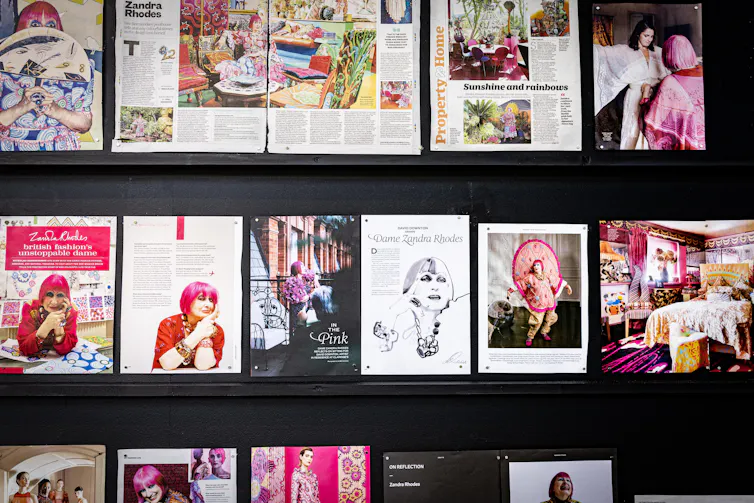
De Montfort University, Author provided (no reuse)
The value of hands-on learning
During archive sessions, we take an object-based learning approach. Students are encouraged to get hands-on with the garments and other items in the collection, analysing their cut, construction, materials, techniques, patterning, embellishment and visual impact. This champions the value of materiality in a digital, AI-driven age where many students experience fashion primarily through a screen.
We have also developed creative approaches to lessons that allow the students to engage with the archive in a stimulating way. Sketching from the archive helps build confidence in drawing, supported by seeing real examples of how vital drawing is to Rhodes’ practice.
In another exercise, students analyse the wide range of influences that inspire Rhodes’ pattern designs, from nature and landscapes to urban cityscapes, found objects and folk art. They then find and photograph their own inspirations and create their own Rhodes-inspired patterns.
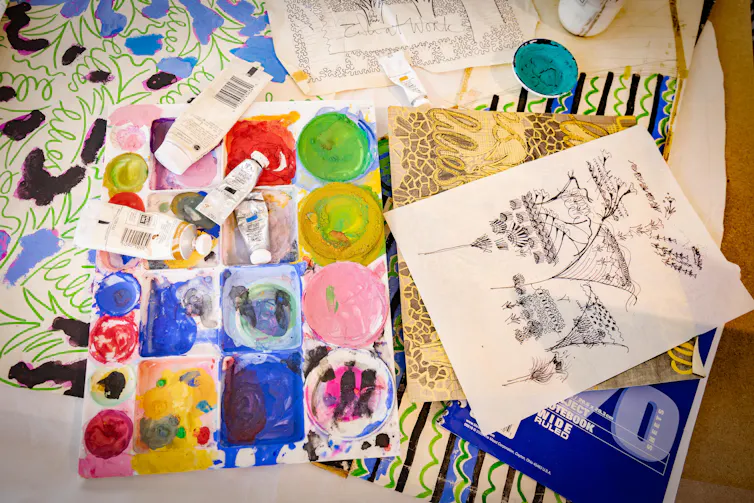
De Montfort University, Author provided (no reuse)
Adapting the Rhodes signature style
Academic staff collaborating with special collections have designed an increasing number of module assessments that require students to use the archive as direct inspiration for their own designed collections. This has expanded to include numerous design and creative subjects.
Footwear students have made Zandra Rhodes-inspired collections, while fashion marketing students have designed and promoted collaborations between existing brands and the designer. Elsewhere, students of the interior design theatre module have created stage sets drawing on her work on opera costuming, and museum design students have prepared proposals for exhibitions showcasing the archive collection.
Our work shows that there is significant benefit to students when they gain an understanding of creative processes and methods through hands-on handling of heritage collections and archival papers.
The excitement of our students when they encounter the Rhodes’ collection is palpable, and we have noted improvements to their work once they have been immersed in the archive.
One described experiencing the archive first-hand as a “really special moment. It was actually really moving being able to dive into someone’s work and life – it felt very personal.”
It is clear that having access to a rich and comprehensive fashion archive from a top British designer has the capacity to engage and inspire the upcoming designers of the future.
Zandra Rhodes: Archive Unfolded will be on show at De Montfort University, Leicester until January 16 2027

NewsBeat55 seconds ago
How popular is your – and your child’s – name? Use our search tool to see which baby names truly set you apart from the crowds…

Business2 minutes ago
DEA Warns of New Synthetic Opioid Cychlorphine, Said to Be 10 Times More Potent Than Fentanyl, Officials Say

Tech8 minutes ago
Quad Platina Review – Trusted Reviews





-

 Crypto World3 days ago
Goldman Sachs and Deutsche Bank Agree: The S&P 500 Rally Isn't Over
-

 Tech5 days ago
Researchers escape OpenAI Codex sandbox to run commands on host
-

 Fashion2 days ago
8 iPhone Accessories That Add Personality
-

 Crypto World5 days ago
Who Needs CLARITY Anyway? ARB Could See 70X Increase: Hodler’s Digest
-

 Tech7 days ago
Trump suggests rebranding AI with a new name, says he’s also creating an AI Force
-

 Business5 days ago
Analog Devices (ADI) Bets $1.35 Billion on Chips that Let Machines Think for Themselves
-

 Crypto World3 days ago
This Bearish Netflix Stock Trade Can Cash In On Video Streaming Giant’s Woes
-

 Crypto World5 days ago
Coinbase, Robinhood, Circle Seen as Tokenized-Stock Winners
-

 Entertainment3 days ago
These 17 Fall Amazon Dresses Seriously Look Like Anthropologie
-

 Crypto World4 days ago
Trump-Xi Polymarket Odds for Handshake Hit 50%
-

 Tech5 days ago
Google’s $899 Googlebook is a bet that you’ll buy a new laptop for Gemini
-

 Crypto World2 days ago
Crude Oil Prices Pressured by Diplomatic Hopes in the Middle East
-
 Business3 days ago
Oil Price Today (September 23): Crude oil below $100 on hopes of US-Iran talks. What did Trump say?
-

 Crypto World2 days ago
Bitcoin price tests $83,600 Supertrend support after $87K rejection
-
 NewsBeat7 days ago
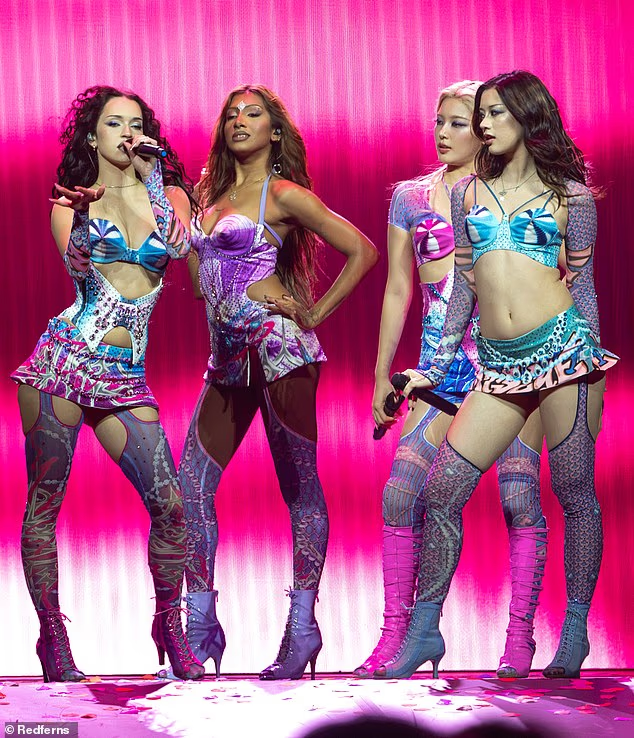
Ed Sheeran protegees Katseye UNFOLLOW star… days after Macklemore was dropped from his tour over Free Palestine remarks
-

 Crypto World2 days ago
Bitcoin Threatens Sub-$84,000 Breakdown as Long Liquidations Spike
-

 Crypto World4 days ago
Meta Jumps 11% As Muse Shines and Investors Show an Appetite for Advancing AI
-

 Crypto World3 days ago
Did Jim Cramer Just Give GameStop Stock the Kiss of Death When He Said the Turnaround Is Working?
-

 Crypto World5 days ago
Bitcoin price holds above $81K as key catalysts line up
-

 Crypto World5 days ago
ARB Price Signals Spur Speculation of 70x Upside in Hodler Digest
You must be logged in to post a comment Login