



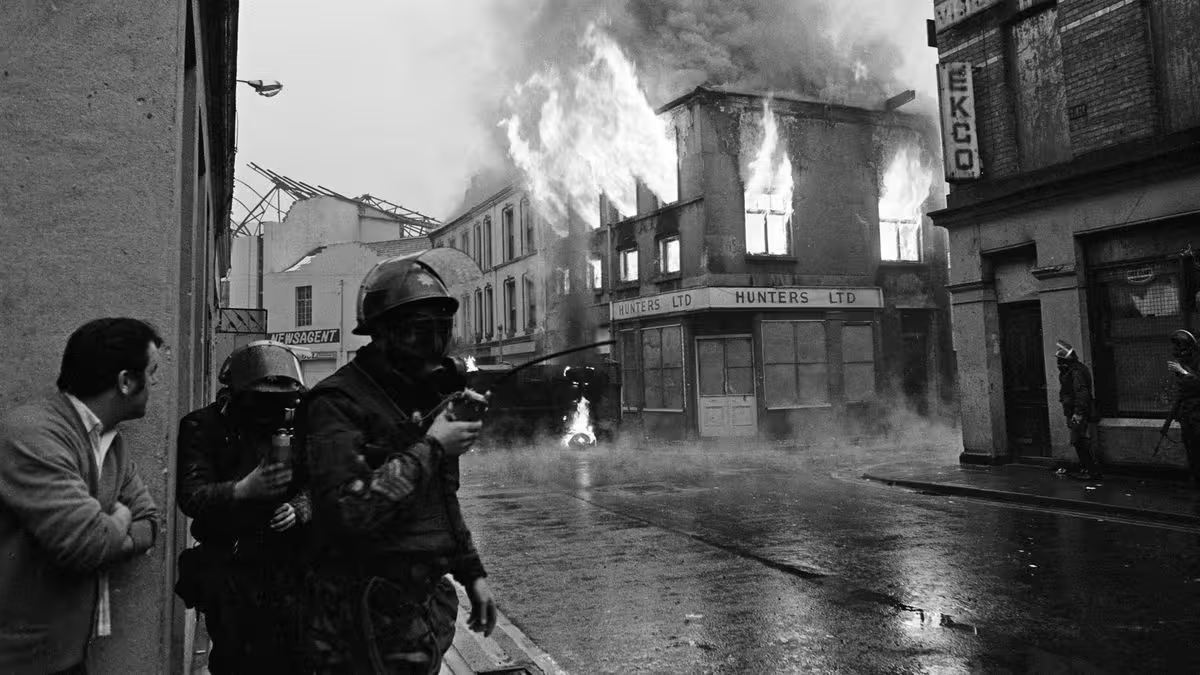
During a recent visit to Belfast, Prime Minister Andy Burnham said the Bill, currently at committee consideration stage, would return to Parliament this autumn.
The Government should consider requiring the consent of the Attorney General to prosecute future offences related to the Northern Ireland Troubles, a Westminster joint committee has recommended.
The Joint Committee on Human Rights (JCHR) said improvements must to be made to the Northern Ireland Troubles Bill.
Committee chairman Lord David Alton said the legislation has to secure the confidence of those it impacts and said the importance of getting it right “cannot be understated”.
Labour introduced the Bill to replace the previous government’s controversial Legacy Act, elements of which were deemed in court judgments to be incompatible with human rights commitments.
Labour’s Bill, agreed as part of a joint framework with the Irish Government, will put in place a reformed Legacy Commission with enhanced powers.
As part of its legislative process, MPs have already backed a remedial order which removed the measures in the previous Act providing conditional immunity from prosecutions for Troubles-era crimes in exchange for co-operation with a truth recovery body, as well as scrapping a bar on future legacy compensation cases.
During a recent visit to Belfast, Prime Minister Andy Burnham said the Bill, currently at committee consideration stage, would return to Parliament this autumn.
The JCHR report scrutinises whether the Troubles Bill is compatible with the UK’s domestic and international human rights framework, and examines its wider implications.
The committee expresses “deep concern” about the use of the remedial order which was laid before Parliament as “a stop gap” between the old and new legislation.
The committee said the Government’s justification for using the order because the matter was urgent “has not been reflected in its speed in advancing the remedial order”.
The report has also recommended improving the independency of the proposed new Legacy Commission and the decision-making process around the disclosure of sensitive information.
It said the definition of “close family member” should be widened to ensure that other family members are not excluded.
The report has also asked the Government for more information to justify decision making on issues including the two different approaches for revived inquests and the use of information submitted to the Independent Commission on Information Retrieval.
The Government has pledged to provide “effective protections” for military veterans who served in Northern Ireland during the Troubles in its new legislation.
The committee said it “acknowledges the sincerely held concerns of veterans today that legal processes involved in inquests, civil claims and criminal prosecutions are having a negative impact on the lives of individuals”.
It added: “Where, in rare circumstances, there are allegations of profound, even lethal wrongdoing, they must be properly investigated.
“The Bill’s approach must ensure that those investigations are carried out in a manner which is fair to all those involved.
“The Government should consider adding provisions to the Bill to require the consent of the Attorney General to prosecute any future Troubles-related offences.
“This could add an extra layer of accountability for prosecution decisions in this sensitive area.”
The committee also raises concerns about the failure of Westminster and the Northern Ireland Executive to agree on who should be funding legacy matters.
It said: “ The Troubles Bill will not be able to succeed without adequate financial support being given to all organisations affected by it.
“Dialogue should continue to resolve the impasse on funding.”
Lord Alton said: “This Bill is an improvement on what came before it, but our report has found areas where it must be improved further.
“This isn’t just about making sure the right legal and procedural frameworks are in place.
“It is about making sure it is in the best position to secure the confidence of those it impacts from the start and over the long-term.
“The importance of getting this Bill right cannot be understated.”
Lord Alton said “flaws” in the previous Legacy Act “contributed to a decade of lost progress”.
He said: “Time is running out for those still dealing with the legacy of the Troubles to find out what happened and hold people accountable.
“We cannot have further delay.”
The joint committee said it will conduct further work on the Bill when further amendments are made in the continuing legislative process.
A UK Government spokesperson said the Bill is needed to “get answers for the families who lost their loved ones during the Troubles, including the relatives of veterans who were killed”.
The spokesperson added: “To that end, the Government welcomes the scrutiny of the JCHR, and its recognition that the Bill is a significant improvement on the failed Legacy Act.
“We will create a framework that commands greater public confidence, including bringing forward a significant package of amendments following extensive engagement with veterans.”
For all the latest news, visit the Belfast Live homepage here and sign up to our daily newsletter .



























































You must be logged in to post a comment Login