Rogue barber shops, vape stores, mini-marts and sweet shops across the region linked to organised crime will be hit
Police are to be given a funding boost in a major crackdown on ‘dodgy’ shops across Greater Manchester. Organised crime gangs operating across the region will be hit by the new offensive as part of the national plans to shut down the illegal operations.
Advertisement
The Home Office said rogue barber shops, vape stores, mini-marts and sweet shops across Greater Manchester linked to organised crime will face raids, closures and seizures. It is part of the £20 million of funding for the High Street Organised Crime Unit for the national crackdown on money laundering and illegal working.
The unit is to provide national backing to the immediate funding for UK regions with the some of the highest levels of high street organised crime, which includes Greater Manchester as well as the West Midlands, Kent and Essex, it was announced.
Click here to get the biggest stories straight to your inbox in our Daily Newsletter
Across Greater Manchester, additional funding will support enforcement activity in Rochdale, Bury, and Bolton. They are the areas identified as containing the highest levels of high street organised crime activity by the National Crime Agency (NCA).
Advertisement
Under Operation Machinize, Greater Manchester Police carried out more than 120 visits to high-street premises, made 14 arrests, and disrupted dozens of illicit businesses across the region.
According to the Chartered Trading Standards Institute, up to half the number of ‘mini-marts’ and vape shops in parts of the UK are estimated by trading standards officials to have links with organised crime. Around a third of ‘American’ sweet shops and a quarter of fast food takeaways are also estimated to have links with organised crime in some areas.
Advertisement
And the NCA estimates at least £12bn of criminal cash is generated in the UK. Money is often laundered through high street shops like mini-marts, barber shops, vape stores and sweet shops to hide profits. Some businesses are also connected to the sale of fake goods, tax evasion, illegal working and illegal drug supply.
The move is expected to see thousands of businesses raided, with hundreds of arrests made and millions in cash seized nationally.
Security Minister, Dan Jarvis, said: “Criminal groups are using seemingly legitimate businesses across Greater Manchester as fronts for serious organised crime, money laundering, and illegal working.
“We are backing Greater Manchester Police with new funding, better intelligence, and more officers to target these criminal enterprises.
Advertisement
“The High Street Organised Crime Unit will bring together law enforcement, government, and local authorities to put these criminal groups out of business and restore confidence on our high street.”
“Starmer sabotages Burnham on Brexit” is the Daily Telegraph’s lead story. It writes that Prime Minister Sir Keir Starmer “has raised the prospect of rejoining the EU” while Greater Manchester Mayor Andy Burnham “seeks to keep Leave voters on side”, despite his “previous desire to reverse the 2016 referendum”. Sir Keir has been seeking closer ties with the bloc but has stuck to Labour’s election manifesto pledges to “stay outside the EU”, with “no return to the single market, the customs union, or freedom of movement”.
“I won’t walk away” is how the Daily Mirror quotes Sir Keir in its headline, describing his message to Labour colleagues as “defiant”. It reports the prime minister “rejects call to set out departure timetable”, despite pressure from some Labour MPs and senior ministers. The front page also embeds a photograph showing Alan Titchmarsh, David Beckham and King Charles III at the Chelsea Flower Show, with the caption “best of buddies”.
The incident happened in Walmgate at 12.15am on Sunday (April 26).
North Yorkshire Police say four people received minor injuries and one required hospital treatment for concussion.
Recommended reading:
Advertisement
A force spokesperson said: “A man was trying the car doors of a white vehicle parked in Walmgate.
“The man then assaulted and verbally abused people who have gone on to challenge him.”
A man in his 20s was arrested in connection with the incident but has since been bailed while police enquiries continue.
Officers have released images of the man they would like to speak to about the incident.
Advertisement
A force spokesperson added: “Please email nicola.russell@northyorkshire.police.uk if you recognise the man pictured, or have any information that could help our investigation.
“Alternatively, you can call North Yorkshire Police on 101.
“If you would prefer to remain anonymous, you can contact Crimestoppers on 0800 555 111 or make an online report.
“Please quote reference 12260074715 when passing on information.”
The new Discover the Magic show skates into NI this December
Disney On Ice returns to Belfast with a brand-new magical adventure this festive season.
Advertisement
Discover the Magic will bring unforgettable memories to guests through dynamic moments on the ice and in the air, delivering compelling storytelling through multi-levelled production numbers.
Mickey Mouse, Minnie Mouse and friends from the Disney Kingdom come together to bring timeless tales to life from Thursday, December 3 to Sunday, December 6 at The SSE Arena.
The first phase release of tickets will go on sale this Friday, May 22 from Ticketmaster.
A spokesperson said: “Join Mickey Mouse and his friends at Disney On Ice presents Discover the Magic, an adventure filled with world-class skating, high-flying acrobatics and unexpected stunts!
Advertisement
“Look for clues in the search for Tinker Bell through immersive, fantastic worlds. Explore the colorful spirit realm of Coco, sail away with Moana as she bravely saves her island, see Belle in the sky as the enchanted chandelier comes to life, and sing along with Elsa in the icy world of Frozen. Watch Stitch crash the action with mischievous surprises.
“Make memories during Aladdin, Toy Story and The Little Mermaid as the search party becomes an all-out celebration!
“The production will skate into Belfast from Thursday 3rd December to Sunday 6th December 2026.”
The Islamic Center of San Diego will be closed until further notice, calling the shooting “an extremely painful and traumatic day for our congregation, students, staff, and the broader San Diego community.”
It asked the public to keep victims in their prayers, avoid speculation, and rely on authorities to sort out what happened and why.
“Places of worship are meant to be spaces of peace, prayer, reflection, and community,” the statement said.
Advertisement
“Violence and hatred have no place in our society.”
Longevity experts list a healthy diet, an active lifestyle, and adequate sleep as well-researched ways to increase your odds of a longer life.
But if you’re looking for a more recreational buffer against ageing, a new paper published in Innovation in Ageing has found that people who engage with the arts tend to age more slowly.
People, especially over-40s, who regularly engaged with culture had lower biological ages at the DNA level, and appeared to age 4% more slowly.
The benefits are “comparable to [those] found in previous studies between current smokers and ex-smokers,” University College London (UCL), whose researchers wrote the paper, said.
Advertisement
How often people attended cultural events seemed to matter
The research, which involved 3,556 adults in the UK, found that, like exercise, regularity mattered.
Those who engaged with the arts (including by reading, listening to music, going to an art gallery, and/or taking trips to museums) at least once a week seemed to see the most benefits (4% slower ageing).
The authors also found that attending a cultural event once a week was as beneficial for those who usually never attended any, as exercising once a week was compared to physically inactive people.
Advertisement
Meanwhile, participants who did an arts activity at least three times a year aged 2% more slowly. For those who did so once a month, that rose to 3%.
And the study’s lead author, Professor Daisy Fancourt, said that frequency wasn’t the only factor to consider. Variety might matter, too.
“Our study also suggests that engaging in a variety of arts activities may be helpful,” she shared with UCL.
“This may be because each activity has different ‘ingredients’ that help health, such as physical, cognitive, emotional or social stimulation.”
Advertisement
Why might the arts help us to age better?
This paper didn’t seek to find that out. It just found a link, not a cause.
Nonetheless, senior study author, Dr Feifei Bu, said: “Our study provides the first evidence that arts and cultural engagement is linked to a slower pace of biological ageing.

“This builds on a growing body of evidence about the health impact of the arts, with arts activities being shown to reduce stress, lower inflammation and improve cardiovascular disease risk, just as exercise is known to do.”
Advertisement
Professor Fancourt added, “These results demonstrate the health impact of the arts at a biological level. They provide evidence for arts and cultural engagement to be recognised as a health-promoting behaviour in a similar way to exercise”.
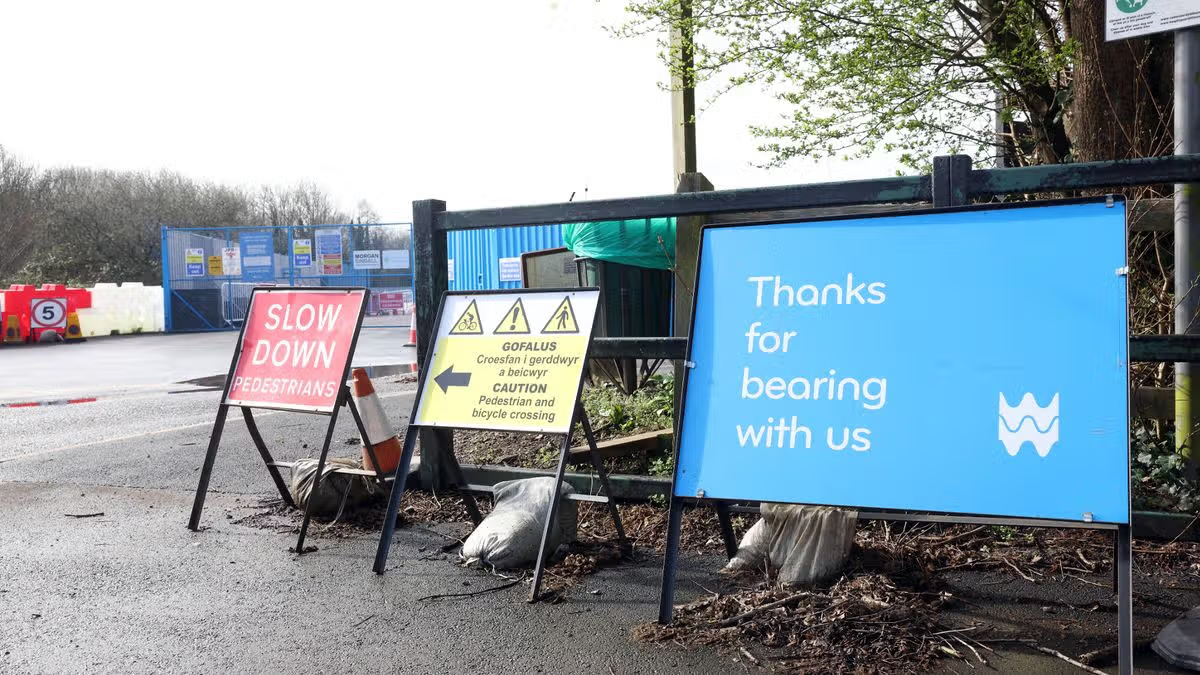
Emergency services were called to Murrayfield Primary School in Blackburn just after 7.15pm on Saturday, May 16.
An investigation is underway following a fire at a West Lothian primary school last week.
Advertisement
Emergency services were called to Murrayfield Primary School in Blackburn just after 7.15pm on Saturday, May 16. Two fire appliances were dispatched to battle the blaze.
The blaze destroyed playground equipment, and left windows in the nursery block damaged due to the intensity of the flames.
Pictures issued by West Lothian Council show piles of charred, blackened material on the ground, and the glass cracked in the affected windows.
However, there was no internal damage and nobody was injured.
The local authority confirmed the school, which is closed on Monday for a local holiday, will re-open as normal on Tuesday, May 19.
A statement read: “There was a fire at Murrayfield Primary School in Blackburn on Saturday evening. Thankfully nobody was hurt and the damage is limited to the destruction of some playground equipment and four windows in the nursery block that have cracked due to the intensity of the flames.
“The playground will have to be cleaned up and the windows replaced, but there is no internal smoke damage and the school will re-open as normal.
Advertisement
“Fire crews were in attendance and the cause of the fire is being investigated.”
A Scottish Fire and Rescue Service spokesperson said: “We were alerted at 7.17pm on Saturday, 16 May, to reports of a fire affecting a wooden play hut at Murrayfield Primary School in Blackburn.
“Operations Control mobilised two fire appliances, and the fire was extinguished.
Advertisement
“There were no reported casualties, and crews left the area after ensuring it was safe.”
Writing on social media, the president said he had been asked by the leaders of Qatar, Saudi Arabia and the United Arab Emirates “to hold off on our planned Military attack of the Islamic Republic of Iran, which was scheduled for tomorrow, in that serious negotiations are now taking place, and that, in their opinion, as Great Leaders and Allies, a Deal will be made, which will be very acceptable to the United States of America, as well as all Countries in the Middle East, and beyond”.
For most of the 20th century, the model of human origins was a tree: with the trunk dividing into branches, and then twigs. Each species of human relative (hominin) was a neat, single branch.
As an undergraduate, I was taught that Homo sapiens was one of these branches that emerged in Africa, spread across the world, and displaced every archaic human it encountered.
Neanderthals, Homo erectus, and other ancient relatives were evolutionary dead ends – unfortunate cousins who left no descendants. In the 30 years since I left university, those early lessons are now radically revised.
That neat replacement story is now comprehensively wrong, largely thanks to studies like the one published in Nature this week by Qiaomei Fu from the Chinese Academy of Sciences and colleagues. The paper achieves something that would have seemed impossible a decade ago: it recovers meaningful biological information from H. erectus fossils far too old for DNA.
Advertisement
Instead of genetic sequences, the team extracted ancient proteins from the enamel of six teeth from three Chinese sites – Zhoukoudian (which, in the early 20th century, produced fossil remains known as “Peking Man”), Hexian and Sunjiadong – all dating to around 400,000 years ago.
Homo erectus is widely regarded as the first hominin to leave Africa; the evidence suggests this species had moved into Eurasia nearly two million years ago. It remains the most geographically widespread human ancestor that ever lived. The new study indicates that Homo erectus exchanged genes (probably through interbreeding) with Denisovans in East Asia roughly 400,000 years ago.
A tooth from the Zhoukoudian site in Beijing that was used in the analysis. Qiaomei Fu, Institute of Vertebrate Paleontology and Paleoanthropology, Chinese Academy of Sciences, Author provided (no reuse)
The study suggests that some of that genetic legacy, it now appears, was passed on to living people in the Philippines, Papua New Guinea, and across south-east Asia.
Tooth enamel is the hardest tissue in the body, and its proteins survive long after DNA has degraded beyond recovery. What the team found in those proteins is striking. All six specimens share a previously unknown amino acid variant – a tiny molecular signature, a single letter changed in the protein sequence, never seen in any other hominin alive or dead.
Advertisement
This variant clusters these east Asian H. erectus into a distinct group, confirming their identity and settling a long-running debate about whether the unusual Hexian fossils were H. erectus at all. A second variant they share, however, is not unique to H. erectus.
A statue at the Zhoukoudian site, where the Peking Man fossils were discovered. beibaoke / Shutterstock
It also appears in Denisovans – a mysterious archaic (non-Homo sapiens) human group known mainly from a cave in Siberia. The corresponding genetic variant turns up in living people at frequencies of 21% in the Philippines and about 1% in India, distributed in a pattern that matches what we’d expect if it entered modern humans via Denisovan ancestry.
The most reasonable interpretation is that H. erectus populations in east Asia passed this variant to Denisovans through interbreeding, and Denisovans later passed it on to the ancestors of modern south-east Asians and Oceanians. This transfer of genetic material from one species to another is known as introgression.
The lineage we once thought was a dead end has, it turns out, left a small but detectable trace in living human genomes – a molecular thread connecting a Peking Man tooth to living people in Asia.
A pattern repeated
But the significance of today’s paper extends well beyond the specific variant or the specific populations involved. What it really shows is that interbreeding between archaic human lineages was not exceptional. It was routine.
Advertisement
Every major hominin lineage we have been able to examine genomically shows admixture. Modern humans outside Africa carry roughly 2% Neanderthal DNA. Papuans and Aboriginal Australians carry an additional 2–5% Denisovan ancestry.
West African populations carry genetic signatures from an unidentified archaic lineage. Even Denisovans themselves, as today’s study adds further weight to, received gene flow from something older and more diverged — likely H. erectus.
The Harbin skull, discovered in north-east China, was recently identified as a probable Denisovan. Fu et al. Cell, CC BY-SA
A 2019 review in the American Journal of Physical Anthropology documents at least three distinct introgression events from Denisovan-like populations into south-east Asian and Oceanic ancestors alone, some occurring as recently as 20,000 years ago. The picture is not one of clean lineages but of a tangled web of contact and exchange extending across millions of years.
The implications are far-reaching. Our genomes are not the product of a single unbroken lineage emerging from Africa. They are mosaics, assembled from contributions by multiple archaic groups, each adapted to its own regional environment.
Some of the Denisovan-derived variants in Papuan genomes, for instance, appear to influence immune function. The H. erectus-derived variant identified today has unknown functional consequences – that remains an open question – but the precedent from other gene variants that have introgressed (genes that have passed from one species into another) suggests that adaptation to new environments may have been part of the story.
Advertisement
Ghost populations
Perhaps most intriguing is what the new paper implies about all the populations we cannot yet study. H. erectus survived in Indonesia until perhaps 100,000 years ago. Homo floresiensis, the diminutive “hobbit” species, was present on Flores when modern humans arrived. Another human lineage, Homo luzonensis, occupied the Philippines.
None of these populations have yielded DNA, and until today none had yielded any molecular data at all. Were they also absorbed, at least partially, into the human populations that replaced them? The genomic evidence from living people has not, so far, detected their signal clearly – but the tools available until recently were blunt instruments.
The proteomic approach demonstrated in today’s paper offers a way forward. If proteins can be recovered from H. erectus enamel at 400,000 years, the same approach applied to floresiensis or luzonensis material might finally reveal whether those lineages, too, contributed something to the humans who came after them.
The old metaphor of a tree – a single trunk branching into distinct species – has been quietly replaced in the scientific literature. It might be better to consider the process as a braided river, with many channels running partly together and partly apart, exchanging water continuously.
Advertisement
This new study is one more confirmation that when ancient human populations disappeared, they left traces of themselves behind.
Police have urged members of the public to stay away from the area
Alice Scarsi, Annette Belcher and Antonio Scancariello
22:32, 18 May 2026Updated 22:35, 18 May 2026
Five people are dead following a shooting at an Islamic Center, it has been reported. Police officers were dispatched to a mosque, one of the largest in the area, following reports of an ‘active shooter’ situation.
San Diego Police Chief Scott Wahl said two suspects are dead, adding that three people died at the Islamic Centre. The incident is currently being treated as hate crime.
Advertisement
The suspects were teenagers, police have said, with their bodies being found in a car near the mosque, reports The Express.
San Diego police officers rushed to the Islamic Center of San Diego, in Clairemont Mesa, on Monday afternoon, to respond to reports of an active shooter. The message added: “Please avoid the area”.
San Diego Police Department officials began receiving reports of the incident at around 11.40am local time. They later said the threat “has been neutralised”, without immediately providing further details. A spokesperson for Sharp HealthCare of Sharp Memorial Hospital said “reports indicate multiple injured people”. Nearby schools were placed on lockdown as the incident was unfolding.
You must be logged in to post a comment Login