

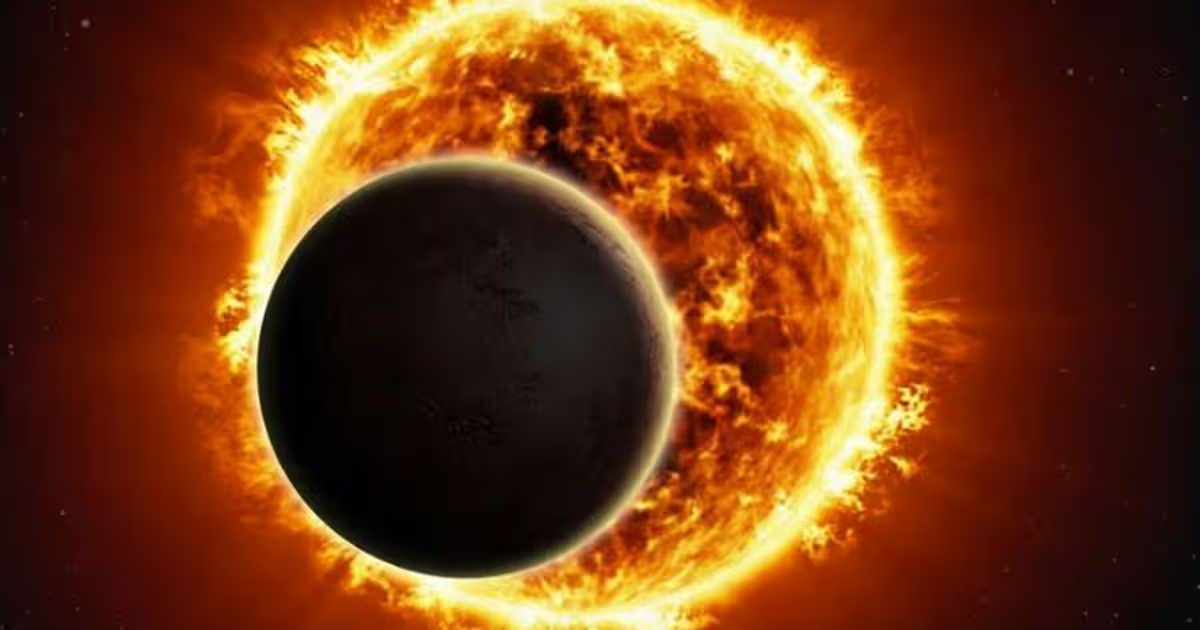
The date and time has been revealed and where you can see the eclipse
The first solar eclipse this year is set to take place this week, though the spectacular phenomenon will be visible from only certain locations. This rare astronomical event, famously dubbed a “ring of fire,” occurs when the earth, sun, and moon reach perfect alignment.
During this alignment, the moon passes directly between the sun and our planet, casting a distinct shadow and leaving only the sun’s outer edge visible as a glowing celestial ring.
Marking a major highlight for the 2026 lunar calendar, the eclipse is due to take place on Tuesday, February 17. While the event promises a stunning visual display, visibility remains the primary concern for those hoping to catch a glimpse.
Because the moon’s shadow follows a specific path, only skywatchers in select regions will have the opportunity to witness the sun transformed into a celestial ring of light.
Whether the “ring of fire” will be visible from the UK depends on specific geographic pathways of the Moon’s shadow, with experts noting that only those in certain places will witness the alignment in its full glory.
The first solar eclipse will take place at 7.10am on Tuesday, February 17. However, the spectacle in the sky will only be visible in a handful of locations, according to National World.
The path of annularity – the path the solar eclipse will take and be visible from – will rise across western Antarctica and set off across the Davis Sea coast and the Southern Ocean.
This means that the upcoming solar eclipse will not be visible in the UK. According to Space.com, the following list is the locations where a partial solar eclipse will be visible from and the percentage of the sun’s disk which will be covered in each location:
- Heard and McDonald Islands, Australia – 88%
- French Southern and Antarctic Lands, France – 88%
- Mascarene Islands, Mauritius/France – 35%
- Port Louis, Mauritius – 32%
- Saint-Denis, Reunion, France – 31%
- Antananarivo, Madagascar – 20%
- Durban, South Africa – 16%
- Maputo, Mozambique – 13%
- Maseru, Lesotho – 11%
- Gaborone, Botswana – 4%
- Harare, Zimbabwe – 3%
- Ushuaia, Argentina – 3%
After Tuesday’s solar eclipse, there will be lunar eclipse on March 3-4. This will turn the moon a red shade in the sky, with the Earth instead passing in between the Moon and Sun and casting its shadow onto the Moon. Due to the reddish hue of the Moon during this phenomenon, a lunar eclipse is sometime referred to as a “Blood Moon”.















![BITCOIN IS ABOUT TO DROP !!! [Bear Flag Confirmed]](https://wordupnews.com/wp-content/uploads/2026/04/1775318607_maxresdefault-80x80.jpg)





































You must be logged in to post a comment Login