Liverpool are reportedly looking to to sign RB Leipzig forward Yan Diomande this summer as Red Bull boss Oliver Mintzlaff has delivered an update
Red Bull chief Oliver Mintzlaff has made his position crystal clear regarding Yan Diomande’s future at RB Leipzig amid speculation linking him with Liverpool. The Reds have been strongly linked with a move for the highly-rated 19-year-old forward ahead of the forthcoming summer transfer window.
Advertisement
Liverpool are expected to be linked with numerous wide attacking options this summer in light of confirmation that Mohamed Salah will depart the club when his contract expires at the end of the season.
Diomande has been earmarked as a star in the making and ranks among Europe’s most coveted young talents following a standout debut campaign at Leipzig.
The Ivory Coast international has scored 13 times in all competitions for Leipzig this term, including 12 strikes in the Bundesliga, and is believed to carry a price tag in the region of €100 million (£87m).
Friday evening witnessed Leipzig in Bundesliga action as they secured a comfortable 3-1 home triumph against Union Berlin, with Diomande providing an assist for Ridle Baku’s strike, reports the Liverpool Echo.
Mintzlaff, Leipzig’s chairman of the supervisory board and Red Bull boss, has delivered his assessment on the speculation swirling around Diomande’s future amid reported interest from Liverpool.
The Leipzig chief has outlined precisely why he remains intent on keeping Diomande at the club beyond this summer, despite suggestions that a departure could materialise during the transfer window.
“I can say: If I were sporting director, I wouldn’t sell this young player, who hasn’t even completed a full season with us,” Mintzlaff is quoted as telling Sky Germany.
Advertisement
“No matter what price is being asked. I believe he’s a player who can still develop further, because he’s still very young. And he can certainly become more expensive.”
“Of course, there are other clubs where players also want to take the next step – FC Bayern is one of them, but also clubs from England and Spain,” he added.
Advertisement
“But we have to expect that a player, even if he delivers outstanding performances here, doesn’t leave again after just one year.
“Therefore, I can only recommend to the management that they keep this player with us for the coming season. And then we’ll have to see how he develops.”
He continued: “We want to play in the Champions League. And that’s naturally an argument for such a young player, to then deliver what he’s shown in a second season and potentially develop further – also at an international level.
“So we have many good arguments. And the best argument is a long-term contract. Therefore, I’m completely relaxed about the whole matter.”
Advertisement
Join our new WhatsApp community and receive your daily dose of MirrorFootball content. We also treat our community members to special offers, promotions, and adverts from us and our partners. If you don’t like our community, you can check out any time you like. If you’re curious, you can read our Privacy Notice.
Sky Sports, HBO Max, Netflix and Disney+ with Ultimate TV package
This article contains affiliate links, we will receive a commission on any sales we generate from it. Learn more
Sky has upgraded its Ultimate TV and Sky Sports bundle to now include HBO Max, Netflix, Disney+, discovery+ and Hayu, as well as 135 channels and full Sky coverage of the Premier League and EFL.
Sky broadcasts more than 1,400 live matches across the Premier League, EFL and more with at least 215 live from the top flight alongside Formula 1, darts and golf.
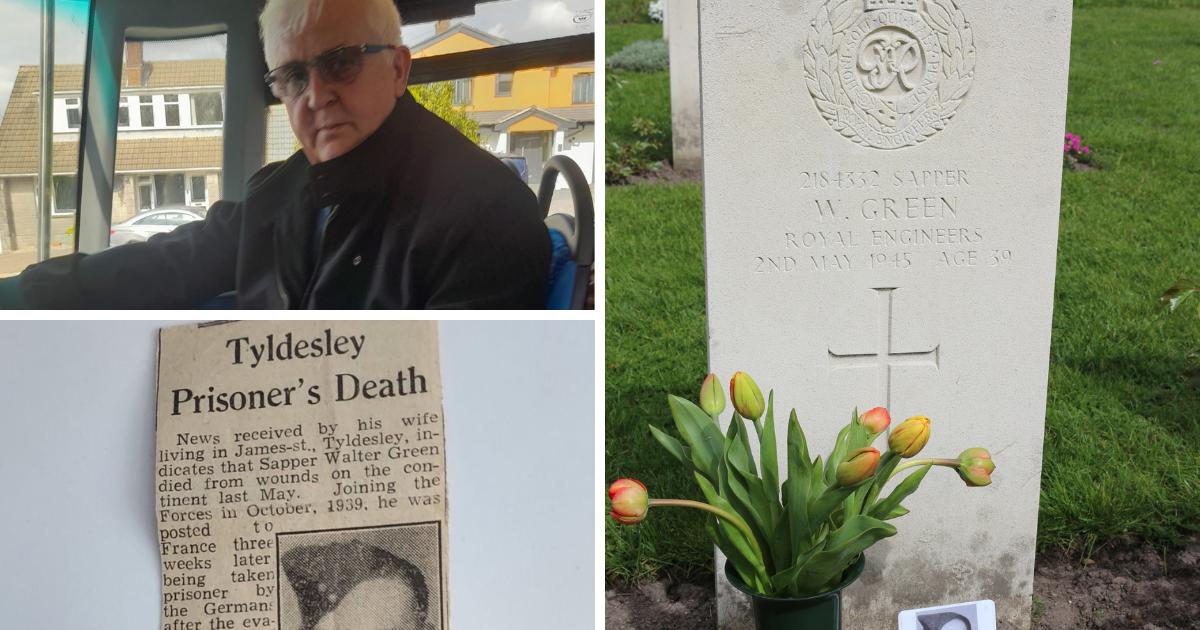
David Yates, from near Tonge Moor, found two long-lost cousins by responding to an appeal for photographs, which will be proudly placed on a war grave in the Netherlands.
He had never met his great uncle Walter Green, originally from Tyldesley.
David’s newspaper cutting. (Image: David Yates)
However, after seeing a BBC North West Tonight appeal looking for relatives of soldiers buried overseas, David realised one of the names listed could only belong to his family.
He said: “I thought there can’t be two Walter Greens from Tyldesley, it had to be my great uncle.”
Advertisement
Walter Green, who died aged just 39 in 1945, is buried at Venray War Cemetery in the Netherlands.
It comes as the cemetery is looking for photographs of three others who come from Bolton, buried at Venray.
Walters grave, now with a new picture. (Image: Venray War Cemetery.)
Photographs of the other war heroes have been found by their families, all except Private Cecil Wood, Son of Thomas and Alice Wood.
Tom van Mierlo, Chairman of Venray War Cemetery, said: “We still live in freedom today because of the sacrifices that these 693 men, and many others, made back then.
Advertisement
“Even for that reason alone, they deserve to have their memory preserved, especially today, because those who cannot remember the past are condemned to repeat it.”
Volunteers have been working there to trace families and place photographs on soldiers’ graves, giving them a face as well as a name.
David Yates. (Image: David Yates)
David explained how the appeal sent him delving into family history, uncovering a forgotten newspaper cutting that had been kept in a box for decades.
He added: “My grandmother had a picture of Walter in her bedroom.
Advertisement
“We even found a letter he sent her in June 1940 saying he was hoping to come and visit.”
Walter had spent some of the Second World War as a prisoner of war.
After being wounded, he eventually died from his injuries. Until now, his grave had no photograph.
The Venray graves. (Image: Venray War Cemetery)
David said: “The man in Holland who looks after the grave told me there were people interested in Walter, but they didn’t have a picture of him.”
Advertisement
The discoveries didn’t stop there.
Through the appeal, David learned he had two cousins he never knew existed, including Walter’s granddaughter, who had never seen a photograph of her grandfather before.
“She’s absolutely over the moon,” said David.
A cross which separates some graves. (Image: Venray War Cemetery)
David believes the care shown by Dutch volunteers is a powerful reminder of the legacy left behind by Allied soldiers.
Advertisement
He added: “I think a lot of this comes from gratitude. Tending to these graves is their way of saying thank you.”
Walter was one of nine children, with family roots stretching from St Helens.
David’s own family later moved to Bolton, where he grew up in Breightmet and now lives near Tonge Moor.
David added: “Of course, there are probably relatives out there who still don’t know who he was,” David added. “But now his story is being told again.”
Just don’t offer columnist Hannah Jones a cup of tea if you don’t understand what’s important in life
There are grand theories about what holds a society together – shared values, functioning institutions, the slow, invisible work of history knitting us into something resembling cohesion. Failing that, a nation collectively holding its breath, hoping Wales remember how to finish a try.
Advertisement
But if we’re honest, it’s something far simpler and infinitely more dependable: a cup of tea.
Tea, in its quiet, unassuming way, is a kind of social glue. It asks almost nothing of us and in return offers comfort, structure and a pause in a world that’s forgotten how to have a proper whiff. It’s the reflex that kicks in long before you’ve processed the news: good, bad, catastrophic, or just a bit s***.
Somewhere, someone is already saying, “I’ll pop the kettle on, mun,” and with the flick of a switch, the world becomes fractionally more manageable.
I bloody love tea. Not in a casual, “oh go on then” way, but with a loyalty bordering on devotional that’s steeped into my emotional infrastructure.
Advertisement
Tea is as adaptable as a Swiss Army knife, only less pleased with itself. There’s tea to soothe you. Tea to help you think. Tea to stop you thinking altogether. Tea to warm you. Tea to steady you. Tea to remind you that you’re still here, even if you’d rather be somewhere else.
There is tea for grief – the quiet, wordless kind taken in slow, stop‑the‑clocks sips.
And then there are the cups you remember. The one pressed into your hands at a kitchen table where the lino curled at the edges like it was attempting to pack up and move to England. The one that tasted better than it had any right to because of who made it, or when, or why. The fact that it came in a chipped mug declaring, “You don’t have to be mad to live here… but it helps” which was less a joke and more a local ordinance.
Tea often stands in for language when words fall short. It says: “I love you.” It says: “I know.” It says: “I haven’t got the faintest idea what to say, so I’m going to do the only useful thing I can think of and make you a cuppa – and no, it’s not going to be that matcha muck in this house.” It is, in its own modest way, an act of care or a tiny domestic sacrament.
Advertisement
Which is why the specifics of it can feel oddly sacred. Personal. Non‑negotiable. And this is where it can all go horribly wrong too.
Although tea will meet you wherever you are, I have very clear ideas about how it should meet me. So clear, in fact, that I rarely drink it outside the safety of my own home. Partly because I don’t have the nerve. Partly because I don’t have a handbag big enough to lug around my own bone china. But mostly because I lack the resilience to be handed a disappointing cwtch up in a cup and pretend it’s fine.
Coffee, meanwhile, occupies a very different space in my life. I can endure a bad one with the kind of stoicism usually reserved for minor injustices, like finding a no‑smoking sign on your cigarette break if I were more Alanis Morissette about stuff.
I can sip it politely, even if it’s missing key components like sugar or milk, as a bad one doesn’t unsettle me. I can convince myself I’m enjoying it if necessary. I might even construct a small internal narrative to get through it, like I’m a cinematic drifter hunched over a tin mug beside a campfire, the drink dreadful but the mood moody.
Advertisement
But I cannot, ever, bring myself to down a bad cup of tea.
Which is why I simply don’t order it. Anything less than lovely feels like an affront – to the drink, to my nature, and to anyone who’s ever said: “Fancy a cuppa?” Possibly the three best words in the English language, and I do include “Gatland is free” in that.
Because nobody has ever said “shall I fire up the Nespresso and you pick a pod as it’s obviously YOUR day today”, have they?
Coffee is theatre. Tea is truth. And those three words aren’t a question, they’re a covenant.
Advertisement
So yes, I am a tea snob. But not in the way people usually mean. I’m not interested in tasting notes or provenance or whether the leaves were harvested under a waxing moon by someone who’s had a sound bath with Charlotte Church in Laura Ashley’s old house. I’m not looking for a story. I’m looking for consistency. Reliability. A cup that quietly does what it’s supposed to do without demanding a standing ovation.
Which is why Fortnum & Mason can keep their rose‑and‑violet nonsense, and Tetley can bog off with their 60 “indulgent” blends. If I want gingerbread, I’ll buy biscuits and dunk them, which only goes to prove that you cannot have your cake and drink it.
The Cup Of Tea Test (copyright me) is also what anybody who knows me will pull out as a kind of shorthand for cleanliness. Let me explain.
Not so long ago, I told somebody, without a moment’s hesitation, that I have a peanut allergy. For good measure, I added out of nowhere that I’m also gluten-free. I’m neither.
Advertisement
I can only apologise to all of you living with these conditions, but I was under considerable pressure at the time.
Detailed lie after exaggerated lie came tumbling out of my gob because some new friends had invited us over for dinner. But after a recent recce, I can safely say I don’t want to go to their house to sit down let alone have them cook for me. Worse, offer to make me a cuppa.
That’s because it’s more than a little bit ych a fi if such a description exists. I discovered this when we were asked to pop over to water their plants. Now, of course, I could have filled the watering can from the outside tap. But I’m not my mother’s daughter for nothing.
My husband, Posh Paws, headed in first. Like most things – such as showers on holidays, so brainbox can work out which way’s cold before I strip off and come a cropper – I send him in to suss it out.
Advertisement
Places and spaces also have to pass my Cup Of Tea Test. It’s quite simple really: there’s no revision involved, no exam at the end, just a quick visual and olfactory sounding out of surroundings. Mostly by him, it has to be said. If said surroundings involve things like dirty pans making their final resting place on a plate of congealed fried egg on a manky worktop, it fails the Cup Of Tea Test which I apply to everything. It never lets me down.
Within moments of his return, my probing about what it’s like inside – “Marble or wooden worktops? Big or little fridge? Separate dining room or table in the kitchen? Dusty or pristine knick-knacks? Does it smell of cat? Did you manage to go upstairs for a nose?” – were answered with the one sentence that speaks volumes to me and puts a full stop on any notion of a dinner party at theirs: “You wouldn’t have a cup of tea in there.”
And blimey, was he bang on.
Dirty dishes everywhere, empty takeaway detritus on the floor, manky socks on the back of the settee, a forgotten punnet of mushrooms growing its own punnet of mushrooms next to the telly. And – AND! – just the one, single, naked-as-the-day-is-long, slice of bread sitting on top of the washing machine.
Advertisement
As I said, ych a fi with Brasso’d knobs on.
Then there was the time I went to visit my friend Hiya Love’s folks. His mother was a retired school teacher who used to get her hair blow-dried twice a week and had a penchant for Jaeger jumpers and real pearls. However, she just couldn’t see her slovenliness through her Chanel glasses.
He had warned me about it the first time I went to see her to say hello, as he knows all about the Cup Of Tea Test.
Anyway, on the face of it, it was OK… just a little messy. But who among us hasn’t cleared 16 completed crossword books and years’ worth of wet Western Mails just to sit down? Then…. (ugh) then…. (can’t cope!)… then she got the shortbreads out of a tin marked DOG BISCUITS.
Advertisement
Then… (bear with)… then… (kecking at the memory now)… then she went to her display cabinet to reach for one of her Royal Copenhagen cups only for her to grab it, BLOW ON IT to get rid of the dust, then WIPE IT CLEAN on her “best” gardening trousers. The ones with the dirt AND the dog hair on.
As an aside, Hiya Love also told me the story of the time his folks were burgled. When the police came down the stairs after checking their bedrooms, one turned to his mother and said: “Oh, we’re so sorry. It’s awful up there. Best to leave it a while before looking at what they have done.”
They thought the place had been utterly ransacked… but that was the state they’d left it in that morning, she laughed.
He’s still helpless when he recalls her turning to her bi-weekly cleaning lady and saying: “Nice job today. Not that I ever think of this house as being untidy. I like to think of it as a museum – everything’s on display.”
Advertisement
So, I will compromise on many things – politics, music, literature, people, wallpaper, men. Tea is not one of them.
And let’s be clear about terminology while I’ve got you. It is simply “tea”. Never bubble, herbal, iced, green, or Earl and its smug buttie Grey.
So, in the spirit of public service, here is my ideal cuppa.
I’m at home. Tea tastes better there – safer somehow, like emotional insulation. One Yorkshire Tea teabag because it’s dependable, no‑nonsense, and understands the assignment. I’m going decaf these days, though I remain unconvinced there’s any meaningful difference. The fact that my left eye no longer twitches is beside the point.
Advertisement
The vessel matters more than people think. It’s got to be somewhere between a mug and a cup, or what I like to call “thin china”, made in a material sturdy enough for my hams‑for‑hands. When you find the right one, buy several. This is not the time for restraint.
Five sweeteners. Non‑negotiable. Canderel tablets, not that powdered stuff. If only Hermesetas is available, I pivot to three sugars with quiet martyrdom and mild excitement that I’m going full on.
Boiling water. None of this waiting‑for‑it‑to‑calm‑down lark. There should be a brief, satisfying moment where the bag fizzes like a tiny volcanic event. Then we wait. Properly wait. Waaaaaiiiiiitttttttttt. Timing matters here, do not rush. There is a window for perfection. You learn it. You feel it. You respect it.
Add milk generously. I’m not fussy about type unless I’m in a cafe in Abergavenny, where everything is dairy-adjacent. Milk before or after water is a debate I refuse to entertain. Life’s too short to go full Devon‑versus‑Cornwall over its regional differences à la the jam/cream first conundrum.
Advertisement
The colour should land somewhere around a Tenby tan – present, but not aggressive.
I own a teapot, of course. I’m not a heathen. Loose leaves are lovely but require a level of commitment I simply don’t have. And nothing fragranced should come near a hot drink: no rose, no violet, no festive flavours trying to blur the line between a drink and a dessert.
Posh Paws makes a respectable cuppa, though he cannot commit to my order of five sweeteners.
He watches me make his with quiet horror, muttering “wrong, wrong, wrong” as if witnessing a minor but troubling faux pas.
Advertisement
And look – if you want to microwave your tea if it gets a bit Baltic, that’s your business. I won’t be joining you, largely because of the mysterious ecosystem living on most microwave ceilings, with bits of baked bean threatening to drop at any moment. But this is not a judgment.
Because for all my rules, rituals, and strongly held opinions, I do understand one thing: There is no single correct way to make tea. Only the right way for you.
For all its structure, tea is deeply personal. It reflects how you like to be looked after, and how you look after others. What you consider “right”. What you’re willing to tolerate. And perhaps that’s why it matters so much.
In a world increasingly loud, fast and impersonal, tea remains small, slow and specific – a tiny act of care in a country that still believes in them.
In the nick of time, Arteta is expecting to welcome Bukayo Saka back into the squad this evening, along with Riccardo Calafiori, although it is unclear if either will be able to go straight into the starting XI.
Jurrien Timber and Mikel Merino remain absent.
Advertisement
Alan Smith25 April 2026 15:15
Hello
… and welcome to live coverage of a huge clash that could have a major say on who wins the Premier League title. Arsenal, licking their wounds and in search of a response following last Sunday’s defeat away to Manchester City, are now second in the table having spent the majority of the campaign top.
But Mikel Arteta’s team know that a win against Newcastle, who are out of form and contention for any of their pre-season targets, would return them to the top because City face Southampton in an FA Cup semi-final.
Virgil van Dijk’s 100th-minute header to win the first Merseyside derby at the Hill Dickinson Stadium will live long in the memory as pressure eased on Arne Slot, who will be hopeful of ending a four-game winless run against Palace that has included three successive losses – including in the Community Shield at Wembley in August. The 13th-place Eagles head to Merseyside unbeaten in four domestically, but with much of the focus now on their quest to reach the Conference League final.
Since the initial warning was issued earlier today, Saturday, April 25, United Utilities has provided residents around Arthur Lane in Ainsworth with a further update this afternoon.
The nature of the repairs means that emergency traffic lights will be put in place while work is underway, but it unclear for how long at the moment.
Arthur Lane in Ainsworth (Image: Newsquest)
In an updated message to residents, the water company said: “We’re sorry if you’re experiencing no water or low pressure.
“We’ve identified the cause to be a burst water main on Arthur Lane.
Advertisement
“Because of the location of the burst we need to put traffic management in place before we can safely begin the repair.
“We’re sorry for any disruption this may cause, we appreciate your patience while we get this sorted.”
It is not yet clear how many properties have been affected.
Engineers are understood to be working to identify and resolve the issue as quickly as possible.
Advertisement
A spokesperson for United Utilities added: “We have a team on site so that repair work can get under way.
“We are very sorry for any inconvenience and hope to have things back to normal as soon as possible. All the latest updates can be found on our website.”
It will close a long and bitter chapter in the story of failed social housing in West Lothian.
The last traces of West Lothian’s notorious Ghost Estate will be gone by the summer of next year.
Advertisement
Springfield Partnerships, part of the wide Springfield Group has agreed a £9m for the final phase of affordable homes at Deans South with the Wheatley group.
The phase of 37 homes will complete the wider transformation of Deans South and will include a mix of one, two and three bedroom homes as well as a new play park.
It will close a long and bitter chapter in the story of failed social housing in West Lothian. The estate inherited by West Lothian Council from Livingston Development Corporation was cleared of tenants in 2004 after crumbling concrete known by its initials RAAC, was identified as the core construction material.
It left only a handful of homeowners who battled for almost 2O years to achieve a “home for home” when the council concluded a deal with Springfield Homes to demolish their homes and build anew.
Ghost Estate campaigner Kerry Macintosh took possession of the keys to her new home two years ago.
Writing on her social media page A Fair Deal for Deans South Homeowners this week she welcomed the news that the development has been shortlisted for the Homes for Scotland’s Affordable Development of the Year.
She said: “The considerate designs implemented have helped regenerate the local area from a Ghost Town into what is now a thriving community.
Advertisement
“This is in recognition of the regeneration of Deans South estate. Providing a solution to 100% RAAC in homeowners’ buildings to ensure provision of safe and energy efficient homes to replace the condemned existing buildings throughout the local Deans South area. We wish Springfield the best of luck in securing this well-deserved award which is due to be announced in May.”
The new development will bring a total of 136 affordable homes to the new Deans South once completed.
Springfield Partnerships Managing Director, Tom Leggeat, said: “The transformation of Deans South has been hugely rewarding. Through partnership working with Wheatley, we have already completed 82 high quality, energy efficient homes, with another 18 due to handover in the coming months. With this contract for the final phase in place, construction work can commence on the remaining 37 homes for people who need them.”
Advertisement
After RAAC was discovered in the former properties in 2004, the homes were condemned leaving a desolate eyesore within the community and families trapped in properties with very little market value.
Tom continued: “Our work with Wheatley to bring high quality housing to the area has changed the lives of the families affected by RAAC in their homes and transformed this development from an abandoned “ghost town” into a thriving community.”
Lindsay Lauder, Director of Development and Regeneration at Wheatley, said: “We’re excited to start this next and final phase of the Deans South development.
Advertisement
“This will bring to a close a complex project that has transformed Deans South into a vibrant community with modern and affordable homes for local people.
“We would like to thank our partners, Springfield Partnership, and West Lothian Council for their support and to the Scottish Government which provided a £6.8million grant towards the development.”
Construction of the final phase of homes at Deans South is under way, with residents expected to move in Summer 2027.
Walkers will come across Roman villas, as well as a Victorian railway that is still used today
A circular walk through the Cambridgeshire countryside has some historic sites, including Roman villas and a Victorian railway station. The Emperors Trail between Ailsworth and Sutton offers a step into part of Cambridgeshire’s history.
Advertisement
The walk, which is around 3.6 miles, is one of Nene Park Trust’s ‘walking in time’ trails. These are self-guided walks that explore the heritage and history of the area.
Along the way, walkers will come across Roman roads and Victorian railways. On the Nene Park website, it said: “You will walk in the footsteps of Roman Emperors, discover the medieval village of Sutton, then pass under the Victorian-built Nene Valley railway before returning to Ailsworth along the River Nene.”
Along the walk, people will see the line of Ermine Street, which was a main route that connected Roman London (Londinium) with York (Eboracum), and this is still visible today.
Here are some points you will come across on the walk:
Advertisement
Walkers start at a railway crossing gate at the end of Station Road, Ailsworth, which was formerly the site of Castor Station
Walk along Ermine Street and the Roman agger (mound), which was an important route busy with traffic, bringing goods, messengers, soldiers and travellers
Along Manor Road in Sutton, there is a stone built platform. This dates back to when milk churns were collected from the then dairy
People will go past Nene Valley Railway’s Wansford Station, which has been open since 1845
Along the Nene Valley Railway, there are fields that contain evidence of a Bronze Age burial mount or barrows, alongside two Roman villas.
To find out more about the Emperors Trail walk, visit the Nene Park Trust website.
Columnist Dylan Jones Evans argues that Plaid Cymru is trying to address the right questions. But that does not mean the party’s plan will work
14:33, 25 Apr 2026
So, to the final assessment of the political parties’ plans for the Welsh economy, and it would be fair to say that Plaid Cymru’s manifesto is the most detailed document produced in this Senedd election.
Advertisement
That does not mean that every proposal within it is convincing, but it is attempting to build a recognisable economic philosophy around a simple question that Welsh politics has avoided: not just how much economic activity takes place in Wales, but who benefits from it, and how much of the value generated here actually stays here.
Plaid argues that Wales has plenty of economic capability, but that too much of its economy remains externally owned, too much profit leaks out, and too much of its policy focuses on managing symptoms rather than building long-term strength. Its answer is a more interventionist and more explicitly development-oriented model, built around more strategic public investment, more active use of procurement, and an institutional framework designed to support business growth in ways that reinforce Welsh communities rather than bypass them.
At the centre of this sits the proposal for a new business-led National Development Agency for Wales that can provide a clearer front door for business support, promote Wales internationally, and coordinate regional economic development in a way that Whitehall-style departmentalism and Cardiff Bay fragmentation have often failed to do. In this respect, Plaid is right to recognise that economic development in Wales has too often lacked institutional clarity and sustained focus, although any new body should not be just another rehash of the Welsh Development Agency, as some have suggested.
Advertisement
Plaid is also right to signal that the Development Bank of Wales needs reform because, despite its rhetoric, there is a growing sense that it is not yet performing to the level Wales needs. If Plaid is serious about creating more indigenous growth, stronger supply chains and better-paid jobs, then a review of the bank has to ask harder questions about whether its products are fit for purpose, whether it is taking enough strategic risk, and whether it is genuinely helping to reshape the structure of the Welsh economy rather than simply supporting activity at the margins.
There is a seriousness to the manifesto’s treatment of procurement. Welsh public bodies spend more than £8 billion each year on goods and services, and Plaid wants a much larger share of that spend retained within Wales, from around 55 per cent to at least 70 per cent. That is not a marginal adjustment but a deliberate attempt to use the public pound to strengthen Welsh firms and build capacity in local supply chains.
One can debate whether the target is achievable and whether it will create as many jobs as claimed, but the underlying instinct is sound, as public procurement in Wales has, for too long, been discussed as an administrative function rather than a strategic economic tool.
The proposal for a comprehensive national skills audit is not particularly glamorous, but employers, colleges, schools and training providers have all complained for years that there is insufficient clarity about future skills demand, too much fragmentation in provision, and too little alignment between policy and labour market needs.
Advertisement
The attempt to connect skills, apprenticeships, vocational routes and economic opportunity is sensible, especially when linked to sectors such as renewables, digital technology, medtech, agritech and the creative industries.
On digital and connectivity, there is support for superfast broadband rollout to the rest of Wales, for the semiconductor cluster in South Wales, for digital innovation, and for more coherent transport planning linked to wider economic development.
With regard to rail, they make the case that Wales has been chronically short-changed, particularly in relation to HS2 and wider infrastructure classifications, but (and excuse the pun) the train has probably left the station on this particular issue, and the UK Government is unlikely to change its mind.
The manifesto is less convincing in its assumptions about what follows from it. At times, Plaid seems to believe that if Wales had the right institutions, stronger tax powers and a fairer funding settlement, a stronger economy would naturally emerge.
Advertisement
Yes, Wales has been held back by weak tools, poor institutional design and a settlement that often leaves it underpowered, but stronger institutions are not, in themselves, a substitute for a stronger economy, nor do they automatically solve the harder questions around export intensity, business scale-up, and commercial competitiveness.
Indeed, focusing on structure rather than strategy is one of the most common mistakes that governments make in their approach to economic development and as I’ve said so many times in the past, entrepreneurship, innovation and productivity must be the beating heart of Wales’s future economic direction.
There is also, inevitably, a degree of political optimism embedded in the document and in proposals such as a Wales Wealth Fund, greater use of pension assets for local investment, and deeper fiscal reform. Each depends on institutional capacity, political leverage and execution that should never be assumed, especially given the weakness of a civil service that has served one party for over a quarter of a century.
Even so, it can be argued that Plaid Cymru has produced a manifesto that seeks to grapple with the drawbacks of the Welsh economy. Whether you agree with it or not, at least it understands that the question is not merely how to attract more activity, but how to build an economy that is more rooted and beneficial to the people who live here.
Advertisement
Of course, that does not answer the question, and there will be much more to do if they form a government, but it could present a serious economic offer that is long overdue, although that may also depend on the person they appoint as the economy minister. Certainly, that individual should be totally committed to developing the massive potential within our private sector here in Wales. If not, as we have seen too many times since the start of devolution, the good intentions in this manifesto may lead to nothing.
The UK’s foreign office has advised against all travel to Mali following the attacks, adding that Bamako International Airport is temporarily closed. Meanwhile, the US Embassy there has told citizens to shelter in place and avoid travel, citing explosions and gunfire around the airport and near Kati.
The answer is simple – as his advisers will have told Donald Trump before he attacked Iran, it is almost impossible to clear a passage through a minefield when the shoreline is held by the enemy, without being prepared to take significant casualties. And this, it seems, the US is not prepared to do.
It is one thing to bomb a less technologically sophisticated enemy from the air, but quite another to get involved in a real fight at sea level with an opponent who has been planning this form of asymmetric warfare for a very long time.
History gives a stark lesson on why America needs to tread warily – a page from the First World War.
Advertisement
It was March 1915. The “straits” concerned were the Dardanelles – the narrow passage linking the Mediterranean to the Black Sea and giving access to Istanbul. The Turks were the defenders, the British and the French the attackers.
They were in the middle of a shooting war. A vital waterway, which would normally be open for the world’s commerce, was closed because of the actions of Turkey, the bordering power. The coastline was heavily defended, and there was a high probability that mines had been laid to block the channel.
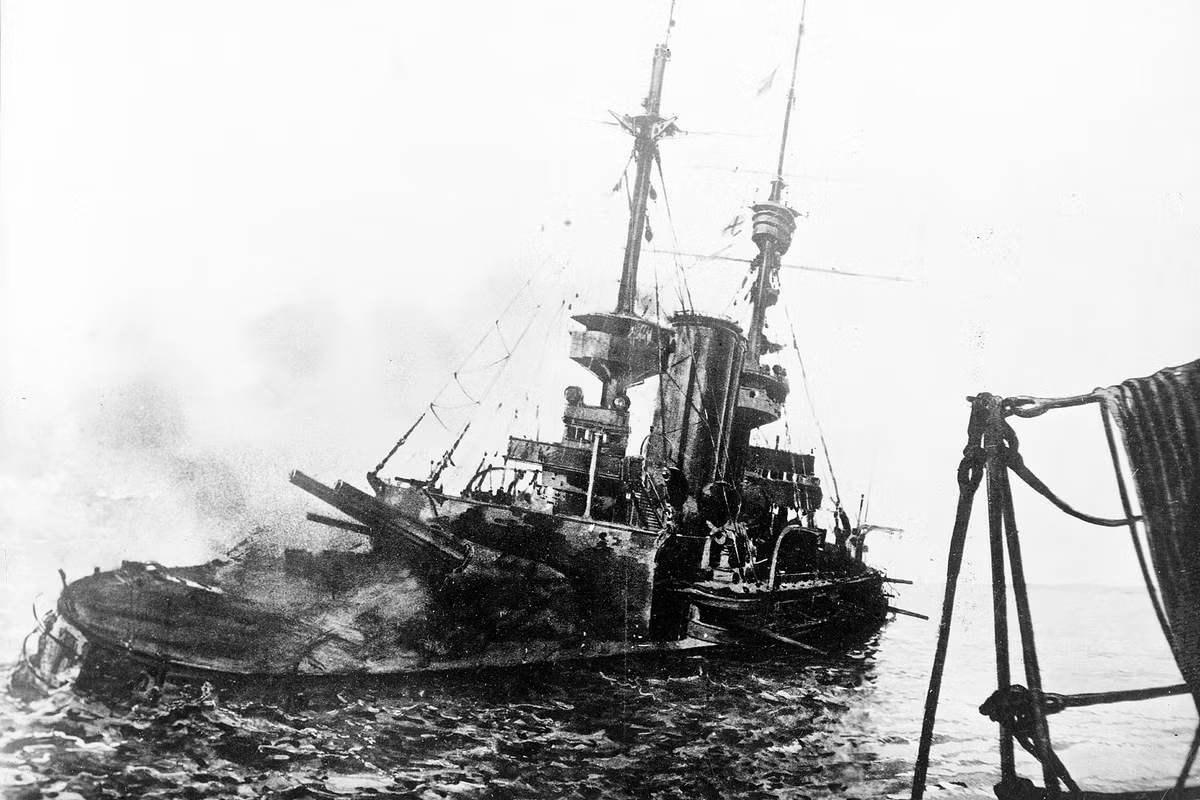
HMS Irresistible, abandoned in the Dardanelles, in northern Turkey, on 18 March 1915. She hit two mines, the second of which destroyed her main engines, and 600 men had to be rescued (Library of Congress/Royal Navy)
A decision was made by the British and French that the straits were to be reopened by force – and a very considerable force was assembled for that purpose.
It comprised no fewer than 14 “capital” ships (in those days “battleships” and “battlecruisers”) supported by escorts and a large force of minesweepers.
The plan was a good one. The capital ships would stand off in clear water and bombard the shore defences. When these had been silenced, the minesweepers would go ahead and sweep another clear area.
Advertisement
The capital ships would then move forward again into swept water and recommence their bombardment – successive waves of big ships moving up, but always into water which had been swept for mines. In this way, the whole channel would be cleared, and the straits reopened.
The big push commenced on 18 March 1915. To start with, it all went well. Four capital ships – HM ships Queen Elizabeth, Agamemnon, Lord Nelson and Inflexible – formed the first attacking line.
The second line was composed of four French ships, Gaulois, Charlemagne, Bouvet and Suffren. They, in turn, were to be supported by six more British ships – HM ships Ocean, Irresistible, Albion, Vengeance, Swiftsure and Majestic – which would form a third line to pass through and relieve the French in line two.
Advertisement
The bombardment was started by the RN ships in line one at 11am. By 12.20pm, the French ships of line two had steamed through the first line to take up their advanced positions.
By 1.45pm, the fire from the shore batteries had slackened under the onslaught of the guns of the eight capital ships, and it was deemed safe enough to send in the minesweepers for the next phase. The third line of six ships was also called up to move the force forward.
However, 15 minutes later, everything started to go wrong. FS Bouvet hit a mine, and in a matter of minutes, she capsized and sank. There were only 75 survivors out of a ship’s company of 718.
The action continued. HMS Irresistible of the third wave was bombarding the forts when she, in turn, struck a mine at 3.14pm. She developed a severe list but continued with the action until she hit another mine, and her main engines were put out of action completely.
Advertisement
An attempt was made to take her in tow, but the situation was hopeless, and the order was given to abandon ship. More than 600 men were taken to safety.
Meanwhile, shortly after 4pm, HMS Inflexible struck a mine. She remained capable of steaming slowly and was ordered to withdraw. However, she had a 30ft x 26ft hole below the waterline and had to be beached to save her from sinking. She was later towed to Malta for repairs and was out of action for three months.
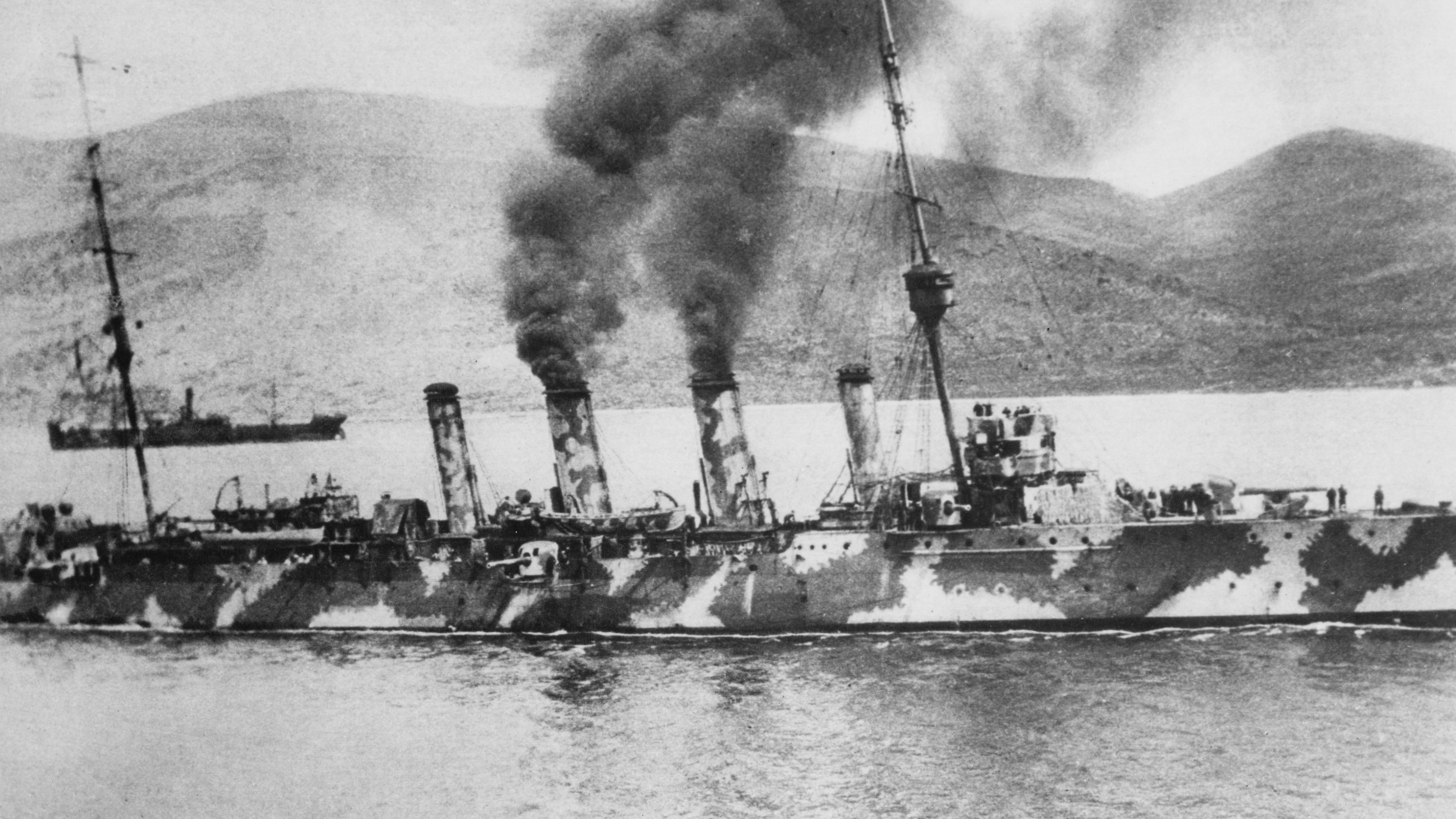
A Royal Navy cruiser painted in dazzle camouflage in the Dardanelles, 1915 (Getty)
After these disasters, Vice-Admiral John de Robeck, the British admiral in charge of the Allied naval forces during the crucial stages of the campaign, finally decided that the waters which had been considered to be safe and swept of mines were anything but.
Accordingly, at 5.50pm, less than seven hours into the operation, he signalled a “General Recall” to withdraw the ships and return to the safe waters outside the straits.
Fifteen minutes later, at 6.05pm, HMS Ocean struck another mine, developed a major list and was deemed not to be capable of being saved. The ship’s company were taken off and she was left to her fate. Both Irresistible and Ocean later sank.
Advertisement
Fourteen major warships had attempted to force the straits. Within four hours, three of them had been sunk and one had been so badly damaged that she was out of action.
This one day of disaster was the end of trying to take the Dardanelles passage by solely naval means. The attempt was never repeated.
USS Abraham Lincoln conducts US blockade operations related to the Strait of Hormuz on 16 April 2026, in the Arabian Sea (US Navy)
From that day on, the focus shifted to “boots on the ground” to conquer the Turks on land – but as is well known, this likewise failed.
A relatively weak opponent had defeated the combined forces of the two largest navies in the world by its use of asymmetric warfare and, most importantly, by the deployment of mines.
A lesson for our times, Mr President.
Advertisement
John Clark is a former Royal Naval Reserve officer who commanded various minesweepers and minehunters during his service






















































You must be logged in to post a comment Login