Connect with us
DAPA Banner
DAPA Coin
DAPA
COIN PAYMENT ASSET
PRIVACY · BLOCKDAG · HOMOMORPHIC ENCRYPTION · RUST
ElGamal Encrypted MINE DAPA
🚫 GENESIS SOLD OUT
DAPAPAY COMING

NewsBeat

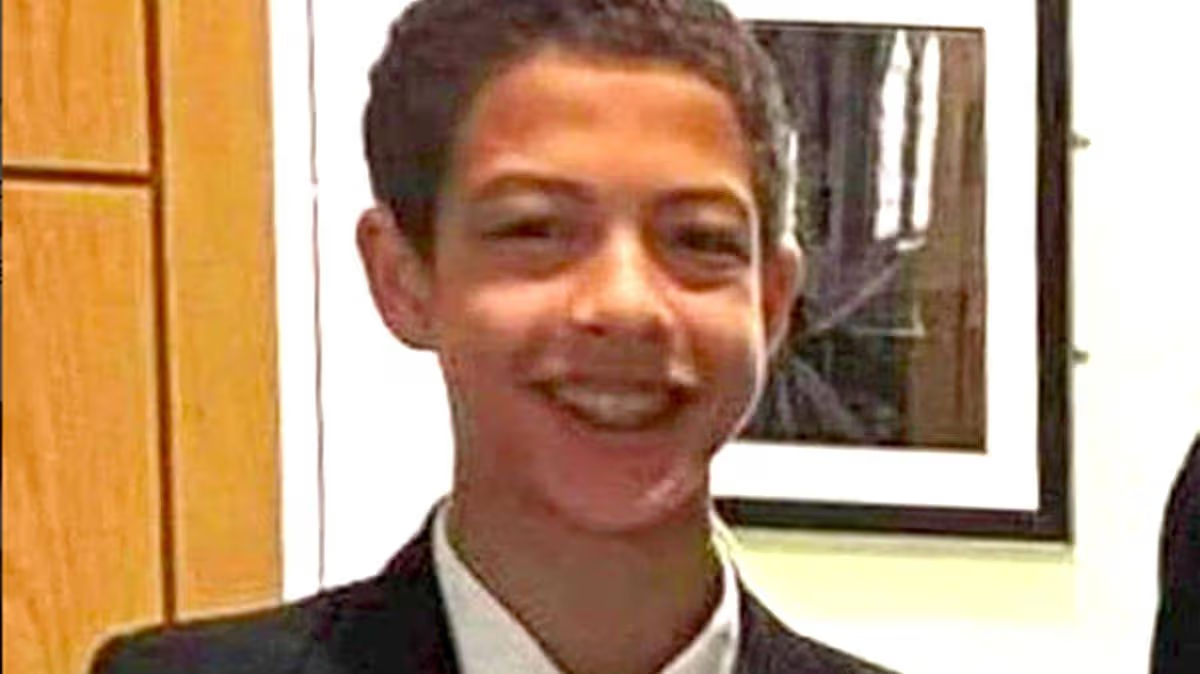
Retired PSNI officer says phone photo gave ‘absolutely nothing’ in Noah search

Published

on

Belfast Live

His naked body was found in an underground water tunnel on June 27, six days after he left home

A retired PSNI officer has said there is “absolutely nothing at all” in a photo taken on Noah Donohoe’s phone after his last known sighting that would have helped police find the schoolboy.

The inquest, which is being heard with a jury, is now in its 18th week at Belfast Coroner’s Court.

Noah, 14, had set off on his bicycle from his home in south Belfast on the evening of Sunday June 21, planning to meet two friends in the Cavehill area in the north of the city.

Advertisement

However, he was later seen on CCTV footage cycling along York Road. The last sighting of him was on Northwood Drive.

His naked body was found in an underground water tunnel on June 27, six days after he left home. A post-mortem examination found the likely cause of death was drowning.

On Thursday the inquest heard evidence from retired PSNI Detective Constable Wilson.

Advertisement

Mr Wilson was a digital media investigator (DMI), acting as a “first point of contact” for digital inquiries and was involved in the search of Noah’s Alcatel phone which was found by a member of the public.

The inquest has previously heard evidence from Detective Inspector Cunningham, from the PSNI’s cyber unit, in relation to a photograph of what appears to be a hand captured on the device at 6.50pm on June 21, after he had last been seen.

Under questioning from Declan Quinn, junior counsel to the coroner, Mr Wilson agreed that his job was to review the available information on Noah’s phone and make a “judgment call” as to what should be elevated for further investigation.

The jury viewed notes from Mr Wilson’s diary of his actions on the 24, 25 and 26 of June at which point he said “by far the major priority is to find Noah and find him alive”.

He said the search of the schoolboy’s phone was to find clues as to “what might have triggered him, where might he have gone” and to “try and understand the person”.

Mr Quinn outlined there is “concern from next of kin that this photograph wasn’t tagged” to become part of further inquiries, which Mr Wilson said he is now aware of.

The barrister said the photograph “appears to be taken at a time after Noah had left his home for the last time and after he was last seen in Northwood road”.

Advertisement

Mr Wilson said he didn’t recall seeing the specific photograph but that he “physically opened every photograph and asked if there’s anything that would tell us where that photograph was taken”.

Looking at the picture, which was displayed to the court, Mr Wilson said it is “clear that a person was holding the phone but as to what you could do to identify that person, absolutely nothing”.

He agreed some shrubbery and greenery could be seen in the background, but asked if there was anything that assisted police in finding Noah, he said: “Absolutely nothing at all.”

The retired detective then faced questions from Brenda Campbell KC, representing Noah’s mother Fiona, who said that one way of finding a missing person would be to discern “the possibility of third party involvement”.

Advertisement

Mr Wilson said officers would consider “is there any crime practiced against them or is it a missing person inquiry, but yes you are considering if there’s any other factors at play”, adding that “hypotheses are directed by the senior investigating officers”.

He said he “didn’t recall” if he knew the working hypothesis and his role was to see if anything in digital media could help to find Noah.

Asked by Ms Campbell if it would have been important to know the working hypothesis, Mr Wilson said “irrespective of whether I knew or didn’t know that wouldn’t change anything I was doing at that point” in terms of “interrogating devices”.

“Nothing would have changed whether I knew or didn’t know,” he said.

Advertisement

Ms Campbell questioned the importance of “investigative curiosity” to which Mr Wilson said he “100%” had a curious mindset.

The barrister also said Mr Wilson spoke with Ms Donohoe when Noah had been missing for three days, describing her as “desperate” for news of her son and being “entirely reliant” on the police at that point in time.

For all the latest news, visit the Belfast Live homepage here and sign up to our daily newsletter here.

Source link

Advertisement
Continue Reading
Click to comment

You must be logged in to post a comment Login

Leave a Reply

NewsBeat

‘Radical change can lead to a fairer and greener world’

Published

on

‘Radical change can lead to a fairer and greener world’

A major new study argues that rising living standards, shorter working hours and a liveable climate are not competing dreams, but parts of the same future – if the world is willing to tackle extreme inequality

For years, the climate debate has often been framed as a choice between two unappealing futures. Either the world carries on consuming and emitting until the planet becomes increasingly unstable, or it cuts back so sharply that ordinary people feel they are being asked to accept less.

A major new report from the World Inequality Lab offers a very different possibility. It argues that humanity could raise living standards for the vast majority of people, reduce extreme inequality and still keep global heating below 2C by the end of the century.

Advertisement

The Global Justice Report, published on Thursday, sets out what its authors describe as a “plan for equality and prosperity within planetary boundaries”. It is not a forecast, and it is certainly not a modest piece of policy tinkering. It is a deliberately ambitious model of how the global economy could be reorganised between now and 2100 so that wellbeing, equality and climate stability are treated as part of the same project.

Advertisement

At its heart is the simple idea that people do not need endless material consumption to live well. Instead, the report argues for “sufficiency” – a shift towards shorter working hours, better health and education, cleaner energy, changed diets, reduced pressure on land and a much narrower gap between the very rich and everyone else.

Under the report’s central scenario, average monthly income would converge towards about €5,000 (£4,250) per person in every country by 2100. That would mean far faster growth in poorer regions and much slower growth in today’s richest economies, but the authors argue that most people in wealthy countries would still gain because income would be distributed more evenly and people would have more time outside paid work.

Nearly 90% of the world’s population would double their monetary income by the end of the century, according to the model. When extra leisure and the avoided damage of runaway heating are included, the report says more than 99% of people would be better off.

Average monthly income would converge towards about €5,000 (£4,250) per person in every country by 2100

One of the report’s most striking proposals is a dramatic reduction in working time. Annual labour hours per employed person would fall from about 2,100 today to around 1,000 by 2100, roughly continuing the long historical trend that has already seen working hours fall sharply in many countries since the 19th century. The aim is not simply to work less, but to redirect human effort towards care, education, health, culture and other lower-carbon parts of the economy.

Advertisement

The report also links this shift to gender equality. Its model envisages women and men converging on equal pay and an equal share of paid and domestic labour, arguing that a fairer distribution of work inside and outside the home is central to any credible vision of social progress.

To stay within climate limits, the authors say rapid decarbonisation would still be essential. Energy systems would need to move quickly away from fossil fuels, with electricity generated from low-carbon sources by mid-century and major investment in renewables, electrification and cleaner industrial processes. But the report argues that technology alone is not enough. Without changes in consumption, land use and inequality, the energy transition becomes harder to finance and harder to sustain politically.

When extra leisure and the avoided damage of runaway heating are included, the report says more than 99% of people would be better off. Image: Holly Landkammer

Advertisement

The report proposes a Global Justice Fund, financed by a global wealth tax and a top income tax levied on the richest 1% of the world’s population. The fund would support climate investment, health, education and country-level dividends, particularly in poorer countries. The report also proposes a world sovereign fund, new forms of international currency and a rebalancing of voting power in institutions such as the IMF and World Bank.

The Global Justice Fund would spend an average of 10.3% of world GDP each year between 2026 and 2060, compared with less than 0.4% currently represented by official development aid and the combined budgets of the UN, IMF and World Bank. The report argues that this reflects the scale of the challenge: climate investment alone is expected to require 3-4% of world GDP annually in the coming decades.

The effect on wealth would be profound. The bottom half of humanity would see its share of global wealth rise from 2% to 30%, while the share held by billionaires would fall from 6% to 0.05%. The report’s authors argue that this is not only a question of fairness, but also of climate logic, because the richest people have disproportionately benefited from high-carbon growth and hold much of the capital needed for the transition.

Advertisement

The aim is not simply to work less, but to redirect human effort towards care, education, health, and culture

Writing in the Guardian, several of the report’s authors, including Thomas Piketty and Lucas Chancel, described the plan as “radical”, but argued that the alternative is to accept a future shaped by deepening inequality, climate breakdown and political instability. The obstacle, they wrote, is “not technical impossibility”, but political choice.

That is also the report’s greatest vulnerability. It sets out what could be done, not what is currently likely to happen. Global wealth taxes, a new international financial order and a managed shift away from overconsumption would face fierce political resistance, particularly from those who benefit most from the present system. Even the authors acknowledge that this would require major coalition-building, social movements and legislative action.

But the report is important because it challenges a familiar mood of defeat. It does not say that a fair, healthy and sustainable world will arrive naturally, or that the transition will be easy. Instead, it says that the figures can be made to add up, that climate safety does not have to mean worse lives for most people, and that equality is not a distraction from the environmental crisis but one of the conditions for solving it.

Main image: Sagar Gnawali

Advertisement

Be part of the solution

At Positive News, we’re not chasing clicks or profits for media moguls – we’re here to serve you and have a positive social impact. We can’t do this unless enough people like you choose to support our journalism.

Give once from just £1, or join 1,800+ others who contribute an average of £3 or more per month. Together, we can build a healthier form of media – one that focuses on solutions, progress and possibilities, and empowers people to create positive change.

Support Positive News

Advertisement

Source link

Continue Reading

NewsBeat

Armenia’s ties with Russia continue to deteriorate as election day approaches

Published

on

Armenia’s ties with Russia continue to deteriorate as election day approaches

Armenia was once widely considered Russia’s closest ally in the South Caucasus, with the two nations maintaining deep political, economic and military ties. But ahead of pivotal parliamentary elections on June 7, Armenia is facing the deepest crisis in its relations with Moscow since it secured independence from the Soviet Union in 1991.

One week before the elections, Russia recalled its ambassador to Armenia, Sergei Kopyrkin, in protest at Yerevan’s growing ties with the EU.

Kopyrkin’s return came a day after the Russian president, Vladimir Putin, warned Armenia that it was leaving itself exposed to what he called the “Ukrainian scenario” by deepening its cooperation with western institutions.

This diplomatic rift has been accompanied by economic pressure. Russia has imposed a series of restrictions on Armenian exports since late May, citing sanitary and technical concerns, while simultaneously threatening to suspend its gas deal with Armenia.

Advertisement

The leaders of Russia, Belarus, Kazakhstan and Kyrgyzstan, who make up the Eurasian Economic Union (EAEU), have also recently demanded that Armenia hold a referendum to choose between them or the EU.

A few years ago, this rift would have been difficult to foresee. Russia has widely been regarded as Armenia’s principal strategic partner and security guarantor for decades. Armenia joined the Moscow-led Collective Security Treaty Organization (CSTO) in 2002 and the EAEU later in 2015. It also hosts a Russian military base near the north-western city of Gyumri, and depends heavily on Russia for energy supplies and trade.

Their partnership began to erode in 2024. That year, Armenia froze its participation in the CSTO, accusing the bloc of failing to intervene during Azerbaijan’s 2023 offensive against the disputed region of Nagorno-Karabakh. The two countries had previously fought a war over the region in 2020, which ended with a Russian-brokered ceasefire.

The Armenian government, which is led by Nikol Pashinyan, subsequently pursued closer political and security ties with the EU and US. It expanded defence cooperation with France and publicly questioned the value of Armenia’s traditional dependence on Russia. Armenia also recognised the jurisdiction of the International Criminal Court in 2024, despite the court having issued an arrest warrant for Putin.

Advertisement

These moves culminated in the adoption of the EU Integration Act in March 2025, paving the way for the Armenian government to begin the process of gaining EU membership. Months later, in December, the EU and Armenia formally adopted a framework designed to deepen political, economic and security cooperation.

Armenia’s westward engagement has become increasingly visible throughout 2026. More than 30 European leaders, including European Commission president Ursula von der Leyen and European Council president António Costa, gathered in the Armenian capital of Yerevan in early May for a summit of the European Political Community.

US secretary of state Marco Rubio visited Armenia later in the month and signed a strategic partnership agreement with Armenia’s foreign minister, Ararat Mirzoyan.

Advertisement

Armenia and Azerbaijan have fought two major wars over the disputed Nagorno-Karabakh region.
Nemanja Cosovic / Shutterstock

Russia is not only losing a longstanding ally in Armenia. It is also losing one of its main levers of influence in the South Caucasus: its key role as a mediator in the Armenia-Azerbaijan conflict.

Already in late 2023, Azerbaijan and Armenia initiated a process to agree on and formally define their shared border. And over the past year, the two countries have held direct bilateral talks in Abu Dhabi and signed a declaration on peace at the White House. They have also begun trade and economic cooperation.

These efforts have influenced public attitudes in Armenia. The proportion of Armenians reporting national security and border issues as the top problem facing their country dropped from 44% in June 2025 to 21% in February 2026. Russia’s regional influence will only decline further as Armenia and Azerbaijan move towards longstanding peace.

Armenia’s choice

This broader geopolitical realignment forms the backdrop to Armenia’s upcoming elections. Pashinyan’s Civil Contract party promotes a pragmatic “post-Karabakh” course. This involves acknowledging current realities, pursuing normalisation with Azerbaijan and its close ally Turkey, and gradually deepening ties with western partners.

Advertisement

The two main opposition forces – the Strong Armenia Alliance and the Armenia Alliance – advocate closer strategic coordination with Moscow. They blame the current leadership for the loss of Nagorno-Karabakh and promise to halt the peace process with Azerbaijan and Turkey if they come to power.

The Strong Armenia Alliance was founded in 2025 by billionaire Russian citizen Samvel Karapetyan. The Armenia Alliance, on the other hand, is led by Robert Kocharyan, who served as Armenia’s president from 1998 to 2008. Kocharyan was also a board member of the Russian investment giant, Sistema. He stepped down in 2021.

The European Parliament has raised concerns about Russian interference in the election. Russia has been accused of conducting a massive pre-election campaign to undermine Pashinyan. This has allegedly involved the spread of online disinformation and a plan to transport tens of thousands of Armenians living in Russia home to vote for the opposition.

As Armenians head to the polls, they will be deciding more than the composition of their next government. They will be choosing between competing visions of the country’s future. In many ways, they will be determining whether the post-Soviet era of Armenia’s close dependence on Russia is coming to an end.

Advertisement

Polling suggests that the Civil Contract party is on track to win. This means Armenia will probably continue its normalisation process with its neighbours while deepening cooperation with western partners.

Yet Russia’s growing efforts to support the Armenian opposition cannot be dismissed. A different outcome on June 7 could bring dangerous revanchist sentiments, stalling regional peace efforts and slowing Armenia’s integration with Europe.

Source link

Advertisement
Continue Reading

NewsBeat

Piers Morgan challenges Gary Lineker after hitting a nerve by mocking his Netflix World Cup deal

Published

on

Daily Mirror

Piers Morgan is planning to go head-to-head with Gary Lineker with his own podcast focused on the World Cup – and has launched it by poking fun at his rival broadcaster

Piers Morgan is planning to take on Gary Lineker for viewers after launching a rival podcast for the World Cup. Lineker will be on screen with Alan Shearer and Micah Richards after signing a big-money deal with Netflix – and now Morgan is challenging him.

Advertisement

Lineker’s Goalhanger company signed a £14million deal to link up with streaming giant Netflix to broadcast a show this summer. The Rest is Football will be filmed daily in the United States this summer as Netflix tries to break into a new market.

Morgan has now launched his attempt to take on Lineker and Co, with his show World Cup Uncensored, featuring John Terry and Simon Jordan, starting on June 8. His social media post declared it would bring “fearless debates, uncensored opinions” before delivering the dig at his rivals: “The rest is boring”.

The Telegraph have reported that the dig at The Rest is Football has not gone down well at Goalhanger, who declined to comment.

WORLD CUP LEGENDS: The stars who lit up football’s greatest tournament – Buy the Special Edition today

Advertisement

“I would find it very, very hard to believe that Gary, in particular, wouldn’t have had a little chuckle. We’re good mates,” Morgan told The Telegraph. “Of course, if they took it over-seriously, it would be reflecting, perhaps, the accuracy of the joke.

“I know Gary really well. I’ve watched what they’ve been doing. I’ve got a lot of respect for it. I think it is the future. I think there’s plenty of room for both of us. But, as he would know, a little bit of banter goes a long way in football.”

He added: “We may have a sort of ‘High Noon’ with me and Gary in Times Square.”

Lineker, 65, left the BBC in May 2025 and says he has been freed by leaving the broadcaster behind. “I’ve got a bit more time, I’m not treading on quite so many eggshells these days, I’m allowed an opinion on things,” he said this week.

Advertisement

“But no, I had a wonderful period at the Beeb, and I’ve covered so many major tournaments, and obviously I was going to do this (the 2026 World Cup) originally, but now I’m doing something different, which is really exciting.”

He also questioned the BBC’s decision to broadcast the majority of the tournament from their studio in Salford, rather than follow ITV out to New York. “I’m a bit surprised the Beeb are not going until possibly the very latter stages of the competition. I won’t miss being in the green box itself, but I miss some of the company,” he added.

“But the fact we’ve got our own show now with loads of guests and stuff, that’s been replaced completely. We’re not in competition with the BBC in this, because obviously they’re focused on live football. We haven’t got the rights, but we’ve got a show that people can watch alongside.”

Advertisement

Join our new WhatsApp community and receive your daily dose of Mirror Football content. We also treat our community members to special offers, promotions, and adverts from us and our partners. If you don’t like our community, you can check out any time you like. If you’re curious, you can read our Privacy Notice.

Source link

Continue Reading

NewsBeat

Photos show condition of historic tennis Club House in Scarborough

Published

on

Photos show condition of historic tennis Club House in Scarborough

​The historic Grade-II listed Club House at the Scarborough Sports and Tennis Club has been undergoing repair and remedial works in an effort to preserve it.

​Built in 1912, the building has fallen into a deteriorated condition following repeated incidents of vandalism.

Tennis Pavilion, Filey Road, Scarborough. NYC.

​Located at Filey Road, the Club House has been subjected to prolonged exposure to the elements and new photographs released by the North Yorkshire Council-owned Align Property Services has revealed the extent of the disrepair.

Tennis Pavilion North Side., Filey Road, Scarborough. NYC.

​Designed by Sir Edwin Cooper, it is considered nationally rare as a purpose-built tennis clubhouse, and significant for its external elevations, dormers, chimneys, porthole windows, columns and slate roof.

Advertisement

Tennis Pavilion, West Side., Filey Road, Scarborough. NYC.

​“The structure reflects the development of leisure and recreational architecture within Scarborough and contributes to the understanding of the town’s social history,” according to a council report.

​North Yorkshire Council has applied for retrospective permission for repair works, including the removal of the remaining roof covering and the installation of a replacement roof using natural slate to match the existing materials, appearance, and detailing.

'Typical Internal Condition' Of Tennis Pavilion, Filey Road, Scarborough. NYC.‘Typical Internal Condition’ Of Tennis Pavilion, West Side., Filey Road, Scarborough. NYC.

​Other conservation repairs include works to dormers, cupola, chimneys, timber fascias and soffits, rainwater goods, the west-facing gable, and investigation/repair works to the principal entrance colonnade where required.

​The works also include the removal of asbestos-containing materials within the basement, specifically within the former boiler room.

Advertisement

‘Typical Internal Condition’ Of Tennis Pavilion, Filey Road, Scarborough.. NYC.

​“The works are required to address identified health and safety risks and to facilitate the safe future management and use of the building,” a report states.

​Align Property said: “The removal of the existing roof covering will result in the temporary loss of historic fabric.

‘Typical Internal Condition’ Of Tennis Pavilion, Filey Road, Scarborough. NYC

​“However, this is justified by the condition of the roof, which is beyond reasonable repair in its current state. The proposed reinstatement using matching natural slate and traditional detailing will preserve the building’s architectural character and ensure that its significance is maintained.

​“The proposed works are necessary to address both structural deterioration and health and safety risks associated with the building. Without intervention, the continued degradation of the roof structure will lead to further loss of historic fabric and potential structural failure.”

Advertisement

‘Typical Internal Condition’ Of Tennis Pavilion, Filey Road, Scarborough.. NYC

​The local planning authority has not set a date for deciding on the plans.

Source link

Advertisement
Continue Reading

NewsBeat

Medics tell of growing concern when patient failed to wake after surgery

Published

on

Wales Online

Nurses and a doctor treating a patient who died unexpectedly after surgery at Wales’ largest hospital have denied injecting him with insulin, or seeing anyone else do so.

Medics working in the post operative recovery area at the University Hospital of Wales told the fourth day of an inquest into the death of Donald Gough of their concern when he didn’t wake after surgery.

They told the hearing at Pontypridd Coroner’s Court that they never had any concerns about misuse, or storage of, insulin at the hospital in Cardiff. For the biggest stories in Wales first sign up to our daily newsletter here

Advertisement

A police investigation was launched and doctors interviewed by officers after “unexplained high levels of insulin” were found in the bowel cancer patient’s system.

Mr Gough died in the hospital’s ICU on November 5, 2022, several weeks after the operation to remove secondary tumours in his liver. He had also suffered a chest infection on ICU.

There was no need for the 77-year-old to have been given insulin as part of his surgery or treatment, but high levels were found in his system and police were called.

Medics caring for Mr Gough after the surgery told the inquest on Thursday, June 4, of their concern when he did not wake, as would have been usual, within an hour of the operation.

Advertisement

Mr Gough had had keyhole surgery to remove secondary tumours from his liver which also involved removing his gall bladder. Doctors had assessed the likelihood of mortality from the procedure as 5% or less.

The nurse responsible for his one-to-one care in the post-operative recovery room insisted insulin could not have been mistakenly injected into him on her watch.

Quizzed by counsel for Mr Gough’s family, Bramble Badenoch-Nicolson, nurse Emma Steer said insulin was kept in a fridge in the unit.

Insulin packaging was distinctive and it could not be confused. It was not part of treatment he would have.

Advertisement

The level six nurse, who has 24 years experience, told the hearing it was her “golden rule” to wait an hour for patients to wait post-surgery but Mr Gough could not be roused.

“I give my patients one hour to wake so I asked for help as Donald’s condition was beyond my expertise,” she told the inquest.

At first it was thought that Mr Gough was slow to wake because he had been given the opiod fentanyl for local pain relief at the end of his eight hour operation. But he did not respond to treatment to counter the effects of that.

Dr Frederick Cripps, who came to help nurse Steer, told Coroner David Regan that a more senior doctor instructed him to give the patient the standard anti-opiod drug naloxone, which usually takes effect fast.

Advertisement

Dr Cripps, who now works at Morriston Hospital in Swansea, said that Mr Gough did not respond to the naloxone as expected. He also didn’t have the excessively dilated pupils characteristic of opiod overdose.

Nurse Steer had also asked another nurse to do a blood gas test but because Mr Gough was not diabetic there was no reason to carry out a blood sugar test.

The surgeon who carried out the operation Giorgio Alessandri also came to see the patient and was “very concerned” he had not woken.

Asked about the blood gas tests Dr Cripps said if he had seen anything abnormal on those he would have acted on that.

Advertisement

In discussion with a more senior PACU doctor he gave Mr Gough more anti-opiod naloxone but there was only “a partial response”.

“Usually you get a more immediate and greater response so I did not know why he was not waking up,” said Dr Cripps.

He added there was “no suggestion at that stage that blood glucose may be a cause of unconsciouness.”

Dr Cripps, a registrar at the time, worked in the adjacent post anesthesia care unit (PACU) where Mr Gough was expected after being in the recovery room, the hearing was told.

Advertisement

But no complete handover had been carried out and, as such, Mr Gough was not his clinical responsibility.

Dr Cripps said the usual handover care document had not been provided by the consultant anaesthetist for Dr Gough’s operation, Dr Benjamin Holst.

Dr Holst had already admitted at the start of the inquest that he had not provided the handover after care as he should have done.

Asked about this Dr Cripps said: “They rang PACU at 6.15pm to say he was in the recovery unit. We only had clinical responsibility when he came to us.

Advertisement

“In the recovery room the consultant anaesthsetist would retain responsibility, unless they specifically came and gave a handover. But in general, they would retain responsibility until the patient was disharged from recovery (to PACU).

“I did not receive a handover at that time. The majority of time I would receive a handover, but it is not always done.”

After Mr Gough died Cardiff and Vale University Health Board contacted South Wales Police on October 11, 2022, to report concerns that Mr Gough had deteriorated after surgery.

A few weeks later on November 5, 2022 the health board told police that Mr Gough had died at UHW after experiencing unexplained high levels of insulin in his system.

Advertisement

An investigation was launched, police consulted with the Crown Prosecution Service and prepared a file of evidence for the coroner. There is currently no ongoing criminal investigation.

The hearing continues.

Get daily breaking news updates on your phone by joining our WhatsApp community here. We occasionally treat members to special offers, promotions and ads from us and our partners. See our Privacy Notice

Source link

Advertisement
Continue Reading

NewsBeat

Two scientists on their race to make a new Ebola vaccine

Published

on

Two scientists on their race to make a new Ebola vaccine

As health workers in the Democratic Republic of Congo (DRC) continue to battle an ongoing Ebola outbreak, scientists around the world are racing to develop a vaccine against the strain of the virus that’s causing it.

Two approved vaccines exist for Ebola, but they target the Zaire strain of the virus, not the Bundibugyo strain causing the 2026 outbreak – which has so far killed 61 people, with 359 confirmed cases in the DRC and neighbouring Uganda.

Advertisement

The outbreak is centred in the Ituri province of northeastern DRC, where conflict, displaced people, a large migrant community and poorly resourced health facilities make stopping the spread particularly challenging.

In this episode of The Conversation Weekly podcast, we speak to two scientists from the Oxford Vaccine Group at the University of Oxford, Teresa Lambe and Rebecca Makinson, who are developing a vaccine candidate for Bundibugyo virus. On June 1, they were among three research groups to receive fast-track funding from the Coalition for Epidemic Preparedness Innovations, alongside Moderna and IAVI.

The Oxford group are using ChADOx1, a viral-vector platform that formed the basis of the Oxford-AstraZeneca COVID-19 vaccine, and adapting it for use against the Bundibugyo strain of Ebola. This builds on previous work developing a vaccine against another strain of Ebola in 2022.

Development of a vaccine typically involves three stages: pre-clinical trials, tests in animals, and manufacture of batches of the vaccine for use in clinical trials in humans, explains Lambe. “Because we are using a platform technology where we have amassed a lot of knowledge around how to make these types of vaccines, we’re trying to run each of those different streams at the same time.”

Advertisement

Lambe says they have already begun testing the vaccine on small animals while manufacturing batches of it for trials, adding that they hope to do a phase one clinical trial “relatively soon, and certainly faster than you would routinely do”.

“The question isn’t really whether we can make an Ebola vaccine because it’s very clear that’s possible,” explains Makinson, a postdoctoral researcher in Lambe’s group. “The big challenge is being able to develop these vaccines … when there’s not an outbreak happening, and then making sure that they’re available as and when and where the outbreaks occur.”

Listen to the interview with Lambe and Makinson on The Conversation Weekly podcast.

This episode of The Conversation Weekly was written and produced by Gemma Ware, Katie Flood and Mend Mariwany. Mixing by Eleanor Brezzi and theme music by Neeta Sarl.

Advertisement

Newsclips in this video from France 24 English and CBS News.

Listen to The Conversation Weekly via any of the apps listed above, download it directly via our RSS feed or find out how else to listen here. A transcript of this episode is available via the Apple Podcasts or Spotify apps.

Source link

Advertisement
Continue Reading

NewsBeat

Veera Indian Dining & Bar opens in ormer Alishaan in Durham

Published

on

Veera Indian Dining & Bar opens in ormer Alishaan in Durham

Veera has opened in what was Alishaan on North Road, which has undergone an extensive refurb since it closed last month after 16 years in business.

The restaurant and bar was opened by Mayor of Durham Cllr Gary Hutchinson in a ribbon cutting on Wednesday (June 3).

Owner Minhaz Syed said: “Veera is bringing something really special to Durham. We are proud to offer fantastic traditional Indian food, prepared with passion and authenticity.

Advertisement

“This restaurant is the result of a great deal of hard work and commitment from our team, and we hope the people of Durham love it as much as we do.”

The team behind Veera say they want to bring traditional Indian flavours using quality ingredients, while creating a welcoming destination for diners seeking an authentic culinary experience.

Paul Howard from the Durham business improvement district (BID) said the opening shows the city’s hospitality sector is thriving.

He added: “It is fantastic to see new investment and ambition being brought into the city centre, creating exciting new experiences for residents and visitors alike.

Advertisement

“We wish the team at Veera every success and look forward to seeing this restaurant thrive in our city.”

Mayor Hutchinson said: “I am thrilled to cut the ribbon and officially open Veera Indian Dining and Bar.

“Their investment here proves our local dining scene continues to thrive. I offer sincere congratulations to the team on this wonderfully refurbished eatery.

“I wish Veera every success for the future.”

Advertisement

Source link

Continue Reading

NewsBeat

Henry Nowak deserves legacy that goes beyond tragedy, says PM

Published

on

Henry Nowak deserves legacy that goes beyond tragedy, says PM

After a private meeting with Nowak’s father Mark Nowak, mother Lucy Ross and stepmother Katie Woodcock, Sir Keir said he was moved to learn about Henry’s “kindness, his warmth, and his love of football” and his bright future ahead which was “cruelly stolen from him in appalling circumstances”.

Source link

Continue Reading

NewsBeat

Portsmouth not among UK’s slowest markets overall, but higher-priced homes still take months to sell

Published

on

Portsmouth not among UK’s slowest markets overall, but higher-priced homes still take months to sell

Some homes sell quickly, sometimes within days of being listed. Others stay up for months, with viewings slowing down and listings lingering while sellers wait for the right buyer to come along. In parts of the UK where property prices are at their highest, that waiting game appears to be stretching out for longer.

Source link

Continue Reading

NewsBeat

Molly-Mae Hague fans spot telltale clue that ‘reveals baby’s gender’

Published

on

Daily Mirror

Molly-Mae Hague fans think they’ve worked out the gender of her second child after the former Love Island star revealed that she had given birth

Molly-Mae Hague may have just revealed the gender of her second child, according to fans. On Wednesday, the Love Island star announced that she had given birth to her second baby with Tommy Fury, whom she met on the show.

The reality star took to her Instagram page on Wednesday, sharing a snap of herself, Tommy and their eldest child, Bambi, with their newborn resting up in her hospital room.

Captioning her post, Molly wrote: “…and then there were 4.” She has yet to share the name they have chosen for their new arrival, or their gender, but just days before giving birth, she uploaded a YouTube video telling fans about a name she had in mind.

Advertisement

However, fans believe they have worked out the gender of the newborn. On TikTok, fans noticed a blue blanket folded up alongside a crib, which Molly showed in her latest YouTube video. Fans have jumped on this as evidence.

A fan penned: “Why is no one talking about the blue baby blanket in the background of Molly’s two new vlogs?” A second wrote: “I think baby boy.” Meanwhile, a third went on to type: “Defo a boy!! I’m the only one that has noticed this?!”

However, some stated that the blanket could have merely been carefully planned by Molly, with one writing: “Molly would have known this would happen that’s why it’s a blanket for both genders.” The blanket in question features both blue and pink, as well as yellow.

Advertisement

And others believe they have worked out the name of Molly and Tommy’s second child. Theories escalated after Bambi was spotted wearing a Miffy T-shirt from the 1955 book, while other guesses include Bunny, Dusk, Dream and Cloud.

But while no name has been officially announced, Molly told fans she feels they may be “disappointed” by the name she and her fiancée chose. Speaking in her YouTube video, Molly said: “Final bets do we think I’m having girl or I’m having a boy? And what do we think we’re calling it? I think people are going to be a bit disappointed, upon reflection I don’t think it’s that crazy.

“I know people are going to pronounce it wrong … I just feel like people are going to say it wrong because when I mention the name to a few people or I’ve spelt it out because I have this big complex about people saying it wrong, and then a few of my friends have said it completely wrong – Like absolutely not how you pronounce it.

Advertisement

“But then also, if you know this word or you know the name, you would pronounce it how it is – For me I just see it as exactly what it is.”

She went on to say: “It’s definitely not as different as Bambi, I wouldn’t say, but I have only ever heard one other child be called it and it’s not someone in the public eye, it’s literally just someone I am connected to through a friend, someone they know, their child is called it. But I just think it sounds so good with the surname Fury that is another reason why I love it so much.”

Molly also hinted that she is considering stitching the name of their newborn into the back of Tommy’s shorts ahead of his fight with Eddie Hall at the AO Arena in Manchester on June 13. She added: “I am thinking, do I put the name of baby number two on his fight shorts? Because he always has Bambi’s name on his fight shorts and I don’t want to leave the baby off. Maybe that’s how we announce the name on his fight shorts, that would actually be quite cool.”

Like this story? For more of the latest showbiz news and gossip, follow Mirror Celebs on TikTok, Snapchat, Instagram, Twitter, Facebook, YouTube and Threads.

Advertisement

Source link

Continue Reading

Trending

Copyright © 2025