Connect with us
DAPA Banner
DAPA Coin
DAPA
COIN PAYMENT ASSET
PRIVACY · BLOCKDAG · HOMOMORPHIC ENCRYPTION · RUST
ElGamal Encrypted MINE DAPA
🚫 GENESIS SOLD OUT
DAPAPAY COMING

Tech

How to watch New Zealand vs Ireland: Free Streams & TV Channels

Published

on

Rewind just a few years and the All Blacks vs Ireland was the foremost fixture in rugby. Although they’ve each won both of their Nations Championship 2026 games so far, neither side has convinced – and against lesser opponents to boot. Saturday’s clash in Auckland, therefore, feels like an opportunity to silence some doubters.

New Zealand narrowly avoided an embarrassing defeat to France’s reserves in their opener, before a comprehensive albeit ragged victory over Italy, while Ireland scraped past a crisis-stricken Australia before being pushed hard by Japan.

Source link

Continue Reading
Click to comment

You must be logged in to post a comment Login

Leave a Reply

Tech

Apple is in early settlement talks with the DOJ over its iPhone antitrust case

Published

on

TL;DR

Apple and the DOJ are in early settlement talks on the 2024 iPhone antitrust case. Apple has made multiple offers. No trial date is set.

Apple and the US Department of Justice are in early discussions about settling the 2024 antitrust lawsuit that alleges Apple violated competition law through its iPhone ecosystem, Bloomberg reported on Thursday. Apple has made multiple offers this year to close the case. The discussions are active but there is no guarantee of an agreement, and no trial date has been set.

The DOJ sued Apple under the Biden administration alongside 19 states and the District of Columbia. The complaint alleged Apple blocked super apps, discouraged outside messaging solutions and cloud streaming apps, restricted rival digital wallets, and hindered smartwatch competition. Apple lost a bid to dismiss the case in June 2025. Apple is already dealing with the Supreme Court’s refusal to pause its contempt order in the Epic case, making a DOJ settlement all the more attractive to reduce its legal exposure.

Apple has already addressed several of the original complaints. It launched a mini apps programme, opened Messages to the RCS standard led by Google, allowed cloud-streaming apps, and opened the iPhone’s NFC payment chip to third-party apps. The Apple Watch still does not work with Android, but Apple has improved compatibility with non-Apple watches on the iPhone.

Advertisement

The 💜 of EU tech

The latest rumblings from the EU tech scene, a story from our wise ol’ founder Boris, and some questionable AI art. It’s free, every week, in your inbox. Sign up now!

The Trump administration’s DOJ is pushing to settle antitrust cases inherited from the Biden era. Stanley Woodward, the No. 3 DOJ official overseeing antitrust, views settlements as a way to save taxpayer money and deliver faster consumer relief than multi-year litigation. Whether the 19 state attorneys general are part of the settlement talks is unknown. Regulators globally are pressing Apple to open its platforms, and a DOJ settlement could set the template for how much Apple concedes before its other cases reach trial.

Advertisement

Source link

Continue Reading

Tech

SteelSeries Coupon Codes: 15% Off in July 2026

Published

on

Gaming is better with great gear. A powerful gaming headset and a good keyboard are two must-haves for me, whether I’m playing Stardew Valley or firing up my latest unfinished run of Baldur’s Gate 3 (I’ll move on eventually to Expedition 33, I promise). A longtime favorite brand of WIRED’s for this kind of gaming gadgetry comes from SteelSeries. SteelSeries’ latest gaming headphones and mice have been a hit in testing, and now you can score your very own with the help of a SteelSeries discount code.

Whether you’re shopping for a new gaming headset or keyboard, or looking for a discount on your first order, a SteelSeries coupon code can get you deals on just about anything SteelSeries offers. Here’s where to find the SteelSeries promo codes to save.

SteelSeries Coupon Codes: 15% Off Gaming Headsets

It’s not a great gaming setup if you don’t have a headset to let you immerse yourself into the game. Most of my favorite games stay longtime favorites thanks to their soundtrack, after all, and gaming headsets are also designed to let you both join a Discord call without muting the game’s music. Both the SteelSeries Arctis Nova Elite and Arctis Nova 3P Wireless were recent hits with our reviewers, and now you can use the SteelSeries promo code POWERUP15 for 15% off gaming headsets.

10% Off With a SteelSeries Coupon for First Orders

Making your first order ever from SteelSteries? There’s a discount code for that. The SteelSeries first order coupon code lets you take 10% off your first full-price purchase as a new customer. To use it, skip the sale section, and pick anything else at full price that catches your eye on SteelSeries’ site. It’s a great way to splurge without totally splurging on things like gaming mice and controllers that might not already be on sale.

Advertisement

Get the Latest SteelSeries Deals and Offers

If you’re curious about what’s already on sale without needing a SteelSeries coupon code, check out the SteelSeries deals section. You’ll find headsets, keyboards, controllers, mice and more already on sale, with discounts often up to 30% or more. It’s a great spot to shop if you’re not picky about what you want, and there’s several colors of the Arctis Nova 3P Wireless you can find for sale right now.

Up to 39% Off SteelSeries Bundles

If you know you want a little of everything—a keyboard! A headset! A controller!—then you should look at a SteelSeries bundle to get a better deal. You won’t need a formal SteelSeries coupon code for these, and can instead head to the gaming bundles section of SteelSeries’ site to get up to 39% off bundles of gaming gear. I’m personally a sucker for the White Out Core Bundle that’s 22% off, but there’s tons of bundles that vary for what you might be looking for.

SteelSeries Promos: 30% Off Gaming Controllers

There’s no gaming without a gaming controller for me, at least where most games are involved. Sure, I want a keyboard handy when needed, but I find it infinitely more comfortable to use a controller instead of the keyboard shortcuts to walk around (not everyone feels that way, so you do you.) If you need a new controller, SteelSeries has you covered with discounted gaming controllers on its site. It’s another category you don’t need a formal code for, and instead can just shop around the gaming controllers section to get up to 30% off.

Get 29% Off SteelSeries Keyboards

Finally, gaming keyboards are also discounted, with no SteelSeries promo code required. Our reviewers liked the SteelSeries Apex Pro, and there’s a ton of colorways and versions of that very keyboard already on sale for you to shop on SteelSeries keyboard section. The discounts go as high as 29% off, but not every option is on sale, so choose wisely.

Advertisement

Source link

Continue Reading

Tech

iPhone owners hit 87% loyalty rate this year, Android-to-iPhone switching drops to 12%

Published

on

Connecting the dots: Apple and Google have long urged smartphone users to defect from their rival’s platform, going so far as to publish apps on each other’s storefronts to smooth the process. Yet a recent survey suggests there is little movement between users of the two mobile operating systems.

According to the latest survey by analysts at Consumer Intelligence Research Partners (CIRP), the share of iPhone owners who upgraded from another iPhone, as opposed to those switching over from Android, rose this year. The figures suggest Apple users are at least satisfied enough to stick with iOS, while a fair number of Android users are still crossing over to iPhones.

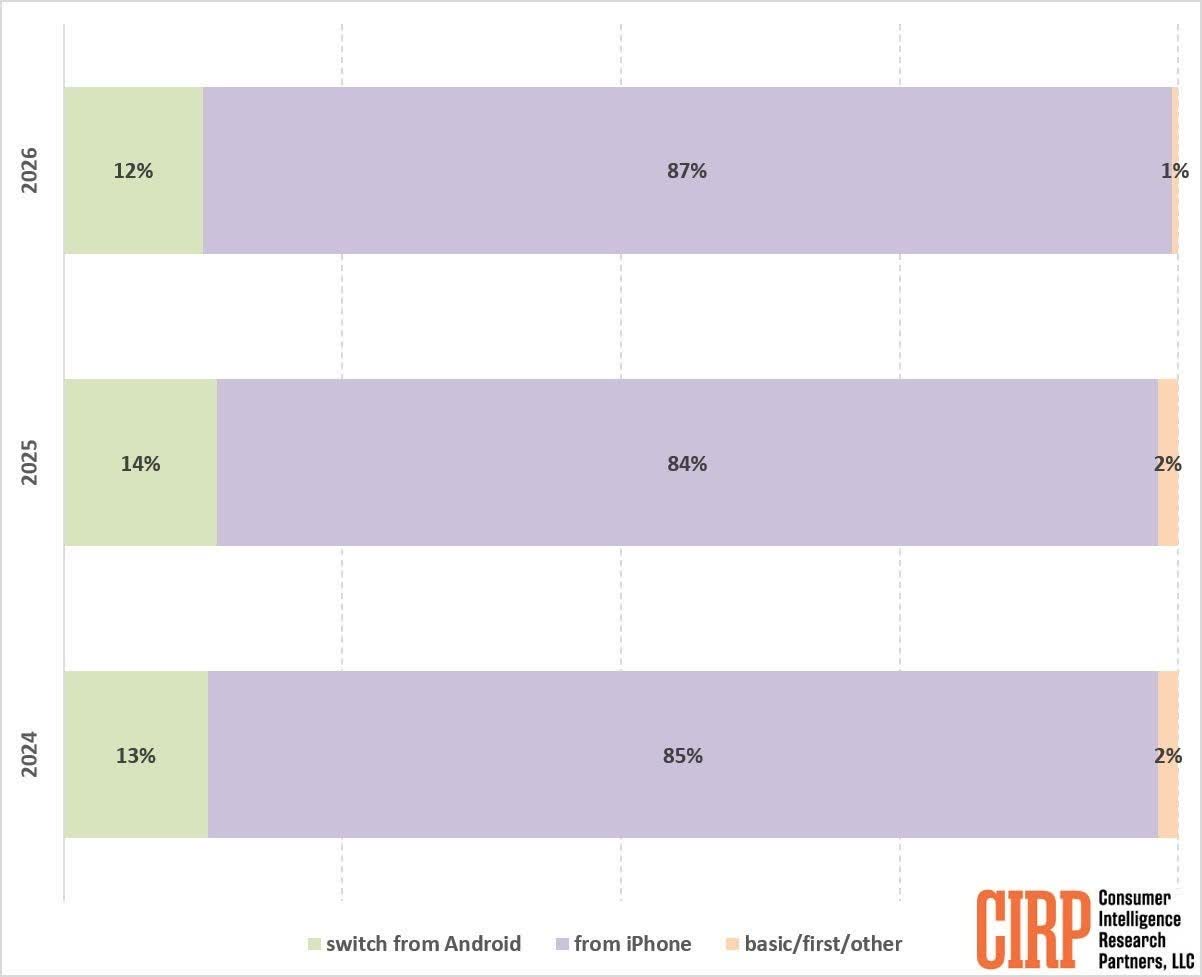
CIRP periodically surveys customers who buy new phones, asking what kind of phone they owned previously. In the quarter ending March 2026, 12% of respondents who bought a new iPhone said they had switched from an Android device, compared to 14% a year earlier and 13% in 2024.

Only 1% upgraded from a feature phone or a smartphone running another operating system this year, down from 2% in each of the previous two years. That leaves the share of iPhone buyers who upgraded from another iPhone at 87%, up from 84% last year and 85% the year before. The figures suggest that most smartphone users have already settled on a preferred platform.

Advertisement

While CIRP does not track how many iPhone users are moving to Android, a similar survey published earlier this year by SellCell found an even higher loyalty rate for Apple in the US. Among more than 5,000 smartphone users, the share planning to stick with the iPhone climbed from 90.5% in 2019 to 96.4% in 2026. Android loyalty, by contrast, sat at 86.4% this year, and Android users were about four times as likely to switch to iOS.

The reasons behind Apple’s edge are unclear. The company’s recent move to support RCS messaging, which lets Android and iPhone users exchange texts with end-to-end encryption and other advanced features, appears to have had little effect on brand loyalty.

Android’s comparatively open platform, which lets users sideload apps, remains one of its most significant advantages over iOS. But Google is preparing to restrict that functionality, a shift that could dull its value proposition for some customers.

Generative AI is another area where the competing smartphone platforms diverge somewhat.

Advertisement

Google has been quicker to weave its Gemini assistant into Android, with features such as auto-scheduling, form auto-completion, dictation, and automatic web browsing. Apple is set to bring comparable capabilities, including visual descriptions, AI web searches, and document drafting, to Siri in iOS 27 this fall.

Source link

Advertisement
Continue Reading

Tech

RFK Jr. May Have Violated The Hatch Act In Encouraging Iowa Congressional Candidates To Drop Out

Published

on

from the if-only-that-mattered dept

I don’t think it’s terribly controversial to say that this second Trump administration has never shown much concern for the Hatch Act. If you’re not familiar with that particular law, it makes it illegal for most of the members of the executive branch of the federal government, and some state representatives, to engage in partisan political activity. Sometimes the question of whether something violates the Hatch Act can be tricky, or a matter of interpretation.

And sometimes RFK Jr. rides in to provide a nakedly blatant example of a Hatch Act violation. Ron Wyden is calling for an investigation into Kennedy after he reportedly called two different Libertarian candidates in Iowa running for congressional seats to suggest that they drop out. This could be otherwise described as election interference in violation of the Hatch Act.

Wyden cited two instances in which Kennedy may have violated the Hatch Act by encouraging two Libertarian candidates in Iowa to drop out of their respective races.

In a phone call to Libertarian House candidate Marco Battaglia of Iowa’s 3rd Congressional District, Kennedy reportedly said, “If this seat flips, it’ll make my life hell.”

In a phone call to Rick Stewart, another Libertarian House candidate running to represent Iowa’s 2nd Congressional District, Kennedy reportedly suggested Stewart could find another position within federal government but outside elected office, adding that he would help him accomplish this.

Advertisement

Kennedy is doing this because both races are reportedly quite close and pretty much everyone agrees that the only real impact these Libertarian candidates would have on the election is pulling a few percentage points of the vote away from the Republican candidates. Plainly partisan political influence on an upcoming election, in other words, with something pretty close to bribery to boot when it comes to offering other positions within government in exchange for dropping out.

“Secretary Kennedy called Stewart in his official capacity as a member of the President’s cabinet, and he asked that Stewart suspend his campaign in order to make it easier for the Republican candidate to win the race, easier for the Republican Party to maintain its majority in the House of Representatives, and easier for Kennedy to personally avoid Congressional subpoenas from Democratic committee chairs,” Wyden wrote in his letter to Greer.

“Iowa’s voters should be able to freely choose who represents them in Congress, and our democracy does not allow political appointees to take that power away from them by deleting candidates from the ballot.”

I don’t really know how to argue with any of that. I also don’t have any problem believing that Kennedy has no idea what the Hatch Act is or says, nor that he was violating any laws in making these phone calls. But if the reports are correct, it appears he did. And I also don’t doubt that further reporting will reveal more of Kennedy doing this sort of thing.

That’s the problem with having unprofessional clowns working in your administration.

Advertisement

Filed Under: election interference, hatch act, iowa, marco battaglia, rfk jr., rick stewart, ron wyden

Source link

Advertisement
Continue Reading

Tech

Heading to a festival? These are the best power packs to keep your devices juiced up

Published

on

Festivals pose a bit of a conundrum when it comes to charging. It’s really useful to have a phone — for checking programs, finding friends, and snapping photos — but the days are long, and there’s minimal access to power points. A power pack is your best friend, and below I’ve rounded up the best models for festival-goers.

I’ve included a mix of options. There are compact, lightweight power banks that won’t weigh your bag down and can charge your phone while you’re using it. These can generally only manage two charges at the absolute maximum, so they’re best suited to one- or two-day festivals, or festivals where you’ll have overnight access to power. There are also larger power packs that offer multiple recharges, but which are generally too bulky and heavy to carry around all day.

Source link

Continue Reading

Tech

Can you put solar panels on your balcony in the UK?

Published

on

As we’ve already noted, plug-in solar is creeping forwards to the point where we’ll all be able to self-install in the near future. Currently, such systems are capped at 800W, and require an electrician to install.

One of the key areas for plug-in solar is people living in flats, with a key question: can you put solar panels on your balcony in the UK? The answer, unsurprisingly, is, it depends.

For a self-install, you’ll need to wait until the new legislation is in place, but once it is, whether it’s possible or not is the same even if you use an installer.

You need lightweight panels

Balcony solar uses thin, light and slightly flexible panels, rather than the hard, rigid and heavy ones for rooftop solar. These lightweight panels are specially designed so that they’re easier to fit safely and don’t put a heavy load on balcony railings.

Advertisement

These are the kinds of panels that will ship with DIY plug-in solar systems when they’re available later this year. Note that these panels can weigh up to 8kg, so they’re still a bit of a handful.

Advertisement

Balcony solar panelBalcony solar panel

You’ll need your balcony to face the right way

We all know that solar requires sunlight, so there’s no point in installing panels if your balcony doesn’t get any sun, either because it’s facing the wrong direction (North), or because there’s shade from trees or other buildings.

If you don’t get much sun, you won’t generate much electricity, so it’s not really worth installing panels.

You might need permission if you live in a conservation area

Installation of solar panels comes under permitted development, so you don’t need to get planning permission for most areas. However, if you live in a conservation area, you’ll need to check to see if you’re allowed panels, and you may need to apply for permission to have them installed.

Advertisement

You’ll need permission if you rent

Renters will be able to request to install moveable solar systems (DIY systems that they can take with them), and landlords aren’t allowed to reasonably refuse. You’ll still need permission to go ahead, but it should be straightforward to get.

Advertisement

You might need permission from your management company

Before you install balcony solar, you may need permission from your management company or freeholder, as the lease may preclude you from installing it. This could be more of an issue on high-rise blocks, where any object that could potentially fall would be more dangerous.

Before you do anything, check and make sure that you don’t need to go through additional steps. It’s possible that some buildings will require any system to be professionally installed by an installer with insurance.

Advertisement

Source link

Continue Reading

Tech

Databricks opens strategic funding round at $188bn valuation

Published

on

Last August, co-founder and CEO Ali Ghodsi told the Wall Street Journal that, in his view, ‘Databricks has a shot to be a trillion-dollar company’.

US software and data analytics company Databricks is raising a strategic funding round at a $188bn valuation following the signing of a term sheet, it said yesterday (16 July).

The round is led by existing investor Coatue and is expected to feature additional new and existing investors before closing later this summer.

The San Francisco-based company offers a services platform around data and AI that aims to help build and scale apps, analytics, and agents for more than 20,000 client organisations such as Adidas, AT&T, Bayer, Block, Mastercard and Unilever.

Advertisement

Databricks said the new funding would be used to “accelerate its AI strategy” through a focus on three of its core offerings: Unity AI Gateway, a “multi-AI governance solution that helps enterprises govern and control costs of their AI”; Genie, an “AI coworker that turns business data into trusted answers and actions”; and Lakebase, a “serverless Postgres database built for AI agents”.

“Enterprises are moving from tokenmaxxing to valuemaxxing,” said Ali Ghodsi, co-founder and CEO of Databricks. “They don’t want to burn expensive tokens on the smartest model for every task – they want the best outcome per dollar. That means having the freedom to choose the right AI for the job.

“This new capital lets us keep pushing our multi-AI strategy forward to meet massive customer demand.”

The funding would also contribute to supporting future AI acquisitions and deepening AI research, the company said.

Advertisement

In February, Databricks was valued at around $134bn after raising $5bn.

In recent times, the company has launched or expanded partnerships with Microsoft, Google Cloud, Anthropic, SAP and Palantir.

Its five-year deal with Anthropic, valued at $100m, offers Anthropic’s Claude AI models through Databricks’ data intelligence platform, allowing its client companies to build and deploy AI agents that can reason on their own data.

Last August, Ghodsi told the Wall Street Journal that, in his view, “Databricks has a shot to be a trillion-dollar company”.

Advertisement

Don’t miss out on the knowledge you need to succeed. Sign up for the Daily Brief, Silicon Republic’s digest of need-to-know sci-tech news.

Source link

Advertisement
Continue Reading

Tech

Meta Is Reportedly Considering A Multibillion-Dollar Data Center Deal With Anthropic

Published

on

It would open up a completely new business for the Facebook and Instagram maker.

Meta is “in talks” with Anthropic to lease some of its data centers, according to a new report in The New York Times. The discussions are still in early stages, the report says, but could end in a deal worth up to $10 billion over two years.

The report follows earlier reporting from Bloomberg that the social media company was eyeing an entry into the cloud services business. Providing compute resources to other companies would be an entirely new business for Meta, which makes the vast majority of its revenue from advertising. Meta CEO Mark Zuckerberg has previously hinted at the possibility of selling its data center space. During an earnings call last year, he said that the company fields such requests “almost every week” and that he considered it “an option” for the future.

While Meta and Anthropic are ostensibly rivals on the AI front, such an arrangement could benefit both companies. Meta has been making massive investments in AI data centers to fuel its own ambitions to build leading AI models. That level of expenditure has also raised some eyebrows as Meta has said it expects to spend between $125 billion and $145 billion in 2026 alone.

Advertisement

But leasing its data centers to a company like Anthropic, which has a seemingly endless need for compute resources, would turn some of those data center investments into a new, multibillion-dollar business. Anthropic previously inked a similar deal with SpaceXAI ahead of the Elon Musk-led company’s initial public offering earlier this summer. That deal is reportedly worth $45 billion over three years. The Claude Code maker immediately raised subscribers’ rate limits after announcing the arrangement.

Source link

Advertisement
Continue Reading

Tech

Apple overtakes Nvidia to reclaim the title of world’s most valuable company at $4.88 trillion

Published

on

TL;DR

Apple ($4.88T) overtook Nvidia ($4.86T) as the world’s most valuable company for the first time since April 2025. Nvidia fell 3.5%. The AI trade is broadening.

Apple overtook Nvidia on Friday to become the world’s most valuable company for the first time since April 2025. Apple closed at roughly $4.88 trillion as its shares held steady, while Nvidia fell 3.5% to approximately $4.86 trillion. Nvidia had held the top spot for nearly a year after becoming the first company to surpass $5 trillion in October.

The shift reflects investors broadening their AI focus beyond the most obvious beneficiaries. “Apple was seen as a laggard in the AI race because it wasn’t spending to develop models, but now sentiment has changed,” said Toni Meadows of BRI Wealth Management. Apple rolled out its long-delayed Siri overhaul last month, and CEO Tim Cook is preparing to hand the role to hardware veteran John Ternus in September. Apple posted its best quarter ever by not building an AI model, proving that the strategy of integrating others’ models rather than training its own can work commercially.

The semiconductor index has fallen nearly 19% from its all-time highs as investors reassess the sustainability of the AI trade. The bigger winners this year have been memory chipmakers: Micron crossed $1 trillion in May, and SK Hynix listed on the Nasdaq earlier this month. “The new entrants to the market could spread out the focus away from the pure Magnificent Seven names into a wider number of names,” said Benjamin Hall of Segal Marco Advisors.

Advertisement

The reshuffling does not necessarily signal a lasting change. Nvidia’s GPUs still power the majority of AI infrastructure, and the company could reclaim the top spot if sentiment shifts. Memory makers like Micron are signing multi-year AI supply deals that position them as long-term beneficiaries alongside Nvidia rather than replacements. Apple’s position is also delicate: the company has raised prices to offset costs from the memory shortage and tariffs, a strategy that could hurt demand if consumers pull back.

Source link

Advertisement
Continue Reading

Tech

Brex built its AI agent policy by watching what agents actually do, not by writing rules first

Published

on

OpenClaw has become one of the most widely adopted agentic frameworks, but it has yet to prove itself at enterprise scale. Agents need real credentials — API keys, OAuth tokens, service accounts — to work effectively, and Brex found that traditional guardrails couldn’t contain what those agents were doing with them.

Brex set out to overcome these limitations by building an internal platform it calls CrabTrap. The open-source HTTP/HTTPS proxy intercepts all network traffic, examines policy rules, and uses a LLM-as-a-judge to decide whether agent requests should be approved or denied. 

“What we noticed was that the network layer was an untapped enforcement point,” Brex co-founder and CEO Pedro Franceschi told VentureBeat. “Every request an agent makes is an opportunity to intercept, reason about, and make a policy decision.”

The takeaway Franceschi wants IT leaders to draw: agent governance should shift from SDK-level permissions and model guardrails toward a centralized network control plane that enforces and learns from real in-the-wild agent behavior.

Advertisement

How Brex targeted the transport layer

The “obvious fix” (at least initially) to the agent security gap was guardrails, and much of the early work has centered on scoped tools, per-action permissions, and human-in-the-loop approvals. But as agents evolve, each new capability means there’s another API to tune or surface to audit, Franceschi noted. 

“Any agentic system with multiple tools and access to the open internet creates an immediate tension for builders: The more capable you make an agent, the more dangerous it becomes, and the safer you make it, the less useful it is,” he said. 

Existing solutions to this tradeoff were “weak”: Fine-grained API tokens help at the margins but can still be misused and constrain functionality. Semantic guardrails (such as context, skills, or prompt steering) are easily bypassed by prompt injection, especially for agents connected to the internet.

Agents can be “defanged” when given read-only access or limited toolsets, but then they can’t do meaningful work, Franceschi said. On the other hand, granting broad write access and a large tool surface can result in hallucinations and real production consequences.

Advertisement

Model context protocol (MCP) gateways enforce policy at the protocol layer — but only for traffic using MCP. Meanwhile, guardrails from LLM providers are tied to a single model and can be “opaque” to customize with enterprise-specific policies. And powerful tools like Nvidia OpenShell offer more of a “per-sandbox egress control.”

“When we started, we hadn’t found a solution to deploying harnesses like OpenClaw safely,” Franceschi said. “Instead of waiting for the industry to catch up, we decided to own the problem and invent the necessary tools.”

Notably, they needed a platform that sat between every agent and every network request, and could make “nuanced decisions about what to allow,” he said. 

This made the transport layer a core architectural component and natural starting point, he said. 

Advertisement

By operating at this layer, CrabTrap is framework-agnostic, language-agnostic, and API-agnostic. It doesn’t require SDK wrappers or per-tool integration. Users set HTTP_PROXY and HTTPS_PROXY in the agent’s environment, and every outbound request routes through the proxy before it reaches a destination.

However, Franceschi emphasized, Brex didn’t start at the transport layer because it thought it was the only answer; rather, they believe in “security by layers.”

“The transport layer was simply an underinvested one, and we saw an opportunity to add meaningful enforcement there alongside everything else,” he said. 

The LLM-as-a-judge training loop

CrabTrap combines deterministic static rules with an LLM-as-a-judge for requests that fall outside known patterns, Franceschi explained. The judge only “fires on the long tail of unfamiliar endpoints or unusual request shapes,” which for a mature agent is typically fewer than 3% of requests.

Advertisement

The more pressing problem was how to know that a policy is the right one? With static rules, it’s “relatively straightforward” to reason about accuracy. But with an LLM judge, the system is nondeterministic, and users need confidence that the policy approves the right requests and blocks the rest.

“Our key insight was to bootstrap policy from observed behavior rather than write it from scratch,” Franceschi said. Beginning with real behavior and editing down based on real-world learnings turned out to be “dramatically more effective than starting from a blank page.”

Brex’s team built a policy builder (itself an agentic loop) that runs underlying agents in shadow mode, analyzes historic network traffic, samples representative calls, and drafts a natural-language policy that matches what the agent actually does. 

From there, they built an eval system that tests policy changes before they go live. CrabTrap compares historical audit entries against a draft policy and reports the exact changes to be made. Users can slice results by method, URL, original decision, and agreement status. 

Advertisement

All of this runs with concurrent judge calls, so replaying thousands of requests “takes minutes, not hours,” Franceschi said. Brex also developed a live feedback loop: Full audit trails are stored in PostgreSQL and queryable through the admin API and dashboard. In cases where a resource is continuously denied, the system can notify a human or an agent to propose a policy update for review. 

“That closes the loop between observed denials and policy refinement,” Franceschi said. 

Core challenges and roadblocks 

Of course, the build wasn’t without its challenges. A big one was latency: “Putting an LLM between an agent and every outbound API request sounds like it would grind things to a halt,” he said. 

However, it didn’t turn out to be as big a problem as expected. This was for two reasons: The LLM judge only activates on a small fraction of requests (the aforementioned 3%). Agents quickly settle into predictable traffic patterns; once observed, high-volume patterns become static rules. Second, by using small, fast models like Claude Haiku meant that, even when the judge did fire, added latency was “negligible.” This can be further reduced with local models and prompt caching, Franceschi said.

Advertisement

The harder and less obvious challenge was prompt injection, he said. The judge receives the full HTTP request and all content is user-controlled, so potentially, a crafted URL, header, or request body could manipulate the judge’s decision. 

Brex addressed this by structuring the request as a JSON object before sending it to the model, so all user-controlled content is “escaped rather than interpolated as raw text,” Franceschi said. 

Results, and where CrabTrap might evolve

Brex tracks a few factors to measure CrabTrap’s internal impact: Engagement with agents, network traffic patterns, and net promoter scores (NPS). The most meaningful result of CrabTrap has been “organizational confidence,” Franceschi said. 

Previously, the team had “real hesitation” when it came to deploying autonomous agents broadly across business operations, because the existing guardrail options didn’t provide enough assurance. 

Advertisement

“CrabTrap changed that calculus,” Franceschi said. They now have an enforcement layer they trust, increasing confidence around expanding agent deployment into more parts of the business and delegating more agent configuration and management to users. 

Franceschi described the policies derived from traffic as “surprisingly strong.” The team expected the policy builder to produce a “rough starting point” requiring heavy manual editing. In practice, though, pointing the platform at a few days of real traffic produced policies that matched human judgment on the “vast majority of held-out requests.”

Additionally, CrabTrap revealed how much noise agents generate. “The audit trail made this visible for the first time,” Franceschi said. They used denial logs and traffic analysis not only to tune policies, but to tighten agents themselves, remove tools, and cut out entire categories of requests that were wasting both time and tokens.

“The proxy became a discovery tool, not just an enforcement one,” he said. 

Advertisement

Areas for growth (and input from the open-source community)

Brex anticipates CrabTrap to continue to evolve, particularly as they have released it as open-source. “We hope the community helps shape it,” Franceschi said. 

Areas of improvement include deeper authentication functionality such as single-sign on (SSO), fine-grained role-based access control (RBAC); escalation workflows that allow agents to request additional permissions; and policy recommendations based on denial patterns.

Programmatic configuration, or developing API endpoints for “creating, forking, and applying” policies to agents, could allow the whole policy lifecycle to be automated rather than managed manually, Franceschi said. 

As for escalation, if an agent is continuously denied a given resource or endpoint, it should be able to route requests to humans or other AI agents for review and back that up with a rationale for why it needs access. 

Advertisement

“That turns CrabTrap from a hard enforcement boundary into something more like a managed permission system,” Franceschi said. 

Additionally, the policy was built to bootstrap from network traffic, but there is opportunity to incorporate additional signals around agent traces and resource-calling, as well as broader context on what agents are ultimately trying to accomplish. This can help produce more accurate and nuanced policies. 

Finally, there’s an “open philosophical question” about the right posture for CrabTrap: Should it be a fully transparent layer that the agent itself is unaware of, or should it operate more like a “well-intentioned manager”? (that is, the agent knows about the layer and can interact with it).

The open-source community can help shape these developments, and CrabTrap will only get better with more users, Franceschi said. Brex’s agents speak to a specific set of APIs; teams using CrabTrap with different agents, services, and policy requirements will surface “edge cases and patterns we can’t hit alone.”

Advertisement

“We have ambitious plans for where it could go, and we’d rather build in the open,” Franceschi said. 

What other builders can learn from CrabTrap

The response has been stronger than expected. CrabTrap has more than 700 stars on GitHub. Franceschi said Brex has also heard from OpenAI, Y Combinator CEO Garry Tan, and programmer Pete Steinberger, all expressing interest in deploying similar internal infrastructure.

The broader lesson: “Don’t let infrastructure gaps become excuses to wait,” Franceschi advised. There are “real blockers” for every enterprise looking to seriously deploy AI agents, including security concerns, lack of tooling, or unclear guardrails. 

“It’s tempting to sit on your hands until the industry catches up,” he said. “The lesson from CrabTrap is that you can own those problems directly.”

Advertisement

Source link

Continue Reading

Trending

Copyright © 2025