No one minds contributing to a sick child’s life-saving medical treatment, but how about a crowdfunder for a celebrity couple’s wedding? Marriage licence, venue, reception, meal, flowers, photography. Any offers?
No, I didn’t think so. And when the couple seeking donations from their guests are former England and premiership rugby player Danny Cipriani and his bride-to-be, Hollywood actress AnnaLynne McCord, it’s even less likely that the proposition will pull on anyone’s heartstrings.
But Danny and AnnaLynne – apparently down on their luck financially despite their lavish lifestyles – are hoping to raise around £10,000 by asking guests to pay towards their big day.
Understandably, Danny’s ex-wife Victoria is among their most vociferous critics.
‘It’s just plain tacky of them to hand round the begging bowl. If it was my neighbours, maybe. But for them? The very idea!
‘They’re even asking for money for the marriage licence. Donations for the honeymoon are just about acceptable, but they’ve both got the capacity to earn. Why don’t they go on OnlyFans? They’re selling every other aspect of their lives. Sell your bodies!’ She’s joking, but I take her point.
‘Scale down the reception. What’s wrong with a barbecue in the back garden? A beautiful, intimate, private moment. No need to be extravagant. They’re silly to want a big do when they’re claiming to have no money.’
Donations, should anyone wish to make them, may be lodged through the happy couple’s website, via the crowdfunding site Honeyfund. There, invitees are encouraged to stump up anything from £75 to £450 to help pay for specific aspects of the wedding. Should they prefer, they may just give money.
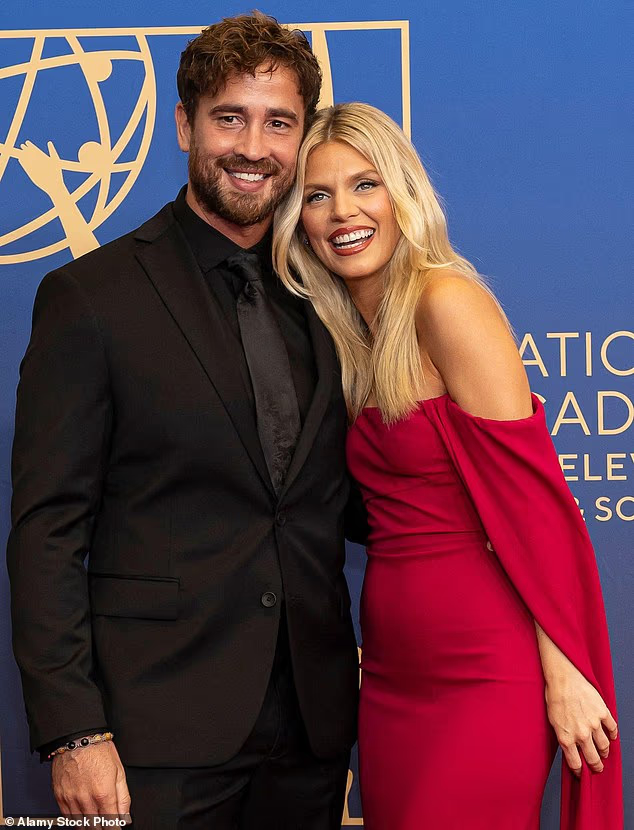
Danny and AnnaLynne are hoping to raise around £10,000 by asking guests to pay towards their big day
Understandably, Danny’s ex-wife Victoria is among their most vociferous critics
Donations, should anyone wish to make them, may be lodged through the happy couple’s website, via the crowdfunding site Honeyfund
‘I wouldn’t have had the gall to say: “Here’s the wedding invite. Now give us £150 for drinks”,’ continues Victoria, 45, warming to her theme. ‘They’re so emotionally and spiritually involved with each other they’re clearly not affected by humiliation.’ A hint of sarcasm is creeping in now.
‘I’m all for love, light, peace and finding yourself,’ she says, referring to Danny and AnnaLynne’s fondness for therapeutic retreats. ‘But Danny’s found himself in a bloody hole if he’s begging for money for their wedding.’
Victoria, a neuroscience practitioner – sparky, petite, raven-haired – was with Cipriani for four tumultuous years, having met in 2020 via social media.
They were married in 2021 and separated three years later, when Danny walked out without explanation. Victoria was awarded a relatively modest lump sum of £275,000 in their divorce.
When I last met her 18 months ago – then in the throes of their complicated and increasingly rancorous divorce – she told me how Danny had an inveterate drug problem. His excesses – and they were eyewateringly epic – were described in full by Danny himself in his raw 2023 autobiography, Who Am I?
It revealed a shocking juxtaposition: how one of the fittest and most gifted sportsmen in the country was in fact in thrall to hallucinogens and cannabis while playing rugby for his country.
He also confessed, at the height of his celebrity status, to sleeping with three women a day.
But contradictions are key to Cipriani. Once heralded as the successor to the great England fly-half Jonny Wilkinson, Cipriani was a maverick on the pitch. Precociously brilliant – aside from representing England he played for Gloucester, Wasps, Sale Sharks and Bath – he was fatally flawed, taking to the pitch just 16 times for his country.
Victoria, a neuroscience practitioner – sparky, petite, raven-haired – was with Cipriani for four tumultuous years, after they met in 2020 on social media (pictured in 2023)
Had Danny been judicious with his finances, he might today be a wealthy man. But Victoria believes he is now penniless.
Reflecting on their marriage today, she says: ‘He was the most beautiful, invested, gorgeous human being – but he could also be completely psychotic, delusional and in a high state of paranoia when he’d eaten a lot of magic mushrooms.’
She described how parcels, masquerading as chocolate bars but in fact containing the hallucinogen psilocybin – commonly known as magic mushrooms – would be couriered to the elegant townhouse in Cheltenham where they lived when Danny was contracted to play rugby for Gloucester.
He also regularly took delivery of marijuana in brown parcels, ‘the size of pillowcases’.
Knowing him as she does, Victoria recognises he spends profligately – he routinely frittered away £600 a time on drugs – but is also recklessly generous.
‘He proposed to me three times and bought me three engagement rings,’ she says.
He is also, she says, hopelessly inept at keeping track of money.
‘He had no idea what his monthly household outgoings were when we met. He’s hopeless with paperwork, whereas I account for every penny.’
That said, she emphatically does not believe he is a cheapskate. ‘Actually, he has a lot of pride and I don’t think the crowdfunding idea will have come from him.
‘When my sister died of a heart attack at 44 her family, who didn’t have much money, set up a crowdfunding page to pay for her funeral. He said, “Absolutely not. We’ll cover the costs.” And he did. The Danny I knew would sell his last pair of socks for a fiver rather than ask anyone for money. I think the crowdfunding must have been AnnaLynne’s idea.’
Victoria, mum to two grown-up children and a grandmother of four, has an alternative money-raising tip for her successor.
AnnaLynne, 39, who made her name in the US TV dramas Nip/Tuck and 90210 in the Noughties, and who met Danny on the exclusive dating website Raya, has been sporting a gigantic sparkler of an engagement ring.
According to one report, it’s a 15-carat, emerald-cut diamond with seven round accent diamonds set on each side of a band of yellow gold.
‘Apparently Danny spent £250,000 on that engagement ring. I don’t actually believe it cost that. Danny’s skint. Maybe it’s costume. But if it’s real, why doesn’t she sell it to pay for their wedding?’ she asks.
Victoria puts forward another idea to supplement their fund. When Danny, 38, left her, without explanation or notice, in January 2024 before moving to the US to start a new life, he took ‘just a couple of pairs of tracksuit bottoms’.
He abandoned, not only his two boisterous giant labradoodles – who still live with Victoria in her modest rented house in Ebbsfleet, Kent – but also a lifetime’s worth of rugby memorabilia, designer clothes, heirlooms and jewellery, which still remain in her care.
‘He even left the cuddly toys he had as a baby and his milk teeth, plus all his rugby kit. It’s his legacy, his love, his passion. How could he not want it?’ she asks, incredulous.
But Danny has never returned to claim this cache, or expressed any intention of doing so when it was discussed during their divorce. ‘He has this ability to walk out of the door and not look back,’ she says.
And as Victoria contends that she paid £900 a month to keep his possessions in storage for two-and-a-half years, she’s felt justified in selling some of them herself on Vinted. ‘I’ve sold the boots he wore for his debut England match and some shirts, but I’ve still got 80 per cent of his rugby kit.’
She adds: ‘There are club shirts, trophies, medals and all his designer stuff – Loake shoes, Dior trainers, Italian suits; a Rolex watch. Everything that he has owned between the ages of zero and 37.
‘I have got two bedrooms full of it. So why doesn’t he come and grab it, and sell it to pay for his wedding?’ she asks.
She looks back on the day she married Danny in the middle of the Covid lockdown on April 27, 2021. Their wedding was a very modest affair, at Stroud Register Office: ‘We weren’t allowed to invite anyone. Even the witnesses had to look through the windows.’
Danny wore casual trousers, his white shirt untucked, and trainers. Victoria chose a knitted dress from High Street store Ted Baker.
‘Danny had planned the most magical wedding in Tobago, where his dad, Jay, is from. He
had said: “I want barefoot on the sand and dolphins.” He had extravagant plans.’
The pandemic, of course, put paid to those plans and in the end they hired a Michelin-starred chef who cooked an intimate dinner for them and ten guests at home.
‘I think AnnaLynne is going to get the wedding I was meant to have,’ says Victoria, who has already noted striking similarities in the way Danny has romanced both her and his current fiancée.
‘On her birthday he chose our wedding song – Spirit Bird by Xavier Rudd – for his social media post. He gave our wedding song away!’ She is indignant.
‘And he proposed to her as he did to me, covering the room with rose petals.’ She doesn’t quite know whether to be outraged or amused by his lack of originality.
When she reflects on their lives together she describes a mix of utter bliss and almost Gothic horror. On one occasion, she told me last time we met, after Danny had overdosed on magic mushrooms, he was admitted to the Priory where, such was his paranoia and psychosis, he thought Victoria was the Devil.
At the time she was 23 weeks pregnant, and a few days later she lost their baby. ‘I went into labour. I was on my own and miscarried our little boy. It was the middle of Covid and I had no medical help.’
Advised not to tell Danny – ‘He would not even have understood’ – she hid the loss until his condition had improved.
‘And when I told him he was on antipsychotic medication. He was heartbroken. He just broke down in floods of tears and in that moment said he would stop taking drugs. He said, “I’ll change.” And for a while he did and our lives were beautiful.’
I wonder if she imagines he has kicked his drug habit now.
‘The Danny I know can’t not take drugs,’ she says. ‘You wouldn’t know when he’s smoking weed. He’s fully functioning. When he was playing rugby he still trained hard. I hope he’s managed to stop – but I can’t imagine he has.’
She says that Danny – who first met AnnaLynne ten years ago, reviving their on-off relationship after he split from Victoria – spent money with wild abandon in the 18 months between their separation and divorce in October 2025, burning through a giddying £450,000.
Victoria believes that within one month in 2024 alone, he spent £30,205 on trips to Egypt where AnnaLynne hosts ‘spiritual and consciousness retreats’.
He also notched up a £10,989 bill for a ‘spiritual vacation’ and more than £10,000 on yoga classes and ‘therapeutic retreats’.
Both he and AnnaLynne say they have tried the powerful psychedelic hallucinogen ayahuasca on journeys to the Amazon to ‘process personal trauma’.
Victoria, who is briskly no-nonsense, dismisses all this as ‘crackers’, showing me a video in which AnnaLynne speaks the fantasy language ‘dragon’ which to the uninitiated sounds like mumbo jumbo. Victoria refers to it all as ‘complete woo-woo’.
Meanwhile, on a more prosaic plane, she describes how their bitter divorce reached its lowest point when Victoria was accused of stealing £70,000 from her then mother-in-law, Anne, whom she was caring for after a stroke.
Victoria had to prove her innocence to the divorce court in a nerve-shredding, nine-month investigation, which ended in her complete exoneration.
‘I cared for Anne as if she was my own mother and handled her finances. Then I had to defend myself against ludicrous accusations of gross financial misconduct and employ forensic accountants to do so.
‘It was a huge shock to be accused – and it wasn’t cheap to clear my name either,’ she says.
Victoria still talks to Danny’s affable dad, Jay, who has confessed to her that he won’t be attending his son’s wedding in Los Angeles on August 22.
‘He says he can’t get a visa in time.’ Victoria wonders out loud if this is a convenient excuse for not going.
She is a resourceful woman who, although resolutely single, is not averse to offers from men who are ‘sane and not on drugs’.
She’s also planning a fresh start, somewhere new. Where is she off to? It is quite a surprise when she says Los Angeles.
‘I might get invited to the wedding,’ she laughs, adding mischievously, ‘but I certainly won’t be paying to go.’
















































You must be logged in to post a comment Login