The change, which came into effect on Friday, May 1, gives tenants in the private rented sector in England the legal right to request permission to keep pets in their rented homes.
Under the Renters’ Rights Act, landlords cannot unreasonably refuse pet requests, marking a significant shift for Oxfordshire renters who have long faced blanket pet bans.
David Bowles, head of public affairs at the RSPCA, said: “This is an historic day for pet ownership.
Advertisement
“For too long, renters in England have been unfairly denied the potential joy of pet ownership.
“That ends thanks to this new law.
“This change is a lifeline – not just for families wanting to add a loving pet to the household, but for the many thousands of animals currently stuck in many full to bursting centres, who will now have many new opportunities to find loving adopters.
“Pet ownership is such a big commitment – but can be so rewarding.
Advertisement
“At the RSPCA, we are celebrating that the Renters’ Rights Act will facilitate happier, healthier tenants right across the country – and help us tackle a pet rehoming crisis.”
The charity has described the new law as an opportunity to ‘revolutionise’ pet ownership and believes it will give more animals a chance of finding a home, especially as many of its centres are currently at full capacity.
In recent weeks, the RSPCA has worked with the UK Government to highlight the impact the change could have for prospective pet owners.
The legislation also promises relief for current pet owners who often face the tough decision of giving up their animals to secure housing.
Advertisement
Mr Bowles said this scenario has been all too common.
He said: “There are gut-wrenching examples of people having to surrender their pets to access somewhere to live, because their tenancy agreement will not allow pets.
“Thankfully, those situations too will soon be a thing of the past.”
Among the animals who may benefit from the new law is Sweeny, a Mastiff who has spent nearly a year at the RSPCA’s Newbrook Farm Animal Centre in Birmingham.
Advertisement
Brittanny Baker, animal care assistant, said: “He’s been with us for 11 months now but he is constantly overlooked by potential adopters which breaks my heart.
“Sweeny may be a big boy, but he’s certainly got a big heart.
“He’s goofy, playful and loveable. He learns fast and enjoys training as well as quiet walks out, and playing in the off-lead paddock.”
More information about the RSPCA’s work and its Good Practice Guide for the housing sector can be found on the charity’s website.
The former PSNI officer also said he “completely” rejected allegations in the letter that an “insidious campaign of rumour and gossip” had been directed at Mr Beattie.
Bairbre Holmes, Press Association
22:08, 02 Jun 2026Updated 22:12, 02 Jun 2026
The UUP leader has said he is “deeply disappointed” by comments made by Doug Beattie, who resigned from the party on Sunday.
The Upper Bann MLA, who once led the UUP, cited a “toxic atmosphere” under its current leadership as the reason for his departure.
Advertisement
In a scathing resignation letter directed at party leader Jon Burrows, the ex-Army captain said: “Your leadership style became dismissive and overly centralised, empowering individuals to actively undermine elected representatives.
“In the absence of any coherent policy direction from the leadership, a toxic atmosphere has been allowed to flourish within the party.”
Speaking on BBC Radio Ulster’s Evening Extra on Tuesday, Mr Burrows said he had “a lot of respect” for Mr Beattie, “both as a gallant soldier and also as a long-standing member and politician in this party”.
However, referring to the resignation letter he said: “I’m deeply disappointed by the comments Doug made, I regret that he made them, and I don’t recognise his characterisation of me whatsoever.”
Advertisement
Asked about disciplinary proceedings which Mr Beattie described as “vindictive and a deliberate attempt to drive” him from the party, Mr Burrows said: “I deal with what is in front of me, and I have high standards, A leader sets high standards in terms of integrity.
“It is my responsibility to set high ethical standards,” he added.
The former PSNI officer also said he “completely” rejected allegations in the letter that an “insidious campaign of rumour and gossip” had been directed at Mr Beattie.
NEW YORK (AP) — And now, Take Two: The White House Correspondents’ Association dinner has been rescheduled — with President Donald Trump apparently in attendance.
The dinner, cut short in April by a gunman who prosecutors say was trying to assassinate Trump, will now take place on July 24. It will be a more intimate gathering with “significantly enhanced safety measures and new access procedures,” said Weijia Jiang, president of the White House Correspondents’ Association.
Jiang did not say where the dinner would be held. But Trump, on his Truth Social platform, revealed it would be at the Waldorf Astoria Hotel on Pennsylvania Avenue — former site of the Trump International Hotel.
The president said he’d been invited to return and speak, and had accepted the invitation. He called the rescheduling “a sign of Strength and Fortitude.”
Advertisement
“This announcement is a very good thing in that we cannot allow Lunatics to change our way of life, or even its scheduling,” Trump wrote.
He added he hadn’t decided on whether to give his originally intended speech, in which he was widely expected to attack the press. “I don’t know whether or not I will give the same rather nasty statements, at least as it concerns certain people, but we will soon find out,” he wrote. “In any event, it will be a ‘HOT’ ticket!”
Rescheduling decision took time
Jiang, in her announcement, noted that “rescheduling was not automatic,” and had involved much consideration and input from board members.
She emphasized the dinner’s stated purpose: “a celebration of a free press and the vital role of journalism in our democracy for over a century.”
Advertisement
“We will not allow an act of violence to have the last word, especially during a year when we are reflecting on the 250th anniversary of America and everything we stand for,” Jiang said.
It was not clear how large the rescheduled dinner would be, or whether it would be a full-scale dinner at all. Jiang made reference to a “more intimate gathering” than the original event, attended by close to 3,000 people at the Washington Hilton, but did not give details, saying they’d be shared directly with attendees.
Her remarks were in line with recent speculation that a rescheduled event would have to be pared down, a nod to financial as well as security concerns.
Concern expressed for wounded officer
Jiang also made note of the Secret Service officer who was shot in April and has been recovering. “Our thoughts remain with the officer who was injured and with everyone who experienced that evening,” she said. “We are indebted to the US Secret Service, law enforcement and the hotel staff whose swift response protected our guests and our staff.”
Some critics said they felt it would be a good idea to scuttle the whole event permanently — not only for security reasons, but for what they saw as an unseemly enterprise of journalists hobnobbing in formal wear with the subjects of their reporting.
“It undermines the public faith in how the press does its work, and it makes it look like we are pals with the people we cover,” Kelly McBride, an ethics expert at the Poynter Institute, a journalism think tank, said in May.
Opposition leaders said they ‘were not going to hold the city council ransom’
Labour’s Katie Thornburrow has been elected as leader of Cambridge City Council after last month’s meeting ended in deadlock. The first meeting of the full council since the local elections had to be adjourned after opposition parties voted against her appointment twice despite hours of deliberation.
Advertisement
The meeting was adjourned until June 1 but this time Cllr Thornburrow was successfully voted leader. The Green Party put forward Cllr Sefira Davison, deputy leader of the group, as leader, but she was defeated by 16 votes to 12 – with 12 more councillors abstaining.
Cllr Thornburrow thanked everyone who took part in negotiations and welcomed all the newly elected council members.
She said: “Not only have you lowered the average age of councillors in the chamber but you’ve brought a range of experience, insight and expertise, and you deserve thanks for stepping forward for election. I know putting myself forward was a hard decision but it’s one I’ve never regretted.”
Cllr Thornburrow said they would be introducing regular meetings between the leaders of Labour, Liberal Democrat and Green groups and starting a cross-party finance working group “that will make budget-setting more collaborative and open”.
Advertisement
She said the “new ways of working” reflect how she personally wants to lead and have also come from the “constructive, extensive conversations” had with opposition leaders.
Cllr Davison congratulated her and said it would be “great comfort for residents” that there would be not just “scrutiny from all sides – but hopefully that scrutiny will be in a collaborative framework for the good of the city.”
Cllr Tim Bick, leader of the Liberal Democrat group, said that a “three-party administration” was their priority but this had “failed because Labour didn’t support it”.
He said: “Our interpretation of the election result was a clear desire for change and we didn’t feel Labour carrying on as before was appropriate.”
Advertisement
Cllr Bick said that other options including a coalition between the Greens and Liberal Democrats were also considered, but said they felt there was “uncertainty” surrounding the Greens “collective views on the major issues affecting our city”.
He said they didn’t want a Labour administration but without a “credible alternative”, there was “sadly no other show in town” and they “were not going to hold the city council ransom”.
In return for the Liberal Democrat group abstaining from the vote, Labour agreed to support a number of their proposals. These include measures to control the spread of HMOs, reopen public toilets and improve street cleaning and public realm enforcement.
They will also bring forward a report on a potential citywide Public Spaces Protection Order to enhance police powers in relation to anti-social driving. Labour have also agreed to prepare a report responding to Equalities Act guidance surrounding public toilet access to protect the rights of the trans community. The rights of both opposition parties will also be extended with guaranteed speaking rights at cabinet.
Advertisement
In a press release issued by the Greens following the meeting, Cllr Davison said: “We heard from the Lib Dems today that Labour being in power wasn’t what they wanted, but it’s what they chose.
“We’ve spent weeks offering fair, reasonable compromises, including a proportionate split of cabinet posts and balanced leadership arrangements, and they told us they wouldn’t accept any offer that didn’t give them immediate leadership of the council.”
She said they would look forward to holding the administration to account and making sure they deliver “the best results for the city”.
The body of Conor Kinlan was recovered from a Cambridgeshire river in January
14:47, 02 Jun 2026Updated 14:56, 02 Jun 2026
Police have released a CCTV image of a witness they would like to speak to in connection with the death of a man who entered a Cambridgeshire river in January. Conor Kinlan was found in the River Nene in Peterborough on January 24 of this year.
Conor’s death is being treated as a murder and three men, who have been charged with murder, are due to stand trial next month. Police would now like to speak to a man captured on CCTV in connection with Conor’s death.
In the CCTV image, the man is seen wearing blue-green trousers, a black jacket, a red and white cap and riding a light green mountain bike. Detective Chief Inspector Richard Stott, from the Bedfordshire, Cambridgeshire and Hertfordshire Major Crime Unit, said: “We’d like to speak to this man who we believe can help our enquiries.
Advertisement
“We recognise the images aren’t of the best quality but hope the man himself may see this and come forward, or someone might recognise the distinctive clothing.” Anyone with information should call police on 101 or online and quote Operation Adeo.
Protesters clash with riot police in Southampton near where Henry Nowak was murdered – Manchester Evening News
Need to know
Police were pelted with bricks and forced to retreat
Tom Burnett Content Editor
21:34, 02 Jun 2026Updated 21:46, 02 Jun 2026
Advertisement
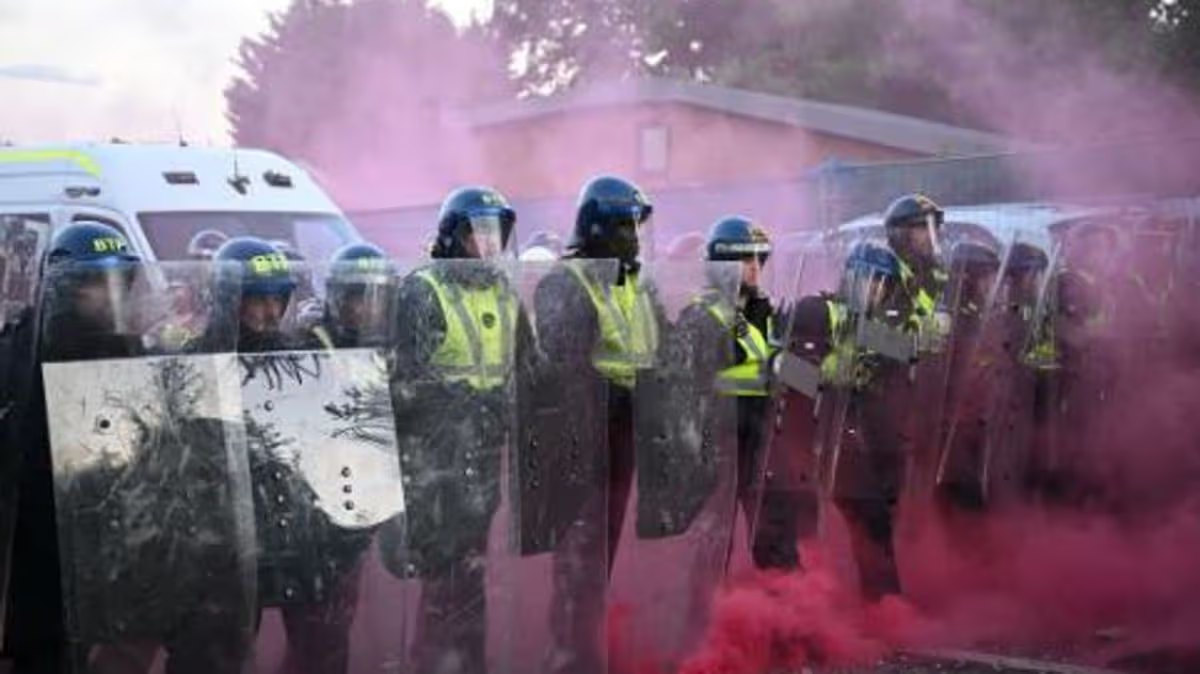
Police at the scene(Image: Getty)
Police holding riot shields have clashed with protesters close to where Henry Nowak was stabbed to death.
A police helicopter hovered overhead as officers were pelted with stones on a residential street in the St Denys area of Southampton before they charged with perspex shields in an attempt to push the crowd back.
Demonstrators chanted “Henry, Henry” as the line of police were pelted with bricks and forced to retreated again.
Following an earlier protest outside Southampton Central Police station, a large group walked across town to the area of St Denys, close to where the murder took place.
Chairs, cans and flares were thrown at police in riot gear, eventually forcing officers and three police vans back from the line they had been holding.
Henry Nowak, aged 18, was murdered by 23-year-old Vickrum Digwa, who told police attending the scene that he had been the victim of a racist attack.
The murder, and the circumstances around the death which saw Mr Nowak handcuffed by Hampshire Police, have seen politicians clash, with Reform UK leader Nigel Farage calling for the response to be ‘pure, cold rage’.
Body-worn camera footage from the incident appeared to show Mr Nowak, who had received two stab wounds on the back of his legs and a fatal wound to his heart, repeatedly pleading “I’ve been stabbed” and “I can’t breathe” while being handcuffed.
On Monday, Digwa was jailed for life to serve a minimum of 21 years for stabbing Mr Nowak with a ceremonial knife with a 21cm blade prosecutors said was a kirpan, which he carried as part of his Sikh religion.
Prime Minister Keir Starmer told broadcasters: “I think Nigel Farage’s reaction is the wrong reaction, and I start my answer to your question through the eyes of the family. They have said they do not want this whipped up. They have been through the most extraordinary, awful experience. They don’t want this whipped up. And Nigel Farage is completely wrong to use this to try and create division. He would be wrong in any circumstances, but when Henry’s family are saying please don’t do that, it is our son, then really politicians as human beings should start where they start. And that is where I start.”
The Independent Office of Police Conduct (IOPC) is planning to report on the police handling of Henry Nowak’s murder in the next three months, Shabana Mahmood said.
In her response to Southampton Itchen MP Darren Paffey in the House of Commons, the Home Secretary said: “The IOPC will and do have the resources that they need in order to conduct their investigation and I know that they will do so with the full independence that is afforded to them in our system. I understand that they intend to report finally within the net three months, and I do believe that a meeting is now taking place with the family.”
Three in five nursing staff and students who responded to a 2021 survey by Nursing Times and Unison said they had experienced sexual harassment at work. For many, it had come to be treated as part of the job.
More recent figures suggest the problem persists. In the 2025 NHS staff survey for England, 11.36% of registered nurses and midwives said they had experienced at least one incident of unwanted sexual behaviour from patients, service users, visitors, relatives or members of the public in the previous year.
The problem is not confined to one country or type of healthcare setting. Around the world, nurses report sexual comments, intrusive questions, non-consensual touching, intimidation and abuse from colleagues, patients and visitors. Yet sexual harassment remains under-researched and often absent from public conversations about healthcare.
A problem hidden in plain sight
Sexual harassment in healthcare can take many forms: a comment about a nurse’s body, repeated advances, sexual jokes or unwanted contact during personal care.
Advertisement
Such behaviour is often minimised. Nurses may be told that a patient “didn’t mean it”, that harassment is “part of the job”, or that it should be expected in certain settings.
This can be especially difficult in areas such as mental health or dementia care, where behaviour may sometimes be affected by cognitive impairment, illness or distress. Illness may help staff understand why something happened. It does not erase the harm caused. Nurses still need protection and proper follow-up.
Repeated harassment can affect confidence, wellbeing and willingness to remain in the profession. More detailed research is needed into how nurses experience and respond to it, and whether organisational policies work in practice.
Who is most affected?
Gender, ethnicity and workplace hierarchies shape nurses’ experiences. In the UK, almost 90% of professionals on the Nursing and Midwifery Council register are women, and around a third are from Black, Asian and ethnic minority backgrounds.
Nurses may have less power than doctors, senior managers or other professionals. Their work can also involve close physical contact. Neither makes abuse acceptable. Gender, ethnicity, seniority, age, sexuality and area of work can all affect what happens, how seriously it is taken and whether a nurse feels able to report it.
When abuse becomes normalised
One of the most worrying features of sexual harassment in healthcare is how easily it can become normalised. Harmful behaviour starts to be seen as ordinary, unavoidable or not worth challenging.
Advertisement
French nurses describe sexual violence in hospitals and the difficulty of challenging behaviour that has too often been treated as part of the job.
If a nurse is repeatedly subjected to sexual comments or unwanted touching, colleagues may advise them to “laugh it off”, avoid a particular patient or handle the situation quietly.
Formal reporting can feel risky. Nurses may worry that they will not be believed, that managers will do nothing or that speaking up could damage their career. When incidents are handled informally, the burden falls on individual nurses and the wider culture remains unchanged.
Why current responses fall short
Health systems are beginning to take sexual safety more seriously. Since October 2024, employers have had a legal duty to take reasonable steps to prevent sexual harassment.
From October 2026, the duty is scheduled to be strengthened. Employers will be required to take all reasonable steps to prevent sexual harassment and will have a new obligation not to permit harassment by third parties, including patients and visitors.
Advertisement
In England, NHS England, all NHS provider trusts and all integrated care boards have signed a sexual safety charter committing them to a zero-tolerance approach to sexual misconduct.
NHS England has also published a national policy framework to help staff recognise and report sexual misconduct and access support. But discussions can focus heavily on behaviour between colleagues. What should happen when a patient repeatedly makes sexual comments, touches a nurse during care, or is confused, distressed or seriously unwell?
Without clear answers, nurses can be left to manage these situations alone.
Listening to nurses
Reports such as Surviving in Scrubs have exposed the seriousness of sexual misconduct in healthcare workplaces. More research is needed into nurses’ day-to-day experiences of harassment from patients and visitors.
Advertisement
A recent scoping review found that education and reporting systems are among the most commonly proposed responses to sexual harassment of nurses. Evidence about which interventions work remains limited.
Policies matter, but nurses also need managers who act when incidents are reported, practical support afterwards and working cultures that do not ask staff to absorb abuse in silence.
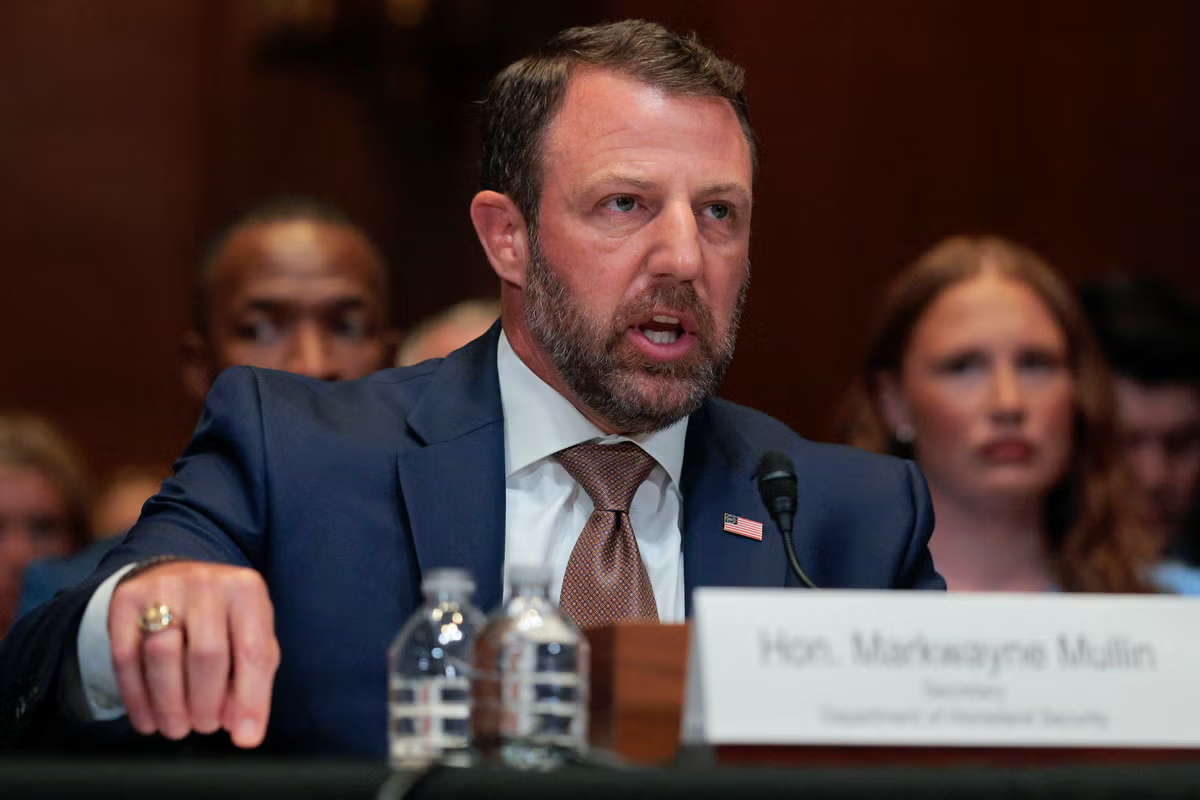
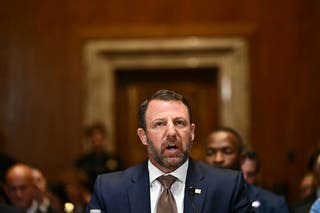
DHS Secretary Markwayne Mullin fielded several questions about the conditions and protests at Delaney Hall, a controversial ICE detention center where detainees are reportedly on hunger strike over allegedly inhumane conditions, spoiled food and lack of access to legal counsel.
But Mullin said recent health inspections “didn’t find one single violation.”
Just before he testified, however, New Jersey’s Health Department sued GEO Group, the private prison contractor that runs the facility, for “immediate” entry to investigate the jail.
Advertisement
Inspectors initially tried to enter Delaney Hall on May 27 but were barred from “full access” to the facility, according to a civil complaint filed on Tuesday. They were barred from the jail’s medical unit, toilets, shower facilities and sleeping areas, and were “unable to ascertain” whether GEO Group and ICE are “taking sufficient precautions to mitigate the serious and unchecked risk of communicable diseases to both detainees at Delaney Hall and New Jersey’s public at large.”
Alex Woodward2 June 2026 21:34
Rep. DeLauro hits out at Trump’s $1.8B ‘Anti-Weaponization Fund’
Rep. Rosa DeLauro criticized President Donald Trump’s proposed $1.8 billion “Anti-Weaponization Fund,” which she called “unconscionable.”
Advertisement
She made the remarks as acting Attorney General Todd Blanche appeared before a House Appropriations subcommittee.
“It can be used to pay out violent criminals who assaulted police officers and ransacked the Capitol on January 6. … These are the people who were arrested, they were tried, convicted, and then pardoned by the administration, and now he wants to raid the Treasury to pay them,” she said.
The plan sparked pushback from both Republican and Democratic lawmakers, with critics labeling it a “slush fund” for his supporters. Trump tabled the plan after a judgetemporarily blocked his administration from “taking any further action pursuant to the creation or operation” of the fund in a ruling released Friday.
Katie Hawkinson2 June 2026 21:28
Advertisement
Mullin addreses Kilmar Abrego Garcia’s case
Lots to unpack in that exchange over Kilmar Abrego Garcia, whose wrongful removal case has been a flashpoint in the legal chaos around the Trump administration’s mass deportation efforts.
Mullin says he is not aware of Abrego Garcia’s long-running legal battle in his attempt to deport himself to Costa Rica, which has agreed to take him.
The secretary said: “Great, if he’s willing to do that we’d be happy to send him.”
Advertisement
But the Trump administration — while also trying to prosecute him in a separate criminal case — has been trying for months to deport him to Liberia.
Mullin’s statement is likely to be brought up by Abrego Garcia’s attorneys in court filings.
A federal judge is currently blocking ICE from re-deporting or detaining him, noting earlier this year that the government has made “one empty threat after another to remove him to countries in Africa with no real chance of success.”
In a memo issued in March, ICE’s then-acting director Todd Lyons argued that sending him to Costa Rica would be “prejudicial to the United States.”
Advertisement
Last month, the judge overseeing his criminal case dismissed the indictment against him after Abrego Garcia argued he was being unlawfully targeted as part of a smear campaign after he won he wrongful deportation case.
“Objective evidence” has shown that federal prosecutors only brought charges against Abrego Garcia after he won his lawsuit challenging his arrest and removal. A decision to re-open a previously closed investigation against Abrego Garcia — coupled with public statements from administration officials including Acting Attorney General Todd Blanche that tied the case to Abrego Garcia’s lawsuit — “taints the investigation with a vindictive motive,” the judge wrote.
Alex Woodward2 June 2026 21:16
Advertisement
Blanche testimony begins
Acting Attorney General Todd Blanche is testifying before a House Appropriations subcommittee.
Acting Attorney General Todd Blanche is testifying at a House Appropriations subcommittee hearing (Getty Images)
Katie Hawkinson2 June 2026 21:11
Sen. Gary Peters grills DHS secretary over FEMA funding
Sen. Gary Peters pressed Homeland Security Secretary Markwayne Mullin over what he called the “unprecedented politicization of disaster assistance.”
Advertisement
“There are reports that President Trump has approved nearly 90 percent of disaster requests from red states, but only 23 percent from blue states, even when the request met the FEMA-established threshold for federal assistance,” Peters said.
He went on to ask Mullin if he believes it’s right for a president to “approve disaster aid based on whether a state voted for him instead of the amount of damage that actually occurred in the state.”
“Senator Peters, that’s not my experience with the president. As I said, we’ve had 37 states approved for public assistance disaster underneath President Trump,” Mullin replied.
Katie Hawkinson2 June 2026 21:00
Advertisement
DHS secretary says agents won’t ‘bother’ people unless they’re breaking the law
Homeland Security Secretary Markwayne Mullin said most DHS agents are “not going to bother you” unless “you’re breaking the law.”
“Has it been your experience that most cops, most Border Patrol officers, most ICE agents will leave you alone unless you do illegal stuff?” Sen. John Kennedy asked.
“That is absolutely correct, and they love doing their job. They don’t do it for the money, they do it because they’re called to do it. … There’s always a few bad apples, but for the most part, those officers, unless you’re breaking the law, they’re not going to bother you,” Mullin replied.
Advertisement
Katie Hawkinson2 June 2026 20:41
DHS secretary ripped over ‘outrageous’ policy proposals
Sen. Patty Murray accused Homeland Security Secretary Markwayne Mullin of floating “outrageous proposals” and said he has yet to “take back the reins from Stephen Miller.”
“You plan to withdraw CBP officers from airports in cities that don’t roll over for Trump. That is insane. It is not only dangerous, it would also spell economic crisis for blue and red states,” she said.
Advertisement
Sen. Patty Murray accused Homeland Security Secretary Markwayne Mullin of floating ‘outrageous’ policy proposals (AFP via Getty Images)
Katie Hawkinson2 June 2026 20:08
Sen. Chris Murphy addresses judges accusing DHS of failing to follow court orders
In his opening statement, Sen. Chris Murphy brought up how judges across the country have accused DHS of repeatedly failing to follow court orders, including at least 96 violations in just one district in Minnesota.
Federal courts are swimming in cases alleging unlawful arrests and detentions filed by immigrants swept up in the Trump administration’s mass deportation dragnet.
Judges have ruled roughly 10,000 times that ICE officers had illegally arrested people without giving them the chance to prove they could safely remain in their communities while their immigration cases played out.
Advertisement
In the Minnesota example, ICE released the man at the center of case, but District Judge Patrick J. Schiltz unleashed his frustrations and listed 96 court orders from 74 different cases that the agency allegedly failed to follow, a count that he said was “almost certainly substantially understated.”
The fact that he can come up with a list of 96 ignored orders “should give pause to anyone — no matter his or her political beliefs — who cares about the rule of law,” he wrote.
Sen. Chris Murphy addressed how judges across the country have accused DHS of repeatedly failing to follow court orders, including at least 96 violations in just one district in Minnesota (Reuters)
Alex Woodward2 June 2026 20:01
DHS secretary responds to Sen. Murphy: ‘We’re doing the job that Congress gave us the authority to do’
Homeland Security Secretary Markwayne Mullin hit out at Sen. Chris Murphy, who claimed his agency has been “run so far off the rails.”
Advertisement
“We’re doing the job that Congress gave us the authority to do, and our men and women out there every single day are enforcing laws. If you don’t like the laws, you can change them. We’re not picking and choosing which laws we enforce, we’re simply enforcing the law,” Mullin said.
“When you throw out reckless terms and you start referring to our agents as being dangerous, unconstitutional and lawless, that’s why our agents’ death threats are up by 8,000 percent,” he added.
Katie Hawkinson2 June 2026 19:58
Advertisement
Sen. Murphy says DHS is ‘off the rails’
During today’s Senate Appropriations subcommittee hearing, Sen. Chris Murphy said the Department of Homeland Security has been “run so far off the rails.”
“The reason why Democrats and Republicans were not able to find agreement on the underlying DHS appropriations bill is because never before in the history of our nation has a federal agency been run so far off the rails as the Department of Homeland Security,” Murphy said.
“Every day this agency is breaking the law at scale and wasting billions of taxpayer dollars. DHS does not implement the law any longer. It makes up the law,” he added.
The Ballymoney man extended his Supersport winning streak at the Isle of Man TT to nine in a row, securing his 34th victory at the event on Tuesday afternoon
21:25, 02 Jun 2026Updated 21:30, 02 Jun 2026
Northern Ireland motorsport hero Michael Dunlop has described Tuesday’s record-extending Monster Energy Supersport race win at the Isle of Man TT Races as ‘comfortable’
The Ballymoney man extended his Supersport winning streak at the Isle of Man TT to nine in a row, securing his 34th victory at the event on Tuesday afternoon.
He holds the all-time record for victories and podium finishes at the Isle of Man TT, with 34 wins and 52 podiums, surpassing the previous record of 26 victories held by his uncle Joey Dunlop.
Advertisement
Michael Dunlop overhauled early race leader Dean Harrison (Honda Racing) at the end of the first lap to eventually win by 24.47s. Peter Hickman (Swan Triumph by PHR Performance) completed the podium in third.
“It was good,” Dunlop said afterwards. “The bike’s been good all week, we’ve been really comfortable, so the main thing was to try and put it on (the podium) today.
“The conditions were a bit strange today, but the bike never missed a beat, the boys worked really hard, and it was nice to be back in here winning again.”
Delayed four hours from an 11am start to allow the roads to dry after the inclement weather on Monday and overnight, the race was also cut from four laps to three but conditions all around the course were good come the start time of 3pm.
Advertisement
Mike Browne led the field away on the Boyce Precision Engineering by Russell Racing Yamaha but by Glen Helen, nine miles into the lap, Harrison led Dunlop by 1.6s with Browne in third 4.2s further back.
As they came into the pits at the end of the lap for their mandatory stop, a first lap speed of 126.602mph gave Dunlop the lead from Harrison (126.587mph) by just 0.127s.
Jumping Ballaugh Bridge for the second time, Dunlop’s lead had almost doubled to four seconds and by Ramsey, he’d extended his lead further to 7.2s as he started the Mountain climb once more.
Dunlop continued to increase his lead through every sector and starting the third and final lap, the gap to Harrison stood at 12.5s as he looked to have broken the Honda rider’s challenge.
Advertisement
The Antrim man never looked back and with the fastest lap of the race, 127.672mph, he took the victory by 24.47s from Harrison (126.258mph) with Hickman (127.215mph) claiming third as the same three riders filled the podium position as Sunday’s Superbike race – albeit in a different order.
“Is it an accurate statement to say he either wins in ‘24, wins the White House — it’s either the White House or the big house?” Fox News anchor Sean Hannity asked Blanche on an episode of the Hang Out with Sean Hannityshow that was released on Tuesday.
“Don’t forget he had a D.C. case breathing down his neck,” Blanche said. “He had the Florida case which had been dismissed, but they were appealing it, and then he had a judge in New York who, there’s no scenario in which he wasn’t going to send Trump to prison.”
Donald Trump managed to avoid going to prison by winning the 2024 election, according to his acting attorney general Todd Blanche (AFP/Getty)
Following Trump’s election victory, the special counsel dropped the federal cases against the president-elect, citing the precedent against bringing an indictment or proceedings against a sitting president.
In congressional testimony last year, Smith said he was confident he would’ve secured a conviction against Trump on his allegations that the Republican conspired to interfere with the 2024 election.
“The timing and speed of our work reflects the strength of the evidence and our confidence that we would have secured convictions at trial,” Smith told the House Judiciary Committee. “If asked whether to prosecute a former President based on the same facts today, I would do so regardless of whether that president was a Republican or a Democrat.”
Donald Trump faced a pair of special counsel cases and a New York criminal conviction going into the 2024 election (AP)
Since returning to the White House, the president has vowed to seek payback for the alleged “weaponization” of the justice system he claims to have suffered.
The DOJ is investigating an alleged decade-long “grand conspiracy” between officials who investigated or prosecuted the president.
As part of the settlement in his recent suit against the IRS, Trump also sought to create a nearly $1.8 billion “slush fund” to compensate allies and victims” of government “weaponization.”
Assisted by the younger duo of Shaun Maloney and Mark Fotheringham, the 74-year-old took charge of eight matches on an interim basis last autumn and then returned to take the reins from January until the end of the campaign, solidifying his status as a hero in the eyes of Celtic supporters by leading the team to an unlikely double.

















































You must be logged in to post a comment Login