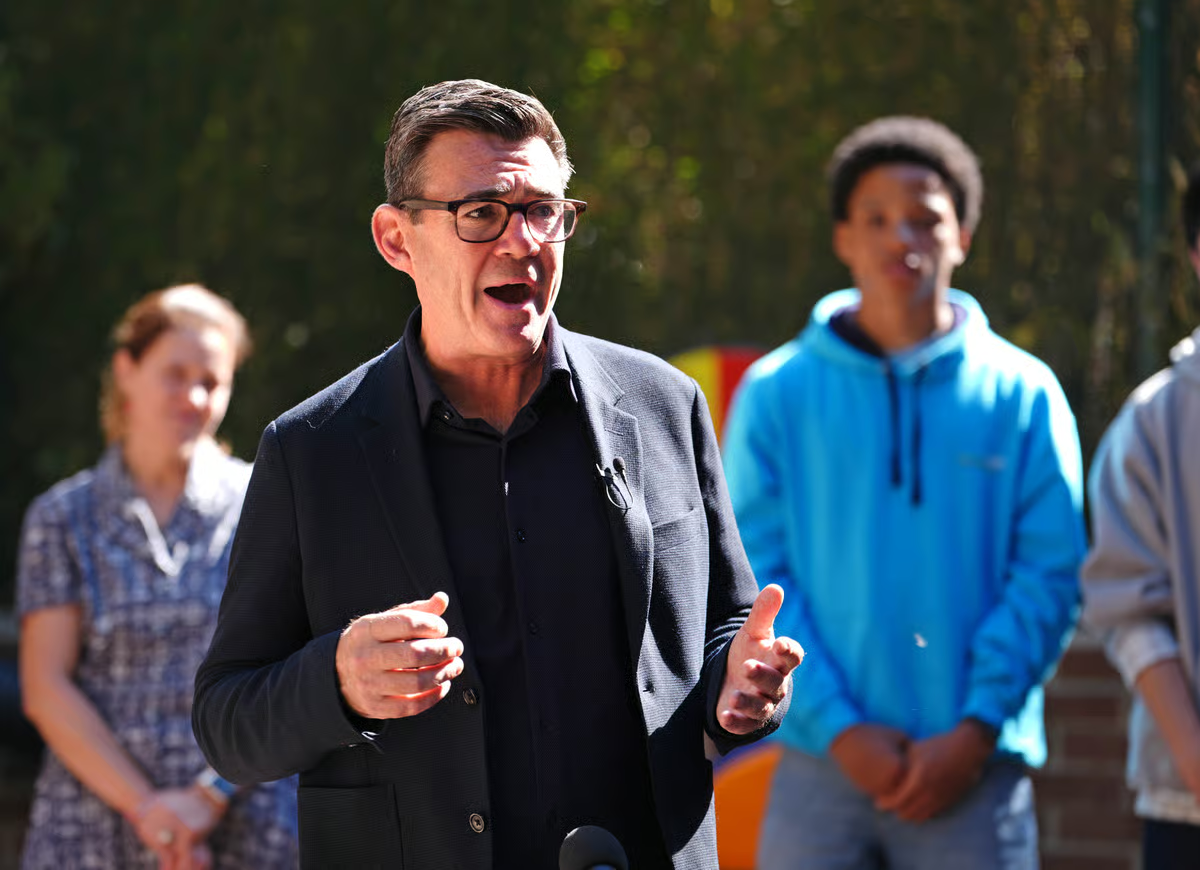
New Labour MS for Caerdydd Penarth Shavannah Taj has had a busy life but says being an elected politician had never been her goal
It was Mark Drakeford who first suggested to Shav (Shavannah) Taj that she should stand to become a Senedd member.
The Cardiff-born mum of two comes from family who worked to help those in difficulty in their community. She had a distinguished career in trade unions; she had worked in retail, in call centres, in hospitality and like doing even like door-to-door sales. But she had never held an elected political post.
She was working in what she calls her dream job, as general secretary of the TUC in Wales, when Mark Drakeford first told her he wouldn’t be standing again and he thought she should put her name forward to stand in the Caerdydd Penarth constituency.
She says it was the support of the unions that employed her, as well as the emergence of Reform UK, that helped make the decision.
Later this year she turns 50 (she says she is broadly fine about reaching the milestone figure) but says being an elected politician was never a long term goal.
“Some of the Labour affiliated unions started having a chat with me,” she says.
“All the polling was suggesting that we were going to have a significant number of Reform coming in and remember at a UK level by then they’d already voted down the employment rights legislation, they had started causing all kinds of problems and harms in councils that they were running. That in particular made the union movement very, very nervous,” she said.

“They said ‘we want a voice Shav, and it’s got to be someone who understands”.
“So for me to do this, I needed to know that I had their support and I had their blessing because coming into these spaces, you need to be remain connected to those values and sometimes you need a kick up your ass to be reminded. It’s a big thing and it’s a privilege. You’re in a very, very privileged position and I never want to forget that.”
Her life story gives her a different perspective to many of her new colleagues in the expanded Senedd.
Unions, and politics had always been part of family life. She remembers waiting while her dad, a steelworker firstly in Port Talbot and then in Cardiff, popped in to pay his union subs.
She also remembers her mum’s unofficial role in her Asian women’s fabric shop in Cathays as a sort of village elder – imparting her wisdom to those who came in for a metre or two of fabric but needed help with all manner of things in their lives.
Inequality was a common theme, she says. “They would be talking about the fact that their child has been excluded from the school and they want some help, or they would come in and be like, ‘my kids have this report, I’m not quite sure what this means’, and so I’d say ‘okay, let me have a look at it for you’ and I’m like 15, 16 years old, looking through this stuff,” she smiles.
At the same time her sister was, she says, rare in their community for going through divorce after a “very difficult” marriage. With two young children, but a family who stood by her, they were all involved in helping raise her sons, who see her more of a big sister than an aunt.
Those combined experiences, of personal adversities and being trusted members of their community, led to the creation of the Henna Foundation, a charity to help victims of honour-based violence and domestic abuse.
Firmly borne out of the role of the Taj women in the shop, they found people would come in, knowing about their family’s experiences and say they were going through domestic violence or issues themselves, and ask for advice. The charity no longer exists, but that early role of helping others, being a safe space is something that has stuck with her.
“The family was going through a lot and when it came to me sitting my GCSEs I was just like ‘what do I write down’ because I’d spent so much time off school because I had always caring responsibilities, helping keep her business alive at the same time, all while she was getting herself together and trying to get herself back on her feet.
“At that time I was going to London, to Bradford, to Manchester with my mum and dad and negotiating prices at 15 or 16 for the fabric that we were going to bring back to Cardiff”.
It meant she had to resit her exams at Cathays High School, and she found the school was sceptical she would return.
“There were some comments made to me at the time that, ‘well, we don’t know if you should stay at school and do your A-levels here because we have had many situations where Asian girls have started their A-levels and then their families have taken them back to Pakistan and they’ve had arranged marriages’ and I said, so ‘you’re writing my story for me based on other people’s experiences’.
“I thought ‘I’m going to show you’.”
She went on to do her A-levels in Coleg Glan Hafren but politics was ingrained in her formative years. She remembers the BNP starting a branch in Cathays and she was one of those campaigning against it in school, and there were events and campaigns when the HIV epidemic hit.
Looking at all that, the unofficial advice hub, the battles for equality, the social justice campaigning as a teenager, I ask how she had opened this interview by telling me she never planned to stand for elected politics. Everything she has said spells out the path of someone who had spent a lifetime training for the chance.
“Now thinking back, that would make sense, but politics always felt really far away still, and you know people like me from my background don’t end up in these spaces especially not in Wales, as a woman, Pakistani, Muslim,” she said.
Her professional life took her to London, and she spent over a decade there, working her way up from the bottom at the PCS union to becoming national organiser. In 2011, she returned to Wales, with her Nigerian husband and daughter (another would follow), after her mother became ill and passed away.
The desire to be near family led to their relocation, and while she initially split her time between London and Wales, a reorganisation saw her become general secretary of TUC Cymru just before the pandemic.
It was just five years ago Conservative Natasha Asghar was the first woman of colour elected and Ms Taj sent her a congratulatory message. Now she is the first for Labour.
“I happen to be the first again. It was like at the TUC, I was the first Muslim, minoritised woman to be in that position.”
“I was always really conscious of not being the only one,” she says, but her experiences have, understandably shaped her politics. In her early days in the Senedd she has already taken the opportunity to call out Reform UK for their language in a debate about the Nation of Sanctuary scheme.
As a Senedd Member she says she wants to talk about the issues that matter most to her constituents.
“I’m really conscious of the fact that it’s really important to talk about the things people care about,” she says. “Cost of living is still a thing. It hasn’t gone away. People are still working several jobs. People have got bills coming out of their ears, right?
“Everything’s going up constantly. People want to know what their average shopping basket is going to cost. But we don’t know, because you go into the supermarket and it doesn’t matter which supermarket you go in anymore, it’s all still crazy.
“There are people who are in work who are still relying on food banks, that hasn’t gone away. Those pressures are still there and what people don’t want is for yet more structures to be put in place and that becomes the reason why things don’t get done.
“People are impatient, but they’re impatient for a reason. And my purpose over the next four years is to constantly be reminding government that people are not patient and people will not forgive us.”
“It’s got to be about delivery, it’s about outcomes, because when I was still at the TUC, we used do some annual polling around asking people about devolution and powers.
“We always used to ask them, the question around do you believe in independence or not? There was always this split between the number of people who wanted independence versus ‘Actually, we’re quite happy because it’s just been one parliament’.
“If you look at all the the polling that’s done on a regular basis it’s almost an even split right between those who want independence and those who want this place to be abolished all together.
“The Senedd has just got bigger if we don’t prove to people that we are worth the money It will go in a different direction.
“There’s always another party waiting in the wings to be the next more radical one so we should spend our time very, very wisely and carefully consider the impact on the ground.”
She joined the Labour Party when Jeremy Corbyn became leader. “I’m a socialist, I always say to people I’m a progressive socialist, and till my dying day that will probably be who I am, that’s just intrinsically my go-to position,” she says.
What does she make of Andy Burnham? Does she think someone with experience of devolved politics outside of London could be good news for Wales?
“I think Burnham has a lot to offer. I think that he has been a good mayor,” she says, but when pushed she adds, “Let’s see what happens with that, because we don’t know who else could be in the running as well. Are we going to see Angela [Rayner] in the mix?”
One of the unknowns is Labour, can it rebuild? Can it do so before next year’s council elections. What’s her take on the party’s struggle in the Senedd election?
“Look, I was hoping, of course, that we were going to return more Labour MSs and bearing in mind, as you say, in my previous role I’ve worked with a lot of them.
“I knew a lot them. I know they were on a very personal level, really deeply committed to the work that they were doing and there were things that they we’re hoping that they would be in a position to be able to. We’re not in the driving seat anymore but we’re hoping that we’re able to use our influence to get the government to make good decisions.
“It was really sad and it was depressing. However, I was also very conscious of the fact that ultimately, people had voted for me and my responsibility, first and foremost, was to my constituents and what I could still do.”

But she doesn’t think her party, or the previous administrations got it all right.
“Welsh politics is going to be fascinating, but in order for us to have more powers, for the UK Government to take us seriously in terms of that as well, we equally have got to do the work.
“We’ve got to prove that we are a fighting force. And when it comes to devolution, when it comes to those points, are we using the powers that we’ve got already?
“Are we pushing things or are we too cautious? Probably. We have been way too cautious, I think. We should have pushed more for further devolution but also to use our powers better.”
What is it like, as that small group facing the numbers Reform UK and Plaid have?
“I’m used to firefighting, right, and I have to think on my feet a lot and that’s my natural go-to.
“I tend to be focused on problem-solving,” she said. The group is small, but tight, she says. For our free daily briefing on the biggest issues facing the nation, sign up to the Wales Matters newsletter here
So what does Labour need to do?
“You’ve got to start listening, genuinely listening and when you listen, you’ve then got to give some consideration to what you’re going to do to solve that problem or to fix that issue and are there things you can do?
“Be more honest with people, be more transparent with people. Sometimes I think that even within government, when the last government was making decisions, they just didn’t communicate with people people didn’t even know that there were things in motion or there were things that were happening because you get so trapped in in the bubble of delivering in government you leave it to government to then communicate that message but from a party perspective, we weren’t necessarily telling people that by the way ‘Labour did that’.”
“The only time we were then talking about it was when the election was happening by which time people were like ‘where is this coming from?’
“As a whole Labour family, we still have Labour MPs, we still have Labour councillors, we have Labour MSs.
“We as a Cardiff Labour team need to be working better together as well and I think that for me that is absolutely critical and that’s how you demonstrate and you show your worth, you show your value., you show what the purposes of Labour, what are our principles, what are our values.
“I think we show that by doing it and it’s got to be things that people can feel that something has changed in their lives, I think that’s always the big thing for me”.
“For me, it’s all new, and for me, it’s a case of, ‘yes, we didn’t do as well as we should’ve, as I’d hoped we would’ve’ but I always think that there’s opportunities in these situations, and you recalibrate, you rethink, you don’t take anything for granted, not everything is meant to be forever, I’m a great believer in that.
“We don’t have God-given rights to like govern Wales, it doesn’t work like that, but in order to come back, and to come back stronger, you’ve got to do the work, and I’m prepared to do work and I know for sure that the people who are with me in that team are prepared to do that work.
That has got to be the jump-off point. But I’m not here to waste my time. I’m here to not waste other people’s time, the people that voted for me or didn’t vote for me.
I was always, even as a trade union official I was very conscious of the fact that members are paying my wages. Like, this is individuals who are out there, They’re working. And they put into a pot that then pays my wages.
“This is not a joke. This isn’t like a circus for us to have fun in. This is serious business,” she says.


You must be logged in to post a comment Login