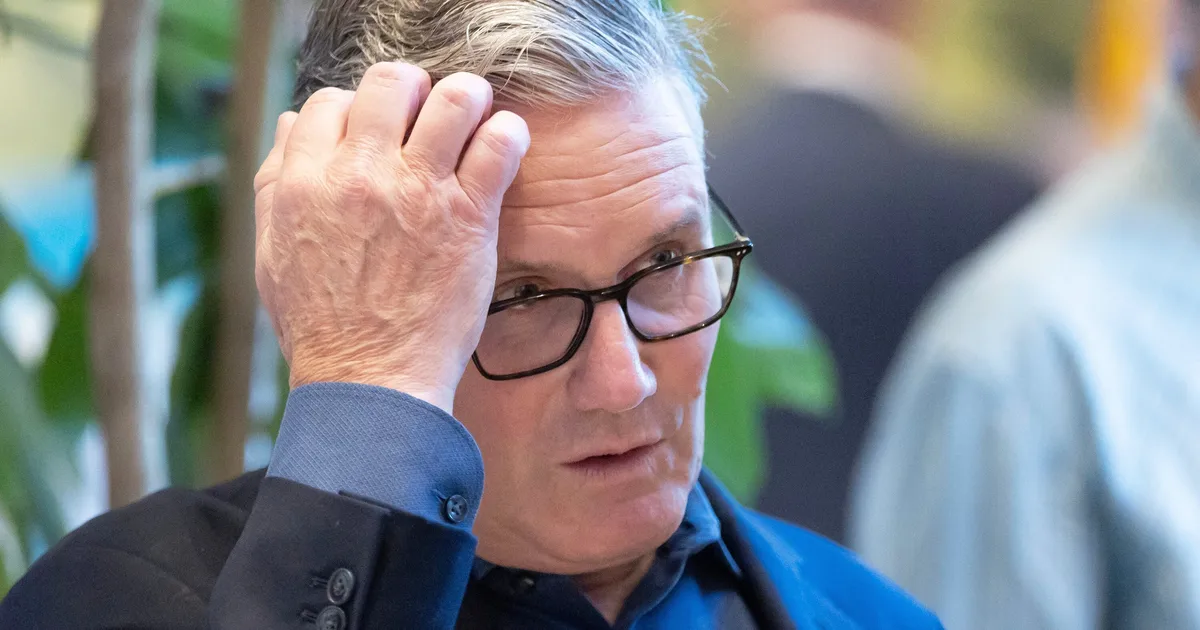
Gavin Robinson said John Swinney’s comments caused “genuine hurt among victims and survivors”.
Cillian Sherlock Press Association
11:24, 23 May 2026Updated 11:31, 23 May 2026
The First Minister of Scotland should issue a “clear and unambiguous apology” over comments urging people to “move on” from the Troubles, the leader of the DUP has said.
DUP leader Gavin Robinson said John Swinney’s comments caused “genuine hurt among victims and survivors”.
Advertisement
Mr Swinney was speaking to The Herald newspaper after his party’s election victory and was asked about potential dealings with Sinn Fein as a result of the three devolved administrations of the UK having pro-independence parties in leading roles.
The leader of the SNP recognised his dealings with Sinn Fein, whose vice president Michelle O’Neill is First Minister of Northern Ireland, had caused some “media consternation”, but he added: “I really do think people have got to move on.”
He said he had “no intention” of apologising for the comments, telling the Press Association earlier this week that: “The issues that are involved in the peace process have involved people moving on, people have had to move on, that’s exactly what they’ve done, and I’m simply reflecting what’s happened.”
Advertisement
However, the leader of the DUP has questioned whether he would consider the same “deeply hurtful” language appropriate for the Lockerbie bombing, the attack at Glasgow Airport or Dunblane shootings.
In reference to Scottish soldiers killed by the IRA, Mr Robinson said no political arrangement or coalition with those “who have never honestly confronted the IRA’s brutal campaign can ever erase the truth about what has done”.
He urged Mr Swinney to “reflect seriously on the offence” his comments caused and “apologise publicly to those victims and survivors who feel insulted”.
In a letter to the Scottish First Minister, Mr Robinson said: “Whilst I appreciate your subsequent efforts to clarify those remarks, the language used has caused genuine hurt among victims and survivors, many of whom continue to live daily with the consequences of terrorism and violence. “
He added: “The passage of time does not diminish the need for sensitivity, nor does it erase the legitimate pursuit of truth, justice and accountability.”
Mr Robinson told Mr Swinney that victims of terrorism are “not an inconvenience to be brushed aside because their pain sits awkwardly alongside today’s political arrangements”.
He added: “They deserve honesty, respect and the assurance that those who lead will never minimise what they endured.”
Advertisement
He told the First Minister that leadership requires “the courage to say difficult things plainly” rather than to “manage relationships at the expense of those who suffered most”.
Mr Robinson said: “No victim should ever be told – directly or indirectly – to simply get over the murder of their loved ones.
“I urge you to reflect seriously on the offence your comments have caused and to apologise publicly to those victims and survivors who feel insulted and abandoned by your remarks.”
The Scottish Government has been contacted for comment.
The most destructive wildfire season on record in Europe was in 2025, with more than one million hectares burned and tens of thousands of people displaced by fires across the continent.
For people in Ireland and Britain, the type of destructive wildfires that ravage southern Europe each summer can seem like a distant problem. But these fires are not confined to the dry Mediterranean landscapes of Spain, Portugal and Greece. In recent years, they have started to extend into regions more commonly associated with rain-soaked hills and bogs.
Similar warnings were issued nationally in Ireland over the Easter bank holiday weekend, when the public was urged to avoid lighting fires or bringing barbecues into the countryside. The threat of wildfires is only expected to ramp up this summer as temperatures rise further.
These are important messages. But focusing only on how fires start risks missing a slower and less visible transformation already unfolding across many upland landscapes. The real wildfire story in places like Ireland and Scotland is not just about climate or how fires start. It is also about how rural upland landscapes themselves are changing.
Changing farming styles
Recent research explores how decades of agricultural policy reform under the EU’s common agricultural policy, alongside falling farming populations and declining active land management, are reshaping vegetation patterns across Ireland’s uplands.
Historically, many upland landscapes were actively managed through livestock grazing, cutting and controlled patch burning. These practices helped maintain open landscapes and reduced the build-up of highly flammable vegetation.
Advertisement
But that balance has shifted. Reduced grazing pressure and changing land management practices are contributing to the expansion of highly flammable vegetation such as gorse, heather and purple moor grass.
While lower grazing pressure can bring biodiversity benefits and support natural regeneration, it can also increase the amount and proliferation of flammable vegetation across the landscape, known as fuel loads and fuel continuity. In practice, this means larger and more connected stretches of vegetation that allow fires to spread more rapidly and across greater distances.
A forest fire in rural Wales. Groomee/Shutterstock
This is especially concerning in upland areas where the average age of people working on farms is rising, and active land management is declining. Rural depopulation and labour shortages mean fewer people are available to manage what is known as commonages in Ireland and common grazing in Scotland. That means less maintenance of grazing systems and a reduction in the small, controlled vegetation burns that historically decreased wildfire risk by clearing vegetation and creating firebreaks. As one upland farmer in County Kerry recently described it to me: “It’s a bomb waiting to go off.”
Advertisement
Increasing flammability
Climate change is intensifying these risks. Hotter, drier conditions increase the likelihood that vegetation will dry out, increasing flammability. But climate alone does not explain why some landscapes burn more severely than others.
Wildfire risk is also shaped by what is growing on the land, how landscapes are managed, and whether fuel loads are reduced or allowed to accumulate over time. Experts responding to the recent Scottish fires also highlighted the role of vegetation build-up, prolonged dry conditions and changing land management in shaping fire behaviour, warning that historically wetter regions may face increasing wildfire risks in the future.
Similar patterns have already emerged across parts of southern Europe, where rural depopulation and land abandonment have contributed to increasingly severe wildfire regimes.
Recent research from Italy has shown abandoned land, declining grazing and reduced active land management have contributed to fuel accumulation, and to the build-up of dense, continuous vegetation – conditions associated with increasingly large and severe wildfires. While the climates and landscapes of Ireland and Scotland differ from the Mediterranean, similar long-term changes are beginning to emerge here.
This creates a difficult tension for policymakers and conservationists. Reduced grazing pressure and natural regeneration can support biodiversity recovery in upland systems. Yet these same changes may also increase wildfire risk where vegetation becomes dense, continuous and unmanaged. The challenge is therefore not choosing between farming or conservation, but finding ways to support landscapes that can sustain biodiversity, rural livelihoods and wildfire resilience together.
Wildfire risk in Ireland and Scotland can no longer be understood simply as a problem of careless ignitions or extreme weather. It runs much deeper than that. It is increasingly tied to long-term changes in how upland landscapes are farmed, governed and managed.
If future policy is serious about reducing wildfire risk, it must look beyond seasonal warnings and begin addressing the deeper forces reshaping our uplands.
Alicia-Adele was diagnosed with an incurable brain tumour after waking up with a numb arm
12:35, 23 May 2026Updated 12:38, 23 May 2026
A mum said she had “no inkling” her daughter was suffering from an incurable tumour after she told her she had woken up with a numb arm.
Alicia-Adele, from Caerphilly, Wales, first complained of numbness in her arm before telling her mum, Amanda Axiak, that she was struggling to walk. The 11-year-old was later diagnosed with an aggressive and incurable brain tumour and died 13 days later – just 15 days after her first symptoms appeared.
Her mum, Amanda Axiak, described being in complete shock at the diagnosis, adding that hearing the news was an “out-of-body experience”. She said: “I almost collapsed. I felt like I had an out-of-body experience. My world had ended that day.
Advertisement
Click here to get the biggest stories straight to your inbox in our Daily Newsletter
“She was perfect. There was nothing wrong with her whatsoever – no headaches, nausea, fever, nothing.”
The schoolgirl first complained about her arm feeling numb to her mum, but Amanda thought nothing of it at first, thinking she may simply have slept awkwardly or over-exerted herself when playing netball. Amanda said: “We were all getting ready for work, college and school. I was doing my makeup when Alicia-Adele came in and said, ‘Mam, I’ve got a bit of a numb arm. It just doesn’t feel right’.”
However Amanda’s concerns began to grow when Alicia-Adele messaged her, whilst at school, saying her symptoms had worsened. Amanda recalls: “She told me, ‘My face feels a bit numb on one side.’ I didn’t like that.”
Advertisement
The mum advised Alicia-Adele to speak to her school’s first aid team. However later that afternoon Amanda received another call from her daughter. Amanda said: “That’s when she said, ‘I’m struggling to walk. “Her leg had started to go numb.”
Amanda immediately contacted her GP surgery. She said: “Within seconds, the doctor phoned me back and said, ‘You need to go straight to the Grange University Hospital because it sounds like stroke symptoms.”
Alicia-Adele’s parents took her to hospital that afternoon and doctors decided to keep her in overnight so she could undergo an MRI scan on Friday. However, on Saturday (April 12), the family were given the devastating news that she had been diagnosed with an inoperable and incurable diffuse midline glioma, commonly known as DIPG – an aggressive childhood brain tumour. The illness is the leading cause of brain tumour deaths in children, with the average prognosis being just eight to 12 months, Wales Online reports.
Advertisement
Amanda said: “They said to me in the hospital they would have picked this up in an eye test but I’d taken her for an eye test at an optician in Caerphilly in March, the month before, and there had been nothing. We had no inkling that this was happening.”
Fifteen days after Alicia-Adele’s first symptoms appeared, and just thirteen days after her family learned the devastating truth about her illness, she passed away. Amanda said: “It ripped us apart. It changed the way I saw the world.
“I’d be walking down the street and see children, and I’d shudder, because I’d think: that child’s world – or that family’s world – could end within days, and they’d have no idea.”
Following Alicia-Adele’s diagnosis, Amanda has now been campaigning for change and is hoping to push the newly elected Welsh Senedd to take action to improve outcomes for brain tumour patients in Wales. She said: “I’m trying to turn heartbreak into hope.
“I want to change things for other families, because if I can do something that helps even one family, then I know Alicia’s life wasn’t in vain. As long as my heart beats, so does hers.”
Dr Karen Noble, director of research and policy at Brain Tumour Research, said: “There are more than 120 different types of brain tumour, and symptoms can differ greatly depending on where the tumour is located. Common symptoms can include headaches, dizziness, coordination problems, changes in vision or hearing, nausea, or changes in the way somebody walks. But many of these symptoms are vague and can easily be attributed to other conditions.
“In Alicia-Adele’s case, there were very limited symptoms, which is why it came as such a shock to the family. We also know that many patients visit their GP several times with symptoms like headaches before a diagnosis is made. Around 40% of brain tumours are diagnosed in accident and emergency departments because they can be so difficult to detect through non-specific symptoms alone.”
Advertisement
She added that one of the biggest challenges for doctors was the lack of rapid diagnostic tools that could help identify when seemingly ordinary symptoms might point to something far more serious. Dr Noble also outlined the key priorities which campaigners such as Amanda are calling on the Welsh Government to act upon.
She said: “Increased investment is essential. The only way we are going to find a cure, and develop better treatments for brain tumours, is by deepening our understanding of the science, the biology and the mechanisms behind these diseases.
“We also know there is a severe lack of clinical trials in Wales. When someone is diagnosed with a brain tumour, it’s vital that we understand not only the type of tumour they have, but also its specific mutations. Even when patients are diagnosed with the same tumour type – such as the diffuse midline glioma Alicia-Adele had – every tumour can have its own unique molecular makeup.
Advertisement
“The more we understand about the genetics and molecular characteristics of a tumour, the more opportunities there may be to access emerging treatments, many of which are available through clinical trials.”
She adds: “That’s why we need more clinical trials in Wales, particularly for brain tumours. We also need broader access to genomic testing, so we can identify patients who may be eligible for trials that are not traditionally associated with brain cancer.
“For example, a clinical trial may be designed for lung cancer patients with a particular mutation, but if that same mutation is found in a brain tumour patient, that treatment could potentially benefit them too. We need systems in place to ensure those opportunities are accessible. So our three main asks are clear: increased investment in brain tumour research, better access to genomic testing to fully understand tumour biology, and greater access to clinical trials for patients in Wales.”
The Welsh Government has issued the following statement, on how it will proceed with research: “Research supported through Health and Care Research Wales has enabled studies across a range of conditions, including brain cancer – from improving our understanding of the disease to exploring new treatments.
Advertisement
“This new government’s Cancer Plan for Wales will place a strong emphasis on research, innovation and improving access to clinical trials so more patients can benefit from new treatments, including for brain cancer. We are also planning a Wales Cancer Conference next year to bring together experts and share best practice in cancer care.
“We also recognise how vital properly stored tissue is for diagnosis, research and access to new treatments. We are committed to strengthening legal safeguards so that high-quality methods of tissue preservation become standard, giving patients and families greater confidence and improving access to cutting-edge care.”
Amanda has also been working with Brain Tumour Research to launch the Alicia-Adele’s Angel fundraising group. Amanda said: “I came up with the name ‘Alicia-Adele’s Angels’, because she herself is an angel but also because of her always wanting to be a paediatric doctor. I think ‘angels’ is what Alicia would have classed her patients. It couldn’t have been a more poignant name.”
Advertisement
The mum has already taken part in a number of fundraising runs for the cause and has raised over £4,000 for Brain Tumour Research. You can still donate to Alicia-Adele’s Angels here.
JOHANNESBURG (AP) — When South African infectious disease specialist Lucille Blumberg checked her email on the morning of May 1, while the country was celebrating the Labor Day holiday, an urgent message caught her attention.
A U.K.-based colleague had written about a passenger from a cruise ship sailing thousands of miles away in the Atlantic Ocean who had been evacuated and admitted to a Johannesburg hospital with suspected pneumonia. Others aboard the vessel were also sick.
The colleague, who monitors diseases in remote British overseas territories in the South Atlantic Ocean, asked Blumberg to follow up on the passenger, who had been evacuated from the ship in one of the territories, Ascension Island.
Blumberg and other experts at South Africa’s National Institute for Communicable Diseases were suddenly thrown into the race to identify the cause of an outbreak aboard the Dutch cruise ship MV Hondius.
Advertisement
“Even though it was a public holiday, we moved, we moved really fast,” Blumberg told The Associated Press. “It was busy. There were many conversations. There were online discussions, and there was laboratory testing happening at the time.”
Within 24 hours, they had determined that the man’s illness was caused by hantavirus, a rare rodent-borne virus.
A process of elimination to identify the disease
The elderly British man had arrived at a private hospital in Johannesburg days earlier and was seriously ill, but health workers weren’t sure of the underlying cause.
By the time he was evacuated from the ship, two elderly Dutch passengers who had been on board the MV Hondius cruise liner had already died, but there had been little alarm. Ascension Island health authorities had reported a cluster of illnesses on the ship that appeared to be pneumonia to the World Health Organization.
Advertisement
At first, Blumberg and her colleagues thought it might be Legionella, a bacterium that causes a serious form of pneumonia, Legionnaires’ disease. Or maybe bird flu.
“I called my infectious disease colleagues, and we had a caucus, and we discussed the usual ones,” Blumberg said. “Legionella is well described in outbreaks in hotels and on cruise ships, and influenza certainly is. These people had visited islands where avian influenza is well documented.”
Tests on all those were negative. The experts also ran an extensive panel of tests for other respiratory diseases. Also, all negative.
The team then began looking more closely at where the ship came from — Argentina — and the fact that passengers on board were avid bird watchers and had reportedly been to parts of South America where there were birds, but also rodents.
Advertisement
Collaboration with experts in South America and the US
That pushed the South African disease experts toward another theory: the rare, rodent-borne hantavirus infection, which is found in parts of South America.
“It’s a well-described, not common, but it’s a well-described virus in Chile and Argentina,” Blumberg said. She added that their work was aided by collaboration with hantavirus experts from South America and the United States, facilitated by the WHO, the U.N. health agency.
“You can get onto a Zoom (call) online and ask your questions and get advice. This is not something every day. So that was quite extraordinary,” Blumberg said.
By then, it was Saturday morning. Blumberg called the head of the only laboratory in South Africa that can test for hantavirus.
Advertisement
“I said, we want to do hanta, and she said, ‘yeah, I’m coming.’”
The tests, carried out on the sick man’s blood samples, came back positive for hantavirus that afternoon. The team did a second set of tests to be sure, Blumberg said.
Finally, there was a ‘wow moment’
Those positive tests, which also identified the Andes strain of hantavirus, allowed the WHO to inform the cruise ship what it was dealing with and announce an outbreak on board. While hantavirus is not easily spread from person to person, the WHO says the Andes virus can be transmitted between people.
The test results also led Blumberg to rush to collect blood samples from a Dutch woman — one of the first two cruise passengers to die — who had disembarked from the ship with her husband’s body on the island of St. Helena and flown to South Africa, where she died.
Advertisement
A posthumous hantavirus test on her was also positive.
“It was a bit of a wow moment,” Blumberg said. “And at least once you know what you’re dealing with, it’s much easier to respond.”
The British man who was the first confirmed case of hantavirus infection from the cruise ship is improving in hospital, South Africa’s health ministry has said. Meanwhile, the ship has arrived at the Dutch port of Rotterdam, where it was disinfected, and the remaining crew members disembarked.
“I’ve been doing outbreaks for 25 years. That’s what we do. We do them every day,” she said. “I think the important thing was to respond immediately to a question that clearly was urgent and then to take it from there.”
Zoe Ball has spoken out after Emma Willis, Josh Widdicombe and Johannes Radebe have been named as the new Strictly hosts.
Shivon Watson and Rebecca Jones
12:28, 23 May 2026
Zoe Ball signs off from the BBC Radio 2’s Breakfast Show for final time
The BBC has officially announced the new presenting team for Strictly Come Dancing, with Emma Willis, Josh Widdicombe, and Johannes Radebe taking over after long-serving hosts Tess Daly and Claudia Winkleman stepped aside.
Advertisement
BBC Radio presenter Zoe Ball, who was amongst those considered for the role, has now said she’s relieved not to have secured the position, reports the Express.
She told The Sun: “I screen tested with Josh and he is hilarious. He is going to be so good. Emma is just gorgeous, and I love Johannes, so they are going to ace it. And I don’t have to have a facelift, so I’m quite happy.”
Speaking at The Podcast Show 2026 alongside her Dig It podcast co-presenter Jo Whiley, she continued: “For Jo and I, it’s hell. We both hate being in vision, that’s why we really loved doing radio.
“Then they started filming that. They film everything. And as we get older, we’re like, ‘dim the lights!’ We’d happily never be filmed again.”
Advertisement
Fellow radio broadcaster Sara Cox, who also auditioned unsuccessfully, revealed on her Tuesday BBC Radio 2 Teatime programme: “I tried out for Strictly.
And I will say I tried out for it two days after I got offered my number one, all-time, dream job of the Radio 2 Breakfast Show.
Advertisement
“So I was like, ‘Oh, I’ll go along and try for Strictly as well, why not, and what next? News at Ten?’ So I went along, and it was the most gorgeous experience. I got into a car that was taking me to a secret destination.”
“It was all hush-hush, and it was basically a bit like, you know, when you can go and play the Crystal Maze interactive game? It was like that. I was like, ‘Great, I’m going to be a Strictly presenter for an hour!’ The whole thing was really great fun.”
This Morning presenter Rylan Clark has also commented on Strictly, posting on social media: “Just wanted to say, as it was reported I was in ‘The Race’ for Strictly.
Advertisement
“The biggest congrats to my Emma and equal congrats to Johannes and Josh. You’re all going to have the best time. Made up for you’s.
“This wasn’t my time, sadly, but I am extremely grateful to even have been considered. I’m taking the news really well (see ) but genuinely looking forward to the new series with you three x (sic).”
Strictly Come Dancing will return to BBC One later this year, with the exact date still to be announced.
National Football League Division One: Donegal 1-22 Kerry 1-18
Donegal waited six months to get another crack at Kerry and they were full value for a four-point win over the All-Ireland champions in Ballyshannon on Sunday.
A crowd of youngsters surrounded the Kerry bus on its arrival to Fr Tierney Park. They were hoping to spot Gaelic football’s MVP. They were to be disappointed. David Clifford wasn’t on the bus due to a bout of flu.
Advertisement
Scorer of 0-9 in last summer’s All-Ireland SFC final between the counties, it was one less headache for Jim McGuinness.
Paudie Clifford, Donegal’s tormentor-in-chief in Croke Park, was also absent with Sean O’Shea almost single-handedly keeping Kerry in touch with four two-point frees.
Dáire Ó Baoill’s goal before half-time and back-to-back two-pointers from Michael Langan put Donegal in command, but those O’Shea frees and a late goal from substitute Donagh O’Sullivan left four points between the sides – a margin of defeat that flattered the visitors.
The Ballyshannon venue was bursting at the seams by the time David Coldrick threw the ball in – all 9,000 tickets for this rematch were sold out 24 hours beforehand.
Advertisement
There was plenty of needle in the early stages – Conor O’Donnell and Tadhg Morley were wrestling moments after the off.
The sides traded scores for much of the first quarter with Young Footballer of the year Finnbarr Roarty scoring a brace of points playing in a more advanced role than in 2025.
Shane O’Donnell won a ton of possession for the home side with the raiding Peadar Mogan adding a classy point while Conor O’Donnell was on target with 0-3 in the first half.
After Donegal goalkeeper Gavin Mulreany had scored a 45 after Shane Murphy’s restart went wrong, the Ulster champions finally made their midfield dominance count with a goal before half-time.
Advertisement
Shea Malone won the break and, with options off both shoulders, he passed to Shane O’Donnell when Dáire Ó Baoill was unmarked inside. The St Eunan’s ace spotted Ó Baoill and delivered a perfect pass with the Gweedore clubman able to round Murphy and slot the ball into the Kerry net.
Mogan’s second from play on the cusp of half-time left Donegal 1-8 to 0-7 ahead at the break.
Michael Langan added a brace of cracking two-pointers on the restart with Hugh McFadden also scoring a two with Kerry increasingly reliant on O’Shea’s dead-ball prowess to keep them in touch.
A huge roar greeted Michael Murphy’s introduction midway through the half with Oisin Gallen also marking his introduction with a point.
Advertisement
Having trailed by nine points, Kerry finished on top with O’Shea moving to 0-11 with Armin Heinrich also chipping in with a good score.
The scrappiest of goals for Kerry gave them a brief, late lifeline with O’Sullivan finding the net after Donegal failed to clear their lines.
The Kingdom tried in vain to engineer another goal to snatch a draw, but it was Murphy who had the final say with a point in the final minute to ensure the Ulster champions were victorious.
Two points on the first Sunday of February won’t atone for that loss in the fourth Sunday of July and Jack O’Connor knows his hand will only get stronger as the season progresses.
Advertisement
Donegal: G Mulreany 0-1 (0-1 45); C McColgan; B McCole, P Mogan 0-2; K Gallagher, C McGonagle, F Roarty 0-3; H McFadden 0-2 (1tp), M Langan 0-4 (2tps); D Ó Baoill 1-2, S O’Donnell, C Moore 0-1; C O’Donnell 0-3 (0-1f), J McGee, S Malone 0-1.
Subs: R McHugh for Gallagher (49), Michael Murphy 0-2 (0-1f) for Malone (44), T Carr for Ó Baoill (62), O Gallen 0-1 for S O’Donnell (62), K Muldoon for C O’Donnell (68).
Kerry: S Murphy; E Looney, J Foley, D Casey; A Heinrich 0-1, M Breen, T Morley; S O’Brien, C Trant; J O’Connor, S O’Shea 0-11 (4tpfs, 0-1 45, 0-1m), M Burns; K Spillane, T Kennedy, T Brosnan 0-6 (2tps, 0-1f).
Subs: L Smith for O’Brien (19), C Keating for Breen (HT), D Lyne for Spillaine (42), D O’Sullivan 1-0 for Burns (52), R Murphy for Trant (55).
Currently, the two air during the broadcasters ‘power hour’ from 8pm to 9pm across weeknights.
But, with the upcoming World Cup, it will mean that Emmerdale and Coronation Street’s normal schedule could change to make way for football coverage.
However, ITV has yet to fully announce its coverage plans for the World Cup or how they could impact other shows.
Advertisement
Emmerdale and Coronation Street face a schedule change
The World Cup kicks off on June 11 and will take place across Canada, Mexico, and the United States.
ITV and BBC will be sharing coverage of the sporting event, with matches kicking off from 6pm to 5am in UK time.
England’s first match will start at 9pm in the UK against Croatia on June 17.
Scotland’s opening game against Haiti will take place on June 14, at 2am UK time.
As the matches are on later than normal, it’s likely to force typical TV scheduling to take a break for the tournament, including Emmerdale and Coronation Street.
Advertisement
Tom Hardy ‘axed from MobLand’ after ‘clashes with producers’
However, soap fans will have to wait a while longer to find out how much their favourite shows are affected, as ITV has yet to confirm its full World Cup schedule.
Corrie legend returning to ITV show after 23 years
An actor is returning to Coronation Street 23 years after first appearing in the show as a child.
Jake Parry, who originally played Simon Barlow on the ITV soap in 2003 alongside his twin brother Oscar, will make his comeback in a new role 23 years later.
Advertisement
He revealed the news in a TikTok post, sharing a brief clip from the show and writing: “Coronation Street trailer.
“Catch me as DAMO next week.”
Although Mr Parry’s return marks a return to the famous Weatherfield set, he has been clear that he will be playing a new character.
Are you looking to see his return? Let us know in the comments
An overturned lorry on the A14 has caused delays for drivers on Saturday, May 23. The A14 westbound between Junction 24 and Junction 23 have been blocked following a crash reportedly involving two lorries.
Drivers have been warned by National Highways to expect delays of 30 minutes. Cambridgeshire Police are on the scene and have been contacted for further information.
Traffic monitoring site Inrix said: “A14 Westbound blocked, queueing traffic due to overturned lorry from J24 A1307 (Cambridge Services / Boxworth) to J23 (Godmanchester).”
Advertisement
A spokesperson for National Highways said: “The A14 westbound in Cambridgeshire between J24 and J23 is blocked due to a collision.”
They added: “There are delays of 30 minutes and four miles of congestion on approach.”
ACERRA, Italy (AP) — Pope Leo XIV on Saturday greeted one by one families who lost loved ones to illegal toxic dumping in an area near Naples, as many paused to share photographs and other mementos of children and young people who have died or are battling cancer — illnesses tied to a multi-billion criminal racket run by the mafia.
Leo’s visit to the so-called Terra dei Fuochi, or Land of Fires, came on the eve of the 11th anniversary of Pope Francis’ big ecological encyclical Laudato Si (Praised Be), and indicates Leo’s commitment to carry on his predecessor’s environmental agenda.
“I have come first of all to gather the tears of those who have lost loved ones, killed by environmental pollution caused by unscrupulous people and organizations who for too long were able to act with impunity,” Leo said in remarks to family members and local clergy inside Acerra’s cathedral.
The pontiff recalled that the area now dubbed the Land of Fires was once called “Campania felix,” Latin for blessed or fruitful countryside, “capable for enchanting for its fertility, its produce and its culture, like a hymn to life.
Advertisement
“And yet — here is death, of the land and of men,’’ the pope said.
The European Court of Human Rights last year validated a generation of residents’ complaints that mafia dumping, burial and burning of toxic waste led to an increased rate of cancer and other ailments in the area of 90 municipalities around Caserta and Naples, encompassing a population of 2.9 million people.
The court found Italian authorities had known since 1988 about the toxic pollution, blamed on the Camorra crime syndicate that controls waste disposal, but failed to take necessary steps to protect the residents. The binding ruling gave Italy two years to set up a database about the toxic waste and verified health risks associated with living there.
Bishop says the dumping continues
Bishop Antonio Di Donna in opening remarks estimated 150 young people had died in the city of some 58,000 over the past three decades — emphasizing that the number didn’t take into account adults and victims in other municipalities.
Advertisement
He urged the pope to admonish those who continue to pollute, noting that the dumping of tons of toxic waste was reported a day earlier near Castera. Di Donna said that Italian officials had identified dozens more human-caused contamination sites throughout the country, including the Venetian port of Marghera, and the leaching of PFAS forever chemicals into groundwater near Vicenza.
“We say to those brothers of ours ensnared in evil and seized by a mirage of fabulous earnings: Convert, change your ways, because what you are doing is not only a crime, it is a sin that cries out to God for vengeance,’’ the bishop said.
The pope later greeted the mayors of the 90 communities impacted by the toxic dumping, and greeted thousands of people waving yellow flags and chanting “Papa Leone” along the route of his popemobile and in a central piazza.
Families of young victims appeal to the pope
The victims include Maria Venturato, who died of cancer in 2016 at the age of 25. Her father, Angelo, said he hopes to speak with the pope to explain their reality, “not for me … for the next generation.”
Advertisement
“I’d like to give these young people a future, so I’m asking for the pope’s help with this. That is, I’m making a strong appeal to him to go to those in power and say, ‘Look, let’s heal this land of fires,’” he said on the eve of the pope’s visit.
Inside the cathedral, Filomena Carolla presented the pope with a book containing memories from the life of her daughter, Tina De Angelis, who died of cancer at the age of 24.
“I’m just angry at the people who poisoned the soil, because what did our children have to do with it? What did they have to do with it, so young,” Carolla told The Associated Press on Friday.
Francis’ plans to visit the area in 2020 were canceled due to the pandemic.
A Saints analyst was seen behind a tree at Middlesbrough’s Rockliffe Park training ground recording one of Boro’s sessions ahead of their first-leg tie, which ended 0-0 at the Riverside Stadium.
The Saints then beat Kim Hellberg’s side 2-1 at St Mary’s in dramatic fashion in the second leg last week, with Shea Charles scoring an extra-time winner.
However, after an EFL investigation, an independent disciplinary commission kicked Southampton out of the play-offs on Tuesday and removed them from the final, with Boro reinstated as Hull’s opponents, having continued to train in preparation for such a potential outcome.
Date, kick-off time and venue
Advertisement
Hull vs Middlesbrough in the Championship play-off final is scheduled for a 3.30pm BST kick-off today, Saturday, May 23, 2026.
The match will take place at Wembley Stadium.
Where to watch Hull vs Middlesbrough
TV channel: In the UK, the game will be televised live on Sky Sports Main Event and Sky Sports Football, with coverage starting at 2.30pm BST.
Advertisement
Live stream: Sky Sports subscribers can also watch the final live online via the Sky Go app.
Live blog: You can follow all the nerve-shredding action on matchday via Standard Sport’s live blog.
Hull vs Middlesbrough team news
Hull will be without Eliot Matazo and Kyle Joseph at Wembley, though Amir Hadziahmetovic, David Akintola and Cody Drameh are all available.
Advertisement
Midfield loanee Toby Collyer has returned to parent club Manchester United following an injury and will play no part.
As for Boro, key star Hayden Hackney will have some involvement after missing 10 games with a groin injury in a huge boost to their chances.
They are missing striker Tommy Conway, who suffered an ankle injury against Southampton that will see him sit out the World Cup with Scotland.
Alfie Jones is also sidelined, with doubts having surrounded the likes of Alex Bangura and Kaly Sene.
Advertisement
Major boost: Hayden Hackney will be fit to play some part for Middlesbrough against Hull at Wembley
Getty
Hull vs Middlesbrough prediction
It has been an emotional week for Boro, while Hull have been left in limbo as to who they might face at Wembley.
Advertisement
Hence, neither side are coming into this huge fixture with any kind of ideal preparation.
Boro will be keen to show the world that they deserve their place in this year’s final despite their defeat by Southampton, while Jakirovic’s men will be hungry to produce a repeat of their performance the last time they visited the capital.
Middlesbrough to win, 2-1.
Head to head (h2h) history and results
Advertisement
Hull vs Middlesbrough match odds
Middlesbrough to win: 20/23
The Standard’s journalism is supported by our readers. When you purchase through links on our site, we may earn an affiliate commission.
A Ukrainian drone attack caused a fire at another Russian oil terminal overnight, local officials in Russia’s Krasnodar region said Saturday, in what appeared to be the latest attack on Moscow’s vital oil industry.
Russia’s Astra news outlet said Ukrainian drones struck the Sheskharis oil terminal and depot, the terminus for Russian state-controlled pipeline company Transneft’s main oil pipelines in the region. Images posted by Astra appeared to show smoke rising above the oil terminal, but they could not be verified. Ukraine did not immediately comment on the attack.
Ukraine has expanded its mid- and long-range strike capabilities, deploying drone and missile technology that it has developed domestically to battle Russia’s 4-year-old invasion. Attacks on Russian oil assets that play a key part in funding the invasion have become almost daily occurrences.
Advertisement
Meanwhile, the death toll from a Ukrainian drone strike overnight into Friday on a college dormitory building in Starobilsk, a city in Ukraine’s Russia-occupied Luhansk region, rose to 11, Moscow-installed officials said.
Russian President Vladimir Putin on Friday denounced the attack on the dormitory as a “crime” and ordered the military to submit its proposals for retaliation. He said there were no military or law enforcement facilities near the college.
At a U.N. Security Council emergency meeting on the strike, held at the request of Russia, Ukrainian Ambassador Melnyk Andrii denied his Russian counterpart’s accusations of war crimes, calling them a “pure propaganda show” and asserting that the May 22 operations “exclusively targeted the Russian war machine.”
You must be logged in to post a comment Login