Imath Uddin Choudhury, 23, has been named in a JustGiving fundraiser launched in his memory following the fatal Bradford crash
Kirstie McCrum and Samuel Port
21:00, 01 Jul 2026
A fundraising appeal has been established in honour of a man identified locally as one of two fatalities following a 100ft crash in Bradford.
Imath Uddin Choudhury, 23, has been named in a JustGiving campaign set up in his memory. The fundraiser states he passed away on Wednesday (July 1) after spending just over a week in hospital with severe injuries sustained in the collision.
Advertisement
Reports indicate an Audi A3 convertible veered off Hawksworth Road in Baildon, close to the Potter Brow Road junction, at approximately 7.24pm on Monday, June 22.
A 20 year old also lost their life at the scene. The 24-year-old driver was detained on suspicion of causing death by dangerous driving, while a 23-year-old passenger sustained minor injuries, West Yorkshire Police confirmed previously.
The fundraiser, initiated by the Grains Of Hope Foundation on JustGiving, had already exceeded its £2,000 goal by Wednesday, reports Yorkshire Live.
The foundation stated: “In memory of Imad, Grains of Hope Foundation is raising funds to support the most needy families in The Gambia and provide water pumps in Pakistan, helping those in need whilst creating a source of ongoing reward for him, by the will of Allah.”
Advertisement
They continued: “May Allah forgive Imath Choudhury, grant him Jannatul Firdaus, widen and illuminate his grave, and make every donation a means of Sadaqah Jariyah for him. Ameen.”
Ensure our latest stories always appear at the top of your Google Search by making us a Preferred Source. Click here to activate or add us as your Preferred Source in your Google search settings.
The UK is bouncing from one type of extreme weather to another this year. This is climate whiplash. Caused by changes in the fast-moving body of air high up in our atmosphere called the jet stream, climate whiplash has increased in likelihood with climate change. This constant changing of extreme weather makes it a challenge to build resilience.
Drought and heatwaves play a big role in this rollercoaster of weather extremes. There are many different types of droughts – in simple terms drought is an absence of water from an area, meaning it is drier. For a drought to be declared in a region of the UK, the National Drought Group (chaired by the Environment Agency which has responsibility for droughts) meets, looks at several factors and decides. This process is similar to how the UK decides to name winter storms.
There have traditionally been four key types of droughts. Hydrological drought is when lakes and rivers drop below certain regional levels. Meteorological drought is based upon how long it has been dry for. Agricultural drought links lack of rainfall to negative consequences on plant growth. Socio-economic drought happens when the demand for water is higher than the supply available.
There is also another type of drought which is relatively new – flash droughts which are caused by hot, dry, windy weather that acts like a hairdryer. One of the main drivers in flash droughts in UK spring and summers is atmospheric evaporative demand. This is how thirsty the atmosphere is. In some parts of the UK such as parts of southern England, it is suggested there is a flash drought where the atmosphere has been thirstier than the available moisture. In most other parts such as North Wales, we are simply experiencing a hydrological drought.
Advertisement
When heatwaves and drought or dry conditions occur together in the UK, they make each other more intense. The baking dry ground causes a rise in the air temperatures. These conditions also raise the risk of wildfires occurring.
But heatwaves are a separate hazard to drought. Heat is so tricky because while you cannot see higher temperatures or hotter conditions, we feel extreme heat. This is why heatwaves are sometimes called silent killers and an invisible risk.
The deadliest heatwaves can occur outside of drought or dry conditions. This is because moisture in the air, humidity, limits our ability to cool down. One way we measure this is through the wet bulb temperature. Meteorologists measure this by using a normal thermometer wrapped in wet muslin cloth – it is an indication of how difficult it is to lose heat through sweat.
New research shows that many people in the UK are now fearful of climate change because of recent heatwaves. While it is good to be concerned, this can lead to inaction and not knowing what to do. There are many solutions to build resilience to climate whiplash and multi-hazards in the UK.
We need to reduce greenhouse gas emissions to net zero. Because we haven’t already mitigated greenhouse gas emissions quickly enough, we are now globally experiencing intensifying climate whiplash. Investment needs to focus on transitioning faster through scaling up clean energy, restoring natural environments and building resilience.
Advertisement
Climate change is also a social challenge. Tackling it can help address longstanding policy areas, social inequalities and emerging challenges. One of the main places we see heat-related excess deaths outside of hospital are in care homes. So mitigating and adapting to extreme weather can be integrated into long-term social care planning.
Investment and considerations of different models for the water industry in the UK can build resilience to multi-hazards. For droughts, storing water; for heatwaves, covering increased pressure; and for flooding and excess rainfall, addressing risk. Schemes such as improving pipe infrastructure, wastewater treatment, reservoir building and more sharing of water within relevant regions of the UK are also important.
Policy can be set out by the UK government to ensure the most vulnerable people to extreme heat in care homes, schools and hospitals will have access to air conditioning when they need it. Policy should also be designed with urban greening, retrofitting and long-term sustainable urban planning with extreme weather in mind. Energy resilience is also important and involves making use of sunnier days and building grid capacity to capture that energy from renewable sources.
Advertisement
While we may keep flashing from hot dry conditions to wet and wild ones, the solutions are in front of us.
Darlington’s earliest recorded name was ‘Dearthington,’ first noted around 1040, derived from the Old English ‘Dēornōthingtūn’.
The name is believed to translate roughly as ‘the settlement of Deornoth’s people,’ referring to an Anglo-Saxon figure named Deornoth, whose personal name combined the elements ‘dēor,’ meaning dear, and ‘nōth,’ meaning daring or bold.
Nothing else is known about Deornoth himself, but his name effectively became attached to the entire settlement that grew up around his farm or estate on the banks of the River Skerne.
Advertisement
From Dearthington to Darlington
The town’s name went through several changes over the centuries as spelling conventions shifted.
By Norman times, it had become ‘Derlynton,’ recorded in 1457, before further variations, including ‘Darnton’ and ‘Darlington,’ gradually emerged during the following centuries.
The nickname ‘Darnton’ stuck around locally for generations, and not always affectionately.
In the 17th century, the town was famously mocked as ‘Darnton i’ the Dirt,’ a jibe inspired by its unpaved, muddy streets, said to have even prompted King James of Scotland to compose a mocking rhyme about the town during a visit in 1603.
Advertisement
A settlement shaped by conquest
Darlington’s origins as an Anglo-Saxon settlement predate the Norman Conquest by centuries, with the town developing on the banks of the River Skerne, a tributary of the Tees.
Like much of the North East, the area later fell under Viking control, with the Danes taking over Northumbria, including the land around Darlington, by 866AD, leaving a lasting Norse influence on place names across the wider region.
Towards the end of the 10th century, the settlement and its dependencies were granted to St Cuthbert, patron saint of Durham’s bishopric, in the presence of King Ethelred, cementing Darlington’s early ties to the Church that would shape much of its subsequent history.
(Image: Network Rail)
A name unrelated to darling or wool
Despite how it sounds today, Darlington’s name has no connection to the word “darling,” nor to the linen and wool trade the town would later become known for.
Advertisement
It’s a coincidence of modern pronunciation rather than etymology, with the true root buried in a Saxon personal name that vanished from record almost as soon as it was written down.
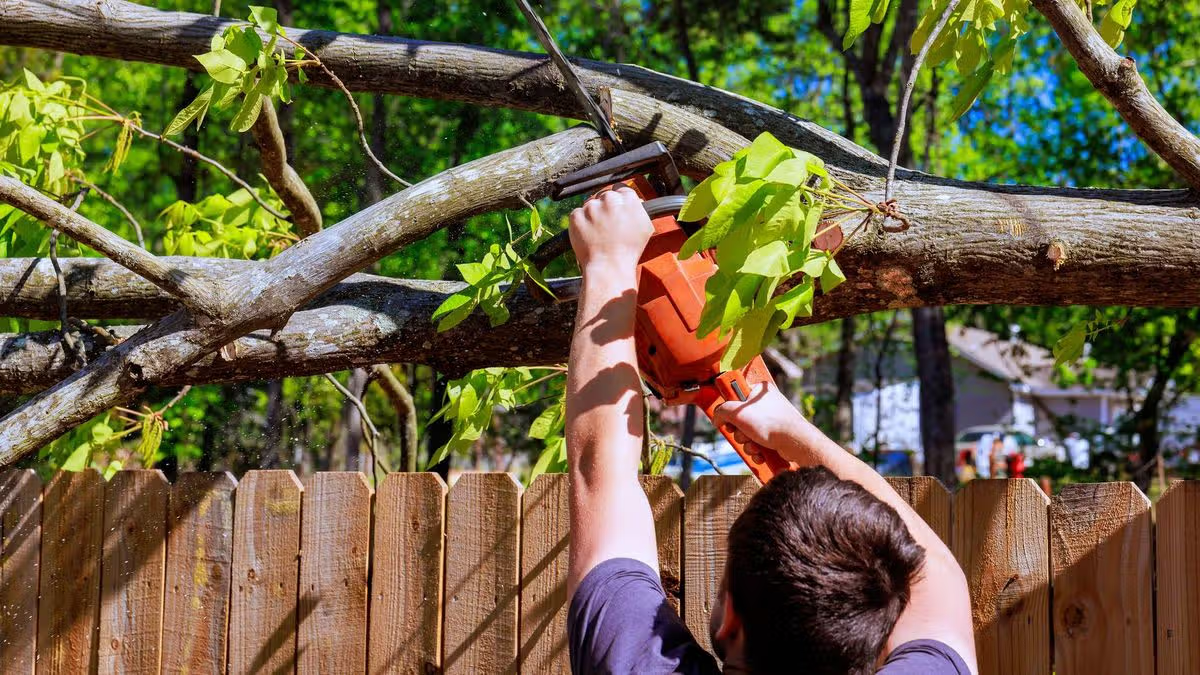
Every now and then your neighbour’s garden may impact your property, as trees and hedges can overgrow. However, little you may know, there’s action you can take to solve the issue
The topic previously came up on Reddit when one person asked what they can do about a neighbour’s trees, and the question got a lot of people talking. However, there are some property rules you need to follow when it comes to tackling the issue, so you need to be clued up on the law before you take action.
A social media user asked: “Can I cut my neighbours trees/plants that overhang into my garden? I just bought a house with a beautiful garden in the UK.
“It gets great sunlight; however, some of it is shaded because of my neighbours at the back. The ends of our gardens meet. They have huge trees and plants that are so overgrown and overhang into my garden and prevent even more sunlight.
Advertisement
“I’ve spoken to them about cutting it themselves, but they’ve ignored me. So my question, can I cut the parts of their trees/plants that overhang into my garden?
“Can I cut and just chuck the cut bits back into their garden? I was just wondering if this encroaches on property tampering or something of the like.”
The question got a lot of people talking, and they offered all sorts of suggestions. They had a lot of thoughts to share.
One said: “Yes you can cut them back to your boundary, as long as you don’t damage the plants. You have to offer to return anything you cut but, if they don’t want it, you need to dispose of them. You can’t throw them over the fence as it would be fly-tipping.”
Advertisement
Another added: “As others have said, you can cut anything which overhangs or comes onto your property. But note that you cannot kill any tree/plant which belongs to your neighbours.
“Example, if a trunk curved into your garden, you shouldn’t cut into that, as it could risk the whole tree.”
A third also replied: “You can cut overhanging branches etc. I’d offer back the clippings (as you must), but throwing them over the fence may create hostility.”
What are the rules?
While many people are right, you can actually cut back overhanging branches, there are rules you must follow to ensure you’re not causing any severe damage or breaking the law. However, it’s advised you speak with your neighbour before doing so to see if you can come to an agreement before taking action.
Advertisement
Regarding trimming hedges and trees, the UK government website states: “You can trim branches or roots that cross into your property from a neighbour’s property or a public road. You can only trim up to the property boundary.
“If you do more than this, your neighbour could take you to court for damaging their property. If you live in a conservation area, or the trees in the hedge are protected by a ‘tree preservation order’ (TPO), you might need your council’s permission to trim them.”
There are also a few other things you need to know. You shouldn’t step into or lean over onto your neighbour’s property to carry out the work without permission.
As well as this, the branches, leaves and fruit you cut off legally still belong to your neighbour. Therefore, you should offer to give them back to your neighbour first. If they don’t wish to keep them, you will be responsible for disposing of them.
Advertisement
You should also always check with your local council’s planning department before starting. If the tree is protected by a TPO, or is located in a conservation area, cutting it without prior written consent can be illegal and can carry hefty fines.
If you’re concerned about anything else, contact your council for further advice. They will be able to help assist you further, and more advice is available on the government website too.
Fans always get excited when the transfer window comes around.
Your team is linked with a big-name signing and you start to dream they could be the ones to lead your club to glory.
Tottenham fans might have felt this way a few years ago when they were strongly linked with a young, prolific striker from Nigeria by the name of Gift Orban.
They had every reason, on paper at least, to be excited.
Advertisement
In the summer of 2023, Orban, then 21, was regarded as one of the hottest prospects in the game.
After scoring 16 goals in 22 games for Norwegian top-flight side Stabaek, he moved to Belgian side Gent and continued his impressive goalscoring record, netting 20 times in 22 matches.
In a wild four-day period in March 2023, he scored seven goals in two matches. He got four in a 6–2 away league win over Zulte Waregem, becoming the first Gent player with a four-goal haul in one game in the 21st Century.
He then followed up with a quick-fire hat-trick in a 4–1 away victory over Istanbul Basaksehir in the Conference League last 16.
Advertisement
That hat-trick was completed within three minutes and 25 seconds, at the time a record in Uefa club competitions.
WASHINGTON (AP) — U.S. President Donald Trump said he will order American forces to hold off on new strikes against Iran, claiming Mideast allies had reached the parameters of a deal to end the five-month old war.
The emerging deal “would include the Immediate, Complete, and Total OPENING OF THE HORMUZ STRAIT, and an end to Iran’s nuclear threat,” Trump wrote in a Saturday evening social media post.
“Based on this request, I have agreed, for the future benefit of the WORLD and, likewise, the survival of a successful and prosperous Iran, to cancel the attack, subject to being able to rapidly make a DEAL,” Trump said.
Israel agreed to join the U.S. in the commitment to try to complete the agreement with Iran that would bring about an end to the war, he added. Iran did not offer any immediate public reaction to the announcement.
Advertisement
Trump’s announcement marked another turn in the conflict a day after he had suggested the U.S. was close to resuming heavy military strikes to force Tehran to the negotiating table.
The U.S. and Israel attacked Iran on Feb. 28, starting a war that Trump said was aimed at destroying Tehran’s missile capabilities, preventing it from obtaining a nuclear weapon and ending its support for allied armed groups. But the stated goals and timelines for the conflict have repeatedly shifted, and an earlier mid-June deal to stop the fighting crumbled within weeks.
Here are the most important developments in the Middle East today:
Saudis concerned about Iran retaliation
Saudi Crown Prince Mohammed bin Salman, the kingdom’s de facto leader, spoke with Trump by phone Saturday and raised concerns about the U.S. potentially escalating the conflict with Iran, according to a person familiar with the leaders’ discussion. The call happened before Trump’s social media announcement.
Advertisement
The Saudis, according to the person briefed on the substance of the call but not authorized to comment publicly, are concerned that Tehran could respond with attacks on the energy infrastructure of the kingdom and other Gulf countries.
The crown prince sought clarity from Trump on what potential new action he was weighing to take against Iran, the person said.
A White House official, who was not authorized to comment publicly and requested anonymity, confirmed the leaders spoke Saturday but did not offer any detail.
Iran has repeatedly attacked vessels attempting to transit through the Strait of Hormuz without its authorization as part of its ongoing conflict with the U.S.
Advertisement
Elsewhere in the region
— The State Department issued new security alerts on Saturday urging U.S. citizens in the region to prepare for the possibility of flight cancellations, temporary airspace closures and other travel disruptions. The warnings covered Bahrain, Israel, Iraq, Jordan, Kuwait, Lebanon, Oman, Qatar, Saudi Arabia and United Arab Emirates.
WADDINXVEEN, Netherlands (AP) — Jeroen Wouda and Dirk Boom walk slowly along a Dutch dike, prodding at the bone dry surface with metal rods and scanning the parched grass for patches of green that could give away the location of a leak.
In a scene that brings to mind the fictional Dutch boy who heroically plugs a hole in a dike with his finger, the two men are hunting for cracks in the low-lying Netherlands’ famed water defenses caused a drought that is gripping Europe and has fueled raging wildfires in France and Spain and sent the Danube and Rhine rivers to record low levels.
Unlike the low-tech solution in American author Mary Mapes Dodge’s 19th-century story, modern dike patrols are able to plot possible problems caused by drought in an app and send it to authorities who can then quickly carry our repairs.
In the Netherlands and neighboring Germany cargo ships that ply the Rhine and its offshoots have been forced to carry significantly less freight or risk running aground in shallow navigation channels. Farmers facing restrictions on irrigating their crops are warning of smaller fruit harvests and rising prices this season.
Advertisement
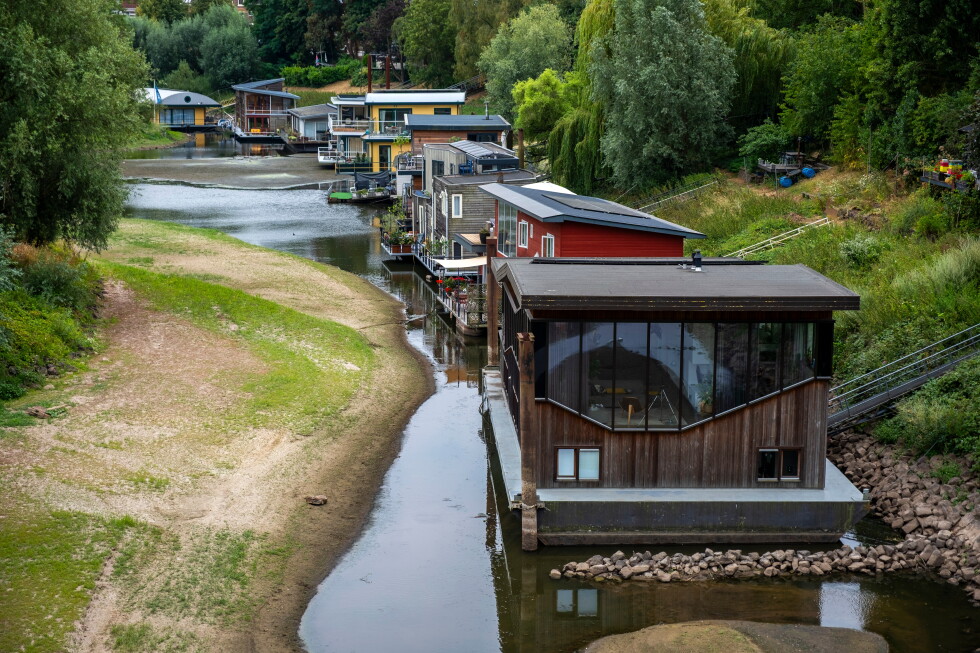
And for some houseboat owners, the drought has left their water-borne homes resting on sandy river bed.
Checking dikes for damage
Peter van Duijvendijk is a flood defense manager at the Schieland en de Krimpenerwaard water corporation, one of 21 such organizations covering the Netherlands that are responsible for issues including flood control.
He has a team of 140 volunteers who are responsible for checking about 100 kilometers (60 miles) of dikes, reporting any problems they find. So far this dry summer there have not discovered any major issues. But they remain alert now and likely into the fall.
The volunteers “are our eyes and ears on the dike,” Van Duijvendijk told The Associated Press.
Advertisement
Like many inland dikes, the barrier in agricultural fields near the small town of Waddinxveen, east of The Hague, is made of peat that needs to be damp to be strong enough to hold back water. It is in one of the lowest points in the Netherlands, some 5 meters (16 feet) below sea level.
“Because it is so dry right now the peat loses moisture, and because of that it becomes weaker,” Van Duijvendijk said. “If that peat becomes weaker, then there is a chance that water will flow through the dike and that waterway will drain into the polder,” referring to reclaimed Dutch land.
Cargo traffic choked by low river levels
Europe’s major rivers face a lack of water flow.
In Cologne, Germany, people walk along parts of the dried-up bed of the Rhine, a river that is a major highway for European freight traffic.
Advertisement
On Saturday, the Rhine’s water level in Cologne dropped below the record low set in October 2018. Marcel Beck, manager of the western German ports of Neuss, Düsseldorf and Cologne at RheinCargo, a port and freight transport company, said the levels are having a “devastating impact” on shipping.
“A ship that would normally carry 2,000 to 2,500 metric tons of cargo can now only transport 400, perhaps 600, metric tons depending on the ship’s design,” he said. “This places an enormous burden on the entire transport chain to reorganize everything in order to still get the goods inland.”
In the eastern Dutch city of Nijmegen, a rusted bicycle and shopping cart are exposed on the dried bed of the Waal — the main Dutch arm of the Rhine — and houseboats are left almost high and dry by receding water.
Advertisement
Sign up for Morning Wire:
Our flagship newsletter breaks down the biggest headlines of the day.
Advertisement
Frans Schilte has seen the summer periods of low water levels get longer in recent years. They used to last a month, but “now it’s like three months,” he said.
His steel-bottomed boat is now resting on the sandy river bed.
“It’s a little out of level, it’s not a big problem,” said Schilte, who describes the drought as “the negative effect of climate change.”
Advertisement
Water levels are a Dutch dilemma
The Netherlands, about a third of which is below sea level, is involved in a balancing act between preventing winter floods and having enough water for crops and canals in the summer.
“Throughout the year, we have enough water in the Netherlands, there’s no shortage,” said Vince Kaandorp, a groundwater hydrologist at Deltares, an independent Dutch water research institute.
“But, of course, it is not evenly distributed over the seasons,” Kaandorp said. “In the winter we drain it away quickly because we want to keep our feet dry and we don’t want water on the land. How can you ensure that you do that slowly and give water time to sink into the ground?”
Such measures don’t have to be high-tech, Kaandorp said. Adding something as simple as a hedge near a river slows down water and gives it time to seep deep into the ground. Authorities are studying how to turn soil into “sponges” to better hold water throughout the year.
Advertisement
The low-lying parts of the western Netherlands that are reclaimed land suffer increasingly from salinity in droughts, posing problems for farmers who grow fruit and vegetables in the fertile soil. Water authorities trying to maintain adequate supplies of fresh water have banned farmers in some parts of the country from pumping water out of canals to irrigate their crops.
“It is an extremely challenging year for growers,” John Kusters, chair of the Netherlands Fruit Growers’ Organization, said in a statement.
___
Associated Press journalists Ahmad Seir in Nijmegen, Netherlands, Daniel Niemann in Cologne, Germany, and Stefanie Dazio in Berlin contributed to this report.
WEST SACRAMENTO, Calif. (AP) — The Los Angeles Dodgers have acquired the biggest prize on the trade deadline market, getting two-time reigning AL Cy Young Award winner Tarik Skubal from the Detroit Tigers on Saturday night.
Skubal got the news during the Tigers’ 8-6 win over the Athletics and was emotional after the game as he prepared to leave the team that drafted him in 2018 and developed him into a star to join the two-time defending World Series champions.
“I’m excited to be a Dodger,” he said. “I’m excited to get down there and meet all those guys and chase three championships in a row. That’s hard to do, so I’m so excited to a part of that. But it’s a lot of different emotions. Definitely kind of a roller coaster a little bit.”
Skubal is the latest star to join the high-priced roster for the Dodgers that already has big-name players like Shohei Ohtani, Yoshinobu Yamamoto and Mookie Betts. If everyone is healthy, he could be part of a rotation with Ohtani, reigning World Series MVP Yamamoto, fellow two-time Cy Young Award winner Blake Snell and Tyler Glasnow. The Dodgers lead the majors with a 3.36 ERA from their starting pitchers and now add Skubal to the mix.
Advertisement
The Dodgers are in first place in the NL West and were already the favorites to become the first team to three-peat since the New York Yankees from 1998-2000 before adding Skubal. They began the season with a $323.3 million opening-day payroll for their 40-man roster and a $163.7 million tax for a $487.1 million total. They will pay Skubal about $9.5 million for the remainder of the season.
ESPN first reported the deal and said the Tigers would receive three minor league prospects in right-handers River Ryan and Brady Smith and outfielder Zyhir Hope.
Skubal is eligible for free agency after the World Series. He has a $32 million salary, a record total in arbitration, after the team offered $19 million, and is expected to sign a massive contract in the offseason.
The 29-year-old lefty said in July that it was his preference to finish the season with the Tigers and to compete for a World Series championship, which has eluded the franchise since 1984. Skubal took the loss in the decisive Game 5 of the division series against Cleveland in 2024 and then got a no-decision in a 15-inning loss to Seattle in Game 5 of the division series last year.
Advertisement
He said it was “very tough” to leave the Tigers having fallen short of the goal of winning a title.
“Ever since that ’24 Game 5, the failure that I experienced on the mound, I’ve used that as fuel to try and bring a World Series to the city of Detroit. I truly did,” he said. “That whole offseason I’ve never been more motivated and then go in and we lose Game 5 again. That failure kind of sparks some more motivation, just to dig deeper and see how good you can truly be. The goal was always to win a World Series for the city, for the organization that took a chance on me. It’s tough. I love all those guys in there. They’re some of my best friends.”
Detroit planned to contend again this season, bolstering the Skubal-led rotation by giving two-time All-Star pitcher Framber Valdez a $115 million, three-year contract in free agency and retaining three-time All-Star infielder Gleyber Torres with a $22 million deal.
The Tigers, though, got off to a rough start and are currently 2 1/2 games out of the last wild-card spot in the American League.
Advertisement
“It’s crazy. Going into the season, this isn’t what I planned on doing,” Skubal said. “But circumstances change, situations change, and I’m very appreciative of everything the Tigers have done for me.”
They bounced back in June and most of July to get into playoff contention with Skubal leading a rotation and three All-Stars in the lineup: rookie infielder Kevin McGonigle, catcher Dillon Dingler and outfielder Riley Greene.
With a chance to possibly persuade management to keep Skubal by improving its playoff positioning, Detroit lost ground by dropping four of its last five games at home, including Skubal’s last start that was made even more memorable by a late-inning collapse.
The Tigers led Baltimore 7-0 after six innings Wednesday and lost 10-9 in 12 innings. Skubal started the game, recorded his 1,000th career strikeout and was cheered at every opportunity by a crowd of 34,406.
Advertisement
“I’ve watched this guy rise to the top of the sport,” manager A.J. Hinch said. “He’s carried us a lot. I’ll forever be grateful that our paths crossed and the things that he did for this organization and for a couple of playoff teams. His presence, his work ethic, his example, his dominance. There’s so much to go through, it’s hard to capture in one quote or kind of one setting. But I’m very grateful that I was able to manage him for the time that I did.”
Skubal is 7-5 this season with a 2.79 ERA and 116 strikeouts in 96 2/3 innings. He is 61-42 with a 3.04 ERA over seven seasons, all in Detroit. In two postseasons, Skubal is 2-1 with a 2.04 ERA in six starts.
Skubal had a minimally invasive surgery on May 6 to remove a loose body from his pitching elbow and returned to pitch on June 13.
“The way the surgery went is exactly how it was supposed to go,” he said in July.
Advertisement
___
AP Sports Writer Larry Lage in Detroit contributed to this report
Wind your way between suburban roads of Prestwich and the rolling hillocks of its golf club and you’ll find yourself in a village within the village. Up a leafy avenue, with its rear patio basking in the late July sunshine, Heathlands Village looks more like a European ski resort than a care home.
With origins reaching back to the 1860s, when Manchester’s Jewish community began establishing charities and homes for the community’s elderly, this purpose-built facility run by the Federation of Jewish Services can now accommodate more than 100 people in residential, nursing and end-of-life accommodation.
Click here to get the biggest stories straight to your inbox in our Daily Newsletter
A charity at which around 30 per cent of residents are state funded, the Fed is one of the biggest employers in the area with around 300 staff. But its impact is felt far wider than that, with around 500 volunteers carrying out vital work in the local community, reaching approximately one in seven Jewish households in Greater Manchester.
Advertisement
And this week it was name-checked by the new Prime Minister.
Andy Burnham called it the ‘gold standard’ of what social care could be in this country as he promised to expedite the Casey Commission into adult social care; improving pay and standards in the social care workforce; and to start cross-party talks on the issue.
Speaking at Jewish Care in Golders Green on Wednesday, The MP for Ashton-in-Makerfield said that the current state of social care is ‘very bad for everybody’ and must be reformed ‘with urgency’.
He cited the many people pushed into hospitals for lack of adequate care, the subsequent strain on the NHS, and the need for integration between a national health and national care service.
“It can break people if they’re left without the support that they need,” he told his audience. “People can see everything they’ve worked for wiped out by the cost of care.”
The majority of residents at Heathlands are privately funded, with residential accommodation costing around £1,300 a week. For the around 30pc of council-funded residents, the Fed receives about £742 per week.
Advertisement
The charity covers the resulting shortfall. To fund the rest of what they do, it must raise £2.5 million a year.
On a sunny day, Heathlands has an airy feel. Walking in past a wood and glass-panelled reception, you are greeted by a bright foyer, dining area, and patio with tables and parasols extending towards the garden.
There is an industrial-scale kitchen serving kosher meals, a comprehensive nursing facility, a hair salon, and a synagogue.
Advertisement
There are mental health support groups; a mums and tots group where toddlers sing with residents; a nursery; animal visits; day trips; a music and art therapist; sports days, bingo games and dance nights.
No dingy corridors, faint smell of bodily functions or miserable-looking residents – the abiding stereotype of many care homes, state-funded or private equity alike – it’s a far cry from your typical facility. What is it that makes Heathlands different?
One of the main issues Burnham highlighted was the practice of 15-minute care visits practiced by many councils across the country. “That’s all that councils say they can afford for many people,” he said.
Fed CEO Mark Cunningham thinks the centre’s success lies partly on its 500-strong army of volunteers, who put in thousands of hours every year.
Advertisement
Volunteering might be doing someone’s shopping and helping to unpack it. It might be driving someone to a doctor’s appointment – or acting as an advocate in that appointment when the clinical jargon seems impenetrable.
It could be helping people access support from benefits and pensions that they didn’t even know they could. But it is often as simple as a chat and a cup of tea: the Fed’s befriending service is one of its most popular.
In the volunteer co-ordinators’ office, you get a sense of the impact. The staff work diligently, calendars and schedules pasted on every wall, headsets and keyboards at the ready, phone ringing every other minute, usually someone in need on the other end of the line.
A team of trained social workers also work from the centre, engaging with anyone from families with a disabled child to victims fleeing domestic abuse, all ages and ‘throughout the various phases and challenges of life’.
It seems like a model for what Burnham called for: preventative, person-centred care.
“Whatever their problem is, we’ll try and solve it, and if we can’t, we will signpost them elsewhere,” says Sara Ogden-Cunningham, who manages social work and community services at the centre.
“Volunteers might be helping with homework, looking after children, helping with cooking while Mum looks after a special needs child. It’s really flexible and very bespoke.”
Advertisement
Inquiries and referrals come in every day from Greater Manchester and beyond in what Sara describes as a ‘very challenging’ but ‘very, very rewarding’ job.
“We get to think holistically and creatively,” she says. “We might go into a four-generation family, it might be a child with special needs or an older parent. We have a lot of those sandwich generations…it’s not really a sandwich, it’s a club.”
But some of the calls are distressing. “We are going into the worst,” she reflects. “Last year we visited a lady who was fleeing domestic abuse. She and her child were living in a house where there was literally no furniture and no bed.”
Raphi Bloom, who is director of fundraising, marketing and communications at the centre, recalls the first visit he went on with Sara. “I walked into the house and the smell of damp stayed on my clothes the rest of the day.
“There is a stereotype that the Jewish community is all affluent and doesn’t need support – that couldn’t be further from the truth.
“The doors were hanging off, they had no food. She had sold all her jewellery and ornaments, and were making do with just a microwave and about £10 a week.
“She was the same age as my mum and she was so dignified but having to pawn her jewellery on Cheetham Hill Road.”
Advertisement
The Fed helped the couple with a new fridge and helped them to claim their state pension and some disability benefits – a complex system that many older people, or those unfamiliar with the internet, struggle with.
“£100 a week on Universal Credit might not sound like a lot, but if you haven’t got it, it’s a fortune,” says CEO Mark. He became a social worker in 1996, which means he has had a front row seat to the more than twenty social care reviews undertaken in the last three decades.
In his speech on Wednesday Burnham called the lack of action a ‘major dereliction of public duty’ – something Mark agrees with.
“It gets kicked into the long grass all the time…it’s a travesty that Parliament hasn’t grasped this nettle. It’s unpopular, nobody wants to pay for it.”
Burnham has acknowledged the challenge of funding and that many can lose ‘everything they’ve worked for’ through paying for care.
“You can have as many headlines as you like about this tax or that, but when people are losing hundreds of thousands of pounds, everything they’ve worked for, well, what about them?” Burnham said.
“Unless we all take some responsibility, it’s just going to carry on,” says Mark. “We will all need social care at some point – we’re going to have to pay for it one way or another.”
Advertisement
And Mark agreed with the Prime Minister that the way to fix the NHS was by fixing social care – and that hospital was ‘the worst place’ for the elderly to end up.
Burnham cited that the number of over-65s going to A&E had doubled to almost six million a year since 2010. “People end up in hospital needlessly and once you are, you’re on a pathway and it’s really difficult to get off,” Mark said.
“A volunteer might notice someone is not well and refer them to a GP. They might discover a mild infection which, if left unchecked, could have led to hospitalisation and then the pattern of decline.
“I think there has to be a holistic, preventative approach to this, and a recognition that some of the solution lies in the community and not hospital wards.
“Social care doesn’t have to be over-elaborate – it’s about connections and community and doing the basics well. People are generally proud and dignified, they don’t want much intervention but just some support.”
Whether that’s an ice-cream van in the garden, trips out, animal visits, or music therapy, Heathlands is about ‘adding fun back into people’s lives,’ says Mark. “There’s a statistic that says 80% of people that go into a care home and don’t go outside again…not here.”
Those who do come to live at the centre – Heathlands’ ethos is all about keeping people at home for as long as possible – are trending older, with the average age now 91, and several residents ‘in the hundreds’.
Advertisement
Saul Levy, 95, came to Heathlands three years ago after a brain haemorrhage meant he could no longer live on his own. He lives in one of the supported living flats – but says he ‘hardly ever’ uses the extra help dressing or showering.
“It’s done me the world of good, it’s given me another lease of life, truthfully. You can do exactly what you want, go to any activities you like.
“I get up when I like, shower myself, dress myself, go for breakfast. It keeps me independent.”
Advertisement
Gerda Rothberg celebrated her 100th birthday a few months ago. She is proud to still be washing and dressing herself – and holding court as Heathlands’ Queen of Rummy.
“No-one can beat her,” smiles volunteer Amanda Harris, who is visiting. “It’s very relaxing here,” Gerda says.
She came to Britain just before the war with her two sisters from East Prussia. Her story of escape on Kindertransport is enshrined in the Fed’s My Voice project, which documents the life stories of Holocaust survivors and refugees.
“It’s something I wanted to do for the generations to come, for the people who say the Holocaust never happened,” she says baldly. “It did happen, it’s a fact, it’s there in black and white.”
Heathlands received an influx of messages after the synagogue attack in Heaton Park last year, says Sara. “People who had never come through our doors began approaching us, saying they had previously been Jewish ‘in name only’.
“After the attack, they were scared and wanted to re-engage with their community.”
“They wanted to be together with other Jewish people, to feel solidarity, a sense of security and identity,” agrees Raphi.
Advertisement
The centre does serve non-Jewish people, but with its synagogue, Kosher catering and celebrations of Jewish festivals, it is ideal for those who ‘wish to see out their days in a warm, loving, state of the art Jewish environment’. Staff are often there for people in their last moments.
“We often have a lot of clients that have no family and we arrange burials,” Raphi says. “We arrange a gravestone and a commemoration service, and often, it’s just our staff that are standing around the grave when this person takes their final journey on Earth.
“We all feel that is a real privilege. When Andy talks about his father, and how carers can bring a lucid moment out of him where he can’t, he genuinely means what he says. It’s personal to him.”
Advertisement
Mark is confident that Heathlands’ success can be replicated elsewhere – with a strong voluntary sector, he adds.
“We think we’ve got a really good model for social care and we’re cautiously optimistic about the future – that we can improve the system we work within.”
New manager Enzo Maresca is a “perfect one” for Manchester City, says defender Josko Gvardiol.
The Italian has been given the perhaps unenviable task of taking over from the legendary Pep Guardiola, who stepped down at the end of last season after a trophy-laden decade in charge.
Maresca signed a three-year deal to succeed the Spaniard, having previously won the Championship title with Leicester and the Club World Cup with Chelsea.
The 46-year-old took charge of City for the first time in Saturday’s friendly defeat on penalties by Inter Milan in Hong Kong.
Advertisement
“The level is that high and he has been chosen with reason as the manager,” said Gvardiol.
“I think he has a quality, has some new ideas and also we need to see what we are going to do [with] the style of [play], the football we are going to play and the tactics.
“I think he is a perfect one, but of course, it takes time. It’s something totally new, it’s not easy to change the manager, so we will take time.
“It’s our job to help him as much as possible and also to listen to try to adapt as quick as possible.
Advertisement
“I met him, we spoke a little bit about my injury [and] also how we played, how I played before with Pep, and that’s it, more or less.”
I enjoy Rings of Power for the most part, but there’s one storyline I’m happy to see the back of (Picture: Amazon/Everett/REX/Shutterstock)
Amazon Prime’s $1,000,000,000 Lord of the Rings prequel series, The Rings of Power, is coming back for a third season, and it just made a show-saving decision.
Since it first arrived in all its high fantasy glory in 2022, Rings of Power has been fighting a battle tougher than Helm’s Deep to win over the beloved franchise’s fiercely protective fanbase.
The epic series, starring Morfydd Clark as Galadriel and Robert Aramayo as Elrond, is set thousands of years before Frodo ever sets foot outside of the Shire, as we trace the origins of the eponymous rings, including the one to rule them all.
Despite the mammoth budget, sweeping sets and expansive world-building, the first series didn’t resonate with the masses. It may have attracted more than 150million global viewers, but it only secured a measly 38% audience score on Rotten Tomatoes.
Advertisement
Criticisms ranged from disappointment at how Tolkien’s work has been adapted to the ‘awful pacing’ and ‘convoluted, padded and boring plot’ – and that’s some of the nicer commentary. I can understand the gripes; it took me two tries of the first season to properly immerse myself in the show.
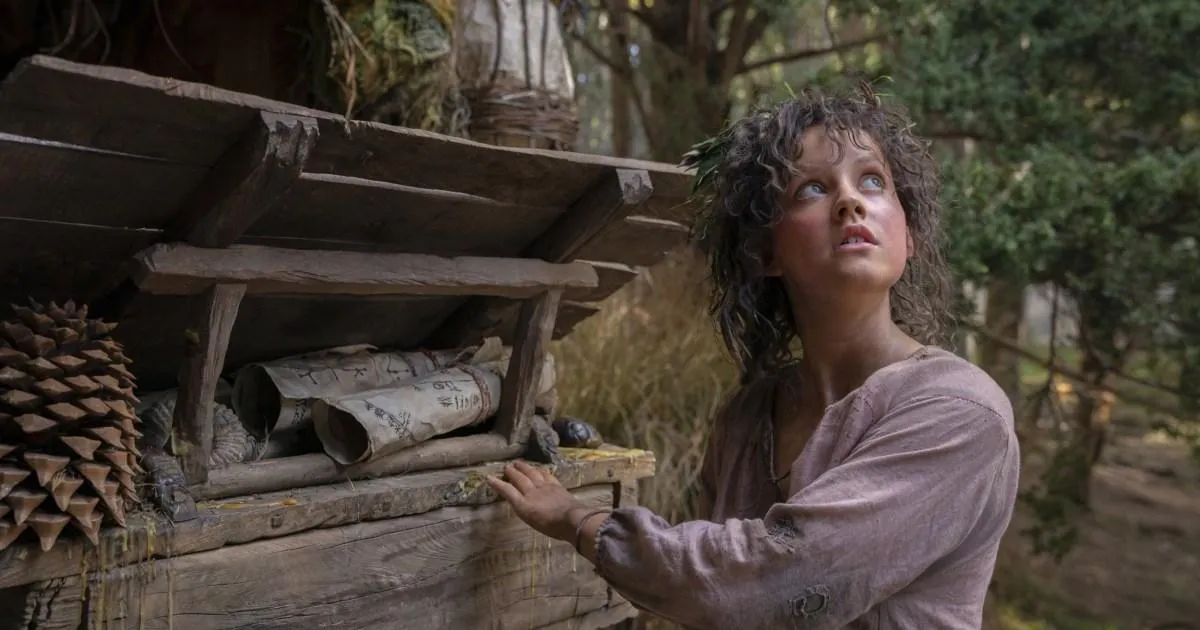
A big part of my discontent was thanks to one subplot that has been a real slog to get through from the very start, and that is the Harfoots – early ancestors of the hobbits – to whom Gandalf first crash-lands on earth.
There’s no denying that the first season was extremely slow – to its detriment (Picture: Amazon/Everett/Shutterstock)
Essentially, we see young Harfoots Nori (Markella Kavenagh) and Poppy (Megan Richards) taking the stranger (Daniel Weyman) – as Gandalf is first known – under their wing while he tries to figure out who he is and his purpose.
The acting is fine enough, but the tedious stretching out of this plot across two seasons, especially when the stakes grew higher every episode with action-packed sequences and riveting storylines, was almost difficult to watch.
I would find a groan escaping my lips every time we would return to this trio of characters, even tempted to skip forward with the remote because I could already see myself nodding off.
Advertisement
Now, the Rings of Power showrunner J.D. Payne has delivered music to my ears by telling Empire that we won’t be seeing much (if any) of the Harfoots in the upcoming season.
‘It was time for them to take a little bit more of a backseat,’ he said, adding: ‘But I will also say: never count a Halfling out.’
I’m grateful that the Harfoots are taking a back seat in the new season (Picture: Amazon/Everett/Shutterstock)
Without a doubt, the second season is leaps and bounds better and kept me mostly hooked from start to finish as we witnessed Sauron’s manipulation of elven-smith Celebrimbor, the comings and goings in Numenor filled with bloody betrayal and Gandalf’s ongoing origin story.
By the end of the second series, Gandalf has revealed himself and is at Tom Bombadil’s house, having bid adieu to his Harfoot friends. And good riddance, I say.
I’m not sure if I’m yet convinced by this storyline in its entirety when there are far more interesting goings-on with Sauron and the ever-precarious politics of Middle-earth, but at least we won’t have to endure any more trekking through the desert with inane chatter.
Advertisement
At least I hope.
If the show leans into all that has made it engaging and special in this third season, we very well could see a turnaround in sentiment. Perhaps naysayers could give the show a try.
Although I’m sure this isn’t the last we’ve seen of Gandalf and Tom Bombadil (Picture: Ben Rothstein/Prime Video)
I’ll certainly be recommending it to more people, knowing they won’t have to endure the more dreary aspects of the tale.
And it seems as though there is plenty to look forward to with the new season as Jamie Campbell Bower comes on board as Celeborn, the husband of Galadriel.
Meanwhile, perhaps most excitingly of all, the showrunners have teased that the One Ring will finally be forged this season.
Advertisement
So, as they say, out with the old and in with the new. Amazon Prime’s Rings of Power might just save itself from doom.



















































You must be logged in to post a comment Login