Connect with us

NewsBeat

Shock 216 UK deaths and 18,000 severe reactions linked to weight loss jabs – fatalities surge 300 per cent in a year … as woman dies after upping Mounjaro dose

Published

on

Weight loss jabs like Mounjaro and Wegovy have been linked to at least 216 UK deaths

Weight loss jabs like Mounjaro and Wegovy have now been linked to at least 216 UK deaths, the Daily Mail can reveal. 

The majority of victims are those who’ve used tirzepatide, the active ingredient in Mounjaro – which has been dubbed the ‘King Kong’ of slimming injections.

Government figures also show a startling rise in deaths, with annual jab fatalities leaping by 300 per cent between 2024 and 2025 – from 22 to 94.

Meanwhile, a total of 150,000 adverse reactions have been associated with the drugs since the earliest recorded figure in 2010 – 18,000 of which were serious or fatal.

Advertisement

Most of these involve conditions affecting the gastrointestinal system, such as inflammation of the pancreas known as pancreatitis and gastroparesis, or stomach paralysis.

The tallies, obtained via an analysis of official drug safety data, come days after an inquest heard that a 73-year-old British grandmother died after increasing her dose of Mounjaro.

Caroline Savage’s death was said to be faecal peritonitis, whereby bacteria leaks into the abdomen via a hole in the bowel.

This often triggers life-threatening sepsis, and is fatal in half of patients who develop it.

Advertisement

Weight loss jabs like Mounjaro and Wegovy have been linked to at least 216 UK deaths

The inquest heard that the slimming injections may increase pressure in the intestines in those with certain underlying conditions, increasing the risk of a hole forming – known medically as perforation.

Experts have warned that patients should be aware of this lesser-known complication.

Advertisement

Penny Ward, a pharmaceutical expert from King’s College London, said that the jabs can cause the gut to work slowly, triggering a back-up of waste products that put pressure on the sensitive bowel lining, increasing the risk of a tear.

She explained because this is ‘not common’ it is a lesser known potential side effect. 

‘Nausea and vomiting are quite common after taking these drugs, but severe, sudden onset of severe abdominal pain is an indication of something more worrisome going on and should be investigated,’ she added. 

The Daily Mail has analysed reports made to the UK’s medical safety regulator, the Medicines and Healthcare products Regulatory Agency (MHRA).

Advertisement

These so-called Yellow Card reports are the UK’s system for tracking suspected adverse drug reactions.

They can be submitted from members of the public, healthcare professionals and those who work in the pharmaceutical industry.

Officials stress that they do not prove that a medicine caused a reaction to happen, only that it is suspected by the individual making the report. 

Other health conditions may have been at play.

Advertisement

Join the discussion

Advertisement

Should doctors be prescribing powerful weight loss jabs despite the rising number of deaths and severe side effects?

Since tirzepatide was licensed in 2024, a total of 120 deaths linked to the drug have been reported to the MHRA.

The figure for semaglutide – sold under brand names Wegovy and Ozempic – is 59, while liraglutide, known as Saxenda, is associated with 37 fatalities.

Of the 18,000 serious or fatal effects recorded, 11,500 specifically concerned tirzepatide, or Mounjaro, which results in faster and more significant weight loss than the other drugs.

Advertisement

Close to 8,000 of these Mounjaro reports concerned women.

The popular drugs are known as GLP-1 agonists, and work by mimicking appetite-suppressing hormones released by the gut after eating.  

Studies show the medications can help patients lose at least a fifth of their body weight within a year. 

The death of Ms Savage follows the first British woman to have tirzepatide listed on her death certificate.

Advertisement

Susan McGowan, a 58-year-old nurse from North Lanarkshire, died in September 2024 after taking two low-dose injections of the drug over the course of two weeks.  

Official records show that she suffered fatal organ failure, septic shock and pancreatitis, with the use of prescribed tirzepatide listed as a contributing factor.    

An MHRA spokesman said: ‘It is important to place these reports in the context of the millions of GLP-1 prescriptions issued in the UK. Reporting volumes can be influenced by increased use, greater awareness of a potential adverse reaction and other factors.

‘As with all medicines, the safety of GLP-1’s are kept under continual review including emerging evidence from spontaneous data and scientific publications.

Advertisement

‘On the basis of the current evidence, the benefits of GLP-1 receptor agonists outweigh the potential risks when used in line with their authorised uses.’

Drug manufacturers Novo Nordisk, who make Wegovy, Ozempic and Saxenda, said: ‘Like all medicines, treatments used for chronic conditions can have side effects, and these can vary from person to person. 

‘We recommend that any patient experiencing side effects while taking GLP-1 RA medicines report them to their healthcare provider and via the MHRA Yellow Card scheme.’

Eli Lilly, who are behind Mounjaro and Zepbound, said: ‘Patient safety is Lilly’s top priority. We take reports regarding patient safety seriously and actively monitor, evaluate, and report safety information for all our medicines.

Advertisement

‘Regulatory agencies conduct extensive independent assessments of the benefits and risks of every new medicine. Patients taking Mounjaro (tirzepatide), like with any other prescription medicine, may experience adverse events. Adverse events should be reported under the MHRA’s Yellow Card scheme.

‘Mounjaro (tirzepatide) should only be used when prescribed by a healthcare professional. We encourage patients to consult their doctor or other healthcare professional regarding any side effects they may be experiencing and to ensure that they are getting genuine Lilly medicine.’

When approached for comment, NHS England declined to say how many GLP-1 users had been officially hospitalised. 

Source link

Advertisement
Continue Reading
Click to comment

You must be logged in to post a comment Login

Leave a Reply

NewsBeat

how the colonial legacies of these cities have shaped migration in the region

Published

on

how the colonial legacies of these cities have shaped migration in the region

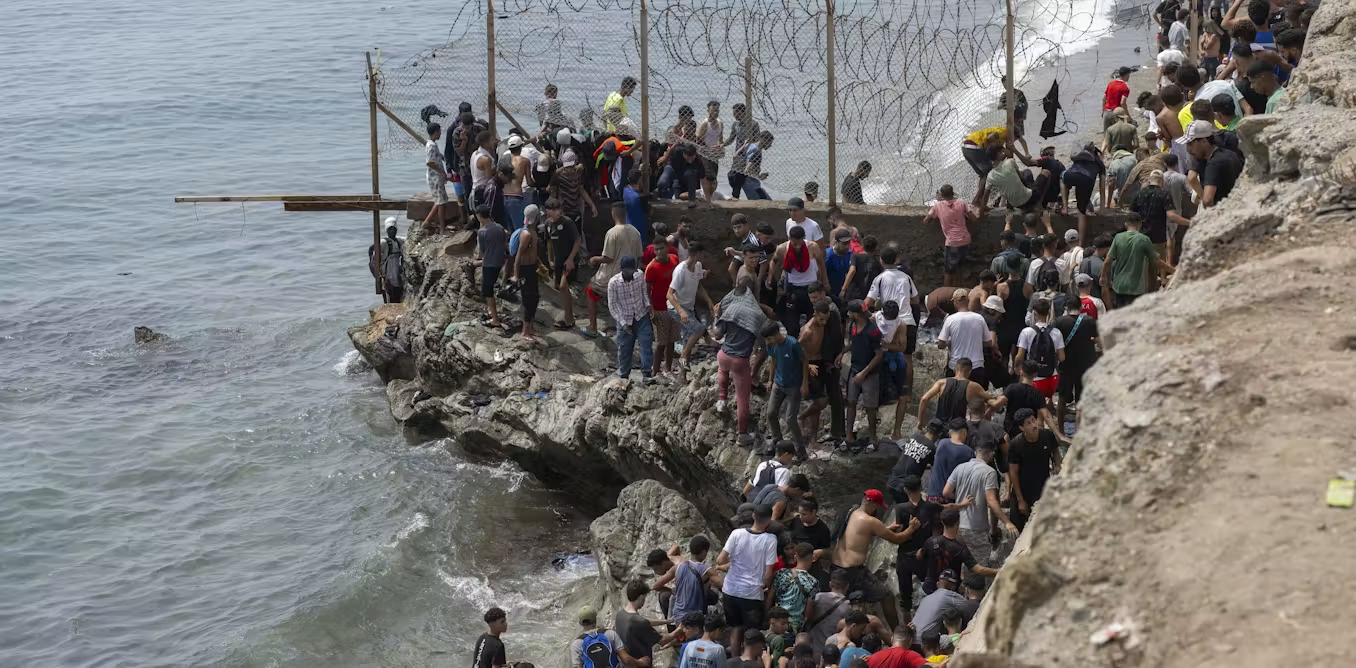
Ceuta, a small Spanish enclave on the Moroccan mainland, was unprepared for the arrival of more than 70,000 undocumented migrants on July 30. They arrived mostly by sea, from Morocco via the Tarajal breakwaters and its shoreline.

The minuscule city of just seven square miles had few provisions for food, shelter or support for the unexpected arrivals. This was a shocking exposure of the apparent porosity of the city’s heavily fortified borders.

More than 95% of the migrants have since returned via the land border, following emergency negotiations between the governments of Spain and Morocco. Those who remain have overwhelmed the city’s migrant reception centres.

According to the latest figures from Spain, at least 88 people are known to have lost their lives while attempting to cross into Ceuta.

Advertisement

The mass influx, however temporary, has fuelled some far-right and nationalist political reactions, as well as protests by those resisting Europe’s rising populism and anti-immigrant sentiments.


À lire aussi :
How the Ceuta border crossing incident immediately played into the hands of Spain’s far right


It has also led to the swift installation of yet another border separating Spain, and Europe, from Morocco by way of a sea barrier at the Tarajal.

Ceuta, like its even smaller sister city of Melilla, also an enclave on the Moroccan mainland, is a border flashpoint. These cities occasionally spark intense debates on undocumented migration to Spain, and hence to the EU.

Advertisement

The fortification of the border at Ceuta and Melilla resonates with the history of Spanish control over this part of north Africa, as well as with Spain’s role as a southern guardian of the European Union.

History of movement

There is a long history of colonialism and migration behind this latest incident. First known as Phoenician settlements and then as Roman ones, Ceuta and Melilla became part of the 8th-century Islamic conquest of the Mediterranean region. Their locations by the sea turned them into key ports and trading points for commerce across the Mediterranean.

As the Portuguese empire expanded in the 15th century, Ceuta was captured and, shortly thereafter, the Spanish and Portuguese crowns were united. When Portugal regained its independence in 1640, Ceuta remained under Spanish control. Melilla, on the other hand, was captured by the Duke of Medina Sidonia in 1497 and has been under the Spanish crown ever since.

In the 19th and 20th centuries, Spain’s control over northern Morocco expanded, while France controlled the rest of the country. As European powers agreed a division of protectorates in the region in 1912, Ceuta and Melilla did not fall under this agreement, since they were historically Spanish-administered towns. The Rif war of 1921-26 was a time of bitter defeat for Spain in the Maghreb, turning Spain’s continued control over Ceuta and Melilla into a symbol of Spanish might in the region.

Advertisement

General Francisco Franco launched the Spanish civil war from Spanish Morocco in July 1936, paving the way for 36 years of dictatorship. The transition to democracy in the 1970s coincided with the start of substantial migration to Spain from Morocco. This increased with Spain’s entry into the European Community in 1986, provoking anxieties about diversity and nationhood that remain unresolved.

The cities became guardians of Spain’s frontiers in the Maghreb. When Spain joined the Schengen area in 1991, this role extended into a Europe-wide duty. The EU has since invested hundreds of millions of euros over the years into fortifying these border towns, including with surveillance and fences. Ceuta and Melilla, small though they are, uphold this history, and have often been accused of doing so in serious contravention of human rights.

Fortress Europe

The notion of Europe as a gated “fortress” has long shaped the continent’s migration policies.

The borders with Ceuta and Melilla turn more brutal in this context. Moroccans, sub-Saharan Africans and many others attempt to brave razor wire, deep water and other perils to claim a foothold in Spain. They are driven by climate change, global inequality and the dream of a better life in Europe, among other factors.

Advertisement
Ceuta, Spain, has a long history of colonialism and migration.
kiomu.studio/Shutterstock

Meanwhile, colonial legacies continue to shape the geopolitics of this region in complex ways.

Morocco does not recognise Ceuta and Melilla as Spanish, and seeks to claim them as Moroccan in diplomatic exchanges with Spain. But it maintains its own colonial exploits, having invaded the former Spanish colony of Western Sahara to its south in the 1970s, sending in 350,000 citizens to settle in Western Sahara.

Another mass crossing of the border at Ceuta occurred in 2021 – though not at the scale of the latest one – amid a diplomatic row, as Spain allowed the leader of the Western Sahara independence movement to be treated for COVID in Spain.

Ceuta’s local government has blamed the Moroccan government for this latest mass influx, by allegedly loosening border controls.

Advertisement

Migration is a repeated theme in the political tensions between Spain and Morocco, which remain unresolved. This incident adds yet another layer to Ceuta’s chequered history as a Spanish town on north African soil. In discussing the politics present in this incident, it is also worth recalling that Ceuta and Melilla’s roles as European borders in north Africa can at times be deadly.

Source link

Advertisement
Continue Reading

NewsBeat

We must tackle the far-right but also tackle the root causes of poverty

Published

on

Daily Record

Record View says we cannot pretend that everyone in a crowd of 1,700 is a violent extremist.

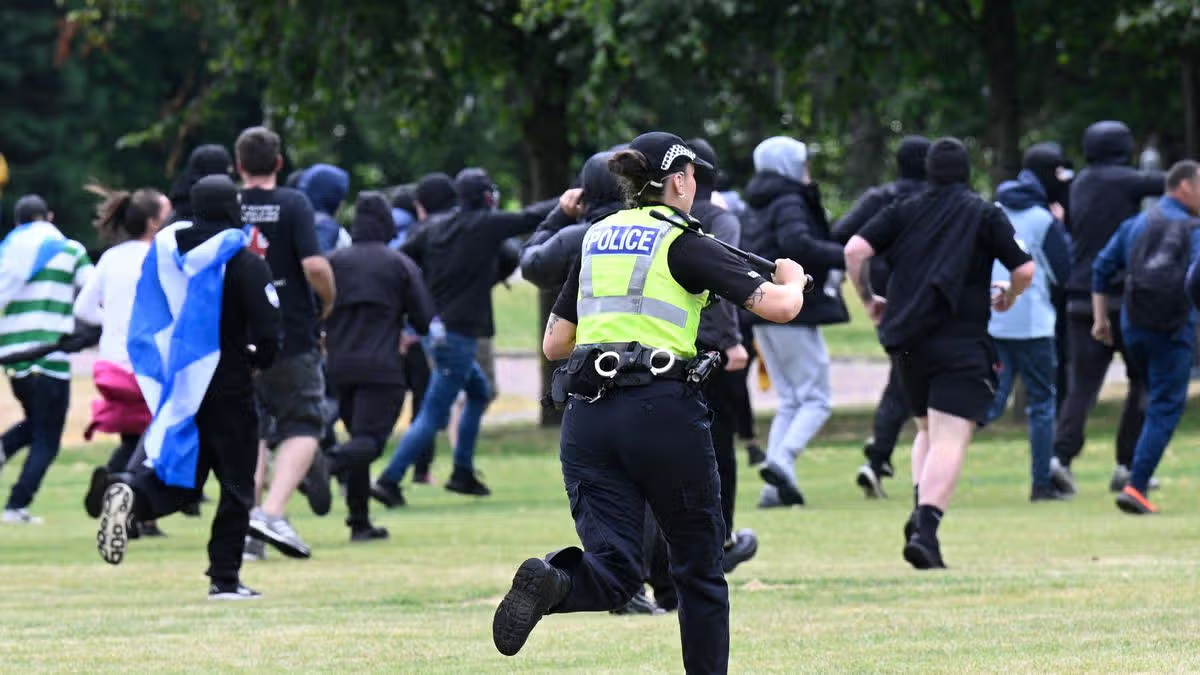
What should have been a positive fortnight for Glasgow as the Commonwealth Games returned was marred by the shocking scenes in the city centre on July 25.

Advertisement

An anti-immigration protest quickly descended into disorder as police struggled to contain hundreds of masked hoodlums from causing havoc as families tried to go about their business.

Police have a duty to facilitate peaceful protest – but anyone who saw the behaviour around Glasgow Green that day will tell you it was anything but peaceful.

The Record has revealed how several of those involved have a series of convictions for domestic abuse and thuggery.

Throwing Nazi salutes in public and harassing innocent bystanders because of the colour of their skin should lead to arrests and convictions, every time.

Advertisement

Hiding in a mob with a face covering does not give anyone the right to terrorise people, regardless of political beliefs.

At the same time, we cannot pretend that everyone in a crowd of 1,700 is a violent extremist.

Some of those who attended will have felt they were taking part in a genuine expression of protest – the kind of direct action caused by years of feeling excluded or pushed to the margins.

Employment opportunities for young Scots are becoming harder and harder to come by – particularly for those living in the poorest areas.

Advertisement

Years of grinding austerity, followed by a cost-of-living crisis, have pushed some to extremes.

Housing in Glasgow is also a major problem, with understandable anger at the lack of homes for locals.

We must tackle the far-right but also tackle the root causes of poverty and exclusion that prove fertile breeding grounds for discontent.

Tech no prisoners

AI could be a force for good, leading to a new age of prosperity for humanity.

Advertisement

But there are also plenty of horror stories about how it could enslave us.

That’s why it is vital that the use of this technology is applied carefully, especially when it comes to law enforcement.

Today we tell how a series of AI cameras are appearing at roadsides in Scotland’s main cities, which can look into your car to check that you’re not doing anything illegal.

Some might argue that you’ve got nothing to fear if you’re obeying the law.

Advertisement

But some civil rights groups are raising concerns about the spread of AI into public observation.

It’s a thorny issue – and one that needs a lot more public debate before this kind of technology is rolled out.

Get more Daily Record exclusives by signing up for free to Google’s preferred sources. Click HERE.

Source link

Advertisement
Continue Reading

NewsBeat

2 Israeli soldiers killed in Lebanon in the first Israeli deaths under truce

Published

on

2 Israeli soldiers killed in Lebanon in the first Israeli deaths under truce

BEIRUT (AP) — The Israeli military said Thursday that two of its soldiers were killed in combat in southern Lebanon in the first Israeli deaths since the implementation of a shaky truce between Israel and the Iran-backed Lebanese militant group Hezbollah in June.

Four other soldiers were seriously wounded, the military said. The deaths had been reported by Israeli media a day earlier.

The Israeli army launched strikes Wednesday in southern Lebanon in response to what it described as Hezbollah’s violation of the ceasefire and issued a call for residents of the village of Mansouri to flee — the first such warning Israel has issued in Lebanon for weeks.

There was no immediate statement from Hezbollah.

Advertisement

The escalation came as Lebanese and Israeli negotiators met in Rome to discuss implementation of a June 26 deal under which Israeli forces are supposed to withdraw from areas they occupy in southern Lebanon and allow the Lebanese army to take control, in exchange for Hezbollah’s disarmament.

Wednesday’s talks ended early due to the escalation on the ground. It was not immediately clear if they would resume Thursday.

Lebanon’s Health Ministry said one person was killed and 12 wounded in an Israeli strike in the town of Tebnine Wednesday. The state-run National News Agency reported more people wounded in overnight strikes on the village of Burj al-Shemali, but the number was not clear. Artillery shelling also targeted the areas of Mansouri and Majdal Zoun, it said.

The latest Israel-Hezbollah war erupted on March 2, when Hezbollah fired rockets across the border two days after the U.S. and Israel launched their attacks on Iran. More than 4,000 people have been killed by Israeli strikes in Lebanon since then, including hundreds of civilians About 40 soldiers and three civilians – including a military contractor – have been killed on the Israeli side.

Advertisement

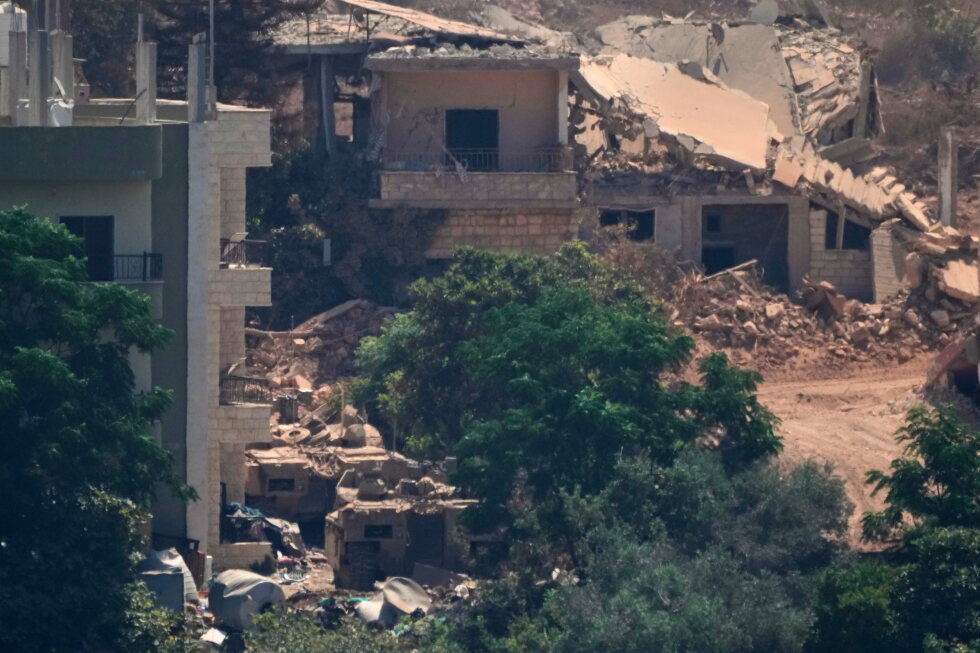
A shaky truce between Israel and Hezbollah has largely held since June 20, but Israeli forces have continued to occupy swaths of southern Lebanon and to carry out periodic airstrikes and shelling.

The talks in Rome have focused on implementation of “pilot zones” where Israeli forces would withdraw and the Lebanese army would take control. Implementation began last month with an initial pilot zone in an area that wasn’t occupied by Israeli forces but had previously sustained Israeli fire.

The Lebanese army entered the town of Zawtar al-Gharbieh and some civilians returned, although many came only to find their homes destroyed and left again.

A diplomat familiar with the negotiations said earlier this week that Lebanon had asked to be either in the town of Khiam or Bint Jbeil. Both areas saw heavy fighting in the latest Israel-Hezbollah war and are currently occupied by Israeli forces.

But U.S. Ambassador to Lebanon Michel Issa suggested ahead of the three-day talks that no new pilot zones would be immediately implemented, saying that “moving too quickly risks jeopardizing the very civilians this process is meant to protect.”

Advertisement

Source link

Continue Reading

NewsBeat

Suri steps into the spotlight… Tom’s girl makes stage debut treading the boards at the Fringe

Published

on

Debut: Suri dresses the part for her show at the Edinburgh Fringe Festival

Advertisement

She might not have spoken to him for a decade but Suri Noelle can’t escape her A-lister dad in the looks department.

Oscar winner Tom Cruise‘s youngest daughter appeared a dead ringer of him as she smiled while arriving at a dress rehearsal for her forthcoming Edinburgh Fringe show, which begins on Thursday for a 13-day run.

As the daughter of Dawson’s Creek star Katie Holmes and Cruise she has decided to follow in her acting parent’s footsteps and is making her theatrical debut in a queer adaptation of Shakespeare’s A Midsummer Night’s Dream.

Seen for the first time in her character, Suri, 20, who it was revealed last week had legally changed her name from Cruise, sported a pillbox fascinator, a yellow shirt with a purple corset and matching skirt.

Advertisement

Suri appears to be as hard-working as her 64-year-old Top Gun star father too. She spent more than three hours preparing for her big debut in a venue on Edinburgh’s St Andrews Square alongside eight of her fellow students from Carnegie Mellon University School of Drama in Pittsburgh, Pennsylvania.

The show, Midsummer!, is described as ‘bursting with queer transformative joy’.

Cruise, a devout and leading member of the Church of Scientology – a religion that is profoundly homophobic – will no doubt feel uncomfortable watching this modern translation.

But the Rain Man actor is a known fan of Scotland, having played golf in St Andrews.

Advertisement

Debut: Suri dresses the part for her show at the Edinburgh Fringe Festival 

Estranged: Tom Cruise with young Suri and Katie Holmes in 2011

Estranged: Tom Cruise with young Suri and Katie Holmes in 2011 

Suri is making her theatrical debut in a queer adaptation of Shakespeare's A Midsummer Night's Dream

Suri is making her theatrical debut in a queer adaptation of Shakespeare’s A Midsummer Night’s Dream

Advertisement

However, it is unlikely he will be attending the show as Cruise has reportedly been estranged from his daughter for years following his 2012 divorce from Holmes, 47, and her decision to cut ties with Scientology.

According to the voter records, the actress registered in Pennsylvania, where she currently lives, under her mother’s middle name, Noelle.

It was previously reported she was pursuing a degree in fashion, but it appears the nepo-baby has pursued her parent’s profession two years after graduating from New York City’s prestigious Fiorello H. LaGuardia High School of Music & Art and Performing Arts.

After their six-year marriage broke down, Ms Holmes was given full custody of their child, who she raised in New York and Cruise could get visits – paying £298,000 a year until her 18th birthday to meet living expenses.

Advertisement

Cruise previously admitted he had not seen the then six-year-old for 110 days over the previous summer, immediately following the breakdown of the marriage.

He agreed that over a five-month period, he saw Ms Noelle for ten days in total, six of which were a father-daughter bonding trip to Disney World.

Instead, he flew between Pittsburgh and London for an annual Scientology event and spent several days holidaying in Croatia with friends.

A source close to the actor has repeatedly denied the father and daughter are estranged.

Advertisement

During her parents’ marriage, Ms Noelle was raised as a Scientologist but after the divorce she and her mother split from the church, turning to Catholicism.

Infamous for discouraging its members from having family relationships with those outside the religion, it is believed Scientology is the reason behind Cruise and his daughter’s fractured relationship.

Advertisement

Source link

Advertisement
Continue Reading

NewsBeat

Elderly woman fed dog food by care workers before death in ‘litany of errors’

Published

on

Daily Mirror

An investigation was opened after concerns were raised by the woman’s family as she was left alone for ‘prolonged periods’ with ‘inconsistent’ care in the months leading up to her death

A woman was fed dog food by care workers months before her death as they made a ‘litany of errors’.

Portsmouth City Council have apologised for the incident, after care workers employed by Radis, who were contracted to provide home care for the council did not provide ‘sufficient’ care for the elderly lady.

It has been determined that the care she received amounted to a “significant personal injustice” following a report by the Local Government and Social Care Ombudsman.

Advertisement

The woman, referred to as Mrs Y, received at-home care from GP Homecare Ltd, known as Radis.

Her care, after she was left with reduced mobility and confined to her bed following a fall in April 2024, raised concerns from her family.

She was often left for prolonged periods of time, with her son noting a “lack of management oversight at Radis”.

Advertisement

He said staff did not refer to her care plan, visits were not recorded accurately and a ‘Do Not Attempt Resuscitation’ document was found “scrunched up in a cupboard”.

Following these complaints, a Section 42 safeguarding enquiry was opened by the council, with Radis also launching an internal investigation.

In this period, Mrs Y suffered a mini-stroke and it was agreed she needed a “soft diet due to the increased risk of choking”.

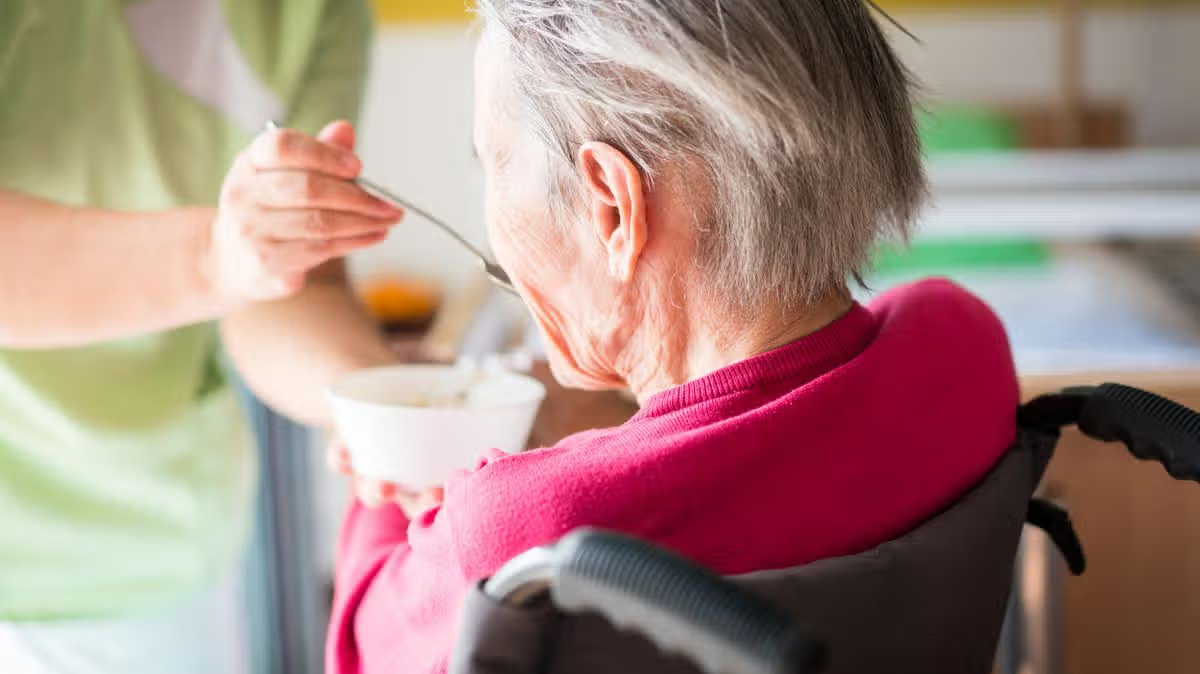
But, in mid-June 2024, a care worker was caught feeding her dog food, recorded as a “lamb dinner”.

Advertisement

The incident occurred when two care workers attended Mrs Y’s home, with one raising concerns about witnessing this error.

The care worker “only realised the meat was dog food when they noticed the packaging in the kitchen”.

They initially attempted to contact a senior colleague to report the issue but their call was not answered so they waited and reported the incident in person the following week.

When they did so, a senior manager asked “why they did not remove the dog food” during the visit and “why they did not report the incident on the day it happened”.

Advertisement

The care worker was also told to remove the dog food from Mrs Y’s freezer “to prevent any other care workers doing the same”.

It was later revealed that the care worker “fed three mouthfuls of microwaved dog food to Mrs Y”.

“This was vacuum packed dog food stored by Mrs Z in Mrs Y’s freezer. The food was labelled as “fresh take on dog food” and “for adult dogs and puppies”.”

Advertisement

After this, a meeting between Radis and the family, concluded a new care provider would be hired.

However, in July 2024, Mrs Y’s health declined and her family decided to delay the new provider’s start date, meaning Radis continued to provide end-of-life care.

Mrs Y’s daughter alleged that “footage from Mrs Y’s home camera showed evidence of a care worker force feeding Mrs Y”.

In late July 2024, Mrs Y died and it was concluded she “died from frailty of old age”.

Advertisement

In response to complaint’s from the elderly woman’s family Radis accepted fault in the care provided and ensured action was taken against the care workers involved.

The council’s investigation also found that Mrs Y was “left unattended for prolonged periods and on occasions left wet or in darkness overnight”

The report stated that staffing was “inconsistent”, with concerns raised about workers “attitude, compassion and respectful communication”.

There were also “Allegations that staff falsified records and that some visits had not taken place despite being recorded”.

Advertisement

The ombudsman proposed the council apologise, refund the care fees, and offer a symbolic payment of £1,000 to the family to “recognise significant distress” and the “delays” in the safeguarding investigation.

Councillor Matthew Winnington, cabinet member for community wellbeing, health and care, said: “We accept the Ombudsman’s findings in full and recognise the seriousness of what happened in this case. We ended our contract with Radis early and we no longer work with, or commission services from them.

“The care described in this report is not the standard anyone should expect, particularly at such a vulnerable time in someone’s life. We have apologised to the family and are very sorry for the distress they have experienced; we know this has been deeply upsetting for the family.

He added: “These events happened two years ago, and since then we have taken action to strengthen how we oversee care providers…Our adult social care services recently received a ‘good’ rating from the Care Quality Commission, reflecting the wider positive experiences of residents, the strength of partnership working across the city, and the support available to help people remain independent.”

Advertisement

Source link

Continue Reading

NewsBeat

Upset Wisconsin Democrats mull whether to back mainstream choice for governor

Published

on

Upset Wisconsin Democrats mull whether to back mainstream choice for governor

NEW GLARUS, Wis. (AP) — Sarah Miller, a software engineer from the liberal stronghold of Madison, has heard all of the chatter about a civil war in the Democratic Party between progressives and moderates. But all she cares about is winning.

That’s why Miller said she is voting in Tuesday’s gubernatorial primary for David Crowley, the Milwaukee County executive endorsed by two-term Gov. Tony Evers. He faces democratic socialist Francesca Hong in a contest that will be the latest test nationally of how far Democrats are willing to swing to the political left.

Wisconsin’s primary comes a week after progressive Abdul El-Sayed narrowly defeated Rep. Haley Stevens in Michigan’s U.S. Senate primary, setting up a crucial test for progressives in November in a key battleground state. Also on Tuesday, voters in Minnesota will decide another U.S. Senate contest featuring a centrist and a progressive.

In a year where voters upset with the Democratic Party mainstream have propelled outsider candidates to victory across the country, Crowley is hoping to buck the trend in Wisconsin. He’s banking on the support of Evers, one of the state’s most popular elected officials, to make up ground in the waning days of the chaotic primary.

Advertisement

Crowley said that El-Sayed’s slim margin of victory “does give me a little bit of hope.”

“We’re going to focus on those undecided voters,” Crowley said.

Wisconsin Democratic voters grapple with electability, chaotic primary

“The divide is real,” Miller, 49, said of the struggle between progressives and more mainstream Democrats. But her focus remains on November, when the winner of the primary will face Republican U.S. Rep. Tom Tiffany, a staunch supporter of President Donald Trump and one of the most conservative members of Congress.

Miller, who described herself as a progressive, called Hong a “very, very weak candidate” and described her popularity as “a little bit of a mirage.”

Advertisement

“I don’t think she can win,” Miller said at a Crowley campaign stop a week before election day at a winery in the rolling hills of New Glarus.

Crowley is banking on more voters feeling that way. A Marquette University Law School poll of Wisconsin Democratic primary voters conducted in late July, before former Lt. Gov. Mandela Barnes dropped out, showed Hong with a significant lead over the other candidates. More than 112,000 absentee ballots had already been returned by the day the poll was released.

Complicating the path for Crowley is the fact that he withdrew from the race on July 8 and only got back in 10 days later, with the backing of Evers, after Lt. Gov. Sara Rodriguez ended her candidacy. Then, 12 days later, Barnes also ended his campaign amid allegations of inappropriate behavior.

Barnes and Rodriguez, who were both seen as potential front-runners, remain on the ballot and votes already cast for them can’t be undone.

Advertisement

“We’ve created a mess,” said Michael Gebben, a 64-year-old Democrat who voted absentee for Rodriguez before she dropped out. “Hopefully we can get out of it.”

Hong bats down controversies as Crowley makes a final sprint

As Crowley sprinted across the state to capture undecided voters, Hong was batting down controversies.

Hong, a single mom and former restaurant cook, faced questions about past social media posts where she called for canceling Thanksgiving because “we should stop celebrating colonialism,” disparaged Valentine’s Day as “another day capitalism tells you how to show love” and repeatedly called for defunding the police.

She has backtracked or clarified many of those past statements in recent days, now saying that she does not support abolishing the police.

Advertisement

Tiffany pointed to Hong’s comments on Thanksgiving and said she wants “to destroy the traditions and culture that unite us.” Tiffany, who had 10-times more cash on hand than either Hong or Crowley did entering August, has portrayed the race as a contest between chaos and common sense.

“Wisconsinites can’t afford for November to come down to the most extreme things Tom Tiffany and Francesca Hong have said online,” Evers’ spokesperson Britt Cudaback said this week in a social media post explaining why the governor endorsed Crowley.

Crowley’s mention of the Evers endorsement drew a round of applause at both of his campaign stops in New Glarus and Madison this week, but similar votes of confidence haven’t always been decisive in other primaries. In Michigan, Democratic Gov. Gretchen Whitmer endorsed the moderate Stevens who came up short.

Even with Evers’ backing, Crowley insists he is not an establishment Democrat despite having served more than three years in the Legislature and as the top elected official in Milwaukee County, the state’s largest, since 2020.

Advertisement

“When people try to call me the establishment, I look at that as a slur, particularly as an African American candidate,” said Crowley, who is looking to become Wisconsin’s first Black governor. “I have never run for office to protect the establishment. I’ve always been here to protect people.”

Voters say message from progressive candidates resonates

Hong supporter Chris Vestin has heard the concerns about electability before.

To him, the fears about Hong’s chances against Tiffany in November sound like a repeat of those who pushed Hillary Clinton over Bernie Sanders in the 2016 presidential race. Sanders defeated Clinton in the Wisconsin primary by 13 points that year, before losing the presidency to Trump. Trump carried Wisconsin in 2016, lost it in 2020 and then won it again in 2024.

“It frustrates me when they say that person is unelectable,” Vestin said of Hong, who is vying to become Wisconsin’s first woman governor and first Asian American governor. “A lot of times it’s racist, it’s sexist.”

Advertisement

Vestin, 54, called Evers’ endorsement of Crowley “counterproductive.”

“Establishment Democrats want to take the choice away,” Vestin said.

On Tuesday in Minnesota, voters will choose between moderate U.S. Rep. Angie Craig and progressive Lt. Gov. Peggy Flanagan in the Democratic primary for U.S. Senate that’s playing out in the aftermath of Trump’s aggressive immigration enforcement surge in the state.

But the stakes are even higher in Wisconsin.

Advertisement

Democrats are trying to hold onto the governor’s office and flip both chambers of the Legislature to have full control for the first time since 2010.

Republicans transformed Wisconsin by enacting a wide array of conservative priorities, including effectively doing away with public worker collective bargaining, when they had full control from 2011 to 2018.

“We need a trifecta,” Crowley told his supporters at the New Glarus rally. “And who is at the top of the ticket matters.”

Crowley supporter Lindsey Lee, 61, of Madison said before the rally there that he believed previously undecided Democrats were coalescing around Crowley.

Advertisement

“It’s like the last 50 yards of a horse race,” Lee said. “Hong is obviously in the lead but Crowley is coming up on a side lane. I think it will be a photo finish.”

Source link

Advertisement
Continue Reading

NewsBeat

Westhoughton secures mobile CCTV unit to deter crime

Published

on

Westhoughton secures mobile CCTV unit to deter crime

The mobile camera will be dispatched to various locations around Westhoughton in an attempt to prevent anti-social behaviour and, if necessary, track down potential criminals.

Westhoughton has been without CCTV for several years due to a number of issues, most recently the collapse of National Car Parks, which ended recent efforts to have Westhoughton’s CCTV system merged with Bolton’s.

The NCP car park at the Octagon Theatre (Image: Newsquest)

Cllr John McHugh said: “We have funds now for mobile CCTV in Westhoughton, which we’ll be using on Market Street.

“The camera will be used to target known hot spots that are affecting residents, local businesses and property.

Advertisement

“Monitoring will be controlled by the anti-social behaviour team in the council and local police. The camera will be moved to different locations where incidents have been reported.”

Westhoughton has been without CCTV for several years due to a series of issues.

The town has been seeking to upgrade its systems since 2023, planning to merge them with Bolton’s systems, meaning they would both be monitored together.

Ditchfield Gardens Car Park, Westhoughton, would have been the site of new CCTV cameras if NCP had not gone bust in March (Image: Google Maps)

A recent report called Westhoughton’s system ‘out of date’, with some cameras no longer working.

Advertisement

The necessity for more cameras was also raised in 2025 after a series of incidents of car vandalism in Westhoughton car parks.

Earlier this year, Bolton Council finally agreed to the proposal to join Westhoughton’s CCTV system up with Bolton’s, where both systems would be managed centrally from Topp Way, Bolton.

The scheme was agreed at a Cabinet Leader Portfolio meeting on March 4.

However, almost as soon as this scheme was agreed, National Car Parks (NCP), who operate and monitor Bolton’s CCTV cameras, went bust.

Advertisement

The back of Library Street Car Park, Westhoughton (Image: Google Maps)

This put several years of work by Westhoughton Town Council in jeopardy as they struggled to get updates from either Bolton Council or NCP themselves.

This latest move will be the first update to Westhoughton’s CCTV system in several years, allowing problem hotspots to be targeted.

Source link

Advertisement
Continue Reading

NewsBeat

The names and faces of Bolton’s most wanted – August 5, 2026

Published

on

The names and faces of Bolton's most wanted - August 5, 2026

Cameron Wroe (Image: GMP)

CAMERON WROE, 31, is wanted on recall to prison.

Tony Meek (Image: GMP)

TONY MEEK, 36, is wanted on recall to prison.

Gareth Bentley (Image: GMP)

GARETH BENTLEY, 38, is wanted on recall to prison.

Craig Manuel (Image: GMP)

CRAIG MANUEL, 40, is wanted for twice failing to appear at court.

Advertisement

A Greater Manchester Police spokesperson said: “Anybody found harbouring any wanted person or helping them to evade justice will be arrested themselves and face possible court action and a criminal record.”

These wanted people are not to be approached.

In the event of any sightings, please ring 999, while anyone with any information can leave a message on the police social media pages, or call independent charity Crimestoppers anonymously on 0800 555 111.

Advertisement

Source link

Continue Reading

NewsBeat

Man arrested after boy attacked by man in York street

Published

on

Woman charged with possession of knife and Class B drug

North Yorkshire Police on Wednesday evening (July 5) said a man has been arrested in connection with the reported incident in Moss Street on Sunday.

The force said the man was released on police bail.

It comes after police issued an appeal for information about the alleged attack which reportedly happened near Moss Street’s junction with Caesar Court at about 12pm on Sunday.

Advertisement

A police spokesperson said the boy was “strangled, pushed and kicked” during the reported assault.

They said the boy was taken to hospital for treatment for injuries to his throat and neck after the alleged incident.

Source link

Advertisement
Continue Reading

NewsBeat

Village pub told it can’t build eight homes they said were ‘critical’ to keep afloat

Published

on

Cambridgeshire Live

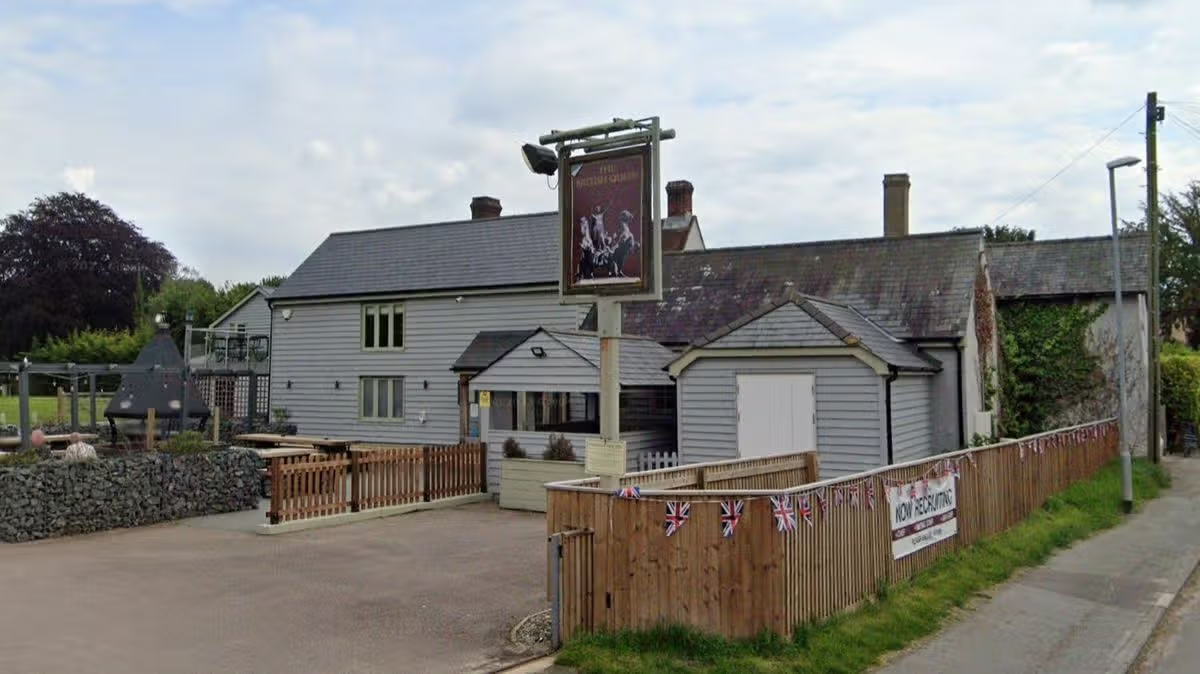
The British Queen pub in Meldreth applied to build the homes last year but South Cambridgeshire District Council rejected them

A Cambridgeshire village pub’s plan to build new homes they said were “critical” to keep them afloat has been struck down on appeal.

Advertisement

The proposal for eight homes behind the British Queen pub in Meldreth was put to South Cambridgeshire District Council last year and, after first delaying a decision, councillors refused the scheme.

A representative of the pub owners said funds raised from the development would be invested into expanding the facilities at the pub, adding that it would be a “disaster for the village” if the pub had to close. An appeal was launched after the plans were refused with a final decision made last month.

Inspector Zoe Raygen said the Grade-II listed pub is an “early example of architecture in the village” with “historic and social significance as a public house”.

Although she found the proposed homes to be “of an acceptable design and not overly large” they would still “diminish the verdant character and appearance of the area”.

Advertisement

The proposed access road would also be close to a tree which was protected by a Tree Preservation Order put in place when the council was considering this application.

Inspector Raygen said it was “a splendid, large sycamore tree with a large, low canopy which contributes substantially to the character and appearance of the area.”

She said: “It is not surprising therefore that the tree has been categorised as A1 in the appellant’s most up to date Tree Survey, a tree of the highest quality.”

The inspector raised concerns that two gardens extend to the edge of the river Mel, which could harm the habitat of bats that use the area for feeding.

Advertisement

Two bedrooms in one house and one bedroom in another would also “have only rooflights providing light and outlook” which she said “could lead to gloomy, oppressive conditions, particularly in the winter or poor weather conditions”.

Inspector Raygen said the pub owners’ claim that the development could secure their future was an “admirable proposal” but she could only give it “very limited weight”.

She said this was due to the lack of detailed information surrounding past trading, projected income from the project and how this would be spent.

Source link

Advertisement
Continue Reading

Trending

Copyright © 2025