



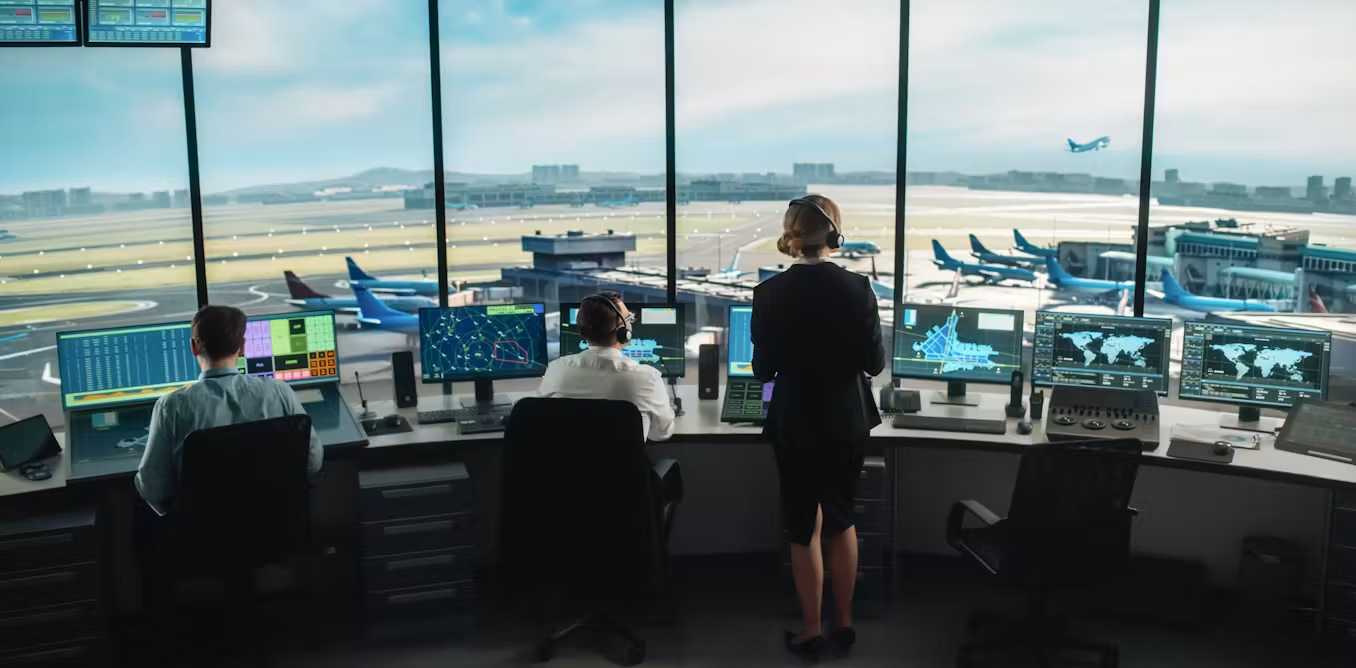
Global air travel is predicted to more than double by 2050, threatening to exceed the capacity of air traffic control officers (atcos) to oversee our skies safely.
One solution would be to recruit more controllers – but that’s not as easy as it sounds. Airspace in the UK and elsewhere is broken up into geographically and altitude-bounded sectors – with each sector normally the responsibility of one atco (the tactical controller) at any time. So, increasing the number of controllers to deal with a greater concentration of aircraft could require a major redesign of UK airspace.
An alternative is to move beyond the current generation of air traffic control technology by increasing the role of AI systems – including providing real-time decision support for atcos.
AI agents could continuously monitor each airspace sector and recommend instructions (known as “clearances”) to issue to aircraft in that sector. These would then be assessed for their appropriateness by the tactical controller.
The UK’s air traffic control provider NATS (a public-private partnership) is, like other national providers, on an automation journey. It has collaborated with the University of Exeter and the Alan Turing Institute on Project Bluebird, which is investigating how AI systems could help meet the challenge of growing air travel volumes.
AI has long been discussed as a threat to jobs and livelihoods. But what’s the reality? In this series, we explore the impact it is already having on different occupations – and how people really feel about their AI assistants.
As part of this project, I have been using immersive participant observation and interviews to investigate how atcos use their existing tools, explore how they feel about the adoption of AI, and how the trust relationships that are key to safe air traffic operation could be affected.
As one controller reflected about existing air traffic procedures: “It’s an overall improved system when you have more trust in the people that you’re working with, and you’re more familiar with them.”
Trust in the AI
Atcos are organised into “watches” – groups of about 15 controllers who regularly work together on the same shift in the same control centre to oversee sectors within their region. While each sector is the responsibility of one tactical controller, the movement of aircraft between sectors requires seamless teamwork.
Automated short-term conflict alert systems to prevent air collisions have been a key part of air traffic control for several decades now. This offers an example of how AI tools may be received, as one atco recalled:
We were all quite nervous when that [conflict alert] system came out – we didn’t know how it was going to work. But very soon, you get your confidence in the system. You understand that the predictions that have been given to you are correct 98% of the time, or whatever they are – and you learn the small minority of situations where it isn’t.
From my discussions with atcos, it is clear that if AI agents are to be trusted, their recommendations must be presented in ways that controllers can quickly make sense of, and decide if they are appropriate. One told me:
There could be all sorts of possibilities where an AI agent is becoming your support controller, your secondary controller, and making suggestions you can either accept or decline … it’s a very interesting concept, if it can demonstrate to me why that’s a good idea – because that’s the bit we don’t know.
Concerns were raised with me about AI agents being “black boxes” whose workings lack transparency. This could make it difficult for an atco to determine when AI recommendations should be accepted and – just as important – when they should not be.
Delivering transparency means satisfying two requirements: explainability (knowing how the AI system reached its decision) and interpretability (understanding why the AI system reached that decision). As part of the project, we have identified ways to ensure transparency – such as the AI agent always revealing which aircraft within a sector it is taking into account when recommending clearances, and why.
In short, teaming atcos with AI agents could play an important role in handling growing air traffic volumes safely – but only if atcos develop strong levels of trust in the AI agents first.
A digital twin
Project Bluebird is working on more efficiency benefits for air traffic control and other air traffic management services. These include more accurate methods for aircraft trajectory prediction, using models trained on tens of thousands of observations of how aircraft behave in flight.
It is building a digital twin of UK airspace – a virtual model of airspace sectors, routes, procedures and other factors that form the operational context for air traffic. This high-fidelity model could be used for the training and evaluation of new types of AI agent, and testing the viability of new airspace designs.
Bluebird is also developing an assurance framework that regulators and other air traffic control stakeholders could use to determine if the safety requirements for AI-based systems are met.
These systems are likely to play an increasing role if the projected growth in air traffic is to be managed safely. While NATS is committed to keeping humans in the loop for the foreseeable future, the atcos I spoke to are cautiously optimistic about the benefits of AI. As one observed:
[Unlike a tactical controller,] an AI agent can think of the whole network. It can look at the whole trajectory of a flight … and even a small adjustment to an aircraft speed or heading can make a big difference to the overall flight.
















![LISA - 'LALISA + MONEY' | 2023 WORLD TOUR [BORN PINK]](https://wordupnews.com/wp-content/uploads/2026/02/1770487179_maxresdefault-80x80.jpg)








































You must be logged in to post a comment Login