









.jpeg?trim=250,0,0,0&quality=75&auto=webp&width=960)

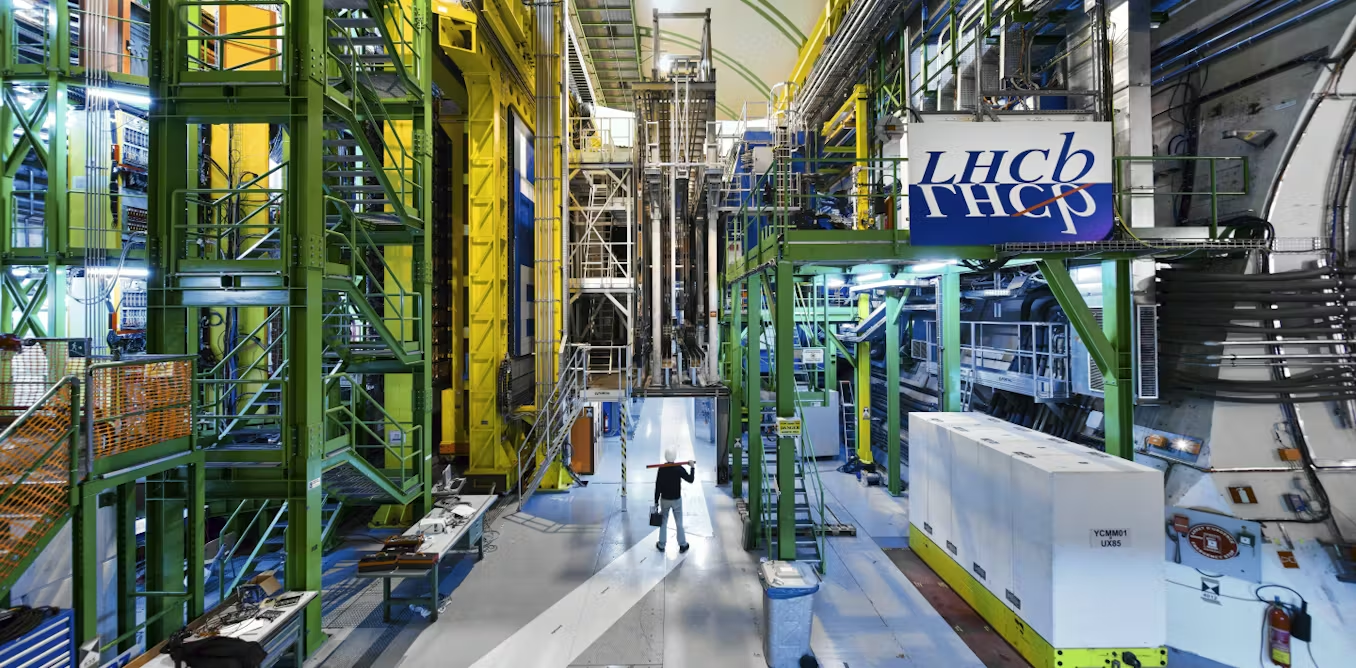
Recent findings from research we have been carrying out at the Large Hadron Collider (LHC) at Cern in Geneva suggest that we might be closing in on signs of undiscovered physics.
If confirmed, these hints would overturn the theory, called the Standard Model, that has dominated particle physics for 50 years. The findings suggest the way that specific sub-atomic particles behave in the LHC disagrees with the Standard Model.
Fundamental particles are the most basic building blocks of matter – sub-atomic particles that cannot be divided into smaller units. The four fundamental forces – gravity, electromagnetism, the weak force and the strong force – govern how these particles interact.
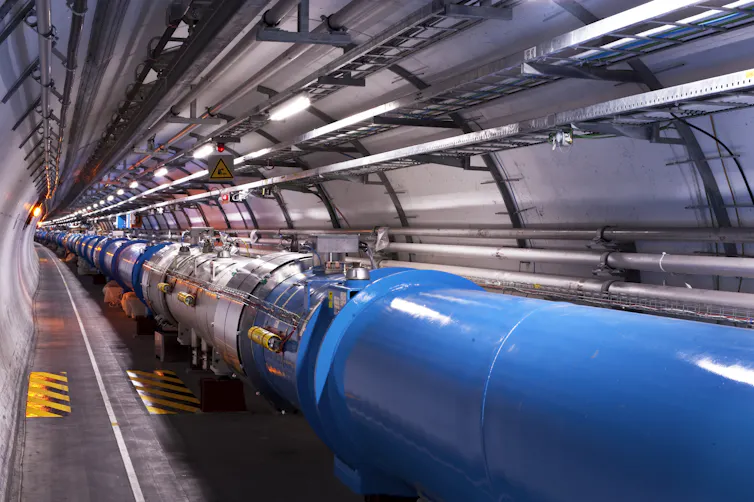
The LHC is a giant particle accelerator built in a 27km-long circular tunnel under the French-Swiss border. Its main purpose is to find cracks in the Standard Model.
This theory is our best understanding of fundamental particles and forces, but we know it cannot be the whole story. It does not explain gravity or dark matter – the invisible, so far unmeasured type of matter that makes up approximately 25% of the universe.
In the LHC, beams of proton particles travelling in opposite directions are made to collide, in a bid to uncover hints of undiscovered physics. The new results come from LHCb, an experiment at the Large Hadron Collider where these collisions are analysed.
The result comes from studying the decay – a kind of transformation – of sub-atomic particles called B mesons. We investigated how these B mesons decay into other particles, finding that the particular way in which this happens disagrees with the predictions of the Standard Model.
An elegant theory
The Standard Model is built on two of the 20th century’s most transformative advances in physics; quantum mechanics and Einstein’s special relativity.
Physicists can compare measurements made at facilities such as the LHC with predictions based on the Standard Model to rigorously test the theory.
Despite the fact that we know the Standard Model is incomplete, in over 50 years of increasingly rigorous testing, particle physicists are yet to find a crack in the theory. That is, potentially, until now.
Alionaursu / Shutterstock
Our measurement, accepted for publication in Physical Review Letters, shows a tension of four standard deviations from the expectations of the Standard Model.
In real world terms, this means that, after considering the uncertainties from the experimental results and from the theory predictions, there is only a one in 16,000 chance that a random fluctuation in the data this extreme would occur if the Standard Model is correct.
Although this falls short of science’s gold standard – what’s known as five sigma, or five standard deviations (about a one in 1.7 million chance) – the evidence is starting to mount. Adding to this compelling narrative are results from an independent LHC experiment, CMS, that were published earlier in 2025.
Although the CMS results are not as precise as those from LHCb, they agree well, strengthening the case. Our new results have been found in a study of a particular kind of process, known as an electroweak penguin decay.
Rare events
The term “penguin” refers to a specific type of decay (transformation) of short-lived particles. In this case we study how the B meson decays into four other subatomic particles – a kaon, a pion and two muons.
With some imagination, one can visualise the arrangement of the particles involved as looking like a penguin. Crucially, measurements of this decay let us study how one type of fundamental particle, a beauty quark, can transform into another, the strange quark.
This penguin decay is incredibly rare in the Standard Model: for every million B mesons, only one will decay in this manner. We have carefully analysed the angles and energies at which these particles are produced in the decay, and precisely determined how often the process takes place. We found that our measurements of these quantities disagree with Standard Model predictions.
Cern
Precise investigations of decays like this are one of the primary goals of the LHCb experiment, and have been since its inception in 1994. Penguin processes are uniquely sensitive to the effects of potentially very heavy new particles that cannot be created directly at the LHC.
Such particles may still exert a measurable influence on these decays over the small Standard Model contribution. This kind of indirect observation is not new. For example, radioactivity was discovered 80 years before the fundamental particles that are responsible for it (the W bosons) were directly seen.
Future directions
Our studies of rare processes let us explore parts of nature that may otherwise only become accessible using particle colliders planned for the 2070s. There are a wide range of potential new theories that can explain our findings. Many contain new particles called “leptoquarks” that unite the two different types of matter: “leptons” and “quarks”.
Other potential theories contain particles that are heavier analogues of those already found in the Standard Model. The new results constrain the form of these models and will direct future searches for them.
Despite our excitement, open theoretical questions remain that prevent us from definitively claiming that physics beyond the Standard Model has been observed. The most serious question arises from so-called “charming penguins”, a set of processes present in the Standard Model, whose contributions are extremely tricky to predict. Recent estimates of these charming penguins suggest their effects are not large enough to explain our data.
Furthermore, a combination of a theory model and experimental data from LHCb suggests that the charming penguins (and therefore, the Standard Model) struggle to explain the anomalous results.
New data already collected will let us confirm the situation in the coming years: in our current work we studied approximately 650 billion B meson decays recorded between 2011 and 2018 to find these penguin decays. Since then, the LHCb experiment has recorded three times as many B mesons.
Further advances are planned for the 2030s to exploit future upgrades to the LHC and accrue a dataset 15 times larger again. This ultimate step will allow definitive claims to be made, potentially unlocking a new understanding of how the universe works at the most elementary level.















































You must be logged in to post a comment Login