MANY York residents are not aware that there is a Roman bathhouse under the Roman Bath public house in St Sampson’s Square – and that it is open to the public as a museum.
That York was the location of a Roman fortress and a city has been known for over two centuries, and discoveries are still being made.
The fortress lies under the city centre and is huge, covering 20 hectares (50 acres).
It was so large because it was the base for a legion of heavy infantry over 5,000 strong. The fortress was built by the Ninth Legion Hispana, probably in the year AD71.
‘Hispana’ was the Roman name for Spain and indicates that the legion was raised there.
Around the time that the Emperor Hadrian visited Britain and ordered the building of Hadrian’s Wall in AD122, the Ninth Legion was replaced by the Sixth Legion Victrix; ‘Victrix’ means victorious and is a battle honour.
![]() Roman Bath pub York
Roman Bath pub York
The fortress, with its high stone walls, remained a stronghold in Anglo-Saxon and Viking times.
The medieval city walls alongside Gillygate and Lord Mayors Walk are the latest version of the defences and directly overlie the fortress walls.
If anyone dug deep enough in the city centre – to lay a sewer, for example – they would encounter the remains of the fortress. The question is, which part of the fortress would they find?
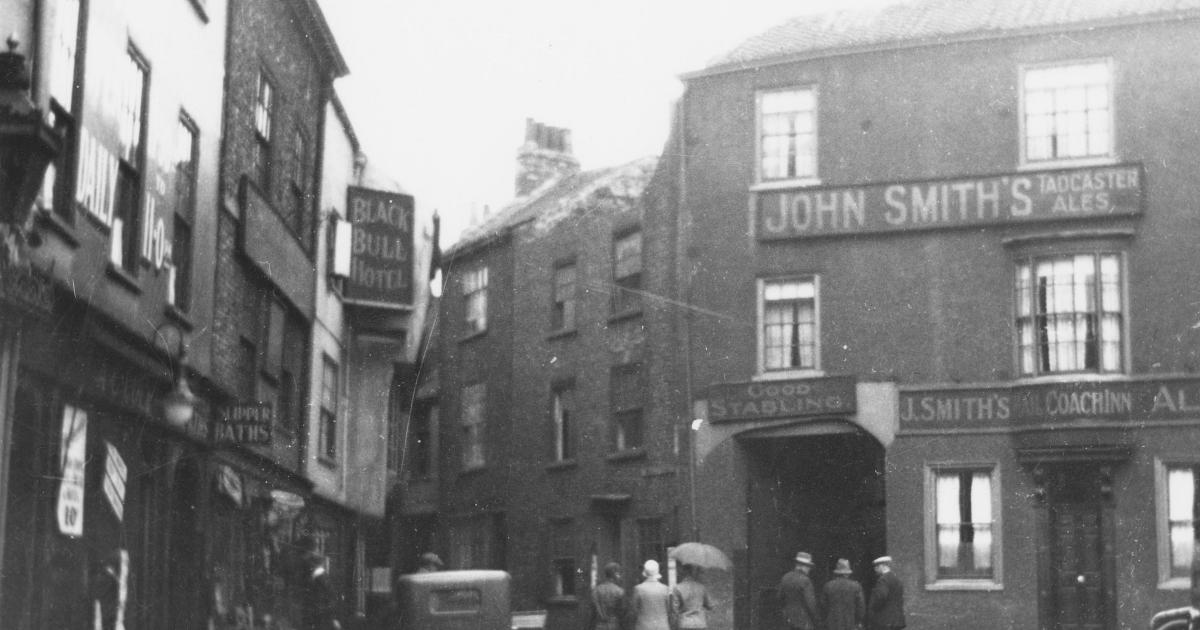
In 1929, the decision was made to demolish the old Mail Coach Inn in St Sampson’s Square and replace it with a modern pub.
![]() St Sampson’s Square,York, in the 1930s, showing The Mail Coach Inn before its alteration and refurbishment. On the left is the Black Bull Hotel.
St Sampson’s Square,York, in the 1930s, showing The Mail Coach Inn before its alteration and refurbishment. On the left is the Black Bull Hotel.
A photograph of that year shows that part of the stables was already being taken down. By the middle of 1930, the stable block had been removed but the ‘public house’ part of the establishment was still standing.
The part-demolished pub was photographed in August of that year when the adjacent property, the Walpamur wallpaper and paint store (now a Pizza Express) burnt to the ground in a spectacular fire. Fortunately, nobody was hurt and the pub suffered only water damage, from a successful attempt to prevent the fire spreading.
![]() Walpamur fire in St Sampson’s Square on August 25 1930. Photo – Explroe York archive
Walpamur fire in St Sampson’s Square on August 25 1930. Photo – Explroe York archive
But the Mail Coach Inn had already hit the headlines by the time of the fire. The new pub was to have a cellar, and in May of 1930 the excavations for the cellar had revealed a massive wall 4 metres (13 feet) below the ground.
Further newspaper reports speak of another, curved wall; and finally, two rooms with raised floors standing on brick pillars were found.
Recommended reading:
How York has changed over time – 10 old photos from the past
Story of historic York pub that survived scandal and 300 years of changes
How one of York’s oldest pubs with a gruesome past got its historic name
These rooms clearly had underfloor heating and they could only be on thing – the bath house for the soldiers. Further discoveries were made in 1931, following the demolition of the remainder of the Mail Coach Inn.
The notable local historian, the Reverend Angelo Raine, was able to make a record of the discoveries and these were published in Volume 1 of the YAYAS Proceedings in 1933.
The legionary bath house would have been one of the first buildings in the fortress built of stone, as it had an important role in the hygiene and fitness of the soldiers.
The suite of heated rooms (and an unheated room) would have enabled the soldiers to sweat, bathe and relax. The baths were part of a leisure complex the size of a football field that would have included a vast exercise hall and an outdoor exercise area with swimming pool.
![]() St Sampson’s Square in about 1890. Finkle Street is in in the middle of the picture. There are three public houses in view in this small area. From left to right: the Hand and Heart (landlord Benjamin Robson) which was absorbed into the Black Bull in
St Sampson’s Square in about 1890. Finkle Street is in in the middle of the picture. There are three public houses in view in this small area. From left to right: the Hand and Heart (landlord Benjamin Robson) which was absorbed into the Black Bull in
Although the discovery of the Roman baths was a complete surprise to the owners of the pub, John Smiths, the brewery commendably decided to leave the baths undisturbed in the cellar.
In 1971, the 1900th anniversary of York being founded by the Roman, the name of the pub was changed to the Roman Bath – so the Roman bath is not so hard to find!
The Roman Bath Museum is open 11am to 4pm Tuesdays to Sundays; there is an admission charge (find out more at:www.facebook.com/YorkRomanBathMuseum)
Can you help?
Other than the building found at the Roman Bath pub, the only other evidence for the Roman baths is in Church Street at the corner with Swinegate, where another building with underfloor heating was found in the 1970s.
The impressive Church Street sewer, found in the same excavations, would have taken waste water away from the baths. This is precious little to go on if we want to better understand the layout and history of the baths.
![]() The Church Street sewer was discovered by contractors in 1972 while digging at the corner of Church Street and Swinegate and was investigated by York Archaeological Trust. [This sewer would have taken waste water away from the legionary baths.] Roman
The Church Street sewer was discovered by contractors in 1972 while digging at the corner of Church Street and Swinegate and was investigated by York Archaeological Trust. [This sewer would have taken waste water away from the legionary baths.] Roman
If anyone in the Swinegate/Grape Lane area thinks there is a Roman wall or some other ancient structure in their cellar, let us know; it could be part of the legionary baths!
We would also like to hear from anyone who has information on, or photographs of, the discovery of the Roman bathhouse under the pub in 1930. Contact info@yayas.org.uk
Kurt Hunter-Mann is a local archaeologist and honorary secretary of the Yorkshire Architectural and York Archaeological Society (YAYAS).
YAYAS developed from its foundation in 1842. It publishes the York Historian and YAYAS Times, with articles and news items about York and its surrounds.
Its archives include photographic illustrations that can be used for research or reproduction with copyright acknowledgement.
Visit the website www.yayas.org.uk for more information about the organisation, its publications and how you can support it.





















































You must be logged in to post a comment Login