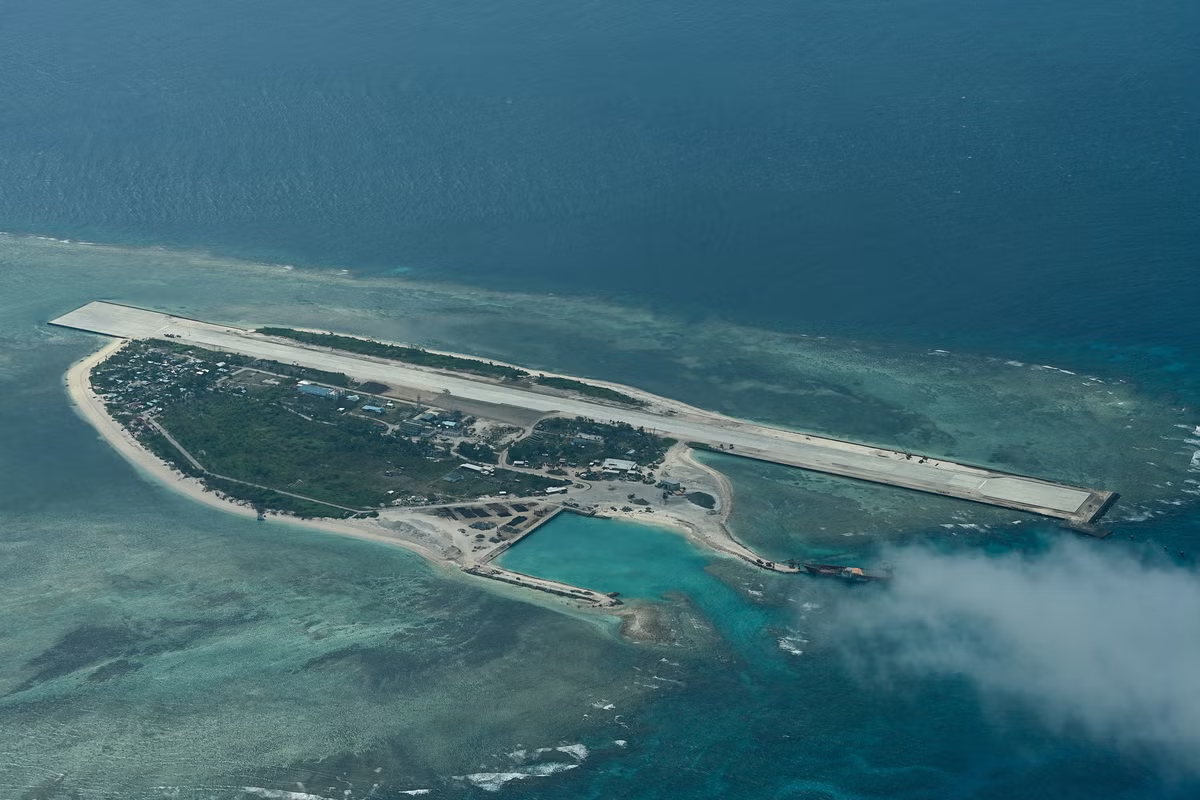
Ocean affairs council minister Kuan Bi-ling travelled to Itu Aba – also known as Taiping Island – to observe exercises carried out by the coast guard.
Itu Aba is the largest naturally occurring island in the disputed Spratly Islands in the South China Sea – which is claimed by China, Vietnam and the Philippines. In a statement, Taiwan’s coast guard described the exercise as a “humanitarian relief, medical evacuation and marine pollution removal” operation.
Taiwan’s official Central News Agency said that it was the first time in seven years that a Taiwanese minister had visited Itu Aba. This visit by the minister comes amid tensions between the two countries. China claims Taiwan as its own while Taiwan says it is an independent, sovereign nation.
Advertisement
One of the exercises that Ms Kuan observed involved a mock interception at sea. According to the coast guard, the officers simulated stopping a cargo ship that ignored repeated calls.
Armed personnel then boarded the vessel to take control. Authorities said the scenario reflected real risks in busy and disputed waters.
“In order to safeguard the nation’s rights and national security, the cargo vessel was escorted back to Taiping Island for further investigation,” the coast guard said.
A video released later showed officers in black gear moving through the ship and entering its control room. During the drill, one officer addressed a crew member directly, saying: “You have entered the waters under the jurisdiction of our country. Please cooperate with the investigation.”
Advertisement
Ms Kuan’s visit coincided with large US-Philippines military drills, which had already upset China. While those exercises were underway, China responded by sending a new amphibious warship into the South China Sea and moving an aircraft carrier through the nearby Taiwan Strait.
Taiping Island is located roughly 1,600km southwest of Kaohsiung and falls under the administration of Cijin district in the southern Taiwanese city, according to Focus Taiwan media outlet.
Taiping Island has a runway capable of handling military supply flights and a recently upgraded wharf that can receive large patrol vessels. Around 200 people live there, mostly coast guard members trained for both security and rescue work.
Despite these facilities, the island is not heavily fortified when compared to nearby outposts controlled by China.
Advertisement
Beijing has spent years expanding its presence across the South China Sea, building artificial islands and adding airstrips, radar systems and other military infrastructure. These moves have raised concern across the region and in Washington.
China maintains that its actions are justified and says it has the right to develop and defend what it considers its territory. Taiwan, however, rejects Beijing’s claims over it and continues to operate independently on the islands it controls.
The wider South China Sea remains one of the world’s most important waterways. Huge volumes of global trade pass through it each year. It is also a major fishing zone and is believed to hold significant oil and gas reserves beneath its seabed.
A 2016 decision by an international tribunal labelled Taiping Island a “rock” under the United Nations Convention on the Law of the Sea. This means Taiwan can claim resources only within 12 nautical miles of it, rather than 200 nautical miles if it were recognised as an “island”.
Advertisement
Taiwan presented its case to the tribunal, arguing that Itu Aba should be recognised as an “island”, saying it has the resources needed to support human life, including a supply of fresh water.
Both Taiwan and China have rejected the ruling of the tribunal and do not accept the arbitration case filed by the Philippines.
Taiwan argues Itu Aba can sustain life, while the 2016 tribunal ruled it does not, classifying it as a “rock,” which sharply limits its maritime rights.
Football Focus is to end after 52 years, BBC Sport has announced.
Launched in 1974, the Saturday lunchtime television programme provided fans with interviews, analysis and stories from across the game before the weekend’s fixtures.
Changing audience habits have meant a growth in the use of digital platforms and on-demand to get the same pre-match content.
As a result, linear television viewing figures have gradually declined since 2018.
Advertisement
Football Focus will run until the end of the season.
Alex Kay-Jelski – director of BBC Sport – said: “Football Focus has been a hugely important programme in the history of BBC Sport and has played a key role in telling the stories of the game for generations of viewers.
“This decision was made before last week’s wider BBC savings announcement, reflecting the continued shift in how audiences engage with football and our commitment to evolving how we deliver content to reach fans wherever they are.”
From next season, Kelly Somers’ The Football Interview will move to Saturday at 12:45 BST on BBC One. Final Score with Jason Mohammad will start on BBC One earlier than it has this season – at 15:45 BST.
Advertisement
Arsenal winger Bukayo Saka, former Chelsea manager Emma Hayes, Manchester City midfielder Bernardo Silva, Liverpool striker Hugo Ekitike and Manchester United boss Michael Carrick are among the players and coaches to have featured on The Football Interview this season.
BBC Sport says it will expand its digital output across BBC platforms, including exclusive shows on YouTube. The intention is to deliver more high-quality, accessible and engaging football coverage at scale.
Football Focus started out as part of Grandstand, with Sam Leitch presenting a pre-cursor called Football Preview.
It was renamed Football Focus, with Bob Wilson becoming an iconic figure. After first taking on presenting duties in 1974, the former Arsenal goalkeeper stayed in the role for 20 years.
Advertisement
Steve Rider, Gary Lineker, Ray Stubbs, Manish Bhasin and Dan Walker – for 12 years – all had stints in the chair.
Its final host will be Alex Scott, who has presented Football Focus for the past five years and will continue to work for the BBC.
“Alex Scott is one of our finest presenters, is hugely popular across the men’s and women’s game and is a big part of our present and future,” added Kay-Jelski.
“She will remain at the heart of our sports output across both the men’s World Cup this year and the Women’s World Cup in 2027, as well as continuing her lead role on the Women’s Super League and BBC Sports Personality of the Year.
Advertisement
“We are also working on a very exciting new project with her – more to come on that soon.”
Scott said being part of the programme had been “incredibly special” and it was an “honour” to have been presenter for five years.
“It has been such an important part of my life, working with some of the very best people in the business, both on screen and behind the scenes,” she said on Instagram.
The BBC has shared first look pictures of the upcoming period drama.
BBC viewers have declared they “can’t wait” after the broadcaster released first look images from its upcoming drama, California Avenue.
Advertisement
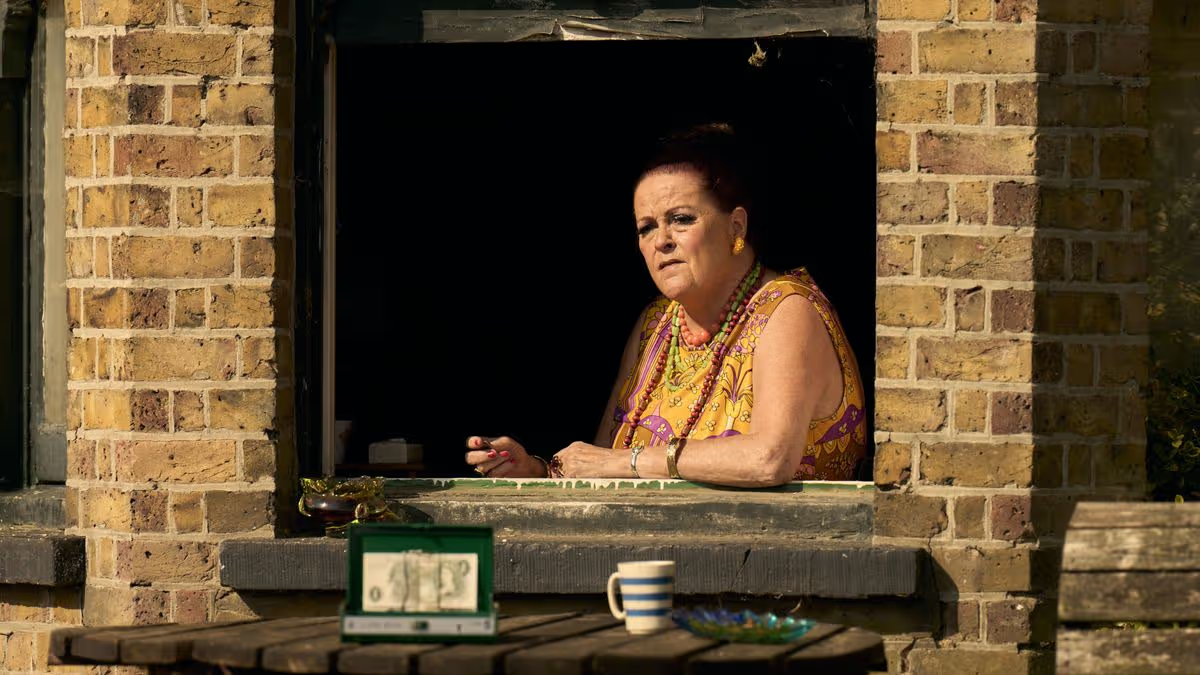
Set against the backdrop of the 1970s, the series centres on a mother and child on the run, and features an impressive ensemble including Unforgotten star Kate Robbins, The Crown‘s Helena Bonham Carter and Bill Nighy from Love Actually, reports the Mirror.
The BBC released a series of photographs depicting the cast in character, with Bill and Helena as former ballroom dancing champs Jerry and Eddie, alongside fellow cast members including Kate, Adolescence’s Erin Doherty and Tom Burke, who appeared in Furiosa: A Mad Max Saga.
Paul Kaye and newcomer Cammie Liebreich are also amongst the cast of the series, which unfolds within a secluded caravan park nestled alongside a canal deep in the English countryside.
“Its peace is irrevocably disrupted by the arrival of Lela and her 11-year-old child, Bee, both on the run, looking for refuge in this hidden world,” said a synopsis.
“It is here that a fractured family will come together, ghosts of the past will firmly be put to rest and an unexpected love is forged.”
The series – which the BBC described as “a story brimming with humour and love” – sees Bill and Helena portray the parents of Lela (Erin).
Advertisement
The couple, celebrated ballroom champions of the 1930s, became wartime fugitives and remain in hiding three decades later.
Tom portrays Cooper, a fairground outsider whose troubled history is set to erupt onto California Avenue. Kate takes on the role of Priscilla, the “formidable force” who manages the caravan park with her husband Kevin (Paul), the site’s manager and all-round handyman.
Viewers said they were “looking forward” to the programme, with many taking to social media to ask when it will air.
Advertisement
“Cast on this is incredible,” observed one viewer, while another concurred: “The cast looks fantastic (though I was ‘in’ at Bill Nighy).”
“Absolutely can’t wait for this,” commented someone else, as another asked: “When is it being added? Really looking forward to seeing this one.”
The programme is created, written, and directed by BAFTA Award-winning writer and director Hugo Blick.
Lindsay Salt, director of BBC Drama, said when the series was announced: “Hugo Blick has given us some of the finest television of the past three decades and it’s an honour to join forces with him alongside Bill, Helena, Erin, Tom and Drama Republic to take BBC viewers on the journey of a lifetime to 1970s California Avenue.”
Advertisement
California Avenue is set to air on BBC iPlayer and BBC One.
Poppy Hope Lomas who died at University College Hospital, in central London, on October 26 2022 (Picture: Family Handout/PA Wire)
The mother of a baby who tragically died from complications from her natural home birth has told an inquest which ruled ‘Nothing will ever bring her back’.
Poppy Hope Lomas was rushed to hospital when her heart rate dropped during the ‘unsafe home birth’ her mother insists she was encouraged by midwives to have.
She was just seven days old when she died at University College Hospital, central London, on October 26 2022.
The planned home delivery took place with Edgware Midwives, the designated home birth team at Barnet Hospital which is part of the Royal Free London NHS Foundation Trust.
Advertisement
Senior coroner Andrew Walker told the inquest into the baby’s death at Barnet Coroner’s Court, north London, that the trust agreed to support Poppy’s mother Gemma Lomas with an ‘unsafe home delivery that was against medical advice’ and failed to address ‘an accumulation of risk factors’.
Sign up for all of the latest stories
Start your day informed with Metro’s News Updates newsletter or get Breaking Newsalerts the moment it happens.
Advertisement
Poppy’s parents Gemma and Jason Lomas, from Enfield, north London, held hands as Mr Walker gave his concluding remarks on Thursday.
In his concluding remarks, Mr Walker told the court: ‘The trust agreed to support Ms Lomas with an unsafe home delivery that was against medical advice and the guidance provided by Royal College of Obstetricians and Gynaecologists (Rcog).
‘The home delivery midwives worked against a background of an accumulation of risk factors including a prolonged rupture of the membranes without antibiotic cover, two decelerations around one and a half hours before delivery, the slow delivery and poor condition at birth.
Poppy Hope Lomas died a week after being born (Picture Family Handout/PA Wire)
‘There was a failure to recognise and appropriately manage these risk factors.’
He said this resulted in an ‘absence or delay in interventions and actions’.
Advertisement
Midwife Sasha Field, who was present at Poppy’s birth, said that an ambulance should have been called when she heard the baby’s heart rate slow down after a contraction.
Ms Field said emergency services should have been called around 90 minutes before Poppy was born, when the decelerations were recorded.
Mr Walker said: ‘To not discuss with Ms Lomas the decelerations and a decision to return to hospital is likely to be a really serious failure to provide basic medical care to Ms Lomas.’
The inquest heard Ms Lomas was not told of the risks involved with delivering naturally at her home, having already given birth to her first daughter Willow by Caesarean in 2018.
Advertisement
Ms Lomas told the court that Alice Boardman, who was head midwife at Edgware Midwives and present at Poppy’s birth, actively encouraged her to have a vaginal birth after Caesarean (VBAC) at home.
Guidance from the Rcog states VBACs should take place in a ‘suitably staffed and equipped delivery suite’ and ‘with resources available for immediate caesarean delivery’.
The coroner made four recommendations to the Department of Health and Social Care, including that patients should sign a consent form ‘clearly’ setting out the risks when they choose not to follow medical advice for delivery.
He added multi-disciplinary meetings with the consultant obstetrician, hospital midwives, home delivery midwives and the patient should be held when a patient chooses ‘an unsafe birth at home’ so they are aware of the risks to their baby and themselves.
Advertisement
The coroner also said: ‘It is a matter of concern that the nationally used expression ‘out of guidance’ is used in these circumstances, when the patient has chosen an unsafe birth at home and in doing so has decided to refuse to consent to the care the hospital recommend for the management of the birth rather than an expression that captures both elements rather than just the Rcog guidance.
‘It is a matter of concern that the home delivery kit does not include a pulse oximeter for maternal heart rate.’
Mr Walker told the court it was likely Ms Lomas’s heart rate was believed to be Poppy’s when checks were being carried out just before the birth.
After the inquest concluded, Ms Lomas read a statement to reporters outside the court, saying: ‘Today’s finding confirmed what we have lived every single day since losing our precious daughter Poppy.
Advertisement
‘We came here for the truth because Poppy’s life mattered and because she deserves to be remembered for more than the circumstances of her death.
‘Nothing will ever bring her back but hearing the truth today acknowledged means everything to us.
‘We trusted the professionals who were guiding us and Poppy should have had the safest possible start in her life.
‘Our hope is that by hearing Poppy’s story lessons will be learned and changes will be made so that no other family has to endure the pain that we will carry for the rest of our lives.’
Advertisement
She added: ‘Poppy was our daughter, she was loved beyond words and she will never be forgotten.’
A spokesperson from the Royal Free London NHS Foundation Trust said: ‘Our heartfelt condolences remain with Poppy Lomas’s family at this incredibly difficult time and we are profoundly sorry for their loss.
‘Following an investigation, we have introduced a number of measures to improve care for women delivering their baby at home.
‘This includes ensuring midwifery teams are aware of the guidance around transferring mothers to hospital and improving communication between clinicians and women.
Advertisement
‘We will carefully review all the matters raised by the coroner and will respond to him in due course.’
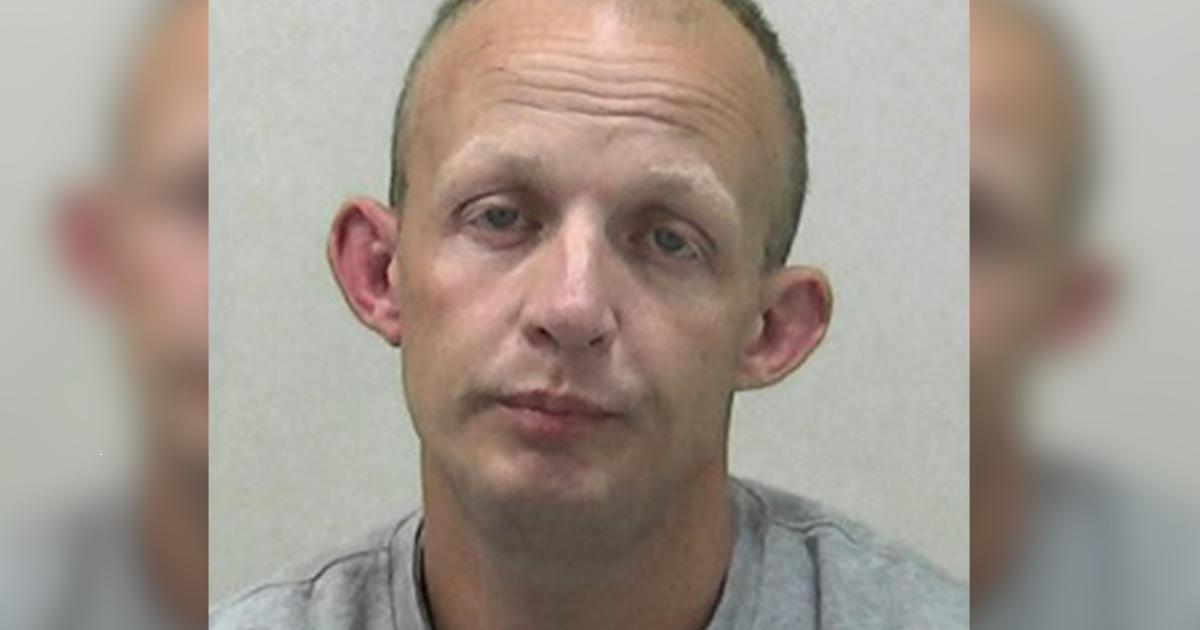
Detectives know that Adam Hall, 43, from Washington, Tyne and Wear, travelled to North Yorkshire to meet men he met on the dating app Grindr.
Hall also met men across the North East, including County Durham and Middlesbrough, as well as West Yorkshire, Manchester and London.
Newcastle’s director of public health, Professor Alice Wiseman, has urged people who have had sex with Hall to access confidential health services in their area.
Advertisement
“The sooner that anyone is diagnosed, the better the treatment is,” she said.
“We want to eliminate HIV in the long term, the way to do that is for those who are infected to receive treatment as soon as possible.
“The earlier you are diagnosed, the sooner you can have anti-retroviral therapy, and if you are consistent with your treatment, you can reduce your viral load so you are no longer infectious to those around you.”
A warning has been issued to other public health directors around the country about Hall’s offending and the potential for there to be more victims whom he deliberately infected.
Advertisement
Hall hid his HIV status from partners, failed to take medication to keep his viral load low, then had unprotected sex with men, sometimes raping them.
He was convicted of five counts of rape and seven counts of causing grievous bodily harm – by deliberately infecting younger partners with HIV after meeting them in bars in the Newcastle area or on the dating app Grindr.
Hall’s victims were aged from their late 20s down to just 15, with the schoolboy finding out he had contracted HIV in a phone call from health professionals moments after he stepped off a school bus.
Two of his victims were just 17 and 18.
Advertisement
One of the victims said: “I blame myself for letting the monster in.”
Judge Edward Bindloss deemed Hall “dangerous” before jailing him for life with a minimum term of 23 years and 42 days.
Second person in country to be convicted of deliberately infecting other people with HIV
After a four-month trial at Newcastle Crown Court, Hall became just the second person in the country to be convicted of deliberately infecting other people with HIV.
Hall denied the charges, even claiming some of his victims wanted to be infected with HIV.
Advertisement
He was known on the Newcastle gay and chem sex scene, worked in bars and at a Tyneside sex shop, and had even tried to set up a charity for people with HIV.
He was diagnosed with HIV in 2010 and could have kept his viral load low with modern treatments.
But in 2016, medical professionals became concerned he was not adhering to his treatment, making him infectious to others he slept with.
Despite being warned, Hall had unprotected sex with men between 2016 and 2023, in some cases raping them.
Advertisement
Prosecutors were sure Hall intended to spread HIV, although he continued to deny it.
A little after 2pm on April 8, the Israeli military hit more than 100 targets in Lebanon in just ten minutes. Israel called the attack Operation Eternal Darkness and said it struck Hezbollah command and control centres across Lebanon. The Lebanese government said at least 300 people were killed and 1,000 injured.
The scale of the attack on Lebanon was reminiscent of the early days of the Gaza war in 2023 when Israel retaliated for the October 7 attacks, which killed more more than 1,200 people, with waves of aerial bombardment of Gaza.
Advertisement
Israel has a powerful and lethal army, and it’s been defending itself against attacks from Hamas, Hezbollah and Iran.
But why has it chosen such brutal military aggression?
Peleg, who is a professor of modern Hebrew studies at the University of Cambridge in the UK and author of the book New Hebrews: Making National Culture in Zion, thinks Israel’s view of itself began to change in the wake of the Holocaust. “There started a really problematic combination of defiance, aggression, and a sense of victimhood and it’s a very explosive and lethal combination,” he says.
Advertisement
In this week’s episode of The Conversation Weekly podcast, Peleg tracks how he sees Israel’s self‑image changed from self‑reliance to aggressive militarism, and how that history helps to explain the way it wages war today.
This episode of The Conversation Weekly was written and produced by Gemma Ware and Mend Mariwany. Mixing by Eleanor Brezzi and theme music by Neeta Sarl.
Listen to The Conversation Weekly via any of the apps listed above, download it directly via our RSS feed or find out how else to listen here. A transcript of this episode is available via the Apple Podcasts or Spotify apps.
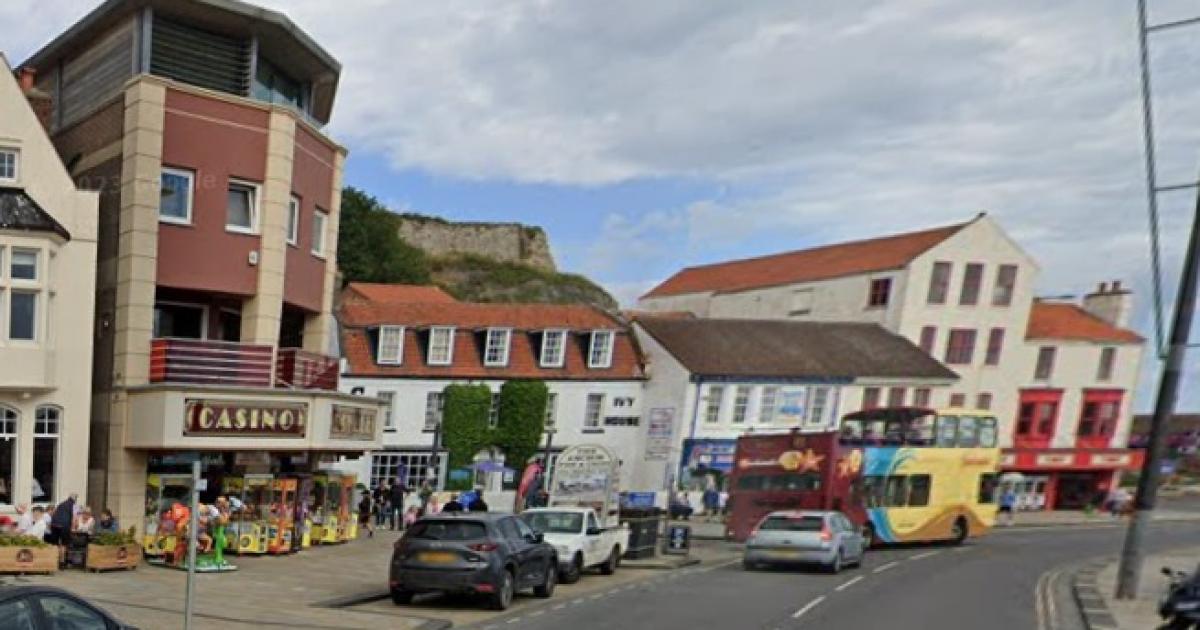
A retrospective application by Jimmy Corrigan’s Ltd to turn the Casino Royale amusement arcade at 47-48 Sandside, Scarborough, into a coffee shop has been approved by North Yorkshire Council.
Advertisement
The site is located on the north side of Sandside, overlooking Scarborough Harbour to the south and southeast.
The scheme involved the creation of a coffee shop and outdoor seating area at a premise that previously had planning permission for an amusement arcade on the ground floor.
Advertisement
No objections were made by the highway authority, which said that the change of use would have no material impact on traffic conditions.
Planners said that the new use and the new shopfront were of an appropriate scale and appearance for the area and preserved the character and appearance of the conservation area, as well as preserving the setting of nearby listed buildings.
Advertisement
Commenting on the outdoor seating area, officers said the proposed area was of an acceptable scale outside the front of the building, “such that it does not encroach on the highway or cause unacceptable obstruction”.
North Yorkshire Council said the development presented “a local business which serves the local community and supports the tourism industry”.
Advertisement
A report prepared by planning officers noted: “The development represents an investment in this business, and such alterations and investments are an essential aspect of keeping such a community facility up to date.
“The coffee shop is now established in and appropriate to its location, providing services not just to the local community, and the new use is complementing the mix of cafe and retail uses within the harbourside location.”
Advertisement
Officers concluded that the development would result in a positive enhancement of an existing community facility, and the application was approved subject to conditions.
One of the US and Israel’s justifications for launching the war on Iran was to ensure the regime in Tehran could never possess nuclear weapons, the ultimate deterrent against external attack. But the main lesson that has been taken from the war, according to some commentators, is that Iran’s own geography already provides it with all the deterrent it needs.
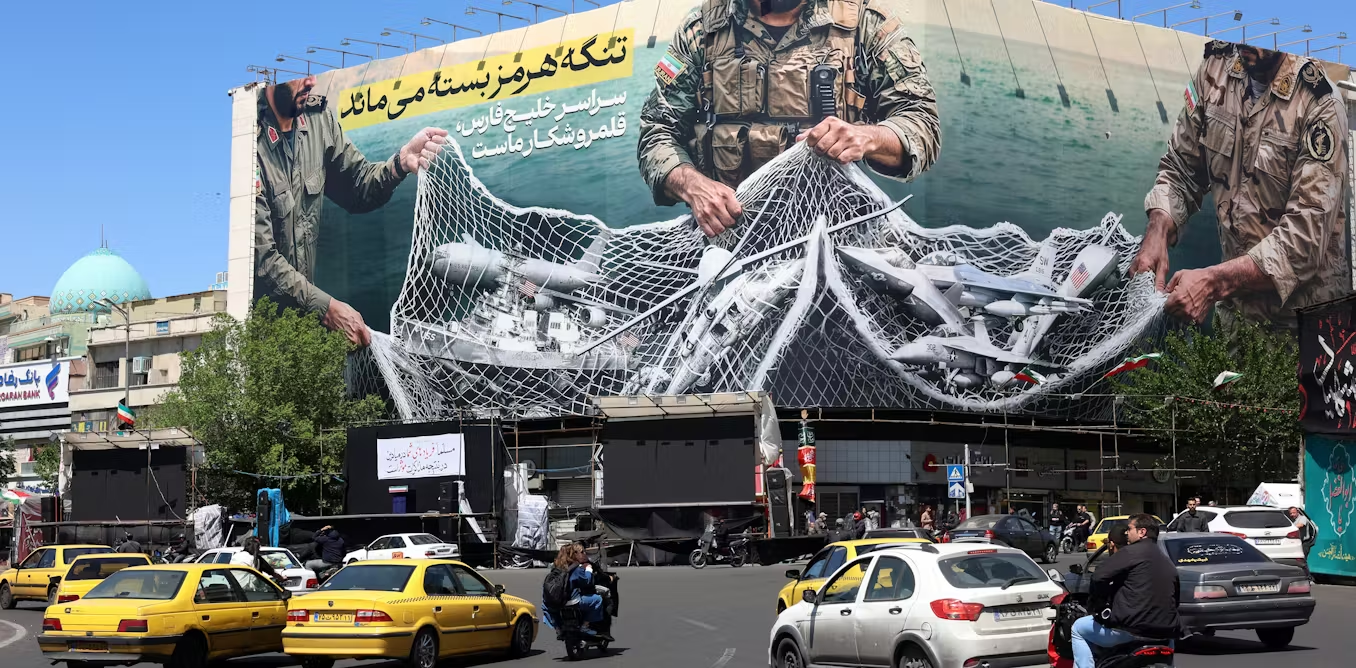
The US-Israeli strikes have inflicted massive damage on Iran’s leadership and have destroyed billions of US dollars worth of military and civilian infrastructure. However, this display of force has proved unable to stop Iran from controlling who enters the Strait of Hormuz, a maritime chokepoint through which around 20% of the world’s oil supply flows.
This has led to the suggestion that Iran could emerge from the conflict with a new blueprint for shielding itself against future threats, regardless of whether it agrees to US demands to dismantle or severely limit its nuclear programme.
Geography is arguably Iran’s greatest strategic asset. The Strait of Hormuz is shallow and narrow, with just two-mile-wide navigable shipping channels. There are also a huge number of coves and inlets along Iran’s southern coastline, providing cover for launching small boats to attack shipping or lay mines, as well as anti-ship missiles and drones.
Advertisement
And there is a vast belt of rugged mountains running from Iran’s north-western border with Turkey all the way down to the Strait of Hormuz. Iran can store, conceal, produce and launch more drones and missiles here than it would ever need to threaten Gulf shipping.
Iran’s Zagros mountain range provides the space to store, conceal, produce and launch the drones and missiles needed to threaten Gulf shipping. Peter Chovanec / Shutterstock
However, Iran’s capacity to close the strait is not new. For decades, Iran has repeatedly threatened to respond to any external attack by closing the strait. It has also, albeit in a more measured way, demonstrated the capability to make the strait commercially unusable.
In response to Donald Trump’s “maximum pressure” policy across both his first and second terms as US president, Iran has harassed shipping with fast boats, rehearsed loading mines on to vessels, test-fired anti-ship ballistic missiles and even seized a British tanker. These are all classic forms of deterrence signalling.
Multiple analysts had warned of the catastrophic economic consequences of full-scale war with Iran precisely because of Iran’s ability to close the Strait of Hormuz. The only person who seems not to have understood this is Trump.
Advertisement
When pressed in March on whether Trump had been briefed before the war that Iran would seek to block Hormuz, his director of national intelligence, Tulsi Gabbard, would not be drawn. But she acknowledged that it “has long been an assessment of the intelligence community that Iran would likely hold the Strait of Hormuz hostage”.
Another challenge to the claim that geography may replace nuclear weapons as Iran’s primary source of deterrence is that its nuclear programme was never a core part of its deterrence. A 2019 report by Chatham House determined that Iran saw its asymmetric capabilities – particularly ballistic missiles and its ability to mobilise its proxy groups in the region – as essential to its national security. Iran’s ability to exercise control of the Strait of Hormuz is another pillar of this strategy.
There is ample reason to believe Iran was engaged in nuclear “hedging” – preserving the option to build a weapon at some point without crossing the line in a verifiable way. But if nuclear deterrence was the core aim, it is unlikely that Iran would have committed to a 2015 nuclear deal that most of the international community argued blocked its path to a bomb.
Regional implications
If a country is attacked, by definition its deterrence has failed. But the perception of restored deterrence can help create conditions for deescalation by justifying an end to the fighting and convincing an adversary that costs can still be imposed. In this sense, Iran’s control of Hormuz may help bring the current war to an end.
Advertisement
Iran’s confidence in having proven its ability to blockade Hormuz may also provide cover for dialling down its nuclear ambiguity posture. And it could compensate for the degradation of its network of proxies that has enabled Iran to project influence across Lebanon, Syria, Iraq, Yemen and Gaza.
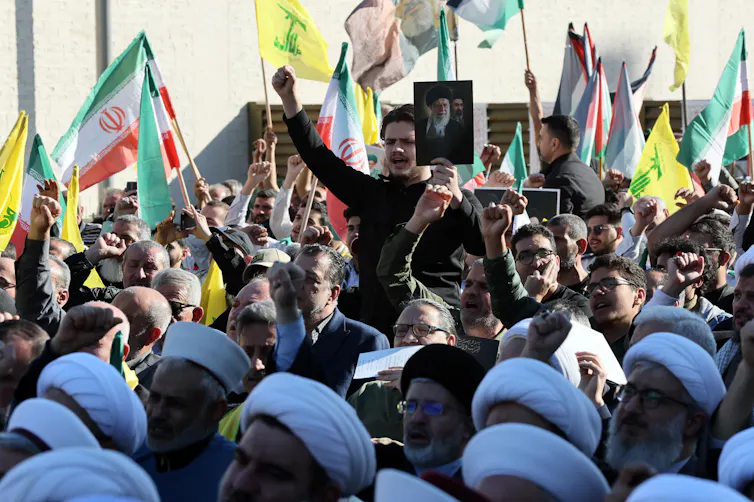
The weakening of this so-called “Axis of Resistance” in recent years has reduced (though far from eliminated) Tehran’s ability to raise the regional cost of any direct attack on Iran. And Hezbollah, which is widely considered the strongest group in this proxy network, has paid a high price for defending Iran since the start of the war.
Iran is highly unlikely to abandon its proxies completely. However, it may now conclude that using them as a form of forward deterrence to avoid being directly attacked has manifestly failed and roll back on the strategy. This would be an extremely positive move for regional stability.
Hezbollah supporters wave Lebanese, Iranian and Hezbollah flags at a rally in Beirut, Lebanon, on April 22. Wael Hamzeh / EPA
Iran’s demonstrated capacity to close the strait is likely to shape the regional order for some time. But Iran is unlikely to be willing to rely on this single pillar of deterrence.
Its sustained missile strikes on neighbouring Gulf states, and damage to critical infrastructure, had already created an appetite for a negotiated end to the conflict among the US’s Arab allies. Trump himself admitted he did not anticipate this reaction.
Advertisement
This makes forcing Iran to suspend its ballistic missile capability extremely difficult in upcoming negotiations, which will leave its neighbours nervous and anxious about their own lack of any deterrence capacities.
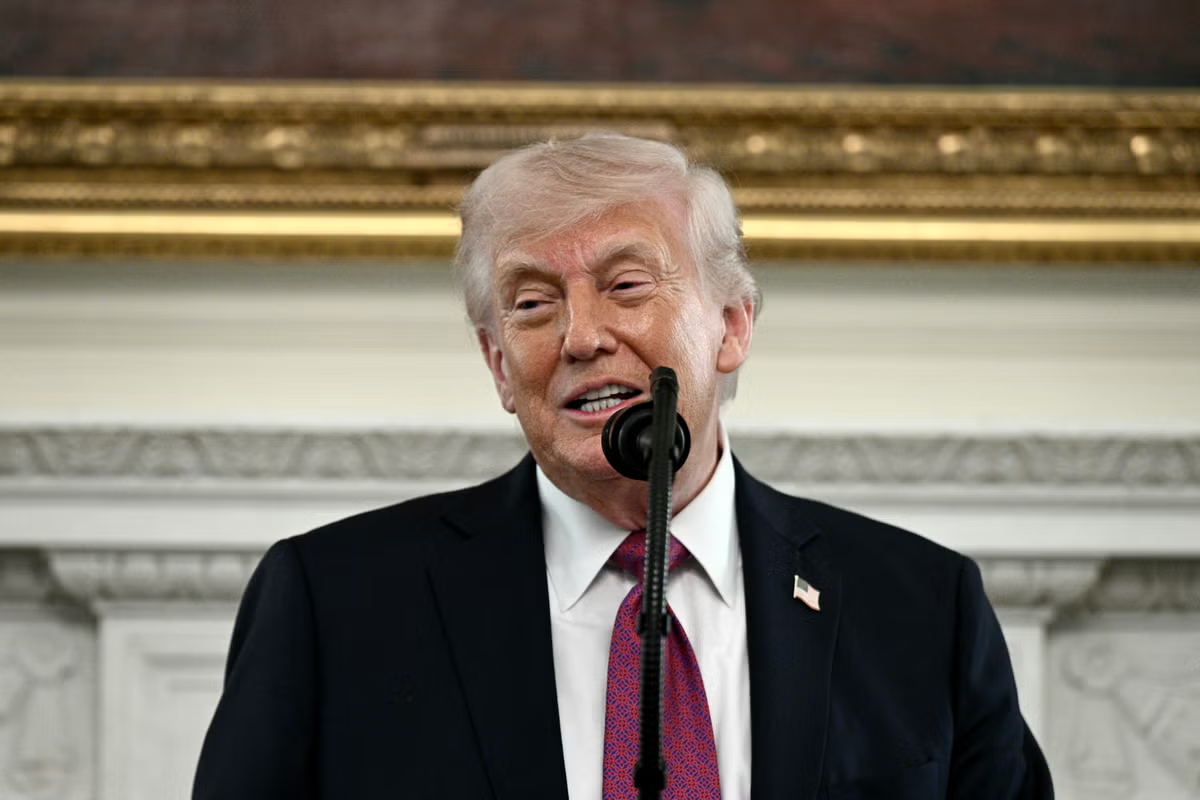
Next week’s state visit from King Charles and Queen Camilla could “absolutely” repair relations with the UK, Donald Trump has said amid a growing rift with Sir Keir Starmer.
Relations between the prime minister and the US president have been fractious in recent months, with the president branding the UK’s approach to the Iran war “terrible” and repeatedly lashing out at Sir Keir – at one point describing him as “not Winston Churchill”.
Asked by the BBC whether the upcoming state visit from the King could help repair the relationship, Mr Trump said: “Absolutely. He’s fantastic. He’s a fantastic man. Absolutely the answer is yes.”
“I know him well, I’ve known him for years,” he added. “He’s a brave man, and he’s a great man. They would absolutely be a positive.”
Advertisement
Mr Trump’s comments will come as a boost to No 10, as there has been hope in Downing Street that Charles and Queen Camilla can help put the UK-US special relationship on firmer footing.
The state visit, which begins at the end of the month, will mark the 250th anniversary of American independence and herald the start of celebrations across the US, with Charles and Camilla marking the milestone at a “block party”.
The first time Charles and Camilla will meet the president and US first lady will be at a private tea only captured by cameras.
The navy-blue velvet gown resembles a tuxedo (Picture: Samir Hussein/WireImage)
Anne Hathaway and her stylist Erin Walsh have made sure her looks for The Devil Wears Prada 2 press tour are worthy of the iconic film itself.
So far she’s posed in sculpted Louis Vuitton, ruffled Valentino and shimmering Stella McCartney.
But that’s not all. For the most recent London premiere, Hathaway stole the show in Versace.
The navy-blue velvet gown had a high-slit skirt with a glittery top and strapless sheer bodice, resembling a deconstructed tux jacket fit with lapels and a row of buttons.
Advertisement
The dress was designed by Versace (Picture: by Samir Hussein/WireImage)
Andrea Sachs is back (Picture: WireImage)
Paired with a statement high-pony with plenty of enviable volume, Hathaway looked fittingly glam and powerful as she, alongside costars Meryl Streep, Emily Blunt, Stanley Tucci and even designer Donatella Versace herself, celebrated the long-awaited sequel to the 2006 cult classic film.
What to expect from the film, you ask? Although The Devil Wears Prada 2 won’t be released in UK cinemas until May 1, early critic reviews have indicated fans won’t be disappointed.
After a 20-year wait for a follow-up, the new film sees Anne Hathaway’s Andy Sachs return to Runway magazine, where she reunites with her infamously frosty former boss Miranda Priestly, played by Meryl Streep.
Fans have been eager to see the return of Streep’s Miranda Priestly (Picture: Scott A Garfitt/Invision/AP)
Another of Hathaway’s recent looks (Picture: Taylor Hill/WireImage)
It’s been teased that the sequel will see Andy working alongside Miranda as the fashion titan navigates her career amid the decline of traditional magazine publishing.
We’ll also see the return of iconic character and former colleague Emily Charlton (Emily Blunt) as the now head of a luxury brand that possesses the advertising dollars which could ensure the glossy mag’s survival.
Speaking with People at last night’s premiere, Hathaway reflected on the ways the growth in her personal life mirrors that of her character’s in the new film.
Advertisement
‘I think we’re both more confident,’ she said. ‘I think that 20 years ago Andy Sachs was really worried about getting it right and she really wanted to please her boss.’
She added: ‘I think that 1776958873 she wants to be herself. And I relate to that.’














































You must be logged in to post a comment Login