Taylor Swift has filed trademark applications covering her voice and likeness, apparently in a bid to halt the creation of artificial intelligence deepfakes.
In a blog post, intellectual-property attorney Josh Gerben (who does not represent Swift) argued that is likely the filings are intended to protect Swift from unauthorized AI versions of herself being created.
Advertisement
“Theoretically, if a lawsuit were to be filed over an AI using Swift’s voice, she could claim that any use of her voice that sounds like the registered trademark violates her trademark rights,” wrote Gerben.
Taylor Swift has moved to trademark her voice and image (AFP/Getty)
Gerben continued: “The image-based filing serves a similar purpose. By protecting a distinctive visual, down to Swift’s commonly worn jumpsuit and pose, Swift’s team may gain additional grounds to pursue claims against manipulated or AI-generated images that evoke her likeness.”
Attorneys for the entertainment law firm Yorn Levine, representing McConaughey, applied for the protection in December 2023, but the U.S. Patent and Trademark Office approved the trademark in December 2025.
Enjoy unlimited access to 100 million ad-free songs and podcasts with Amazon Music
ADVERTISEMENT. If you sign up to this service we will earn commission. This revenue helps to fund journalism across The Independent.
While state consumer protection laws already protect celebrities from having their likeness replicated to sell products, McConaughey’s trademark strategy means that the Interstellar actor will now have grounds to sue in federal court over general “misuse” on the internet, even if misleading AI videos using his image are not explicitly selling anything.
Yorn Levine founder and lawyer Kevin Yorn said in a statement shared with The Independent: “We embrace AI, invest in it, and actively support its evolution. Progress, however, should have boundaries. Protecting individual voice, image, and intellectual property is essential to building a future that works for everyone. Along with Matthew, we are forward-looking, engaged in the possibilities of AI, and thoughtful about how everyone’s creative identity is represented and protected.”
McConaughey told the Wall Street Journal: “My team and I want to know that when my voice or likeness is ever used, it’s because I approved and signed off on it. We want to create a clear perimeter around ownership with consent and attribution the norm in an AI world.”
A woman divorced her husband after losing 10 stone using weight loss jabs and ‘regaining’ her self confidence. When Natalie Strange, 37, first met her husband, she thought he would be the man she would spend the rest of her life with.
But, after losing 10 stone with the help of jabs, she’s now back on the dating scene. Natalie, from Norwich, credits Mounjaro as a “saving grace” in getting her life back and finding the confidence she thought was long gone.
As a stay-at-home mum-of-three, Natalie found herself becoming a “shell” of her former self, and turned to food – racking up £250 a month on her takeaway “addiction”. It saw her weight shoot up to 19 stone, and she wore a UK dress size 22 at her heaviest.
Advertisement
“I had lost my self-worth and felt like I no longer had a purpose,” she said. “After having kids, I lost my confidence and just ended up going with the flow. Each day was monotonous and boring. I lost sight of who I was.
“It didn’t help that we had lost the spark between us, with time in the bedroom next-to-never.” In March 2024, she decided to try the weight loss medication, and lost 10 stone, dropping down to a size 10.
Natalie realised that – despite trying couple’s therapy – her relationship of 18 years wasn’t working. She said: “I had always gone into marriage thinking I’d be with that person forever. For me, divorce was off the table.
Advertisement
“So there’s that element of feeling like I’ve failed. And I do have that doubt of ruining my kids’ lives – though they love having two Christmases, two holidays; basically two of everything. Sometimes, I do wonder if I made a rash decision, but then we spend time together and I realise that isn’t the case at all.”
While she’s still going through divorce proceedings, that hasn’t stopped Natalie from getting back out there. She added: “I’ve joined dating apps. When I joined, at first, I had really low expectations of anybody being interested in a single mum-of-three.
“But, without blowing my own horn, I was inundated with men that wanted to talk to me. It was a huge eye opener and such an ego boost. I went out with my friends for my birthday and let’s just say I’ve acted single on nights out ever since then.
“I feel great and so proud of myself for walking away from something that was no longer serving me. I’ve found myself again and that sense of adventure I was hungry for. The jabs have changed my life.
“I’d have never had the confidence and bravery to step out on my own without them. Using them has given me the validation I was searching for. Now, the world is a kinder place and I’m living the life I once dreamed of – happy and free.”
AS shoots burst their way through the soil and the days get warmer and brighter, you may have started to see amphibians making their way to their breeding habitats – hearing the chorus of frogs or spotting them hopping across our roads, or potentially even catching the occasional glimpse of a newt.
The arrival of our spring wildlife is a relief, and a welcome change from what has felt like the ever-grey and dark of winter.
However, that isn’t to say that we have been hibernating in the same way as our wildlife.
For the first time in over 25 years and after extensive planning and groundworks, winter saw the restoration of the main pond at Yorkshire Wildlife Trust’s Askham Bog nature reserve to create the open water habitat which has steadily been lost from the reserve over the years.
Advertisement
Partnership projects with the Environment Agency led to new sustainable solutions to support farming, flood alleviation and wildlife activities at Carlton Marsh nature reserve in Selby; while in February, away from the prying eyes of the public in a hidden corner of Flamingo Land Resort near Pickering, Yorkshire Wildlife Trust hit a milestone – the 100th pond to be created or restored for great crested newts within the last five years.
Great crested newt. Photo by John Bridges
The process of restoring or creating a pond starts off with finding the right sites. Any groundworks must expand or strengthen existing great-crested newt populations based on historical records, finding a really good and firm clay base so a pond holds water naturally, and other factors such as finding places with reduced disturbance, away from invasive species, and not likely to be washed away by flood.
For restoring ponds, this needs to be done with the upmost sensitivity, at the correct time of year and with a considered and measured approach. We create detailed plans, bring in expert contractors to excavate the ponds, shape the ponds with shallow gradients and variable depths to maximise their value for wildlife – and then wait, for the rainwater to come naturally and for the ponds to recharge over winter ready to provide a home for newts and other wildlife in the next breeding season.
Recommended reading;
Advertisement
Over the last five years, we have created or worked on over 16,000m2 of habitat – the equivalent of a single giant pond a third bigger again than Trafalgar Square! These new and improved ponds have helped to create a better-connected blue ‘corridor’ for amphibians thanks to funding from Natural England – and now, with the arrival of spring, we can really see these ponds come to life. Survey and monitoring is a key component of our work to measure success, and these too have seen change over time.
Monitoring historically involved long-established and licensable methods like bottle trapping, sweep netting, manually searching ponds at night with torches, and egg searches. Recent years have instead seen advancements in testing water to find environmental DNA (eDNA) – the animal’s skin cells, mucus, sperm, eggs and faeces left behind in ponds. Studies show that eDNA is 99.3per cent accurate in identifying the presence of great-crested newts, and this technique has become a key component of our protected species surveying work. It’s no mean feat; this year our team will be surveying an astonishing 77 ponds across the county, looking for the presence of great-crested newts.
Feeling inspired? Why not go exploring your nearest watery world and see what amphibian life you can spot – newts will be most visible at this time of year, although make sure you don’t disturb them!
Do you own land and want to help us create or restore ponds on it for wildlife? If you have space for a pond which is a minimum of 150m2, we’d love to hear from you. Email info@ywt.org.uk or visit www.yorkshirewt.org.uk/wildlife-pond-creation for more information.
Advertisement
John Thompson is the Yorkshire Wildlife Trust’s Wetland Creation Officer
Atletico Madrid’s trip to Arsenal in the league phase feels a long time ago, but it will stick in their mind not just for the four goals they shipped, but for their struggles in attack.
Atletico produced only 0.32 xG from open play in that defeat and managed only one shot on target, so, if they are to take anything against Arsenal this time around, getting Julian Alvarez in the game will be key.
The Argentina forward has scored nine goals in the competition this season, more than any Atletico player had managed in a Champions League campaign.
Advertisement
He’s also a menace defending from the front, with a mammoth 853 high-intensity pressures – more than anyone else this season. That’s 70 per game on average.
That work ethic, ruthlessness in front of goal and the wizardry to bend a free-kick into the top corner, as Barcelona found out, make the 26-year-old vital to Atletico’s chances of progressing.
The Department for Work and Pensions has confirmed that if you are due a payment on Monday, May 4 or Monday, May 25, you will be paid early – here is the full list of benefits affected by the May 2025 bank holidays
Linda Howard Money and Consumer Writer
04:00, 28 Apr 2026
The Department for Work and Pensions (DWP) has confirmed that certain individuals expecting State Pension or benefit payments next Monday will see the money land in their bank accounts early. HM Revenue and Customs (HMRC) has also confirmed that some payments scheduled for Monday, May 4 will be issued on Friday, May 1.
The change comes as DWP offices and phone lines will be closed over the bank holiday, with payments typically made when all services are available, including webchat and Jobcentre Plus offices. Affected payments include State Pension, Universal Credit, Personal Independence Payment (PIP), Child Benefits, Adult Disability Payment (ADP) and Attendance Allowance.
Advertisement
A second bank holiday in May – on Monday, May 25 – will also see scheduled payments issued early on Friday, May 22. Below is a full list of DWP and HMRC payments which could be affected by the May bank holidays.
It’s important to be aware that if your upcoming payment does not fall on either of the bank holiday dates – May 4 or May 25 – it will be issued as normal, reports the Daily Record.
DWP May bank holiday payment dates
Payments due to be made on Monday, May 4 will be issued on Friday, May 1 and those scheduled for Monday, May 25 will arrive on Friday, May 22.
Payments affected:
Advertisement
Attendance Allowance
Carer’s Allowance
Employment Support Allowance (ESA)
Income Support
Jobseeker’s Allowance (JSA)
Pension Credit
Personal Independence Payment (PIP)
State Pension
Universal Credit
HMRC May bank holiday payment dates
Payments due to be made on Monday, May 4 will be issued on Friday, May 1 and those scheduled for Monday, May 25 will arrive on Friday, May 22.
Patrick Agnew booked a one-way ticket to Senegal to change his life and fight the demons he was battling, but in the process, he changed the lives of hundreds of children.
For years, the Lisburn man, known online as AgnewTravels, says he was in a “very dark place.” Between struggles with alcohol, falling out with family, and five years of conflict on TikTok, he felt he was at his last hurdle. He packed his bags and headed for Africa.
When Patrick arrived in the heart of the slums in Senegal, he found 50 children, some as young as seven, living in a building with no windows, no doors, and no electricity.
“The conditions are horrendous,” Patrick said. “Kids are sleeping on the street or on the sand inside. They had broken steel beds with spikes sticking into their backs and mosquitoes eating them alive every night.”
Advertisement
Instead of just watching, the Lisburn man got to work. Using his own TikTok earnings and donations from a GoFundMe that raised £4,000 in a single day, Patrick started building.
Patrick is out from 7 am every morning, spending 10 hours a day in the blistering heat collecting wood and hammering frames together. He has already:
Advertisement
Built 15 brand new wooden beds to get the kids off the sand.
Fitted new mattresses, pillows, and mosquito nets.
Handed out 400 pairs of new shoes to children who were walking barefoot.
Fed nearly 1,000 children in just one week.
The local children have been working alongside him, learning how to use hammers and saws. “They’re at a stage now where they can do the measurements and cut the wood themselves,” he said. “They ask for nothing, but they’ve done nothing but smile since I got here.”
Patrick is open about the fact that he hasn’t always been a saint. He knows he’s had “ups and downs” online but says this journey has humbled him.
“I’ve had hate for five years, and a lot of it I brought on myself. I take full accountability for that. I was that person because I was unhappy with my own life,” he admitted.
“People at home think they have a difficult life, but they don’t. When you see kids in 40°C heat with ripped clothes and no food, it opens your eyes. In a world full of hate, just be kind. It costs absolutely nothing.”
Patrick’s journey isn’t over yet. After a week of downtime to recover from the 10-hour workdays, he plans to travel to an orphanage in Uganda to continue his work. You can follow his journey online here.
Britain’s Murder Map, fronted by Vicky McClure, advances a theory that George Puttock, who died in 2022, may have been responsible for his wife Helen’s death.
Jane Hamilton and Sally Hind Deputy Chief Reporter
The programme, Britain’s Murder Map, fronted by Line of Duty star Vicky McClure, advances a theory that George Puttock, who died in 2022, may have been responsible for his wife’s death.
Helen’s son David Puttock has hit out at the claims and confirmed he is seeking legal advice over the “slur”.
Advertisement
David, who lives in Canada, said: “My dad was investigated and ruled out. That’s not opinion, that’s fact.
“They’ve taken a man who can’t defend himself and turned him into a suspect for the sake of a TV programme.
“It’s not just wrong, it’s cruel.”
He added: “This isn’t some theory in a book or something said online.
“This has gone out on television to a huge audience, and it names my dad as a possible killer. That has consequences.”
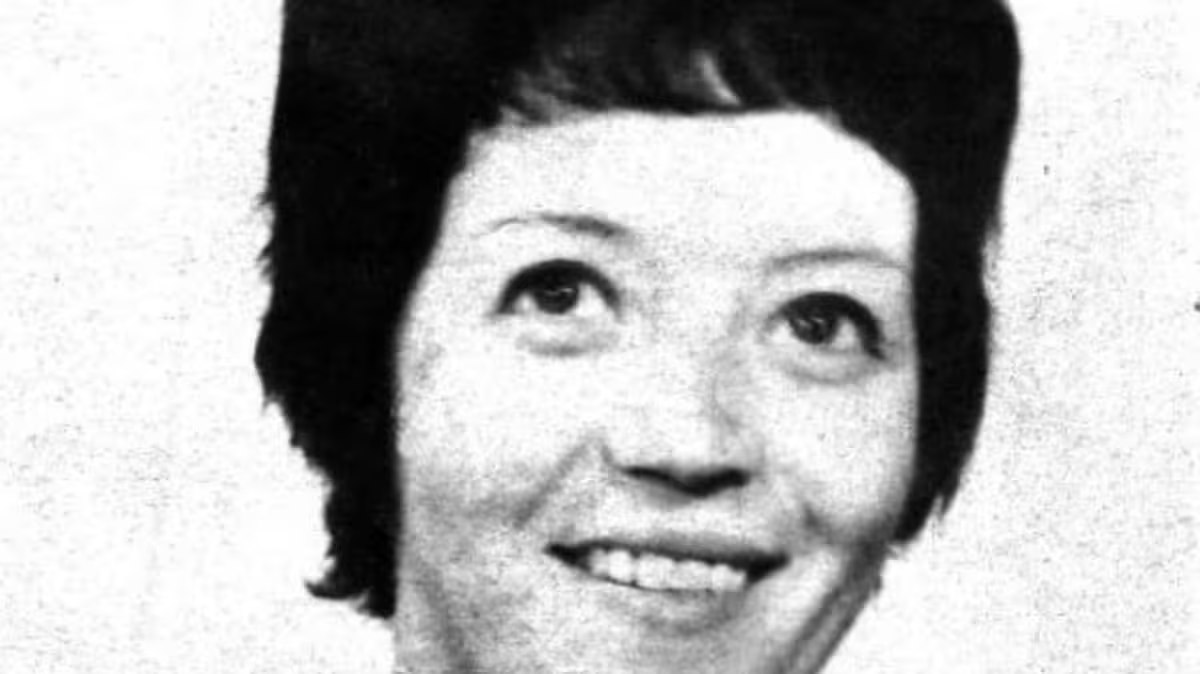
Helen Puttock, 29, was the final known victim of the Bible John murders after a night at Glasgow’s Barrowland Ballroom in October 1969.
She had been out with her sister, Jean Langford, when they met a well-dressed man who called himself “John”.
Advertisement
Witnesses said he spoke about religion, quoted from the Bible and did not drink alcohol.
The three shared a taxi part of the journey home. Jean was dropped off first. Helen remained in the cab with the man.
She was found dead hours later near her home in Scotstoun. She had been sexually assaulted and strangled.
Her murder followed the killings of Patricia Docker in 1968 and Jemima McDonald in 1969. Both women had also been to the Barrowland Ballroom in the hours before their deaths.
Advertisement
Detectives linked all three murders and launched one of the biggest investigations Scotland had ever seen. Hundreds of men were interviewed and thousands of statements taken.
Despite that, the man known as Bible John was never identified.
George, Helen’s husband, was among those spoken to during the inquiry. He did not match witness descriptions of the man seen with Helen that night.
Advertisement
He was later eliminated through forensic examination.
David added: “Police looked at my dad in detail. They had every opportunity to pursue him if there was anything there. They didn’t, because there was nothing to pursue. People forget this wasn’t a casual check. This was a full murder investigation.
“My dad was her husband. Of course he was going to be looked at.
“And he was ruled out.”
Advertisement
The programme, which is also presented by McClure’s real-life husband, Jonny Owen, claims new analysis of behaviour and background points back inside Helen’s home.
David said he rejected their suggestions and added: “They’re ignoring the actual evidence and replacing it with speculation. They’re taking something that was settled and reopening it without anything new. That’s not an investigation. That’s storytelling.”
Criminologist Professor David Wilson said the case continues to attract new theories, often without evidential support.
Advertisement
He said: “One of the tragedies about the ‘Bible John’ case is that it has now become a mini industry.
“That industry is kept alive by people suggesting new hypotheses — new ‘takes’ — on what happened.
“One of those hypotheses is that Helen Puttock died as a result of domestic violence. In other words, she was killed by her husband George.
“There is no evidence to support that suggestion whatsoever.
Advertisement
“More importantly, the detectives who originally investigated the case — many of whom I interviewed at length — were adamant that the three women who were murdered were killed by the same man whom we know as ‘Bible John’.”
The Bible John murders remain one of Scotland’s most notorious unsolved cases.
The killer is believed to have targeted young women leaving the Barrowland Ballroom, gaining their trust before attacking them.
Descriptions given by witnesses, including Jean Langford, led to a photofit image that has been widely circulated for decades.
Advertisement
Despite advances in forensic science, including DNA profiling, the case has never been conclusively solved.
David said: “We’ve lived with this for more than 50 years. We’ve lived with not knowing who killed my mum. That’s hard enough without having my dad dragged into it again. There are real people behind this. My family has had to deal with this our whole lives. To see it presented like this, as if it’s just another angle, is incredibly difficult.”
David confirmed he is now seeking legal advice over the claims made in the programme.
Advertisement
He said: “I’m not prepared to just let this pass. There has to be some responsibility when you put something like this out there. You can’t just name someone as a killer and walk away.”
The programme has reignited debate around the case, which has been the subject of numerous books, documentaries and investigations over the years.
Police have previously said they remain open to new evidence in relation to the murders.
David said: “Everyone wants answers. We want answers more than anyone. But it has to be based on evidence. Not on speculation about my dad just because he is no longer here.”
Advertisement
Two Rivers Media, who made the programme, and Sky History Channel were contacted for comment.
Advertisement
A spokeswoman for Two Rivers Media said: “The programme Britain’s Murder Map examines historical cases and was produced in line with the Ofcom Broadcasting Code and all relevant legal requirements. Its purpose is to explore unresolved cases and consider alternative interpretations of the available evidence, rather than to assert definitive conclusions.
“In this instance, the theory referenced was presented as the view of a contributor and clearly framed as speculative, with appropriate language used throughout to ensure it was not understood as fact.
“The programme also included important context, noting that no forensic evidence was found, that George Puttock was never arrested, and that he had been previously eliminated from police enquiries.
“In line with our obligations, the adult son of Helen Puttock was contacted in advance of broadcast and made aware of the programme.
Advertisement
“We remain committed to responsible programme-making and are satisfied that the content was presented fairly, with appropriate context and in compliance with Ofcom guidelines.”
Get more Daily Record exclusives by signing up for free to Google’s preferred sources. Click HERE
One person described the roads as having ‘masses of potholes’
Locals say public transport is “non-existent” in a Cambridgeshire town, and the “hideous” roads are blighted with potholes. Ramsey is a rural town in between Huntingdon and Peterborough.
Advertisement
Despite being within a driveable distance from bigger towns and cities, locals feel their public transport to get to these places isn’t good enough. As well as public transport, people find Ramsey’s roads to be filled with potholes, making them unattractive and unsafe.
Jane Kinpton described public buses as “non-existent”. She said it feels like it takes “two hours to get to Peterborough” by bus, despite only being a 25-minute drive away.
Jane, who lives in Ramsey Forty Foot with her husband Jeff, added: “We live near a bus stop and hardly see any buses. We don’t use public transport, even though we have a free bus pass. We only use it to go to Cambridge.”
Jeff said: “We have two cars instead. You won’t believe the mileage we have to do.” Jane added that she believed the town’s roads were “dangerous”. Jeff agreed: “I know two people that have had to have tyres changed because of the potholes.”
Advertisement
Elaine Baxter doesn’t live in Ramsey, but travels to the town regularly to visit her parents and often uses the buses. She said: “I think the buses aren’t too bad for a rural area. However, the problem is you can’t get back from Peterborough or Huntingdon so easily.”
Elaine’s mum is immobile and her dad is blind. With limited public transport, she said her parents are “trapped” here. She added: “It’s really hard to get them to the hospital [in Peterborough].”
With her parents being vulnerable, Elaine also has concerns about the pothole-filled roads. She said: “I find walking with my mum hard. And with my dad being blind, dad has face planted the pavement a couple of times. It’s a hazard.”
Long-term resident Debbie Lowther describes the roads as “hideous”. She said: “We have masses of potholes. However, Fen roads are notoriously bad, and it comes down to costs.”
Advertisement
One woman, who wished to remain anonymous, said she “doesn’t bother” to use the buses. She added: “They are either always late or don’t turn up. I go to Peterborough quite a bit as my daughter lives there. It takes ages to get there on the bus. Despite petrol going up, I’d rather just drive to avoid wasting my life away.”
The woman also described Ramsey’s potholes as “abysmal”. She said: “They seem to be everywhere. It’s so dangerous not just for drivers, but for cyclists and even someone walking across the street. What if someone was walking with a child in a pushchair and they become caught in the pothole? Someone could get really hurt.”
The Cambridgeshire and Peterborough Combined Authority oversees transport in the county. Despite a claim that a journey takes around two hours to Peterborough, the CPCA emphasised that it is funding a bus route that will take around 40 minutes to Peterborough.
Mayor of Cambridgeshire and Peterborough Paul Bristow said: “I wasn’t prepared to leave Ramsey stranded and worked with the Combined Authority Board to launch the X31 this year, giving people a reliable connection to Peterborough.
Advertisement
“I want our rural places to have improved public transport and that’s why I’m working to bring in a franchised bus service that works better for those communities. And in the meantime I’ll continue to support places like Ramsey where there is a strong case for us stepping in to keep services running.”
A CPCA spokesperson added: “Like most of England, bus services in Cambridgeshire and Peterborough operate under a deregulated system, which means commercial operators decide which routes to run based on profitability. Where services are less viable, often in rural areas, the Combined Authority can step in to fund them, but resources are limited.
“The Combined Authority has been supporting bus services in Ramsey. At the start of this year, we funded the improved X31, which provides direct journeys of around 40 minutes between Ramsey and Peterborough via Upwood and Bury. These services run every two hours and are also timed to support students travelling to Peterborough College.”
The spokesperson added: “We also fund the Ramsey to March 32 service, which stops at Whittlesey, where onward journeys to Peterborough can be made. In September 2025, when the previous operator pulled out of the former 31 Ramsey Peterborough route, we stepped in to save the service and keep the town connected until the improved X31 could launch.
Advertisement
“We understand the challenges rural communities face with public transport. That’s why we’ve been investing back into the bus network to protect and improve services in areas like Ramsey. We are always reviewing how well our subsidised services are performing and will make changes if needed.
“Looking ahead, the Combined Authority is working to bring in bus franchising, which will give us far greater control over routes, frequencies and service standards across the region. This will allow us to design a bus network that better serves our communities.”
The county’s roads are overseen by Cambridgeshire County Council. On the issue of potholes, a council spokesperson said: “Ensuring safe travel is a key priority for us – this year we’re continuing record levels of investment in highways maintenance across the county, which is being used to repair roads, cycleways, footpaths and other highway assets.
“Residents can help us keep our roads and footpaths safe for all users, by reporting the issues they find online via our website.”
Comedian Jorma Taccone has revealed that Kevin Spacey was the one Saturday Night Live host that he was not excited to work with during his time on the show.
Taccone was a member of the Lonely Island trio alongside Andy Samberg and Akiva Schaffer. The group produced digital shorts on SNL from 2005 to 2011 as the late night series began to incorporate the internet into their comedy, meaning the short writers interacted with the variety show’s cast members — including the weekly guest hosts and musical acts.
“In general, I liked almost every host that came to SNL,” Taccone, 49, said on Friday’s episode of The Daily Beast’s podcast show Obsessed. However, he added that there was one celebrity that he “wasn’t super geeked on.”
“I’ve never said this before,” Taccone confessed before revealing that he was talking about Spacey, 66, who hosted SNL for the second time in May 2006 with musical guest Nelly Furtado.
Advertisement
The “I’m On A Boat” co-writer recalled: “I did not enjoy that, and felt very uncomfortable around him.” Taccone did not elaborate further.
Lonely Island member Jorma Taccone said Kevin Spacey hosting ‘Saturday Night Live’ made him uncomfortable (Getty Images)
Spacey, a once celebrated two-time Oscar winner, was exiled from mainstream Hollywood in 2017 after multiple men accused him of sexual misconduct. He has consistently denied all allegations against him and maintained his innocence.
ADVERTISEMENT. If you sign up to this service we will earn commission. This revenue helps to fund journalism across The Independent.
Kevin Spacey has been accused of sexual assault several times but has denied all allegations against him (Getty Images)
Taccone is not the only SNL cast member who recalled an uncomfortable experience during the House of Cards actor’s hosting stint. In 2022, Tina Fey revealed at the Netflix is a Joke comedy festival in Los Angeles that Spacey had flirted with her years before he came out as gay in response to the sexual assault allegations against him in 2017.
“This is the kind of weird thing that used to happen to me,” Fey said at the time. “One time when he was hosting SNL, at the after-party, it was late and Kevin Spacey tried to hit on me.”
She joked that she doubted his attraction to her at the time, saying: “I was like, ‘Who is this for? Who is this little performance for?’”
Advertisement
Rape Crisis offers support for those affected by rape and sexual abuse. You can call them on 0808 802 9999 in England and Wales, 0808 801 0302 in Scotland, and 0800 0246 991 in Northern Ireland, or visit their website at www.rapecrisis.org.uk. If you are in the US, you can call Rainn on 800-656-HOPE (4673)
If anyone moved to Emmerdale for a quiet life, then it’s definitely the wrong village for them. The ITV soap has teased more drama to come next week in the Dales.
Advertisement
After Bear Wolf confessed to murdering Ray Walters, and Moira Dingle off the hook, the sentencing begins with Bear nervously awaiting his time to shine on the stand.
Elsewhere, after the birth of baby Leyla, Jacob decided to drop his complaint against Dr Caitlin Todd – thanks to Charity’s interference also. However, things continue to get worse for the trainee doctor.
Click here to get the biggest stories straight to your inbox in our Daily Newsletter
As Joe Tate continues to swan around even after everything he’s done, he might not have the taste of success much longer as Dawn decides enough is enough.
Advertisement
Here’s what else is coming up in the Dales…
It’s time for the sentencing…
It’s the day of court. Paddy, Dylan share an emotional moment before heading out to face the day ahead. April’s a bundle of nerves as she prepares for her testimony, with Marlon encouraging her to be brave and use the day to tell the jurors the truth about Ray’s abuse. As the trial begins, the defence and prosecution barristers argue their cases in front of the judge, jury, and spectators, and Bear is overwhelmed as he’s forced to relive Ray’s death and his experience at the farm.
April then testifies but struggles under cross-examination; leaving her devastated. Before long it’s Dylan who testifies for the defence, recounting how Bear saved his and Paddy’s lives from Ray. But will he cope under cross-examination? Afterwards, April’s distraught in the court corridor, worried she messed up, but Marlon tries to comfort her by praising her bravery.
Advertisement
Back in the courtroom, Simo takes the stand and Bear begins to spiral on hearing his words. After court adjourns, Zara explains the situation and how she feels they are left with no other choice, than putting Bear on the stand the next day and Paddy reluctantly agrees… But will Bear be up to it?
The next day Paddy and the family nervously arrive at court before Bear’s testimony to see whether Bear will make or break the case. The tension lessens briefly when Bear’s counsellor commences by giving a powerful expert testimony, explaining how Bear was groomed by Ray and feared for his life.
With his family watching encouragingly, a nervous Bear Wolf then takes the witness stand to begin his own testimony…
Jacob tries to trap Dr Todd…
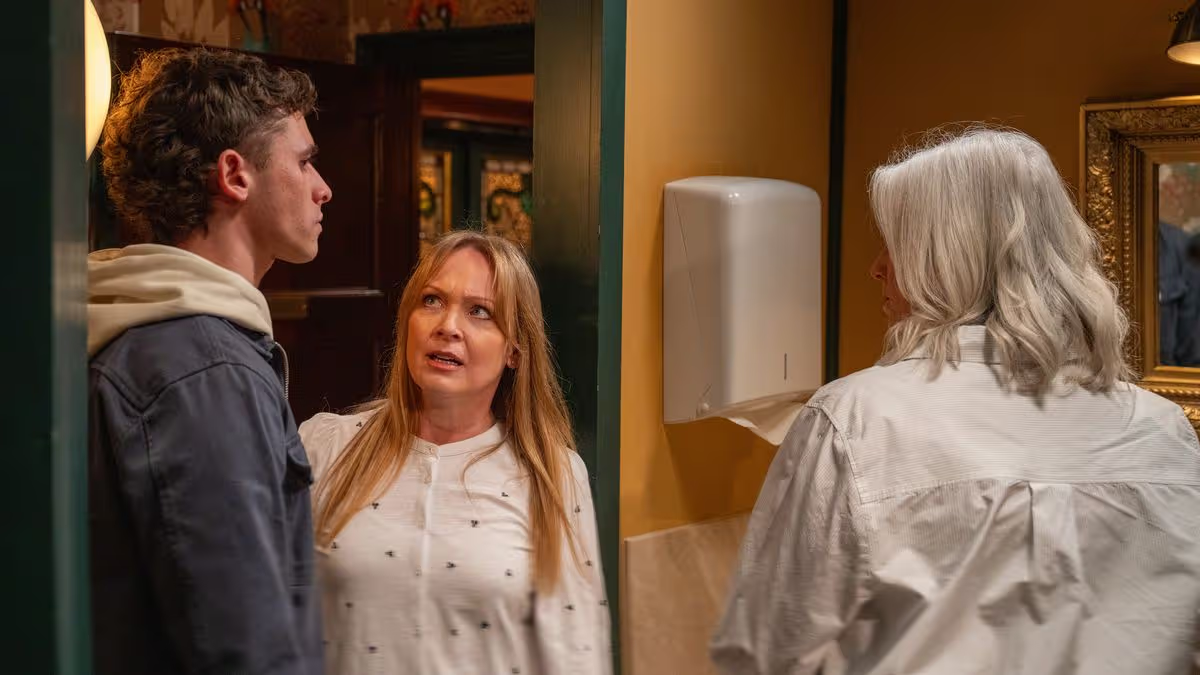
Jacob is uncomfortable bumping into Dr Todd in the village as she mocks him overtly.When Dr Todd maliciously implies to Sarah how Jacob is desperate to return to work despite their baby, Sarah heads to confront Jacob. Soon furious Jacob finds Todd in the Woolpack Corridors and warns her off from lying to his wife. When Jacob follows her into the ladies loo he has seemingly fallen into Dr Todd’s trap as when Vanessa walks in she is alarmed to find Jacob in there.
Later, Vanessa confronts Jacob about his earlier conduct and Sarah demands to know what’s happening, and Jacob finally comes clean to her about all of Todd’s harassment. As Jacob tearfully confesses to all of Todd’s bullying, Sarah comforts him and promises they will face the problem together.
The next day Sarah notices how much Jacob is suffering as a result of Todd’s manipulation and offers her support, urging him to stand up to his bully. She later goes to confront Vanessa for believing Todd over Jacob. At work when Jacob speaks to Carol in HR about making a formal complaint about Todd he is blindsided when Carol reveals Todd has already submitted a complaint about him. And how Todd has provided a substantial file of evidence, including voice recordings. Jacob despairs, feeling he has no chance against such a longstanding colleague.
Later, Jacob tells Sarah about Todd’s file of fabricated evidence against him. Seeing Jacob’s ready to give up, Sarah strongly encourages him to fight back for the career he has always dreamed of, for Leyla’s sake. Heading Sarah’s words, Jacob goes to Tug Ghyll to speak to Todd.
Advertisement
Dawn plans her revenge for Joe…
Dawn struggles to muster the energy to deal with Joe’s excitement over the baby. Soon a troubled Dawn heads to find Moira and confesses she’s struggling to stay with Joe and disguise her loathing of him. Moira urges her to stay for the money as she will need the money to fight him in court. And soon the plan begins..
Elsewhere in the village…
The ladies darts craze continues in the pub. Struggling to keep Robert’s betrayal from Cain ahead of his operation Moira’s stress mounts. That evening Cain expresses worry about how his operation will change their relationship, but Moira assures him they will face whatever together as a team as they wait to see what tomorrow will bring.
Emmerdale airs on weeknights at 8pm on ITV1 and is available to stream on ITVX.
Famously, where Ian Fleming glamorised spies, John Le Carré placed his former spook colleagues in more lifelike circumstances, making them grimmer, grubbier and more mortal. Many, though, sought also to be moral, struggling Greene-like with personal fallibility, compromise, great power politics and the search for good deeds in a naughty world. But these figures, as with Fleming, were all about heroics — fighting the good fight, usually against communism/totalitarianism. Smiley, after all, was based in part on a vicar.
There is rather less room for righteousness in James Wolff’s latest thriller, Spies and Other Gods. In Le Carré, the characters just are spies: it is what they get up to in that role that exercises him. But Wolff is just as interested in why people become spies and what it does to them. Exhibit A is Sir William Rentoul, chief of an unnamed intelligence outfit whose brain is going — or is it? — and who awards himself a last fling out “in the field” (a term no spy ever uses, Wolff tells us). Rentoul realises that a life of deceiving and manufacturing uncertainty has shut out many of those closest to him, including his recently deceased wife (much missed, notwithstanding his infidelities).
“It’s remarkable that this thought has never before occurred to him,” writes Wolff, “that secrecy might have driven his wife away, or at least kept her at a distance, created a cavity wall between them stuffed with operations that didn’t quite come off, old files no one’s going to revisit, the half-dozen or so alias identities that he used in the field. No wonder they couldn’t feel each other’s warmth.” It’s a more benign version of the disillusion of failed spooks in Mick Herron’s Slough House.
.
Advertisement
Crusty spies and modern women
What’s more, senior folk like Rentoul aren’t appreciated as they used to be. “He’d once imagined he would depart with a fanfare: a reception at Downing Street, tea with the king, a party for key global allies. The Americans would no doubt fly him over to Washington for something.” Imagine Donald Trump wasting his ballroom’s money-making opportunities on that. Nowadays a text message does the job.
But it’s not all crusty old men living in the past. In keeping with the times, Wolff’s women are far more convincing than Fleming’s and Le Carré’s, more on a par with Herron’s. They have pivotal roles, for one thing, and bring further realism and intrigue to the plot, which is right up to the minute, about the search for Caspian (sorry, CASPIAN, in spook-speak), a hitman who tours Europe murdering Iranian dissidents.
Zak, a young Birmingham-based dentist tangentially connected to the killer, agrees to help with the search, believing he will find excitement and meaning to enliven his humdrum, druggy life.
Advertisement
Wolff conveys a world of expedience, uncertainty, default mendacity and motive-mongering with economy, deftness and wit. Potential sources have to be approached using aliases and with enough stealth to avoid a commotion, so that their secrets “slide out sideways like wooden blocks”. Elsewhere, the narrator — a ghostly, all-seeing figure who refreshingly breaks fiction’s point-of-view rules — observes: “Sometimes there’s smoke because there’s fire, sometimes it’s a piece of bread stuck in a toaster.”
A healthy dose of insecurity
You fancy Wolff, an ex-spy writing under a pseudonym, struggled with life’s Big Questions when he was in service. There is even a glimpse of that healthy self-doubt when, having lampooned the clunky style of a “former intelligence officer” turned novelist, he writes: “Anyone who chooses writing spy novels over spying itself can’t have been much good in the first place.”
Another character says: “We assume that God and spies have our best interests at heart but the evidence so far is mixed. You both work according to some sort of ethical yardstick that permits waterboarding and dead babies.”
Advertisement
Wolff’s next book will be about the overlap between espionage and journalism. I can’t wait.





















































You must be logged in to post a comment Login