





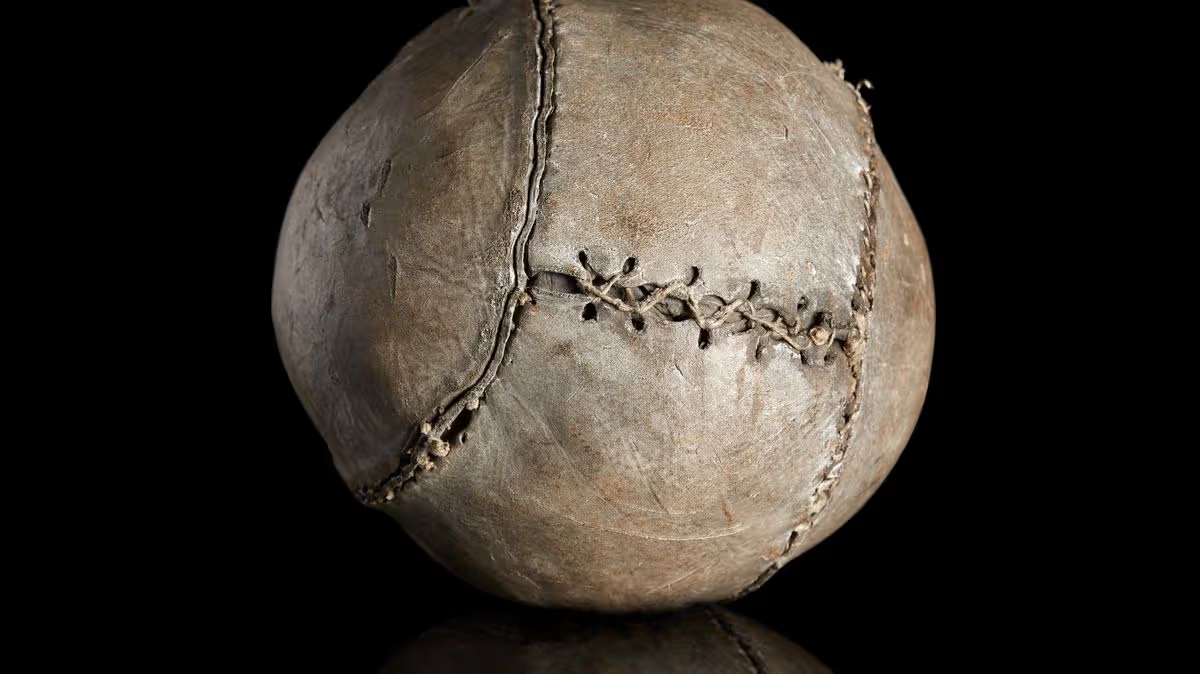
The historic football dates back to the 1500s and has been a key exhibit at the Smith Art Gallery and Museum in Stirling – but is now heading to Miami for an exhibition ahead of Scotland’s last World Cup group match.
A special piece of football heritage is heading on a special journey Stateside to give some extra luck to Scotland’s World Cup journey.
The world’s oldest football – believed to date back around 500 years and discovered lodged in the rafters behind oak panelling in the Queen’s Chamber at Stirling Castle – has been based at the city’s Smith Art Gallery and Museum.
But it has set off for a trip across the Atlantic this morning as it prepares to go on display at the Coral Gables Museum in Miami as part of their headline exhibition – ‘Diplomacy and the Beautiful Game From Scotland to Brazil to Haiti’.
The football, which scientific testing has dated to between roughly 1540 and 1570, will also attend Scotland’s final group stage match against Brazil on June 24, making it the first time the ball has attended a match at the tournament.
Caroline Mathers, Director of the Stirling Smith Art Gallery & Museum, said: “This is one of the most exciting moments in the recent history of the Smith. The world’s oldest football belongs to Stirling, and to see it travel to the United States to take its place alongside the world’s greatest football tournament is a source of enormous pride.
“It is a reminder that a small, free-to-enter museum in central Scotland holds objects of genuine international importance — treasures that tell the story of our nation to the world. We are delighted to share it on the global stage, and we look forward to welcoming it home again.”
Neil Benny, chairman of the Board of Trustees at the Smith, added: “The Smith plays a vital role in the cultural life of Stirling and central Scotland, and this loan is a powerful demonstration of that role.
“We are grateful for the continued support of Stirling Council and our partners, whose backing makes it possible for the museum to care for and share collections of this calibre.
“An object that has been part of Stirling’s story for nearly five centuries is now an ambassador for the city on the world stage. We hope it inspires people across central Scotland to come and discover everything else the Smith has to offer.”
Roughly the size of a small melon, the ball is made from thick leather panels stitched together and turned inside out for a smoother, more aerodynamic surface, with a pig’s bladder forming the inner core.
Recognised by Guinness World Records as the oldest football in the world, it is celebrated as one of the “History of Scotland in 25 Objects” and remains the prize exhibit of the Smith’s collection of more than 40,000 artworks and objects.
The football was seen off at a special ceremony at the museum at 11am before heading on a plane to cross the Atlantic.
Faroque Hussain, Honorary Consul of Brazil KPM, based in Glasgow, said: “This partnership brings together Scotland, Brazil and Miami through a shared love of culture, heritage and football.
“It is a privilege to help support the journey of such an extraordinary object from Stirling to the global stage, and to celebrate the historic links and friendships that make this project possible.
“We are proud to work with the Stirling Smith Art Gallery & Museum, the Consulate General of Brazil in Miami, Coral Gables Museum and our sponsors and supporters to share this remarkable story with audiences in the United States.”






































You must be logged in to post a comment Login