Connect with us

NewsBeat

The National Grid collapses, Britain goes dark… chaos is unleashed: Nightmare scenario that Britain’s Net Zero obsession is pushing us ever closer to, by energy expert KATHRYN PORTER

Published

on

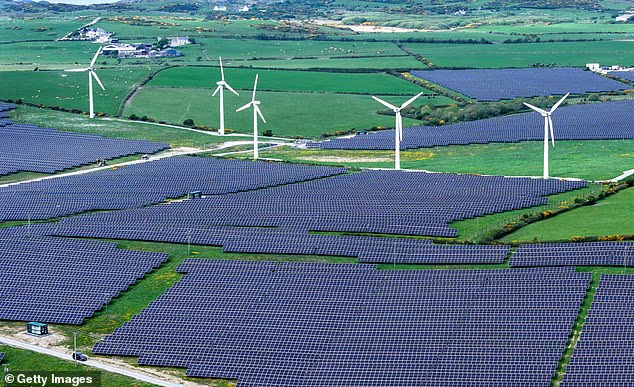
Wind turbines stand next to a solar farm near the Anglesey village of Rhosgoch in Wales

Imagine this. At 8.37pm tonight, as one section of the national grid is hit by a sharp imbalance between electricity supply and demand, the entire network starts to go down. One piece topples the next, like dominoes.

The country goes dark. The lights switch off in every home and business. Airports, hospitals and other essential utilities scramble to switch to back-up generators.

Trains and lifts judder to a halt. Mobile phone transmitter towers switch to battery and back-up power, but networks rapidly become congested and coverage progressively deteriorates.

Firefighters struggling to contain wildfires across the country face catastrophic disruption as computer systems and terrestrial communications fail or become overloaded.

Advertisement

Emergency service radio networks and satellite phones continue to function at first, but communications become increasingly difficult as back-up systems are stretched, batteries run down and generators exhaust their fuel.

With the blazes spreading, the services find it harder to establish which towns and villages are most in danger. Orderly evacuation becomes impossible, with confusion and panic spreading in the worst-affected areas.

By 10pm, with millions of homes in complete darkness, the risk of house fires begins to rise as people turn to candles, camping stoves, barbecues, portable generators and improvised methods of cooking and lighting.

Because fire crews are already stretched beyond capacity, some fires cannot be reached quickly and spread rapidly.

Advertisement

Wind turbines stand next to a solar farm near the Anglesey village of Rhosgoch in Wales

Road accidents increase as traffic lights, street lighting and electronic road signs fail. Police and safety crews are slower to respond because communications are degraded and roads obstructed, meaning some minor incidents develop into more serious collisions and create congestion.

With roads blocked and petrol stations unable to supply fuel because the pumps need electricity, thousands of drivers are stranded, spending the night in their cars or at the roadside, many without water, unable to tell loved ones what is happening.

Advertisement

By morning, the streets are crowded with people demanding to know what’s going on. The absence of internet, wifi and reliable phone signals stokes the confusion. Sporadic rioting breaks out, forcing the government to consider deploying the Army.

And this is just the first 12 hours.

Recent warnings from whistleblowers inside the National Energy System Operator (Neso) – which is responsible for the operation of the national grid – suggest that restoring the system after a total shutdown like this would be neither quick nor straightforward.

Although parts of the country might be ‘re-energised’ quickly, a complete restoration could take days, with some areas potentially without power for much longer.

Advertisement

Of course, all this hasn’t happened – yet. But the truth is that the national grid is more fragile than at any time since privatisation in 1990.

On Monday, it emerged that Neso would like to operate the grid with reduced levels of ‘inertia’, the kinetic energy stored in the spinning components of generators that carry on revolving even in the event of them losing power.

This move is designed to save £96million a year and help the government hit its Net Zero targets. But I consider this to be a very dangerous proposal as it will increase the possibility of blackouts – and I wrote to Ofgem last year to object to it.

The national grid is already under strain thanks to the ongoing heatwave. It was last month forced to halt exports to certain European neighbours via four of its ten interconnector cables for several hours.

Advertisement

This incident followed an even more serious event the month before. The gravity of the situation was highlighted by Conservative shadow energy secretary Claire Coutinho, who told MPs in early July that whistleblowers claimed Britain had narrowly avoided a ‘blackout’ on June 23 as temperatures reached 34C (93F).

Kathryn Porter, an energy consultant and founder of Watt-Logic, says she wrote to Ofgem last year to oppose the plan to operate the grid with reduced levels of ¿inertia¿

Kathryn Porter, an energy consultant and founder of Watt-Logic, says she wrote to Ofgem last year to oppose the plan to operate the grid with reduced levels of ‘inertia’

Dawn breaks over a dark London skyline in 2021 ¿ Kathryn says if millions of homes were in complete darkness due to a blackout, 'the risk of house fires' would rise

Dawn breaks over a dark London skyline in 2021 – Kathryn says if millions of homes were in complete darkness due to a blackout, ‘the risk of house fires’ would rise

No one in a senior post at Neso wants to admit the scale of the looming crisis. Doing so would invite hard questions about senior management decisions and the adequacy of the systems on which the country relies.

Advertisement

Thanks to successive governments’ obsession with Net Zero, Britain’s approach to power generation has been transformed out of all recognition in a few short years.

When the Climate Change Act was passed in 2008, around four-fifths of our electricity came from fossil fuels. Fast forward 18 years and we have no coal-fired power stations at all, with the closure of the final plant – Ratcliffe-on-Soar Power Station in Nottinghamshire – bringing to an end 140 years of coal-fired electricity generation on September 30, 2024.

But while renewables are now responsible for 47 per cent of our domestic electricity production, gas remains a vital power source as it is impossible to predict with any great accuracy when the sun will shine and the wind will blow.

Indeed, Neso missed its target of running the electricity network for at least 30 minutes in 2025 without any fossil fuels. Yes, you read that correctly: renewables are incapable of meeting our power needs for even half an hour in a single year.

Advertisement

Our supply difficulties were made worse last year by the fact that, after years of decline, there was a 1 per cent rise in UK electricity demand in 2025, driven by cold weather and some recovery from the demand destruction caused by the 2022-23 energy crisis.

We also import far more of our electricity than at any time in our history – 14 per cent in 2025 compared with around 1 per cent in 2008.

And therein lies the problem. Our biggest sources of imported electricity are two countries experiencing generation problems of their own.

France, which has more nuclear power stations than any other European country, faces shutdowns due to age-related defects, with the French nuclear regulator warning of further risks as time goes on.

Advertisement

Meanwhile, Norway – which relies on a network of 1,100 reservoirs and 1,700 hydroelectric power stations to produce 90 per cent of its power – is suffering from a shortage of water.

As a result, both may be forced to restrict exports.

An electricity pylon surrounded by dark clouds – Britain's towns and cities are linked by 4,500 miles of overhead power lines supported by pylons

An electricity pylon surrounded by dark clouds – Britain’s towns and cities are linked by 4,500 miles of overhead power lines supported by pylons

The other countries which export to us rely, as we do, on wind and solar and – as we share similar weather – can experience shortages when we do. With low European gas stocks heading into this winter, there are real concerns about the availability of electricity for export in these countries.

Advertisement

When Claire Coutinho attempted to raise the alarm in Parliament last month, the then Energy Secretary Ed Miliband accused her of scaremongering.

The reality is that, if anything, she was understating the peril we face. It’s no exaggeration to say our electricity system increasingly runs on hope and blind optimism.

This is because Neso’s engineers have no way of knowing how much solar energy is entering the system at any one time.

Britain’s towns and cities are linked by 4,500 miles of overhead power lines supported by pylons and around 900 miles of underground cables, and this high-voltage grid moves electricity at tens or hundreds of thousands of volts.

Advertisement

It’s a highly efficient way of sending electricity across country but impractical and dangerous for use in the home, where most appliances require a 230-volt supply.

And so the power first passes through a series of substations where transformers reduce the voltage to standard household levels.

However, electricity from most solar panels flows directly into the low voltage grid that feeds homes and businesses, which makes it very difficult for Neso engineers – who operate the high-voltage grid – to plan around it.

In effect, they have to guess how much is entering the system. To make matters worse, the software the engineers use to balance the grid was written back in the 1980s and is increasingly unreliable.

Advertisement

Just this week the entire balancing software failed, forcing engineers to revert to the use of spreadsheets and telephone instructions to hundreds of power stations in order to keep the grid running.

Because, absurdly, the software they use to balance the grid was written back in the 1980s.

The Houses of Parliament in central London sit in darkness after the lights were switched off for Earth Hour on March 29, 2014

The Houses of Parliament in central London sit in darkness after the lights were switched off for Earth Hour on March 29, 2014

To the casual eye it looks more like Ceefax, the BBC’s long-discontinued precursor to online news, than a modern operating system for a crucial national resource.

Advertisement

Unable to see where demand is rising or falling, they are – as one whistleblower told The Mail on Sunday recently – ‘flying blind’.

It also emerged this week that hundreds of power stations had their meters installed backwards, so they look as if they are using electricity instead of generating it. That Neso didn’t identify these problems during commissioning testing is astonishing.

In a fundamentally flawed system, this Heath Robinson approach goes only so far. Sometimes more drastic measures are called for. And on June 23 this year, as we have seen, the grid reached a crisis point.

Leaked reports from Neso insiders revealed that, as the summer heatwave pushed temperatures above 34C (93F), a spike in demand to power fans and air conditioning systems created a perfect storm.

Advertisement

As solar generation dropped steeply in the early evening and wind generation slumped to near zero, several gas-fired power stations suffered unexpected outages.

This led to grid conditions that exceeded safe operating limits for extended periods and NESO went into panic mode.

At the time, it was exporting electricity to the Netherlands through its cross-border cable but, in its desperation to bring the grid back into balance, Neso fell back on emergency protocols and abruptly halted those exports.

This was done without warning and without the prior agreement of the Dutch operator TenneT. And it still wasn’t enough to rectify the problem.

Advertisement

And so Neso decided it needed to stop sending electricity to the French, too. Given France’s status as a net exporter of power to this country, however, they had the sense to ask nicely before flicking the ‘off’ switch.

Such disruptions of service are far from ideal in a world where the exchange of energy between nations is vital to maintain a constant supply of electricity.

All this indicates that Neso didn’t see this crisis coming. It’s clear that they weren’t prepared for a shortfall of such proportions until it hit them – and then they started making increasingly drastic decisions.

Incredibly, inside sources say these decisions were influenced by Neso’s corporate affairs team, which was apparently keen to avoid any grid-stabilising actions that might involve rationing, with all the reputational damage that would involve.

Advertisement

Neso has since confirmed that its PR team was present in the control room as the events of June 23 unfolded but says it was just one source of ‘input’ into operational decisions.

Despite the accounts given by whistleblowers, Neso now claims there was no real crisis on June 23. Such a reaction does not instil confidence. If Neso flatly refuses to admit the problem exists, it’s bound to re-occur.

And next time we might not be so lucky. Nationwide blackouts could become a familiar reality.

Two of our European neighbours know just how calamitous a full electricity shutdown can be. In April last year, both Spain and Portugal lost power, with the outage lasting for 16 hours in some regions.

Advertisement

Officially, the incident caused eight deaths, including several people who suffocated after their mechanical ventilators shut off.

Three other victims died from carbon-monoxide poisoning as faulty generators pumped out the lethal gas, and one person perished in a house fire caused by a candle.

However, a subsequent study estimated that the toll was far higher, with 165 ‘excess deaths’ over two days attributed to the blackout, most likely from falls, delays to treatment and other causes.

The European regulator ENTSO-E described it as ‘the most severe and unprecedented blackout that had occurred in Europe in the past 20 years’.

Advertisement

Fortunately, the blackout occurred during benign weather. Many more people could have died if it had happened in the middle of winter or during a heatwave because – without electricity – heating and cooling systems generally won’t function.

And a resumption of power supply is not straightforward. In Britain, getting the lights back on once power is restored is a major undertaking, as it involves using a seat-of-the-pants method known as a ‘black start’ that has never been fully tested.

When a power station has been offline for maintenance, it is usually restarted using power from the national grid. But this isn’t an option when the whole grid is down.

In a black-start situation, some large power stations use diesel generators to get going. They then have to trickle just enough power to the grid to energise other power stations until enough generation is available on the high-voltage grid to meet expected demand on the low-voltage grids.

Advertisement

But if that demand is not estimated correctly, not only would the grid immediately trip off, but some equipment could be overloaded and break.

For that to happen after the country has already been in a nationwide blackout for days would be catastrophic.

Little wonder that the mood among national grid engineers is close to despair. In a letter to The Mail on Sunday last month they literally begged the public for help in persuading Ofgem to investigate their fears over grid security.

Given that almost every aspect of modern life is reliant on electricity, maintaining a safe, robust national grid ought to be a top priority. Instead, we have become dangerously complacent.

Advertisement

Britain is living with an unimaginable risk, yet most people know nothing about it, and the government doesn’t seem to want to know.

When we are finally forced to face reality, it will be too late.

Kathryn Porter is an energy consultant and founder of Watt-Logic

Source link

Advertisement
Continue Reading
Click to comment

You must be logged in to post a comment Login

Leave a Reply

NewsBeat

Circus acrobat who plunged 15 feet in front of a horrified crowd and shattered a dozen bones on impact is now SUING Cirque du Soleil for nearly $17 million

Published

on

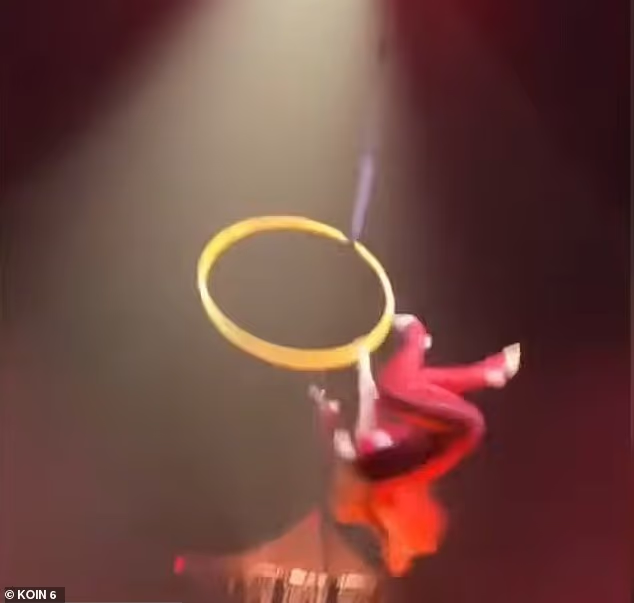
Mariia Konfektova, a Russian aerialist who set the world record for most seated aerial hoop rotations in 30 seconds, fell 15 feet from a hoop during a Cirque du Soleil performance in 2024

A former Cirque du Soleil acrobat who suffered devastating injuries after falling 15 feet during a performance in front of a large crowd has sued the circus.

Mariia Konfektova, a Russian aerialist who holds the world record for most seated aerial hoop rotations in 30 seconds, was swinging on a hoop during Cirque du Soleil’s KOOZA show in Portland, Oregon, in 2024 when she plunged to the ground.

Shortly after the accident, Cirque du Soleil stated that its performer was ‘recovering and being cared for by our medical and coaching team.’ 

The circus said at the time that Konfektova had fallen on her head and was hospitalized, leaving the full extent of her injuries unclear.

Advertisement

But a personal injury lawsuit filed in Multnomah County Circuit Court on Thursday detailed that the aerialist suffered 11 broken bones, fractures to her lower back, wrist, skull and at least seven bones in her face, as well as a concussion and double vision. 

Konfektova is seeking $16.75 million from Cirque du Soleil. She claims that she had to undergo multiple surgeries because of the accident and that she has been left with permanent injuries, according to the lawsuit, which was obtained by The Oregonian.

The civil complaint alleged that the circus failed to provide adequate safety equipment, including mats, nets or other equipment that could have mitigated harm from a fall.

It also alleged that Cirque du Soleil ignored concerns Konfektova raised about the rigging for the hoop she fell from, and that the circus fired her when she returned to work and continued raising safety concerns after the accident. 

Advertisement

Mariia Konfektova, a Russian aerialist who set the world record for most seated aerial hoop rotations in 30 seconds, fell 15 feet from a hoop during a Cirque du Soleil performance in 2024 

Konfektova suffered 11 broken bones, fractures to her lower back, wrist, skull and at least seven bones in her face, and a concussion and double vision, according to a recent lawsuit

Konfektova suffered 11 broken bones, fractures to her lower back, wrist, skull and at least seven bones in her face, and a concussion and double vision, according to a recent lawsuit

Konfektova's lawsuit is seeking $16.75 million from Cirque du Soleil. She alleged that she had to undergo multiple surgeries and has been left with permanent injuries

Konfektova’s lawsuit is seeking $16.75 million from Cirque du Soleil. She alleged that she had to undergo multiple surgeries and has been left with permanent injuries 

Advertisement
The lawsuit also alleged that Cirque du Soleil ignored concerns that Konfektova raised about the hoop's rigging, and that the circus later fired her after she raised more safety concerns

The lawsuit also alleged that Cirque du Soleil ignored concerns that Konfektova raised about the hoop’s rigging, and that the circus later fired her after she raised more safety concerns 

Portland Tribune editor Dana Haynes, who met the performers for a profile days before the shows began, told KOIN in 2024 that Konfektova was not provided with a net because her performance ‘started on the ground, and rose and spiraled and came back down and landed on the ground, and danced and went back up again.’

Haynes also told the outlet that conditions in the various locations the traveling circus goes to can change the way the equipment is set up, and even small changes can have a major impact on performers’ vigorously rehearsed routines. 

‘The Australian head coach told me that the hoop mechanism is off by a centimeter. Because of that, they were adjusting. Maria’s twirling, because of that centimeter, while not visible to the coach, affected her spin,’ Haynes said. 

Advertisement

The civil complaint stated that Konfektova was transitioning between movements when her right foot slipped. 

Her hands were touching the hoop for stability, but the aerialist was not holding on, causing her to fall to the stage, the lawsuit said.

According to the lawsuit, Oregon’s Occupational Safety and Health Division (OSHA) fined Cirque du Soleil $8,070 for failing to provide safety equipment after concluding an investigation a few months after the accident. 

The circus told OSHA during the investigation that it typically requires safety equipment for performances starting at around 20 feet, the lawsuit states. Konfektova’s performance was set at about five feet below that threshold.

Advertisement

The lawsuit named five defendants, including Cirque du Soleil, Cirque du Soleil Nevada Newco, Cirque du Soleil Canada, CDS Canadian Holdings and Spectacle BidCo Holdings, according to court records. 

The lawsuit alleges that Cirque du Soleil failed to provide adequate safety equipment during Konfektova's performance. An X-ray of her fractured wrist is pictured

The lawsuit alleges that Cirque du Soleil failed to provide adequate safety equipment during Konfektova’s performance. An X-ray of her fractured wrist is pictured 

Konfektova's right foot slipped as she was transitioning between movements, which caused her to fall, according to the lawsuit. Her arm is pictured in a cast

Konfektova’s right foot slipped as she was transitioning between movements, which caused her to fall, according to the lawsuit. Her arm is pictured in a cast

Konfektova's performance was set at about five feet below the 20-foot threshold Cirque du Soleil told OSHA it uses before providing safety equipment, according to the lawsuit

Konfektova’s performance was set at about five feet below the 20-foot threshold Cirque du Soleil told OSHA it uses before providing safety equipment, according to the lawsuit

Advertisement

The civil complaint highlighted a total of 16 performers who have suffered injuries from falls during the circus’ shows and practice sessions over the past 20 years, including three who died.

One fatality occurred in Montreal in 2009, one in Las Vegas in 2013 and one in Tampa in 2018. 

The Daily Mail has reached out to Cirque du Soleil for comment. 

Source link

Advertisement
Continue Reading

NewsBeat

Not Caerphilly or Cardiff but castle on a hill surrounded by walks that end with homemade cawl is spectacular

Published

on

Wales Online

It’s been voted one of the most romantic ruins in the country

We’ve got a lot of castles in Wales, 427 of them to be exact. All have unique settings, histories and unique appearances, so it’s hard to have a one-off preference, an immovable favourite.

Advertisement

In city and town centres you have the Caerphilly, Caernarfon, or Cardiff, all with their own stories and places in the history of our nation. Conwy’s ancient castle is ancient fortress with the town within and part of one of Wales’ UNESCO World Heritage Sites.

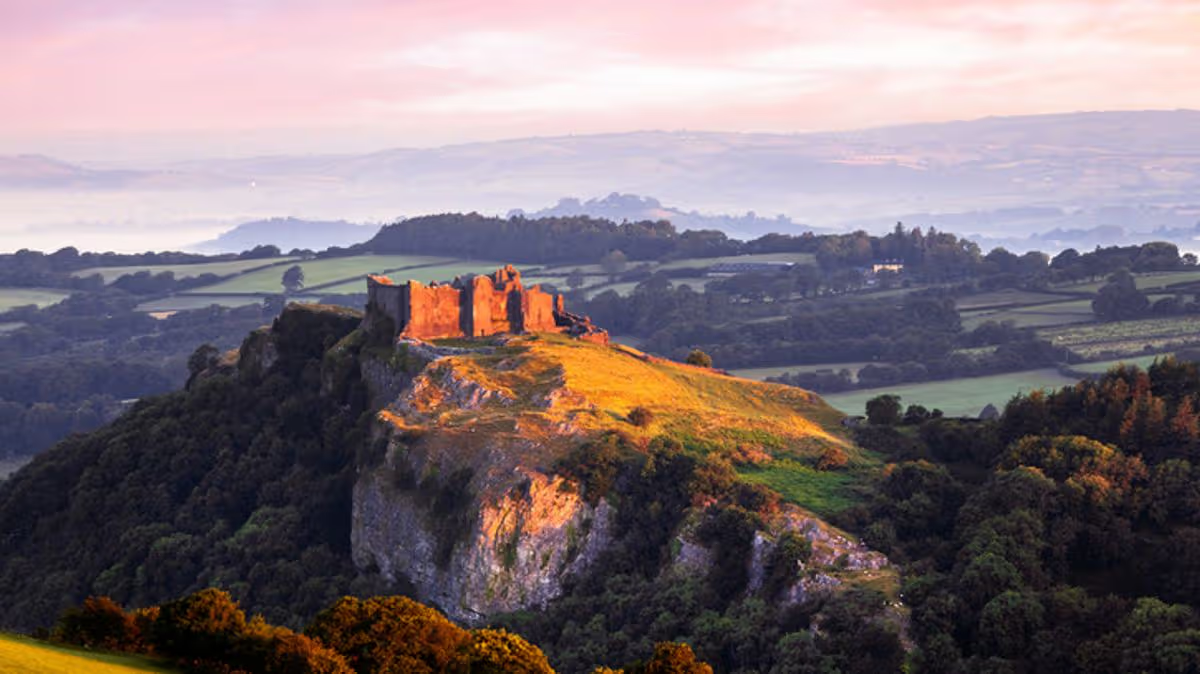
But there’s one castle that really takes my breath away each time I see it. I’ve never been more awestruck by a castle vista from the car window as with Carmarthenshire’s Castell Carreg Cennen. Bumbling round the country lanes, usually en route to or from Wright’s for my twice (or thrice) yearly Cubano – read more on that here – the view of Carreg Cennen takes my breath away each time.

I’m not over-egging it I promise. Set up on the craggiest limestone Welsh hilltop this fortress from Middle Ages has been named the ‘most romantic’ ruin by Countryfile mag readers, and The Telegraph also listed it as one of the best 10 castles in Wales to take your children. The super rural ruin is great to look at from afar and this scene is only equalled by the 360degree views from the castle itself.

Set almost 300ft above the river form which is takes its name, Carreg Cennen is a 13th century castle where you can explore the gatehouse, big towers and ruined fortifications. One of the attractions of the castle is its natural cave at the end of an atmospheric tunnel. I say ‘attraction’, I’m a wimp so I’ve never dared venture down – but it’s definitely one for spooky explorers!

Advertisement

In a corner of the castle’s inner ward you’ll find a set of steps leading down into the bowels of the castle. Walk down the steps, descend through a cliff-edge tunnel and keep walking through a precarious and pitch black tunnel carved into the rock for as long as you dare. According to Coflein, the online catalogue of archaeology, buildings, industrial and maritime heritage in Wales, human bones were discovered here in the early 20th century, while teeth were found as recently as 1980.

Outside of the castle grounds there are two circular walks which will sate those hiking pangs – both are signposted and the short walk is 2.7k long (1.6m) end the long route is 6km long (3.7m). Both start at the castle’s cafe. Find the route map at Discover Carmarthshire.

En route around the walk you”ll find some interesting wildlife and and rich, diverse flowers and plants. The woodland you’ll pass through is a Site of Special Scientific Interest and is a good place to look for woodland birds like Wood Pigeon, Nuthatch, Blue Tit and Wren.

The castle dates back to at least the 13th century, but Roman coins discovered at the site suggest that people occupied the land centuries earlier. Its previous owners include Sir Rhys ap Thomas and King Edward I, who captured the castle in 1277.

Advertisement

King Edward gave the castle to a soldier named John Giffard, who had supported the king in his conflict with Welsh prince Llywelyn ap Gruffudd. Giffard then rebuilt Carreg Cennen into the impressive structure that it became in subsequent centuries.

Under English control, the castle was attacked by Owain Glyndwr in 1403 and was damaged further during the War of the Roses later in the 15th century. From superstar gigs to cosy pubs, find out What’s On in Wales by signing up to our newsletter here

By the 19th century it was owned by the Cawdor family, until they sold it to the Morris family in 1963 ‘by accident’ – you can read more about that here. Today it is owned by Margaret Morris and her husband Bernard Llewellyn alongside their daughters.

Advertisement

The tea room is run by the family and here you’ll get a really lovely bowl of homemade cawl – round these parts it’s a thick veggie soup, other areas of Wales put lamb or beef in, depends where you’re from! Anyway, this cawl comes with bread and a chunk of cheese – it’s exactly what’s needed after a good walk. You can also get dishes with Carreg Cennen’s Longhorn beef reared nearby and there’s a good selection of cakes and hot and cold drinks.

It’s a cosy way to end your visit which, for me, starts when you see the castle emerge over the fields and trees. I’m enamoured with it from that moment and have tried to capture the view many, many times – but it just doesn’t translate – you’ll just have to visit there yourself!

How to get there

Carreg Cennen Castle is situated around five miles from the town of Llandeilo, and around 19 miles east of Carmarthen. From the village of Ffairfach on the outskirts of Llandeilo, take a right on the A476 heading east and travel down an unmarked road until you reach the village of Trap, where you will find signs directing you to the castle.

Advertisement

From the M4, leave the motorway at Pont Abraham roundabout and take the A483 towards Ammanford. Travel through Tycroes and Ammanford and take a left onto Wern Ddu Road. Continue north until you get to Blaengweche, where you’ll see a signpost for the castle directing you east towards Trap.

Source link

Continue Reading

NewsBeat

Pilot, 62, fighting for life after plane crash trapped him in wreckage | News UK

Published

on

Pilot, 62, fighting for life after plane crash trapped him in wreckage | News UK
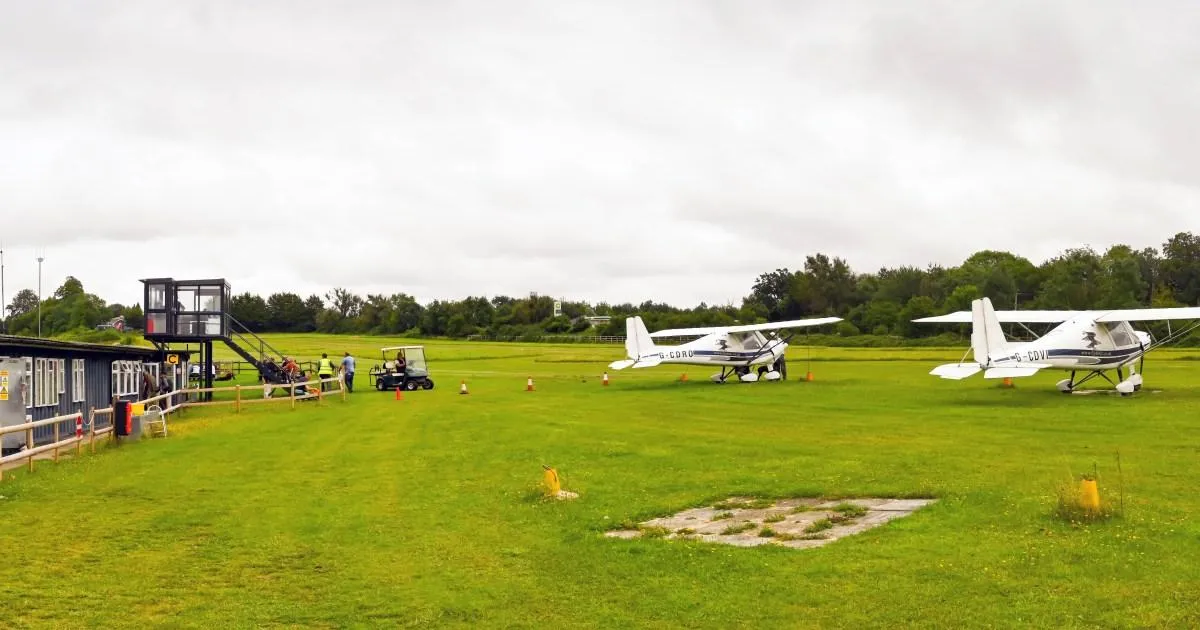
Popham Airfield’s website says both runways are closed ‘until further notice’. (Picture: Getty)

A pilot is fighting for his life in hospital after his light aircraft crashed and flipped over at an airfield.

The pilot had to be ripped out of the wreckage after the plane came down in Popham Airfield in Hampshire at 5.45pm on Sunday.

He was taken to Southampton Hospital where he is receiving treatment for his injuries.

Hampshire Police said officers had attended the scene and liaised with the Air Accident Investigation Branch.

Advertisement

A notice on Popham Airfield’s website states that both runways are closed ‘until further notice’.

Sign up for all of the latest stories

Start your day informed with Metro’s News Updates newsletter or get Breaking News alerts the moment it happens.

A spokesperson for Hampshire Police said: ‘We were called to reports of a collision at Popham Airfield involving a single light aircraft which had overturned.

‘The pilot, a man aged in his 60s, has sustained serious and potentially life-threatening and life-changing injuries.

Advertisement

‘He has been taken to hospital for treatment.

‘Officers have attended the scene and have liaised with the Air Accident Investigation Branch.’

Hampshire fire service added: ‘Firefighters were called to a light aircraft crash at Popham Airfield at around six o’clock this evening. 

‘Crews from Rushmoor, Andover, Basingstoke and Winchester were alerted to the scene alongside police and ambulance teams. 

Advertisement

‘One casualty was released from the aircraft and passed into the care of paramedics. 

‘Firefighters made the aircraft safe, before the incident was handed over to police to manage the scene. 

‘Fire engines have begun to depart and return to station.’

South Central Ambulance said: ‘We received the 999 call at 5.43 for a microlite crash at Popham Airfield with reports of the pilot trapped.

Advertisement

‘Our first crew on scene arrived at 5.59.

‘Air ambulance and critical care doctors also attended. Police and Fire also attended.

‘The patient, a 62-year-old male, was freed and taken to Southampton Hospital by road ambulance.’

Source link

Advertisement
Continue Reading

NewsBeat

BBC Ludwig scores ‘millions’ of viewers as series 2 of Cambridge-set drama opens

Published

on

Cambridgeshire Live

The BBC’s Cambridge-set comedy drama Ludwig has returned for a second series and now ratings prove it’s a hit

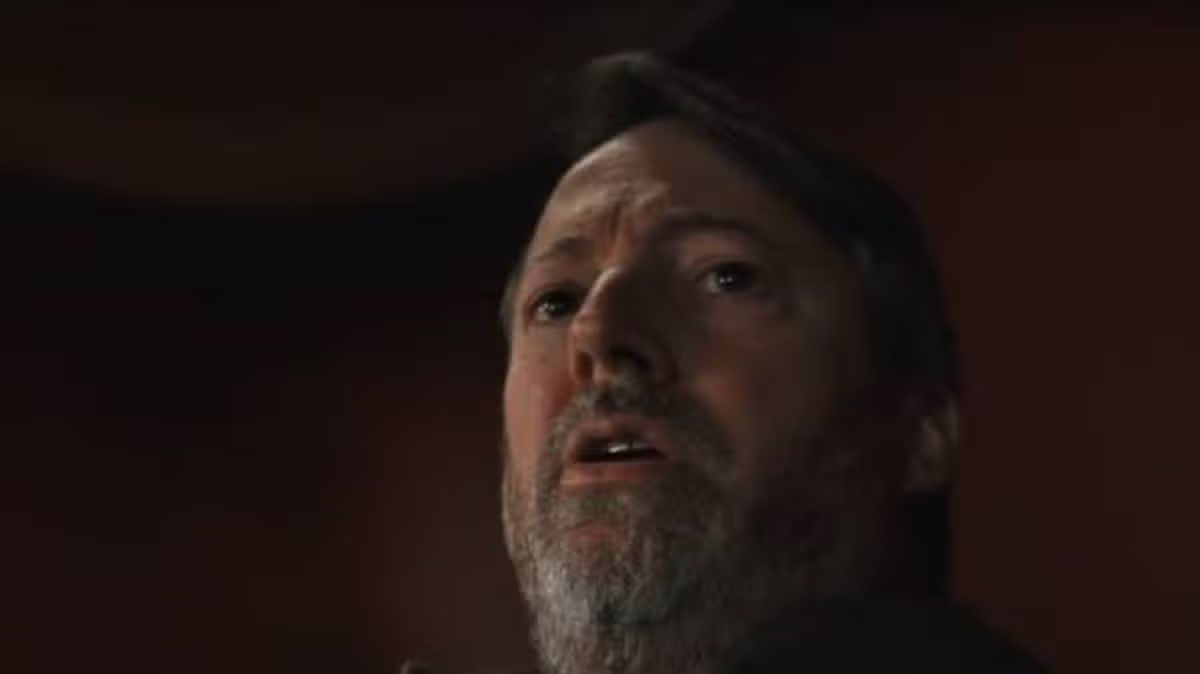
The Cambridge-set BBC comedy drama Ludwig starring David Mitchell and Anna Maxwell Martin has made a triumphant return, as viewing figures have now proved.

The show, which features Mitchell as an accidental detective, has returned for a second season, and millions of fans tuned in for the opening episode.

Advertisement

The drama made its comeback on Thursday, August 20, when fans were quick to rush to social media to share their delight within minutes of the opening credits.

One said on X – formerly Twitter – “Binge watched S1 of #Ludwig Absolutely loving it. S2 here we come. It’s real life Scooby Doo.”

Another added: “Delighted that #Ludwig is back. One of the best new shows in recent years.” While a third commented: “#Ludwig is back. I am so happy.”

Advertisement

Now according to Broadcast, nearly 3 million viewers tuned in for the first episode. Created by Mark Brotherhood, the series stars Mitchell in the dual role of reclusive puzzle maker John Taylor aka Ludwig and his twin, DCI James Taylor, who disappears without a trace in the first episode.

Contacted by James’s wife Lucy Betts-Taylor, played by Anna Maxwell Martin, John agrees to pose as Jack, ending up solving murder cases thanks to his deductive skills, reports Digital Spy.

The new episode featured an unusual double confession at a theatre where John took centre stage as he set out to prove who didn’t commit the crime, reports the Mirror.

Viewing figures show it drew 2.8 million viewers, capturing 28.5% of the TV-watching audience at that time — an improvement on the first season’s debut, which attracted 2.7 million viewers in 2024.

Advertisement

Season 1 went on to become the BBC’s biggest new scripted show since 2022, with 9.5 million viewers discovering it within 28 days. It also claimed the title of the BBC’s highest-rating scripted show of 2024 and the biggest comedy series launch since at least 2018.

As far as Cambridge as a location is concerned, when asked about the show’s setting during a Q&A for season 1, David said: “Yes, I was a student there, and I love Cambridge. I’m delighted that it was set in Cambridge, because I genuinely feel that having a picturesque context is such a key part of the genre.

“Obviously, Inspector Morse – set in Oxford. Miss Marple – set variously in different villages. Poirot and Sherlock Holmes – set in the past, which we all know is more aesthetically pleasing, despite the horrible time people had living through it.”

Advertisement

More recently, ahead of season 2, he said of the city: “I went to university there, and I love it. You want people to enjoy slipping into this world like a pair of slippers, but with a dead body in them. Cambridge is obviously a great candidate for that. Inspector Morse is one of my favourite shows, but that was set in Oxford.

“That’s where people want to escape to in this kind of program. I think you’ve got to have a beautiful setting to juxtapose with the nature of the crimes.”

Ludwig is on BBC One and BBC iPlayer

Source link

Advertisement
Continue Reading

NewsBeat

Ulez linked with better lung growth in children, research finds

Published

on

Ulez linked with better lung growth in children, research finds

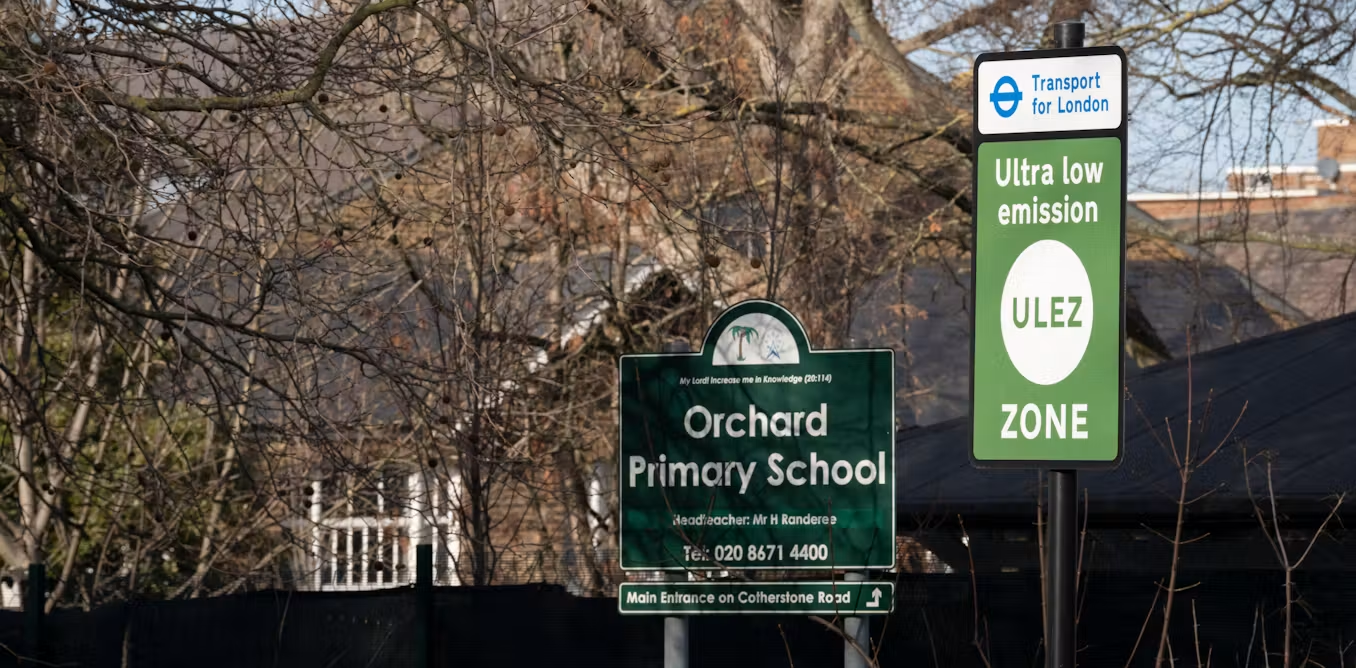
When London introduced the ultra low emission zone (Ulez) in 2019, the idea was straightforward: cut the dirtiest vehicle emissions and improve the air people breathe. But the big question at the time was whether this measure would actually translate into measurable health benefits.

Our new study, published in The Lancet Public Health, suggests that it has had benefits for children’s lung development.

Between July 2018 and April 2019, we recruited 3,414 children aged six to nine, and followed their development over five years. A total of 1,664 of these children lived in central London where the Ulez was introduced. A further 1,750 children lived in Luton – a comparable urban area without a clean air zone.

At the start of the study, before the Ulez was introduced, children in London had both higher exposure to air pollution and lower lung function than children in Luton. We assessed lung function using non-invasive breathing tests, including FEV₁, which measures the amount of air a person can forcibly breathe out in one second after taking a deep breath.

Advertisement

After accounting for other factors (such as sex, ethnicity, deprivation and whether they had asthma), average FEV₁ was about 38mL lower among London children. Their modelled residential exposure to nitrogen dioxide (NO₂), a pollutant closely linked to vehicle exhaust, was also almost 19μg/m³ (micrograms per cubic metre) higher.

Between 2019 and 2023, after the Ulez was introduced, the picture of air quality changed. According to a model of the two residential areas, nitrogen dioxide fell much faster in central London than in Luton. It dropped by 3.77μg/m³ in London compared with just 1.77μg/m³ per year in Luton.

Over the same period, children’s lung function improved faster in London. Annual growth in FEV₁ was around 10mL per year greater than in Luton. That may sound small, but lung growth happens gradually. Modest differences accumulated across childhood can matter for long-term health.

By the end of follow-up, the earlier gap had closed almost completely. The average FEV₁ was essentially the same for children living in both places. The proportion of children with clinically low FEV₁ (which is below the predicted range for their age) also fell more in London, from 14% to 8.8% – compared with 8.9% to 6.9% in Luton.

Advertisement

We also looked at forced vital capacity, or FVC, which reflects lung volume. This is the total volume of air a person can quickly exhale from their lungs after taking a deep breath. London children started with about 55ml lower FVC measurements. Their FVC increased faster than Luton children’s over follow-up, but the gap did not disappear. By the end of the study the London children still had approximately 25mL lower average FVC than the children in Luton.

In other words, one measure of lung function caught up fully, while another showed substantial but still incomplete recovery. Given FVC more closely reflects structural lung volume and growth than FEV₁ does, this may explain why it has taken longer to change.

Children’s lung function improved faster in London.
James Jiao/ Shutterstock

These findings are important because impaired lung growth in childhood is linked to worse respiratory health later in life.

Our findings also point to a plausible mechanism. Across the whole cohort, higher long-term exposure to nitrogen dioxide and particulate matter pollution was associated with poorer lung function and growth overall.

Advertisement

While all pollutants were linked to lower lung development, the clearest association was with nitrogen dioxide. Given nitrogen dioxide is strongly linked to road traffic exhaust emissions, it is therefore particularly relevant to an intervention such as the Ulez.

Pollution and lung function

As this was a natural experiment rather than a randomised trial, it cannot prove causation definitively. It does, however, provide strong real-world evidence that cleaner air was associated with healthier lung growth.

This also does not mean that Ulez explains everything. London and Luton are not identical – and weren’t even at the start of the study. Our pollution estimates were based on modelled residential exposure, which cannot capture non-residential exposures – including school hours, travel and indoor environments.

The COVID pandemic also disrupted school-based follow-up – although we conducted analyses that tested whether this changed the interpretation. Overall, the main findings held up.

Advertisement

We are cautious about saying the Ulez “caused” these improvements in the way a clinical trial might establish cause-and-effect. But the timing, the faster fall in traffic-related pollution, the comparator town and the pattern of lung growth together make a causal interpretation plausible.

The broader message is that transport policy is also health policy. Clean air zones are often debated in terms of charges, fairness and inconvenience. Those concerns are real, and policies need to be designed fairly with support for people on low incomes and for those who rely on vehicles. But there is another side to the ledger: children’s health.

Many of the children most exposed to traffic pollution are not from the communities most responsible for generating it.

In central London, where car ownership is relatively low, many children still live, learn and play near busy roads. That means children can bear the health burden of traffic pollution even when their own households contribute relatively little to it. That makes air pollution an equity issue as well as an environmental one.

Advertisement

Back in 2019, one of us (Ian Mudway) argued that Ulez should be evaluated as a public health intervention and evaluated carefully. Our study suggests that it was indeed a medicine worth testing, and that it may already be delivering benefits.

Cleaner air will not solve every urban health problem. But our findings suggest that reducing traffic-related pollution can help children’s lungs grow better. That is not a trivial gain. It is an
investment in healthier lives.

Source link

Advertisement
Continue Reading

NewsBeat

The Traitors star Freddie Fraser comes out as he shares loved-up snaps kissing his new boyfriend a year after split from stunning girlfriend

Published

on

The Traitors star Freddie Fraser comes out as he shares loved-up snaps kissing his new boyfriend a year after split from stunning girlfriend

Advertisement

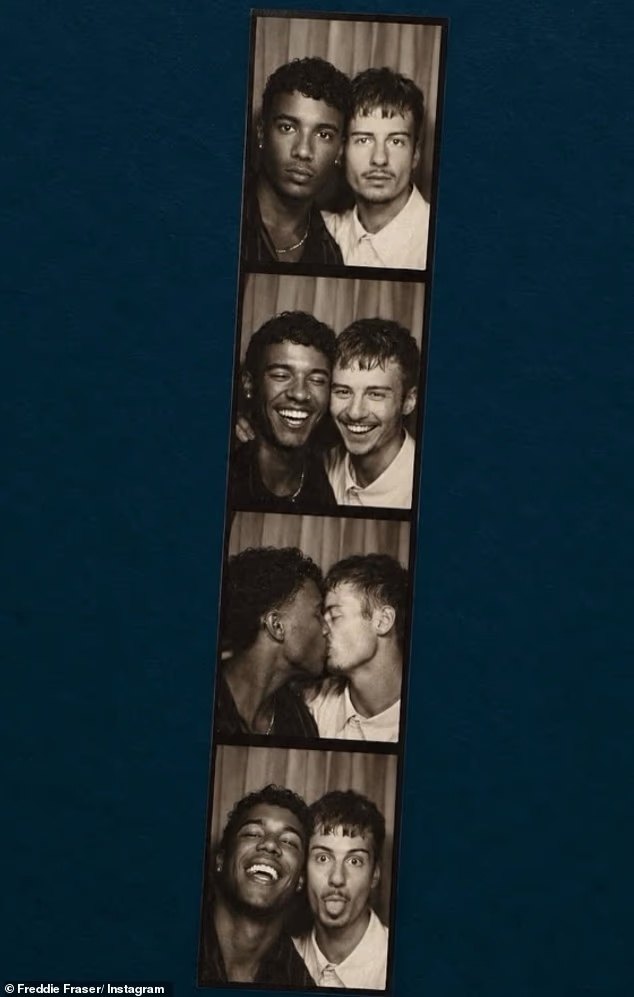
The Traitors star Freddie Fraser has come out by sharing loved-up snaps kissing his new boyfriend – a year after splitting from his stunning girlfriend.

The TV star, 22, has never publicly addressed his sexuality before but was seen packing on the PDA with new partner Bailey Ramsden this weekend.

Drag star Danny Beard commented under the post saying: ‘Welcome to the club gayyyy boiiiii,’ as fellow Traitors star Stephen Libby said: ‘The hard launch we LOVE to see.’

He simply put a white heart in the caption of the post which was a snap of a photobooth print out as they cosied up to one another. 

Advertisement

Freddie’s new partner Bailey is a social media influencer with around 11,000 followers and lives in London.

Freddie will best be remembered from his famous shower scene on The Traitors which he has previously poked fun at. 

Advertisement
The Traitors star Freddie Fraser has come out by sharing loved-up snaps kissing his new boyfriend - a year after splitting from his stunning girlfriend

The Traitors star Freddie Fraser has come out by sharing loved-up snaps kissing his new boyfriend – a year after splitting from his stunning girlfriend

It comes after last July it was reported that Freddie had split from his girlfriend Nisha after starring in the show

It comes after last July it was reported that Freddie had split from his girlfriend Nisha after starring in the show

It comes after last July it was reported that Freddie had split from his girlfriend after starring in the show.

Freddie is said to have quietly separated from his university sweetheart girlfriend Nisha Davenport.

Advertisement

At the time a source told The Sun: ‘Freddie quietly split from Nisha earlier this year, shortly after a loved-up trip to Budapest.

‘She’d been by his side throughout his Traitors fame but Freddie soon found himself living a showbiz lifestyle that he’d always dreamed of.

‘They were also both incredibly aware that after university it would be more difficult than ever to keep the romance going strong. The split was very amicable and there was no drama on either side.’

Then, last September Freddie was briefly linked to Love Island star Yasmin Pettet after they were spotted together at the National Television Awards 2025.

Advertisement

Yasmin shortly after confirmed she had split from her boyfriend Jamie Rhodes who she had left the show with that summer.

One attendee told The Sun at the time: ‘Yasmin and Jamie weren’t together at the party a lot at all, compared to Harry and Shakira and Cach and Toni, who were glued to each other’s sides.’

They added: ‘Then I saw her holding hands with Freddie and pulling him away. She said, ‘We need to go somewhere private, no one can see.”

The Daily Mail contacted Yasmin’s representative for comment at the time.

Advertisement
Drag star Danny Beard commented under the post saying: 'Welcome to the club gayyyy boiiiii', as fellow Traitors star Stephen Libby said: 'The hard launch we LOVE to see'

Drag star Danny Beard commented under the post saying: ‘Welcome to the club gayyyy boiiiii’, as fellow Traitors star Stephen Libby said: ‘The hard launch we LOVE to see’

The TV star, 22, has never publicly addressed his sexuality before but was seen packing on the PDA with new partner Bailey Ramsden this weekend (seen on The Traitors)

The TV star, 22, has never publicly addressed his sexuality before but was seen packing on the PDA with new partner Bailey Ramsden this weekend (seen on The Traitors)

Freddie famously started his time on The Traitors as a Faithful but was recruited as a Traitor in the final week. He has gone on to have a successful social media career

Freddie famously started his time on The Traitors as a Faithful but was recruited as a Traitor in the final week. He has gone on to have a successful social media career

Advertisement

Yasmin penned on Instagram that week: ‘As per my recent TikTok myself and Jamie split before the NTAs but hadn’t formally announced it yet. 

‘We’re still really good friends and I’ll always have so much love and care for him for making my Love Island experience what it was.

‘I find it laughable that everyone thinks I cheated on Jamie with Freddie from the Traitors which is not true and anyone who knows me knows my type is late 20s, 30s plus.’

She added: ‘Jamie is literally the most amazing man ever and I’m forever grateful for the memories we made and time we spent together.’ 

Advertisement

Yasmin was not seen out with Freddie again after that time. 

Freddie famously started his time on The Traitors as a Faithful but was recruited as a Traitor in the final week. 

He has gone on to have a successful social media career.  

Advertisement

Advertisement

Source link

Continue Reading

NewsBeat

GEOFFREY LEAN: Burnham’s plans for mayors may look like local democracy in action – but it’s the exact opposite

Published

on

Sunday¿s revelation is not an extension of local democracy but the exact opposite, writes Geoffrey Lean

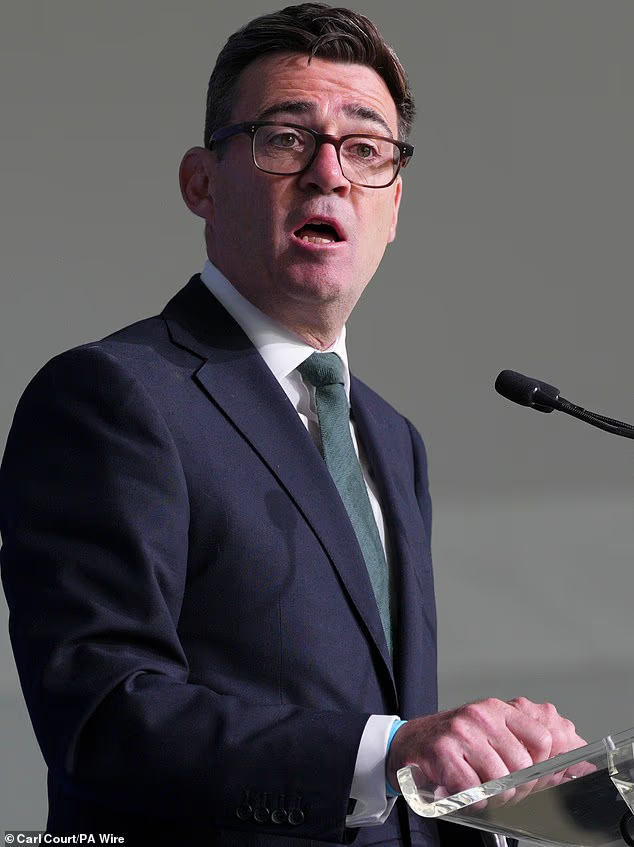
Since Andy Burnham walked into No10, he has made much of his determination to devolve power to the regions.

Indeed, he has called his plan to transfer a raft of decision-making powers away from Westminster and Whitehall the ‘biggest rebalancing of power our country has seen’.

But Sunday’s revelation that he plans to give regional mayors the ability to over-rule councils and force through planning approval for housing estates and tower blocks is not an extension of local democracy but the exact opposite.

The victims of this shameless power grab will, of course, be the residents of our villages, towns and cities who will have no power to object effectively to sprawling housing estates and the sort of ugly edifices the King once described as ‘monstrous carbuncles’ being built in their neighbourhoods.

Advertisement

This initiative contradicts the PM’s pledge to ‘bring power home’ and is just the latest step in the authoritarian and mendacious planning campaign Labour has been waging since winning the general election just over two years ago.

Under the new proposals, mayors will be able to direct local authorities to approve developments of more than 150 homes, commercial spaces above 15,000 square metres, and any building of about ten storeys or more.

And they will also be empowered to give their own upfront permissions for schemes so that developers will not even need to apply to councils for the right to start building. 

Since ten of the 14 metro mayors are Labour they may well be used to rubber-stamp central government policy. And if they should fail to toe the line, ministers will retain the power to impose their own decisions anyway.

Advertisement

Sunday’s revelation is not an extension of local democracy but the exact opposite, writes Geoffrey Lean

The scheme will add another layer of bureaucracy to the planning process at a time when the country is already very short of planning officers, and may well do little to achieve the Government’s arbitrary target of building 1.5million new homes within five years.

London mayor Sadiq Khan already has similar powers, but instead of rising, the rate of housebuilding in the capital has been falling.

Advertisement

And Mr Burnham’s latest proposal is only the latest in a string of anti-democratic interventions.

Just last week the Government directed councils to give a default ‘yes’ to housing near railway stations, even in the Green Belt, as part of its unparalleled assault on supposedly protected countryside.

Nearly nine out of ten Britons oppose building in the Green Belt – the cherished, health-giving ‘countryside next door’ for 30million people – so the 2024 Labour manifesto said it would be ‘committed to preserving’ it and pledged not to change ‘its purpose and general extent‘.

It did propose developing odd bits of ‘lower-quality’ protected land, dubbed ‘grey belt’, but ministers consistently indicated that the land concerned would consist of eyesores such as old car parks and disused petrol stations.

Advertisement

That, as we now know, was more barefaced deceit.

In practice, vast areas of pristine, hitherto protected land are being classified as ‘grey belt’: an area bigger than the whole of Surrey is authoritatively expected to be opened to development. 

The truth is that just about every developer who wants to build on the Green Belt is claiming that its site should become ‘grey belt’ – and the Government usually agrees. Mainly as a result, the size of the area being developed around London more than doubled last year.

Scandalously, such devastation is entirely unnecessary, even to meet the Government’s target.

Advertisement

Housebuilders are already sitting on land with planning permission for 1.4 million homes. As an unpublished government report admitted in 2024, nearly half the dwellings given permission over the previous decade had never been built.

And the tendency of successive governments to over-promise and under-deliver when it comes to housebuilding shows no sign of changing.

As the housing minister Matthew Pennycook said the other day, the five-year target is ‘really stretching’. After more than two years, the Government is only a quarter of the way there.

This, however, is not for lack of dictatorial moves by this Labour administration. Sir Keir Starmer vowed to ‘knock down those standing in the way’ of his plans.

Advertisement

And ministers are amending the requirement for Sports England to be consulted on planning applications after it managed to block 90 per cent of almost 400 plans to build on playing fields, and they restricted the public’s right to take decisions to a judicial review.

Meanwhile, they have instructed the Environment Agency to wave plans through while they slash protection for wildlife, nature and the landscape from development.

Labour is vulnerable. Its MPs now represent more than half of the constituencies containing Green Belt land and their voters are getting angry.

Mr Burnham may end up reaping a whirlwind.

Advertisement

Source link

Continue Reading

NewsBeat

Man charged with murder after Irish mum-of-three found dead in Australia

Published

on

Daily Mirror

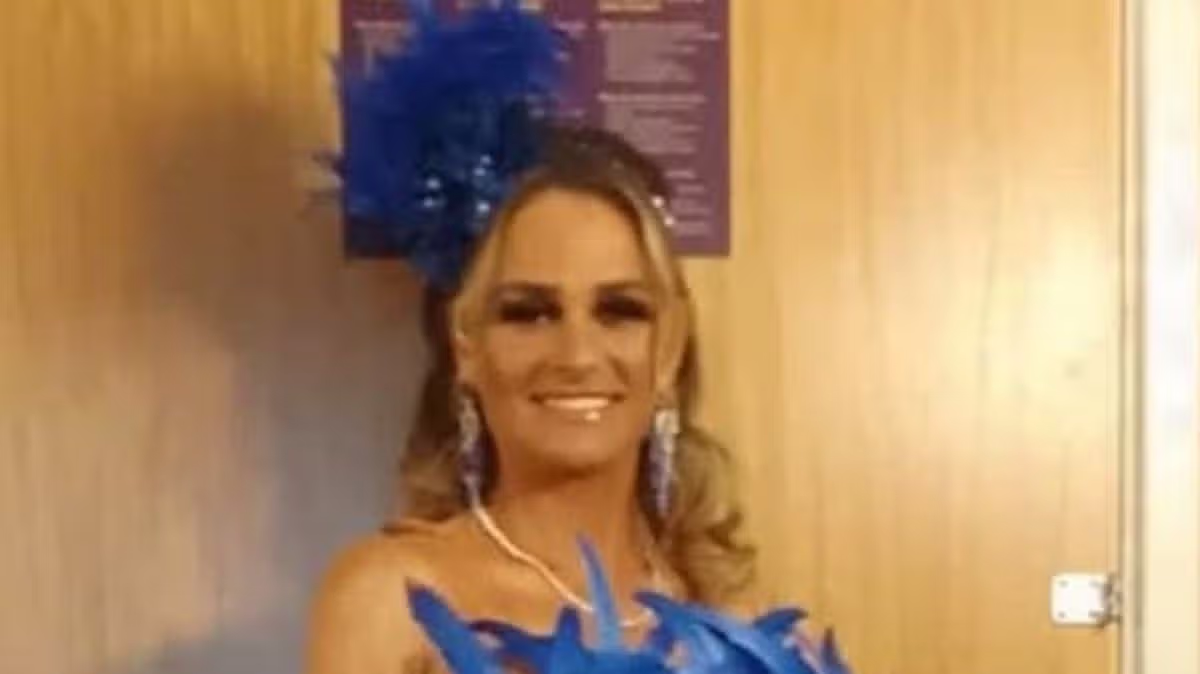
Annmarie O’Reilly, 30, originally from Clonmel in Co Tipperary, died after being found injured at her home in Ferntree Gully, a Melbourne suburb in Victoria, Australia

A man has been charged with murder in Australia after an Irish mum-of-three was found fatally injured at her home in a Melbourne suburb.

Annmarie O’Reilly, 30, who was originally from Clonmel in Co Tipperary, was found in a critical condition by emergency services at a property in Ferntree Gully on Friday morning local time.

Paramedics tried to save Ms O’Reilly, but she was pronounced dead at the scene a short time later, the Irish Mirror reports.

Advertisement

Patrick Stokes, 45, who is understood to have known Ms O’Reilly, was arrested nearby later that day and taken into custody. Stokes, who is reported to be from Ireland, was charged with one count of murder on Saturday, Victoria Police said.

Ms O’Reilly’s brother, Jimmy O’Reilly, paid tribute to her in a post on Facebook. “Rest in peace to my beautiful sister Annmarie, the nicest woman you’d meet, the best mother to her kids,” he wrote. “May you get the best bed in heaven … love you so much.”

Stokes appeared before Melbourne Magistrates’ Court and was remanded in custody to appear again on February 23, 2027.

Advertisement

In a statement, Victoria Police said: “Homicide Squad detectives have charged a man with murder after a woman was located deceased inside a residential property in Ferntree Gully yesterday morning.

“Emergency services were called to the residence on Ferntree Gully Road just before 10am on 21 August and located an injured woman.

“Despite efforts to revive the 30-year-old Ferntree Gully woman, she was declared deceased at the scene. A 45-year-old Ferntree Gully man was arrested nearby and taken into custody. The man has since been charged with one count of murder.

“He appeared at Melbourne Magistrates’ Court this evening via audio visual link where he was remanded in custody to appear on 23 February 2027. It is alleged the parties were known to each other.”

Advertisement

The Irish Department of Foreign Affairs said it is aware of the death of an Irish woman and is providing consular assistance.

Source link

Continue Reading

NewsBeat

Funerals of two killed in M9 horror crash to be held as teens laid to rest

Published

on

Belfast Live

Five teenage boys died following a collision on the M9 after the vehicle they were travelling in struck a family heading to Dublin Airport in the early hours of Sunday, August 16

The funerals of two young victims of the devastating M9 crash last weekend are set to take place.

Five teenage boys lost their lives after a high-powered BMW they were travelling in drove the wrong way along the M9, colliding with a family en route to Dublin Airport in the early hours of Sunday, August 16.

The BMW is believed to have been travelling at speeds exceeding 120km/h (75mph) when it struck the Hyundai near Junction 3 of the M9 in Co Kildare at approximately 3am.

Advertisement

Four individuals travelling in the Hyundai – sisters Niamh and Alma Kinsella and Ella Hendricken, along with a young boy – suffered catastrophic injuries and continue to receive hospital treatment.

Jeremy O’Brien, 18, from Carlow, Alex McCarthy, 16, from Carlow, Joey Carthy, 15, from Athy, Kildare, Jack Kennedy, 17, also from Athy, and Kamil Pustkowski, 17, from Limerick, all lost their lives in the collision, reports the Irish Mirror.

Three of the teenagers have already been laid to rest, with 15-year-old Joe Carthy becoming the first of the five to be buried on Friday.

Advertisement

His funeral was held at St Michael’s Church in Athy just before 11.30am, while Alex McCarthy’s service took place in Askea, Carlow, on Friday afternoon.

A small gathering of mourners also assembled in Limerick on Friday to pay their final respects to Kamil Pustkowski, who lay in repose at a local funeral home before a cremation ceremony was held.

A funeral mass for Jeremy ‘Bobbles’ O’Brien will be held on Monday at 11am at the Church of the Holy Family, Askea, followed by burial at St. Mary’s Cemetery, Carlow.

Jack Kennedy’s funeral mass will take place on Tuesday at 11am at St. Michael’s Parish Church, Athy, ahead of a private cremation later that afternoon.

Advertisement

Want to see more of the stories you love from Belfast Live? Making us your preferred source on Google means you’ll get more of our exclusives… To add Belfast Live as a preferred source, simply click here.

Source link

Continue Reading

NewsBeat

DUNCAN BARKES: Music Matters: Calling all soul brothers and sisters!

Published

on

DUNCAN BARKES: Music Matters: Calling all soul brothers and sisters!

Soul and R&B legends The Drifters play Portsmouth Guildhall on 26 September. The band was originally created in 1953 by George Treadwell and Clyde McPhatter. George managed the group which saw them begin a career that spawned many chart hits throughout the 1950s, 1960s and 1970s on both sides of the Atlantic.

Source link

Continue Reading

Trending

Copyright © 2025