

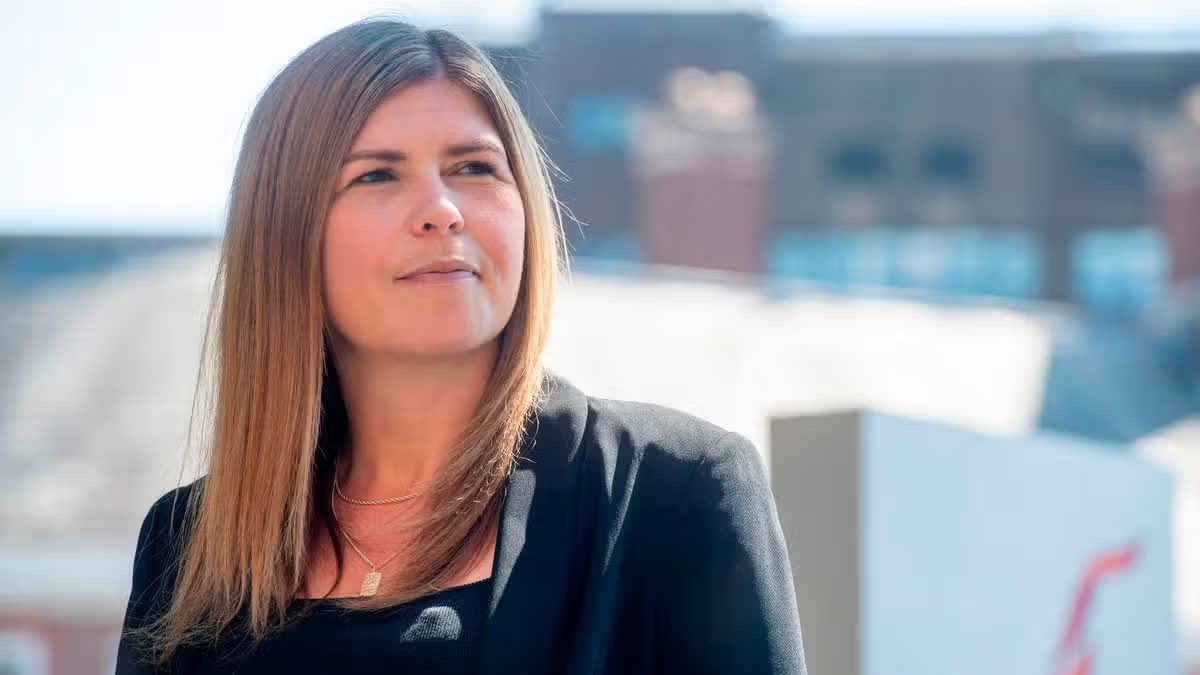
Laura Doel is the new general secretary of TUC Cymru
On Laura Doel’s CV you’ll find roles in unions, politics, and even newspapers. She worked in manufacturing at Tillery Valley Foods and there was also the spell as a Chinese takeaway driver with a sideline as a taxi, but that’s a different story.
Now, she is the new general secretary of TUC Cymru. An umbrella organisation, it has 47 affiliates, who represent 400,000 members in Wales.
Unions are something that run in her blood. For the biggest stories in Wales first sign up to our daily newsletter here
“I was born and raised in South Wales Valleys, so everybody in my family was a member of a union. They were miners, they were steelworkers, they were in manufacturing and so it was instilled in me from, you know, from the beginning. You get a job in a trade or a profession, you join a union, and the NUJ was my first union as a journalist.
“There’d been big history and tradition and culture of where I’m from that, everybody is part of the trade union movement,” the 43-year-old, originally from Aberbeeg says.
“It was no shock that I would end up becoming an activist within Unison. I became an activist within three days of starting at Blaenau Gwent Council,” she smiles.
A seven-year spell at NAHT followed until the role of General Secretary of the Wales TUC became vacant when Shav Taj, the previous holder was elected to the Senedd as a Labour MS to represent Caerdydd Ffynnon Taf.
The umbrella organisation’s role, she explains, is that it “seeks to promote the issues that matter to our trade union affiliates”.
And given the varied CV she’s just summarised as we meet in Transport House in Cardiff, she says she feels well placed to do just that.
“I’ve scratched the surface there, even with the plethora of jobs that I’ve had in the past but actually, what it does do is it gives you not only a grounding in various types of industry, but also a greater understanding of what matters.
“What matters to people and what matters to people in work, and how important it is that you have a safe and secure job, that you’re comfortable in your workplace, that you’re supported in your workplace because I’ve worked in some places that definitely didn’t embody that, but I’ve worked in some fantastic places.
“It does instill that sense of purpose and collectivism, which sounds a cliché,” she admits.
“A lot of what the trade union movement does, and what our focus in TUC Cymru is, is about creating those conditions of service where you don’t need to contact your union, because you haven’t got into a situation where you feel that you need that one-to-one support.
“We do a lot of work in that campaigning piece about making sure that we have those conditions of service, whatever the workplace is, that people can thrive and people are protected and be valued, and get a decent day’s pay for a job well done.
“We do a lot with our affiliates to make sure that they are supported and their issues are listened to. We do a lot of lobbying with government, as you’d expect, and employers, both in the public and the private sector, to promote the importance of that value of the workforce.
“Because as we have seen and as has always been the case, the workforce is the essence of the success of industry, the success of education, the success of everything – the workers are the things that make this country tick.
“They’re the things that make things happen and we need to make sure that they are protected. They are our greatest resource when it comes to the economy, for example. So, therefore, we need to make sure that we are creating and supporting those conditions where they can do well.”
The process to appoint a new general secretary was underway by the time of the Senedd election in 2026, and as soon as she knew the job was coming up, she wanted it.
“This job came up at a time where, let’s be honest, it’s a hugely challenging time, not only economically, but also politically,” she says.
While she knew a new Welsh Government was likely, no-one foresaw then a new Prime Minister and all that also brings.
“One of our main priorities is around the public sector. We are seeing—and we’ve had successive UK and Welsh governments not invest in the public sector as much. as they should.
“What you’d say about the public sector is, it’s not just the people that work in it.
“It’s the services that they provide are crucial to the economy. For example, the issues that we have in social care, that don’t just affect those people that use social care directly, it affects their families, it affects their abilities to work, it affects their abilities to look after themselves and manage their own finances. It has a huge economic impact, the pressure on public sector. And if we don’t get that right, we are never going to be able to address the other challenges that we already face.
“For us as TUC Cymru, that is an absolute priority, making sure that there is significant investment in public sector, making sure that we have the roles to deliver for people across Wales because of the huge impact it has when we don’t get it right, making sure that those workers feel valued and are paid appropriately for the—for the crucial role that they do.
“When we’re looking at priorities around investment, we need to be looking at how we protect and create jobs in Wales.
“We are encouraged by the new Welsh Government and their plans for the establishment of a new development agency, and we look forward to working with that government on that.
“But we need to make sure that worker voice is at the heart of that discussion, because the workforce brings with it a wealth of expertise and—and skills that we will need to be able to make whatever it is that we want to do a success.
“We have highly skilled workers in Wales, we have people that have a lot to give when it comes to expertise in a variety of different industries. We need to utilise the resources that we’ve got, and for us, that will mean making sure that we attract business to Wales, making sure that we grow the businesses that are here, making sure that they are supported to be able to create those conditions where the workforce can thrive, making sure that we’ve got highly skilled, sustainable jobs, and that we’re also forward-thinking.
“We talk a lot about AI and the threat that AI has to particular—particularly industry. But actually, there is an opportunity to use AI to our advantage if we do it right. TUC has been very clear: we’re not about subsidising highly paid, skilled workers for AI, and we know the challenges around that, as we’ve seen other countries fall into that trap.
“What we need to do is harness AI to use it to the extent where it can be of benefit to the existing workforce and it can help with job creation and that’s the kind of conversation that we are interested in having, and where we have had discussions with government about where we feel those areas of priority need to be.”
It is, she says, early days for both the Plaid Cymru minority government in Wales, and Andy Burnham’s Labour government in London.
But, I ask whether given Plaid failing to get enough support from across the Senedd for its supplementary budget in the dying days of the last Senedd term, does it worry her looking forward?
“We’re not just talking about a new government, we’re talking about a party that’s not been in power on its own,” she says, urging a little calm about worries about legislation passing while acknowledging Plaid has put pressure on itself with its 100 day plan.
“There is obviously, and would be with any government, but certainly from this government, ambition and that drive to do something, to bring positive change and to bring it quickly.
“I think the reality is it’s a bit more complicated than that, and that’s starting to play out.,” she says.
The supplementary budget not passing was, she says “a really challenging situation” but she says it never needed to get to where it did.
“There was an opportunity missed when it came to that supplementary budget. Education unions were absolutely clear, and had been clear, by the way, for four years about their concerns around ALN funding,” she says, pointing out it wasn’t about politics but a much longer-standing issue.
The WLGA, which represents councils had issued a report too.
“That information was already out there. The issue that transpired that led to Labour not supporting that supplementary budget was the fact that those two unions went into dispute the day before the vote. There should have been discussions. It didn’t need to get to that situation.
“I think what we will see, though, and I am confident in, is that we have politicians in Wales who understand and will work with other like-minded parties to put the people of Wales first and I think it’s going to take a little bit of time for those relationships to build and to be solidified, and let’s not forget we’re talking about a lot of new people as well”.
She mentions how Rhun ap Iorwerth made his first public speaking appearance having become First Minister was at TUC Cymru Congress. Given how closely the Labour and union movements are interwoven, it was a shrewd move.
“TUC is not affiliated to the Labour Party, but of course we have a history and a tradition that we are incredibly proud of. But we are going to be working with whoever is in power that shares the same values of the trade union movement, and that is about putting workers’ rights first, that is about making sure that we create those jobs and those conditions of service where workers can thrive, and that’s certainly been the intention of Plaid Cymru.
“That was what they set out, what the First Minister set out at Congress, that he wanted to do. He talked about the value of the workforce in Wales, he talked specifically about the skills that we’ve got, and his intention to grow the economy via that workforce and we take him at his word.
“We’ve already started those conversations with government ministers. I think it’s fair to say that those conversations have been positive, but of course, we’re all finding our feet. “
They are supportive of Plaid’s plans for a new development agency. “Things like the new development agency is a really interesting concept and how we hope to be a key part of that.
“When we’re looking at other reforms across other areas, when it comes to public sector pay, for example, we hope to be able to bring the wealth of expertise that we have from the people on the ground to be able to create the conditions of service in those sectors that will not only benefit those individuals, but of course the knock-on economic effect of people having well-paid, sustainable jobs in our communities.
“That’s how I want to position us, that step further than what we potentially had previously.
“Now it’s about delivering, and that will be with this new government and those people that want to work with us to deliver for those people in Wales.”
There is, she says, social partnership legislation in Wales. “We need to make sure that we’re using all the levers that we’ve got available to us for that to be successful.
“We don’t have to look that far or, you know, long ago, where things have been, where we’ve seen economic success, where we’ve seen jobs grow, where we’ve seen improvements in educational standards, it’s about where we bring everybody together and that’s what the TUC is about, bringing the workforce together.
“We have a key role to play in making sure that we bring those partners together, and we want to be part of that discussion, we want to be part of that delivery.”
Get daily breaking news updates on your phone by joining our WhatsApp community here. We occasionally treat members to special offers, promotions and ads from us and our partners. See our Privacy Notice










































You must be logged in to post a comment Login